Crane Company
Q3 FY2026 · Earnings Call TranscriptOctober 28, 2026
Operator
Welcome to the Crane Company third quarter 2026 earnings conference call. At this time, all participants have been placed in a listen-only mode, and the floor will be open for your questions following the presentation.
If you'd like to ask a question at that time, please press *1 on your telephone keypad. If at any point your question has been answered, you may remove yourself from the queue by pressing *2.
Others can hear your questions clearly, we ask you pick up your handset for best sound quality. Lastly, should you require operator assistance, please press *0.
I would like to now turn the call over to Allison Poliniak, Vice President of Investor Relations. Please go ahead.
Allison Poliniak
Thank you, Stephanie, and good day, everyone. Welcome to our third quarter 2026 earnings release conference call.
I'm Allison Poliniak, Vice President of Investor Relations. On our call this morning, we have Alex Alcala, President and Chief Executive Officer; and Rich Maue, our Executive Vice President and Chief Financial Officer; along with Jason Feldman, Senior Vice President, Treasury and Tax, who is on for Q&A.
We will start up our call with a few prepared remarks from Alex and Rich, after which we will respond to questions. Just a reminder, the comments we make on this call will include some forward-looking statements.
We refer you to the cautionary language at the bottom of our earnings release and also in our annual report, 10-K, and subsequent filings pertaining to forward-looking statements. Also during the call, we will be using some non-GAAP numbers, which are reconciled to the comparable GAAP numbers in tables at the end of our press release and accompanying slide presentation, both of which are available on our website at craneco.com in the Investor Relations section.
Now, let me turn the call over to Alex.
Alex Alcala
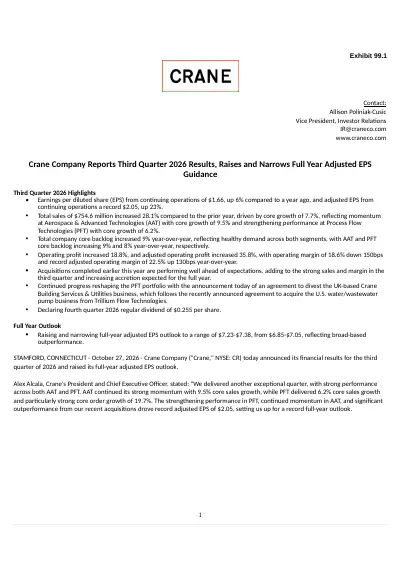
Thank you, Allison, and good morning, everyone. Crane delivered another quarter of record performance, reflecting the strength of our portfolio, broad-based demand across our end markets, exceptional execution throughout the company, and the continued success of our acquisition strategy.
Demand remains very strong across aerospace and advanced technologies. Momentum continues to build within process flow technologies, and our recent acquisitions are performing well ahead of expectations.
Together, these drivers resulted in 8% core sales growth, strong operating leverage, record margins, record earnings, and a record backlog, while reinforcing our confidence in the outlook for both 2026 and 2027. Of note, order activity was particularly strong in Process Flow Technologies, where core orders increased 20% year-over-year and 8% sequentially.
This, combined with exceptional strength and resilience across the Aerospace & Advanced Technologies, total company backlog increased 9% year-over-year, providing strong visibility as we close out the year and enter 2027. Execution continues to be a key differentiator.
Adjusted operating margin expanded 130 basis points to a record 22.5%, despite the temporary dilutive impact of our recent acquisitions. These results demonstrate our ability to translate growth into meaningful earnings expansion, while continuing to invest for the future.
Our acquisitions continue to significantly exceed expectations. Revenue growth, margin expansion, and earnings contribution are all ahead of plan.
We now expect to achieve our 10% ROIC hurdle approximately 18 months earlier than originally anticipated. We expect these acquisitions to contribute approximately 30 cents per share to 2026 earnings, up from our previous expectation of 20 cents per share, with operating margins expanding more than 500 basis points this year.
These incredible results reinforce our confidence in the Crane Business System and our ability to create substantial shareholder value through disciplined capital deployment. We are equally excited about the opportunities ahead, including the pending acquisition of Trillium Pumps.
Given our strong year-to-date performance, record backlog levels, and confidence in both our core and acquired businesses, we are raising our full-year adjusted EPS outlook by 35 cents at the midpoint to a range of $7.23 to $7.38 per share. Turning to Aerospace & Advanced Technologies, this segment continues to perform exceptionally well.
Demand remains robust across commercial aerospace, defense, and space, supported by a record backlog and a growing pipeline of opportunities. Commercial aerospace remains healthy, with solid OE demand and continued strength in aftermarket.
On the defense side, investment remains very strong, as customers continue to prioritize missile defense, radar, advanced power conversion, and space-based capabilities, all areas where we continue to invest and win. Strong execution and continued program wins are providing increasing visibility into the future growth.
As a result, we continue to expect 2026 core growth modestly above the high end of our long-term 7% to 9% growth framework, while leveraging that growth between 35% and 40%. The team continues to execute at a very high level, and we remain highly confident in the long-term growth opportunities across the segment.
Process Flow Technologies also delivered an outstanding quarter. The business returned to core growth, while delivering record profitability.
Core sales increased 6%, orders grew 20%, and adjusted operating margins expanded, despite the dilutive impact of recent acquisitions. More importantly, the transformation of the portfolio continues to gain momentum.
Growth was broad-based across cryogenics, power, wastewater, nuclear, and general industrial markets. We secured additional wins in cryogenics, supporting the growing space launch market; new pharmaceutical orders related to GLP-1 capacity expansion; and further wins in wastewater and power.
For the full year, our outlook has improved, driven by solid core growth in the second half. We now expect low single-digit core growth full year and continued margin expansion.
We also continue to enhance the quality of the portfolio through disciplined capital allocation. The announced acquisition of Trillium Pumps strengthens our position in the attractive water and wastewater markets, while the announced divestiture of our Building Services and Utilities business further sharpens the strategic focus of the segment.
Before moving on, I want to recognize and thank the outstanding BSU team. For nearly 120 years, this business has been an important part of Crane, built by incredibly talented people who consistently deliver results the right way.
We are grateful for the many contributions and proud of what they have accomplished. As they begin this next chapter, I'm confident they have a bright future ahead.
Together, these actions continue to reposition PFT around highly engineered, mission-critical technologies, serving attractive growth markets including pharmaceuticals, water and wastewater, power, cryogenics, and nuclear. Importantly, we are not finished.
We continue to see attractive opportunities to further strengthen the portfolio, and remain confident in our ability to outperform the markets we serve over the long term. To summarize, Crane is performing at a very high level.
Our businesses are executing exceptionally well. Our end markets remain attractive.
Our acquisitions are exceeding expectations. Our portfolio continues to become stronger and more resilient.
We will enter 2027 with record backlog, strong momentum across both segments, increasing earnings power, and significant strategic flexibility. As we look toward 2027, our confidence continues to grow.
Over the summer, we completed strategy reviews across all our businesses, and those reviews reinforce our long-term growth framework. In particular, four themes stand out.
First, Aerospace & Advanced Technologies remains exceptionally well-positioned. Strong aerospace and defense demand, combined with the benefits of years of investment in differentiated technologies creating a resilient portfolio, gives us confidence in the segment's ability to deliver attractive growth for many years to come.
Second, the transformation of the Process Flow Technologies portfolio is gaining momentum. While the benefits are increasingly visible in our results today, we believe we are still in the early innings of that value creation journey as we continue to reshape the portfolio around higher growth, higher margin, and less cyclical markets.
Third, our acquisition strategy continues to create meaningful value. We have significant capacity to deploy capital, a robust pipeline of opportunities, and a proven ability to integrate businesses and accelerate earnings, margins, and returns.
Last, but most important, we have an incredible intangible asset, the Crane Business System. The combination of world-class processes and a high-performance culture built on focus, intensity, and accountability continues to differentiate Crane and drive sustainable value creation.
Simply put, our businesses are performing very well, our portfolio is stronger than it has ever been, and we continue to see significant opportunities to create value through both organic and inorganic growth. Before turning it over to Rich, I'm pleased to announce that we will host our next investor day on February 19th in New York City.
We look forward to sharing more about our strategy, growth opportunities, and long-term outlook at that event. With that, turn the call over to Rich.
Rich Maue
Thank you, Alex. Another outstanding quarter with certainly more to come.
Alex, as you just said, the Crane Business System, this machine that we have and this unique culture, it's what enables us to consistently deliver the results that we do quarter after quarter. It reminded me of the Academy Award-winning movie Fletch, during an iconic scene where Chevy Chase was impersonating Gordon Liddy, an airplane mechanic supervisor.
During that scene, I was reflecting on our well-oiled machine, and I thought about all our coaching to our leadership teams, and even how we talk with our investors. When Fletch proclaims, "It's so simple.
Maybe you need a refresher course. It's all ball bearings nowadays, guys.
Now you just prepare that fetzer valve with that 3-in-1 oil and some gauze pads, and I'm going to need about 10 quarts of antifreeze, preferably Prestone. No, no, make that Quaker State.
We'll just keep delivering top-quartile results quarter after quarter." With that in mind, let me start off with total company results.
Total sales were up 28% in the quarter compared to last year, with 8% core growth, reflecting broad-based strength across both Process Flow Technologies and Aerospace & Advanced Technologies. Sales from our four acquisitions contributed 21% growth in the quarter, once again outperforming our expectations.
Adjusted operating profit increased 36%, reflecting the impact of the higher core sales, contributions from the acquisitions, productivity, and favorable pricing net of inflation, another outstanding result. Total core FX-neutral backlog was up 9% compared to the prior year, reflecting strength at both Aerospace & Advanced Technologies and Process Flow Technologies.
Core orders increased 11% year-over-year, with continued strength in Aerospace & Advanced Technologies, off 2% as expected, and when excluding a multi-year order received in the same period last year were up in the mid-teens, and Process Flow Technologies up an exceptional 20%. We generated strong free cash flow in the quarter and repaid $170 million of debt, resulting in pro forma net leverage today at 1.1 times, a very strong balance sheet that positions us well for further M&A.
Before discussing segment performance, I wanted to remind everyone that our adjusted results exclude the net benefit from AEP tariff recoveries recorded during the quarter. Once again, in our view, it's important to isolate these one-time benefits from the true underlying operating trends in the business.
A few more details on the segments in the quarter here. Starting with Aerospace & Advanced Technologies, sales of $344 million increased 27% in the quarter, with core sales up 9.5%.
Our record backlog of nearly $1.3 billion increased 9% on a core basis, and increased 20% including the impact of the Druck acquisition. Once again, demand remains very strong across our highly diverse portfolio.
Top-line strength in our core business was driven by the commercial OE ramp, as well as ongoing broad-based strength within the defense market. Total aftermarket remains strong, bolstered by military, and when isolating prior-year initial provisioning, was up 11%, with core commercial aftermarket up at a high single-digit rate, exactly what we expected.
Adjusted segment margin was exceptional at 26.3%, ahead of our core leverage expectations and up 100 basis points year-over-year. That performance is notable given the higher OE sales and expected dilution from the Druck acquisition, and it speaks to the resiliency of our margin profile irrespective of any changes in OE aftermarket mix.
Druck continued to outperform our expectations, and our core A&AT business delivered another very strong quarter. Taken all together, we remain very confident in our full-year segment sales outlook, and continue to expect full-year core sales growth slightly ahead of our 7% to 9% algorithm.
The diversity of the overall A&AT portfolio supports the durability of that 7% to 9% regardless of periodic changes in sales composition, whether that be in OE versus aftermarket or commercial versus military. Moving on to Process Flow Technologies, in Q3, we delivered sales of $413 million, up 29% compared to a year ago, with core sales up 6.2% and the acquisitions of Panametrics, Waterstons, and Optek-Danulat adding nearly 24 points of growth.
Demand improved significantly in the quarter compared to the prior year. Core FX-neutral backlog at PFT increased 8%, on a sequential basis was up 2%, and core FX-neutral orders were up 20% year-over-year and up 8% sequentially.
Adjusted operating margin was a record 24% and was 80 basis points above the prior year. Like A&AT, results were above our expectations given better performance across both our core businesses and each of our three acquired businesses.
In summary, another outstanding quarter. Moving to the non-operating items below the segments, corporate expense for the quarter was $20 million as expected, and for the full year, we expect to be within our previously guided $80 to $85 million range.
Net non-operating expense for the quarter was $14 million, and we continue to estimate full-year 2026 net non-operating expense of approximately $58 million. Lastly, we continue to estimate our tax rate for the year to approximate 23%.
Taking all of this into account, our performance to date as well as the risks and opportunities we see ahead, as Alex mentioned, we are raising our adjusted full-year guidance by 35 cents to a range of $7.23 to $7.38. Overall, again, an outstanding year to date, and momentum continues to build.
With that, operator, we are now ready to take our first question.
Operator
Thank you. The floor is now open for questions.
At this time, if you have a question or comment, please press *1 on your telephone keypad. If at any point your question is answered, you may remove yourself from the queue by pressing *2.
Again, we ask that you pick up your handset when posing your questions to provide optimal sound quality. Thank you.
We'll take our first question from Jeff Sprague with Vertical Research. Please go ahead, your line is open.
Jeff Sprague
Hey, thanks. Good morning, everyone.
Alex Alcala
Good morning, Jeff.
Jeff Sprague
Going deep into the archives there. Now, on PSI, Alex, obviously very, very encouraging.
Is the endpoint now much higher on this than you thought? Also, obviously you're ahead of schedule on what you wanted to do, but is the upside here even bigger than you thought?
Maybe you could kind of frame that relative to how you initially bridged the deal shortly after you closed it.
Alex Alcala
Thank you, Jeff. The upside is higher.
I think we had that 5-year 5-year mark where we're going to go from $60 million EBITDA to $150 million in 5 years. Now we think that's going to be quicker than that.
Then, when we look at the 5-year mark, the growth is going to be higher, and the margins are going to be higher as well. Upside to that 5-year reference point, for sure.
Jeff Sprague
Then one of the other sort of interesting things here, and I don't know if it's how you plan to approach all deals, but a lot of companies that are doing deals, right, seem to be allergic to trying to fix stuff, they just want to pay for growth. Not saying that everything you'll be looking to buy is a fixer-upper, but both PSI and Trillium, right, they seem to rhyme, good assets, maybe not run the way they should be, an opportunity to kind of run it through your business system.
As you look at the M&A pipeline, is there a lot of that sort of asset opportunity out there?
Alex Alcala
Jeff. That's a good observation.
I think we do look at deals from the lens of CBS, we obviously would see more opportunity than the seller. Each deal is different.
There's other deals, you may remember Optek, which we also did earlier this year, smaller deal, we don't talk a lot about, but that was a high-growth business, very well run, and we're just adding, contributing to it. I think we're open to a combination of circumstances, certainly not opposed to turnarounds or improvements like what we've been doing.
It's all about where we see shareholder value creation and a combination of a path to improving the portfolio when we're hitting that 3-, 5-year mark.
Jeff Sprague
Great, thank you. I'll leave it there.
Operator
Thank you. We'll take our next question from Matt Summerville with D.A.
Davidson. Please go ahead, your line is open.
Alex Alcala
Hey, Matt.
Matt Summerville
Thanks. Hey, morning.
I was wondering if you could maybe comment, you've sold the business up in Canada, you're in the process of selling the UK business. Are there more consequential portfolio actions still to be had specific to PFT?
I'm also curious, sort of tangential to that, given that I would assume that transaction in isolation is going to be dilutive, maybe comment on that and maybe how much Trillium can backfill relative to that dilution.
Alex Alcala
Thanks, Matt. There is no more substantial divestitures that we're looking at right now.
We evaluate the portfolio every year, and our thinking could change. If you recall, like you mentioned, we divested that Crane Supply in Canada, exposure to nonresidential construction.
This business in BSU, primary exposure is also nonresidential, this completes our exit of that market. A very well-run business, operated by a great team, but not really aligned to the markets that we're trying to expand into.
As far as the accretion/dilution, I'll let Rich answer that.
Rich Maue
Matt. I think the way to think about the BSU business, right, this is a business that does roughly $160 million will be the outlook this year in revenue.
They're essentially at fleet margin. When you look at that and compare to Trillium, Trillium is $115 million in revenue with below fleet margins.
There'll be some dilution to your point. Obviously, the timing of the close and the amount will coincide, right?
We're currently thinking that that will close sometime near the end of the first quarter. If you try to create a model around that, it's not a full-year impact, but we would expect to offset a good portion of that with Trillium in the year.
If that helps.
Matt Summerville
Perfect. Then maybe if you could just provide a little bit more end-market and geographic color specific to PFT in the context of that 20% year-on-year improvement you saw in organic order activity.
Thank you.
Alex Alcala
Matt. It's looking quite positive from our perspective for PFT.
I think a number of end markets that are seeing the growth, which is a positive from our perspective, makes us confident on sustainability, where we've seen the tailwind, those markets where we've been focused on over the last few years and increasing our exposure: cryogenics, which is driven by space launch; water/wastewater, primarily a US-based business, where it's been resilient; pharma, which our backlog is growing, and we expect increased investment, particularly in the US; power as well. All these markets.
Of note, chemical continues to be flat, where in the past, we've depended on chemical recovery to boost our growth. That's not the case anymore in PFT.
That chemical recovery is all upside still. We expect it to drive growth without us depending on that, and that will be additive to it.
I think regionally, US continues to be the best market overall. Europe pretty flat.
Middle East has recovered from the first half and continues to be solid. Then we have much less exposure in the rest of the world.
Matt Summerville
Thank you, Alex.
Operator
Thank you. We'll take our next question from Nathan Jones with Stifel.
Please go ahead, your line is open.
Nathan Jones
Good morning, everyone. Maybe a follow-up around the chemical market there.
I would imagine it's probably the tale of a couple different regions, with capacity still coming out of Europe and maybe capacity improvements in the US. Maybe you could talk about chemical in a little bit more detail from a regional perspective and your outlook for a recovery there.
If Europe just ends up being kind of a flat chemical market or something like that and stops going down, can the US add growth to that? Just how you view the shape of a recovery there.
Alex Alcala
Nathan. I think you stated, Europe, we expect to continue to be flat, even going to next year.
I think the two markets that are the most interesting for us is the US and Middle East. I think the US, as I mentioned last call, has held up pretty well.
As when oil prices are high, there's a feedstock advantage on natural gas. Even when there's capacity globally, it makes sense for chemical companies to invest in the US.
We see some sporadic project activity. Middle East also recovering.
I think a full recovery that you'll notice in the P&L is usually driven by construction, residential construction, durable goods, which I'm not expecting, not counting on at least in the first half of 2027. We'll see after that.
Again, very pleased with the transformation of the portfolio that we're much less dependent on that recovery to drive growth.
Rich Maue
Nathan, maybe just to add, if you recall, our chemical exposure is mainly in the US, right? Maybe 70% of our chemical exposure is US-based.
Nathan Jones
Thanks for that. I'm going to try and pin you down a little bit more on PSI.
The 5-year target was $150 million of EBITDA. Said you're going to get there quicker than that now.
Do you have a new target for the 5-year number that's over that $150 million?
Alex Alcala
Yeah. I think it'll grow in the 4% to 6% range, and be leveraging at that 35%, 40% after the 3-year mark.
Nathan Jones
On top of the $150 million?
Alex Alcala
At a minimum.
Nathan Jones
All right, got it. Thanks very much for taking the questions.
Alex Alcala
Of course.
Operator
Thank you. We'll take our next question from Myles Walton with Wolfe Research.
Please go ahead, your line is open.
Myles Walton
Thanks, good morning. I'm curious if I can bounce something off of you.
Were the acquisitions at PFT about 100 basis points dilutive to the reported margins, just backing into it based on you talked about 500 basis points this year for the acquisitions? Then, if that's the case, the 300 basis points of core margin expansion on 6% core growth, could you just maybe help us understand how you got that kind of operating leverage in the core business?
Thanks.
Rich Maue
In the quarter, look, I think you're correct. Our performance from a margin point of view was exceptional.
The leverage on the core business, and I'll give both, in the Aerospace & Advanced Technologies sector, we were just above the high end of our 35% to 40%. Think low 40s in terms of operating leverage there.
It's a combination of everything, right? We just continue to execute really well from a price/cost point of view, productivity point of view, and so forth, even in the face of any changes in mix.
Like I said, the durability and resiliency of our Aerospace & Advanced Technologies part of the portfolio, we're going to see that kind of performance irrespective of the composition of revenues. On a PFT side, we're already accretive in that zone today with the deals, as we're exiting the year.
Our core leverage in the quarter I think it was just north of 40%, 40-something like that, fairly solid. Hey
Alex Alcala
Myles, just to add to that, we've continued to invest in PFT through the cycle, there's no incremental cost increase that we'll see, the leverage is pretty strong. As we continue to mix more into these higher-growth markets, that's also where we are more profitable.
We see this bit of a flywheel effect where the growth is in our higher-margin businesses, the incremental leverage will be very solid in PFT as we continue to drive growth. Got it.
Myles Walton
Just that clarification, if I could. The margins up 500 basis points, that's for the full year.
You're saying you're already above that level here in the third and fourth quarter, is that right, in terms of the PSI acquisition?
Alex Alcala
Yes, in the second half, just mathematically, I think we have to be there. Yes.
Myles Walton
Great. Then so then this PFT performance from a margin perspective, we should think about this as being reasonably sustainable at these levels?
Alex Alcala
Yes. Again, it gets back to our core leverage rate in that 35% to 40% range through cycles.
We expect Q4 to be very very similar.
Myles Walton
Thank you.
Operator
Thank you. We'll take our next question from Dan DiCicco with BMO Capital Markets.
Please go ahead, your line is open.
Dan DiCicco
Great, thank you for taking my question. Hello.
Mentioned some PFT wins throughout the quarter, I think power, cryogenics, wastewater. Could you provide some color on what you're seeing there?
Thanks.
Alex Alcala
If you think about those markets, Dan, cryogenics, the two main markets are space launch, not on the rocket itself, but on the launch pads, and those build-outs continue. We're seeing good traction there.
Then the second biggest market is just general aerospace in the factories with environmental testing. As aerospace ramp-up continues, we see that demand, and the teams are doing an exceptional job.
When you think about power, again, our power business is mainly US-based, and the expansion on natural gas combined cycle turbines, that's where we see the momentum. Pharma, similar in the US, the reshoring activity, the funnels are increasing, capacity expansion in the US, those type of project wins.
I think those were some highlights, Dan.
Dan DiCicco
All
Alex Alcala
what we expect to continue, those markets to continue to 2027.
Dan DiCicco
Great, thank you. That's it for me.
Very helpful.
Operator
Thank you. We'll take our next question from Ronald Epstein with Bank of America.
Please go ahead, your line is open.
Andrew Steinhardt
Good morning. This is Andrew Steinhardt on for Ron.
Thank you for taking our question.
Alex Alcala
Hey, how are you?
Andrew Steinhardt
Doing well. I just wanted to ask a quick one on the missile demand and the broader domestic munitions ramp.
With several primes securing UCAs over the past few months, can you talk about how the process towards getting under contract for these programs has looked from your end so far?
Alex Alcala
I'll comment, and then I'll let Rich comment. Just to reset, we're on about 15 missile programs.
I think our jump-off point this year is around $35 million, mostly our different type of product, power products and microwave products. We expect next year to grow 40%, 50%.
A lot of that demand is already in the backlog. Then the projections for after that, 4 to 6 times growth of that 35 base.
I think it's where these contracts come into play, securing a bit more growth next year, but also securing that continued expansion and growth to the rest of the decade. Do you have anything, Rich?
Rich Maue
I'll echo that, but just say that the demand signals that we're getting just continue to increase. We continue to see a lot of activity, a lot of RFQ work, and so forth, to the point that you made.
We're seeing a lot of that. It's not slowed, it's increased.
Andrew Steinhardt
Can you just comment on what the process with these UCAs actually looks like from the view of a subcontractor?
Alex Alcala
Sorry, you broke up a little bit. Can you repeat?
Andrew Steinhardt
Just looking to see if you guys could provide some color on what the UCA contracting process just looked like from the view of a subcontractor.
Alex Alcala
I think you asked I don't know if everybody heard, but we seem to break up. How the contract processing looks for that missile demand.
We get RFQ requests for tranches of multi-year opportunity for the different programs. We provide those updated quotes.
Then we align with the customer, secure, and then get a contract and a purchase order. It's all happening at different times, in different programs, for different tranches, for different periods of years.
It's just on an ongoing basis. Hope that helps.
Operator
Thank you. Once again, if you do have a question, you may press *1 on your telephone keypad at this time.
I would like to now announce Justin Ages with CJS Securities. Please go ahead, your line is open.
Alex Alcala
Hey, Justin.
Justin Ages
Hey, morning, all. Given the ongoing repositioning that you guys have done in PFT, can you give us an update on what the relative contribution of each of the end markets is?
You used to say like nuclear, 5%, anything like that so we can see what the current contributions are?
Alex Alcala
I'll give you a quick snapshot. I think starting with chemical, right, in the past it's been like 30%, now we have it close to 20% in chemical.
Water/wastewater is around 14%, 15%. General industrial, 20%.
Then our power business, when I say power, it's gas and nuclear, it's like 15%. What did I miss?
I think those are the main ones, Justin.
Justin Ages
Great, thank you. Then given the lingering conflict in the Middle East, can you just remind us what your current exposure there is?
The
Alex Alcala
exposure is mainly in PFT, and it's less than 5% overall. We don't see really any material impact this year going forward.
We saw some delays in shipments earlier in the year that's somewhat normalized. There's plenty of activity.
Not really a headwind that we expect.
Rich Maue
I would say maybe tangentially, it's just the freight costs being higher and things like that that we've been able to more than offset.
Justin Ages
Great, thank you for taking the question.
Operator
Thank you. This concludes the question-and-answer portion of today's call.
I would like to now turn the call back to Alex Alcala for closing remarks.
Alex Alcala
Thank you for your questions and continued interest in Crane. We have significant momentum across the company, a record backlog, and substantial opportunities ahead.
Most importantly, we have a proven team, a proven system. We remain highly confident in Crane's future and our ability to create long-term shareholder value.
Thank you, and have a great day.
Operator
Thank you. This concludes today's Crane Company third quarter 2026 earnings conference call.
Please disconnect your line at this time, and have a wonderful day.