CTW
NNASDAQ:CTWQ2 FY2026 · Earnings Call TranscriptMay 13, 2026
Matt Chesler
Good morning and good evening. Thank you for standing by.
Welcome to the CTW earnings conference call for the first half of fiscal 2026, representing the six months ended January 31st, 2026. Please note that today's conference may be recorded.
My name is Matt Chesler from FNK IR. Hosting today's call is Ryuichi Sasaki, CTW's founder, CEO, and chairman, and Patrick Liu, CTW's CFO.
Before we begin, please be aware that today's discussion may include forward-looking statements as defined under the Private Securities Litigation Reform Act of 1995 and other federal securities laws. These statements reflect management's current expectations and involve risks and uncertainties that could cause actual results to differ materially.
CTW undertakes no obligation to update these statements except as required by law. For a detailed discussion of risks and uncertainties, please refer to our Form 20-F and other filings with the SEC.
We will also discuss certain non-GAAP financial measures. These measures should not be viewed as a substitute for GAAP results and may differ from those used by other companies.
Reconciliations to the most comparable GAAP measures can be found in our Form 6-K, our earnings release, and on the Investor section of our website. With that, I'd now like to turn the call over to Ryuichi for a video and prepared remarks.
Ryuichi Sasaki
皆さま、おはようございます。そしてこんばんは。本日はご参加いただき、誠にありがとうございます。本日の決算説明会は、上場後初めての決算説明会となります。上場企業として規律ある事業運営と高い透明性を重視しながら、グローバル展開を通じて中長期的な企業価値向上に取り組んでまいります。まず、業績概要についてご説明いたします。2026年度上期において、当社は7本の新作ゲームをリリースし、期末時点での運営タイトル数は35本となりました。この継続的なグローバル展開は、アニメIPコンテンツの幅広い人気と、ブラウザベースモデルの高いアクセス性を反映しているものと考えております。財務面では、ゲーム内総課金額は4,860万ドル、売上高は4,090万ドルとなりました。いずれも前年同期比で約1%の微減となりました。主な要因としては、新規リリースタイトルの立ち上がりが想定を下回ったことや、既存タイトルの成熟化に伴うものです。結果として、業績は当初想定を下回る内容となりました。一方で、売上が想定を下回る中でも、当社では広告投資や運営コストの見直しを迅速に行い、機動的な運営を徹底いたしました。社内では、ユーザー動向、収益性、マーケティング効率などを継続的に分析しており、それらを踏まえて広告投資やコスト配分を柔軟に調整しております。その結果、販売マーケティング費用は前年同期比15%減少し、広告宣伝費については24%削減しております。当社では、単純な売上高成長ではなく、投資対効果を重視した運営を行っております。想定した結果が見込めない場合には、素早く施策の見直しを行っております。売上減少に加え、新規タイトルへの投資、上場企業としての運営コスト増加、さらに為替影響などにより、営業損失は170万ドル、純損失は120万ドルとなりました。当社としては、この結果を重く受け止めておりますが、一方でコストコントロールを進めたことで、損失幅について一定程度抑制できたと考えております。期末時点での現金残高は1,950万ドルとなっており、IPOによる調達資金を背景に、引き続き安定した財務基盤を維持しております。営業キャッシュフローは40万ドルのマイナスとなりましたが、これは短期的な業績要因に加え、インフラおよび組織体制強化への継続投資によるものです。当社としては、今後の成長に向けた先行投資の局面であると考えております。下期に入ってからは、「学園黙示録」および「賭ケグルイ」を含む4本の新作タイトルをリリースしております。まだ初期段階ではありますが、初動の数値については、上期タイトルと比較して改善傾向が見られております。さらに、「薬屋のひとりごと」や「灼眼のシャナ」など、追加タイトルも控えております。地域展開についても、上期売上の約70%が日本市場になりますが、特に北米市場を中心に、海外市場には大きな成長余地があると考えております。この取り組みの一環としては、1月にはニューヨークに拠点を設立し、現在、マーケティング、パートナーシップ、ユーザー獲得を担う現地チームの構築を進めております。当社のブラウザベースモデルは、登録不要で即時アクセス可能で、マルチデバイスにも対応しております。ユーザー獲得コストが上昇する市場環境の中で、当社の強みの1つと考えております。今後も人材やインフラへの投資を継続しながら、財務規律を重視した運営を進めてまいります。当社の優先事項は明確です。コンテンツパイプラインの品質と安定性の強化、海外市場の拡大、技術・システムへの継続投資、長期リターンを重視した事業運営、これらに継続して取り組んでまいります。従業員の皆さまには、日頃の尽力に心より感謝を申し上げます。また、株主の皆さまには、上場企業として最初の1年を歩む当社へのご支援に深く感謝を申し上げます。なお、CTW CaymanからCTWへの社名変更につきましても、グローバルブランドおよびNasdaqティッカーとの統一性をより明確にすることを目的としております。当社はまだ成長途上にありますが、強化を進めているコンテンツパイプライン、拡大する海外展開、そしてデータ分析を軸とした運営体制を基盤として、今後も中長期的な成長に自信を持っております。本日はお時間をいただき、誠にありがとうございました。それでは、CFOのパトリック・リュウに引き継ぎます。
Patrick Liu
Thank you, Ryuichi. Good morning, everyone.
As Ryuichi discussed, the first half of fiscal year 2026 was a softer period that we expected from a top-line performance standpoint. Financially, our priorities were clear: respond quickly to underperforming game launches, allocate capital with discipline, protect monetization efficiency, and preserve balance sheet flexibility as we continue investing for long-term growth.
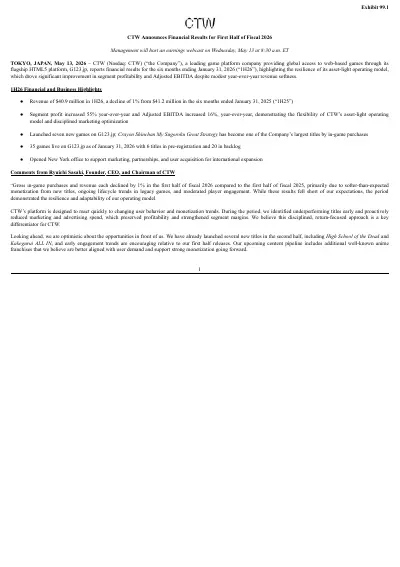
Revenue for the first half was $40.9 million compared with $41.2 million in the prior-year period, a decrease of 0.7%. Gross in-game purchases were $48.6 million, down 1.1% year-over-year.
These year-over-year changes were relatively modest on the surface. Yet, they reflect an important shift in the underlying drivers of performance during the half.
We launched seven new games during the period. As Ryuichi noted, those launches performed below our expectations.
At the same time, several mature titles continued moving through later stages of their lifecycle, and overall user activity declined. That said, one of the more important takeaways from the first half is that, even in this softer revenue environment, the quality of monetization across the platform remained resilient.
Monthly active users declined to approximately 2.0 million from approximately 3.3 million last year. However, paying monthly active users remained stable at approximately 75.7 thousand compared with approximately 76.7 thousand last year.
As a result, the conversion rate improved to 3.82% from 2.35%. In addition, we also saw improvements across key monetization and efficiency metrics.
ARPPU increased to $18.90 from $16.31. ARPMU increased to $4.00 from $2.50.
ROAS improved to 109% from 106%. In practical terms, traffic declined primarily among non-paying users, while the platform continued to attract and retain a higher-quality paying audience and generate more efficient returns on advertising spend.
We also continued to make gradual progress on geographic diversification. Revenue from users outside Japan increased to 31.6% of total revenue, up from 28.8% last year.
Japan remains our largest market, but expanding our international mix remains a key strategic priority. Turning to expenses and profitability.
Cost of revenue increased 39.6% year-over-year to $13.9 million. General and administrative expenses increased 13.6% to $5.1 million.
Research and development expenses increased 25.3% to $1.7 million, reflecting ongoing investments in platform capabilities and organizational infrastructure, and additional costs associated with operating as a public company. At the same time, sales and marketing expenses declined 15.2% to $22 million, driven primarily by a $5.9 million reduction in advertising spend.
This reduction was intentional, reflecting the disciplined response Ryuichi described earlier. When new titles did not meet our internal performance thresholds, we quickly scaled back marketing rather than pursuing top-line growth at unattractive returns.
This responsiveness is a core strength of our operating model. As a result, we recorded an operating loss of $1.7 million compared with a half-million loss in the first half of 2025.
Net loss was $1.2 million compared with net income of $0.6 million last year. While we are not satisfied with reporting a loss, it is important to view that result in the context of a period in which revenue underperformed expectations, combined with continued investment in infrastructure and long-term capabilities, while maintaining meaningful cost flexibility.
There are also two period-specific items worth noting. First, we recorded approximately $1.9 million of share-based compensation expense related to stock options granted in December 2025.
Second, following early adoption of ASC 2025-06, we capitalized approximately $2.1 million of qualifying internal-use software and cloud implementation costs. Both items are relevant to understanding the period-over-period financial profile and the level of ongoing investment in the business.
On a non-GAAP basis, performance remained solid. Adjusted EBITDA increased to $4.3 million from $3.7 million, representing a 10.5% margin.
Segment profit increased to $18 million from $11.6 million. These metrics highlight that the core economics of the platform remain healthy and responsive to disciplined cost management, despite softer revenue and a GAAP net loss.
Turning to cash flow and the balance sheet. Net cash used in operating activities was $0.4 million compared with $2.6 million of cash generated in the prior year.
This change was driven primarily by working capital movements, including additional advances made to game developers and higher prepaid royalties as we invest in future content and platform support. We ended the period with $19.5 million in cash and cash equivalents, up from $12.2 million at July 31st, 2025, supported by the proceeds from our IPO.
We believe this positions us well to invest selectively in content, systems, and international growth while maintaining strong liquidity and financial discipline. Overall, the first half of fiscal year 2026 was a period of softer top-line performance, but also one that demonstrated the responsiveness of our operating model and the robustness of our financial monitoring systems.
We acted quickly when new title performance did not meet expectations. We improved key monetization and efficiency metrics.
We maintained positive adjusted EBITDA, and we ended the half with a solid cash position and the flexibility to continue investing for the long term. Thank you.
I will now turn the call back to the operator for the Q&A section.
Matt Chesler
Thank you, Patrick. We're now going to open up the call to question and answers.
From Zoom, there are two ways that you can participate. The first is to use the raise your hand icon, which is at the bottom of the screen.
Clicking this alert will alert us that you want to be called on to ask a live question, and then you'll be placed in queue and called upon in turn. Just note, you're going to be on mute until you are called upon.
The second way to participate in Q&A is to use the Q&A widget, which will allow you to type in and text a question. We'll take questions from there as well, but just note if we run into a time constraint, we'll get back to you if your question is not asked on today's call.
With that, we'll now pause for a moment to build the queue. The first question is going to be from Steve Silver from Argus Research.
Steve, go ahead.
Steve Silver
Everybody, thanks for taking the questions. I was hoping you guys could just discuss a little bit about how the company's using technology to build in the capabilities of reacting quickly to changing user behavior.
Just trying to get a sense as to any of the metrics you look at and how much time you give to a new title before making the determination that a title is underperforming and requires a change in the marketing strategy.
Patrick Liu
Thank you. Thank you very much for the question, Steve.
In regards of your question, I think you asked about how our technology works and how we actually monitor new game launches and how we react in regards to the early performance indicators of a new game after it was initially launched, right? Basically, I think we have been communicated with the market before, the company, we have internally developed a set of AI-backed systems and tools to help us monitor the performance of each new launch games on as well as every live games that is on our G123 platform.
One of the very important system that we are using internally is the AI-backed advertisement management system, and also the user data monitoring tool that we are able to see the real-time performance of each individual game that is actually live on G123 platform. For example, for each of the new games that launched on our platform, we basically most of time we do a relatively soft launch, means we may spend a small amount of advertisement in day 0 to day 3 immediately after the game is launched.
During that period of time, we can continually monitor the performance, including paying user retention, paying user conversion rates, and all those key KPIs that we believe indicates the potential of any new game launched on the platform. Based on the results of those games basically between day 0 to day 3, the marketing team of the company going to decide is this really a hitting title or this is somehow not as expected.
Based on that results, we will further adjust the advertisement spending as well as strategies for day 4 and 7. We're going to continue monitor the performance of that game through that period of time.
Eventually, we're going to roll into day 7 to day 14 and then continue adjusting the advertisements proactively. I would say that is how internally we use our AI-backed tools monitor game performance and adjust our advertisement marketing cost allocation and spending.
Steve Silver
Great. Thanks.
In the context of the trend in terms of active users, do you get a sense as to whether a lot of that has been attributable to the customer excitement over some of these new underperforming launches, or do you get a sense of whether there's any macroeconomic trends affecting those results as well?
Patrick Liu
In regarding of these new titles that launched for the first half of the fiscal year 2026, I don't think it's as simple as to say, oh, it's a bad IP or it's a single game format problem. I think probably broadly speaking, we believe the first-half underperformance was primarily to monetization quality and unit economics rather than traffic acquisition or initial user interest.
I think several of the new titles generated reasonable engagement and the user acquisition metrics initially, but the payer conversion, monetization depth, and the long-term return on advertising spend profile were below our internal expectations. I think in some cases, we believe certain titles attracted broader casual audiences with lower monetization behavior relative to several of our stronger-performing historical launches.
As a result, while top-of-funnel traffic and engagement were acceptable, the long-term monetization efficiency did not justify aggressively scaling advertising investment. Also we think that it is actually very important to recognize gaming performance can vary significantly by timing, audience fit, monetization design, live operations execution, and broader market conditions, even while underlying IP awareness is strong.
I think basically that is the observation we have been seen from the first half of the current fiscal year.
Steve Silver
Great. One more, if I may.
The prepared remarks or the press release cited 20 titles in the backlog. Curious as to whether there's any context around the number within that 20 in terms of maybe titles that might move into pre-registration in the back half of the fiscal year?
Patrick Liu
Basically in regarding of the future releases, the pipeline we have, so far, you will be able to see on our website, we have, I believe, six games that is actually five or six games that is actually in pre-registration. For the remaining of those titles, we are still working very actively with the IP holders, with the game developers to assure that the game is actually under development and also we're making the progresses in the correct way.
Because the fact that for any of those games that we haven't really released the pre-registration for the games, we are, because of the contract we have with IP holders, we are still not able to explicitly detail disclose the specific name or IP related to those games. We would say that a lot of those games are associated with very popular anime IPs, and some of them are also recently popular in North American region.
We do have a lot expectations when those games are ready to be released to the public.
Steve Silver
Great, thank you for taking my questions.
Patrick Liu
Thank you, Steve.
Matt Chesler
Our next question is from Vincent Fernando from Zero One Research. Vincent, please go ahead with your question.
Vincent Fernando
Hi. I see that your segment margin expanded from 23.7 to about 37%, despite flat in-game purchases.
That shows there's some operating leverage in the platform. I'm just wondering, can you walk us through maybe what the dynamics behind that?
Is it that you're able to detect where certain products and in-game purchases are doing well and you divert resources into that? Just want to understand the dynamics, how are you able to increase the percent of margin from the in-game purchases?
Thank you.
Patrick Liu
Got it. In regard of the margin of in-game purchases versus the revenue, the main factor of that is actually reflecting the new combination or mix of all the games that is actually on our platform.
Historically, I believe you probably see that we have been disclosed that there's a significant portion of our revenue is actually generated by the game which is called Vivid Army. For that game, we historically has a slightly higher revenue share percentage with the game developer of that game.
Because the fact that along the fiscal half-year of the fiscal year 2026, we actually launched, historically we have been continue launching new games, and the game mix is actually changed slightly. Right now, it's still the largest game by itself, but the game developer of that game is actually not the largest game developers that generates revenue for us.
For the newer games, we tend to give a slightly lower revenue share to the game developers. Because of the change of the revenue proportion generated by higher revenue share games, the overall average revenue share percentage is actually declined year-over-year, and that explained why you see, yes, even though the top line softer, but from in-game purchases to revenue, we actually see a slightly improved margin.
Vincent Fernando
Great. Thank you.
Another question, I see that your ROAS was 109%, and obviously you've optimized your marketing title by title. This kind of maybe goes back to the question the previous analyst a bit, but I just want to understand, is that kind of the level that's kind of a target, and then your engine is kind of optimizing to make sure you maintain that level?
How quickly does it respond to that? Just want to understand how the engine operates relative to ROAS.
Patrick Liu
Yeah. Basically in regards of the ROAS, internally we do try to set up a target for each individual game.
Overall, I think if we just do a quick calculation of the average ROAS target we set for all the games, I think we do expect to see return on advertisement spending over 100% from the platform in total overall. To monitor that, I think I kind of explained that earlier when Steve asked about how we monitor new game launches.
Basically it's a step-by-step procedures, and when we launch the new game, we monitor basically from day 0 to day 3 to see the early performance indicators, and based on those, we adjust our advertisement spending basically proactively, and then continue to monitor the return ROAS plus other key KPIs that indicate the performance of the game and adjust the advertisement spending and allocation accordingly. I think that is the way how we maintain a relatively high ROAS compared to industry average.
Vincent Fernando
Got it. The other thing I want to go into was basically, despite your your top line being a little softer, you've had paying month paying monthly active users, sustained.
How does the engine look at paying monthly users? Is it that are you are you do you market to them when you see that they're paying so that you like redirect spend to the people who are paying?
Do you have do you have loyalty programs, things like that? Just want to understand the dynamic, how the engine maintains the paying active users.
Patrick Liu
In regard of the paying monthly active users, I would say the main efforts we put as the company to maintain their activity in the games and within our platform is actually not through a lot of the online advertisements, because for those paying monthly active users, a lot of time they have already spent a significant amount of times as well as money in the game on our platform. They kind of know us already well before.
To maintain the activity level for those paying monthly active users, we tend to work a lot with the game developers and ask them to continually update the game content. Every single time when the user come back to the game, they are seeing something new, and they still basically keep the interest up, right?
In regards to the online advertisements, a lot of times the online advertisements is mainly to attract the new users and the new paying users. That is also explains a little bit about while we do see advertisement expense go down a lot because we're actively monitoring how we should spend the advertisement money, the paying monthly active users didn't really change much, but you see MAU is down a lot.
That is actually a fact of a lot of those new users or non-active users are attracted by those online advertisements.
Vincent Fernando
Just one more question, if I may. Revenue outside Japan rose from 29% to 32%.
You've said you've opened the new New York office. I guess with anime culture being increasingly a global trend, even a huge thing in the US, how do you view how large the international opportunity is for CTW over the next two to three years?
I guess, if we think about where are you targeting, let's say, in two to three years, where can international revenue go, as percent of total?
Patrick Liu
Yeah. Basically, I think one of the company's strategy regarding marketing is I think we have been continually saying this is that we are aggressively expanding into the North American region, US markets in particularly.
The rationale behind of that decision is we realized that there's a lot of market potentials as you just mentioned. In regarding to our expectation for the next two or three years, how we see revenue generated from outside Japan versus Japan, we believe that, as long as we are able to efficiently do the localization and find new partners in the new regions and adapt our model to the new regions, we should be able to eventually get around, say, 50% to 60% of our revenue generate from regions outside of Japan.
That's also depends on a lot of external factors, marketing trends, and everything.
Vincent Fernando
Great. Thank you.
I'll leave the queue for other questions.
Patrick Liu
Thank you, Vincent.
Matt Chesler
At this time, there are no more questions in the queue, I am going to turn the call back to Patrick for some concluding remarks.
Patrick Liu
Okay. All right, thank you, everyone, for joining today's earnings release for the first half of fiscal year 2026 of CTW.
We are looking forward to keeping everybody informed as we progress. Again, thank you, everybody.
Matt Chesler
Thank you everyone for joining us today. You may now disconnect your lines.
Patrick Liu
Thank you.