CTW
NNASDAQ:CTWQ4 FY2026 · Earnings Call TranscriptOctober 16, 2026
Pat Federle
Please be aware that today's discussion may include forward-looking statements as defined under the Private Securities Litigation Reform Act of 1995 and other federal securities laws. These statements reflect management's current expectations and involve risks and uncertainties that could cause actual results to differ materially.
CTW undertakes no obligation to update these statements except as required by law. For a detailed discussion of risks and uncertainties, please refer to our Form 20-F filed yesterday and our other filings with the SEC.
We will also discuss certain non-GAAP financial measures. These measures should not be viewed as a substitute for GAAP results and may differ from those used by other companies.
Reconciliations to the most comparable GAAP measures can be found in our earnings release and our Form 6-K filed yesterday and on the Investor section of our website. With that, I will now turn the call over to Ryuichi.
Ryuichi Sasaki
皆様、本日はCTWの決算説明会にご参加いただき、誠にありがとうございます。2026年7月期はCTWにとって上場企業として初めての決算期であり、重要な1年となりました。同時に、経営として明確な選択をした1年でもあります。売上を伸ばすことだけを追うのではなく、成長の質と投下資本に対するリターンを優先しました。今回の決算には、その判断の両面が現れています。売上高は前期を下回り、業績予想を下回る結果となりました。一方で、広告費を大幅に削減しながら、広告費に対するゲーム内課金額の比率であるROASを基準とする100%以上に維持いたしました。また、セグメント利益を増加させ、有利子負債のない財務体質を維持いたしました。そして、2026年7月期に進めた取り組みは、2026年7月期以降、より力強く規律を持って成長を目指すための基盤を構築するものであったと考えております。初めて当社の説明をお聞きになる皆様に事業の概要をご紹介します。CTWは日本のアニメIPの正式なライセンスを取得した基本プレイ無料のゲームを提供するブラウザゲームプラットフォーム「G123」を運営しています。モバイルユーザーを中心にアプリをダウンロードすることなくブラウザが使える様々な端末からわずか数秒でゲームを始められるサービスです。アニメのIPホルダーや外部のゲーム開発会社と連携し、世界中のアニメファンにゲームを届けています。また、社内のデータシステムを活用して各タイトルの実績を評価し、コンテンツやマーケティングへの投資配分を判断しています。それでは当期の業績と事業の状況についてご説明します。2026年7月期には『学園黙示録 HIGHSCHOOL OF THE DEAD: Day Zero』や『薬屋のひとりごと 後宮異聞録』など15本の新作ゲームをリリースしました。期末時点の稼働タイトルは42本で、さらに16本がリリース待ちまたは事前登録の段階にありました。しかし、上期にリリースした複数のタイトルが計画を下回りました。また、一部の既存タイトルでは運営期間が長くなるにつれて成長が緩やかになりました。これらがユーザーの利用状況と売上の両方に影響しました。こうした状況に対し、社内の実績基準を満たしていないタイトルへの積極的な広告投資を続けることはしませんでした。その代わりにユーザー獲得費用を意図的に抑え、より高いリターンが期待できる機会へ資金を振り向けました。このように実績に応じて投資を調整する規律は当社のビジネスモデルの重要な要素です。当期の広告費は前期比で1,140万ドル、率にして22%削減しました。この削減率は売上高の減少率の2倍以上です。ROASを基準の100%以上に保つため広告費を抑えました。当期のROASは105.8%となり、獲得したユーザーによるゲーム内課金額がそのユーザーの獲得に要した広告費を上回りました。各タイトルをROASに基づいて評価し、その結果に応じてユーザー獲得費用を増減させることが当社のマーケティング戦略の基本です。ユーザー基盤の質という点では前向きな動きも見られました。当期のユーザー動向には広告費削減の影響と改善すべき課題の両方が現れています。全体の利用は減少しましたが、月間課金ユーザー数は概ね安定しており、月間アクティブユーザーに占める課金ユーザーの割合は上昇しました。一方、日次の課金動向と月間課金ユーザー1人当たりの平均支出は軟調に推移いたしました。これには上期にリリースしたタイトルの低調な実績が一部影響したと考えております。こうした動向を踏まえ、今後のタイトルラインナップを充実させ、ユーザーの継続的な利用を促しながら持続的な成長につなげることが重要だと考えています。その一方で、月間アクティブユーザー1人当たりの平均収益を示すARPMAUと、日次課金アクティブユーザー1人当たりの平均収益を示すARPDAUはいずれも前期から改善しました。2026年7月期はユーザー数の拡大という点では厳しい1年でしたが、プラットフォームの収益化を支える基盤は引き続き健全であると考えています。投資の規律はセグメントの収益性向上にもつながりました。セグメント利益は前期比3%増の3,230万ドルとなりました。ゲーム内課金額に対するセグメント利益の割合は前期の29.3%から33.4%に改善しました。同時にCTWの次の成長段階に向けた投資も続けました。今後数年間の事業運営を支えられる持続可能な水準まで人員体制を整え、ニューヨークのOne World Trade Centerに当社初の北米拠点を開設しました。また、G123への投資を継続するとともに上場企業として必要な管理基盤の整備を進めました。こうした投資に加え、プラットフォームの拡充や海外展開に向けた取り組み、サーバーおよびプラットフォームの運営費用の増加、上場企業としての運営費用などにより当期は営業損失を計上しました。ただし、調整後EBITDAは350万ドルのプラスを維持しました。また、期末の現金残高は1,440万ドルで有利子負債はありません。北米の売上高は当期に減少しました。主な要因は当社のリターン基準を満たしていないタイトルのユーザー獲得費用を抑えたことです。これは規律ある資本配分に伴う一時的な影響と捉えており、北米市場に対する長期的な見方は変わっていません。北米は引き続きCTWにとって大きな成長機会のある市場です。2月に発足したニューヨークのチームはパートナーシップ、ロケライゼーション、ユーザー獲得、企業広報に取り組んでいます。北米のユーザーやパートナーに対するCTWの認知と存在感を高めていきます。当社のブラウザを通じた提供モデルは海外市場で特に魅力を発揮できると考えています。従来のアプリのダウンロードや登録に伴う手間を減らし、様々な端末からすぐにゲームを楽しんでいただけるためです。事業面での取り組みに加え、この1年はCTWにとって重要な節目が続きました。2025年8月にはNasdaq Capital Marketへの新規上場を果たしました。2026年2月にはOne World Trade Centerに北米での活動の中核となるニューヨーク拠点を開設しました。5月にはCTW CaymanからCTWへの社名変更が株主総会で承認されました。そして8月には米国東海岸最大のアニメイベントであるAnime NYCに来場者登録スポンサーとして参加しました。今後に目を向けると、2027年7月期に最も重要となるのは新作タイトルラインナップの質だと考えています。世界中で親しまれ、高い知名度を持つアニメIPを題材としたタイトルを含め、16本がリリース待ちまたは事前登録の段階にある状態で新しい期を迎えました。中でも『学園黙示録 HIGHSCHOOL OF THE DEAD: Day Zero』は2026年4月下旬のリリース後、3ヶ月以内に月間ゲーム内課金額で当社トップのタイトルとなりました。2026年7月期の終盤にリリースされたため通期業績に反映された成果はまだ限定的でした。G123でのリリース以降、欧米市場では同タイトルに対する強い関心と活発な利用が見られました。ここで得られた知見やユーザーの嗜好に関するデータは今後北米で新作タイトルを展開する際のターゲティングに役立ちます。アジア市場でも手応えを得ています。このタイトルの実績に加え、今後のタイトルラインナップ全体と規律あるユーザー獲得への取り組みが、持続的な成長への回帰に対する私たちの自信を支えています。2027年7月期の重点方針は以下の通りです。第1に、新作タイトルラインナップの質を高め、継続して良質なゲームを提供していきます。第2に、日本のIPに対する需要が強い海外市場で当社の事業を拡大していきます。第3に、効率よく事業を拡大し、コンテンツやマーケティングについて迅速に判断するため技術とデータシステムへの投資を続けます。そして第4に、成長そのものを目的とするのではなく持続可能なリターンを重視し、規律ある資本配分を維持します。世界各地で働く従業員の皆さんにはCTWの成長を支える日々の努力と献身に心から感謝しています。2026年7月期はタイトルが期待通りの成果を上げられない場合にも迅速に対応できることを示した1年でした。支出を削減し、投資リターンを守り、調整後EBITDAのプラスと有利子負債のない健全な財務基盤を維持しました。2027年7月期はこの規律を土台にタイトルラインナップの充実と海外市場での事業拡大を進め、上場企業としての最初の1年で得た学びを生かしていきます。これによりCTWは持続的な成長への回帰に向けてより強固な基盤を築くことができていると考えております。株主の皆様にはCTWのさらなる発展に向けて引き続きご支援をいただいていることに心より御礼申し上げます。本日はお時間をいただき、またCTWにご関心をお寄せいただき、誠にありがとうございました。それでは最高財務責任者のパトリック・リュウに業績説明を引き継ぎます。
Patrick Liu
Thank you, Ryuichi, and good morning and good evening, everyone. As Ryuichi mentioned, prioritizing returns over top-line growth is central to our strategy.
From a financial standpoint, that ongoing discipline guided four priorities in fiscal year '26: moving quickly when new titles underperformed, keeping our advertising spend above our return thresholds, investing selectively in our platform and global expansion, and maintaining a strong debt-free balance sheet. The results reflect those choices.
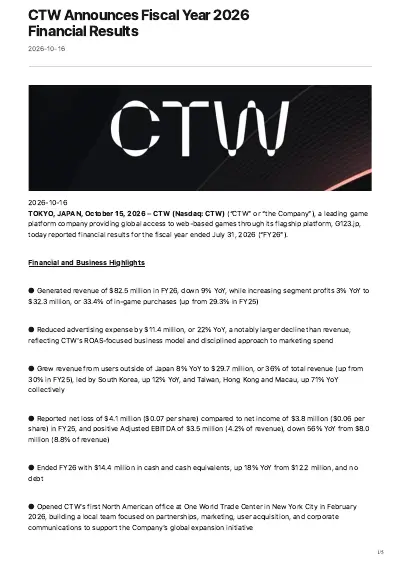
Revenue declined, but segment profit grew. ROAS stayed above our 100% benchmark, adjusted EBITDA remained positive, and we ended the year with $14.4 million in cash and cash equivalents and no debt.
Revenue for fiscal year '26 was $82.5 million compared with $90.4 million in fiscal year '25, a decrease of 8.7%. Gross in-game purchases were $96.8 million, down 9.5% year-over-year.
We launched 15 new games during the year and ended fiscal year '26 with 42 active titles. However, the titles we launched in the first half performed below our expectations, and several mature titles continued moving through the later stages of their life cycle.
We saw success in the launch of Highschool of the Dead: Day Zero, which was released toward the end of April, meaning slightly over three months of contribution was recognized in fiscal year '26. The strong user traction we have seen to date in Asia and North America with this title is only partially realized in these results.
Within our user base, the decline in activity was concentrated among non-paying users. Monthly active users declined 33% to approximately 2.26 million from approximately 3.38 million last year, while paying monthly active users increased slightly to approximately 89.1 thousand compared with approximately 88.5 thousand last year.
As a result, the ratio of paying monthly active users to monthly active users improved to 3.95% from 2.62%. Paying daily active users declined 13% compared with a 7% decrease in overall daily active users, while average revenue per paying monthly active user declined to $90.60 from $100.74.
We believe these trends partially reflected weaker performance of our first half launch. ROAS was 105.8% in fiscal year '26 compared with 116.4% in fiscal year '25.
While lower than last year, ROAS remained above our 100% benchmark, meaning that in-game purchases generated by newly acquired users continued to exceed the advertising spend used to acquire them. This supports our long-term, ROAS-focused marketing strategy.
We also continued to make progress on geographic diversification. Revenue from users outside of Japan increased 8.2% to $29.7 million, or 36% of our total revenue, up from 30.4% last year.
Revenue from users in South Korea increased 12.4% to $10.5 million, and revenue from users in Taiwan, Hong Kong, and Macau collectively increased 71.2% to $8 million. It is encouraging to see this momentum in Asia outside of Japan.
Combined revenue from users in these markets grew 31.9% to $18.5 million, or 22.4% of total revenue, up from 15.5% last year, and we believe the appeal of anime across the region gives us room to build on this growth. Revenue from users in North America, which includes the United States and Canada, was $6.2 million compared with $7.5 million last year, a result of reduced user acquisition spending on underperforming titles.
Building our presence in North America is a long-term effort, and our New York team, established in February 2026, is focused on partnerships, user acquisition in that region, localization efforts, and corporate communications. We expect to see a return to growth as we issue new titles and continue to implement our presence and growth initiatives in the region.
Revenue from users in Japan decreased 16.1% to $52.8 million. Japan remains our largest market, but expanding our international mix remains a key strategic priorities.
Turning to expenses and profitability. Cost of revenue increased 29.2% year-over-year to $28.5 million, driven largely by higher personnel, outsourcing, and server and software costs, along with higher revenue share to IP holders and amortization, partly offset by lower payment processing fees and the absence of the prior year prepaid royalty impairment.
These increases reflect our continued investment in the team, infrastructure, and in external creative resources that support our platform and game operations. General and administrative expenses increased 37.9% to $11.7 million, primarily reflecting the buildout of our corporate and administrative functions as a public company, the opening of our New York City office, and approximately half million of Taiwan business tax expense, a portion of which related to prior periods.
We believe the core infrastructure required of a public company is now largely in place, and we expect general and administrative expenses to increase only modestly in absolute terms over time as the business scales. Research and development expenses decreased 31.2% to $3.8 million.
Sales and marketing expenses decreased 17.2% to $45.9 million, driven by an $11.4 million or 21.7% reduction in advertising expense to $41 million. Advertising declined at more than twice the rate of revenue.
This reduction was intentional. When titles did not meet our internal performance thresholds, we scaled back marketing rather than pursue top-line growth at unattractive returns.
As a result, segment profit increased 3% to $32.3 million, or 33.4% of in-game purchases, compared with $31.3 million or 29.3% of in-game purchases in fiscal year '25, as lower advertising expense more than offset lower in-game purchases and higher server costs. We reported an operating loss of $7.3 million compared with an operating loss of $1.1 million in fiscal year '25.
Net loss was $4.1 million, or $0.07 per share, compared with net income of $3.8 million, or $0.06 per share last year. Fiscal year '25 net income included a $4.7 million contingent gain on recovery of previously impaired assets, and fiscal year '26 included an income tax benefit of $1.7 million.
There are also two items worth noting for the year. First, we recorded $2 million of non-cash share-based compensation expense compared to none in fiscal year '25, most of which related to share options granted to directors, executive officers, and certain employees in December 2025 in recognition of their long-term commitment to the company and efforts in successfully launching our IPO.
Second, following our early adoption of ASU 2025-06 effective August 1st of 2025, we capitalized $4.1 million of internal use software development cost for our G123 platform. Both items are relevant to understanding the year-over-year financial profile and the level of ongoing investment in the business.
On a non-GAAP basis, adjusted EBITDA was $3.5 million, or 4.2% of revenue, compared with $8 million, or 8.8% of revenue, in fiscal year '25. We remained adjusted EBITDA positive while reducing advertising spend and continuing invest in head count, platform development, and our global expansion initiative.
Turning to cash flow and balance sheet. Net cash used in operating activities was $3.2 million compared with $0.1 million of cash provided in fiscal year '25.
This change reflected our net loss and working capital movements, including $6 million of advances to our game developers as we invest in future content. Net cash used in investing activities was $4.7 million, included the $4.1 million of capitalized software development costs.
We ended fiscal year '26 with $14.4 million in cash and cash equivalents, up from $12.2 million at July 31st, 2025, and supported by $10.6 million of net proceeds received at the closing of our IPO. We believe this positions us to continue investing selectively in content, systems, and international growth while maintaining strong liquidity and financial discipline.
Overall, fiscal year '26 was a year of softer top-line performance, but also one that demonstrated that the responsiveness of our operating model. We acted quickly when new title performance did not meet expectations, reduced advertising significantly while keeping ROAS above our 100% benchmark, grew segment profits, and maintained positive adjusted EBITDA and a debt-free balance sheet, with a vision to return to sustained growth in fiscal year 2027.
Thank you for your time and interest in CTW. I will now turn the call back to Pat for Q&A session.
Pat Federle
Thank you, Patrick. We're now going to open up the Q&A session.
From Zoom, there's two ways that you can participate. The first is to use the raise your hand icon, which is at the bottom of your screen.
Clicking this will alert us that you want to be called on to ask a live question and so you'll be placed into a queue and then called on from there. Just note that participants will remain on mute and called on in order that they file into the queue.
The second way to participate in today's Q&A is to use the Q&A widget, which will allow you to type in and submit a question. We will take questions from there as well, but just note if we run into a time constraint, we'll be sure to get back to you if your question is not asked on today's call.
With that, we'll now take a quick pause and allow the queue to build. Okay.
It looks like we have a few questions here, with that, we're going to begin with Vincent Fernando from Zero One Research. Vincent, you should now be on the line.
Vincent Fernando
Hi. Thank you so much.
I just have a few questions actually. I'll try to ask them to save some time.
The first question is, your launches have drawn on current anime, older catalog titles, and original games. From what you're seeing, what kind of anime property works best relative to cost?
How does that shape what you choose to license next? All right.
Patrick Liu
Thank you very much, Vincent. I'm going to respond to this question.
I do want to let so from our perspective, we do not necessarily view newer anime IP or established catalog titles or original games as inherently more attractive than the other ones maybe. I think each anime title, each anime IP has its unique characteristics, cost structures, and potential audiences.
From the company perspective, when we evaluate content opportunities, we consider a range of factors, including the popularity and engagement of the underlying fan base, expected monetization relative to the cost of licensing and launching the game, and also, which includes the prepaid royalties, the royalty rates, revenue share rates, and advance to the game developers. As of the end of the fiscal year '26, we had partnerships with 38 anime IP holders and have 48 IP licenses.
I think from our prior experiences launching the IP-based games, we see that the age or the recency of an IP does not necessarily determine its commercial potential. For example, Highschool of the Dead: Day Zero, which is based on a manga first serialized back in 2006 and adapted for television in 2010, generated approximately $6 million in its first three plus a little bit over three months' launch, and the game itself actually became the highest revenue-generating games on our platform over that period.
I think this is actually a great example that demonstrate that established catalog IPs with dedicated fan communities can continue to offer meaningful opportunities even though the manga, the TV adaptation of this anime was almost over 10 years old right from right now. Also beyond of the popularity of the original IP, we also learned that successful game performance also depends heavily on how well the game captures the characteristics that fans appreciate about the original content.
Beyond that is the users also care a lot about overall quality of the gameplay, the overall user engagement, and monetization. That means even sometimes even a highly popular IP may not necessarily translate into a very successful game if the gaming experiences does not meet the user's expectations.
We also recognize that sometimes different genres and different gameplay mechanics may appeal to different audiences and geographic markets. From our perspective, I think looking ahead, we intend to maintain a diversified approach to content selection, balancing well-known anime IPs and properties, established catalog IPs, and opportunities involve original games or different game genres.
From company side, we will continue working closely with our IP and the developer partners to evaluate the commercial potential of each opportunity and draw our experiences from prior launches and game operations to help us to continue grow the platform and grow the business. I think from the business side, the objective is very clear, we don't just want to secure the most recognizable IPs, but to us, we want to identify the content that can deliver an attractive user engagement and sustainable monetization relative to the investments required.
Vincent Fernando
Got it. Thank you for that.
My next question is just in regards to how you look at games when they launch. What I understand is you have systems where you read a new game launch and within a couple of weeks, you're receiving data and you're steering advertising towards titles that seem to be performing better based on various metrics.
I just want to dig into that a little bit. What do you look for in a title when it launches that shows you that okay, I should put more ad spend on that title, and kind of as a corollary to that, how do you decide when to lean into the user acquisition, on the platform and different titles?
I guess just get some visibility on what you look for in the metrics right after a launch? Thank you.
Patrick Liu
Got it. Thank you for the question again.
From our perspective, after a game's launch, in the very first few weeks after launch, we look closely at engagement and monetization data, something like user acquisition and character creation data, the first-day retention, paying user conversion, and some other early monetization trends, and also, most importantly, the expected ROAS of our advertisement spending on the new launches. We believe that these indicators help us assess how well a game is attracting and retaining users and also, most importantly, how effectively it converts interest into actual spendings and whether its performance supports additional marketing investment.
We typically try to form an initial view of a new launch within the first few weeks, but after the game launches and operated on the platform, we definitely will continue monitor the performance of the games and refine our assessment as more operating data became available to us. From company perspective, our approach to user acquisition is basically as you said and also we talked about this a lot during the earnings call, is we approach user acquisition driven by the actual performance of individual games rather than the single platform-wide advertising decision.
Basically that means for each individual title that launch and operated on the platform, we actually evaluate the actual and expected ROAS and other operating KPIs to determine whether we want to invest additional marketing investments and whether those additional investment is actually justified. When a game demonstrate attractive returns, we generally seek to increase advertising investment to capture additional monetization update opportunities.
Sometimes, we do see for whatever reason some of the games is not performed as we expected, the performance falls below the expectation, at that moment, we will adjust the spending accordingly. I think [clears throat] this actually exactly what we have experiences for fiscal year '26, and also we do believe this discipline will continually get us into fiscal year '27.
Vincent Fernando
Got it. Thanks for that.
I noticed, for example, in the latest results, maybe some of that's playing out, cuz obviously maybe you've pulled back a bit, cuz I saw the total MAUs come off a bit, but actually paying MAUs still very stable. That's what I thought maybe it's some of that dynamic there.
My last question is so Japan has new smartphone rules, as I've understood, and then we've seen some US court rulings on App Store payments that's kind of starting to loosen app stores' hold on app payments. Are you seeing increased interest, maybe from publishers who maybe previously felt they were locked into the app stores, now looking for in-browser game distribution through you?
Is there any change now in how you're speaking to potential partners because of these new developments for app stores? Got it.
Patrick Liu
Thank you. This is actually a quite interesting question.
We have actually talked with a lot of industry players, especially on the gaming studio, game development partner side. We believe over the past few years, we have observed some increasing interest from game developers, publishers in distribution channels outside of the traditional App Store ecosystem.
Through today, we still believe that app stores remain as one of the important distribution channels for a lot of the game distributors and the game gaming studios. The App Store have become increasingly competitive in today, especially considering the large number of games right now available through app stores.
I think, as a result of that, we do see some of the more and more developers are actually increasingly interested in exploring some alternative ways to reach users, improve some distribution efficiencies, and manage platform-related costs. We believe that the recent regulatory development, as you mentioned, actually further support this broader trend that we observed from our side.
I think this actually gives some unique advantages to our browser-based platform because G123 was designed from the beginning as a browser-based gaming platform and operating independently from the traditional App Store ecosystem. Our games can be accessible globally across devices, and we don't need app downloads and we process in-game purchases through established third-party payment providers that are connected directly with our platform.
Also, beyond of just the global accessibility, we also offer some additional benefits to game developers and game studios. Beyond of just the distribution, we also offer our gaming development partners user acquisition and marketing capabilities, and we also support game developers in designs in their games, and we provide localization services, and we also give them access to an established anime and manga IPs.
From our perspective, we believe these, in combination, represent some very attractive value for all the game developers and publishers in the world. I think this basically also means that from the company's side, from CTW side, we believe the growing interest in the alternative distribution models and channels actually creates some additional opportunities for CTW to expand our developer and publisher relationship networks.
In particular, I think it may allow us to engage with some larger and more established games developers that have traditionally focused more on just native app distribution. I think that's actually what we expect to see in the near future.
Vincent Fernando
Just a super quick follow on that. You mentioned that other game developers now may be more open to this outside the App Store.
What about IP owners? Are there some Japanese IP holders maybe they kind of for some reason, they always wanted to be inside the app stores and now maybe is there new opportunities for new IP owners to work with you?
Patrick Liu
From our side, I think based on our observation, we do see there are more and more IP holders that became more interesting of exploring other potential monetization channels and the distribution channels. From our side, we don't necessarily think that there are direct connections or incentives for the IP holders to seek for distribution channels outside of traditional app stores just because the fact of the recent regulatory updates, right?
From our perspective of views, we have been seeing, and I think this is actually what will continue to be part of the truth, is from IP holder side, they always want to have a diversified monetization channels and approach. That's means because the platform we have built is totally outside of traditional App Store ecosystems, so that's always going to be something valuable for the IP holders to consider when they explore the different monetization opportunities beyond of the traditional App Store distribution channels.
I think from that perspective of views, from our side, we will continually contact and connect with new IP holders whenever opportunities comes. Beyond of just the traditional Japanese manga IP holders and anime IP holders, we may, from time to time, depends on market conditions, depends on opportunities, we may also exploring other IP holders outside of Japan, as well.
Vincent Fernando
Got it. Those are my questions.
Thank you so much.
Patrick Liu
Thank you, Vincent.
Pat Federle
Thank you, Vincent. Our next question here will come from Steve Silver at Argus Research.
Steve, you should now be on the line.
Steve Silver
Great. Thanks so much for taking the questions.
Anime NYC was more than a month ago now, and it took place after the end of fiscal 2026. I was just curious if you could talk or provide any color around whether there was any meaningful change in website traffic noticed in the weeks following the conference, and just if you could talk a little bit about the types of professionals that attended that conference that you think may provide business development opportunities moving forward.
Patrick Liu
Thank you, Steve. We actually attended Anime NYC in August of 2026, and I think from our perspective so this is actually the very first time we have been actively participating in a very large anime-focused convention in North America.
The main purposes of this event, the participation of this event is really try to put the G123 brand in front of fans and industry professionals in the markets that we are trying to build. I think the event itself, we have received some event report.
It's said that over 170,000 attendees participated in the Anime NYC, and we definitely have a lot of very interesting connections with professionals that working on licensing, working on gamings and other parts that's relevant to our business. I think from our side, one of the most valuable aspects of this event is really just the opportunity to interact directly with anime fans and to better understand their interest and preferences and expectations.
I think from our side, these interactions actually provided a very useful insights into the anime IP, the gaming experiences that resonates with North American audiences that we are trying to expand into. From our side, we don't really disclose event-specific website traffic metrics or anything quantifying the immediate impact at the current stage.
From our side, we believe these type of initiatives really together contributes to building a stronger foundation for our long-term growth in North America. Most importantly, this is really just a brand awareness build-up and also help us to better understand the local demands and the needs for anime-themed gaming.
Steve Silver
Great. Thanks for that.
One more, if I may. The company closely tracked the number of pre-registrations for titles, including, I guess, The Apothecary Diaries and Shakugan.
I'm curious as to whether there's anything you could say just in terms of how initial in-game purchases might have just tracked the number of pre-registrations that you saw, and maybe just more in general, how launches of new titles that had strong pre-registrations have gone. Obviously, market conditions are different and each title's launch might be different, but I'm just curious as to historically whether the trend has followed through any strong pre-registration trend.
Patrick Liu
Thanks for the question, Steve. From CTW side, when we see the pre-registration numbers, first of all, we do believe that these pre-registration numbers is definitely valuable indicator of initial market interest in a particular anime or manga IP and the game associated with those IPs.
I think that for us, we do see based on the previous experiences, if we do see a strong pre-registration interest, it's actually help us to build the awareness ahead of the actual launch of the game, and also it's going to help us to improve overall efficiency of early-stage user acquisition. However, I think based on our prior experiences, we do see that the pre-registration numbers sometimes do not necessarily translate directly into actual game performance or in-game purchase after the game is launched.
I think ultimately the game success is actually depends on a lot of other factors beyond of just the simple popularity of the underlying IP. The other factors including things like the overall quality of the gameplay, whether the game actually aligned with the fans' expectations, overall user engagement, retention, and monetization.
I think based on our prior experiences, sometimes a title with strong pre-registration numbers may attract users more efficiently at launch, but that does not necessarily mean that it will achieve higher retention or paying user conversion rate. From the company side, we continue to closely track pre-registration numbers as part of our launch preparation.
When the game is actually launched, our focus going to shift from just monitoring the pre-registration numbers to actually monitor the actual performance of the game, including the things that we have mentioned in the previous earnings call, means that user acquisition, retention, the paying user conversion, monetization, and most importantly, the ROAS. We actually use these indicators to continually evaluate the game's performance and use these indicators to optimize the game content and the marketing strategy to try to get maximized monetization and maximized profitabilities from the game.
Steve Silver
Great. I appreciate the color and best of luck in the new fiscal year.
Patrick Liu
Thank you so much.
Pat Federle
Thank you, Steve. Really appreciate those questions.
Looks like we have time for a couple more. Our next question will come from Aaron Grey at Alliance Global Partners.
Aaron, you should now be on the line.
Aaron Grey
Hi, good morning and thank you very much for the questions here. Just to maybe dive a bit deeper into some things that have already been covered a bit more forward-looking.
Talking about some of the drivers between the MAU trends and in-game purchases during the period, and as we look forward, do you expect those to trend more in a similar direction over the long term with some volatility near term? What are the things that might drive that divergence on a go-forward basis?
Any commentary you might be able to provide maybe quarter-to-date now that we're about 2 and 1/2 and 2 and 1/2 months into the next half. Thanks.
Patrick Liu
Thank you so much, Aaron, for questions. From our side, first of all, I do want to just re-emphasize, the games offered on G123 platform are all under free-to-play, pay-to-win mode.
The monetization basically primarily driven by the in-game microtransactions, the in-game purchases. From an operating perspective, we focus not only on the attracting users to our platform, but also try to convert the free users into paying users and retain those paying users and encouraging continued engagement and spending within the games on our platform.
I think from that perspective, MAU and in-game purchase volume and reported revenue are related, but distinct matters of our business performance. I think one very important distinction is that for us, non-paying users tend to be more sensitive to advertising and the promotional activities, and because these activities are significant drivers of new user acquisitions most of the times.
On the other side, for paying users, generally, they demonstrates a stronger engagement and retention, and most of the times are less directly affected by changes in advertising spending. I think basically that means when we change our user acquisition investments, it's going to have a greater impact on overall active users than our paying user base or in-game purchases.
I think this is actually something you see in the past fiscal year '26. I think from our side, we do believe that we want to continually introduce new games to the platform and maintain high-quality games on our platform.
I think over the long term, as our platform grows and our user base become more mature, we probably going to see sometimes that the active users, the MAU, and in-game purchase to generally move together and driven mostly by new launches of the new games. In near term, we believe as we continue expand globally and trying to address demands from new markets to the company, and we believe there you will continue to see there's going to be some divergence in MAU movements and the in-game purchase movements.
Aaron Grey
Hey, great. Appreciate that, Patrick.
Second one for me, just commenting a bit further on some of your marketing initiatives to increase awareness to the platform, maybe more particularly here in the US, but also Japan, as well. Really through some of the commentary you had on reducing some of the marketing just because of some of the traction you were getting.
How do you think about the juxtaposed position of we need to spend more to get more attention, but then again wanting to keep up the ROAS, do you maybe just reallocate maybe where some of that spending could go to into the games that are getting the ROAS or how can we better think about not having to reduce the marketing spend to keep the ROAS up whereas reallocating it to different games or otherwise to keep the ROAS up while still keeping revenues flat to growing? Thanks.
Okay.
Patrick Liu
Thank you again for the questions, Aaron. I want to let you know from the company's perspective, Basically, we think that this is actually comes into two questions.
The first question is from marketing strategy perspective, how we're going to continue allocate our advertisement spending into different games and what decides how much money we want spend on marketing and the overall advertisement. From that perspective, I think we have repeatedly talking about our core strategy, which is basically ROAS-focused marketing strategy.
From the company's side, that means we're going to continue evaluate the actual performance of each individual game on the platform and use the actual performance or expected performance of those games to guide us to see how much we want actually spend on individual games' advertisement and marketing. Also, we going to continue use that approach to decide how we're going to allocate advertisement budget into different games.
Beyond of just that, I think from our side to continue expand the company and continue our growth, we definitely will try new things to make our advertisement or marketing efforts even more efficiently than what we have through today. Some of the things that we are trying to do since we have established our New York City office in downtown Manhattan, including things like we are trying to expand our brand awareness and user base in US and by participating in more industry-focused conventions or events.
I think the participation of the Anime NYC is actually one of a good example of the company doing brand awareness build-up. Beyond of that, I think from the marketing team, we are also continually exploring additional user acquisition and promotional channels that may be more effective in reaching audiences globally, including US and Japan.
I believe our marketing team right now are evaluating and some potential OEM-related distribution and marketing partnerships and also we are trying to build up some collaborations with local content creators and social media influencers, which I believe we believe that actually are going to help us to address the a lot of the targeting audience of our platform and our games. I think from our side, from the marketing activity side, our objective is really try to diversify our marketing channels, re-trying to reach new audiences and also identify more efficient ways to introduce G123 and our games to the users globally.
I think by doing both ways, means continue maintain the ROAS-focused marketing allocation and investment strategy, plus the exploration of additional user acquisition and promotional channels, I think, in combination, these things going to help us to continue expand globally and get back to a growth phase of the company.
Aaron Grey
Great. Thanks.
Appreciate the color. I'll jump back in the queue.
Pat Federle
Thank you. Aaron.
Looks like we have time for one more set of questions. Our next question asker will be Michael Kupinski from Noble Capital Markets.
Michael, you should now be on the line.
Michael Kupinski
All right. Thanks, Pat.
I was wondering, in terms of the advances to game developers rose to $17.9 million net, and how do you think about underwriting these advances, and how should investors think about impairment risk?
Patrick Liu
Thank you so much for question, Michael. From the company's perspective, advances to game developers is actually in a very important part of our business model.
These advances allow us to support development of new games for the distribution on our platform. All of these advances we made to the game developers are non-interest bearing, and those will only recover through withholding of the developer's revenue share after the game is launched.
The actual recovery of these advances will depend on the successful development, launch, and also the commercial performance of the underlying games. I think from the company's perspective, we have been taking a selective approach when entering into agreements with game developer partners and when we try to provide advances to the game development partners.
Our evaluation of these relationships and advances including things like the overall popularity and potential appeal of the underlying anime or manga IP, the developer's own technical capabilities and experiences, whether the developer has historically some track record of successfully launching games maybe through another web platform or app stores. Also sometimes we do, if it's an existing developer partner, we also evaluate our history with the game developer, as well.
However, even though we do evaluate every single factors that we believe going to impact the overall game performance, the actual game performance after is launched is inherently very very difficult to predict. There are external factors that not in full control of the business.
Even though we do do a lot of evaluation of the risks, those whatever factors we have considered may not be able to fully eliminated the risk of an unsuccessful launches. I think for fiscal year of '26, we recognized approximately $2.6 million in impairments, and in the prior fiscal year, we had roughly $3.1 million in impairment in advances to game developers.
I think these generally reflect the risks associated with overall game development and monetization. I think from the company side, we will definitely continue to manage our advances to the game developers as part of our broader portfolio strategy, and recognizing that the performance of individual titles, individual games can vary significantly.
I think from our side, the focus is the same, that we will continue selecting capable development partners, evaluating the commercial potentials of new projects, and monitor the performance of the games after it's launched. When we make any additional decisions of advances to game developers, we definitely will continually making disciplined investment decision based on all information available to us.
Michael Kupinski
Thank you. Thanks for the color.
You capitalized $4.1 million of software development under ASU 2025 in 06. How will that affect the P&L going forward, and what is the platform investment delivering at this point?
Patrick Liu
I think from our side we have early adopted the ASU 2025-06 from the beginning of last fiscal year. From our side of view, we believe that this new framework actually provides a more appropriate basis for recognizing qualifying software development investment as assets, rather than just relying the traditional sequential development stages.
Of the $4.1 million we have capitalized in fiscal year of 2026, roughly we have a net remaining balance of about $3.5 million after considering the amortization happened in the fiscal year. Of that $3.5 million net balances, around $2.5 million are software or services that already placed in service at the year end, and we do have roughly around another $1 million still under development as of the end of the fiscal year of '26.
Of the capitalized portion, we believe for the next two fiscal years, we probably going to have roughly $1 million amortization, annual amortization, for each of those two years. I think from the company side, these investment in software development actually supports the overall platform and features and functions, and also a lot of those development actually are used across game launches, marketing, localization, and ongoing game operations.
I think that these developments actually help us to streamline a lot of our internal workflows and automate certain repetitive process for the business. I think overall, these developments help us to be able to support a much larger scale of operation with roughly same size of the team or resources we have today.
I think from the company side, we do expect that we will continue invest in platform and internal technology capabilities, including things like AI-enabled tools, data analytics tools, workflow automation. The focus is still to trying to improve overall efficiency over game launches, helping us to improving user acquisition and performance monitoring capabilities.
I think these ongoing investment over the time will help us to continually improving overall operating efficiency and help us to compete more efficiently in this gaming sector.
Michael Kupinski
Thank you. That's all I have.
Thanks for taking my questions.
Patrick Liu
Thank you.
Pat Federle
Thank you, Michael. Thank you once again to everyone for joining us on today's fiscal year 2026 earnings webinar.
We thank you for your continued support of CTW, and you may now disconnect your lines. Have a great weekend.
Bye.