Commercial Vehicle Group, Inc.
Q3 FY2026 · Earnings Call TranscriptNovember 3, 2026
Operator
Good morning, ladies and gentlemen, and welcome to CVGI's third quarter 2026 earnings call. During today's presentation, all parties will be in a listen-only mode.
Following the presentation, the conference will be opened to questions with instructions to follow at that time. As a reminder, this call is being recorded.
I would now like to turn the call over to Michelle Hards, Vice President of Investor Relations. Please go ahead.
Michelle Hards
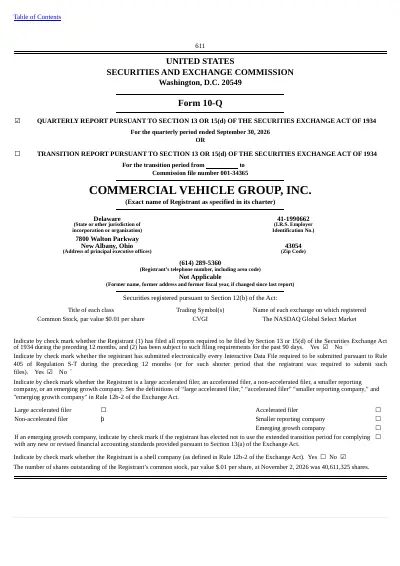
Thank you, operator, and welcome everyone to our third quarter 2026 conference call. Joining me on the call today are James Ray, President and CEO, who will be retiring; David Ruppel, who will be succeeding James as President and CEO; and Angie O'Leary, Chief Financial Officer.
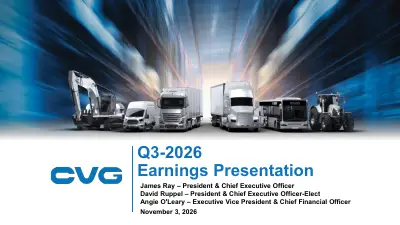
This morning, we will provide a brief company update as well as commentary regarding our third quarter 2026 results, after which we will open the line for questions. As a reminder, this conference call is being webcast, and the Q3 2026 earnings call presentation, which we will refer to during this call, is available on our website.
Both may contain forward-looking statements, including, but not limited to, expectations for future periods regarding market trends, cost-saving initiatives, and new product initiatives, among others. Actual results may differ from anticipated results because of certain risks and uncertainties.
These risks and uncertainties may include, but are not limited to, economic conditions in the markets in which CVG operates, fluctuations in the production volumes of vehicles for which CVG is a supplier, financial covenant compliance and liquidity, risks associated with conducting business in foreign countries and currencies, and other risks as detailed in our SEC filings. I will now turn the call over to James.
James Ray
Thank you, Michelle. Good morning, and thanks to all those who joined the call.
Before I turn to the third quarter results, I would just like to quickly reflect on my nearly three years as CEO of CVG. We navigated very challenging end-market conditions, refinanced the balance sheet, and transformed the operating structure of the company to be more focused on profitable growth.
As you saw in the press release last night, David Ruppel is joining us next week as the incoming President and CEO. Given he has not yet started and has not had full access to the business, today's discussion regarding performance and guidance will be handled by the current management team.
I'll ask him to spend a few minutes introducing himself now. Dave?
David Ruppel
Thank you, James, and good morning, everyone. First, I want to say how excited and honored I am to join CVG as President and CEO.
Throughout my career, I've had the opportunity to lead global businesses, build high-performing teams, and drive operational and commercial excellence. I believe these experiences align well with both the challenges and opportunities ahead for CVG.
I see tremendous potential in CVG and look forward to working with our global teams to build on the positive momentum in our business. Together, we will work to bring value to our customers and our shareholders.
Thank you to the board for its trust and to James for his support through this transition. James, I'll turn the call back to you.
James Ray
Thanks, David. Please turn your attention to the supplemental earnings presentation, starting on slide 4.
You'll hear us reiterating key themes throughout today's call. First, revenue growth continued and remained broad-based across all three segments.
Second, stronger volume and operational improvements translated into meaningful margin and earnings expansion, including a return to positive adjusted EPS. Third, improved earnings and continued debt reduction strengthened the balance sheet and reduced net leverage.
Diving into the details, CVG once again delivered year-over-year revenue growth across all three segments. The 36.5% increase reflected stronger customer demand, improving end-market conditions, and the ramp of previously awarded new business.
These efforts to diversify end-market, geographic, and customer exposure positioned us to capture that demand and support the increase in production. During the quarter, CVG delivered an adjusted gross margin of 13.8%, up 170 basis points compared to last year and 90 basis points sequentially from the second quarter of 2026.
The year-over-year and sequential margin expansion was driven by continued improvement in operations and productivity, favorable product mix, and disciplined cost management, with further operational efficiency initiatives expected to continue to drive improvement. Notably, this is the highest adjusted gross margin delivered since the third quarter of 2023.
We have recently highlighted the growth in our Global Electrical Systems segment, and that accelerated again with 30.2% growth in segment revenues in the quarter. CVG continues to benefit from new program ramps across both North American and international markets, especially Zoox in North America and additional wins from the EMEA region, which are increasing utilization across our manufacturing footprint.
The company also benefited from higher demand in construction markets in the quarter and expects continued strength going forward. Another highlight in the last quarter was the continued debt and leverage reduction.
Through these deleveraging efforts, including the sale-leaseback transactions and proceeds from the ATM program, CVG reduced debt by $10.3 million since the end of 2025, facilitating a net leverage ratio reduction from 4.1 times at the end of 2025 to 2.7 times at the end of the third quarter. The goal remains to bring leverage back down to the 2 times level over time.
The combination of these three drivers—strong revenue growth, improved gross margins, and lower interest expense on debt—drove positive GAAP and adjusted earnings per share for the quarter for the first time since the first quarter of 2024. The company expects to carry this momentum forward by driving operating leverage on improved volumes to further increase CVG's profitability.
Turning to slide 5, I want to dive deeper on the year-over-year and sequential adjusted gross margin improvement seen in the third quarter. Our performance in the third quarter marks the sixth consecutive quarter of year-over-year adjusted gross margin expansion and the third consecutive quarter of sequential expansion.
The main drivers of gross margin expansion were volume leverage, as all three segments grew, productivity gains in our plants, and better product mix and pricing. CVG delivered that improvement while still absorbing certain elevated costs.
As volumes ramped, the company incurred premium freight and overtime to meet customer schedules. The recovery of higher commodity, freight, and tariff costs from customers continues to lag behind the costs themselves, and CVG's seating footprint consolidations, which the company expects to complete by year-end, are carrying temporary inefficiencies.
The company has plans in place to address each of these and sees opportunity to further expand margins heading into 2027. Turning to slide 6, I'd like to add more detail around CVG's deleveraging efforts.
At the end of the third quarter, the net leverage ratio was 2.7 times, down from 3.3 times at the end of the second quarter and 4.1 times at the end of 2025. Since year-end, the improvement reflects both debt reduction, supported by the sale-leaseback transactions and second quarter ATM proceeds, as well as higher adjusted EBITDA.
CVG repaid more than $30 million of term loan borrowings this year. After considering changes in ABL and other borrowings associated with funding growth, total debt decreased $10.3 million and net debt decreased $16.8 million since the end of 2025.
The debt reduction remains a clear priority while the company works toward achieving its stated leverage goal of 2 times. Together, improved operating margins and lower interest expense are translating revenue growth into stronger earnings, as evidenced by the return to positive adjusted EPS for the quarter.
Overall, the company is encouraged by the momentum it continues to see across all three segments. CVG's growth initiatives are delivering results, margins continue to improve, and the balance sheet is stronger, and teams remain focused on disciplined execution.
While the company continues to monitor the broader macroeconomic environment, CVG is well positioned to build on the progress achieved so far and looks forward to a strong finish to 2026. With that, I will now pass the call over to Angie.
Angie O'Leary
Thank you, James, and good morning, everyone. If you're following along in the presentation, please turn to slide 7.
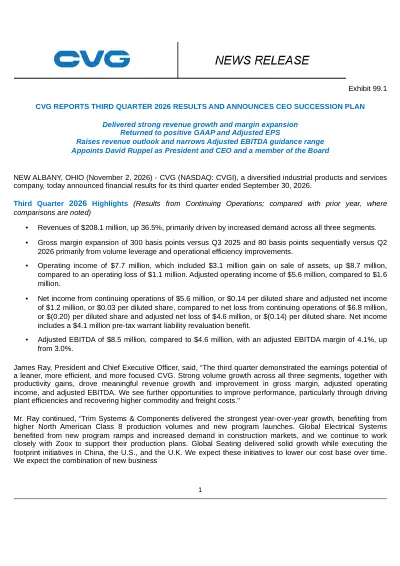
Consolidated third quarter 2026 revenue was $208.1 million, up 36.5% from $152.5 million in the prior year period. The increase was primarily due to the increased customer demand in global markets and the ramp of previously awarded new business wins across all three of our segments.
Third quarter 2026 revenue also increased 6.6% sequentially, continuing the acceleration we reported in the first half of 2026. As you'll see from the guidance update James will share in a few minutes, we expect year-over-year growth to continue in the fourth quarter.
Operating income was $7.7 million, which included a $3.1 million gain on the sale of assets, compared to an operating loss of $1.1 million in the prior year period. Adjusted operating income was $5.6 million, compared to $1.6 million.
Adjusted EBITDA increased 85% to $8.5 million for the third quarter, compared to $4.6 million in the prior year period. Adjusted EBITDA margin was 4.1%, up 110 basis points from 3% in the third quarter of 2025, as higher gross profit was partially offset by higher SG&A expense.
SG&A expense increased $6.4 million year-over-year. Approximately $4 million of the increase came from share-based and incentive compensation and approximately $700,000 of incremental costs related to the CEO succession process.
I'll talk more about the impacts of share-based and incentive compensation in a moment. Despite the year-over-year increase, SG&A remained relatively flat as a percentage of sales, at 11.3% compared to 11.2% in the third quarter of 2025, and we continue to tightly manage discretionary spending.
Interest expense was $3.4 million, compared to $4.1 million in the third quarter of 2025, primarily due to lower debt balances. Net income from continuing operations in the quarter was $5.6 million, or 14 cents per diluted share, compared to a net loss of $6.8 million, or 20 cents per diluted share, in the prior year period.
GAAP net income for the quarter included a $4.1 million pretax warrant liability revaluation benefit and a $3.1 million gain on the sale of assets. Adjusted net income for the quarter was $1.2 million, or 3 cents per diluted share, compared to an adjusted net loss of $4.6 million, or 14 cents per diluted share.
The improvement reflects higher sales, improved gross margin, and lower interest expense, partially offset by higher SG&A. Furthermore, these quarterly results reflect the first time we are reporting positive GAAP and adjusted EPS since the first quarter of 2024.
Free cash flow from continuing operations, including $4.1 million of sale-leaseback proceeds, was $0.6 million, compared to an outflow of $3.4 million in the prior year period. Operating cash flow was $1.6 million, while capital expenditures increased to $5.1 million, up from $1.8 million a year ago, as we invested to support new business launches.
As growth accelerates, our financial priorities remain the same: convert higher earnings into cash, invest appropriately to support profitable growth, and strengthen the balance sheet. Working capital has increased as receivables and inventory have grown with higher volumes and new launches.
We see that as an opportunity and are working to align inventory more closely with the volume growth and to manage receivables and customer terms as programs ramp, and we expect those actions to support stronger cash conversion going forward. Turning to slide 8, we have provided additional detail on incentive compensation to help explain the relationship between this year's gross profit growth and adjusted EBITDA performance.
We included additional detail in our earnings release this quarter, showing the impact of certain items related to long-term incentive compensation. As you can see, the year-to-date impact of those drivers has been $7.1 million, up approximately $4 million year-over-year, due to the company's improving business fundamentals and higher stock price in 2026, as well as heavier-than-normal vesting schedule for restricted stock awards.
There's an additional impact from our annual incentive plan, which is accruing again after no bonus was earned in 2025. These factors are currently limiting EBITDA growth this year.
As we look ahead, we anticipate two of these factors to ease in 2027, as we cycle past the 2025 comparison when no annual incentive was earned, and we expect a more normal vesting schedule for restricted stock grants. As a result, we would expect incremental EBITDA margins in 2027 to be more in line with our historical performance.
The one component that can still cause variability is the expense associated with our cash-settled long-term performance awards, which we remeasure each quarter based on our share price. That expense rises when our share price rises and falls when it declines.
In the second quarter, it added about $1.5 million of expense, and in the third quarter, it produced a benefit of about $400,000. James will talk more about guidance later, but it's important to note that our adjusted EBITDA outlook incorporates our current estimate of the impact of these performance awards.
However, changes in our share price could still affect SG&A relative to our guidance. As a reminder, all performance awards are designed to align executive compensation with shareholder returns.
Moving to the segment results starting on slide 9, our Global Seating segment achieved revenues of $84.7 million, an increase of 23.3% compared to the prior year period, driven primarily by increased customer demand in North America and Asia Pacific. Adjusted operating income was $4.6 million, an increase of $1.6 million compared to the third quarter of 2025, reflecting higher volume and improved gross margin performance.
We also realized benefits from our recent footprint consolidation efforts in China and expect additional benefits as we advance initiatives in the U.S. and UK.
Turning to slide 10, our Global Electrical Systems segment's third quarter revenues were $64.4 million, an increase of 30.2% compared to the prior year period, primarily due to the ramp of new business wins and increased customer demand in construction markets. Adjusted operating income for the third quarter was $3.7 million, an increase of $2.3 million compared to the prior year period, primarily attributable to volume and favorable product mix.
Adjusted operating margin more than doubled to 5.7% from 2.8%, demonstrating the operating leverage we can generate as new programs increase utilization within our plants. We continue to work closely with Zoox to support their production plans while also launching previously awarded programs with several key customers in Europe.
Together, these launches are increasing utilization across our North American and EMEA facilities and supporting growth opportunities into 2027. Moving to slide 11, our Trim Systems and Components revenues in the third quarter increased 71.9% to $58.9 million compared to the prior year period, reflecting higher customer demand and improved product mix and new program activity.
As we've mentioned previously, this segment solely serves the North American market and is most directly impacted by Class 8 production volumes, which were up about 54% year-over-year in the third quarter based on ACT data. Our revenue growth outpaced the increase in Class 8 production, reflecting our customer and program mix.
Adjusted operating income for the third quarter was $2.7 million, compared to a loss of $0.3 million in the prior year period. The increase was primarily attributable to higher volumes and improved operational efficiency.
Taken collectively, we delivered strong revenue growth, gross margin expansion, and a return to positive adjusted EPS, with adjusted operating margins up year-over-year in all three segments. We are ramping new business wins and seeing end-market improvement.
While we continue to invest in working capital and capacity to support that growth, we see further opportunity in plant efficiency, cost recovery, and cash conversion, and we are encouraged by improvements in the underlying trajectory of the business. That concludes my financial overview commentary.
I will now turn the call back over to James to cover our end-market outlook and a review of our 2026 guidance.
James Ray
Thank you, Angie. I will start with our key end-market outlook on slide 12.
According to ACT's Class 8 heavy truck build forecast, 2026 estimates imply an 8% increase in year-over-year volumes, followed by another 9% increase in 2027. They currently expect further strong growth of 12% in 2028.
Similar to prior quarters, we are showing you a quarterly breakdown of the ACT data and outlook. Production levels for the second half of 2026 are projected to exceed first-half production levels by approximately 23%.
Moving to CVG's construction market outlook, based on recent commentary and outlooks from customers, the construction market is expected to be up in the high single-digit percentage range, primarily driven by stronger industrial production and fiscal stimulus initiatives for 2026. Turning to slide 13, I'll share a few thoughts on CVG's updated outlook for 2026.
As always, our guidance reflects current macroeconomic trends, forecasted Class 8 truck build rates, demand in construction markets, and the expected ramp of new business. Based on strong year-to-date performance, continued new business ramps, and improving end-market demand, CVG is raising its 2026 revenue outlook and narrowing its adjusted EBITDA guidance range.
The company now expects revenue of $755 million to $775 million, representing 18% growth over 2025 results at the midpoint, supported by strong growth across all three business segments. CVG now expects adjusted EBITDA of $26 million to $29 million, compared with our prior range of $26 million to $31 million, reflecting the additional compensation expense related to the CEO succession.
The new midpoint of the range represents approximately 54% growth over 2025. The higher revenue outlook is expected to generate additional gross profit.
However, that benefit is expected to be substantially offset by higher incentive compensation and the costs associated with supporting new program and volume ramps. As a result, we have narrowed the adjusted EBITDA range by lowering the upper end.
The year-over-year increase in incentive compensation reflects strong performance against the company's incentive targets, compared to no annual incentive payout in 2025, as well as the impact of higher stock prices on long-term awards. Furthermore, roughly one-third of this expected increase is non-cash.
While incentive compensation is an ongoing component of the cost structure and will vary with performance, CVG would not expect the current year-over-year increase to be indicative of the underlying rate of SG&A growth. Finally, the company continues to expect positive free cash flow in 2026.
Consistent with recent actions, debt reduction remains a priority for capital allocation as CVG continues to strengthen its balance sheet and reduce net leverage toward a long-term target of approximately 2 times. Before I conclude, I'd like to reinforce the priorities for the balance of 2026 and beyond.
CVG is encouraged by the third quarter performance and continued advancement of its strategic objectives. The company's stronger earnings profile, broad-based revenue growth, and improving balance sheet reflect the progress our teams are making across the globe.
The focus remains on sustaining that momentum through profitable growth, continued operational improvement, positive free cash flow, and further deleveraging. Finally, I would like to thank all CVG employees for their continued efforts to drive shareholder value every day.
With that, I will now turn the call back to the operator and open up the line for questions. Operator?
Operator
We will now begin the question-and-answer session. Please limit yourself to one question and one follow-up.
If you would like to ask a question, please press star one to raise your hand. To withdraw your question, press star one again.
We ask that you pick up your handset when asking a question to allow for optimum sound quality. If you are muted locally, please remember to unmute your device.
Please stand by while we compile the Q&A roster. Your first question comes from the line of Joe Gomes with Noble Capital.
Your line is now open, please go ahead.
Joe Gomes
Good morning. Thanks for taking my questions.
James Ray
Morning, Joe.
Joe Gomes
James, it's been a great time working with you. Wish you success in your new endeavors.
David, welcome aboard. Looking forward to seeing how things unfold from here.
David Ruppel
Thank you, Joe.
Joe Gomes
Start with a question, on Zoox, how's that production ramp looking? Has it changed any?
Hopefully for the positive. Maybe just a little more color on that opportunity.
James Ray
Sure, Joe. The Zoox ramp is going, I would say, a little slower than planned.
As you can imagine, new vehicle, new plant, new workforce. We are staying in close alignment with them daily on our support for their ramp schedule.
They are increasing the number of vehicles per week every week, and we are aligned with supporting that. They have also indicated that there could be additional potential volume in '27 and beyond.
We're very encouraged with this. They continue to roll out their vehicles across multiple cities.
We are continuing to add capacity in anticipation of further growth next year, we're ready and not behind, we're getting in front of it. We have staffing in place.
Again, we have to staff a little ahead of time to make sure our workforce is trained and start really driving labor efficiency. Wire harness manufacturing, especially in autonomous vehicles where you have redundant systems, the complexity of the harnesses are higher than typical for non-autonomous vehicles.
We're really encouraged with it. We're very happy to see that they're having success in the market, and all indications are in front of us that they're going to achieve their volumes in the years coming.
We're excited about it. We have a facility in Aldama that's really focused on Zoox, and it will be completely dedicated to them starting in Q1.
Joe Gomes
Great. Thanks for that.
Then last quarter you talked about some I'll call it headwinds, maybe just some uncertainties. You talked about the freight costs, sea container availability, fuel surcharges, couple other little items there.
Just wondering, maybe you could provide some more color on how those have been played out in the third quarter and what you see for them going for the rest of the year.
James Ray
We continued to see headwinds in Q3. Fortunately, we were able to offset some of those headwinds, and as a result, you can see in our results.
We do have some lagging recovery from customers. Usually, it's a quarter behind, not just on freight and the material economics, but also where we have disruptions with suppliers and we have to have premium freight and those things.
We incurred that in Q3. We see some stabilization in Q4 as the conflict eases a bit.
The material economics piece is going to continue, we believe, and we stay closely aligned with customers for recovery where we have agreements in place or looking at substitutions or resourcing or nearshoring. All of those levers are in play, and as we plan the balance of the year and look into next year, we're continuing to optimize our supply chain and also make sure that we have good alignment and agreement with our customers on how we're going to manage the supply chain, both complexities and economics.
Joe Gomes
Great. Thanks for that, James.
Appreciate it. I'll get back in queue.
James Ray
Thank you, Joe.
Operator
Your next question comes from the line of John Franzreb with Sidoti & Co. Your line is now open, please go ahead.
): Oh,
John Franzreb
good morning, everyone, and thanks for taking the questions. I'd like to start with the increase in inventory and I guess also receivables.
I'm kind of curious about the timing of cash conversion there. Will we see a lot of that in the fourth quarter, or will you still need to use maybe alternative financing, more sale-leasebacks or ATM uses, anything like that in the fourth quarter, or you have the cash outlook that kind of negates that?
Angie O'Leary
Yeah. Sorry.
Hey, John. This is Angie.
I'll take that question. I guess starting with the second part of your question there, we do not anticipate any more sale-leaseback transactions, and the ATM program, as we still have some availability there, but will continue to be opportunistic there in terms of when we would execute that based on where our stock price is.
Our focus in Q4 is really to work on that working capital efficiency. We do feel that we'll be able to bring down the inventory levels there in Q4 just as we align with more stable volume as we go into year-end.
We continue to work on receivable terms as well. From an efficiency perspective, I think we're doing a pretty good job managing the growth and keeping the cash conversion cycle as tight as we can.
James Ray
John, were you able to catch all that? It seemed like we have echo on the line.
):
John Franzreb
I'm not hearing it on my end, if that helps. Yes, I got it.
In the second quarter, you kind of suggested that the Class 8 truck outlook was such that you would expect the ramp to be up sequentially in the second half of the year. I'm kind of curious if that's still the case that given the normal seasonality of the business, would you expect Trim to be up sequentially in Q4 versus Q3, or is there a change in that kind of an outlook?
James Ray
No, we expect it to be relatively flat. ACT is showing a little less than 5% decline Q3 to Q4.
Again, ACT is one of the leading indicators we look at. We pay much more attention to our customer schedules, and just within the last couple of weeks, we've seen changes in vehicle build schedules with several of our major Class 8 customers.
In some cases, they're taking a couple of days out, but in other cases, they're actually adding days. Several of our customers have indicated they may work over the holiday up until New Year for which typically is downtime.
I think there's some risks and opportunities, but right now, it looks like we have some potential tailwind that might bump up that decline that ACT is forecasting. We stay close, and we have 12-week insight, but it changes within four-week windows.
We're staying really close in line. The most important thing is making sure that we have the aligned capacity, whether it's up or down, we can be more efficient and flex with their schedules.
It is a little dynamic. There are other supply chain constraints that our OEMs are dealing with component manufacturers and suppliers of other parts.
As this volume ramps, they're seeing some growing pains across the supply chain. We're keeping up with them.
We have opportunities to continue to reduce some of our backlog and past due going into Q4, and we expect to be caught up really by the end of November where we are past due in some cases. ):
John Franzreb
That's good news. I appreciate the insight, James.
Thanks for taking my questions.
James Ray
Sure. Thanks, John.
Operator
Your next question comes from the line of Gary Prestopino with Barrington Research. Your line is now open, please go ahead.
Gary Prestopino
Hi. Good morning, everyone.
Hey, Angie, could you just help me out here? I went through the Q and was trying to find some of these impacts to EBITDA.
I saw a $700,000 recruiting cost, which is for the new CEO, and welcome to him. There was another $700,000 for advisory services.
What was that involved with?
James Ray
I can comment on a couple, Gary, and I'll let Angie fill in others. As we continue to drive operational efficiency improvement, we do engage some consultants across several of our sites to help accelerate the operational efficiency improvements.
A portion of that is related to, I would say, ops improvement, ops excellence, quality consultants. We expect those to stabilize from an operation standpoint by the end of this year.
As we go into '27, our platform will be much more stable. We would have incorporated the volume increases for the second half, and there's still an expectation that volume will pretty much remain where it is going into Q1.
We see some stability coming and would expect a reduction in some of those expenses.
Angie O'Leary
Just to add on there, we do from time to time use consultants to kind of fill where we have open roles, like the chief accounting officer role. As we go out throughout the rest of the year here, we'll expect to see some of those costs reduced.
Gary Prestopino
Okay. If I'm trying to get to a real adjusted EBITDA number, and I realize you don't back in stock comp, but it's safe to say the recruiting costs were there, that's not going to occur again.
The advisory costs will still continue into fiscal '27, but not at that rate of whatever it was this quarter.
Angie O'Leary
I think we will still continue to have some advisory costs going forward. There are always projects that we have in the pipeline.
Going forward, obviously, we'll talk about that when the time comes. Will be focused on continuing to work on projects that improve efficiency and just how we do things, how we work differently going forward.
I think that would be something that you would continue to see. Like I think we talked about last quarter, we do anticipate that for 2026, our SG&A as a percent of revenue will continue to be at about the same rate it was this quarter, in that 11.5% range.
Gary Prestopino
Okay. Then just lastly, continuing on this whole thing with stock comp, it looks like for the six-month period you had about $2.4, $2.5 million of stock comp, which works out to about $1.25, $1.25 per quarter.
It jumped up to $3 million this quarter. When you're talking about normalization going into '27, are we looking at somewhere back in that $1.2 to $1.3 million per quarter?
Angie O'Leary
I think historically, when we haven't had years where we have significant age- and service-based vesting, were around that $4 million mark. I think we would expect we would get more in line with that range.
Gary Prestopino
Thank you.
Operator
Reminder, if you would like to ask a question, please press star one to raise your hand. To withdraw your question, press star one again.
We ask that you pick up your handset when asking a question to allow for optimum sound quality. If you are muted locally, please remember to unmute your device.
There are no further questions at this time. This concludes the Q&A session.
I will now turn the call back to Mr. Ray for closing remarks.
James Ray
Thank you all for joining today's call. We continue to execute and deliver clear progress across CVG in the third quarter.
Revenue growth accelerated across all three segments, we delivered another quarter of adjusted margin expansion, we returned to positive adjusted EPS, and we further reduced net leverage. The focus now is to build on that progress through disciplined new business execution, continued operational improvement, positive free cash flow, and further deleveraging.
The management team looks forward to updating you on CVG's progress next quarter. Thank you, all.
Operator
This concludes today's call. Thank you for attending.
You may now disconnect.