Commvault Systems, Inc.
Q2 FY2027 · Earnings Call TranscriptOctober 27, 2026
Operator
Hello, and thank you for standing by. My name is Demi, and I'll be your conference operator today.
At this time, I would like to welcome everyone to the Commvault Second Quarter Fiscal Year 2027 Earnings Conference Call. All lines have been placed on mute to prevent any background noise.
After the speakers' remarks, there will be a question-and-answer session. If you would like to ask a question during this time, simply press *, followed by the number 1 on your telephone keypad.
If you would like to withdraw your question, press *1 again. I would now like to turn the conference over to Michael Melnyk, Vice President of Investor Relations.
You may begin.
Michael Melnyk
Good morning, and welcome to our earnings conference call. Before we begin, I'd like to remind you that the statements made on today's call will include forward-looking statements about Commvault's future expectations, plans, and prospects.
All such forward-looking statements are subject to risks, uncertainties, and assumptions. Please refer to the cautionary language in today's earnings release and Commvault's most recent periodic reports filed with the SEC for a discussion of the risks and uncertainties that could cause the company's actual results to be materially different from those contemplated in these forward-looking statements.
Commvault does not assume any obligation to update these statements. During this call, Commvault's financial results are presented on a non-GAAP basis.
A reconciliation between the non-GAAP and GAAP measures can be found on our website. Thank you again for joining us.
Now I'll turn it over to our CEO, Sanjay Mirchandani, for his opening remarks. Sanjay?
Sanjay Mirchandani
Good morning, and thank you for joining us. Before reviewing the results, I'll take a minute to discuss the broader context.
We believe that Commvault sits at the intersection of long-term market trends that are driving our momentum: massive data growth, IT complexity, and AI accelerating innovation and risk at scale. All of this makes the need for resilience more critical than ever.
Our platform, which unites data protection, data security, identity resilience, and recovery, helps us win customers, deepen relationships, and meet evolving enterprise needs. Our strategy is working.
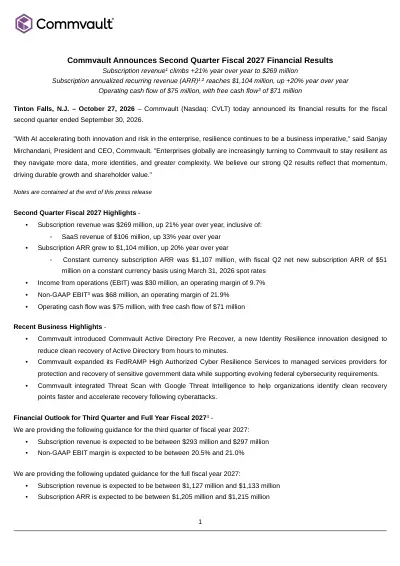
We delivered solid results ahead of our guided metrics and built momentum across the business. A few highlights from the second quarter include: subscription ARR grew 20% to $1.104 billion; SaaS ARR grew 35% to $454 million; subscription revenue grew 21% to $269 million; and we generated free cash flow of $71 million in the quarter.
We're growing at scale, expanding margins, and generating strong cash flow. We believe the combination reflects the strength of our platform and the durability of our model.
As you'll hear from Gary, we're raising our full-year outlook, which demonstrates our confidence in what lies ahead for Commvault. Before we get into that, let's discuss the growth drivers that featured prominently in our Q2 results.
First, subscription customer growth. In Q2, we added over 500 subscription customers, representing 17% growth year-on-year.
Enterprises are prioritizing investments in cyber resilience and recovery. Customers are telling us that when disruptions occur, they must be able to operate in a state of continuous business.
That's why organizations continue to move away from legacy and point solutions and embrace innovation from Commvault. Case in point: a Fortune 500 insurance carrier wanted to advance resilience and stay ahead of evolving security requirements.
The customer chose Commvault over the legacy vendor in this multi-million dollar subscription deal for three reasons: 1, our cyber resilience solution demonstrated exceptional time to recovery at scale, which competitors could not match; 2, we enabled the customer to consolidate incumbent vendors and other point solutions on our platform; and 3, we helped the customer reduce risk and complexity. This leads to our next growth driver: multi-product adoption.
Today, more than half of our managed SaaS customers are using more than one offering from Commvault. This is an important indicator of the opportunity ahead.
Our strategy is to add customers and deepen relationships over time. With nearly half of our managed SaaS customers using just one product, we believe significant expansion potential remains.
As our customers look to reduce complexity and risks, we see more opportunities to deliver value on our platform. We believe this land-and-expand motion can drive durable, long-term growth.
In addition to foundational products like M365 Protection and Air Gap Protect, customers are rapidly embracing our cloud-centric protection offerings, like Clumio for AWS and Google Cloud, and protection for SaaS apps like Azure DevOps, Microsoft Dynamics, and Google Workspace. As a result, customers are realizing greater value as they expand with Commvault.
For example, after assessing recovery objectives and cost requirements, a top 50 global asset management company expanded its portfolio and SaaS footprint with Commvault. This transaction included Clumio, operational recovery, and Air Gap Protect.
The customer realized greater storage flexibility and better TCO than its prior multi-vendor solution. In another example, an existing Clumio customer wanted to consolidate its fragmented data protection architecture.
The goal: improve visibility and recovery times while reducing costs. To support the customer's evolving needs, we signed a multi-year expansion agreement to protect workloads including M365, Hyper-V, as well as Okta and Active Directory.
That dovetails into our third growth driver, which is focus on identity resilience and data security. As we've stated in previous quarters, identity is a primary entry point for attackers and a growing area of enterprise risk.
Recent data shows that nearly 80% of ransomware attacks start with compromised identities. At the same time, non-human identities exponentially outnumber human identities.
That's why customers are adopting our solutions to make sure that critical systems are resilient and available after an attack. For example, an existing Commvault customer, one of the nation's largest integrated healthcare systems, added our Active Directory offering across its global data centers for faster, automated recovery.
This was our largest Active Directory transaction to date and contributed to the ARR growth we're seeing with identity, which nearly doubled year-over-year. When you look at our growth drivers, the common theme is the same: customers need to keep critical data, identities, agentic workflows, and applications protected and recoverable.
This is where Commvault shines. We're also seeing that our conversations with customers and prospects continue to evolve.
They want to know how we can help them deploy AI with confidence while mitigating risks. We'll share more about the growing importance of AI resilience and cyber recovery at our upcoming SHIFT conference in Nashville, from November 10th to 12th.
We will also unveil groundbreaking innovations, new partnerships, and feature prominent AI visionaries from Anthropic, AWS, Databricks, Microsoft, NVIDIA, and others. We hope you can join us in person or virtually.
Before I turn it over to Gary to discuss the financials, I'll leave you with this: we believe that AI creates opportunities to expand our total addressable market as enterprises wrestle with more data, more identities, and more agentic activity. It's also a great moment to participate in initiatives that advance resilience across the industry.
To that end, we are proud to be part of Anthropic's Project Glasswing. This expands our use of frontier AI models to include Mythos.
Finally, we believe our relentless focus on execution will continue to deliver durable, profitable growth and strong free cash flow. This gives us the confidence to raise our full-year guidance.
With that, I will turn it over to Gary to walk through our results and outlook in more detail.
Gary Merrill
Thank you, Sanjay, and good morning, everyone. Q2 was a strong quarter with solid execution and continued momentum across our SaaS and term software businesses.
All three growth pillars contributed to the quarter: new customer additions, upsell and cross-sell, and continued momentum from our newer offerings. First, let me walk through our fiscal Q2 results in more detail, starting with subscription ARR and free cash flow, our North Star metrics.
As a reminder, we believe these metrics are best evaluated on an annual basis, which aligns with how we plan and manage the business. Subscription ARR increased 20% to $1.104 billion.
On a constant currency basis, we delivered $51 million of net new subscription ARR, driven by continued strength in our SaaS offerings and improved performance in our term software business. Notably, our term software business net new ARR improved to $21 million on a constant currency basis.
This was driven by continued strength in new customer wins, as well as conversions improving to normalized levels. Our SaaS business contributed $30 million to our net new subscription ARR.
As a result, SaaS ARR grew 35% year-over-year to $454 million, reflecting new customer growth, multi-product expansion from existing customers, and double-digit growth in ARPA, or average revenue per account. We continued to make steady progress in multi-product adoption, a core pillar of our growth strategy.
As of Q2, 53% of Commvault-managed SaaS customers are using two or more products, up from approximately 45% a year ago. Subscription ARR growth continued to be supported by the uptake of our identity resilience and data security offerings, which represented approximately 30% of net new subscription ARR.
We're also seeing increased contribution from emerging cloud-centric and application-based protection offerings. Subscription net dollar retention, or subscription NRR, was 113%, within our normal operating range.
This reflects stronger contribution from new customers relative to expansion across the install base. Cross-sell remains a key growth driver, as both our new and existing customers broadly adopt our platform.
Now, turning to free cash flow. Q2 free cash flow was $71 million, driven by strong collections and continued discipline across the business.
For the fiscal year-to-date period, free cash flow grew 18% to $122 million. Now, I will discuss our second quarter income statement performance.
Subscription revenue grew 21% to $269 million, fueled by SaaS revenue, which grew 33% year-over-year to $106 million. Subscription revenue represented 86% of total revenue, compared to 81% in the prior year.
Our other revenue lines performed in line with expectations, resulting in total revenue growth of 13% to $312 million. Turning to profitability.
Gross margins improved 110 basis points year-over-year to 81.6%. SaaS gross margins expanded 650 basis points to 70%, reflecting ongoing product optimization and our strategic agreements with our hyperscale partners.
Operating expenses increased 9% to $185 million, representing 59% of total revenue, compared to 61% one year ago. We continue to invest in go-to-market capacity and strategic product initiatives, including our AI recovery roadmap, while maintaining disciplined cost management across the business.
Non-GAAP EBIT was $68 million, and non-GAAP EBIT margin expanded 330 basis points year-over-year to 21.9%. Turning to capital allocation.
We repurchased approximately 808,000 shares for $109 million during the quarter. We are on track to return at least 60% of annual free cash flow to shareholders, while preserving balance sheet flexibility.
Now, I will outline our guidance for the remainder of fiscal year '27. For fiscal Q3, we expect subscription revenue of $293 million to $297 million, representing approximately 15% year-over-year growth at the midpoint, resulting in approximately $339 million of total revenue, and EBIT margins in the range of 20.5% to 21.0%, including costs associated with our annual SHIFT user conference that occurs in a couple of weeks.
For the full fiscal year 2027, we are raising our guidance: subscription ARR to the range from $1.205 billion to $1.215 billion, representing growth of approximately 19.2% at the midpoint. Our increased full-year subscription ARR guidance implies approximately $195 million in net new subscription ARR.
Please refer to our earnings presentation for a constant currency reconciliation for a net new ARR guidance. Subscription ARR will continue to be led by our SaaS offerings, which we expect will exceed $500 million of ARR by the end of the fiscal year.
We are also raising our subscription revenue guidance to a range of $1.127 billion to $1.133 billion, representing approximately 16% year-over-year growth at the midpoint. This will result in total revenue of $1.30 billion to $1.31 billion, reflecting the strategic decline of our legacy perpetual software and maintenance revenue streams.
Non-GAAP EBIT margins are now projected to be in the range of 21.0% to 21.5%. We also now expect free cash flow of $255 million to $265 million for the full year.
As a reminder, Q4 is generally our strongest free cash flow quarter, reflecting the collection of calendar year-end renewals. Finally, from a share count perspective, we project a diluted share count of approximately 42 million shares.
In closing, our strong first-half results demonstrate our ability to scale the business with discipline. We remain focused on growing net new subscription ARR, expanding margins, and generating strong free cash flow as we pursue the opportunity ahead.
With that, I will open the call for questions. Operator?
Operator
Thank you. We will now begin the question-and-answer session.
To ask a question, you will need to press *, then the number 1 on your telephone keypad. To withdraw your question, press *1 again.
We do request for today's session that you please limit to one question and one follow-up. Our first question comes from the line of Todd Weller with Stephens.
Your line is open.
Todd Weller
Thanks. Good morning, and thanks for taking the question.
Gary, could you talk about the improvement in term license net new ARR you saw in the quarter? Then how are you thinking about the second half of the year, and maybe frame for us 3Q versus 4Q from that perspective?
Gary Merrill
Hey, Todd, thank you. It's Gary.
I will answer that. We're pleased with the performance of the improvements we played on the term software ARR.
As we think about the drivers, the drivers was driven by new customer. What we're seeing in an AI-first world are now customers that are prioritizing cyber resilience, and we're seeing that flow through both our on-premise business as well as our term.
The strength in the new customer, and then the second tailwind that we're seeing strong execution from our go-to-market team is now being able to execute and sell our more advanced cyber resilience bundles. No longer is traditional backup even acceptable in the market.
Customers want the highest-tier protection that we offer.
Todd Weller
Thank you.
Operator
Next question comes from the line of Param Singh with Oppenheimer. Your line is open.
Param Singh
Yeah. Hi.
Thank you for taking my question. I wanted to understand what's the cross-sell opportunity still left on the identity resilience side?
It still seems early days. If so, shouldn't we see a little bit more of acceleration in ARR?
Thank you.
Gary Merrill
Yeah. It's Gary.
I'll jump in and get this one on identity. One, yes, a key foundational pillar of our growth strategy is executing against identity.
Identity maintains to be the primary threat vector that the bad actors will penetrate as they start to get into our customers' environments. From a growth driver perspective, what we saw in the first half was strong results from our identity business, specifically protecting Active Directory, that was up nearly 100% year-over-year.
Really strong performance there. Now, as we think about the second half of the fiscal year is when we see larger renewal pools and is where we expect to accelerate the momentum on the cross-sell opportunity that you're talking about.
Sanjay Mirchandani
Yeah. Hey, Param, it's Sanjay.
Just giving you a little more color on the how. See, we announced our identity resilience strategy two years ago, almost two years ago.
Our premise then and our premise now more than ever has been that you have to protect identity because that's the front door that usually gets exploited. Over 80% of the time, an identity compromise is what causes a downstream breach.
Our strategy is not just about protecting Active Directory or Okta or any other directory system. Our strategy is the tying together the cause-effect, what happened at the front end of the identity compromise and what did it do all the way through to the business.
It's the implication. Now, with AI, that becomes even more prevalent and visible because the agentic capabilities of non-human identities can cause a lot to happen inside an organization.
Our separation from the pack is our ability to tie those together and roll it back to the last known good state over time with the click of a button.
Param Singh
Thanks so much for that, Sanjay and Gary. Really appreciate it.
If I could really as a follow-up, I'm starting to see very early evidence of agentic AI traffic picking up in the enterprise. Of course, everyone saw Anthropic's S-1 last night.
Want to get a sense from you, is there a time lag for backup and recovery to see that kind of evidence as well in customer adoption? How should we be thinking about this?
It's
Sanjay Mirchandani
one of the things that we're going to share quite at a high decibel in a couple of weeks at our SHIFT conference, is that recovery and resilience can't be what it used to be. It has to be active-active.
It's active discovery and an active recovery. In the era of AI, time is not your friend when things go sideways.
We believe that there is a little bit of time lag as people start looking at agentic rollouts. Our message to our customers is think about recovery as you build the AI stack.
That's what we're doing internally as well. That's what we're sharing with our customers as well.
The product announcements that we're going to bring out in a couple of weeks around the AI stack are going to be in this mold, in this form, because the days of saying, "I have a backup," are long gone. What you really need to say is, "I know how to recover my business."
Michael Melnyk
Demi, we'll take the next question, please.
Param Singh
Thanks, both.
Gary Merrill
Thank you, Param.
Operator
Okay. Next question comes from the line of Howard Ma with Guggenheim Securities.
Your line is open.
Howard Ma
Thank you and good morning. Sanjay, one for you, and then I have one for Gary.
Where would you say we are as an industry on the demand curve for core data protection and resilience driven specifically by AI projects being done more on-prem? Because if you look at the adjacent markets of server and storage, demand for real-time operational use cases has clearly seen an inflection.
This is kind of related to the last question, but more on timing, do you expect us to see a similar inflection point for data protection, operational resilience, but just with a lag? I think,
Sanjay Mirchandani
Howard, good to hear from you, too. First and foremost, we believe that AI deployment in the enterprise, we see our customers building AI stacks internally and using them for mission-critical capabilities internally, those will be hybrid.
We sense they will be hybrid. The data estate that they use to train their models, to build their applications, is hybrid.
Our solutioning is hybrid by design. We've always been that way.
What we see is a very sustainable flow as the TAM increases because we do believe that with AI, there's going to be more data protected, more workloads protected, and new types of data and applications to be protected. They have to be protected almost real enough time.
We believe that that's a natural tailwind inside of the enterprise as new applications are built. When you look at what the frontier models are doing, they're generating a whole new slew of things for customers to deal with, which is not just discovering vulnerabilities, and applying patches, but really making sure that you have sort of a bulletproof infrastructure.
Because if you believe that the odds are not in your favor and something might happen, whether it's malicious or not, the best security you can have is your ability to recover. That's the singular premise by which we're working.
We believe that's a tailwind. We think this is going to have an impact for us for sure.
Right now, we're seeing it sort of indirectly, if you would, which is more workloads, more frequently, more capabilities about getting your data in order for AI applications. I think in a couple of weeks, when we announce our new AI-enabled product capabilities, we should see more of a pick up there, a natural pick up there.
Howard Ma
Thanks, Sanjay. That's really helpful.
For Gary, can you help us think about the variability in SaaS net new ARR? Because if you look at the last three quarters, including this one, I believe Q4 was $38 million, and that's a seasonally stronger quarter, but it also had some one-time benefit, I believe, related to Clumio.
Then Q1 was seasonally lighter at $25 million. Then you just put up this $30 million or $30.5 million quarter, which by the way, if you add up the $25 million and $30 million, that's in line with your comments about the stronger back half, back-half seasonality.
As we look into the back half, just can help us think about what are the pluses and takes, and how given that there's more of a consumption, it's still small, but there is a consumption element to the SaaS line now, essentially how much potential upside or downside could there be in the back half? A
Gary Merrill
great question. Thanks, Howard.
We're extremely pleased with SaaS business. The ARR is up 35% year-over-year.
There is some variability quarter-to-quarter. It's foundational to why we guide our ARR business on an annual basis, okay?
That primary reason is our customers are hybrid. Depending on the workloads and the projects will drive the timing.
Even if now you just look at the first half of the fiscal year, just do half-over-half, the net new ARR driven by SaaS is up I think roughly 18% on a constant currency, first half to first half. I think that's a key metric.
The other key metric is we're tracking ahead of our guidance. We believe we will exceed the $500 million target on SaaS ARR by the end of the year.
The foundation of the guidance raise, so as we raise guidance for the second half, the foundation of that raise was built on both the momentum and the visibility that we have of our SaaS business. We expect that is going to lead where we will end up as we drive into the second half.
Howard Ma
Thank you.
Michael Melnyk
Demi, we'll take the next question, please.
Operator
Next question comes from the line of Michael Romanelli with Mizuho. Your line is open.
Michael Romanelli
Hi. Thanks for taking the question.
It sounds like execution improved from a go-to-market perspective, and you highlighted just better adoption of these advanced cyber resilience bundles. I guess, can you just elaborate on that a bit?
Then, I guess, how would you assess the current go-to-market engine, including pipeline generation, sales productivity, and coverage? In your view, where does the go-to-market still have the greatest opportunity to improve?
I guess are there any changes to coverage or specialization planned for the second half? Then I have a follow-up.
Gary Merrill
It's Gary. I'll jump in, and Sanjay, if there's anything you want to add, you can finish it off.
A bunch of things to unpack there on the go-to-market. First, we exceeded our expectations for Q2.
The beat on Q2 actuals was driven solely through go-to-market execution, okay? Higher close rates year-over-year.
Therefore, really proud of the momentum we had, especially in a period where our fiscal Q2 can be seasonally our lightest quarter. We executed through it and delivered really really strong.
We're in a good space. We will continue to strategically invest in capacity, because we think the opportunity that is out there in the market to continue to accelerate growth is there.
We will continue to see it, especially on the cloud and the cloud-native side. We will continue to invest in our Clumio products.
As Clumio expands workloads, and we look to drive those cloud-native workloads, that will be a key area of investment and continued investment for us.
Sanjay Mirchandani
Yeah. Michael, I think Gary summed it up.
I would just say that we are really focused on making sure our field, our go-to-market organization, is squarely focused on helping customers really build that harness to deploy AI as they build the AI stacks inside of the enterprise. We're working with them to make sure that right from day zero, that they have resilience or even recovery built right into their pipelines.
That becomes important. All customers who are building these applications are starting with making sure that they have their data estate in exactly the way they need it.
There again, we play a part given what we do. We're spending time with customers really helping them see how to accelerate their journey with enterprise-grade AI applications, but in a way that protects them from day zero.
That's the important thing, because as I said in an earlier question, you can't look at this the way you could maybe five years ago, which is you have a backstop. Here, you've got to be actively discovering and actively recovering.
Michael Romanelli
Got it. Super helpful color.
Then just as a follow-up, you've discussed the growing role of hyperscaler ecosystems and cloud marketplaces. As those channels mature, how should investors think about their longer-term contribution to potentially new logo acquisition and just overall deal sizes for Commvault?
Thanks.
Gary Merrill
Hyperscalers specifically, I think what you were focused on. If you think about prioritization of the partner ecosystem, right now we are investing significantly in co-build, co-market, and co-sell for all of the hyperscalers.
Our cloud growth is driven solely through the big three hyperscalers, okay? We are no longer relying just on the Microsoft ecosystem with the momentum that we now have with our Clumio business, and what we're seeing there from AWS and GCP, we now have best-in-class cloud offerings for our hybrid customers and cloud-native customers across all three hyperscalers.
Sanjay Mirchandani
On the marketplace, it's all about meeting customers where they are. If that's the preferred route a customer wants, we're completely enabled across all platforms and all clouds.
Michael Melnyk
Demi, we'll take the next question, please.
Operator
Next question comes from the line of Joseph Gallo with Jefferies. Your line is open.
Joseph Gallo
Hey, guys. Thanks for the question.
I just wanted to follow up on the new customer strength. Any trends or geos or product lines or who you're displacing to call out?
Should we expect that to continue in the second half, or will that be more renewal weighted?
Gary Merrill
Hey, Joe, it's Gary. Very strong new customer across both of the on-premise and the SaaS business.
To give you a little more color, to kind of give the next click down, on the on-premise business, it's driven mainly this quarter, the recent strength was primarily through the Americas, really driven by the large, complex Fortune-type companies. Now, that drags along with it also the SaaS and cloud business, because those deals get done as a hybrid arrangement.
Excellent momentum there. On the SaaS business, we are now actually accelerating the percentage of SaaS customers that are net new to Commvault.
In Q2, about 40% of our SaaS customers were net new to Commvault. I think that's up compared to like 30% a year ago.
What we're seeing is our ability to land not only on-premise, hybrid, but also straight to the cloud. We have all three motions going.
Sanjay Mirchandani
I'll supplement that by saying that as customers look at AI across the enterprise, the realization that having point solutions or multiple solutions is not the right answer. We're seeing a renewed conversation, set of conversations around platform consolidation and hybrid capabilities, and that plays right to our strength.
Gary Merrill
Joe, I can hit probably the second part of your question, too. I think it was about second-half contribution as it relates to the mix between new customer and existing.
The guidance was raised based primarily on the expectation on the cross-sell and longer renewal pools. If we keep the momentum up and accelerate new customer along with the anticipated cross-sell expansion opportunity we have in our seasonally stronger second half, that would be a great result.
Joseph Gallo
Gary, that was perfect. It leads in to what I wanted to follow up on, which was, okay, you feel like you have great visibility into the second half.
Within that renewal pool, especially on term, are you seeing customers sweat assets or just given all the AI talk and strategic importance, are people actually pulling forward?
Gary Merrill
No. I'll hit the last piece first.
There was no change in the dynamics of the quarter on either push-out or pull-in. We track seasonal metrics on both of those patterns, and we were within our historical norms.
Nothing unusual that happened in fiscal Q2. It was excellent sales execution.
From a capital expenditure perspective related to hardware, that ultimately becomes our competitive strength because we work with all of the major storage providers. Helping our customers prioritize hardware if they need it to match their project is becoming a natural process for us.
Right? We're now into a year almost of some of these supply chain headwinds, and now it becomes part of our sales motion.
The last piece I want to mention to complement that is also now the flexibility to start to take customers straight to the cloud. There's many applications now, depending on supply and hardware availability, that we can also help our customers bypass the on-premise and take those workloads straight to the cloud.
We're also seeing some of that contribution as well.
Michael Melnyk
Thanks, Joe.
Operator
Next question comes from the line of Shrenik Kothari with Baird. Your line is open.
Shrenik Kothari
Thanks for taking my question. Sanjay, just a follow-up to an earlier question on identity.
You highlighted this largest Active Directory deal and also identity ARR is doubling year-over-year. Then also Clumio customers are consolidating Okta, Active Directory.
Just wanted to understand, previously, you had characterized identity as a relatively lower ASP opportunity. Are you starting to see customers beginning to scale identity resilience at a broader sort of enterprise scale?
How often are cloud-native customer relationship expanding into identity, and have a quick follow-up then.
Sanjay Mirchandani
Shrenik, I was scribbling away. Let me parse down your question.
The first part is around do we see identity really being, let me paraphrase, a growth driver? Would that be a fair statement?
Shrenik Kothari
Yes. Yes, absolutely.
Okay.
Sanjay Mirchandani
The short answer is absolutely. We are investing in R&D rapidly with around identity resilience because it's fortuitous timing.
We believed identity was, when ransomware was prevalent as a core thing, as a core workforce that we were trying to protect against, identity became the place that we had to start. We've invested heavily, ground-up building capabilities on identity resilience, and it's multi-platform.
We'll continue to grow that. Then we've made sure that the value we bring to customers is integrating our ability to discover what the vulnerability or the situation with the identity is, and the effect it has on the rest of the organization, data, non-data, applications, what have you.
The cause-effect becomes very important. In light of the agentic enterprise, the non-human identities are proliferating exponentially faster than human identities.
Some different studies will show you 1 to 150, 1 to 200, maybe growing. I believe that will keep growing.
As identities grow, and they act on your behalf, and they have privileges, and they can do things autonomously, the ability for us to have full discoverability and not just say what happened, but be able to tie back to what do you need to roll back, and the ability to do a bulletproof roll back becomes the value. We believe that is where things are going.
I don't know if I answered your question, but that's what I tried to.
Shrenik Kothari
No, that's super helpful. Just a quick follow-up for Gary.
You highlighted double-digit ARPA growth and, of course, multi-product adoption increasing, too. As just looking at the consolidated subscription NRR, it was I'd say 113%, still very very strong, but a modest moderation versus this prior quarter, if I saw that right.
Just how to sort of reconcile those and if you can highlight how the larger multi-product customers are expanding, if there's anything around the term or renewal timing? Just wanted to hear your thoughts.
Gary Merrill
Yeah. I can give full clarity and dig down in there.
Subscription net dollar retention was 113%. Remember that I've talked about a baseline of 114%, plus or minus 200 basis points on either side for this fiscal year.
We're operating right in the historical range that we've talked about. We put the definition of net dollar retention in the appendix.
It's a cohort analysis from one year ago. Therefore, all the momentum we would have seen even over the last two fiscal quarters on new customer that calculation does not benefit from.
What we've seen, which is a little bit of a mix in the first half, the mix has gone more weighted towards new customer relative to the expansion on a relative basis, which drives the minor variability in the number. We are still comfortable with that 114%, plus or minus 200 basis points, depending on the new versus existing mix.
Operator
Next question comes from the line of Eric Heath with KeyBanc. Your line is open.
Eric Heath
Hey, thanks for taking the question. Maybe two just on the SaaS cross-sell, and one on the guidance, if I could.
Maybe first on that SaaS adoption at 53% of customers with two-plus products. I think that was a considerable jump up quarter-over-quarter from sub-50% last quarter.
Maybe just specifically highlight some of the stuff you're doing to drive that nice sequential improvement.
Gary Merrill
Eric, I'll hit it. It's Gary.
A couple things. One is on the multi-prod, we crossed over 50%, as you said, of our SaaS-managed Commvault customers with more than one product.
What we are seeing right now is that our fastest growing cohort are the three to eight customer products. Is it not only relying on identity and data security, but now we're even getting contribution, I think we even put it in our prepared remarks, about the cloud-centric offerings.
We said the cloud-centric offerings were up 50% year-over-year. Now we're bringing things, which includes Clumio, it includes protections for like Azure DevOps, Google Workspace.
Now some of more of these cloud-centric and straight-to-cloud and cloud-native options are also start contributing. From a cross-sell perspective, we now have the identity, the data security,
Sanjay Mirchandani
Threat Scan,
Gary Merrill
and now the more cloud-centric offerings that are contributing, okay? Our SaaS close cycles are much shorter, and our customers now view the platform as a benefit to their overall resilience options.
All of this comes together with then aligning our field teams with the right resources and compensation incentives to drive the motion.
Eric Heath
Awesome. I appreciate that, Gary.
Then maybe just on the guidance. I think when we look back on the first half of this year, I think you'd beat cumulatively by $10 million or $11 million on subscription ARR in the first half on a constant currency basis, but raising the guidance for the year at about $8 million.
I know I might be splitting hairs a little bit, but just curious maybe why we're not seeing a little bit more of a raise to the second-half guidance. Thanks.
Gary Merrill
Yeah. Fair question.
Sanjay and my approach is to give clarity to the guidance that we're comfortable with not only hitting, but achieving. I think that's foundational to how we think about setting guidance.
The half point is the best time to revisit that. We obviously would take another revisit at the end of fiscal Q3.
In the first half, kind of talk half-over-half, in the first half of the fiscal year on a constant currency basis, we did a little bit over $90 million of net new ARR, and the raised guidance assumes we'll do a little bit over $100 million in the second half. Think about that as a foundation that we're working towards as we move into the second half.
Operator
Next question comes from the line of James Fish with Piper Sandler. Your line is open.
James Fish
Hey, guys. I did want to ask on that SaaS piece, and maybe just a follow-up there.
That 53% is up 4 points. Understand, we're talking about the fastest growing products, but where are we at in terms of the largest penetrated products?
What's sort of left to kind of grab here? How to think about really what that three to eight product cohort is really growing?
Gary Merrill
Yes. Good to hear from you, James.
It's Gary. I can hit it.
The runway in the cloud is long, very long to go. Some of the metrics that we look at internally, it's industry reports that we rely on, is that still only about 30% of cloud workloads are protected by third parties, like Commvault, versus maybe basic native tools.
That tells you that the fastest part of the market, which is cloud, still has massive greenfields that is out there, okay? Where we see the highest growth rates is exactly where we want it.
We see the highest growth rates in identity, we see it in the cloud-native workloads, especially related to the offerings we have with Clumio. Now, as we start introducing even new terms and new metrics, like we talked about this quarter, some cloud-centric, because we're now starting to see that adoption that's adding to that three to five product customer cohort.
It's a lifetime value play, James, in that a lot of these add-ons we talk about as we get into identity and the cloud and the cloud-native, right, they are singles and doubles that will drive consistent ARPA growth, but not one time a big bang.
James Fish
Makes sense there, Gary. Just because you guys are one of the ones that have exposure here, any update or any color as to how federal spending in that vertical was this quarter?
Thanks, guys.
Gary Merrill
No problem. Fed continues to operate as a percent of revenue at a consistent level.
That means that our Fed business grew roughly in line with the overall business, okay? Give you that perspective.
The interesting piece on Fed, what's happening is we're now seeing the Fed business accelerate more on the cloud side. This quarter, even from like a bookings or billings concept, we finally crossed over half of our Fed business being SaaS and cloud.
I think that's the dynamics we're seeing. It's now showing up on the cloud side.
Operator
Next question comes from the line of Jason Ader with William Blair. Your line is open.
Jason Ader
Thank you. First one's for Sanjay.
Sanjay, where would you say you have the most differentiation in the cloud SaaS protection area, and how would you describe that?
Sanjay Mirchandani
I would say the way we've approached our cloud offerings has been initially, we built our Metallic platform that had breadth. We gave customers full hybrid capabilities over time on what they had on-premise to what they might have required from a cloud point of view.
Then a couple of years ago with Clumio investment, we went very deep. This is protection initially for AWS, now we do GCP, where I internally like to say we defy the laws of physics.
We can do recoveries at scale and at cost points that are very, very attractive for customers. Now we have the depth and the breadth.
We continue to use that as our way. Now around that, what we do that the native providers won't do is we give you multi-cloud abstraction.
You can protect workloads regardless of which cloud they are. We give you full life cycle management on the data that you have with us.
We have full policy application, full compliance capabilities. We build a ransomware protection.
We were able to give a complete suite of capabilities which, in light of AI, holds us in good stead.
Jason Ader
Gotcha. Okay.
Then for Gary, I have to ask the operating margin question, as I always do. You guys are still kind of in this 20% to 21% range.
I guess this quarter was a little higher than that, but the guidance implies kind of in the 20% to 21% range. What's it going to take for you guys to really kind of break out of that 21% zone?
When might we expect that breakout to happen?
Gary Merrill
It's an excellent question. If you think about the operating leverage, Jason, that we produced in the first half, I think that's a good metric to think about the potential of the company from a foundational perspective.
Right? I think we were clearly over I think 21% in both in both quarters.
We're heading into our seasonally strongest quarter or strongest quarters in in the second half, right, where we where we would expect sequential acceleration, first half to second half, on on the top line. We're demonstrating that we can drive margin expansion in this business because we've done it in the in the first half.
I think EBIT margins were up 330 basis points year-over-year. We we were demonstrating we can do it.
Now it's the it's the balance of that versus investing for the opportunity ahead, okay? There's a couple important investment areas that we are focused on, two primary investment areas.
Number one is making sure that we have the capacity in the field selling teams to deliver the numbers. The only other area from a resource perspective is making sure that we are innovating on AI recovery and our innovation ahead.
That, tied with making our company more efficient from an AI perspective internally, will keep the the investments focused there. We've demonstrated that our ability to drive margin expansion, we can do.
Now, we haven't given guidance into next year yet, I can only talk about, the second half. You're correct, it assumes we hover around that 20%.
We have our SHIFT event in in Q in Q3, but we'll update next year probably in a quarter or so.
Operator
Next question comes from the line of Rudy Kessinger with D.A. Davidson.
Your line is open.
Rudy Kessinger
Hey, great. Thanks for taking my questions, guys.
First one's for Sanjay, then I have a follow-up for Gary. Sanjay, you talked about, I think, in response to a question earlier, AI, you believe it will be a tailwind.
It's kind of indirectly a tailwind right now with new workloads and whatnot, but you expect it to pick up. I guess, just are we seeing that yet in the second-half guide this year?
Is that all yet to come in terms of AI being a tailwind for the business? What is it that's giving you that confidence that it will?
Is it conversations? Is it pipeline?
Just trying to level set when we might see that tailwind actually flow through into the numbers here.
Sanjay Mirchandani
Rudy, it is conversations. It is pipeline, but it is data.
Right now, what we're seeing is an increase in workloads, increase in volume, the types of workloads that need to be protected. We've built connectors into platforms like Databricks, that customers are using to really mine their data for AI.
The conversations all lead to the fact that indirectly we're looking at volume increase and workload type increase. Without getting ahead of our launch, because our CMO will absolutely crucify me, in two weeks we're going to unveil a whole set of capabilities that are AI-enabled for AI recovery, because we believe that it's not about throwing in the towel and saying, "Oh, the security isn't going to work."
The frontier models are powerful. Things are going to happen.
Customers need to embrace AI, and we want to enable that. We're enabling that by saying that we give you the ability to be able to have, in time, a single-click recovery on your AI applications, not just the data, but also the applications, and all the discovery around it.
I don't want to get ahead of the actual product announcements, but it's going to be a lot about AI and where customers are and the issues that customers are grappling with right now.
Rudy Kessinger
Fair enough. Looking forward to those announcements then.
Sanjay Mirchandani
Yes.
Rudy Kessinger
Yes, I'll be there for sure. Looking forward to seeing you guys.
Gary, on the second-half ARR guide, kind of a two-parter. Firstly, on SaaS, just as a percentage of net new ARR in the second half, is 60% to 70% range still kind of the right framework that we should have in mind?
Then secondly, a question I've been getting a lot leading up to this print this morning is just how much larger is the renewal pool in the second half versus the first half? Any quantification you can share on that?
Gary Merrill
Yep. Good to talk to you, Rudy.
On the first question was, okay, SaaS net new ARR contribution. We've talked about, or I've talked about specifically, 60% at least as a minimum of the SaaS contribution for the year.
That holds. We are tracking probably slightly ahead of the initial thinking on SaaS guidance, crossing hopefully well over $500 million.
The guidance is more anchored towards the SaaS side of the business as the anchor to guidance. Much of that is driven by the renewal pool, especially on the units.
Remember, because the SaaS business is sometimes less about the dollars, but more about the number of customers. If you look at the growth we're seeing in the number of SaaS and subscription customers, and we have an average contract length that's significantly shorter than the software, it would kind of imply that the renewal pool and available customers to cross-sell to is significantly larger.
Michael Melnyk
Demi, we'll take the next question, please.
Operator
All right. Next question comes from the line of Yun Kim with Loop Capital Markets.
Your line is open.
Yun Kim
All right. Thank you.
Just a quick question around sales cycle around some of these newer products, cyber resiliency, the data security, and AI-related products. Are the sales cycle for these type of products much longer than your traditional backup and recovery offerings?
Are you finding yourself doing a lot of education when you're involving these sales cycle for these newer products, especially as it relates to AI?
Gary Merrill
It's Gary. I'll jump in and take this one.
On the advanced innovation that we're talking about, things like identity or even our other cyber, data security, and resilience offerings, our sales cycles are typically shorter than we've seen historically because we have a compelling event related to resilience in an AI-first world. If we're dealing with an on-premise RFP that's basic backup only, that's probably our longest sales cycle because it's a traditional workload.
What we see, and what it shows up in the numbers, we're seeing our close rates improve year-over-year because the advanced innovation, whether it's identity, it's cloud-native, it's with Clumio, where we can drive consumption within 30 to 60 days, we're actually seeing the growth happen in the products that has the shortest time to tell.
Yun Kim
Great. That's good to hear.
Then also Gary, real quick, any trend around different geos? Looks like the growth in international lagged Americas for the first time.
Gary Merrill
Yeah. That's correct.
Think about it from a seasonality. Fiscal Q2 is holiday summer in Europe.
Therefore, it's traditionally could be a lighter quarter related to just the holiday schedules in Europe as we plan for in the business. We had the seasonally strongest new customer business in the Americas.
It's that combination. Overall, if you did constant currency, both the Americas and international both grew double digits year-over-year.
It's not like one is falling behind into single digits. It's seasonality with continued double-digit growth.
Thanks, Yun.
Yun Kim
Okay. Next question comes from the line of Junaid Siddiqui with Truist.
Your line is open.
Junaid Siddiqui
Great. Thank you for taking my question.
Sanjay, as enterprises move AI workloads and data into production, are you seeing a distinct new resilience budget emerge around AI infrastructure, or is AI protection still largely being absorbed into existing data protection deployments?
Sanjay Mirchandani
Early days, Junaid, early days, but we're seeing a higher awareness for protection earlier in the cycle. I can say that quite definitively.
How it translates over time to be determined. It's no different than how different companies are deploying AI.
Some of them have created AI officers, some of them it's part of IT, some of them it's a project for someone in the company. It's still formulating in my opinion.
It is high levels of awareness. I would say to you that protection and recovery, the way we position it, is top of mind.
It would be hard for me to quantify which budget necessarily we see it coming out of right now. I'd say if I had to pick one, I'd say it's still core data protection.
Junaid Siddiqui
Got it. Thank you.
Just as a follow-up, since the launch of Cloud Unity, you've talked about stronger adoption of identity resilience, data security, and recovery capabilities under this unified control plane. How much of the recent cross-sell success could you maybe attribute to the Unity architecture?
Gary Merrill
Yeah. I can wrap up with this one.
It's that Unity architecture provides the experience for both the customer and Commvault to make sure they have visibility across their entire estate on what workloads are protected and not. When you combine that kind of product-led type growth opportunity we have with customers with the visibility that we give them, which is the foundation of what Unity is as the foundation of cross-sell, and then you combine that, Junaid, with the go-to-market organization and sales plays and incentives, it's the combination of both that are driving the multi-product adoption stats that we talk about, especially getting over 50% of SaaS customers managed by Commvault with more than one product.
It's the combo.
Michael Melnyk
Demi, we'll take our last question, please.
Operator
All right. Our final question comes from the line of Patrick O'Neill with Wolfe Research.
Your line is open.
Patrick O'Neill
Hey, guys. Thanks for taking my question.
Just wanted to follow up on an earlier question on displacements when landing new customers. Who are you displacing the most, and then maybe are you seeing any of that strength come from an acceleration in customers looking to move off of legacy solutions ahead of a heightened threat environment?
Thanks.
Sanjay Mirchandani
Short answer, yes. I mentioned that.
Consolidation especially in light of, Patrick, as customers are looking at their data estate to sort of get it ready, primed for models and training and usage within the enterprise, having recovery be a disaggregated thing across multiple point solutions, generational solutions, is not the right answer. That is a definite tailwind that's driving a consolidation conversation.
We're seeing a resurgence in that conversation. We're displacing the usual suspects that have been around for a while.
Operator
That concludes our Q&A session. I will turn it back to Michael Melnyk for any closing comments.
Michael Melnyk
Thanks, everyone, for joining the call this morning. If you have additional questions, feel free to email me or reach out, and we'll make sure to get back to you.
For those of you who can't join us at SHIFT on November 10th to 12th in person, we will have a virtual stream on November 18th. We encourage you to tune in.
Thanks very much.
Operator
This concludes today's conference call. Thank you all for joining, and you may now disconnect.