Darling Ingredients Inc.
Q3 FY2026 · Earnings Call TranscriptOctober 29, 2026
Operator
Good morning, and welcome to the Darling Ingredients conference call to discuss the third quarter 2026 financial results. After the speakers' prepared remarks, there will be a question-and-answer period and instructions to ask a question will be given at that time.
Today's call is being recorded. I would now like to turn the call over to Ms.
Suann Guthrie, Senior Vice President of Investor Relations. Please go ahead.
Suann Guthrie
Thank you for joining the Darling Ingredients third quarter 2026 earnings call. Here with me today are Mr.
Randall C. Stuewe, Chairman and Chief Executive Officer, and Mr.
Bob Day, Chief Financial Officer. Our third quarter 2026 earnings news release and slide presentation are available on the Investor page of our corporate website, and it'll be joined by a transcript of this call once it is available.
You can also find reconciliations and disclosures with respect to non-GAAP financial measures in our earnings news release and slide presentation. During this call, we will be making forward-looking statements, which are predictions, projections, and other statements about future events.
These statements are based on current expectations and assumptions that are subject to risks and uncertainties. Actual results could materially differ because of factors discussed in today's press release and the comments made during this conference call, and in the Risk Factors section of our Form 10-K, 10-Q, and other reported filings with the Securities and Exchange Commission.
We do not undertake any duty to update any forward-looking statement. Now, I will hand the call over to Randy.
Randall C. Stuewe
Thanks, Suann. Good morning, everyone, and thanks for joining us today.
Our third quarter results showcase the capability, performance, and resilience of our global ingredients business. Sequentially, our performance was slightly impacted by timing of sales, accounting treatment of North American fat sales to Diamond Green Diesel, and global compensation expense.
Otherwise, it was another robust quarter. This financial strength, bolstered by substantial cash from Diamond Green Diesel, has allowed us to continue to make significant progress toward achieving our debt targets and significantly strengthening our balance sheet by reducing net debt by approximately $420 million in the quarter.
Additionally, we continue to return capital to our shareholders via stock buybacks. For the quarter, combined adjusted EBITDA was approximately $514 million, including about $310 million from our global ingredients business and $204 million from Diamond Green Diesel.
Now, turning to our Feed Segment, we delivered stable and solid margins during the quarter. This performance underscores the value of the operational improvements we've made and our team's focus on commercial execution.
Protein prices and demand remain strong, and we expect fat prices to strengthen in the fourth quarter. Canadian and Brazilian tariffs remain challenging, but we are working hard to develop alternative markets.
While our results this quarter reflect the timing of some accounting and inventory adjustments that Bob will detail a little later, the underlying commercial momentum of this segment remains strong into the fourth quarter and next year. In our Food Segment, Brazilian tariffs continue to complicate some of our South American shipments.
However, strong China collagen sales partially offset this temporary headwind. Our Nextida portfolio continues to gain momentum via repeat and new orders, and we've expanded it now with the recent launch of Nextida Cognia, a targeted collagen designed to support mental clarity and cognitive resilience.
Additionally, our joint venture with Tönnies continues to progress through the regulatory process, and we are targeting a close, hopefully, in the first quarter of 2027. Now, turning to our Fuel Segment, Diamond Green Diesel faced a series of temporary operational and logistical headwinds this quarter.
We had a short-term, third-party hydrogen outage in the Gulf that impacted our volumes, alongside a delayed SAF shipment and imported feedstock timing and hedging impacts. Once again, Bob will walk you through some more details in a moment.
However, even in a slightly noisy quarter, DGD remains a massive cash engine. During the quarter, we received $171 million in cash distributions from Diamond Green Diesel from both dividends and PTC sales.
For the fourth quarter, we expect DGD to produce approximately 325 million gallons. While we remain conservative in our full-year modeling assumptions, the reality is that Q3 timing and hedging headwinds have reversed, and we are currently realizing DGD margins that are moving much closer to today's stronger spot market conditions.
Now with that, I'd like to turn the call over to Bob, take us through the financials, then I'll come back and discuss my thoughts on the fourth quarter and our full-year outlook. Bob?
Bob Day
Thank you, Randy. Good morning, everyone.
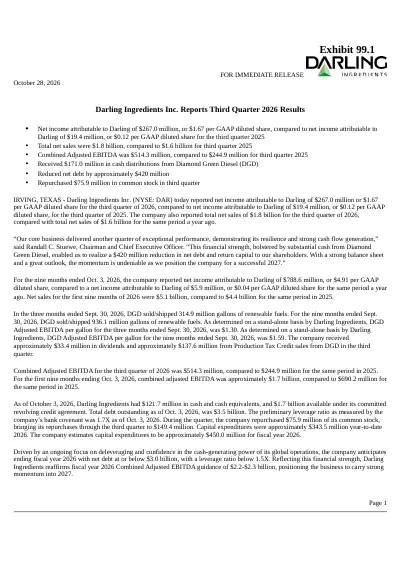
As Randy said, again, this quarter, we generated significant earnings and cash, and we substantially strengthened the balance sheet. Net income was $267 million or $1.67 per GAAP diluted share, compared to $19 million or 12 cents per GAAP diluted share in the third quarter last year.
For the first nine months of 2026, net income was $789 million or $4.91 per GAAP diluted share, compared to $6 million or 4 cents per GAAP diluted share a year ago. Net sales in the third quarter were $1.8 billion, compared to $1.6 billion for the third quarter 2025, and $5.1 billion for the first nine months of 2026, versus $4.4 billion for the same period a year ago.
Third quarter combined adjusted EBITDA was $514 million, compared to $245 million in third quarter 2025. For the first nine months of 2026, combined adjusted EBITDA exceeded $1.6 billion, versus $690 million a year ago, reflecting strong contributions from both our core ingredients business and Diamond Green Diesel.
Meanwhile, the core ingredients EBITDA experienced a sequential decrease from the second to third quarter, which was primarily driven by two items. The first was an increase in long-term incentive accruals, an indirect outcome of strong year-to-date results from both core ingredients and DGD.
The second was driven by inventory adjustments that we expect to reverse in the fourth quarter. To give more detail on the inventory items specific to the sequential decline in the Feed Segment, approximately $15 million was associated with the accounting treatment of two items.
The first was the deferral of half of the profit on Darling feedstock sold to Diamond Green Diesel. Because Darling owns 50% of the DGD JV, GAAP accounting rules require that we defer 50% of the margin earned on product sold until that product is processed and sold at DGD.
This is purely a timing issue. Once DGD processes and sells this fuel in the fourth quarter, this deferred profit will flow back to our bottom line.
Additionally, late in the quarter, a lower of cost or market adjustment, or LCM, in our Feed Segment turned negative from what had been positive and finished much lower than expected. This was caused by an unusually high volume of product in transit at quarter end, the margins on which cannot be recognized until title has transferred.
Altogether, these items totaled approximately $30 million, which explains the difference in the core ingredients EBITDA reported versus what had been expected. Notwithstanding those items, core ingredients EBITDA finished at the high end of last quarter's guidance at around $340 million.
Moving to Diamond Green Diesel, by historical measures, DGD delivered a very strong quarter. Darling's share of DGD EBITDA was $204 million on 315 million gallons sold, an average margin of around $1.30 per gallon, and a massive turnaround compared to -$2.9 million in the third quarter of 2025.
Meanwhile, replacement margins during the quarter were higher than $1.30 per gallon, I'd like to provide some color to help bridge the difference. Two items in particular, hedging losses and production tax credit capture, are expected to come back positively in the fourth quarter.
Specifically for feedstock hedged in the third quarter that was not yet converted into fuel and sold during the third quarter, would have experienced a hedge loss that will either come back in the form of a higher RD or SAF sales price and margin, or if futures prices drop, the hedge will return cash. Either way, those hedge losses come back once the associated feedstocks are converted into fuel.
Regarding production tax credit capture, late in the quarter, Port Arthur experienced challenging weather, forcing it to use a disproportionately high amount of foreign feedstocks, earning less production tax credit value than a normal feedstock mix. This had a double impact for Darling because while it lowered the average RD and SAF margin, it also caused DGD to hold a higher percentage of Darling domestic feedstocks than normal, contributing to the increased deferred profit accrual mentioned earlier.
In both cases, hedge losses and production tax credit value, those will come back through the P&L in the fourth quarter. Other items that are more market-based were a lowering RIN value during the quarter, starting at around $2.45 and dropping to below $2, contributed to a lower than replacement margin capture.
The last item I want to mention is the short-term hydrogen outage that we experienced in Norco, which explains the difference between guided versus actual volumes. As we look to the fourth quarter, however, the setup is more stable, with very strong replacement margins, a much lower RIN as part of that price structure, which means lower margin risk, and higher diesel futures prices, decreasing the likelihood of large hedge losses at quarter end.
All that said, the real story here is the incredible cash generation, debt paid, and shares bought during the quarter. Darling received approximately $170 million in cash from DGD, roughly $33 million as dividends and $138 million from production tax credit sales, and the core business generated over $300 million in cash, coming from current earnings, the sale of the majority of our non-grease trap assets, and the sale of our European casings business.
In total, we reduced net debt by around $420 million and bought back around $76 million in shares. As a result, our leverage ratio improved significantly to approximately 1.7 times at quarter end, compared to 2.9 times at the end of last year.
Finally, the company recorded $76.8 million of income tax expense for the third quarter, yielding an effective tax rate of 22.3%. The effective tax rate excluding the impact of the production tax credit and discrete items was 24.2%.
The company also paid $22.7 million of income taxes in the third quarter and $71.7 million year to date. For 2026, we expect the effective tax rate to be about 25% and cash taxes of approximately $35 million for the remainder of the year.
With that, I will turn the call back over to Randy.
Randall C. Stuewe
Hey, thanks, Bob. To wrap up, the third quarter demonstrated the resilience and earnings power of our core business, even with a challenging geopolitical environment, all while Diamond Green Diesel once again provided significant cash.
Looking ahead to the fourth quarter, I want to leave you with three clear messages. First, our global ingredients business has strong momentum.
Raw material volumes are stable, demand for proteins remains strong, and global fat prices will most likely rebound as the RVO will require biofuel producers to run full in the fourth quarter and all next year. All said, our global footprint continues to deliver a predictable, high-margin cash flow.
Second, Diamond Green Diesel is a cash generation machine. While there was noise this quarter around capture, feedstock timing, and hedging, DGD's structural competitive advantages have not changed.
We operate at the lowest cost per gallon in the industry, backed by world-class scale, logistics, unmatched low-CI feedstock from Darling. The timing and hedging disconnects from Q3 are behind us, and we are entering Q4 realizing margins much closer to spot conditions.
Third, our cash flow output and balance sheet discipline are obvious. We are reaffirming our full-year 2026 combined adjusted EBITDA guidance of $2.2 to $2.3 billion.
With significant cash flow coming through the door in Q4, including ongoing PTC monetizations, we remain firmly on track to achieve our target of bringing net debt down to or below $3 billion by year end. Our capital allocation priority is disciplined and focused.
We are focused on driving organic growth, optimizing our portfolio, and delivering long-term value to our shareholders. We have built a resilient and highly cash generative business, and we are confident in our ability to execute our strategy and carry this strong momentum into and through 2027.
With that, I'll turn it over to the operator for Q&A.
Operator
We will now begin the question-and-answer session. Please limit yourself to one question and one follow-up.
If you would like to ask a question, please press star one to raise your hand. To withdraw your question, please press star one again.
We ask that you pick up your handset when asking your question to allow for optimum sound quality. If you are muted locally, please remember to unmute your device.
Please stand by while we compile the Q&A roster. Your first question comes from the line of Derrick Whitfield with Texas Capital Bank.
Your line is open, please go ahead.
Derrick Whitfield
Good morning, guys, and thanks for your time.
Suann Guthrie
Morning, Derrick.
Derrick Whitfield
Wanted to start with margin capture for DGD. Bob, certainly greatly appreciate your commentary on this margin capture for the quarter.
When you guys think about the health of your balance sheet and the volatility of HOBO spreads that are increasingly driven by diesel cracks more than bean oil, how are you thinking about managing hedge risk for the next couple of quarters when you're forced to hedge heating oil in backwardation and the Iran conflict is seemingly will persist into 2027? Are there any other hedges that you guys could employ that would mitigate your exposures?
Bob Day
Thanks, Derrick. This is Bob.
We have lots of options as it relates to hedging, but I think when replacement margins are as wide as they are, typically, hedging feedstock purchases with diesel or ULSD futures is an attractive opportunity. I think the thing that the market misses sometimes is there's so much that can move, especially with a business the size of DGD, there's so much that can move from one quarter to another, and it's important to look at the results over a longer period of time.
We do not use mark-to-market accounting, and I think we see some of the comments out there, and it's interesting. I don't think that perspective is well understood.
In a typical ag business and some energy businesses, you're going to value your inventories up to market and you represent that, quarter to quarter, you can see kind of how hedges are performing. In a business like this, if we're hedging a product for one period, let's say in this case the third quarter, that doesn't get converted into its final product until the next quarter, that hedge loss is realized in the immediate quarter and then it comes back as a gain in the next quarter.
In a business our size, when we have something like a slowdown because of a hydrogen outage and there's expensive feed, that's just going to have a lag effect that's bigger than what most other companies experience. We're not concerned at all with the hedging and our ability to limit risk.
We just think that there's a lack of understanding as to how these things can flow from one quarter to another.
Derrick Whitfield
Great. Appreciated and understood.
For my follow-up, I wanted to shift to policy. From a policy perspective, the Trump administration has been supportive of the former with nearly every decision during his second term.
With the view that some obligated parties will be challenged to meet the RVO this year, how do you think the EPA will handle deficit carryforwards? What are you hearing on how the administration is viewing Set 3 policy?
Bob Day
Look, I think if anything, the EPA has been proven correct in its estimation about what the industry's capable of. When we look at our RIN S&D for 2026, from our perspective, it looks balanced.
As we go through the end of '27, it's tight, but it's not ridiculously underbalanced. I think the EPA has made it clear what it wants to do with SREs, what it wants to do with reallocations.
Whether those reallocations happen in 2026 or 2027, we don't think that has a significant impact overall on the RIN S&D and prices. Not sure how they're going to handle that, but like I said, we don't think that that makes a big difference.
They need to handle this supplemental ruling before they can get into Set 3 and start talking about 2028 to 2030. What we're really encouraged about is we understood what their goals were when they came into Set 2, and they've largely achieved those goals.
I think they're pretty happy with the outcome of the policy, and so we're very optimistic about what '28 beyond is going to look like.
Operator
Your next question comes from the line of Manav Gupta with UBS. Your line is open, please go ahead.
Manav Gupta
Morning, Randy and Bob. Question maybe more for Bob, but whoever wants to take it.
The leverage is dropping, your target was 2, now probably looks like 1.5, honestly 1.5 looks conservative given you said you're realizing margins closer to spot. I'm just trying to understand how much cash would you like to hold on the balance sheet after which you could say, look, Darling probably could do better on the valuation side if it had a dividend.
I'm just trying to understand at what point can Darling actually look at some kind of a dividend, maybe it's '27, but if you could talk about those dynamics.
Randall C. Stuewe
It's great question, Manav. This is Randy.
Clearly we said in Investor Day that we will be coming out and articulating the kind of the go-forward financial policy. I think the thing that's relevant in this quarter, couple things.
One, we did have some headwinds out there and some volatility, but yet we still paid down $420 million of debt, bringing us down to I think net debt to 3,371 or something like that, real close. Clearly the PTC monetizations and really the strength that we see in fourth quarter here will put us $3 billion or below as we go into 2027.
By Q1, we should be pretty close to $2.5 billion. We've kind of magically always said around the board table that 2.5 is kind of where we want to be, and then that cash from there would then either be distributed via buybacks or a potential dividend.
That's clearly in the discussion at the boardroom right now, and we feel confident about what's going forward. We look back, we're about a year, year and a half behind where we wanted to be, and that came off of the consternation and the delay of the RVO of delevering from the three big acquisitions that we did.
Really as we move forward, the message Bob and I are trying to deliver is this we have transformed the company, it's a cash generation machine globally now, it's balanced, and ultimately we have options in '27 that we've not had in prior years.
Manav Gupta
Thank you so much, Randy. I'll turn it over.
Operator
Your next question comes from the line of Tom Palmer with JPMorgan. Your line is open, please go ahead.
Tom Palmer
Good morning. Thanks for the question.
In recent quarters, Randy, you've provided a view of what you think base business EBITDA might look like for the following quarter. It was helpful to get the full-year EBITDA outlook, but I wondered if you might share kind of a view of how that base ingredients business might look like in 4Q.
Randall C. Stuewe
Tom, it's right. We thought, obviously, this quarter was challenging in the sense not of the operating side, but with Valero releasing on the 22nd and us not being able to match them given our accounting cutoffs.
Ultimately, we have visibility to the end of the year, and we knew that once the 418 or 408 number went out on DGD that people were going to question what is the true run rate for the balance of the year, and so we decided to put it out at the 2.2 to a 2.3. I think consensus might have been 2.237 or whatever it was or whatever the number is out there.
We're confident in being able to deliver that. That's a combination of the core business at really around 1.250, plus or minus 10 there, and then really DGD operating in that range of capture between $1.50 and $2 a gallon on 1.2 billion gallons.
That's how we did the math. We traditionally don't like to try to guide DGD from the standpoint of everything Bob just said, that there's so many moving parts, but we do have visibility to the end of the year now, and it's consistent with what we've said all year and really in Bob's modeling during Investor Day.
That's where the numbers are coming from. Certainly we hope it's conservative.
It feels like it's conservative at this time, but we've got midterms and all kinds of stuff that's still out there right now.
Bob Day
I just want to add a little color to that as well because I think it's important. We got a lot of feedback over the last several quarters and requests to only guide the core ingredients business, and so we did that.
When we got to this quarter, however, what we found is that the core ingredients business EBITDA was impacted by things that largely were happening at DGD, and so it didn't serve the purpose that it normally would. Specifically, I think when we talk about long-term incentives, DGD is a big part of that.
DGD is having an extremely positive year, that's certainly going to have an impact on those things, and those accruals come out of what we report in the core ingredients business. Then the other things that I talked about in the opening, DGD deferred profit, lower of cost to market accrual in the Feed Segment and the core business, those are things that really backed up into Darling because of events that occurred at DGD.
We got the feedback, we guided about the core, but when the core is influenced by DGD, then it makes it more difficult. I think we got to the end of the year, and Randy looked at me and said, 'I think we've got better line of sight into how the corporation's going to perform overall than just the core because of the accounting volatility that can happen at the end of the year.'
That's where that conservative guide comes from.
Tom Palmer
Thanks for all that. One more, I guess just on the guide.
Randy, you noted in the prepared remarks the view that fat prices will move higher and noted some of the supply-demand aspects around the RVO as justification. I wanted to kind of clarify, one, is that embedded in the outlook if we see kind of fat prices start to move higher, or more think about that as a potential upside driver?
Then just hand in hand with that, because you do I think maybe have insights into the supply-demand dynamics that may not always be evident right away in pricing, are you starting to see any firming in kind of that demand pull? Thanks.
Randall C. Stuewe
No, that's a good question, Tom, and no, it's not really embedded in the outlook. I think we're going to pick up momentum as we go through November and December, getting some downtime that's over.
You've got some seasonality in the business. The tariffs are making life a bit challenging around the world, as we tried to outline in our earlier comments, and so ultimately, it's going to make US fats move on up.
We're seeing European fats starting to strengthen. There's some pretty significant downtime in the processors there in Europe, and then ultimately, that should carry forward with a bigger RVO then in 2028.
No, we're seeing, as I looked at the veg oil market, you're off a little bit this morning again, but 65 to 70 cents seems to be a really fair value for fats going forward, and that's for this year and then next year.
Tom Palmer
Great. Thank you.
Operator
Your next question comes from the line of Conor Fitzpatrick with Bank of America. Your line is open, please go ahead.
Conor Fitzpatrick
Morning, everybody. Thanks for taking my question, and appreciate all the color earlier on accounting treatment of all the different segments.
I wanted to turn attention to kind of medium-term, next few years demand impact of low carbon fuel standards all across North America. It looks like if you add them up between the US states and the Canadian Clean Fuel Regulation, you get about half a billion gallons per year of demand growth each year through 2030 on average, maybe a bit less if Canada implements some of its protectionist rule changes that it's considering.
Obviously bullish for renewable diesel, bullish for feedstocks, I was wondering how you think profit would be allocated and settle out between the feed and the fuel side from growing LCFS demand over the medium term. Thanks.
Bob Day
Thanks, Conor. I think two things I would want to say to that.
Today we're at a point where the RVO is slightly bigger than the cumulative sum of the LCFS programs the United States. The RVO is really carrying the day, but I think you bring up a really good point for let's say Darling shareholders to understand, and that is LCFS programs and their growth over time, it provides a safety net against let's say a disappointing Set 3.
We don't think Set 3 is going to be disappointing, but it provides that safety net. If the RVO were to be smaller, then what would likely happen is LCFS premiums would be large, and then that stacks on the margin and the margin would be secured as a result of that.
What we expect is going to happen is we will have a robust RVO Set 3. LCFS premiums will layer on top of that, but they'll be supportive, but they won't necessarily make the margin kind of like it did back in 2021 and 2022.
It is a safety net out there, and we're very optimistic as far as how that looks. As far as how that sort of relates to Darling's segments, and we talk about now through 2030, we've said before, we've largely made the investment in DGD we need to make.
We're not intending to add to total capacity. There could be a time when we add more SAF capabilities to the existing capacity, but by far and large, the cash investment in DGD has largely been made, and so we expect DGD to continue to perform at a high level.
As we take cash generated and invest it back in the core ingredients business, we anticipate rendering, collagen, those businesses will get bigger, will generate more EBITDA, and they will represent over time a bigger percentage of Darling's EBITDA than the DGD renewable diesel, sustainable aviation fuel will.
Conor Fitzpatrick
Great. Thanks.
And—
Operator
Your next question comes from the line of Heather Jones from Heather Jones Research LLC. Your line is open, please go ahead.
Heather Jones
Good morning. Thanks for the question.
I wanted to ask about legacy DAR into Q4 again. Randy, your comment about 1.225, that would imply roughly 300 to 310 for the legacy piece for the quarter.
I assume you'll get the $30 million that you all referenced for Q3 back in Q4. It implies a larger than normal sequential deterioration there.
Just wondering, is that conservatism or how would you frame that for us?
Randall C. Stuewe
Let me clarify that. 1.250, that assumes a 320 to 340 Q4.
Bob Day
I just want to clarify the flow through. The accrual for long-term incentive, that won't come back.
That's just a fact of good performance in the business, and that is an additional cost item. We don't think that's going to flow back.
The other $15 million, DGD deferred profit, lower of cost or market, that could flow back depending on where market prices end at the end of the year.
Heather Jones
I'm glad I asked. Then on fats pricing, you mentioned veg oils being weak and all.
It seems like there's probably some managed money movement on that. If I look at cash pricing into the Gulf for feedstocks, they're not going crazy by any stretch, but they do seem like they've started to turn across multiples fats.
Just wondering, are you seeing these big producers start to work through the large inventories they had built up going out of Q3 because of disruptions, etc.? Just if you could help me understand that because they are ticking up like a penny, half a penny, they're finally moving in the right direction.
Bob Day
We can't speak for other renewable fuel producers and what their inventory situations are. I think what we do see though is a very attractive replacement margin for renewable diesel, biodiesel, sustainable aviation fuel.
What's also I think encouraging about that is we have a high replacement margin while RINs are lower than they had been, structurally, that suggests that there's lower risk to that margin as well. This is incentivizing everyone in the industry to just maximize their production.
If they had big inventories, they have the incentive to chew through those inventories, and buy new and maybe cheaper inventories and widen those margins. I can speak for Diamond Green Diesel and say that we're maximizing our ability to produce, and I think the same is going on across the industry.
Heather Jones
Wonderful. Thanks so much.
Operator
Your next question comes from the line of Pooran Sharma with Stephens. Your line is open, please go ahead.
Pooran Sharma
Hi, good morning. Thanks for the question here.
Wanted to maybe dive into the feed business here and ask about protein. That has seen an uplift over the last several months.
I think it's due to El Niño related complications. Wanted to get your read on as you sit here today and look to 2027, do you expect this portion of your feed business to be kind of structurally higher, or are you expecting conditions to kind of normalize and protein to kind of come back to where it had been over the past few years?
Randall C. Stuewe
Pooran, this is Randy. Clearly you highlighted one of the key drivers.
I kind of reflect back here, if two years ago you would have told me all this soy crushing capacity was coming online in the US, I fundamentally believed they were going to have a hard time placing all of the soybean meal. That really hasn't materialized.
In fact, it's gone the exact opposite, my crystal ball was pretty wrong there. What we've seen now though with the El Niño is the fishmeal.
If you think of aquaculture in the world, it's a much bigger piece of the global diet than it's been in the past, and with the warming of the waters, the fish have gone further offshore and deeper. Ultimately, we've got fishmeal prices very, very elevated.
There's nothing out there that says next year that that's going to change much, at least at this time. It looks like we'll continue with very strong protein prices as we go forward for '27.
Bob, you seeing anything different, or...
Bob Day
I don't see it different. Another thing providing underlying support has been the massive growth in the poultry sector in the United States.
Chickens eat soybean meal, cows don't really eat soybean meal, we've seen a decrease in the cow herd, increase in poultry. We believe that poultry demand and production is here to stay and to continue growing, and so that provides underlying support for protein so even if fishmeal supplies return to the world market, we're still pretty optimistic about where protein prices are going to be over the next several years.
Pooran Sharma
Great. Thanks for the color on that.
Just on the follow-up here, wanted to dive into the third-party hydrogen outage that impacted production. Was wondering if we could just get some incremental detail on kind of the nature of that disruption.
Was it an isolated supplier issue, or is there a broader vulnerability in the Gulf Coast hydrogen sourcing that puts a risk in future quarters potentially?
Bob Day
Look, I think so the hydrogen outage affected everyone in the Louisiana Gulf. I think what's encouraging is it didn't affect our business for a very long time.
Obviously, we guided, I think it was 335 million gallons, and we came out with 315, there was a difference in 20 million gallons. I would say that difference is certainly associated with the hydrogen outage.
When you think about that event and how unlikely that is and the lack of frequency with which things like that happen, that isn't a huge impact on the business. That's the way that we look at it is even when events like this occur, our operation is able to get back up and running in a relatively short period of time.
When you look at the history of DGD's operations, we just haven't had these things result in a material impact to the business, and we don't think that's going to change.
Pooran Sharma
Great. Thank you very much.
Operator
Your next question comes from the line of Andrew Strelzik with BMO Capital Markets. Your line is open, please go ahead.
Andrew Strelzik
Hey, good morning. Thanks for taking the questions.
My first one obviously on the food segment. You sound very confident about the longer-term outlook there, but I wanted to better understand some of the pressure that you realized there this quarter and whether we should assume that that continues for the time being with tariff policy or if there's anything you can do internally in terms of mix or trade flows or anything else to improve that.
Bob Day
I appreciate the question, Andrew. I think the tariffs do have a short-term impact on the food segment.
These are long-lead supply chains. The product that's the most in demand in the United States is water-soluble collagen.
That's a beef hide produced product. The beef, while we slaughter cows in the United States, we don't have tanneries, and so the raw material that's used to make beef hide gelatin and collagen isn't available in the United States, and so it's in places like Brazil or other countries, which means that there's a long-lead supply chain that is also affected by tariffs.
Ultimately, the demand for those products is real and it's very consistent. When we have tariffs come up, what typically will happen is buyers will draw down inventories instead of buying new volume, and suppliers like ourselves will have to build up a little bit of inventory or we slow down our sales.
It has a short-term negative impact on a quarter or a couple of quarters, but then eventually if tariffs stay, packaged prices on the shelves adjust to those realities, and then the demand returns and the supply chain starts to function again. We have seen some of that disruption as a result of the tariffs.
I think you saw a slightly lower result from the food segment this quarter, that's really the explanation behind that. Overall, fundamentally, the demand for those products remains strong, water-soluble collagen demand continues to grow at near double-digit rates, and so we're very confident in what that business is going to be looking like over the next several quarters.
Andrew Strelzik
Okay. That makes sense.
Then for my follow-up, I wanted to ask about I guess the implied 4Q guidance and kind of revisit maybe what you're assuming at the high end of the range versus the low end of the range, and in particular kind of from a recapture perspective. You kind of touched on some of that with respect to the base business, but there's a number of moving pieces there.
What are you including in the guidance in terms of what you would expect to recapture, and kind of what are the rest of the moving pieces versus the high end and the low end? Thanks.
Randall C. Stuewe
I think the word is consistent. We guided into Q3 $325 million to $340 million, coming off of if you take the $352.5 million in the core business in Q2, you take off the $18 million of IEEPA tariff refunds, we really operated at $334 million, and Bob and I felt we'd operate in that $320 million, $340 million range.
Ultimately, between the impacts that DGD had on deferred profits, and then the true-up of the annual compensation expense, we operated at that level, at that guided level. We just see that very consistent going forward here.
As I said, raw material volumes are stable around the world. We're having to make lots of adjustments in the world, and you think if this just isn't a USA rendering business.
We got hit in September with 50% tariffs in Canada, those fats have to find a new way to come into the marketplace. You've got a 37.5% tariff in Brazil right now.
That not only impacts collagen, but it impacts fats moving up to the Gulf here. There's a lot of moving parts here right now as you said, but really at the end of the day, we see a pretty consistent quarter coming on, finish out the year around 1.250.
We could probably range it 1.225 to 1.250, but it feels like it's on the higher end of the range right now.
Andrew Strelzik
Great. Thank you very much.
Operator
Your next question comes from the line of Matthew Blair with TPH. Your line is open, please go ahead.
Matthew Blair
Thanks, and good morning. Could you provide an update on the SAF market?
How are SAF versus RD spreads trending? Is DGD at max SAF rates, or something much less?
Are there opportunities to export SAF, or does mostly your SAF stay in the US? Thank you.
Bob Day
Thanks, Matthew. This is Bob.
Our sales of SAF have definitely shifted more towards the US than Europe. I think as everyone knows, we pay a duty when we go into Europe, we do have some disadvantages into that market.
Meanwhile, the US market, the voluntary market for SAF continues to grow, and the structure of that is very positive for Diamond Green Diesel because essentially you take a renewable diesel price and then add to that when you sell SAF. All of our SAF sales are made at a higher netback margin to DGD than RD sales.
As far as the volumes, I think they've been relatively consistent, but slightly growing, and so we're pretty encouraged. We think we'll continue to slightly increase volumes, but we don't have a lot more we can make.
We're getting near our max production.
Matthew Blair
Great, thank you. Then on the D4 RIN market, given the short, could you talk about why D4 RIN prices have sold off this quarter?
Is that just a function of actual petroleum diesel prices moving up and offsetting that D4 price dynamic?
Bob Day
I think what we need to start with is the RVO, what is the mandate? What margin needs to exist in order to stimulate and incentivize the appropriate amount of biofuel production?
We have that today. If you look at replacement margins, they're very attractive and very wide.
We have relatively high diesel prices, and more important, the bean oil heating oil spread continues to be more favorable for the biofuel segment, and so the RIN just simply doesn't have to be higher than it is today in order to create that replacement margin for renewable diesel and biodiesel to incentivize the production that's needed. That's really what's behind it.
I don't think if the RIN went back to where it was, let's say four months ago, we would have a replacement margin of $3.50 a gallon or something, and that would be great, but that isn't necessary in order to stimulate the production needed to meet the mandate. The RIN is appropriately valued when considering all those other inputs.
Matthew Blair
Great, thanks for your comments.
Operator
Your next question comes from the line of Jason Gabelman with TD Cowen. Your line is open, please go ahead.
Jason Gabelman
Hey, thanks for taking my questions. I wanted to ask on capital allocation.
The multiple on the stock on the $2.2 to $2.3 billion EBITDA that you've guided is certainly lower than where it's historically been. As the balance sheet gets to your targeted levels, would you consider supporting the stock a bit more than you had the past couple quarters, and maybe if you could talk more broadly about what your capital allocation decisions look like after you get to that net debt target?
Thanks.
Randall C. Stuewe
Thanks, Jason. This is Randy.
Absolutely. We said the last couple quarters, we were laser focused on getting to that $3 billion mark of total net debt.
I can see the finish line now, and I feel very confident about that. Ultimately, it's kind of a new world here for us.
The decisions that are going to have to be debated in the boardroom is once we hit that $2.5 billion mark and we're building cash on the balance sheet, do we put a dividend underneath this or do we do a more robust buyback program opportunistically? We said we would absolutely come back to you here towards the end of the year and let you know what the final decision is there.
These are high-class problems that we've been waiting for to deal with. Clearly, Bob and I have been with board guidance opportunistically buying back shares in Q3.
It's on the program for Q4, and ultimately, we'll go into the year carrying the same momentum we had this year. Hopefully, it's just as I sit in the chair, the multiple that we're trading at with a trailing 12-month $2 billion combined adjusted EBITDA appears to be way, way too low, but I'm sure I'm the first CEO that's ever said that on a stock valuation.
End of the day, I think I was debating with the team the other day, and I said the marketplace doesn't have visibility to what we have yet, and doesn't carry the confidence that we carry, and we carry confidence into '27 right now that should mirror what we've had here in 2026.
Bob Day
I'll just add, I think if you look at the last five years, the typical enterprise value EBITDA multiple has been about 9.2 times. As you point out, Jason, when you look at our guidance and you look at just analyst expectations for Darling's end-of-year EBITDA, we're effectively trading below 6 times, which doesn't make a lot of sense.
As Randy said, our goal is, and very clearly stated goal, to get our debt down to $3 billion and below. Meanwhile, we have been buying shares.
I think in the second and third quarter combined, we bought around $150 million in shares. As we get this debt paid down and we're generating cash at the level that we are, that does give us a lot more flexibility to be more aggressive about buying shares or a dividend is possible.
I think that is likely to occur as we move forward.
Jason Gabelman
Great. My follow-up's kind of related to the trading levels.
One explanation is lack of confidence on where the RVO goes once this Set rule expires at the end of next year. Can you just remind us the timeline for approving the next Set rule here in the US and any expectation if that's going to be one, two, or three years, because we've kind of seen all those timelines in the past five or six years?
Bob Day
I think our understanding is it's likely that they will complete the supplemental ruling on Set 2 and the reallocation of SREs before they really get into the process around Set 3. We think that we're probably looking at mid-first quarter before the supplemental ruling gets completely resolved and is done, and then at that time they'll move into the process for Set 3.
It's anyone's guess, but I think the message we've gotten from the EPA is that they are motivated to get this done and do it before we get into 2028. We've lived through a couple years more recently where this thing was very delayed in its implementation, and they appear to be very committed to not let that happen this time.
Sometime mid-year next year is probably what we would expect. As far as how long of an RVO, the discussion is really revolved around two to three years and leaning towards three years, and we've certainly given the feedback that longer is better to create certainty in the market and bring more capital investment into the market if that's what they're looking to accomplish.
Jason Gabelman
Great. Thanks for the answers.
Operator
There are no further questions at this time. I will now turn the call back to Randall Stuewe for closing remarks.
Randall C. Stuewe
Hey, thank you. Thanks, everybody, for all the questions today, and as always, if you have additional questions, reach out to Suann, Bob, or I.
Stay safe, have a great holidays, and we'll talk to you here shortly.
Operator
This concludes today's call. Thank you for attending.
You may now disconnect.