Dixie Group, Inc (THE)
OOTC:DXYNQ4 FY2025 · Earnings Call TranscriptMarch 26, 2026
Operator
Good day, and welcome to The Dixie Group, Inc. 2025 earnings conference call.
Today's call is being recorded. At this time, for opening remarks and introductions, I'd like to turn the call over to the Chairman and Chief Executive Officer, Dan Frierson.
Please go ahead.
Dan Frierson
Thank you, Rob, and welcome everyone to our fourth quarter conference call. I want to introduce also Allen Danzey, our CFO, who is with me.
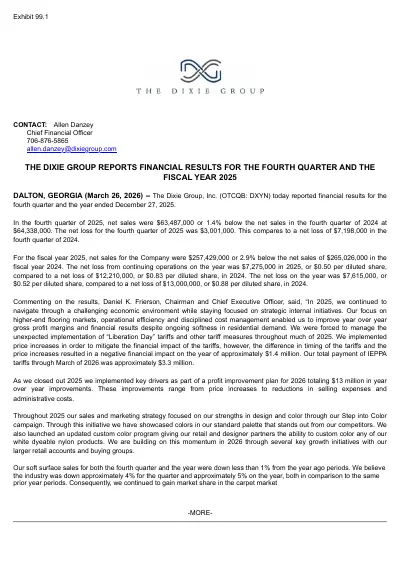
Our safe harbor statement is included by reference to our website and press release. In the fourth quarter of 2025, net sales were $63,487,000, or 1.4% below the net sales in the fourth quarter of 2024.
The net loss for the fourth quarter of 2025 was $3 million. This compares with a net loss of $7,198,000 in the fourth quarter of 2024.
For the fiscal year 2025, net sales for the company were $257,429,000, or 2.9% below the net sales of the fiscal year 2024. The net loss from continuing operations on the year was $7,275,000 in 2025, or 50 cents per diluted share, compared to a net loss of $12,210,000, or 83 cents per diluted share, in 2024.
The net loss for the year was $7,615,000, or 52 cents per diluted share, compared to a net loss of $13 million, or 88 cents per share, in 2024. Our soft surface sales for the quarter and the year were down less than 1% from the year-ago periods.
We believe the industry was down approximately 4% in the quarter and 5% for the year. Consequently, we continued to gain market share in the carpet market during this difficult period.
At this time, Allen will review our financial results, after which I will have additional comments.
Allen Danzey
All right, thank you, Dan. Despite the lower year-over-year sales, we did generate higher gross margins at 27% on the quarter and year-to-date or full year 2025 also at 27%.
That compares to 21.7% in the prior-year quarter and 24.7% in the prior fiscal year. These improved margins in 2025 were the result of cost reductions and profit improvement initiatives that we implemented throughout the year.
Selling and administrative expenses for the fiscal year 2025 were $2.2 million, or 3.1% below the prior year. Significant reductions in selling expenses, particularly in our samples and marketing areas, were partially offset by higher legal expenses in our administrative area.
Other operating expenses of $1.2 million on the year was mainly driven by legal settlements in the third quarter of 2025. Our interest expense on the year was $7.3 million compared to the 2024 interest expense of $6.4 million.
Higher internal interest rates and amortization of financing fees contributed to this difference. Net loss on the quarter was $3 million compared to a net loss of $7.2 million in the prior year.
For the fiscal year 2025, we had a net loss of $7.6 million compared to a net loss of $13 million in the prior year. On our balance sheet, our year-end receivables of $23 million was slightly down from the prior year-end balance of $23.3 million, and our net inventory balance was also slightly down year-over-year at $66.4 million in 2025 compared to $66.9 million in 2024.
Accounts payable and accrued expenses were $38.8 million compared to $30 million in the same period of the previous year as a result of extended terms and timing of the payments due. Net property, plant, and equipment decreased by $4.6 million from prior year, and this included $5.6 million in depreciation on the year, with capital expenditures in 2025 approximately $600,000.
Our debt balance, net of restricted and unrestricted cash, decreased by $7.6 million from prior year, prior year-end. Currently, our availability to borrow today under our senior credit facility is estimated to be approximately $10 million, which is subject to a $6 million excess availability requirement.
Our investor presentation is available on our website at dixiegroup.com. Dan?
Dan Frierson
Thank you, Allen. As 2025 began, there was a great deal of optimism that the new year, with a new regime in Washington, would bring relief for the housing and floorcovering industries.
Instead, the housing industry continued to linger in the doldrums, and the floorcovering industry experienced another year of decline. Our industry has now been in recession for 4 years.
The units produced today are down about 30% from 4 years ago. Traditionally, the level of existing home sales is an accurate barometer of our industry's level of business activity.
In 2025, existing home sales were at a 30-year low, despite the fact that our population has grown during this 30-year period by 70 million people. Another way to look at it: last year, there were about 3 houses sold for every 100 households.
This is the lowest ratio since 1982. At that time, you may remember, the economy was mired in recession and mortgage rates were in the 16% range.
Today, the economy is in a much stronger position, and home prices have increased more than 50% since 2019. Clearly, there is pent-up demand, which will get realized when mortgage rates decline further.
During 2025, mortgage rates declined from the high 6% range to the low 6% range, but further reductions will be needed to unleash the demand. We're hopeful that this will happen in the not-too-distant future, but until then, we must continue to navigate in the current environment.
During this slowdown, we have continued to gain market share in the carpet market. In 2025, our carpet sales were flat, but industry sales were down about 5%, and consequently, we've had to lower costs, restructure facilities, and streamline operations.
In 2025, we reduced costs by over $12 million, and now have reduced costs by $60 million over the last 3 years. We have also implemented a profit improvement plan for 2026, this year, which will improve profitability by over $13 million.
The reduction in business has necessitated reducing our number of associates over this period of time by 30%. We've also been better stewards of our working capital, and greatly reduced capital expenditures, except for the extrusion equipment, which we started up in 2024.
2025 was the first year, complete year of production for the extrusion equipment, and it has provided us with lower-cost raw materials and, strategically, a consistent supply of raw material as other suppliers have exited the business. Our commitment to piece-dyeable nylon fiber enables us to offer a larger palette of color to our discriminating customers, which we are promoting with our Step into Color campaign.
This allows our designers to create unlimited color options for every market, as well as offering custom color to our most discerning customers upon demand. We were surprised and impacted, as were many other companies, by the implementation of Liberation Day tariffs and other tariff measures that followed.
We raised prices 3 times during the year to mitigate the financial impact. While these increases offset the cost of the tariffs, the difference in the timing of the tariffs and the price increases for our customers had a negative impact of approximately $1.4 million.
The total payment of IEEPA tariffs by our company was approximately $3.3 million. During this prolonged period of slower business, we have continued to invest in additional products to enhance our offering and position in the upper end of the market.
As the leader in the tufted wool product category, we continue offering additional beautiful, natural products through 1886 by Masland and Décor by Fabrica. The high end of the floorcovering market has performed better than the rest of the market, and consequently, as we stated earlier, we have continued to gain market share in a very difficult environment.
In 2025, we continued expanding our DuraSilk solution-dyed PET Solutions polyester offering. By incorporating our well-known style, design, and color capabilities to these products, we have broadened our product offering and enhanced our market share.
In the hard surface category, our main objective in 2025 was exiting China as a source of product due to the high tariffs implemented and threatened. We accomplished this move earlier in the year with little impact on our customers.
We continue to add product to our TRUCOR brand and to our Fabrica high-end wood program. With the addition of the Calais Collection, the Fabrica wood offering is consistent with Fabrica's best-in-class reputation and had strong growth during the year.
We have continued to expand and enhance our digital marketing efforts with partners focused on changing buying habits in the markets we supply. These efforts are resulting in increased lead generation, increased sample order activity from our websites, and improved capabilities for online product visualization.
We also saw growth from retail stores where we have implemented our Premier Flooring Center program. Late in the year, one of our significant competitors exited the residential carpet business.
As we have in the past, we used this opportunity to fill the void by mounting a Make the Move campaign with our customers. With the profit improvement plan in place and the introduction of many new products, 2026 will show significant improvement in our results, even if market conditions do not improve.
It is too early to determine the potential impact of the Iranian situation. It does appear that an early cessation of hostilities would limit the impact on raw material costs, but a prolonged conflict could have a major impact on input costs for our industry.
Consequently, recently, two major industry players have announced price increases on residential products to be effective in late April due to both internal and external rising costs. We'll continue to monitor and evaluate market conditions and the appropriate actions to be taken.
Far this year, our sales pattern is similar to last year, with sales of soft surface down slightly, but performing better than our hard surface products. At this time, we will open the meeting to questions.
Operator
Thank you. We will now be conducting a question-and-answer session.
If you'd like to ask a question, please press star one on your telephone keypad. A confirmation tone will indicate your line is in the question queue.
You may press star two if you'd like to remove your question from the queue. For participants using speaker equipment, it may be necessary to pick up your handset before pressing the star keys.
One moment, please, while we poll for questions. Our first question comes from Barry Blank with CH Darby.
Your line is now live.
Barry Blank
Good morning, Dan. Good
Dan Frierson
morning, Barry.
Barry Blank
My landlines are out, I have a poor cell phone connection, I hope you can hear me okay. I got a couple of things.
You discussed what you expect to happen if interest rates go down. I'm not so sure they're going to go down.
How bad will it hurt us if we get an interest rate rise, which is very possible?
Dan Frierson
Barry, I would agree with you that interest rates, of course, have risen in the last couple of weeks since the Iranian activity started, and I think they could rise more. I believe the level of existing home sales has been pretty steady at the 4 million range for the last couple of years when rates were higher.
I don't anticipate they'll go down a lot more, but we clearly will not have improved volumes, and we're not projecting improved volumes for this year.
Barry Blank
Let's assume that this Iranian situation does not end as quickly as we expect to. How is that going to affect getting the materials that you need to produce the goods that you can sell?
Dan Frierson
I'm not as concerned about getting the material as the price of the material or the pricing of everything related to oil. I think in terms of getting the products, obviously we produce most of our own products here in this country.
We do import from the Far East some, we import from India, we import from Turkey, and a little from the Middle East. The bigger impact will likely be rising raw material costs and passing those on in an expeditious manner.
Barry Blank
I've got one more area, and then I'll let other people talk. The common stock is down at basically all-time low.
Of course, it's probably justified with the losses that we have. I'm not saying that.
People will look at Dixie Group, customers, suppliers, that sort of thing, and see this. I really think that maybe a little more attention could be paid and there's a few things that could be done.
Number one, I mentioned in the past, a stock dividend. That costs the company absolutely nothing to give this.
If you look at it, you say, "Well, gee, you're not getting anything because the pie is just split into smaller pieces." I did a graduate thesis in the '60s, and almost all 5 and 10% stock dividends, the stock went down 5 or 10%, but they recovered that within 20 days in 90% of the instances.
It really does make a difference to people. They are actually getting something if we have that.
The second thing that would really look good, and it doesn't have to be big quantities, if management and the board and stuff like that would make some purchases of stock, because a lot of people look at insider buying and they don't see it. With the stock down at record lows, I think it's kind of critical to have some sort of buying by the people inside the company.
Dan Frierson
Barry, I don't disagree with you, and we will be looking at all of your thoughts there with our board at our next board meeting. Thank you.
Barry Blank
Thank you, Dan.
Operator
Our next question comes from Mike Hughes, a private investor. Your line is now live.
Mike Hughes
Good morning. Thanks for taking my questions.
Just looking at the investor presentation, you list $14.2 million in cost saves for 2026. I just want to be clear on this.
That $14.2 million is all incremental savings in '26 versus '25, is that correct?
Allen Danzey
That is year-over-year profit improvement initiatives.
Mike Hughes
Right. Go ahead, Dan.
I'm sorry.
Dan Frierson
I'd say so the answer is yes.
Allen Danzey
Emphatically, yes. You're correct.
Mike Hughes
Okay. It says $8.4 million will come from lower material costs and pricing.
When you put this together, the $8.4 million coming from lower material cost, is that still the case as of today because of what's happening in Iran, or are you actually starting to see the price increases, or you're just worried that they could happen if this drags on?
Dan Frierson
Mike, the bulk of that came from price increases in the fourth quarter that we put into effect, that were in effect as of January. That was the bulk of that.
Part of it was raw material decreases. We have seen some of that, but I am very concerned if this Iranian thing goes much longer, that that portion of it will be impacted.
Allen Danzey
Yes. We also have some recovery of freight costs.
Again, as Dan mentioned, these things were put in place last year, and this is the full effect in 2026.
Mike Hughes
Okay. I think I asked you about this on the last call or the prior call to that, just asset sales.
I think you indicated there were additional assets that you could sell if necessary. Is that something you're actively pursuing right now?
Allen Danzey
Yes. We have the opportunity, as you mentioned, around certain assets.
We have buildings in North Georgia, as well as equipment that we could take out for financing. We have looked at these opportunities, we'll continue to pursue those, and if we find an opportunity that makes sense for us and the board approves, we will move forward with that and make that information available.
Mike Hughes
Okay. Then the $1.4 million in net tariff impact for the year, how much of that was in the fourth quarter?
Dan Frierson
I don't have that figure in front of me, but obviously the bulk of it was in the third and fourth quarters.
Mike Hughes
Okay. Then the $3.3 million in tariffs that you've paid to date, have you applied for a refund, or what's that mechanism going to look like?
Dan Frierson
We're waiting for clarification. We have hired outside help to help us with that.
Allen Danzey
Yeah. We are very actively pursuing that and understanding the climate as it's being worked through.
We have access through the ACE portal and have worked with our brokers to make sure that we have done the right things to position ourselves that once the refunds are being issued, that we are in place to expedite that movement as well as we can.
Mike Hughes
Okay. Then I understand the commentary about the soft side of the business in the first quarter kind of trending similar to last year.
Any change in the trends on the hard side?
Dan Frierson
No, I think they're pretty similar. Our wood program continues to be very strong and show growth.
Our luxury vinyl plank business, either SPC or WPC, it's very competitive and not as strong. It's very similar to last year.
Mike Hughes
Okay. Then last question for you.
Allen, do you have a capex number for '26?
Allen Danzey
I think Dan, you may recall that's $3 million?
Dan Frierson
2.5.
Allen Danzey
Yeah, 2.5. We're looking at 2.5 as part of our plan for 2026 for the capex.
Dan Frierson
Obviously, that will be looked at as we progress through the year. We spent a lot less than that last year.
Mike Hughes
Okay. Thank you very much.
Allen Danzey
All right. Thank you, Mike.
Operator
With no further questions in the queue, I will turn the call back to Dan Frierson for any additional or closing remarks.
Dan Frierson
Rob, thank you very much. We are in a very volatile period with the Iranian situation.
I do think that hopefully that is resolved in the not-too-distant future. We appreciate your being with us on the call and your questions.
Thank you very much, and talk to you next quarter.
Operator
Ladies and gentlemen, that will conclude today's conference. We thank you for your participation.