Estee Lauder Companies, Inc. (The)
Q1 FY2027 · Earnings Call TranscriptNovember 2, 2026
Operator
Good day, everyone, and welcome to The Estée Lauder Companies fiscal 2027 first quarter conference call. Today's webcast is being recorded.
For opening remarks and introductions, I would like to turn the call over to the Senior Vice President of Investor Relations, Ms. Rainey Mancini.
Rainey Mancini
Hello. On today's webcast are Stéphane de La Faverie, President and Chief Executive Officer, and Akhil Shrivastava, Executive Vice President and Chief Financial Officer.
Since many of our remarks today contain forward-looking statements, let me refer you to our press release and our reports filed with the SEC, where you'll find factors that could cause actual results to differ materially from these forward-looking statements. To facilitate the discussion of our underlying business, the commentary on our financial results and expectations is before restructuring and other charges and adjustments disclosed in our press release.
Unless otherwise stated, references to net sales refer to organic net sales, which excludes the noncomparable impacts of acquisitions, divestitures, brand closures, and the impact of foreign currency translation. You can find reconciliations between GAAP and non-GAAP measures in our press release and on the Investors section of our website.
Retail sales performance discussed is based on information available as of October 30th, 2026. As a reminder, references to online sales include sales we make directly to our consumers through our brand.com sites and through third-party platforms.
It also includes estimated sales of our products through our retailers' websites. Throughout our discussion, our profit recovery and growth plan will be referred to as our PRGP.
During the Q&A session, we ask that you please limit yourself to one question so we can respond to as many participants as possible within the time scheduled for this webcast. Now we have a brand video before Stéphane begins.
Stéphane de La Faverie
Thank you, Rainey. Hello to everyone.
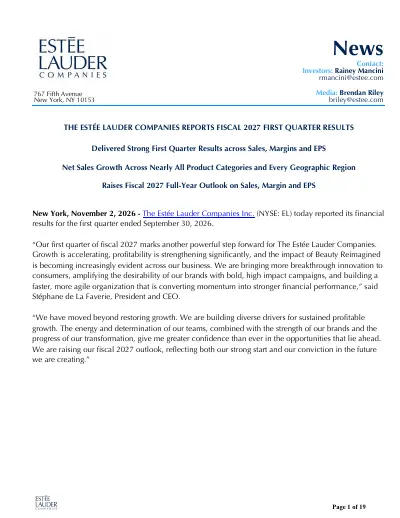
Our first quarter performance marks another powerful step forward for The Estée Lauder Companies. Growth is accelerating, profitability is strengthening significantly, and the impact of Beauty Reimagined is becoming increasingly evident across our business.
Simply said, we have moved beyond restoring growth. Through Beauty Reimagined, we are creating a stronger foundation for sustained, profitable growth, and the progress that we are making gives us even greater confidence in the future we are building.
I know there's been a lot of debate regarding the durability of our recovery. This quarter, we delivered another data point to prove our momentum is real and durable.
We have placed the consumer at the center of how we operate: from the way we build our brands, to the innovation we bring to market, to the investment we make. I am incredibly proud of our team around the world.
Your hard work is translating into our much improved performance. With the strong first quarter result, today we are raising our fiscal 2027 outlook.
For organic sales growth, we now expect to deliver 4% to 5.5%, up from 3% to 5% previously, and an acceleration from the 3% in fiscal '26. With the favorable impact of foreign exchange translation, our reported sales growth forecast become 5% to 6.5%.
For operating margin, we are now expect 170 to 250 basis point expansion, up from 150 to 230 basis points, marking another step change in profitability on top of the 320 basis points improvement we achieve in fiscal '26. Now, let's get into our first quarter numbers.
Reported sales increased 7%, and organic sales rose 6%. Three of four categories grew.
Every geographic region grew. This is exactly the kind of diversified growth we sought to deliver when we designed Beauty Reimagined.
Our profitability improved significantly, driven by operating leverage and PRGP benefits. Gross margin expanded 240 basis points, operating margin expanded 480 basis points, and diluted EPS grew 125%.
Underpinning this result, we increased consumer-facing investment by 8%. Fragrance outperformed as organic sales rose 20%.
We committed to create and capture growing demand in this vibrant category by strengthening our leadership in the luxury price tier and building our presence in the prestige price tier. We are doing just that.
Hero fragrances and innovation from Le Labo, Tom Ford, Jo Malone London, and KILIAN PARIS were highly sought after. Le Labo, again, delivered strong double-digit organic sales growth, with like-for-like door also up double digits, while Tom Ford's new Ombré Leather Reserve was a spectacular success, while also creating a halo on the iconic Ombré Leather.
KILIAN PARIS was our fastest-growing brand as ongoing strength in luxury complemented its blockbuster launch of the Cocktails collection in the prestige price tier. This was not our only success in that price tier.
Strong demand for prestige launches from all of Estée Lauder, Balmain Beauty, and KILIAN PARIS highlights the significant opportunity ahead, with each brand bringing a distinctive offering to the tier. We are just getting started, with Estée Lauder Glimmer success in the U.S.
and U.K. boding well as we take it around the world.
In Western European markets, our fragrance retail sales grew over four times faster than the industry, driving strong share gains, while we also outperformed the industry in the U.S. In Japan, our luxury and artisanal brand soared as Le Labo and Tom Ford realized strong double-digit retail sales growth, driving prestige share gain in the category.
Skin care rose 4% organically. Iconic hero product and innovation were a powerful combination across price tiers.
From La Mer in luxury, to Estée Lauder in the heart of prestige, to The Ordinary in the entry price tier, we are demonstrating the strength of our brands across the consumer landscape. Looking at makeup, we have reignited our performance, delivering a second consecutive quarter of organic sales growth.
Innovation across lip, face, and eye fueled MAC, as well as Tom Ford, with both brands up double digits. Strategically, we are driving broad-based performance for these two brands, fueled by launches in the quarter and earlier in calendar '26, demonstrating how well innovation is resonating.
In the U.S., MAC has gained prestige makeup share for seven consecutive months, while for the quarter MAC gained share in China, Japan, and Korea. Equally impressive, Tom Ford outperformed prestige makeup in China, Japan, and Korea in the quarter.
For hair care, we stabilized performance, progressing sequentially from a modest decline. The Ordinary's hair density serum drove strong growth, offsetting Aveda's brand-specific supply chain logistic challenges, which we are aggressively working to resolve.
We remain encouraged by Aveda's improving trends across brand health, share in the U.S. salon, and innovation.
The brand is also driving strong share gains in the U.S. and U.K.
beyond the salon net channels. Now for the regions.
We grew across the board for the second consecutive quarter. Every region would have accelerated sequentially if not for the Americas benefiting in the fourth quarter from the gift card liability reversal.
Asia/Pacific led the growth. Global travel retail was a strong contributor in the region, with retail sales stabilizing thanks to Korea and the online business in Hainan.
For travel retail in the west, while smaller piece of our business, retail sales growth accelerated sequentially to mid-single digit, outpacing the industry. Mainland China delivered 9% organic sales growth as skin care and makeup each rose high single digit, while fragrance increased double digit.
We outperformed the industry to gain prestige beauty share for the seventh consecutive quarter, led by Tom Ford, The Ordinary, Le Labo, and La Mer, even on a much harder comparison. Our priority emerging market excelled, with organic sales up 15%, driven by Türkiye, Mexico, and India.
We are thrilled to have completed the acquisition of Forest Essentials in October, and have confidence it will be a strong contributor to our emerging market portfolio, which we continue to expect to reach 15% of our business in the next several years. Our diversified growth extend beyond categories and geographic regions.
We delivered high-single-digit organic sales growth online, driven by both established platform and expansion. Encouragingly, online growth was also well balanced.
Asia/Pacific rose double digit, while each of the other three regions grew high single digits. In the U.S.
and China, we gained share online, with retail sales growth more than two times faster than the industry in our two biggest markets. We are particularly pleased by the strong result we are seeing as we anniversary launches.
For example, MAC's U.S. TikTok Shop sales more than doubled from its year-ago launch.
Complementing online growth, brick-and-mortar, which includes travel retail, rose mid-single digit organically. We are investing in experiential retail across all platforms: in specialty-multi, department stores, and our freestanding stores, and seeing the benefit through new consumer acquisition.
Our first quarter performance truly embodies Beauty Reimagined in action as we doubled down in our strengths in fiscal 2027: expanding more brand into high-growth channel across more markets, launching a bigger and bolder innovation pipeline, continuing to increase consumer-facing investment, and increasingly benefiting from 1ELC, our new operating model. Before I close, I am proud to highlight that last week we published our fiscal 2026 Social Impact and Sustainability Report.
I am deeply grateful to our employees, whose passion, resilience, and creativity are driving progress towards our 2030 goals, as you will find in the report. I also want to thank our partners and communities, whose collaboration and shared commitment are essential to drive meaningful change.
In closing, we are becoming a faster, more agile, and more disciplined organization. Beauty Reimagined has transformed our company and positioned us for more diversified and sustainable long-term sales growth, prestige beauty share gains, and stronger profitability.
This Wednesday, we are excited to share more about how Beauty Reimagined has come to life across the organization, and especially in China, at our Capital Market Experience, which will be webcast. To our colleagues around the world, thank you.
This strong results are yours: five consecutive quarters of organic sales growth and margin expansion, with performance in the most recent two quarters especially strong. Onward and upward.
Akhil, over to you.
Akhil Shrivastava
Thank you, Stéphane. Hello, everyone, and thank you for joining us.
We are pleased with our strong start to fiscal 2027. Our first quarter results demonstrate our focus on growth and disciplined execution against Beauty Reimagined, supported by a more agile organization and strong operating model.
We remain focused on delivering sustainable growth, expanding margins, and strengthening cash generation. We are doing this while strategically investing behind consumer-centric opportunities to sustain our momentum and drive long-term value creation.
I'll start with a brief recap of our first quarter results, and then turn to our raised outlook for the full year. Please refer to our press release issued this morning for more information on our first quarter performance.
In the quarter, organic net sales grew 6%, led by strong double-digit growth in fragrance and mid-single-digit growth in skin care, supported by robust innovation. Sales growth accelerated in Asia/Pacific, mainland China, and UKEM, while performance in the Americas improved year over year.
These results demonstrate our progress in building more diversified growth across product categories and geographic regions. Now turning to margins.
Gross margin was 75.7%, an expansion of 240 basis points from 73.3% last year. This improvement reflects our mindset of operational excellence and the transformative actions we have taken across our supply chain.
Net benefits from strategic pricing actions, procurement savings, and manufacturing efficiencies helped drive greater leverage in the quarter. Operating margin was 12.1%, an expansion of 480 basis points from 7.3% last year.
This expansion reflects sales leverage and disciplined cost management across the organization. In line with our strategic investment allocation approach, we increased consumer-facing investments by 8% to fuel growth and strengthen long-term brand equity and desirability.
These investments include higher advertising and promotional activities to deepen consumer engagement and support innovation, along with our focus on enhancing selling productivity. At the same time, we continued to manage costs in a disciplined way, reducing non-consumer-facing expenses by 1% to expand margin and create fuel for growth.
We are also continuing to advance One ELC. The work underway across our operating ecosystem, including EBS, a more unified media model, as well as digital and direct-to-consumer capabilities.
This enables superior consumer experiences, greater speed, simpler processes, and improved productivity. This can be seen in our Shopify deployment and the partnering with Profound, an AI marketing platform bringing global insights into how our brands appear across AI platforms.
At the same time, our focus on efficiencies remains embedded in how we operate. The approval phase of the restructuring component of our PRGP is behind us, but our commitment to everyday efficiency continues.
We are executing the approved initiatives, capturing savings, and simplifying our cost base. This creates flexibility to invest for growth while expanding profitability.
As we have said before, we continue to expect the vast majority of the PRGP's full run rate benefits to be realized by the end of fiscal 2027. Our effective tax rate improved to 31.9% from 40.5% last year.
Diluted EPS increased to 72 cents from 32 cents last year, growth of 125%. We remain laser-focused on cash productivity.
Cash flow used for operating activities was $166 million in the quarter, an improvement from $340 million in the prior year. While our first quarter typically represents the seasonal use of cash, our teams have improved our use by approximately 50% in each of the past two years, driving meaningful progress in cash productivity.
This reflects higher net earnings, excluding non-cash items. Despite higher restructuring payments and working capital investments, we saw a favorable change in operating assets and liabilities.
Capital expenditure were $69 million, down from $96 million. This reflects the timing of projects and our continued focus on prioritizing consumer-facing investments.
Our strong cash productivity and disciplined capital spending drove a notable improvement in free cash flow in the quarter, a use of $235 million compared with a use of $436 million. Before turning to outlook, we are pleased to have completed the acquisition of the remaining interest in Forest Essentials on October 5th.
This builds on our longstanding partnership and strengthens our presence in India's fast-growing prestige beauty industry, with an opportunity to expand the brand's consumer reach globally. The brand's results are not expected to have a material impact on our fiscal 2027 full-year consolidated results.
Turning now to our fiscal 2027 full-year outlook. We raised our outlook to reflect the momentum in the business and our progress against the priorities we set at the beginning of the year.
Our outlook assumes no further deterioration in the geopolitical landscape or related impacts, including no material impact from the conflict in the Middle East, and the stabilization of current disruptions in other key markets in UKEM. While we remain cautious amid ongoing geopolitical and macroeconomic uncertainty, we are controlling the controllables, focused on disciplined execution, and maintaining flexibility to respond as conditions evolve.
For the full year, we now expect organic net sales growth of 4% to 5.5%, up from our previously communicated range of 3% to 5%, with stronger growth still expected in the first half of the year compared to the second. Full-year operating margin is now expected to range between 12.9% to 13.7%, up from our previous range of 12.7% to 13.5%.
Diluted EPS is now expected to range between $3.20 to $3.45, up from $3.10 to $3.35. We now expect to generate net cash flow from operating activities between $1.4 and $1.5 billion, up from a previous expected range of $1.3 and $1.4 billion.
In closing, fiscal 2027 is off to a very strong start. Our results reflect our focus on the consumer, investments in brand desirability and innovation, a more disciplined operating model, and strong execution across the organization.
We remain focused on translating this momentum into sustainable growth and long-term value creation. We are grateful to our teammates around the world for their commitment, innovation, creativity, and execution with excellence.
That concludes our prepared remarks. I'll now turn it over to the operator to begin the Q&A session.
Operator
The floor is now open for questions. At this time, if you would like to ask a question, please click on the raise hand button, which can be found on the black bar at the bottom of your screen.
When it is your turn, you will receive a message on your screen from the host allowing you to talk, and then you will hear your name called. Please accept, unmute your audio, and ask your question.
As a reminder, we are allowing analysts one question. Time permitting, we will return to you for additional questions.
We will wait one moment to allow the queue to form. Your first question comes from Lauren Lieberman with Barclays.
Please unmute your audio and ask your question.
Stéphane de La Faverie
Lauren, maybe you are still muted? Maybe we can go to the next person, and we'll go back to Lauren.
Operator
Absolutely. Moving on to Dara Mohsenian with MS.
Please unmute your audio and ask your question.
Dara Mohsenian
Hey, can you guys hear me?
Stéphane de La Faverie
Yes, Dara. Hi.
Hey.
Dara Mohsenian
Ni hao. Looking forward to seeing you guys in Shanghai.
Stéphane de La Faverie
Ni hao. Absolutely.
Dara Mohsenian
Clearly a strong organic sales growth result in the quarter. Full-year raise on OSG is also positive.
You did have a lot of innovation contribution in Q1, I just wanted to get a bit of an update on the pace of organic sales growth as we move through the balance of the year over the next few quarters. Is there increasing confidence you're now more at this mid-single-digit pace in the balance of the year after the strong 6% Q1 result?
The range for the full year does give a little bit of flexibility, are we sort of comfortable more in that mid-single-digit range going forward, or will there be some quarters more like low to mid-single digit as you think about it? Maybe just within that, the beauty category looks like it's doing really well in a number of markets around the world: China, the U.S., despite the fact that we've seen a broader luxury slowdown outside of the beauty category.
Just given some signs of consumer stress out there, I just want to get your perspective on if you think you're seeing any impact to the beauty category, and if your internal momentum is sort of enough to offset some of these external pressure points we're seeing, and how that played out maybe towards the end of fiscal Q1 or so far in October. Thanks.
Stéphane de La Faverie
Oh, thanks, Dara. That's the entire strategy in one question, but no, no, very happy, and Akhil and I will tag-team to answer your question.
Now, when it looks at the organic sales growth, obviously we're very proud of the very strong start of the fiscal year. I think you've seen as we committed as part of Beauty Reimagined to a very broad growth from a region, from a category standpoint, generally speaking, around all our categories, our brands, and our channels.
We've committed and we continue to reiterate that this first half of this fiscal year is stronger in innovation. We have a lot of innovation that it is in skin care, in fragrances, in makeup, and in hair care that is coming in the first half of this fiscal year.
Frankly, all this innovation is off to a very, very strong start, contributing to the strong growth that you saw in the various categories. Now in the second half, if you remember, we said there would be a softening of the innovation as a contribution to the total.
Now we're still committed to the 25% of the sales for the fiscal year. In the first quarter, we delivered 29% of our sales coming from innovation, but still again, committed to deliver on the total year 25%.
Some of the strengths that you see in the first half, obviously, will continue in retail in the second half, but there's this rebalancing on innovation, and also we are lapping in the second half a higher base of travel retail. We'll expect less growth in net sales, but obviously a continuous improvement from our retail trajectory overall.
I would say, this is why we have the confidence to raise the guidance for the year based on a strong start, but obviously, and this is what we are focusing as a team, retail sales continuing to accelerate quarter over quarter. When it comes to your question on the beauty category, look, I'm very confident that the beauty category is remaining a very strong category in consumer goods in general.
We're seeing an acceleration. If you remember, in the last fiscal year we guided 2% to 3%.
Actually, the industry actually more or less delivered close to 3% growth in fiscal '26. We're seeing about 100 basis point improvement in the beauty category overall.
You've mentioned markets like China, like the U.S. as very strong, but the emerging market also continues to be very strong, and for us, you saw the 15% growth that we've delivered in emerging market.
For whatever issue that it will be, name it like the Middle East or like some disruption in Europe that we are monitoring very closely, we are obviously really pushing where we have strong momentum, which are our largest market, and frankly also closing the gap where we still have gap to close. Overall, very confident on the category, very confident in our performance, and very confident that we will be able to deliver within this new guide that we are giving for the year.
Akhil Shrivastava
Thanks, Stéphane. Dara, I'll just add a few things to what Stéphane said.
One, we are very pleased with the diverse engines that Stéphane talked about, whether we look at it from a region, category, or brand perspective. The company is firing on many, many engines, so that we like.
Within that, when you look at our mix of 6% growth, both Americas and UKEM were 4%, so that bodes well for the rest of the year. Of course, Asia/Pacific and travel retail and China were very strong, and, as Stéphane said, the base period of these businesses have a tougher comp in the back half.
Our plan is to keep driving the momentum in these businesses, grow share, which we are doing, while the market will have ups and downs. We intend to keep growing share.
In the western part of the world, Beauty Reimagined strategy is working in many places in many aspects of the business, and that we intend to continue. We intend to continue to fuel our business so that the progress in Western markets continues, and that is what is baked into our forecast.
When we started the year, our expectation was that first half would be stronger, back half would be slightly less than that, and that still holds. Of course, we are busy executing against that to prove out our overall guide for the year.
Dara Mohsenian
Thank you.
Operator
As a reminder, when it is your turn, you will receive a message on your screen from the host allowing you to talk. Please accept, unmute your audio, and ask your question.
Your next question comes from Lauren Lieberman with Barclays. Please unmute your audio and ask your question.
Lauren Lieberman
Hi again. Can you guys hear me this time?
Stéphane de La Faverie
Yes, Lauren. We can hear you.
Lauren Lieberman
Good. Sorry about that.
Stéphane de La Faverie
No worries.
Lauren Lieberman
I wanted to ask about the 1ELC operating model, and I know that in the prepared remarks you mentioned a couple of the new partnerships that you announced during the quarter. I was curious if you could talk a little bit about the unlocks from 1ELC, because the restructuring, it's tangible, it's a number, here's our gross cost savings.
How should we think about what comes out of this shift to 1ELC from a, whether profitability standpoint, revenue growth unlock, but how you would articulate what opportunities that creates going forward? Thanks.
Stéphane de La Faverie
I'll start, Lauren. Thank you, because this is something that we've put a lot of energy behind, and I want to make sure that we don't confuse what the PRGP as enabling with this new operating model.
This new operating model is our new ways of working. Obviously we have partners from enterprise business services with Accenture, our integrated commerce with Shopify, or even our media around the world operated by WPP, and there is many other partners such as Microsoft and Google that also are powering our technology, our cloud.
Microsoft, one that we've announced an extended partnership last week to really build our cloud and our data. Overall, this 1ELC operating model, you have to think about it as really the backbone of how we're operating for the company.
It is designed for us to just bring efficiencies over time. Think about the PRGP as a one-time event, obviously, that has helped us to really reposition our cost base and reduce our fixed costs, reinvesting into consumer-facing to reignite growth.
Going forward, we don't see that as one moment in time. Transformation is a new way for us to operate for the future of the company, and it's going to give us efficiency in media, efficiency in the back of house, much more agility around the company.
We're really focusing on harnessing the power of our brand, the power of our innovation, and really investing to drive growth in the future. This partners have really allowed us to really build a very strong backbone from technology to consumer-facing activities and so on and so forth.
That also, in a way, is helping us to reduce the duplication and the fragmentation of the activities throughout the organization around the world. That has been one of the key focus for us to do, and this reduction of duplication, fragmentation is allowing us to spend more time on creating innovation, boosting desirability, creating the consumer experience to obviously accelerate our growth as we've demonstrated with the increased guide on the top line this year, and as we demonstrated with the results in Q4 of the last fiscal year as well as Q1 of this fiscal year on a 6% and a 5% at the end of last fiscal year.
Think about this ecosystem as a way to really power our brands, power our market, and really become the best consumer-centric prestige beauty company in the world.
Akhil Shrivastava
One thing that I'll add to that, Lauren, every time we have a meeting, Stéphane opens it with three pillars of 1ELC. It's really culture, it's system process, and one team.
These are the things that underpin the changes that Stéphane just talked about. From a culture perspective, we are clearly demonstrating speed, agility, and a culture of empowerment and accountability.
From a one team perspective, the work we have done to make roles clearer, we do not talk enough about it, but our brands, regions, and affiliates are very clearly focused on their unique deliverables, which was one of the points that was always talked about for the company in a big matrix of brand channels and affiliates. The third thing is when you look at the three pillars Stéphane talked about: media, e-com, and back-end processes.
This is the company, and we are going to the best-in-class solutions for all of them. Combined, these things are improving not only our top line, our bottom line, and overall well-being of our people who will work in the company to focus on the best work.
Operator
Your next question comes from Steve Powers with Deutsche Bank. Please unmute your audio and ask your question.
Steve Powers
Great, can you hear me okay?
Stéphane de La Faverie
We can hear you, Steve.
Steve Powers
Perfect. Thank you, Stéphane.
I guess maybe going back a little bit to Dara's question, clearly the results this quarter very strong and fairly balanced geographically, though less so by category. Can you maybe discuss the strength you saw in fragrance this quarter versus the solid, but less outsized performance in other areas of the business, and how you see those trends unfolding over the balance of the year?
As you do that, maybe relatedly discuss just how you perceive consumption this quarter relative to the organic run rate, and any areas of inventory build that we should consider as we think about the quarters to come. Thank you.
Stéphane de La Faverie
Okay. I'll start with the fragrance category and the strength that we're seeing, and Akhil can just join on the inventory.
Look, we feel very good about the long-term opportunities in fragrances, and I think what is been very exciting for us this quarter, there's been a long way in the making to get there. We've demonstrated that we have a very strong luxury portfolio.
When you think about Tom Ford Private Blend, when you think about Le Labo, you think about Frédéric Malle, or Jo Malone London, and on and on, we've demonstrated over the past years that we have a very strong portfolio. What we've done differently this quarter is that we've really accelerated the investment behind this brand, and we've really accelerated innovation, and innovation has resonated across every single of our brand.
What is new is really what we've committed to go after also, the prestige price tier. If you remember, if you look from east to west, in the east, there's a high penetration of luxury fragrances, and we've always performed very well.
We've demonstrated again strong share gain in China, in Korea, in Japan. On the other hand, in the west, the large majority of our fragrance business is still done in the prestige price tier, which we haven't really captured our fair share over the past few years.
This quarter, we've launched for the first time in over a decade the Estée Lauder Glimmer fragrance, which is off to very strong start in the U.S. and in the U.K., which gives us the confidence to roll out Glimmer by Estée Lauder in the second half of this fiscal year in more markets, especially in Europe, in Latin America.
We've also have the continuous strength of Balmain Beauty, especially with Bronze de Balmain, the fragrance has been very, very strong across the Western market. Now the new addition to the portfolio in prestige is the new collection, The Cocktails collection by KILIAN, that has been a resounding success in absolutely every market where we've launched it.
All of that has contributed to very strong growth in net sales, but also market share gain in pretty much every market. At 20% growth in net sales, we are absolutely convinced that we have one, if not the best, performance in the industry in fragrances.
In retail sales, we're seeing the follow-through in all key markets: from the U.S., to where we gained share in the U.S., we gained share in the U.K., we gained share in Continental Europe, also across many markets in Asia: Japan, China, Korea. All of that is demonstrating the strength.
Why I believe, Steve, that this could continue, there's two factors: there's us, obviously, the strong innovation, continuing to expand distribution where it makes sense for our luxury fragrances, but also going to capture market share in the prestige category, where we haven't had our fair share in the past. The second thing, we are seeing still younger consumer gravitating towards this category thanks to platforms like TikTok Shop, which we are seeing a lot more activities in fragrances, and we are participating into it.
We've launched many of our brands on TikTok Shop, and you'll see more activity going forward. Between the strength of our innovation, the strength of our portfolio, the new prestige strategy in addition to our luxury strategy, and the category that I believe is still robust around the world, we believe that we will continue to do so and to accelerate.
If you remember, when we were in August, on the back of a 10% growth in fiscal '26, we committed to even stronger acceleration. Q1 is a demonstration of that.
Akhil Shrivastava
Thank you, Stéphane. Steve, I'll say two things on months of cover for our inventory.
Overall, we are tracking this across region, and we are shipping to retail, we are in good shape. I think one of the reasons your question probably comes from is the strength we see in APAC and TR.
We are shipping to retail, but our base period shipment was lower, there our net shipment index is higher than the retail we have seen, but we are shipping to retail and our inventory is very balanced for each one of the markets and channels. Every time it goes slightly off-balance, we fix it in the next quarter.
This is something Stéphane and I had promised, and that's what we are tracking against.
Stéphane de La Faverie
Steve, I want you to hear it from Akhil and from me and for everybody: we are shipping to retail. That's the commitment we have as a leadership team, and it's your role to just ask the question.
We are laser-focused to really aligning our net and our retail, and saying today we are seeing retail accelerating, obviously we're seeing net accelerating, but this is a strong commitment that we have across our categories, across our brands, and frankly, across all channels around the world.
Steve Powers
Very clear. Thank you, both.
Stéphane de La Faverie
Thanks, Steve.
Operator
Your next question comes from Bonnie Herzog with Goldman Sachs. Please unmute your audio and ask your question.
Bonnie Herzog
All right, thank you. Hi, everyone.
Hi, I had a question on your op margin targets for the year. How much of the guidance raise was maybe just a function of over-delivery in the quarter versus an underlying improvement in the pace of expansion that we should expect you to build upon, I guess as the year progresses?
Then how should we think about the potential risks from commodity and maybe freight inflation to your revised margin guidance? I guess, how much flex do you have with your PRGP savings to still deliver in that range without curtailing reinvestments?
Thanks.
Akhil Shrivastava
Thanks, Bonnie. As you pointed out, we have passed on some of the beat of the first quarter, or not the beat really, but some of the strength of the first quarter to rest of the year.
What we are intend to do for rest of the year is we want to invest, continue investing in our brands, because we are clearly seeing momentum, and we want to invest to drive long-term value, which really comes through growth and sustainable growth and share build. Secondly, on the rest of the year, you're right that the deferral policies on some of the commodity complex kicks in more in the back half, which is why we expected that, which is why we had said on the full year, in spite of a very strong gross margin that you've seen on quarter one, we expect a modest growth for the full year, because we had factored these items.
Of course, in our business, commodity complex is not a big input cost to the materials, but of course freight impacts everybody. It is factored into our guidance.
Of course, every time we give you a guidance, we want to have multiple paths to get there, including the work we are doing on PRGP, including managing a business with contingency and various scenario planning. Hopefully that gives you the clarity, Bonnie.
Bonnie Herzog
Yes, thank you.
Operator
Your next question comes from Chris Carey with Wells Fargo Securities. Please unmute your audio and ask your question.
Chris Carey
Hi, can you hear me?
Stéphane de La Faverie
We can hear you, Chris.
Chris Carey
Great. Customary can you hear me question.
Thank you for the question. I wanted to ask just about the organic sales outlook for the full year.
Clearly very positive with the higher outlook. You just noted that growth in the back half will be slightly below fiscal Q1, if I heard that correctly.
Can you just frame for us some of the puts and takes that would put you at the higher end of the range for the full year? Perhaps discuss category growth rates by region and how you would see some of the category contribution coming through the year?
Just it could be seen as a wide range depending on how this evolves, namely into fiscal Q2, I just want to get a sense of what would put you at the high end or the low end and some of the key drivers. Thanks so much.
Stéphane de La Faverie
Chris, when you think about the year, and I think we've said it, and without just going too much into the detail, you've said it, we believe that the first half of the fiscal year from a net sales standpoint is going to be stronger than the second half just because of simply the phasing of innovation, and as Akhil and I said earlier, the higher base of travel retail in the second half of last year that we are lapping this year. I want to be very clear, that's not what we expect from a retail standpoint.
Retail standpoint for us will continue to be strong throughout the year, and that's very important. Now, when you look at ex-travel retail, we're seeing the rest of the world accelerating and continuing to grow from first half to second half.
I think we have some favorable item when it comes to UKEM, obviously because of the lower base of last year due to the disruption of the Middle East, and we are starting to see, obviously, traffic is still very slow, but we're starting to see better retail trend in the Middle East. Frankly also, if you remember, Middle East is, when you think about the local market plus the airport, is less than 2% of our business, and with the strength of the rest of the emerging market, we're seeing continuation.
In the U.S., we're seeing, obviously, us continuing to reduce the gap with the market. What I was very happy and encouraged in the quarter, not only we are continuing with volume market share gain, we have also now starting to see both in fragrances and hair care value market share gain.
We're moving in the right direction, and if you start digging more into it, we are gaining market share in MAC and The Ordinary, in makeup and in skin care, that is showing that all categories with some of our key brands are moving in the right direction. See the total ELC ex-travel retail continuing with good momentum, and obviously travel retail, the retail is moving in the right direction, but obviously we have to lap a much higher base in the second half, and we're committed to ship to retail.
This is why we are seeing what we're seeing in the total year. What will obviously and all our objective, why we did give a guidance, this one between 4% to 5.5%, our objective is always to try to just deliver towards the top of the guidance, and it will be the continuation of very strong momentum on our innovation, the turnaround that we're seeing in the west, the acceleration of travel retail west while we're continuing to work through the transition in travel retail east.
There's a lot of good momentum, and obviously, we can control what we can control, and this is what we're doing, and we're expecting a normalization, I would say, of the impact of the Middle East conflict and some of the other ongoing geopolitical and macroeconomic uncertainties that we may see in other geographies.
Chris Carey
Thank you so much.
Stéphane de La Faverie
Thanks, Chris.
Operator
Your next question comes from Rupesh Parikh with Oppenheimer. Please unmute your audio and ask your question.
Rupesh Parikh
Good morning, and thanks for taking my question. I just wanted to go back to mainland China.
Just curious what you're seeing on the ground right now, how you feel about the sustainability of the momentum in the coming quarters, and then any early thoughts on the 11.11 holiday. Thank you.
Stéphane de La Faverie
Rupesh, a very good question, considering that we are already on the ground in China, and by the way for everybody, we're doing our first ever earning calls live from China ahead of our Capital Market Experience that is in couple of days. Look, the market is healthy in China.
We're seeing now obviously in this quarter low-single-digit growth into the quarter, but it's lapping a very high quarter last year and which was in a high-single-digit growth for the market. Overall, we're seeing China as a mid-single-digit growth.
I've been very, very clear: China is no longer what we call an emerging market. It is a mature market of a significant size when it comes to beauty, a mid-single-digit growth for the industry is very strong.
In the midst of that, we are gaining share. You saw that now we're on the seventh consecutive quarter of market share gain, and what I love of what I'm seeing in our performance in China, it is broad-based.
We're gaining market share across the three main category of skin care, makeup, and fragrances, and we have today 11 brands in growth, of which six are in double-digit growth. Very, very strong performance in the market.
We grew double the market, almost double the market in the quarter, which is very very strong. Now, when it comes to 11.11, Rupesh, it's too early.
11.11 is so dynamic, and being here in this moment always reminds me that every day is a different thing. Our team are working towards, obviously achieving our goals.
We have very strong animation, strong offers, very strong innovation behind all our brands in the quarter, but it's too early to tell 11.11 because telling you something on November 2nd can change on November 3rd, let alone on November 11th, but that would be very strong. The retail is strong, and that's what matters to us, and in a retail that is strong, we're seeing a strong momentum.
Now, this is China mainland. We are also seeing in the total China ecosystem, when you include travel retail, also travel retail being going in the right trajectory, and we have double-digit growth in Hainan, and we're seeing also strong performance in Korea as the Chinese consumers are trying to travel again within the Asia corridor.
Rupesh Parikh
Great, thank you for all the color.
Stéphane de La Faverie
Thanks, Rupesh.
Operator
Your next question comes from Filippo Falorni with Citi. Please unmute your audio and ask your question.
Filippo Falorni
Hi, good evening, everyone, for everyone dialing in from Asia, and good morning to everyone in the U.S. I wanted to double-click on the travel retail comments, Stéphane, that you just made from a retail sales standpoint.
You've seen strong improvement in the business. Maybe touch about the changes that you've seen in the Shanghai and Beijing airports from last year from a more not necessarily a shipment standpoint, but more from a retail sales standpoint, as that allowed to gain more share in those airports and broadly in the mainland China travel retail business.
Then in Hainan, you mentioned an improvement in retail sales online, maybe can you expand a bit more what you're seeing in online sales versus offline in Hainan? Thank you.
Stéphane de La Faverie
No, thank you, Filippo, for the question. As Akhil said and as you stated, we have had strong growth in the quarter in travel retail, very proud of the work that the team is doing.
We've committed to put back investment into creating consumer experience in this channel. Put it simply, travel retail remains the second largest channel in the world after online, it's a very, very important channel, and we are happy to see strong net sales growth in the east and also the acceleration in TR west.
I'll just touch one second on TR west because I think it's important to understand the total channel with our strategy of diversification. Not only we're accelerating in TR west, but we are gaining market share in TR west thanks to the deployment of many of our brands in the channel that were not present, mainly our luxury fragrance brands like Jo Malone, Tom Ford, KILIAN, and so on.
That has been very strong. We are seeing travel retail worldwide stabilizing to slight positive, this is very strong for what we see.
The strengths are really coming from Hainan, and they're coming from Korea, as I mentioned earlier, and obviously the west in our case. Hainan, double-digit growth in quarter one.
The west, mid-single-digit growth in quarter one, but ahead of the industry. When we look at the transition that we stated last year on the airport, the transition is complete, and our performance accelerating.
We've worked our teams work very, very closely with our partners on the ground, and all the transition in mainly in Beijing and Shanghai airport is completely complete at this point, and we are seeing some significant improvement overall. Now, you've asked about online.
Online is not a new, but it's a fairly new phenomenon over the past few years, and online for travel retail is accelerating for the entire industry, it's not only us. It is part of an ecosystem of where we are capturing and where we are retaining the consumers, and today we're seeing some recovery.
It's still a little bit in flux, but we're working very closely to our partners to just make sure that we capture the consumer. I think overall I feel confident about the trajectory that travel retail is going under, and more importantly, very excited about what we are doing and what our team on the ground are doing to just bring back experiential retail and using online to be able to retain the consumer throughout this channel.
The same way we do it in the local market, we think about an omnichannel, we think about exactly the same way, like in travel retail. Again, the only thing I would say is retail is accelerating.
For us, very strong performance in first quarter, that most likely will continue in the second quarter, but a lower net sales performance in the second half due to the higher base that we are lapping, but retail will continue to just increase with the right momentum, and obviously, as I said multiple times, we're really committed to ship our net sales in line with retail going forward.
Filippo Falorni
Great, thank you very much.
Operator
We have time for one last question. Your final question comes from Olivia Tong with Raymond James.
Please unmute your audio and ask your question.
Olivia Tong
Great, can you hear me?
Stéphane de La Faverie
Yes, Olivia. We can hear you.
Olivia Tong
Perfect. Thank you.
Wanted to ask you about China and Americas, obviously very strong improvement, and your view on ability to sustain or accelerate those share gains that you've made, and the actions that you've taken that improve your ability to drive continued growth. Then secondly, you differenced in the press release areas where you drove dollar share versus volume share, can you expand on how you think about the importance of driving volume versus dollar share, especially in makeup, and sort of balancing the volume before price mix or whether it's in lieu of price mix?
Thanks so much for the question.
Stéphane de La Faverie
No, thank you, Olivia. I'll start, and I'm sure Akhil will want to add something.
Look, the truth is that we are committed to go after growing above the industry. Now, this is our overall commitment on the total for the company, and especially in the two largest market around the world.
I'm very proud of what the team has done in China with seven consecutive quarter of market share gain, and we intend to continue to do it. I think one of the new things that we are deploying in the market is also our innovation.
I think I've mentioned it in a prior call, 30% of our global innovation is now coming from China. Some is just for China, some is for what we call China for the world, but really accelerating not only our speed of bringing innovation to market, but also the relevance of the innovation that we're bringing to market, working very, very closely with our China team.
We believe that will continue to help us to stay ahead of the industry in an industry that I said earlier that we see be in the mid-single-digit growth, huh, so, and we want to just maintain this strong performance, and to maintain a performance that it will be broad-based from a category standpoint. This is why we are continuing to invest not only on our skin care brand, and our latest addition in the market has been The Ordinary, that has been a resounding success.
Now we are lapping the one-year anniversary with very strong performance, but we're seeing strong performance also on La Mer, and then continuing to accelerate on fragrances and on makeup. I feel good on our ability to just continue to gain market share in China on the future.
Now, obviously, things can vary by quarter, but overall our objective is to gain market share. When it comes to the U.S., we're not there yet in a value share, as I said earlier.
We are in a volume share, and to answer your question, volume has been very important for us in a market where we've lost market share for over a decade, and it was very important for us to reignite the recruitment engine. The way I think about volume and value, you need the volume first to just really making sure that we reignite the recruitment wheel, because one thing we know: we have exceptional brands and exceptional innovation.
Getting the product in the hand of the consumer is the first step to getting them to loyalty. I think many of what we're doing from a consumer recruitment and consumer retention, once we get the volume, will turn eventually in value.
That's what we've seen this quarter with fragrances and hair care, where we've seen in both cases the retail trend, both from strong innovation, but also strong retention, we are turning the volume into value share. When it comes to makeup and skin care, we have more work to do.
Now, obviously, on a brand like The Ordinary, we are gaining in skin care in volume and in value, and in the case of MAC, we're also gaining in volume and in value for the first time in a long time. We want to use the playbook that we have with MAC and The Ordinary that also are the entry of prestige, and there's a lot of demand, a lot of growth at the entry of prestige, using this playbook to apply it to every single of our other brand, that it is on Bobbi Brown, or on Clinique, or on Estée Lauder, to really making sure that we are bringing the entire portfolio from volume to volume plus value going forward.
Akhil Shrivastava
Olivia, I'll add just a few things to Stéphane's point. It's a great question.
As part of the first strategy of our Beauty Reimagined consumer coverage, Stéphane and I constantly look at consumer penetration, which is key. We are always looking at volume and value share so that they are working both in tandem.
Secondly, as part of strategic revenue management, you'll see when we file our Q, we of course look at volume, price, and mix, and you'll see very strong volume and units. This is something we have not had in last few years, as Stéphane pointed out, you'll see strong unit growth, which, of course, augurs well for overall better flywheel.
Thirdly, we are leveraging the whole portfolio, starting from Ordinary to La Mer and Tom Ford, to reach consumers at every price point across brands, and of course, within each brand, we are constantly looking to make sure consumer has access to our brands at different franchise at different price points, which builds a more strategic and more sustainable revenue model, which is what our promise to you has been and which is what we're working on. Hen hao.
Xiexie.
Operator
That concludes today's question-and-answer session. If you were unable to join for the entire webcast, a playback will be available at 1:00 p.m.
Eastern Time today until February 2nd. Please visit the Investor section at the company's website to view a replay of the webcast.
That concludes today's Estée Lauder conference call. I would like to thank you all for your participation, and wish you all a good day.