EverQuote, Inc.
Q3 FY2026 · Earnings Call TranscriptNovember 2, 2026
Operator
Hello everyone, thank you for joining us, and welcome to the EverQuote third quarter 2026 earnings call. After today's prepared remarks, we will host a question-and-answer session.
If you would like to ask a question, please press *1 to raise your hand. To withdraw your question, press *1 again.
I will now hand the conference over to Sara Buda, Vice President of Investor Relations. Please go ahead.
Sara Buda
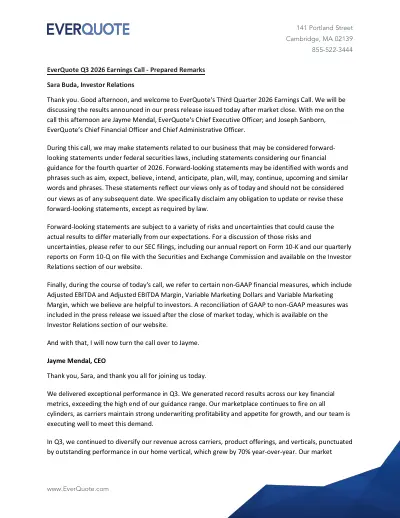
Thank you. Good afternoon and welcome to EverQuote's third quarter 2026 earnings call.
We will be discussing the results announced in our press release issued today after market close. With me on the call this afternoon are Jayme Mendal, EverQuote's Chief Executive Officer, and Joseph Sanborn, EverQuote's Chief Financial Officer and Chief Administrative Officer.
During this call, we may make statements related to our business that may be considered forward-looking statements under federal securities laws, including statements considering our financial guidance for the fourth quarter of 2026. Forward-looking statements may be identified with words and phrases such as aim, expect, believe, intend, anticipate, plan, will, may, continue, upcoming, and similar words and phrases.
These statements reflect our views only as of today and should not be considered our views as of any subsequent date. We specifically disclaim any obligation to update or revise these forward-looking statements, except as required by law.
Forward-looking statements are subject to a variety of risks and uncertainties that could cause the actual results to differ materially from our expectations. For a discussion of those risks and uncertainties, please refer to our SEC filings, including our annual report on Form 10-K and our quarterly reports on Form 10-Q on file with the Securities and Exchange Commission and available on the Investor Relations section of our website.
Finally, during the course of today's call, we will refer to certain non-GAAP financial measures, which include adjusted EBITDA and adjusted EBITDA margin, variable marketing dollars and variable marketing margin, which we believe are helpful to investors. A reconciliation of GAAP to non-GAAP measures was included in the press release we issued after the market close today, which is available on the Investor Relations section of our website.
With that, I'll now turn the call over to Jayme.
Jayme Mendal
Thank you, Sara, and thank you all for joining us today. We delivered exceptional performance in Q3.
We generated record results across our key financial metrics, exceeding the high end of our guidance range. Our marketplace continues to fire on all cylinders, as carriers maintain strong underwriting profitability and appetite for growth, and our team is executing well to meet this demand.
In Q3, we continued to diversify our revenue across carriers, product offerings, and verticals, punctuated by outstanding performance in our home vertical, which grew by 70% year-over-year. Our market position remains strong, and we are growing and deepening customer relationships with both carriers and agents.
Furthermore, we believe we are making great progress as we begin to lead the P&C insurance industry into the AI era. First, we continue to use AI to drive productivity.
In Q3, our engineering teams reduced cycle time by 36% quarter-over-quarter through adoption of our agentic coding pipeline. We have also achieved broad adoption of AI tools across non-engineering functions, allowing us to innovate and launch new products faster, while growing adjusted EBITDA by over 40% year-over-year.
Second, AI remains a reliable driver of our consistent marketplace growth. We have deployed Smart Campaigns to new carriers and to more local agents.
This AI bidding solution drives benefits, including higher conversion rates, which in turn allows us to access more budget so we can maximize highly targeted policy volume at customers' performance targets. We also rolled out new AI-native features to local agents in the quarter, including a new AI-based reporting tool that surfaces insights to help them understand and optimize account activity.
Third, and perhaps most importantly, AI underpins our strategy to broaden our value to customers and expand our long-term addressable market. We are at the forefront, leading P&C insurance distribution into the AI era.
In Q3, AI agents took center stage when Meta and OpenAI launched their personal agents. We have long anticipated personal agents as the next step in the evolution of insurance digital marketing and distribution, from web-native to LLM-native to agentic.
For months in advance of the launches of Muse and DAX, we were in discussions with carriers about agentic commerce to help educate and prepare them for this next wave of change. In fact, during the quarter, we published a thought leadership white paper on agentic shopping and P&C insurance distribution, which has led to an active dialogue with major carriers as they themselves contemplate how to adapt.
This topic has become a major focus area for our customers, and we are partnering with carriers to innovate solutions that help them navigate this fast-developing landscape. Last week, we launched Luva, a separately branded, AI-native P&C insurance shopping platform for consumers that will be integrated with LLMs and AI commerce agents.
We believe EverQuote can emerge as a key player in the AI ecosystem by bridging the needs of consumers using LLMs and AI agents to research and shop insurance with insurers' need to access these consumers while maintaining control over how their pricing, product, and brand are represented. We are rolling out apps across LLM and agentic platforms like Meta, OpenAI, and Anthropic.
These integrations are subject to the platforms' review and approval process, but will build on each solution over time in close partnership with carriers. It is clear that our carrier and agent customers will need help adapting as agentic AI plays a larger role in P&C insurance distribution over time.
We see tremendous opportunity in this dynamism. With our unique data, technology, and industry relationships developed over the last 15 years, we are ideally suited to help steward P&C insurance distribution into the AI era.
Recent and forthcoming product launches position us to capitalize on this market evolution. In summary, it has been an exciting quarter at EverQuote, and we are proud of maintaining our track record of sustained profitable growth while making investments in our future.
As evidenced by our Q3 performance, the business is healthy and the team is executing well. We continue to make progress across our strategic priorities, and we are accelerating new product innovation to lead our industry into the agentic AI era.
I will now turn the call over to Joseph, who will discuss our financial results and outlook.
Joseph Sanborn
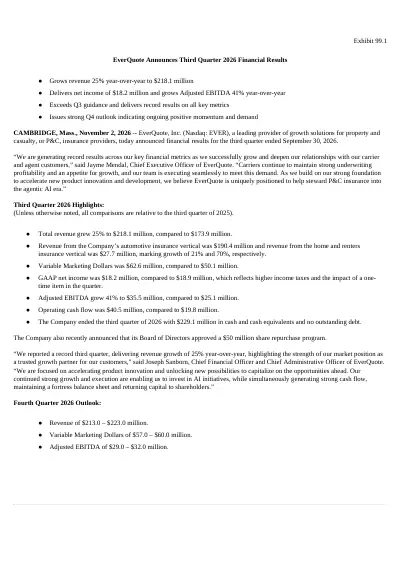
Thank you, Jayme, and good afternoon, everyone. We delivered record results in Q3 and exceeded the top end of our guidance across all key financial metrics.
We grew revenue 25% and adjusted EBITDA 41% year-over-year. We also drove record variable marketing dollars, or VMD, and adjusted EBITDA, while at the same time generating strong cash flow.
Our AI investments are already yielding results, and we will continue to invest to extend our market leadership position even further. Now let's turn to the details of the third quarter.
Total revenue increased to $218.1 million. Revenue from our auto insurance vertical grew to $190.4 million in the third quarter, an increase of 21% year-over-year.
Our home insurance vertical grew 70% in Q3 to $27.7 million, as carriers continued to lean into home as a growth opportunity, and as we align our solutions and resources to scale this vertical and diversify our business. We are executing well in a healthy environment.
Looking at customers, 8 of our top 10 carriers grew sequentially, underscoring that demand continues to be broad-based. VMD increased to $62.6 million in the third quarter, up 25% from the prior year period.
Variable marketing margin, or VMM, was 28.7% for the quarter. Turning to operating expenses and the bottom line.
In the third quarter, GAAP net income was $18.2 million, down from $18.9 million in the prior year period, due primarily to income taxes increasing $7.3 million year-over-year and a one-time $4 million dollar termination fee related to a vendor contract for advertising services. Q3 adjusted EBITDA increased 41% from the prior year period to $35.5 million, representing a 16.3% adjusted EBITDA margin.
Cash operating expenses, which excludes advertising spend and certain non-cash and other charges, were $27.2 million in Q3, up slightly from Q2. We reported operating cash flow of $40.5 million for the third quarter.
We ended the period with no debt and cash and cash equivalents of $229.1 million. We recently announced that our board authorized a new $50 million share repurchase program.
As a reminder, under our previous program, which concluded in Q2, we purchased 2.5 million shares totaling $50 million dollars. The recent authorization is a component of our three-prong approach to capital allocation, which includes: 1, maintaining a fortress balance sheet; 2, pursuing targeted M&A and investment opportunities that align with our growth strategy to expand our TAM; and 3, returning capital to shareholders through stock repurchases.
The continued strength of our operations and expectations for ongoing growth and profitability give us confidence that we have the flexibility and capacity to execute these priorities. Finally, as Jayme mentioned, we are focused on broadening our offerings and leading our sector into the agentic AI era.
This includes new solutions to capitalize on emerging models for agentic LLM traffic and extend the value we provide carriers and agents as they adapt to new models. These initiatives build on the success of our marketplace and reinforce our position as an AI beneficiary long-term.
We look forward to sharing more with you in the coming quarters. Turning to guidance for the fourth quarter of 2026.
We expect revenue to be between $213 and $223 million, representing 12% year-over-year growth at the midpoint. We expect VMD to be between $57 and $60 million, representing 19% year-over-year growth at the midpoint.
As we mentioned, we are investing in new agentic LLM channels and developing new solutions to drive long-term growth. As a result, VMM is expected to decrease sequentially from Q3.
Our Q4 adjusted EBITDA is expected to be between $29 and $32 million, representing 22% year-over-year growth at the midpoint. Looking ahead, we expect healthy carrier demand into the coming year.
Insurer combined ratios remain low, and we are benefiting from operating in the relatively early stages of a prolonged soft market cycle. As illustrated in our investor presentation available on our IR website, industry analysts have forecast this soft market cycle could continue well into 2029 or beyond, as carriers focus on growing policies in force.
Amidst this positive environment, EverQuote is a trusted growth partner of choice for both carriers and agents. Our home vertical is showing impressive growth, and we continue to broaden our customer relationships.
Our investments in expanding AI solutions are delivering measurable customer results, establishing a strong foundation for sustained growth. As a reminder, on our November 2025 earnings call, we shared our goal to become a billion-dollar revenue company within two to three years while also generating strong cash flow.
Here we are 12 months later. As evidenced by our results and guidance, we are executing well toward our goal.
We are on track to reach the $1 billion revenue mark within the stated timeline, which means that we expect to achieve our goal within the next one to two years. At the same time, we are making the right investments today to lead our sector into the agentic AI era tomorrow, and scale well beyond our near-term $1 billion revenue goal while generating strong cash flow.
In conclusion, we continue to execute our strategy to be a trusted growth partner for our customers. We reported a record quarter across all key metrics with strong growth and cash flows.
We have a focused growth strategy to innovate and expand our offerings, capitalize on new growth opportunities with agentic AI, and broaden our value for our customers. We believe this is an exciting time to be a shareholder of EverQuote, as we continue building upon our strong foundation while also innovating for what's next.
Jayme and I will now take your questions.
Operator
We will now begin the question-and-answer session. If you would like to ask a question, please press *1 to raise your hand.
To withdraw your question, press *1 again. We ask that you pick up your handset when asking a question to allow for optimum sound quality.
If you are muted locally, please remember to unmute your device. Please stand by while we compile the Q&A roster.
Your first question comes from the line of Ralph Schackart with William Blair. Your line is open, please go ahead.
Ralph Schackart
Good evening, and thanks for taking the questions. Jayme, maybe just to kind of kick it off at a high level, can you walk us through how you see the workflow, let's say I go to an agent such as Muse or something similar, and I don't know, maybe simple query like I want to lower my auto insurance and maybe get a little bit more details, how does that sort of trigger, I guess, maybe your agent or sort of that flow, or how does EverQuote in this evolving world integrated to that?
Then I have a follow-up.
Jayme Mendal
Sure. I think there's how it works today and then how it's likely to evolve over time.
Today, Meta Muse will sort of make a determination as to how best to complete that task, and through our testing, we've seen it try a lot of different things, from going directly to carrier sites to looking at comparison sites like ours. If you zoom out, we've been anticipating and planning for agentic commerce for some time now, and I think from the consumer's perspective, these personal agents are going to be helpful across a lot of tasks, including researching and shopping insurance.
As we know, there are certain aspects of the insurance sector that differentiate it from others. You've got the regulatory and compliance considerations, the preference towards rate opacity from a handful of particularly the largest carriers, got material costs associated with accessing rates, and so while from the consumer's perspective, using an AI agent to compare and shop is likely an attractive option, I think that ultimately the shape that this takes over time will really start to depend on how carriers respond.
Ralph, we published a thought piece on this, and we've since spoken with just about every major carrier on this topic over the last 6 weeks, and so I'll share a few things that we've heard, which I think represents probably the latest in terms of how the industry is thinking about it. First, I think most carriers are in kind of learning mode right now, they're just observing what's going on and trying to sort of understand it.
Number two is, I think across the board, they do perceive potential risk to their business if agentic commerce is left kind of unmanaged, and the risks that they're concerned about, I think, is continuous reshopping, which could compress their policy life expectancy. I think they do not support rate transparency, particularly if it's out of context or not controlled by the carrier themselves.
That can lead to adverse selection. Then you still have a lot of legal and compliance questions that are unanswered.
I think initially most carriers are likely to move pretty slowly and impose some guardrails around how their rates are accessed, much like they did in the web era, candidly. Ultimately, I think the carriers will start to want to access this traffic as long as they can access it in ways that align with their requirements.
You've got the consumer that will probably want to apply this use case, you've got the carriers who are still working through it, and then you've got the third category, which is what you asked about, which is the actual AI agents themselves or the platforms that operate them. What do they want?
They want a streamlined path to access products, right? They want inexpensive, they want fast, they want ultimately effective.
We've done a lot of testing, but based on this testing, I think today, they're pretty far off from getting the job done well. They can only access a relatively small subset of available products, and it costs quite a bit to actually run one of these shopping cycles today in terms of compute.
This is going to develop over time. We see it as a really significant opportunity for EverQuote given our position in the value chain, our scale, our technical acumen, carrier relationships we have.
We do see an evolution towards more agentic discovery over time, same way traditional advertising shifted to digital, and we think EverQuote can play a significant role in this next phase of distribution to help solve for the best outcome not just for consumers, but also for carriers and for the AI platforms themselves alike.
Ralph Schackart
That's super helpful, thank you. Just maybe one quick one.
Just looking at homeowners growth of 70%, obviously very strong. This quarter, Joseph, I think you talked about just carriers leaning in, but any more color on this in terms of drivers and then how should we think about this growth rate going forward?
Thank you.
Joseph Sanborn
We were pleased with how the vertical did this quarter. Just to give some context, Ralph, we made some decisions in first part of last year to really start to put some new execution expertise around the home vertical.
We've talked about how we saw this opportunity emerging, first the carriers focused on getting the right pricing in auto, now they've switched into home, and we saw that coming, we got ready for it. Our team has been doing a really nice job.
The first part of this year, we had 30% 30, 35% growth in Q1 and Q2. Q3 was even stronger.
What drove it in Q3, I think it would be a couple of things. One is, I think our team is doing a nice job scaling the offering, but we're also putting some dedicated resources on there as well.
We also see the carriers at the same time leaning into the home opportunity broadly, and so we've been working with them, and as we've been putting more resource on, we've been helping them say how do we set up this vertical with the specific attributes and characteristics in the workflow that are required for home, and we've been doing that. We've been very pleased with it.
I would say the overperformance on home was in part driven by carriers coming on even stronger in the quarter than they anticipated when they told us at the start of the quarter how they were looking, we're pleased by that. As we look ahead, we see home continuing to be our stronger grower than auto in the medium term.
I would say 70% was very impressive, and I wouldn't put that into your model, Ralph, but I would say having outsized growth from the home vertical, we were in the 30s for first part of 30s percent year-in-year growth for Q1 and Q2. We sort of see the home vertical continue to grow nice strongly going ahead.
Just be mindful on the numbers, it's off a relatively small base, in any given quarter when you have a few things go really well, that can sort of amplify the year-on-year growth, which is what a little bit has happened in Q3. Again, really strong execution by the team.
We're really pleased, and we're bullish on home's opportunity as we look ahead.
Ralph Schackart
Great. Thanks, Joseph.
Thanks, Jayme.
Joseph Sanborn
Thank you.
Jayme Mendal
Thanks, Ralph.
Operator
Your next question comes from the line of Maria Ripps with Canaccord. Your line is open, please go ahead.
Maria Ripps
Great, congrats on the strong quarter, and thanks for taking my questions. Clearly, you've seen strong momentum here exiting the year.
As we look ahead to 2027, can you maybe talk about the key growth drivers sort of in addition to a favorable industry backdrop, and how should we think about sort of their relative contributions to growth?
Jayme Mendal
Can you repeat that last part of the question, Maria? You broke up a little.
The contribution?
Maria Ripps
Yeah. As we think about 2027, how should we think about sort of key growth drivers in addition to a favorable industry backdrop and sort of relative contribution to overall growth?
Joseph Sanborn
Right. Sure.
Jayme Mendal
You mentioned the favorable backdrop, but we do expect that to persist with carrier underwriting as healthy as it's been, and I think most analysts seeing this soft market cycle extending at least into 2029, and so we feel good about the backdrop for next year. Beyond that, I think we always think about it there's distribution, and so how do we drive more carrier budget and improved pricing, and that, over the last couple of years, it's been driven through our AI bidding product, Smart Campaigns, which we continue to improve and drive greater adoption of, most notably, this last quarter, we expanded it to a critical mass of local agents, and we'll continue to roll that out into next year.
Then, within the agent population, there's a number of incremental products that we're rolling out as we work to consolidate to be the one-stop growth partner for the local agent, and so we see those starting to get some scale moving into next year. Then over onto the traffic side, as we get more budget, we're able to push that back and compete more aggressively in the traffic landscape, and we continue to expand into more channels, into un- and under-penetrated channels, some higher-funnel channels.
AI search, we expect to grow into next year, we got more traffic to feed that distribution budget. Joseph mentioned non-autos and our expectations for home next year.
Then, the other product which we recently launched is Luva. It's a new experience we think will allow us to begin to tap into a new segment of shoppers who are a bit more sort of research-oriented, AI-native shoppers that should help with growth next year as well.
Maria Ripps
Got it, that's very helpful. Then, just in terms of sort of AI agents and your white paper, so as insurance shopping sort of shifts towards AI agents, how should we think about sort of the economics of customer acquisition for your platform?
I guess could greater automation improve conversion and acquisition efficiency, or could we see sort of some pressure on the economics as AI platforms essentially take a larger role in driving demand?
Jayme Mendal
Yeah. I think, when we think about the unit economics, to put in context, right now it's negligible.
It's sort of immaterial in terms of its scale. We get less than 1% of our traffic from LLMs and even less from agentic shoppers.
It is reasonable to expect it will grow over time. Question number one is for us in terms of unit economics is what does it do to volume, because to the extent that agents can shop, reshop with greater frequency and less friction, we actually may see an increase in monetizable events as that happens.
Then, I think the jury's out in terms of how exactly the economic model will evolve, but to the extent that these agents are able to do good research and improve the likelihood that the ultimate referral converts into a policy, we could see greater performance from the referrals going out and, in turn, greater monetization.
Maria Ripps
Got it, that's very helpful, thank you. Thanks, Maria.
Operator
Your next question comes from the line of Naved Khan with B. Riley.
Your line is open, please go ahead.
Naved Khan
Hi. A couple of questions from me.
Maybe the first one, we're hearing some changes to Google Search, in terms of Google kind of increasing the coverage for AI Mode, and it seems like just looking at your numbers, doesn't seem to have affected your numbers, or even looking at the guide for the Q4. Maybe just talk about your ability to kind of adapt to Google's changes, and how kind of you look at the quality of the leads you get from there directly and also the diversification in your own traffic.
Then I have a follow-up.
Jayme Mendal
Sure. I think to begin, we have a very diversified traffic portfolio.
Google is a large partner, but we have a very diversified base of traffic to begin with. I think over the last few years, the segment of Google traffic that's been most impacted has been organic traffic, which, for better or worse, and right now it's for better, we've never had much exposure to organic traffic.
We've always been heavily concentrated with paid programmatic advertising, and we have managed to kind of work through all the changes that have occurred with Google to date, and we expect that to persist moving forward. Overall, we see shopping activity relatively stable this year at elevated levels because I think the overall policy value and premiums just remain high, and so people are shopping and reshopping frequently in response, I think, the cumulative effect of rate increases over time, and we've seen relative stability over the course of the year.
Naved Khan
Understood. Okay.
Then, I just wanted to touch on this partnership with Guani Vani, I guess, is how you pronounce it. I think there is some kind of exclusivity there.
What does it cover exactly? Is it for the US, does it cover P&C or something broader?
What's the duration there? Also with respect to any kind of revenue generated through such a partnership, how do the economics compare versus something that you get through the channels?
Thank you.
Jayme Mendal
Sure. The basic premise of their offering is that they provide technology, infrastructure, and services to help companies of regulated industries distribute through AI channels.
They will help build applications and then host infrastructure that provides related services, compliance services, insights, analytical services, and we have partnered that with them on our market, effectively. They serve multiple markets, geographically and from a vertical standpoint, and the scope of our partnership is to help them distribute their offering to our customers in P&C insurance within the US market.
Then Joseph can add.
Joseph Sanborn
It's a multi-year arrangement, obviously there's milestones as it evolves. The economics, I think we were pleased with how the economics work from our partnership basis.
As you might imagine with any partnership, it's not a perfect answer exactly how it compares to current economic spend, and how much we sell, but I think we feel very good on the opportunity in the partnership. I think sort of stepping back from the specific arrangement puts some broader context of our strategy.
As we think about bringing more AI-first products to carriers and agents, how do we go about doing that? Some of those we will certainly be building ourselves, and we're doing that.
Some of those will find companies like Guani Vani where it makes sense to partner. We can do that as well.
Sometimes acquisition will be involved as well, and investment. There's a whole range of possibilities, but Guani Vani sort of fits into that strategy, just sort of to give you sort of the broader context.
Jayme Mendal
Great.
Joseph Sanborn
Thank you. Thanks, Naved.
Operator
Your next question comes from the line of Brian Smilek with J.P. Morgan.
Your line is open, please go ahead.
Hi everyone, this is Vignesh on for Brian. Thanks for taking my question.
I guess just as you look into 2027, you kind of touched on it, but just a little more color into how the conversations with the carriers are kind of shaping up, and if you're seeing any changes in kind of appetite, and what that broad-based strength kind of looks like. I know you mentioned eight of your kind of top 10 customers also grew sequentially, any color on that would be good.
Joseph Sanborn
Sure. Thanks for the question, Vignesh.
I guess maybe we'll start with how are we feeling right now. As I said in our prepared remarks, it's a healthy environment, and we expect that to continue into, not just into next year.
We see it's a, sort of relatively early stages of a prolonged soft market cycle. As you know in insurance, a soft market cycle is good.
The research we referenced in our IR deck shows it's going into 2029, several analysts, we feel very good about that backdrop. As you look at carriers right now, we see carriers broadly healthy, right?
They want to grow policies in force. We saw in Q3 eight of our we had sequential growth in eight of our 10 carriers, top 10 carriers, we feel really good about that.
As we look into next year, we see that dynamic continuing, and so we see this favorable backdrop as being very very good time for EverQuote.
Got it, thanks. Then, I guess one follow-up on the launch of Luva, I guess.
Could you kind of talk about maybe how you see monetizing the platform, and any sort of maybe milestones to track into next year? Yeah.
Thanks.
Jayme Mendal
There's a number of ways we will monetize. Depending on the carrier relationship, some will be treated as commission, some will be, paid as effectively a per-performance on the placement of the policy, and there may be some referral-based models as well.
It will be a hybrid from a monetization standpoint, but that's really based on what suits the carrier for this channel. We're all of what 5 or 6 days old at this point, but some of the things that we'll be looking at as we progress into next year is obviously further development of the product in terms of the carrier panel, the capabilities, and then adoption, right?
This is really meant to access a segment of shopper that wants a different kind of comparison experience that's built around conversation, education, really deeper understanding of their coverage and their policy options, and it was designed from day one around the needs of consumers using LLMs and conversational AI and built on top of infrastructure that can be leveraged to serve agentic commerce. We're going to be looking for arrivals specifically through those channels to ensure that the sort of the intended segment that we are trying to serve is actually accessing the product and getting the value.
Operator
Your next question comes from the line of Jason Kreyer with Craig-Hallum. Your line is open, please go ahead.
Jason Kreyer
Great, thank you, guys. Can you just talk about the progression of the AI partnerships, just where you're at in terms of rolling out the partnerships that you talked about on the call, and then maybe what kind of a pipeline you're developing to extend to additional AI partners?
Jayme Mendal
Just to clarify, are you talking on the carrier side or on the platform side?
Jason Kreyer
More on the platform side, like you talked about, Meta and Anthropic and OpenAI and stuff. Thanks.
Jayme Mendal
We have relationships across the board. I think that each of these platforms is still trying to learn their way into our category, particularly into the distribution landscape within insurance, and so we've been having good, productive conversations with them to try and sort of educate them about some of the unique characteristics of our market.
Our expectation is that we'll be able to kind of build relationships that will sort of give us certain access and ability to really partner with them over time.
Jason Kreyer
Appreciate that. Maybe one for Joseph.
You've called out the expectation for a downtick in VMM Q3 to Q4. You said that would be at least in part driven by the move into agentic.
Curious what your perspective is over the next couple of years. Do you think that VMM, do you think those will remain stable, or is there potential for upside or downside to VMM as agentic becomes more and more part of workflows?
Joseph Sanborn
Sure. Great question.
To give you some context, when you think about the investments we're making in our AI offerings, one of the areas those investments show up is in the traffic line. Again, different than some of the investments we've talked about in AI investments previously, where they're showing up in driving efficiencies in the OpEx line, where we're able to drive a lot of increase in leverage through those investments in AI, different with our AI and the investments we're making in agentic traffic sources.
Just like any new traffic source, those new channels do not perform as well in the early days, and again these particular traffic sources are new. They're still evolving for us and for the industry as a whole.
As we look at that area, we're very bullish on the opportunity. You're seeing in Q4 we're making investments in these traffic channels, and Luva's part of that.
Those will continue into the first part of next year. As we look at the VMM margin, what I would sort of say is I would look at Q4 as a reasonable proxy for next year sort of a starting point.
We'll see how it evolves from there, but I guess that could give you a high-level view on it from the VMM margin level.
Jason Kreyer
Great color. Thank you.
Joseph Sanborn
Thanks, Jason.
Operator
Your next question comes from the line of Jed Kelly with Oppenheimer. Your line is open, please go ahead.
Jed Kelly
Hey, great. Thanks for taking my question, and another nice quarter with a strong free cash flow.
I think, ever since I've known you, it's been almost 10 years, or maybe over 10 years, the company at its core has always been machine learning, AI, it seems like you've got a pretty big advantage harnessing this technology relative to your competitors. How should we think about, is there an opportunity here to sort of maybe consolidate the market, gain more distribution, accelerate share gains?
How should we see that in terms of using this to maybe drive better unit economics from the carriers or gain more market share? Just can you talk about how we kind of think about your ability to use the solution and just accelerate share and drive better unit economics for the business?
Jayme Mendal
Yeah. Thanks, Jed.
To your point, since the company's inception, I think one of the value-adds we've been able to bring to carriers is we tend to be kind of at the leading edge within our industry in terms of performance marketing and customer acquisition in digital channels, through the use of whatever the latest technology and data available is. That has driven the growth that has gotten us to this point.
Now, we are now in the early stages of the evolution to kind of the next phase of things, and I think the same pattern is likely to play out again, and we're really leaning into it, right? We are trying to stay very much in close contact with all the AI platforms and with the carriers to help start to bridge the gap between what is a very fragmented, very opaque, and nuanced market, and these platforms that really are just trying to deliver maximum value to their consumers.
I think if we can maintain a strong position in helping bridge that gap, there's going to be just a tremendous amount of opportunity along the way for us to build products and deliver traffic in a way that really benefits both sides of that marketplace.
Jed Kelly
Got it. Then just around capital allocation, see you're implementing a share buyback, get that just given the current valuation, but does it make sense maybe, given where valuations are now for some of your other competitors, does it ever make sense to explore more M&A versus buying back stock where it's hard to see if the market's going to give you credit for that?
Any thoughts on that? Thanks.
Joseph Sanborn
Sure. Thanks, Jed.
When we think about capital allocation, it continues to be the same as we've said before, which is there's three ways we think about it, right? Which is first is we want to make sure we have a fortress balance sheet.
As you think about the deepening our partnerships with our carrier partners, they will want to see a partner who has got depth on their balance sheet and will be here, and so I think that certainly is important to us and it always has been, even more important now as you think about these longer-term relationships. The second is, M&A and investments, right?
We see this as Vani Vani was an example of an investment. We think about M&A as an opportunity as well, and M&A is something certainly we're looking at, but what form it will take, we will see over time.
Again, whether it's investments or M&A, it's all about how we will build our TAM over time as the world evolves in this AI-first world, so that'd be the second. Buybacks, for us, we can do all three.
We are the cash flow generation that gives us the flexibility and capacity to do all the above. On buybacks, we see it as opportunistic utilization, and it sort of also helps us offset employee dilution, which happens on an annual basis, and we think that's wholesome.
Jed Kelly
Thank you, and great quarter.
Joseph Sanborn
Thank you, Jed. Appreciate it.
Operator
Your next question comes from the line of Gregory Peters with Raymond James. Your line is open, please go ahead.
Gregory Peters
Good afternoon. I guess most of the questions that I had in mind have been asked, but maybe you can just remind me, during your commentary, you talked about the vendor services contract that was not renewed.
Maybe you could just remind me the details behind that, what's going on there?
Joseph Sanborn
Sure, sure. This was a relationship we entered into about a year ago.
It was sort of a a new traffic opportunity, a branded traffic opportunity, and it was sort of a multi-year arrangement, 5-year arrangement. As we've progressed into that arrangement, we realized it was not performing to the way we liked.
It was also distracting from our other traffic operations. We decided to end that particular contract.
We still have a relationship with that in brand, and we continue to work with them, but the exact arrangement didn't make sense. The it was a 5-year arrangement that we we cut it short, we took the charge in the period.
That was reflected on the reflected in and it was it was a it was reflected in our adjustment to net income. This was sort of a very unique kind of situation for us.
We had not done something like this before, and it was something we tried and obviously we we reassessed when when it when it wasn't working the way we expected.
Gregory Peters
Thanks for that color. Can I go back to Smart Campaigns?
I believe you're helping improve the conversion rates, and yet you say you're doing it and your revenue results reflect it, but I don't know if there's some statistics you can add to your disclosure that will help us understand, hey, when the carriers use our Smart Campaigns, their conversion rates improved by 2x or 3x or something like that, but any color you can provide on that would be helpful.
Jayme Mendal
We've shared case studies in the past, Greg. It always depends on where the carrier starting point is, but in some of the case studies we've shared in the past, I think some of the numbers we've used have been double-digit or 20 20% performance improvements in a controlled test as a result of testing Smart Campaigns against their whatever legacy bidding they were doing prior to that.
Gregory Peters
Okay. Thanks for the answers.
Jayme Mendal
Thank you, Greg. Appreciate it.
Operator
There are no further questions at this time. I will now turn the call back to management for closing remarks.
Jayme Mendal
Thank you. Thanks everyone for joining us.
To close out, I want to first thank the EverQuote team for delivering yet another excellent quarter with record financial performance. We continue executing our strategy, deepening customer relationships, and driving further innovation as we lead P&C insurance distribution into the AI era.
Look forward to sharing further updates in the coming months as we build on this momentum. Thanks all.
Operator
This concludes today's call. Thank you for attending.
You may now disconnect.