First Advantage Corporation
Q3 FY2026 · Earnings Call TranscriptNovember 5, 2026
Operator
Good morning everyone. My name is Bo and I will be your conference operator for today.
I would like to welcome you to the First Advantage third quarter 2026 earnings conference call and webcast. Hosting the call today from First Advantage is Stephanie Gorman, Vice President of Investor Relations.
At this time, all participants have been placed in a listen-only mode to prevent any background noise. After the speakers' remarks, there will be a question and answer session.
If you would like to ask a question during this time, please press *1 on your telephone keypad. If at any point your question has been answered, you may remove yourself from the queue by pressing *2.
Lastly, if you should require any operator assistance today, please press *0, and please note today's event is being recorded. It is now my pleasure to turn the call over to Ms.
Stephanie Gorman. Please go ahead, ma'am.
Stephanie Gorman
Thank you, Bo. Good morning everyone, and welcome to First Advantage's third quarter 2026 earnings conference call.
In the Investors section of our website, you will find the earnings press release and slide presentation to accompany today's discussion. This webcast is being recorded and will be available for replay on our Investor Relations website.
Before we begin our prepared remarks, I would like to remind everyone that our discussion today will include forward-looking statements. Such forward-looking statements are not guarantees of future performance.
Actual results may differ materially from those expressed or implied in the forward-looking statements due to a variety of factors. These factors are discussed in more detail in our filings with the SEC, including our 2025 Form 10-K and our Form 10-Q for the third quarter of 2026 to be filed with the SEC.
Such factors may be updated from time to time in our periodic filings with the SEC, and we do not undertake any obligation to update forward-looking statements. Throughout this conference call, we will also present and discuss non-GAAP financial measures.
Reconciliations of our non-GAAP financial measures to their most directly comparable GAAP financial measures, to the extent available without unreasonable efforts, appear in today's earnings press release and presentation, which are available on our Investor Relations website. I am joined on our call today by Scott Staples, our Chief Executive Officer; Joelle Smith, our President; and Steven Marks, our Chief Financial Officer.
After our prepared remarks, we will take your questions. I will now turn the call over to Scott.
Scott Staples
Thank you, Stephanie, and good morning, everyone. Thank you for joining our call.
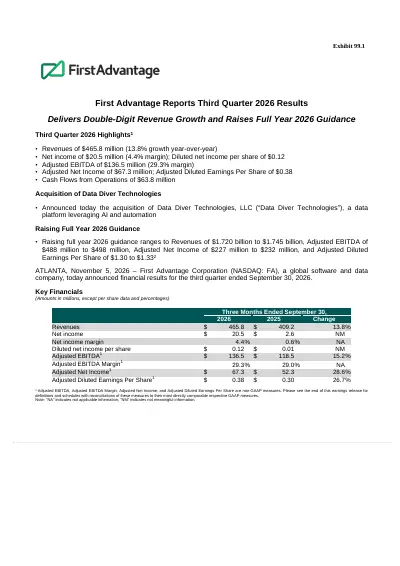
Today, we have four key messages. First, we delivered yet another quarter of outstanding results in the third quarter, with revenue growth of 14% year-over-year, adjusted EBITDA margins of 29.3%, and year-over-year adjusted diluted EPS growth of 27%.
We continue to demonstrate consistent go-to-market performance, the strength of our leading AI-driven technology platform and proprietary data, sustained operating efficiency, and the durability of our diverse enterprise customer base and vertical mix. Second, we are making strong progress on our FA 5.0 growth strategy.
Our focus on product innovation, platform capabilities, AI and automation, and go-to-market execution is translating into tangible results. Just a few days ago, we were very proud to have celebrated the two-year anniversary of closing the Sterling acquisition, which has been a critical element supporting and accelerating our growth.
Third, our strong cash flow generation continues to provide flexibility to execute our balanced and disciplined capital allocation strategy. As we have previously mentioned, we are constantly evaluating opportunities to create shareholder value and remain focused on deploying capital where it can have the greatest impact.
Along with our earnings release today, we are excited to announce that we have further invested in our proprietary data and technology strategy with the tuck-in acquisition of DataDiver Technologies, a data platform leveraging AI and automation, which Joelle and I will discuss shortly. Finally, we are again raising our full year 2026 guidance across all key metrics to reflect our strong year-to-date performance, continuing go-to-market success, stable labor market trends, and our confidence in our growth outlook for the remainder of the year.
In fact, the low end of our revised full year guidance ranges now exceeds the high end of our previous guidance ranges across every metric. Now, turning to slide 5, we delivered outstanding results in the third quarter across the board, continuing our strong performance from the second quarter.
Our results exceeded our stated expectations, benefiting from sustained broad-based momentum across our Americas business, continued contribution from our recent large contract wins, peak holiday hiring progressing earlier than expected, and modest carryover from Q2 customer initiatives. We are also encouraged by the healthy pace of order volumes in October and the continued stability within the broader hiring environment.
We believe the strengths of our business, including our focus on high-volume enterprise customers, diverse vertical mix, global footprint, and balance across blue-collar and white-collar hiring, continue to position us well in the market. These attributes provide stability and reinforce our confidence in delivering durable growth across a variety of macro environments.
In this rapidly evolving environment, our customers continue to place a high value on our AI-driven product innovation, leadership in identity fraud detection, and our combination of regulatory expertise, risk management, and focus on compliance. This enables First Advantage to deliver high-quality, highly automated, and high-volume screening globally at scale.
One recent milestone I would like to highlight is the two-year anniversary of closing the Sterling acquisition on October 31st. We are executing well and realizing benefits well ahead of our original expectations.
Today, we are a larger, stronger, and more diversified company, offering customers a broader portfolio of best-of-breed technologies and products backed by greater scale and innovation capabilities. As a result, we have strengthened our market position, expanded our growth opportunities, and enhanced our ability to create long-term value for shareholders.
With Sterling, we demonstrated our capability and discipline in executing our M&A strategy, successfully integrating the business, and delivering growth and synergies. As we announced today, we are applying our M&A playbook again with the tuck-in acquisition of DataDiver.
Turning to slide 6, DataDiver is a company we know very well and have worked with for a number of years as a key third-party data provider to First Advantage. Over the past couple of decades, DataDiver has built a proprietary data platform powered by an automated fulfillment engine that collects, aggregates, retains, and delivers high-volume criminal and court records.
As a reminder, First Advantage has been a product innovator in this space for years, investing in data and automation, such as our National Criminal Records File and our Verified proprietary databases. DataDiver builds on that foundation by adding incremental proprietary data, proven technology, and an experienced data team, creating a neat opportunity to accelerate our data and technology strategy.
With over 1 billion data records already in our proprietary databases, the combination will expand our existing databases, grow our automated fulfillment coverage across the US jurisdictions, enhance our existing solutions, and accelerate development of new capabilities. The DataDiver acquisition also adds resources and capabilities that support faster turnaround times, high-quality results for our customers, and further differentiate First Advantage in the market.
The acquisition is centered on DataDiver's proprietary data assets and technology, and also includes a small employment background screening component. The acquisition adds annual revenues of approximately $20 million and adjusted EBITDA margins in line with our existing profile, with upside synergy opportunities.
Overall, this $125 million acquisition represents an important investment in our strategic data assets. With that, I will now turn the call over to Joelle, our President, who will share more on our outstanding third quarter, including our go-to-market execution, vertical performance, product innovation, and further details on our acquisition of DataDiver.
Joelle Smith
Thank you, Scott, and good morning, everyone. Turning to slide 8, and an update on our go-to-market performance and the underlying dynamics behind our outstanding results this quarter.
Our robust 14% year-over-year revenue growth for Q3 exceeded our previously stated expectations and our long-term growth algorithm target. Combined upsell, cross-sell, and new logo revenues again delivered robust growth, achieving 12.5% growth in the quarter.
We continued to benefit from the large go-lives from the end of 2025 that we have discussed on previous calls, as well as the contribution from the many other enterprise deals we have won in prior quarters. We had excellent base growth in the quarter, coming in at 5%.
Underlying base trends remained strong and broad-based, and we saw some continuing benefits from customer initiatives started during the second quarter, which contributed a little more than 1% to this quarter's base growth. Retention remained solid at 96%, in line with our long-term model.
Our sales teams delivered a solid 14 enterprise bookings in Q3, with each deal having an expected annual contract value of at least $500,000. These wins, combined with the continued strength and expansion of our late-stage pipeline, reinforce our confidence in the durability of our new logo and upsell/cross-sell execution and support our positive outlook for the fourth quarter.
Turning to our verticals on slide 9, we yet again outperformed broader labor market headlines and data trends in Q3, reflecting our strong market position and our strategic execution. Throughout the quarter, the tones from our enterprise customers regarding their hiring plans remained neutral to positive, which you can see reflected in our Q3 base performance.
Our balanced and resilient customer mix, focus on high-volume hires, and verticalized go-to-market strategy drove broad-based revenue growth across almost every vertical in our Americas business. We saw sustained strength in transportation and logistics, as well as retail and e-commerce.
This was supported by ongoing healthy consumer activity driving labor demand, along with an earlier-than-expected start to the peak holiday season hiring toward the end of the quarter. We saw standout performance in industrials and manufacturing, resulting in increased screening activity for this vertical, driven by strong demand for their products and services and increased economic activity in aerospace and defense.
We also saw positive momentum in general staffing, healthcare, TMT and hospitality, and the gig economy. As you can tell, the outstanding performance in the quarter was truly broad-based across most verticals.
Turning to our international business, which represented approximately 11% of our total sales in the quarter, Q3 were down 4% year-over-year, following nine consecutive quarters of growth, with performance in APAC and India having been impacted by disruptions in the Middle East and the related broader macroeconomic uncertainty. Our EMEA business performance remained more stable.
Despite the near-term headwinds in certain countries, we continue to be a partner of choice for managing our multinational customers' expanded screening needs across the geographies. We remain confident in our long-term international opportunities.
Turning now to our product update, identity fraud remains a critical topic with our customers and prospects, with 45% of hiring professionals having experienced candidate identity misrepresentation, as reported in our 2026 Global Workforce Trends Report earlier this year. In fact, the subject continues to be the tip of the spear in our discussions, as customers and prospects fight growing recruitment and onboarding fraud in the workplace.
Our "Trust in a Changing World" message has landed right on point as we help our customers answer an increasingly important question: are my candidates who they say they are? As employers face growing risks from hiring fraud, synthetic identities, fraudulent or AI-generated documents, and other emerging threats, demand for identity fraud detection products, like our digital identity solution, continues to grow and drive meaningful differentiation in the market.
We believe it is helping to expand our pipeline, improve win rates, and support retention, as customers and prospects increasingly view identity fraud detection products as key components of a modern screening program. We continue to use our good AI to fight the bad AI.
Building on that momentum, we recently announced an exclusive strategic partnership with ID.me to launch a purpose-built, FCRA-compliant digital identity verification product specifically designed for making employment decisions. Historically, digital identity verification has been outside the scope of the Fair Credit Reporting Act, or FCRA, which is the federal framework that governs background screening.
Our new product brings digital identity within that framework, allowing us to incorporate the identity fraud results into the background screening report. This means customers can now make critical employment decisions based on the combined results of the digital identity verification and the traditional background screening report, enabling their screening program to be more comprehensive and compliant.
Customers have told us that this increases both their willingness to adopt digital identity and expand its use within the screening programs. As the only large-scale background screener providing this level of compliance, it's a meaningful differentiator that can help support retention, strengthen our pipeline, and help us win new business.
Turning to slide 10, our SmartHub AI routing technology has been a game changer in our employment and education verifications businesses. Now, we are extending that same technology to how we source criminal records data.
We have officially launched Criminal SmartHub, which was developed entirely in-house by our data science and engineering teams. Criminal SmartHub uses proprietary AI to evaluate thousands of potential data sources to fulfill customer orders.
In seconds, Criminal SmartHub scans our proprietary criminal records, public data sources, and third-party data sources to intelligently identify the fastest, highest-quality, and most efficient way to fulfill the order. The result is faster turnaround times and greater efficiency for our customers.
We believe Criminal SmartHub is another great example of our technology leadership in the industry, the scalability of our proprietary AI, the value of our proprietary data, and our continued commitment to delivering best-in-class products to our customers. The value of technology like Criminal SmartHub is amplified by the quality, breadth, and accessibility of the data it consumes.
As we continue to invest in automation and AI-driven fulfillment, expanding our proprietary data assets remains a strategic priority. That is why we are so excited to announce our acquisition of DataDiver.
A meaningful benefit to our customers will be accelerated screening turnaround times, as expectations continue to shift from days to hours and increasingly toward near real-time results. By expanding our data and fulfillment capabilities, we can deliver faster, more efficient screening outcomes for one of our highest-volume product lines, while enhancing our existing solutions and creating new opportunities for product innovation.
Ownership of these proprietary data assets also gives us greater control over an important part of our fulfillment ecosystem, further enhancing our differentiation in the market. With that, I'll now turn the call over to Steven.
Steven Marks
Thank you, Joelle, and good morning, everyone. I'll start with our third quarter results on slide 12.
Our third quarter revenues were up an impressive 14% year-over-year, coming in at $466 million. This exceptional performance exceeded our stated expectations and our long-term growth algorithm target range.
Results were driven by broad-based volume acceleration in our Americas business, an earlier-than-expected start to peak holiday season hiring, and the continuation of some customer initiatives from Q2, which alone contributed slightly more than 1% to base growth this quarter. Adjusted EBITDA for the third quarter was $136.5 million, up 15% year-over-year.
Our adjusted EBITDA margin of 29.3% came in above our stated expectations and reflects sequential quarterly improvement of 70 basis points, driven by our broad-based revenue growth and our strong operating leverage as we were able to keep sales and marketing and G&A flat year-over-year even as revenue grew. Margins also benefited from data cost savings driven by the increased use of incremental data partners and algorithm updates to our SmartHub for verifications product, as well as our strong execution on synergies and cost discipline, all while flexing to adapt to the product mix changes as a result of the large deals we have previously discussed.
Our adjusted diluted EPS was 38 cents, a 27% increase year-over-year. Our per share earnings growth was supported by our overall performance in the quarter, year-to-date share buybacks, and synergy realization.
Earnings growth also benefited from our disciplined expense and capital management and our interest expense as a result of our voluntary debt repayments to date and our July 2025 debt repricing. We have continued actioning cost synergies from our Sterling acquisition, reflecting our disciplined execution and strong integration process.
At two years post-closing, we are proud to say that we have meaningfully exceeded our initial synergy thesis. By year-end, when we formally conclude our integration process, we expect to finish near, if not at the top, of our synergy target range.
We are also proud that we have achieved these synergies very thoughtfully and had essentially no impact on customer retention. Our best-of-breed product, technology, and customer service approach was received very favorably across our customer base and enabled us to achieve our goals.
Now turning to cash flow, net leverage, and capital allocation on slide 13. During the quarter, we generated operating cash flows of $63.8 million.
Year-to-date, this brings our operating cash flows to $186.8 million, a substantial increase of $57.6 million, or 45% on a year-over-year basis. Q3 operating cash flows were driven by the larger scale of our business, our overall focus on cash flow, and the natural working capital impacts of our revenue growth outperformance.
Our cash balance as of September 30th, 2026, was $241 million. Our synergized adjusted EBITDA net leverage ratio at quarter-end was 3.5 times, and represents a 0.9 times decrease from when we closed the Sterling acquisition two years ago.
Regarding acquisitions, given the strategic importance of DataDiver, we view this tuck-in as a highly compelling use of capital that preserves our flexibility to execute our long-term capital allocation strategy. We funded the $125 million acquisition using mostly cash from our balance sheet and, to a much lesser extent, our revolver.
We expect to pay off the acquisition borrowings in the near term using free cash flow. The acquisition does not change our overall deleveraging strategy and provides incremental tax benefits to the company.
We remain fully committed to our 2028 leverage targets. Our use of capital for share repurchases during the quarter was not material, and going forward, we will continue to be disciplined with our capital allocation approach to ensure we are executing a plan that maximizes ROI and shareholder value.
Moving to slide 14 and our updated 2026 guidance. Today, we are again raising our previously announced full year guidance, supported by our outstanding performance in the first three quarters of the year and our outlook for stability in the hiring markets for the remainder of the year.
We now expect 2026 total revenues in the range of $1.72 billion to $1.745 billion, adjusted EBITDA of $488 million to $498 million, adjusted net income of $227 million to $232 million, and adjusted diluted EPS of $1.30 to $1.33 per share. At the midpoints on a year-over-year basis, this represents approximately 10% revenue growth, 12% adjusted EBITDA growth, and 26% adjusted diluted EPS growth.
Our raised guidance range reflects a balanced posture on our Q4 outlook that incorporates the healthy state of our underlying demand trends, specifically those impacting US seasonal hiring, as well as the ongoing geopolitical and macro uncertainty. As a result, the continuation of current trends would support performance above the midpoint of our range; however, consistent with our approach towards guidance, we believe it is prudent to account for a broader range of outcomes given the factors outside of our control.
It is also important to remind you that our fourth quarter 2026 growth rates are being measured against an exceptionally strong fourth quarter last year, during which we grew a notable 12% year-over-year. More specifically, in Q3 of this year, we started to lap the 12-month anniversaries of the large 2025 go-lives we previously discussed, and for Q4, these wins will now be fully annualized.
As we have shared in the past, for Q4 we expect a more modest level of growth, with revenues being more evenly distributed this year as we grow over last year's strong 17% new logo and upsell/cross-sell growth. We also expect base to be neutral to slightly positive for Q4, supported by the strong demand trends from Q3, which continued into October.
Q4 adjusted EBITDA margins are expected to remain in line with our mid-28% year-to-date performance. For adjusted diluted EPS, we expect year-over-year expansion in Q4 reaching the low 30-cent range.
Please note that our updated guidance includes the very modest impact of the DataDiver acquisition in the last two months of the year. We have provided additional full year 2026 guidance assumptions in the appendix of our presentation, which again are not meaningfully impacted by the acquisition.
With that, let me turn it back to Scott for closing remarks before we open the line for your questions.
Scott Staples
Thank you, Steven. In closing, Q3 was another quarter of outstanding execution and performance, and we are pleased with the solid momentum we are seeing in the fourth quarter so far.
We remain focused on driving long-term value creation by providing best-in-class, differentiated products that address our customers' evolving needs. The acquisition of DataDiver is another example of how we are investing to enhance our data and technology offerings to continue to position First Advantage for profitable growth over the long term.
We remain confident in our ability to deliver consistent financial performance and continue to progress well toward the 2028 financial targets we established during our May 2025 Investor Day. I would like to recognize and thank the entire First Advantage team for their hard work and dedication to supporting our customers every day.
With that, we will open the line for questions.
Operator
Thank you very much, Mr. Staples.
Ladies and gentlemen, at this time, we will now begin the question and answer session. If you do have a question, please press *1 on your telephone keypad.
If at any point your question has been answered, you may remove yourself from the queue by pressing *2. Also, if you are using a speakerphone, we request that you please pick up your handset while asking your question to provide optimal sound quality.
Additionally, we ask that you please limit yourself to one question and one follow-up. We'll go first this morning to Andrew Nicholas with William Blair.
Daniel Maxwell
Hi guys, good morning. This is Daniel Maxwell on for Andrew this morning.
Maybe to start off on the synergy front, if you can maybe frame what's left to go on synergies on the Sterling side as we figure what to layer on top of core incremental margins for next year, as well as any color you can give on expected synergies from the DataDiver acquisition.
Steven Marks
Daniel, good morning. I think, look, there's really not a whole lot left to do, I would say, on the Sterling acquisition front.
As we shared on the call, we're kind of effectively weeks away from really saying that the acquisition's done. We've shared kind of throughout the year that a lot of the remaining 2026 synergy capture is going to come from more the cost to sales lines, as we just work through and finalize the alignment of fulfillment practices and workflows.
I think, a, that's where the synergies are coming from. I think, b, you're really seeing the value of that come through.
We saw the revenue outperformance and broad-based growth that we talked about in Q3. Our ability to fulfill that volume, and we shared this kind of last quarter, within the workforce management structure that we already had in place is one of the key drivers for the margin outperformance in Q3.
I think it's really not a whole lot left to do. We just have a few more programs to finalize and action, and as we shared in the remarks, we think we'll end the year at effectively the top end of our range, and most of that's in cost to sales.
In terms of DataDiver, I think there are some real synergies there. It's a combination of some being able to very similar to kind of a Sterling mindset, balance out our data acquisition methodologies between the new tech that we're buying, which is really good tech, and I'll let Scott or Joelle share some remarks there, and at the same time, leverage those resources for new product capabilities and product enhancements that Joelle was talking about in her remarks.
Hey
Scott Staples
Steven, the only thing I would add is on the Sterling side, as Steven was saying, we're basically done. We actually, as we head into 2027, don't really plan on talking about this going forward because it's been a huge success.
In fact, we're kind of taking a victory lap here and saying we integrated it perfectly. We had no impact really to attrition.
It's actually helped our growth engine. We're at the top, if not potentially exceeding our synergy targets.
Everything that we need to action is already in flight. There's no new things to do.
I think we're really closing a chapter on a really nice part of our journey here, and pretty proud of what the team has accomplished.
Daniel Maxwell
Great, that's helpful. Sticking with the DataDiver side of things, maybe you guys can talk to kind of the build-versus-buy decision and how difficult it would be for a competitor to replace this technology.
Then if you could also sort of rank the attractive aspects of the deal between the technology, the data asset, and I'm assuming the small-to-medium business screening component was kind of third of that list, but correct me if I'm wrong there.
Scott Staples
I'll kind of tag team with Joelle on this one a little bit. You're absolutely right in the fact that when you look at these things, you look at build versus buy.
In our prepared remarks, we mentioned that DataDiver has been at this for decades. They've done a really nice job of building out their tech platform, their automation, their algorithms.
There's a little bit of overlap obviously with what we do, but this actually fills a lot of gaps for us. They cover some jurisdictions that we hadn't get automated to.
In some of their jurisdictions, we like their automation better than ours. This gives us access to bulk data.
There's some really nice things here. It also gives us a really nice data team.
We get the entire team is coming over to help us drive future endeavors as to what we can do with this. This will, again, drive faster turnaround times for our customers, better automation, and even new product ideas.
Now that we've got a larger team here, access to more data, we can launch more products and really help our customers with this critical element of their screening. I will let Joelle kind of fill in a little more color here.
Joelle Smith
Thanks, Scott. It's not really a build versus buy, it's build and buy.
We've been building this, and it just goes to the complexity and size and scale of just how wide and big all of the jurisdictions are across the United States. There's states, there's counties, there's a lot of complexities to it.
The combination of these two things, and as Scott said, we've been working with them for a really long time, it really amplifies our ability to have a more complete product offering, and it accelerates the speed for us to be able to do it. It's a force multiplier.
We're very happy with it. The technology that they have and the data that they have is a great complement to what we do, and we're excited to see where this goes.
Daniel Maxwell
Thanks a lot.
Operator
Thank you. We'll go next now to Shlomo Rosenbaum with Stifel.
Avi Crespo
Hi, thanks for taking the questions. I'm actually covering for Shlomo Rosenbaum.
This is Adam Schwartz. Just in terms of the revenue EBITDA raise, I think revenue is up $42.5 million, I think EBITDA $14 million.
Could you just kind of break it out between sort of what was the 3Q beat versus the DataDiver addition, and then maybe what you sort of expect the outperformance in 4Q to be?
Steven Marks
A really good question. Certainly, we had an amazing Q3, and that's obviously a material component of the computation to raise guidance.
When you think about the impact of DataDiver, it's very modest. That deal closed this week, you get 60 days contribution on a business that's running roughly $20 million, it's roughly a 1% lift to Q4 if you're kind of just doing really simple math.
Really not a major computation into the guidance raise at all. Really, when you think about what gave us confidence to raise by that much, an incredibly strong Q4, as we shared on the call, good momentum into October, and if the current trends continue, we feel good about ending above the midpoint as we shared on the call in the prepared remarks, but obviously want to have a little bit of a wider range.
We've seen the last couple of seasonal peaks go long or go short, and obviously a lot of fast-moving, major geopolitical and macro-oriented items in the market these days. We feel like we've got a very appropriately sized range, and then obviously if the current trends continued as we shared, we expect to be at the upper end of that metric.
Avi Crespo
Great, thank you. Just in terms of DataDiver, there's a $20 million annual revenue that you're expecting.
Does that include any sort of revenue that maybe going away since you were using them as a vendor? Maybe just the background Okay.
Steven Marks
It is. Sorry, it's a small component.
You're talking fractions of that revenue, it goes away. Obviously, that also means part of our cost of sales goes away, and it's a very immaterial wash on the P&L.
Avi Crespo
Great. Just in terms of background for DataDiver, how is the growth trend in that business?
I guess, of course, you think through the strategy behind it, and we would expect a stronger lift in that growth, would be our guess.
Steven Marks
Look, obviously we're very bullish on the business. We wouldn't have bought it if we weren't.
They've had some good growth trends. Again, when you compare that to the size of First Advantage, it becomes a little bit of it gets washed out very quickly just because of the materiality of the difference between First Advantage that's running at a $1.7 billion pace based on our latest guidance.
We do feel very good about the business we acquired. Obviously, as Scott and Joelle shared in their remarks, we're strong believers in data and having strategies around data.
That's really the core reason for getting into the business is great tech, great data, and great ability to build incrementally on top of that.
Scott Staples
Steven, I would add, we also have a really good track record of doing M&A. We think we have a great process of finding the right companies, integrating them, and getting greater growth out of them than they would as a stand-alone.
Obviously, you can look at the success we've had with Sterling. Even before that, we've had multiple tuck-ins, which we have exponentially accelerated their growth and gotten value out of it.
We feel like this asset under our umbrella, we can do a lot with it.
Avi Crespo
Great. Thanks for taking my questions.
Operator
Thank you. We'll go next now to Jeff Silber with BMO Capital Markets.
Ryan Griffin
Hey, thank you so much. This is Ryan on for Jeff.
Just wondering how we should be interpreting the implied 4Q guide versus what was embedded in there previously for 4Q. I think the refined outlook, is it just maybe a softer view, though I know you're thinking you end up near the higher end of the range if things continue as is?
Thank you.
Steven Marks
Good question. If we kind of think about maybe where we started the year and in the originating guidance we gave out in February, the commentary that we shared there was we kind of expected base to be maybe neutral to slightly below neutral.
We're obviously feeling a little better about base given the trends the last couple of quarters, the strength within the verticals that Joelle shared within her remarks, and obviously a good October. I would say the real evolution there is probably just a feeling a little bit better about base today than we did eight months ago when we started the year.
Now with all that said, obviously, we still feel really good about the parts of our algorithm that we control and influence, our new logo and upsell/cross-sell being within our long-term guidance range there. Retention has been delivering at that 96% rate and there's no reason to think that that doesn't continue.
Certainly I think there's a little bit of just better feeling towards base, and obviously a lot of demand for talent out there right now. If you think about that evolution, certainly that's a key component of it in terms of Q4 growth rate.
I think obviously with the only caveat being, as I shared in one of the previous answers, a lot of moving factors impacting macro, and we want to make sure that we've got a little bit of coverage, if you will, in the range. Again, as I shared in the remarks, if things continue the way they are, we expect to be at that upper half of the guidance range.
Ryan Griffin
Appreciate it. Then on the continuing benefits rescreening that was strong again in the quarter, do you think that's becoming more of a durable trend in how companies have their risk mitigation framework?
Scott Staples
I think that's a bit hard to predict. The broader picture is that we're definitely seeing a major trend toward risk mitigation, and especially companies are very in tune and their antennas are up big time to fraud detection.
I think in general, the overall trend is to utilize more and more of our products. I think it's a combination of seeing more rescreening, also seeing ongoing monitoring.
We're seeing nice uplift in our monitoring business as well, which I think I mentioned last quarter, is starting to really become meaningful revenue for us. I think in general, sort of the risk profile of companies has changed with all the stuff that's going on in the world.
It's possible that that becomes more of a durable trend, but I think we've seen really two quarters of it, we're kind of wait and see. Certainly conversations with customers have changed over the last 12 months.
Operator
Thank you. Just a quick reminder, ladies and gentlemen, *1 for questions this morning.
We'll go next now to Manav Patnaik with Barclays.
Ronan Kennedy
Hi, good morning. This is Ronan Kennedy on for Manav.
Thank you for taking our questions. I think you had 14 enterprise bookings in 3Q versus 20 in 2Q.
It described the late-stage pipeline is continuing to strengthen and expand. Is there an element of normal quarter variability there or anything to note with regards to change in conversion rates, sales cycles, or customer decision-making?
Scott Staples
I'm going to let Joelle give you some details here, but just to look at the bigger picture, yeah, 14 bookings this quarter, which we're pretty happy with, and Joelle will give you the reasons why. 20 last quarter, but then we had three quarters in a row of 17.
We're kind of just within our range, but we are seeing a little bit of change when it comes to deal sizes, go-lives, things like that, but I'll have Joelle give you the color.
Joelle Smith
Sure, thanks, Scott. A little bit the 20 last quarter, 14 this quarter, it's a little bit of a timing thing, but it's also, as Scott alluded to, we have larger and a little bit more complex deals that we're closing.
The revenue for the enterprise deal is $500,000 annually or more, and so we're seeing that expand and grow as we're continuing to expand all of the growth opportunities that we have. Upsell, cross-sell, and new logos still continue to hum and outperform.
I think that the 14 and the 20 respectively is just a timing thing. We still feel really good about Q4, we still feel really good about the pipeline, late stages, large and growing, and we have larger deals.
All in all, we're still feeling really good.
Scott Staples
I think, Ronan, if you go back a year or two in our business, most of our contracts started sort of single product line. We start with background screening, and then we add drug testing and all these other things on as we engage with the customer.
That drives a lot of upsell/cross-sell. What we're seeing is customers are actually buying multiple products right out of the gate.
It takes a little longer to contract that, integrate that, go live with that, but at the end of the day, the benefit is that those are larger ACV deals. Joelle right in that we're seeing larger contract values, win rates continue to remain strong and even improve.
Pipeline is phenomenal, and a lot of it's driven by this whole trend, as you've heard us talk about for the last couple of years, of identity fraud detection and all these other things that companies are worrying about. It's just leading to better contracts for us in terms of more products right out of the gate versus having to upsell and cross-sell those things downstream.
Ronan Kennedy
Very good. Thank you both for that.
As a follow-up, if I may, base growth 5% in 3Q and a little more than 1% from the customer initiatives. As those roll off and given that healthy trends, what's the best way to think about underlying base growth entering '27?
Then Scott, Joelle, given the comments in response to my first question, how should we think about the composition of growth, new logo, upsell, cross-sell, given all those factors you've discussed? The composition of the '27 growth without looking for formal guidance, just if you can contextualize how to think about the composition of growth for '27.
Hey,
Scott Staples
Steven, why don't you take the first part, and I'll take the second part?
Steven Marks
I think certainly obviously we have a healthy base environment. I think you're seeing that commentary from all over the place.
Even I was listening to the Visa CEO a couple of days ago and talking about how that's contributing to their success. I think the hiring velocity right now of just broad market's really good.
Obviously the comps start getting much more difficult, Ronan. I know you've been following for a while.
The part of the year, even 3Q had some easier comps. We had a phenomenal Q4 last year, we're benchmarking, and then when we get into '27, we'll obviously have higher comps.
The pace of the market right now feels really good. We'll give out more color on 2027.
Obviously need to account for some recent events and making sure that we have a good point of view on the updated macro and get some latest customer feedback and making sure that hasn't modified plans. Certainly over the short duration, we feel good about how our customers have been responding to the macro and the needs of the market right now.
Scott Staples
Hey Ronan, on the second part of your question, yeah, we don't really see a lot of change in the algorithm. If you look back at the company even over the last couple of years, we've been super consistent on the three things that we control: upsell/cross-sell, new logo, and retention.
Obviously, the wild card has been base, but you've seen that not only stabilize, but come into the positives in the last two quarters: flat in Q1, 7% Q2, 5% Q3. If you look at upsell/cross-sell, we've always been so steady in upsell/cross-sell ranges.
New logo, I can't remember a quarter where it wasn't 4% or 5%. Retention, I can't remember a quarter where it wasn't either 96% or 97%.
We don't think that algorithm changes too much going into 2027. Even though customers might be buying more upfront, there's still tremendous amount of upsell opportunities because of all the changes that you see in identity fraud detection, because of the potential opportunities we have with more data-based services now that we have DataDiver and our proprietary data records.
We just keep adding to product innovation and customers are still wanting deeper and deeper searches to protect themselves. We don't see any slowing down of those algorithms and no major changes to those algorithms.
Ronan Kennedy
Excellent. Thank you very much.
Operator
We'll go next now to Stephanie Moore with Jefferies.
Harold Antor
This is Harold Antor on for Stephanie Moore. Just wanted to double-click on the AI capabilities, spoke about it at Investor Day and you've spoken about it a lot on the call today.
Just wanted to get a sense for, I guess, if you look at the revenue growth, and how fast you've seen the revenue growth from those products? Then you talk about them being a differentiator, are these helping with retention?
Are these helping with you winning new business or is it a little bit of both? Just anything to get a sense for how the revenue profile growing from AI has been over the last 12 months.
Scott Staples
I'll answer that, and Joelle, if I miss anything, please jump in at the end. I think it's actually getting more difficult for us to talk about AI individually or singularly because there's so much of it in the company right now, and there's so much of it embedded across almost all of our products.
Whether it's the AI we're using to enhance the candidate experience, or whether it's the AI we're using for the routers that we use in our verifications products or in our criminal search products, there's just so much AI that we've got deployed in the company. It's hard to say, yeah, there's specific revenue that's been driven from this given AI because it's so embedded.
I think what you are seeing is basically a holistic lift from all the AI. You're seeing higher customer satisfaction, you're seeing strong retention, we do feel it's a factor in our win rates because when you demo these kind of things and you show what the AI is doing, customers and prospects really like what they're seeing and really like the investments that we've made in AI.
Then obviously there's a margin benefit as well, but again, it's hard to just carve out and say that that's just because of AI because it's so embedded. We've talked to you in the past about using AI in our customer care with chatbots and our customers and candidates interacting with us through AI chatbots, and how that's enabled us to use less heads in our call centers and things like that.
Really hard question to answer, but I would say the whole sea has risen for us because of all the AI that we've deployed, and we're certainly seeing great benefits from it. I also think it's just part of the story.
As Joelle and Steven have both mentioned, the sales team continues to crush it. They're really humming.
The big picture here is that we just had the best quarter in company history. There's not one thing that points to that.
It's everything sort of coming together. It's the products we've rolled out, the sales team humming, the AI efficiencies that we've gained, the impact that has on pipeline and customer wins and retention.
As we mentioned in the script, we're seeing broad-based growth across virtually all of our verticals, and leading to the best quarter in company history. There's a lot of reasons that go into that.
Harold Antor
Thank you, that was helpful. Then I guess my last question is just on capital allocation.
Just between share repurchases and tuck-in acquisitions, I guess how would you rank those initiatives just given the Data Diver acquisition today? Should we expect you to get a little bit more aggressive on the acquisition front?
Just anything there would be helpful. Thank you.
Steven Marks
Harold, look, I think we don't look at it as a deviation. We've always said from the get-go after Sterling that we were going to be obviously focused on deleveraging, but obviously disciplined and opportunistic if there's times to be able to go when the stock price was at a good valuation, start to hit on some share repurchases, create shareholder value.
Obviously, we had a very unique opportunity to buy a data asset that's very, very key and we can create a lot of value out of. I think nothing's changed in the playbook.
We haven't changed the priorities. We'll keep a very disciplined approach, review the market.
Obviously we borrowed a little bit of cash out to make sure we could fund the acquisition. We feel like we'll be able to easily repay that debt and, by the time we talk to you guys on our next earnings call in February, we don't think that'll be on our balance sheet anymore, kind of thing.
I think our approach remains unchanged, and obviously we'll deleverage and then also make sure that we can create value and keep First Advantage hitting on all cylinders.
Harold Antor
Thank you.
Operator
Thank you. We'll go next now to Kyle Peterson with Needham.
Kyle Peterson
Great. Good morning, and nice results.
Wanted to start out particularly on upsell/cross-sell. You guys continue to have a lot of success there.
I guess, what are some of the drivers of that, and I guess what inning are we in roughly in terms of how long that can continue to supplement and be a big part of the growth story?
Scott Staples
Kyle, it's interesting, and if you look at the last three quarters, 8%, 8%, 9%. Pretty steady.
Again, if you go back three, four, or five years, it's always been a really good number, upsell/cross-sell. It goes back to what I kind of said a little earlier.
Customers are looking for more protection. Risk is become their number one priority.
If you look at things that have been in the press over the last couple of weeks, especially with companies like Binance and things like that, companies are very worried about identity fraud. Our identity fraud detection products are in high demand.
It's not just identity fraud, it's also customers doing deeper and deeper searches. They really want to be protected, they don't want to let bad actors in their companies, they need to protect the brand, their shareholder values.
Obviously, we're talking about large amounts of money when something bad happens to them, they're turning to us for help, and that is driving really most of the upsell/cross-sell.
Steven Marks
Kyle, just from a modeling perspective, I just add in, right, obviously, we had some big wins last year. You're seeing that flow through.
We've shared this the last couple of quarters, there are trends that sometimes we'll see that outperformance on our algorithm on new logo, sometimes on upsell/cross-sell. To Scott's point, a lot of trends driving our 80,000 existing customers to want to consume some more incremental services.
We feel really bullish about that, and obviously our long-term algorithm and being able to deliver that controllable growth.
Scott Staples
Kyle, just to expand on your baseball analogy, I really think the game just sort of changed and restarted. Identity fraud detection is actually a whole new ballpark.
I think we're in sort of first pitch. Now we've been doing this for a number of years, but I think the stakes are higher now and the visibility's higher now.
I see a nice multi-year run rate for us here on upsell/cross-sell because of all the things that are happening in the world.
Kyle Peterson
Great. Really appreciate that.
Then as a follow-up, wanted to see if you guys could provide a little more color on the gig economy work that you guys have been doing. Seems like that's growing at a really nice clip.
What's the competitive environment in that space like versus some of these enterprise deals? I guess what does it look like in terms of kind of greenfield newer opportunities that didn't exist before, or versus competitive takeaways, or what's the bigger driver there?
Scott Staples
Let Joelle take this one, and I think it's not only gig, but we mentioned this new concept to you a quarter or two ago about job stacking. I'll let Joelle take that question and explain it all.
Joelle Smith
Absolutely. Thanks, Scott.
Gig, and it's not just specific to gig, as Scott said, but there's a couple of factors that are driving a lot of this cross-sell, upsell, and activity in gig. One is certainly job stacking.
You've got people working on multiple gig platforms at the same time. That triggers a screen every single time they enter or exit the platform.
You also have gig is being hit very hard with the fraud detection. We're seeing a lot of demand from that use case coming through with our gig customers in particular.
You have a delivery driver that's dropping off some type of package or groceries or anything like that. You have people that are going into people's homes from a care or a dog walker or any of those types of things.
You have to make sure that you have a fully comprehensive risk profile. That's expanding the cross-sell, upsell opportunity that we have had across many of our verticals for a long time.
I think gig is maturing, and they're really looking at this risk mitigation strategy as a key component. They really look at this as trust and safety.
When we are able to talk to them about the different product lines that we offer, and being able to add to that density of their package to protect their end users that are using the platform services, it really helps them to feel better about a lot of the challenges that Scott talked about in this world right now. It's a maturing of the industry, it definitely is growing, we're seeing a lot of demand across our product portfolio, and it's really being driven by the fraud issues that we're seeing and then also just wanting better risk coverage.
Kyle Peterson
Understood. Thank you.
Operator
Thank you. We'll go next now to Scott Wurtzel with Wolfe Research.
Scott Wurtzel
Hey, good morning, guys. Thanks for taking my questions.
Just wanted to ask a follow-up on the base trends and more around kind of what you're seeing in the hiring environment right now. I understand the business has obviously become a lot more diverse over the last couple of years, but just as we sort of approach the holiday season, maybe on the retail side of things, what you're hearing from your customers.
Scott Staples
Scott. Our customers still remain neutral to positive even as they look into 2027.
We haven't had all those discussions with them yet, but their outlooks really haven't changed the entire year. We told everybody in Q1 that our customers were neutral to positive, where in the media it was probably neutral to negative, definitely a difference.
I think one big reminder is that we really focus on enterprise. We talk about big customers that hire a lot of people with high volumes and high turnover.
I think what happens in the SMB space may be very different than what happens in the enterprise space. I think our base results are really the result of our strategy around the verticals that we're in and around the size of company that we're in.
If you look at Q3, and this is just I think the only thing you really need to know about the state of the economy and the labor market is, the verticals that absolutely crushed it the most were transportation, logistics, retail, and e-commerce. Absolutely crushed it.
That kind of shows you what's going on in the economy. We had really strong growth out of industrials and manufacturing.
If you talk about really strong growth and crushed it, you're talking about double-digit growth. At the same time, we had good single-digit growth in just about all the other verticals: so staffing, healthcare, hospitality, professional services, gig all had really nice growth in the quarter.
As Steven mentioned in his remarks, we had a really good October as well, what we saw in Q3 continued into October. Obviously we can't predict November and December, but signs are strong that the American economy's doing well, the American consumer is spending, American consumer is traveling, we're seeing such broad-based growth across all verticals that it really just in our minds is a great indicator of the strength of our business.
Scott Wurtzel
That's helpful. Just a quick follow-up on the DataDiver acquisition.
It seems like based on some of your remarks that it is sort of both a data and a fulfillment play. Just wondering if you can talk about maybe some of the data gaps that you may be closing with the acquisition.
Scott Staples
I don't think we have gaps that we're closing. I think it's more of enhancements, but I'll let Joelle answer that.
Joelle Smith
It's definitely an enhancement. There's thousands of these sources, and a zillion different ways to go about getting the data.
This just enhances our ability to go get kind of direct source data. It also adds to the record data that we have, and allows us to enhance kind of our proprietary data.
It's a coming together of, they've been doing this for decades, we've also been doing it for a long time, there's a mechanism of thickening the historical data, there's a growth and kind of making more complete records. It's really a complement to what we've already been doing, and it really continues to kind of build that asset that we have been working on for some time now.
It's really just about enhancing what we have, it's not necessarily a gap.
Scott Staples
We also basically cut out the middleman, too, right? Now we have direct access to primary source data.
Scott Wurtzel
Awesome. Thank you.
Operator
Thank you. Ladies and gentlemen, that is all the time we have for questions this morning, so that will bring us to the conclusion of today's call.
We'd like to thank you all so much for joining us today and your participation. This will conclude the First Advantage third quarter 2026 earnings conference call and webcast.
At this time, you may disconnect your line, and please have a wonderful day. Goodbye.