Farmland Partners Inc.
Q3 FY2026 · Earnings Call TranscriptOctober 29, 2026
Operator
Hello, everyone. Thank you for joining us, and welcome to the Farmland Partners Inc.
Q3 2026 earnings call. After today's prepared remarks, we will host a question-and-answer session.
If you would like to ask a question, please press *1 to raise your hand. To withdraw your question, press *1 again.
I will now hand the conference over to Luca Fabbri, President and Chief Executive Officer. Luca, please go ahead.
Luca Fabbri
Thank you, Erika. Good morning, and welcome to Farmland Partners' third quarter 2026 earnings conference call and webcast.
We truly appreciate your taking the time to join us for these calls because we see them as a very important opportunity to share with you our thinking and our strategy in a format less formal and more interactive than public filings and press releases. I will now turn over the call to our General Counsel, Christine Garrison, for some customary preliminary remarks.
Christine?
Christine Garrison
Thank you, Luca, and thank you to everyone on the call. The press release announcing our third quarter earnings was distributed after market close yesterday.
The supplemental package has been posted to the Investor Relations section of our website under the subheader Events and Presentations. For those who listen to the recording of this presentation, we remind you that the remarks made in herein are as of today, October 29th, 2026, and will not be updated subsequent to this call.
During this call, we will make forward-looking statements, including statements related to the future performance of our portfolio, our identified and potential acquisitions and dispositions, impact of acquisitions, dispositions, and financing activities, business development opportunities, as well as comments on our outlook for our business, rents, and the broader agricultural markets. We will also discuss certain non-GAAP financial measures, including net operating income, FFO, adjusted FFO, EBITDAre, and adjusted EBITDAre.
Definitions of these non-GAAP measures as well as reconciliations to the most comparable GAAP measures are included in the company's press release announcing third quarter 2026 earnings, which is unavailable on our website, farmlandpartners.com, and is furnished as an exhibit to our current report on Form 8-K dated October 28th, 2026. Listeners are cautioned that these statements are subject to certain risks and uncertainties, many of which are difficult to predict and generally beyond our control.
These risks and uncertainties can cause actual results to differ materially from our current expectations, and we advise listeners to review the risk factors discussed in our press release distributed yesterday and in documents we have filed with or furnished to the SEC. I would now like to turn the call to our Executive Chairman, Paul Pittman.
Paul?
Paul Pittman
Thank you, Christine. Hello, everybody.
It was tough quarter from the standpoint of our earnings due to some reserves and negative surprises we had along the way. The underlying core value of the portfolio, which today is gradually getting ever more concentrated in the Midwest, is incredibly strong.
Nothing negative going on there. Farm economy is pretty decent, but not perfect by any means.
Costs are high. The core portfolio continues to perform very, very well.
We got a surprising and negative result in a piece of litigation in Louisiana, which is a major piece of the reserves we took. Then we also have a one loan situation that we continue to be worried about.
We thought it prudent to take a reserve there, even though we will continue all efforts to collect the full amount. With that, I will stop and turn it over to Luca, I believe is follows me here.
Luca Fabbri
Thank you, Paul. Just wanted to kind of strengthen a little bit Paul's comments about the resilience of the farm economy, especially the resilience of the asset class.
This is not a great year for farmers because, despite pretty good news on both yields and crop prices, everybody's now reading headlines about the devastating impact of the cost items on their P&Ls, especially diesel prices. This is especially negative at this time of the year when they are burning through a lot of diesel fuel for harvest.
We are about a third of the way into our lease renewal process for the renewing leases, very focused on the Midwest. We are seeing that there is a lot of uncertainty regarding profitability among farmers.
This is also a lease renewal cycle that is coming off a renewal about 3 years ago on average that was incredibly strong. Far, we are seeing relatively flat to slightly up lease renewals, but we're still very early to know exactly how it's going to end up in aggregate when we are done.
The other point I would like to make is that, as always, we are incredibly strong believers in the asset class, especially for the core of our portfolio in the Midwest. We see the best farmland acquisition opportunity as being our own stock because we are trading at a significant discount to NAV.
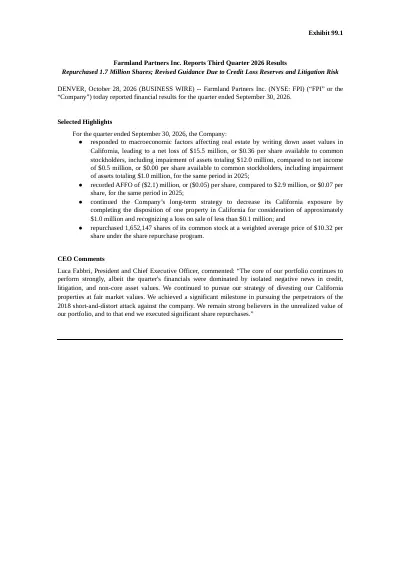
To that effect, in the quarter, we purchased about 1.7 million shares at an average price of $10.32. This is all of the comments I wanted to make, and I will turn the call over to our CFO, Susan Landi, for her overview of the company's financial performance.
Susan?
Susan Landi
Thank you, Luca. I'm going to cover a few items today, including a summary of the 3 and 9 months ended September 30, 2026, a review of our capital structure, and updated guidance for 2026.
I'll be referring to the supplemental package, which is available in the Investor Relations section of our website under the subheader Events and Presentations. First, I will share a few financial metrics that appear on page 2.
For the 3 months ended September 30th, 2026, net loss was $15.5 million or 36 cents per share available to common stockholders versus a net income of $0.5 million or 0 per share available to common stockholders for the same period in 2025. AFFO was negative $2.1 million or negative 5 cents per weighted average share, compared to $2.9 million or 7 cents per weighted average share for the same period in 2025.
For the 9 months ended September 30, 2026, net loss was $11.7 million or negative 28 cents per share available to common stockholders versus net income of $10.4 million or 18 cents a share available to common stockholders for the same period in 2025. AFFO was $1.7 million or 4 cents per weighted average share, compared to $6.5 million or 14 cents per weighted average share for the same period in 2025.
Page 5 shows a more comprehensive look at the main drivers of these changes year-over-year. On the revenue side, we were positively impacted by higher receipts from oil and gas royalties and higher interest income due to a higher average balance on loans under the FPI loan program and financing receivables.
These increases were offset by lower rental income due to asset dispositions that occurred in the prior year, in addition to some lower crop sales in the current year versus the prior year. Operating expenses were higher on both a quarter-to-date and year-to-date basis over the prior year, and this was primarily due to an increase in the provision for credit loss reserve related to loans under the FPI loan program, as well as an increase in the estimated loss contingency related to litigation that Paul had mentioned previously.
On page 12, there are a few capital structure items to point out. We had undrawn capacity on our lines of credit of approximately $107 million at the end of Q3 2026.
Page 15 is our updated outlook for 2026. The assumptions are listed at the bottom of the page.
Changes from the July guidance primarily relate to two non-recurring charges: the additional credit loss reserve and the increase in the loss contingency related to the litigation. Note that these two events account for 9.5 cents of the 10 cent decrease in AFFO per share.
The forecasted range of AFFO $8.9 million to $10.7 million or 21 cents to 25 cents per share. This summarizes where we stand today.
We will keep you updated as we progress through the year. This wraps up our comments this morning.
Thank you all for participating. Operator, you can now begin the Q&A session.
Operator
We will now begin the question-and-answer session. If you would like to ask a question, please press *1 to raise your hand.
To withdraw your question, press *1 again. We ask that you pick up your handset when asking a question to allow for optimum sound quality.
If you are muted locally, please remember to unmute your device. Please stand by while we compile the Q&A roster.
The first question comes from the line of Craig Kucera with Lucid Capital Markets. Your line is open, please go ahead.
Craig Kucera
Hey. Good morning.
With the impairment charges you had this quarter, were those affiliated with just the assets held for sale, or was that just a more broad-based valuation adjustment in California?
Paul Pittman
Luca, you want to take that one?
Luca Fabbri
Sure, and I'll have Susan chime in for some more details. Fundamentally, we have a few farms that we are either holding for sale or we have earmarked for sale in California that is frankly all the farms that we don't particularly like.
The $12 million impairment charge relates to both the ones held for sale and the one that we intend to sell. Susan, anything you want to add to that?
Susan Landi
Nope, that's good.
Craig Kucera
Okay. Thank you for that.
I guess with Saberpoint and reading your SEC filings, it reads like you thought this was the final gating factor as far as the appellate decision that'll allow you to pursue those claims. Is that your opinion?
Can you give us a sense of what those damages might be you might be seeking?
Paul Pittman
Let me take this one, and Christine, our General Counsel, will chime in after me if she wants to add something. The victory that we got at the appellate level in the Texas courts on the Saberpoint case is incredibly strong.
Saberpoint, in our opinion, will continue to delay. That opinion, if you actually read the entire opinion, which is publicly available, was very, very strong.
It says, look, it's an appellate court, it says we're not the trier of fact, but it sure looks like there's a smoking gun here, is the paraphrasing what that opinion said. Our claims will be allowed to proceed.
We assume Saberpoint will appeal this to the Supreme Court of Texas, not because they think they can win, not because they think the court will probably even take it, but it's further delay. Our hope is that we will engage in a settlement at some point, instead of having to try this.
If I was on the Saberpoint side, I would certainly not want to go all the way through the court process and have a court announce that I basically committed fraud on the market. Remember these guys are quote-unquote asset managers, and if they go all the way through this case and get another opinion like the one just written, I don't think they can be in the securities business anymore for the rest of their lives.
I think their pressure on them to settle is going to get strong. Who knows?
As far as the amount that we could recover, what we ought to recover is $100 million plus. Will we recover that?
Probably not. I just don't think Saberpoint has as much money as they damage they caused.
We're going to go get every penny we can from them. I'll just leave it at that.
Craig Kucera
Fair enough. I'd like to circle back to the provision for credit loss allowance.
This was the borrower who's given you some trouble in the past, did that continue to be reserved against this quarter? How much has not been reserved against, if that is the case?
Paul Pittman
Let me answer the question generally, and then Susan or Luca, look up specifics if we can share them. The answer to the question is yeah, we've taken reserves in the last few quarters against potential loan loss risk.
It is the same borrower. The borrower per se is not causing us trouble.
They made some payments in this quarter. They caught up on a bunch of interest and things like that.
It is not a situation where it's dire. Although we're a public entity, we're bound by GAAP.
When a guy is paying slow and paying late, the risk of that borrower is increasing, even if they're saying and promising they're going to pay you. We continue to take these reserves.
I don't want to suggest for a second that they're purely driven by accounting considerations. We believe the risk is increasing.
That's why we're taking reserves. We still will work diligently to collect all of this.
It's just that you've just got to be honest with yourself when things aren't going exactly per contract, to speak, and you're the lender, you got to accept that that is not a good fact and make some reserves, and that's what we're doing there. Luca or Susan, if you can disclose anything more specific, feel free.
Susan Landi
I believe part of your question was what is our exposure? Our total exposure between the loans and the financing receivables in aggregate is $51 million.
I don't know if you had any more specific questions.
Luca Fabbri
There is significant, of course, very significant collateral behind that loan. Some of the collateral is traditional real estate collateral, but there is significant other types of collaterals and guarantees that are harder to value.
We've taken an approach that we think we embrace the principle that our financials should be conservative, but in the realm of reality. We opted in our analysis to pretty much discount significantly the non-real estate collateral that we have behind this loan, including personal guarantees and so on and so forth.
Craig Kucera
That's helpful. Thank you.
Just one more for me. Given your comments regarding the attractiveness of buybacks, I think this quarter you nearly topped out your existing repurchase authorization.
Is it reasonable to assume that the board will re-up the existing authorization?
Paul Pittman
I'm going to answer that. I think that's a reasonable assumption.
Craig Kucera
Okay. Thank you, appreciate the time.
Operator
Your next question comes from the line of Buck Horne with Raymond James. Your line is open, please go ahead.
Buck Horne
Hey, thanks. Morning, guys.
I just kind of want to follow up on the credit loss reserve question a little bit. It looks like in the guidance you're not anticipating having to take any additional reserves in the fourth quarter or maybe going forward.
Correct me if I'm wrong on that. Just wondering, though, what are the other flags you guys are looking at in that portfolio if there are any other indicators of issues or whether it's struggles with payments or profitability?
How is the rest of the exposure looking going forward?
Paul Pittman
Let me describe with a little more granularity what kind of happened, which disappointed us this quarter. As I said, they made some payments and caught up on some interest and other things.
There was supposed to be a relatively significant asset sale that was going to bring us capital, and that had been an asset sale that had been in the works, as you can imagine, for 4 to 6 months, maybe more. That, at the last moment, didn't close.
That's never a good fact. We're not right in the middle of those negotiations ourselves, because it's the borrower making the sale of the asset to repay us.
That's just not a good fact. When we were expecting substantial additional reduction in our exposure, and then it doesn't happen, like I said, you have to take that as a bad fact, even if it isn't dispositive that things are going to go negative for you.
That's the kind of thing that's going on. We, as Luca said, we think we're going to be covered here, but when you sit down and say, 'Okay, things go to hell in a handbasket and you're going to fire-sale these assets, are you going to get a full recovery?'
The answer in our math is that we're concerned that we wouldn't, therefore we take a reserve. We think we're well-reserved at this point, but next quarter will reveal more facts and circumstances that may affect what we need to do next quarter, although we're not anticipating a further reserve.
Buck Horne
Okay. All right, that's helpful.
That's all for me. Thank you.
Paul Pittman
Thank you, Buck.
Operator
As a reminder, if you would like to ask a question, please press *1 on your telephone keypad. There are no further questions at this time.
I will now turn the call back to Luca for closing remarks.
Luca Fabbri
Thank you, Erika. Thank you, everybody.
We appreciate your interest in our company and look forward to updating you on our activities and results in the coming quarters. Have a great rest of your day.
Operator
This concludes today's call. Thank you for attending.
You may now disconnect.