Fairfax Financial Holdings Limited
Q3 FY2026 · Earnings Call TranscriptNovember 4, 2026
Operator
Good morning, and welcome to Fairfax's 2026 third quarter results conference call. Your lines have been placed in a listen-only mode.
After the presentation, we will conduct a question-and-answer session. At that time, to ask a question, please press star one on your phone keypad.
Now, for time's sake, we ask that you limit your question to one. Today's conference is being recorded.
If you have any objections, you may disconnect at this time. Your hosts for today's call is Peter Clarke with opening remarks from Mr.
Derek Bulas. Derek, please begin.
Derek Bulas
Good morning, and welcome to our call to discuss Fairfax's 2026 third quarter results. This call may include forward-looking statements.
Actual results may differ, perhaps materially, from those contained in such forward-looking statements as a result of a variety of uncertainties and risk factors, the most foreseeable of which are set out under Risk Factors in our base shelf prospectus, which has been filed with Canadian securities regulators and is available on SEDAR+. Fairfax disclaims any intention or obligation to update or revise any forward-looking statements, except as required by applicable securities law.
I'll now turn the call over to our President and COO, Peter Clarke.
Peter Clarke
Thank you, Derek. Good morning, and welcome to Fairfax's third quarter conference call.
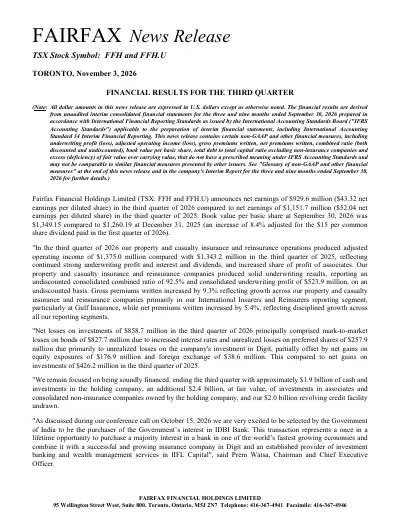
I plan to give you some highlights and then pass the call to Wade Burton, our President and Chief Investment Officer of Hamblin Watsa, to comment on investments, and Amy Sherk, our Chief Financial Officer, to provide some additional details. We had another strong quarter, with operating income from our insurance and reinsurance companies, adjusted to an undiscounted basis and before risk margin, of $1.4 billion, up from $1.3 billion in the third quarter of 2025.
Consolidated interest and dividend income of $669 million was up from $655 million in the third quarter of 2025. Our share of profits of associates were $378 million, up from $305 million, and our underwriting income was very strong at $524 million, slightly down from the $540 million in the third quarter of 2025.
In the quarter, our net losses on investments were $859 million, driven by mark-to-market unrealized losses on our bond portfolio, principally due to increasing interest rates. In the third quarter of 2025, we had net investment gains of $426 million.
As we have always said, we expect investment gains to perform well over the long term, but they will fluctuate quarter to quarter. Our net earnings for the third quarter were $930 million, and $3 billion for the first nine months.
All in, our book value per share at the end of the third quarter was $1,349 per share, up 8.4% from year-end 2025, adjusted for our $15 dividend. During the third quarter, we closed two acquisitions.
Sleep Country completed its acquisition of Sleep Number for purchase consideration of $523 million, all financed internally, and we closed the previously announced acquisition of an 80% equity interest in Andrew Peller for purchase consideration of $239 million. Subsequent to September 30th, in October, we completed the sale of our Eurolife life operations to Eurobank for $906 million for a pre-tax gain of approximately $200 million.
That gain will be included in our results in the fourth quarter. Also in October, Fairfax was selected by the Government of India as the strategic buyer for a 60.7% equity interest in IDBI Bank for approximately $5.6 billion.
We are very excited to be selected by the Government of India to be the purchaser. On October 9th, Recipe entered into a share purchase agreement to acquire Evergood, a food service business in Greece, which again will be fully funded by Recipe.
Closing is subject to regulatory approvals and customary closing conditions. On October 7th, we agreed to partner with Whittington to acquire certain operations of the Boots Group, the leading pharmacy and health and beauty retailer in UK and Ireland, for approximately $8.9 billion, inclusive of assumed debt.
Fairfax has committed to provide up to approximately $2.3 billion of the purchase price. Following the closing of the transaction, we expect to own 50% of the equity of Boots, and Whittington will have operational control.
Closing of the transaction is subject to customary conditions and is expected to be in the first quarter of 2027. With the conflict in Iran, members of the Fairfax family are once again, and unfortunately, facing difficult and dangerous circumstances.
GIG's management is ensuring that all employees in the Gulf region have the support they need to stay safe, which remains their first priority. While the duration of the conflict remains uncertain, Gulf continues to operate as usual under very challenging conditions, and related losses have been minimal.
We are also thinking about all our employees in Ukraine, as that conflict is escalating, and as winter is approaching, it makes for some very difficult conditions. Our thoughts and prayers are with all our employees at Gulf, ARX, Universal, and Colonnade Ukraine.
I will now give you some additional detail on the components of our net earnings for the quarter. Our consolidated investment return was 0.2% for the quarter, driven by interest and dividend income, strong profits from our associates, offset by net losses on investments.
Consolidated interest and dividend income of $669 million was up 2% year-over-year, benefiting from a growing investment portfolio and increasing government yields. Profits of associates of $378 million in the quarter increased by $73 million from a year ago, led by the Waterous Energy Fund and Eurobank, offset by profits from Poseidon, as we sold half our position last quarter.
We continue to be very excited about the long-term prospects of our associate companies. Net losses on investments of $859 million were driven by unrealized losses on bonds, primarily from US Treasuries, due to the increase in interest rates in the third quarter; unrealized losses on our preferred shares in Digit Insurance of $258 million; offsetting that by gains of $177 million on equity exposures, primarily due to mark-to-market gains on Metlen Energy, Eldorado Gold, IIFL Finance, and Equinox Gold.
Offsetting this are losses on Under Armour and our Fairfax TRS. Our non-insurance consolidated companies continue to perform well, with operating income of $254 million in the quarter, up from $211 million in the third quarter of 2025.
More on investments from Wade. As mentioned in previous quarters, our book value per share of $1,349 does not include unrealized gains or losses in our equity-accounted investments and our consolidated investments, which are not mark-to-market.
At the end of the third quarter, the fair value of these securities is in excess of carrying value by $5.1 billion, an unrealized gain position, or $256 per share on a pre-tax basis, a significant increase from year-end 2025 at $151 per share. In the third quarter, net earnings included $148 million unrealized loss due to increasing interest rates in the quarter.
This consisted of the unrealized losses on our bonds of $828 million, offset by the increase in discount under IFRS 17 on our insurance and reinsurance reserves held of $679 million. For the third quarter of 2025, this number was a net loss of $308 million.
Our insurance and reinsurance businesses wrote $8.9 billion of gross premium in the third quarter of 2026, up 9.3% versus the third quarter of 2025. Our North American insurance segment's gross premium was up 5.1%, or $124 million.
Crum & Forster's premium was up 6.6% to $1.8 billion in the quarter. Crum continues to see profitable growth opportunities in its accident and health division, while premium was down across most other segments due to the softening market conditions in those lines of business.
Zenith's premiums increased $23 million, or 13.3%, primarily from its strong retentions, expanding its large account workers' compensation segment, and earned price increases, while Northbridge gross premium was relatively flat in Canadian dollars, reflecting a competitive marketplace. Our global insurer and reinsurer segment was up 5.3%, with gross premiums of $4.5 billion in the third quarter of 2026.
Brit's gross premium was $837 million, up 16% in the third quarter of 2026 versus the third quarter of 2025, with the majority of the growth from the recent expansion of its Brit Re platform in Bermuda and its specialty business benefiting from improved pricing. Odyssey Group's premiums were $1.6 billion, down 1% in the third quarter of 2026, with both its reinsurance and insurance business showing small declines.
Reinsurance was down primarily from US property treaty business, driven by softening markets, especially on catastrophe business. Their insurance premiums decreased primarily in its agriculture business.
Allied World's premium was up 5.9%, with gross premiums of $1.8 billion, with growth in their global markets division and North American insurance division, primarily in construction, casualty, and A&H, while its reinsurance segment was down 3.1% due to competitive pricing. Ki's gross premium was up 10% in the third quarter of 2026, driven by casualty treaty, offset by lower open market property business in the United States.
Our international insurance and reinsurance operations' gross premiums was $1.9 billion in the quarter, up 27.1%, or $409 million, in the third quarter of 2026 versus the third quarter of 2025. Driving the increase was Gulf Insurance, primarily due to the significant rate increases on marine business as a result of the conflict with Iran.
The majority of this business was not retained by the company, it only affected gross premiums and not net. Excluding this premium, our international operations were up 13%, with strong underlying growth across most of our international operations.
Fairfax Asia was up 14.5%, Fairfax Latin America 13%, benefiting from some foreign exchange, Brit was up 9%, and Colonnade Insurance was up 5.3%. On a net written premium basis, premium was up 13.2% versus 27.1% on a gross basis, again reflecting the marine business at Gulf, and Fairfax Asia was up 37% on a net basis, reflecting growth and also higher retentions on their ceded business.
International operations currently accounts for approximately 21% of our overall gross premiums. Looking ahead, these operations offer strong long-term potential for sustained growth thanks to skilled management teams, emerging insurance markets, and robust local economies.
Our combined ratio was 92.5% in the third quarter, with underwriting income of $524 million, compared to a 92% combined ratio and underwriting income of $540 million in the third quarter of 2025. All our major insurance and reinsurance segments continue to post strong results with good underlying margins while remaining disciplined in a softening insurance market, especially in North America.
For comparable purposes, our IFRS 17 combined ratio was 81.7% compared to 81.5% a year ago. Our global insurers and reinsurers posted a combined ratio of 90.9% and underwriting profit of $344 million.
Allied World led the way with a combined ratio of 88.2%, Brit had a combined ratio of 89.6%, Ki had a combined ratio of 91.7%, and Odyssey's combined ratio was 93.6%. Our North American insurers had a combined ratio of 95.1% for the third quarter.
Northbridge had a combined ratio of 94.5% in the quarter that included over 10 points of catastrophe losses due to the above-average cat losses in Canada in the quarter. Crum & Forster had underwriting income of $66 million, or a combined ratio of 94.8%, while Zenith, our workers' compensation specialist, after a couple years of above 100 combined ratios, posted another quarter of underwriting profit.
Our international operations delivered a combined ratio of 93.1% for the quarter, with very strong underwriting income of $82 million. Colonnade in Eastern Europe led the way with an excellent combined ratio of 86.9%.
GIG also had an excellent quarter at 90.4% and contributed almost half the underwriting profit. Brit continues to produce strong results with combined ratio of 93.4%, and Fairfax Asia had a combined ratio of 95%, led by Singapore Re at 88.1%.
Eurolife in Greece, Falcon Thailand, and Fairfirst in Sri Lanka had combined ratios above 100 in the quarter, resulting in underwriting losses of approximately $5 million, due to large losses in Sri Lanka, catastrophes in Thailand, and motor results in Greece. The companies are focused on bringing these combined ratios back below 100.
In the third quarter, our insurance and reinsurance companies recorded favorable reserve development of $156 million, or a benefit of 2.2 points on our combined ratio. Each of our major segments recorded favorable reserve development.
In the fourth quarter, our companies will perform full actuarial reserve reviews, and we are in that process right now. Through our decentralized operations, our insurance and reinsurance companies continue to produce strong results, writing annualized gross premium of almost $35 billion, with underlying margins remaining attractive in the main, in spite of softening rates.
In many lines, it is becoming more competitive, but we benefit from our size and scale, and more importantly, we have exceptional long-term management teams that are all focused on the bottom line and have the experience to manage the cyclical nature of the insurance business. Our long-term approach enables our companies to stay disciplined, patient, and focused on profitability rather than top-line growth targets.
I will now pass the call to Wade Burton, our President and Chief Investment Officer of Hamblin Watsa, to comment on our investments.
Wade Burton
Thank you, Peter, and good morning. Our investment portfolio ended the third quarter at $78.8 billion.
Fixed income ended the quarter at $53.1 billion. Common and preferred stocks, including our TRS and real estate, came to $13.1 billion, and associates and consolidated investments like Eurobank, Recipe, Sleep Country, and Peak Achievement ended the quarter at $12.6 billion.
Within the fixed income portfolio, we are still short duration with enormous liquidity: over $8.3 billion cash and short-term bonds, and a little over two years duration. It is a volatile time in fixed income, particularly rates.
Credit spreads are still narrow, the volatility has been in rates and primarily upward, which is good for Fairfax. Interest income has gone from $500 million in 2021 to $2.7 billion annual run rate last quarter.
While inflation is persistent above 3%, the spread between inflation and the US Treasury curve is at a good healthy level. We could be in this higher rate environment for some time, which we are well-positioned to benefit from.
However, if there's a collapse in inflation and rates, we have locked in a sizable amount of interest income for the next few years given our term structure. Our portfolio has little credit risk, mostly US Treasuries, has locked in ample interest income, and retained flexibility.
All this is to say our fixed income portfolio is in a good position given the environment. Over many years, our fixed income efforts have made money in the secular decline of rates from 1980s to 2015, has avoided the Great Financial Crisis of 2007 and '08, and in fact made a good amount of profits from CDS, and was perfectly positioned leading into the post-COVID inflationary environment.
Fixed income is very much a core strength of Fairfax, and will be for years to come. For the equity and equity-like portfolio, as mentioned, we ended the quarter with common and preferred stocks, including our TRS and real estate, of $13.1 billion, and associates and consolidated investments of $12.6 billion.
The underlying free cash flow and the management teams of our holdings has never been stronger. From Fokion Karavias at Eurobank, David Sokol and Bing Chen at Poseidon, to Steve Cahillane at Kraft Heinz, and Kevin Plank at Under Armour, to name only a few, our investee companies are very well-run, and we are optimistic about the long-term growth in their underlying earnings.
The vast majority of our investments are financially sound, and we're carrying them at values where we believe we can earn our 15% return over time. Permanent capital is a huge advantage on the investment side because it gives us and the management teams time to reach their true earnings potential.
We are long-term value investors. This is how we've tried to compound the equity and equity-like portfolio at Fairfax.
Over 40 years, this approach has worked well, and we are dead aimed at trying to make it work even better for you over the next 40 years. With that, I'll pass the call over to Amy Sherk, CFO.
Amy Sherk
Thank you, Wade. I'll begin my comments by providing some additional details on our key transactions.
On July 31st, 2026, Sleep Country completed the acquisition of the assets and certain liabilities of Sleep Number Corporation for purchase consideration of $523 million, as determined through a Chapter 11 court-supervised bidding process. The assets acquired and liabilities assumed of Sleep Number were consolidated by Sleep Country into the company's non-insurance companies reporting segment, and included goodwill and intangible assets of $445 million, principally goodwill of $177 million and brand names of $171 million.
Sleep Number is a US manufacturer and retailer of premium adjustable mattresses. On August 14th, 2026, the company acquired an 80% controlling interest in Andrew Peller Limited, with the remaining 20% interest retained by John Edwards Enterprises Inc., for consideration of $239 million, or $332 million Canadian, comprising of cash of $191 million, or $265 million Canadian, and $48 million, or $67 million Canadian, of non-recourse borrowings incurred by Andrew Peller.
The assets acquired and liabilities assumed of Andrew Peller were consolidated into the company's non-insurance companies reporting segment, and included other assets of $450 million, principally premises and equipment of $246 million and inventory of $150 million. Subsequent to September 30th, 2026, on October 9th, 2026, Recipe entered into a share purchase agreement to acquire 100% of Evergood Single Member S.A., the food services business of Greece-based Vivartia Holding (smSA), for estimated gross consideration of approximately $350 million, or €313 million, which includes the assumption of borrowings of approximately $113 million, or €101 million.
This transaction will be entirely funded by Recipe, and closing is subject to regulatory approval and customary conditions, expected to happen in late 2026 or early 2027. On October 27th, 2026, the company completed the sale of its Eurolife life operations to Eurobank for approximately $906 million for a pre-tax gain of approximately $200 million that will be included in the company's consolidated financial results in the fourth quarter of 2026.
During the period from the announcement of the proposed sale of Eurolife life operations in October of 2025 to closing, the company consolidated net earnings of approximately $113 million, or €97 million, of the Eurolife life operations. The company had classified assets of $3.5 billion and liabilities of $3.6 billion related to the Eurolife life operations as held for sale at September 30th, 2026 on the consolidated balance sheet.
Peter has covered the Boots and IDBI transactions, I will just add that we expect to account for both under the equity method of accounting. A few comments on our non-insurance company results in the third quarter and first nine months of 2026: non-insurance companies reported operating income of $254 million in the third quarter of 2026, compared to $211 million in the third quarter of 2025.
Operating income in the third quarter of 2026 was primarily from the other operating segment of $122 million, principally from Peak Achievement and Andrew Peller, and from the restaurants and retail operating segment of $79 million, principally from Sleep Country and Recipe. Non-insurance companies reported operating income of $484 million in the first nine months of 2026, compared to $296 million in the first nine months of 2025.
Operating income in the first nine months of 2026 was primarily from the other operating segment of $199 million, driven by Peak Achievement, and from the restaurants and retail segment of $150 million, principally from Recipe and Sleep Country. Looking at our share of profit from investments in associates in the third quarter and first nine months of 2026: consolidated share of profit of associates of $378 million in the third quarter principally reflected share of profit of $158 million from Eurobank, $53 million from Waterous Energy Fund III, $35 million from the company's reduced share of Poseidon, and $35 million from Exco.
Consolidated share of profit of associates of $792 million in the first nine months of 2026 principally reflected share of profit of $395 million from Eurobank, $144 million from Poseidon, $124 million from Waterous Energy Fund III, and $63 million from Exco, partially offset by a non-cash impairment charge related to other non-insurance associates of $92 million. I will close with a few comments on our financial condition.
Maintaining an emphasis on financial soundness, at September 30th, 2026, the company held $1.9 billion of cash and investments at the holding company, has access to our $2 billion unsecured revolving credit facility, which was undrawn, and an additional $2.4 billion at fair value of investments in associates and market-traded consolidated non-insurance companies. At September 30th, 2026, the excess of fair value over carrying value of investments in non-insurance associates and market-traded consolidated non-insurance subsidiaries was $5.1 billion, compared to $3.1 billion at December 31st, 2025, with $3.6 billion of that excess related to publicly traded Eurobank and $0.8 billion related to Poseidon.
The pre-tax excess of $5.1 billion is not reflected in the company's book value per share, but is regularly reviewed by management as an indicator of investment performance. The company's total debt to total capital ratio, excluding non-insurance companies, decreased to 27.3% at September 30th, 2026, from 28.0% at June 30th, 2026, principally reflecting common shareholders' equity, primarily from net earnings attributable to shareholders of Fairfax of $930 million.
The company's total debt to total capital ratio, excluding non-insurance companies, increased to 27.3% at September 30th, 2026, compared to 26.2% at December 31st, 2025, reflecting increased total debt, partially offset by increased common shareholders' equity. Common shareholders' equity increased by $629 million to $26.9 billion at September 30th, 2026, from $26.3 billion at December 31st, 2025, primarily reflecting net earnings attributable to shareholders of Fairfax of $3 billion, partially offset by purchases of 1,086,435 subordinate voting shares for cancellation for cash consideration of $1.8 billion, or $1,630.87 per share; payments of common share dividends of $329 million; and other comprehensive loss of $338 million, primarily related to unrealized foreign currency translation losses net of hedges due to the strengthening of the US dollar against various currencies.
The company views these unrealized foreign currency movements as market fluctuations, similar to unrealized gains or losses on its equity and fixed income portfolios. In closing, book value per share was $1,349.15 at September 30th, 2026, compared to $1,260.19 at December 31st, 2025, representing an increase per basic share in the first nine months of 2026 of 8.4%, adjusted to include the $15 per common share dividend paid in the first quarter of 2026.
That concludes my remarks, and I'll now turn the call back over to Peter.
Peter Clarke
Thank you, Amy. We are now happy to take on any questions that anyone might have.
Fran?
Operator
Thank you entirely. We will now begin the question-and-answer session.
If you would like to ask a question, please press star one. Please unmute your phone and record your name clearly when prompted.
Your name is needed to introduce your question. To withdraw your request, you may press star two.
Please one moment for our first question. Our first question is from Stephen Boland with Raymond James, and your line is now open.
Oh,
Stephen Boland
good morning. Maybe a question for Peter.
There's a number of growing press articles out of India, and I apologize if you mentioned this in the opening remarks, just missed the first few minutes, and this IDBI union that seems to be against the takeover. The question is: how credible is this threat?
Is it just noise? Will you have to deal with them?
Thanks. No,
Peter Clarke
thanks for your question. For IDBI Bank for today's call, as the transaction is not yet closed and we're still waiting for regulatory approval, there's really not much more that we can say that we have not already provided.
What I would recommend is that you review our press release dated October 14th and listen to the special conference call we had on October 15th. Other than that, on IDBI Bank, there's not that much more we can say at this time.
Thank you for your question. Next question, please.
Operator
Bart [Dziarski?] with RBC Capital Markets, your line is open.
Bart Dziarski
Great, thanks, and good morning, everyone. I wanted to ask around, maybe a capital allocation question within the operating sub.
Just given the softer pricing environment in insurance, and the underlying operations are all well-capitalized, at what point do you think about upstreaming some of that excess capital to the holding company, just given the pricing environment? Thanks.
Peter Clarke
Thanks, Bart, and that's a good question. We're constantly reviewing that.
Especially in the fourth quarter, we look at all the capital positions in-depth for all our insurance companies. Really fourth quarter is a big quarter for dividends coming up to the holding company.
I think you'll see that once we get through year-end. You're right, over the 2019 to '24 time period, we grew significantly, and a lot of our insurance companies used their earnings to fund that growth.
That has slowed down now. A lot of our companies are producing excess capital, with premiums slowing down, that provides more access to dividends for us.
More to come in the fourth quarter. Thank you very much.
Next question, please.
Operator
That is from Tom MacKinnon with BMO Capital, your line is open, sir.
Tom MacKinnon
Thanks very much. Question on the interest and dividend income of 587.6.
It seems to be flat year-over-year. I thought you would have gotten a little bit more momentum in that.
It's kind of down quarter-over-quarter, just given where new money rates are and the duration of your portfolio. Is there anything that you would share with us as to that observation?
Thanks.
Peter Clarke
No, I think if you look year-over-year, I think our interest and dividend income was about $670 million this year versus $655 million. There is fluctuations on the dividend side in particular.
I think our interest income increased more than the absolute number, with dividends down. The third quarter is usually light on dividends; first quarter and second quarter, much higher.
In our fixed income portfolio, we're approximately $55 billion today, very conservative, very flexible, duration is just over two, with an average term to maturity of about three years, a little over three years, and approximately 75% of it is in government bonds. We have a lot of flexibility, and I think there's really nothing more than that to report.
Thank you for your question, and next question, please.
Operator
Jaeme Gloyn with National Bank Financial, your line is open now.
Jaeme Gloyn
Thanks. I wanted to touch on growth, and apologies if you did this in the prepared remarks as well, but seeing acceleration in Q3 across a lot of the business lines compared to, let's say, first nine months growth.
Is there something you're seeing in terms of a shift in markets, maybe it's something unique, just looking for some more market color if you're seeing a shift given that more rapid growth rate this quarter versus the rest of the year?
Peter Clarke
No, thanks for the question, Jaeme. Really not.
In the third quarter, we continue to see similar trends that we've reported the last number of quarters: softening across many of our companies, especially in North America, and particularly in property, and our reinsurance business, and property cat as well. Casualty lines continue to see rate increases, mainly in the single digits, but again, that depends on the lines of business.
As I've said many times, where we are seeing some growth is on our international operations. We continue to see the benefits of our diversified insurance and reinsurance operations worldwide, by geography and product.
For example, in the third quarter, as I said in my opening remarks, our premium was up 27% on a gross basis on the international business and about 13% on a net basis, and we saw considerable growth right across the group: Gulf Insurance, they had that one, the marine book that was up, but that was not retained on a net, but they had other strong growth, motor business in Saudi, Brit was up, Fairfax Asia was up, and Fairfax LatAm was up. Really the growth today is being driven by the international operations.
Thank you for your question, Jaeme, and next question, please.
Operator
Presently, I have no further questions in queue.
Peter Clarke
Thank you, Fran. If there are no further questions, thank you for joining us on our third quarter 2026 conference call, and we look forward to talking to you next quarter.
Thank you again, Fran.
Operator
You're very welcome. Again, we are concluded.
Thank you very much for your participation. You may please disconnect at this time.