Five Star Bancorp
Q3 FY2026 · Earnings Call TranscriptOctober 27, 2026
Operator
Welcome to the Five Star Bancorp Third Quarter 2026 Earnings Webcast. Please note this is a closed conference call, and you are encouraged to listen via the webcast.
After today's presentation, there will be an opportunity for those provided with a dial-in number to ask questions. To ask a question, you may press star, then one on your telephone keypad.
To withdraw your question, please press star, then two. Before we get started, we would like to remind you that today's meeting will include some forward-looking statements within the meaning of applicable securities laws.
These forward-looking statements relate to, among other things, current plans, expectations, events, and industry trends that may affect the company's future operating results and financial position. Such statements involve risks and uncertainties, and future activities and results may differ materially from these expectations.
For a more complete discussion of the risks and uncertainties that may cause actual results to differ materially from the company's forward-looking statements, please see the company's annual report on Form 10-K for the year ended December 31, 2025, and quarterly reports on Form 10-Q for the three months ended March 31, 2026, and June 30, 2026, and in particular, the information set forth in item 1A, Risk Factors, in those reports. Please refer to slide two of the presentation, which includes disclaimers regarding forward-looking statements, industry data, unaudited financial data, and non-GAAP financial information included in this presentation.
Reconciliations of non-GAAP financial measures to their most directly comparable GAAP figures are included in the appendix to the presentation. The presentation will be referenced during this call, but not followed exactly, and is available for closer viewing on the company's website under the Investor Relations tab.
Please note this event is being recorded. I would now like to turn the presentation over to James Beckwith, Five Star Bancorp President and CEO.
Please go ahead.
James Beckwith
Thank you for joining us to review Five Star Bancorp's financial results for the third quarter of 2026. These results were released yesterday and are available on our website, fivestarbank.com, under the Investor Relations section.
Joining me today is Heather Luck, Executive Vice President and Chief Financial Officer. Q3 2026 was another quarter of solid execution for Five Star Bancorp, highlighted by continued balance sheet growth, net interest margin expansion, strong profitability, and the successful completion of our underwritten public offering.
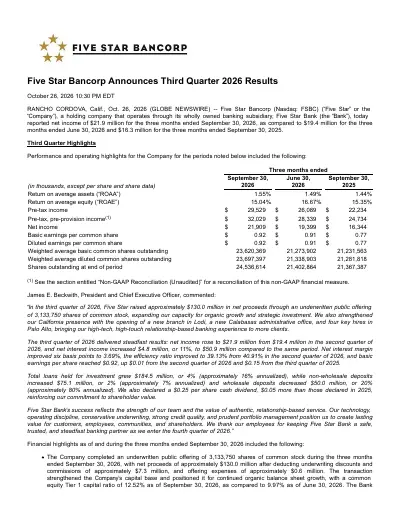
Net income increased to $21.9 million from $19.4 million in the second quarter of 2026. Basic earnings per share rose to 92 cents despite an 11% increase in weighted average basic common shares outstanding following our underwritten public offering in July.
Loans held for investment grew by $184.5 million during the quarter, or approximately 16% annualized. Growth was driven primarily by commercial real estate lending activity and continued production from our commercial banking teams.
Deposits grew by $25.1 million, while non-wholesale deposits increased by $75.1 million, reflecting continued improvement in our funding mix. During the quarter, Five Star Bancorp completed an underwritten public offering, providing approximately $130 million of net proceeds after deducting underwriting discounts, commissions, and offering expenses.
The offering was completed to support general corporate purposes, continued growth, including through the investments in the bank to pursue growth opportunities, and for working capital. We believe the offering the offering enhanced our capacity to pursue strategic opportunities while maintaining our conservative approach to capital management.
As expected, the 11% increase in weighted average basic shares outstanding from the offering had a modest dilutive effect on return on average equity and earnings per share for the quarter. The issuance meaningfully strengthened our capital position, improving our common equity Tier 1 capital ratio to 12.52% at September 30, 2026, an increase of 255 basis points over the prior quarter.
We continued executing on our statewide organic expansion strategy during the quarter, with the opening of our newest full-service branch in Lodi, strengthening our presence to support the agricultural and business communities in the Central Valley. We also expanded our presence in Southern California and the San Francisco Bay Area through the opening of our Calabasas administrative office and the addition of four experienced banking professionals professionals in Palo Alto during the quarter.
Our business development officer team increased from 45 to 50 during the quarter, enhancing our ability to deepen existing relationships and drive future loan and deposit growth. Financial highlights during Q3 2026 include net income of $21.9 million, up 13% from the prior quarter; pretax, pre-provision income of $32 million, up 13% from the prior quarter; return on average assets of 155 basis points compared to 149 basis points in Q2 2026; return on average equity of 15.04% compared to 16.67% in Q2 2026; net interest margin of 3.69%, an increase of six basis points from the prior quarter; average loan yield of 6.14%, an increase of six basis points from the prior quarter; average cost of total deposits of 2.19%, an increase of three basis points from the prior quarter; efficiency ratio of 39.13% compared to 40.91% in the prior quarter; and book value per share of $25.
$25.15, cents, a 14% increase from the prior quarter. Our Q3 results were driven by robust balance sheet growth.
Loans held for investment grew by $184.5 million, or approximately 16% on an annual basis, reaching $4.7 billion at September 30th, 2026. Total deposits grew by $25.1 million during the quarter.
More importantly, non-wholesale deposits increased $75.1 million, more than offsetting a planned reduction in wholesale funding and further improving our deposit mix. Non-wholesale deposit accounts constituted approximately 96% of total deposits at quarter end.
We also maintained a strong liquidity position, ending the quarter with approximately $2.5 billion in available liquidity. Our asset quality remains strong.
Nonperforming loans decreased to 0.28% of total loans at September 30th, 2026, from 0.30% at June 30, 2026. Consistent with the prior quarter, the nonperforming loan balance related primarily to a single Community Reinvestment Act-related credit that was originally downgraded during 2025 and placed on nonaccrual status during the second quarter of 2026.
As of September 30, 2026, the outstanding balance was $11.4 million, and the loan remains well-secured by collateral with an appraised value that is meaningfully exceeds its carrying amount. We continue to view this relationship as an isolated credit issue rather than an indication of a broader portfolio weakness.
Credit trends across the remainder of the portfolio remained stable and generally consistent with our expectations. Our commercial real estate portfolio continues to benefit from conservative underwriting, with a weighted average loan-to-value of approximately 56%, providing significant collateral support across the portfolio.
We recorded a $2.5 million provision for credit losses during the quarter, primarily related to loan growth and changes resulting from our annual CECL model refresh. The public offering during the quarter drove meaningful improvement across all capital ratios.
Our common equity Tier 1 capital ratio increased to 12.52%, our Tier 1 leverage ratio increased to 11.21%, and our total risk-based capital ratio increased to 15%. Total shareholders' equity increased to approximately $617 million at quarter end, providing flexibility to support continued balance sheet growth and strategic expansion opportunities.
The bank continues to exceed all regulatory standards required to be consi- to be required to be considered well-capitalized. We remain committed to delivering value to our shareholders.
In Q3, we paid a cash dividend of 25 cents per share and declared an additional 25 cents per share dividend expected to be paid in November of 2026. Total assets increased by $182 million during the quarter, driven primarily by strong loan growth.
Commercial real estate loans increased $81.8 million, while consumer loans increased by $50.9 million. Year-over-year, total assets grew from $4.6 billion to $5.6 billion, demonstrating continued momentum across our markets.
Cash and cash equivalents stood at $679.5 million at September 30, 2026, representing 14.08% of total deposits. Total liquidity, consisting of cash and cash equivalents, as well as unused and immediately available borrowing capacity, was approximately $2.5 billion as of September 30, 2026, compared to $2.3 billion at June 30, 2026.
Insured and collateralized deposits increased to 68% of total deposits at quarter end, while net uninsured and uncollateralized deposits declined, further strengthening our funding profile. The current environment, marked by evolving trade and fiscal policy, geopolitical uncertainty, and continued interest rate variability, requires careful balance sheet management.
We believe we are well-positioned to navigate this backdrop. Approximately 73% of our loans held for investment are adjustable or floating rate, providing meaningful responsiveness to rate movements.
Combined with our strong liquidity position and conservative underwriting standards, we believe our balance sheet is structured to perform across a range of economic conditions. As we move into Q4, while economic and policy uncertainty remains elevated, client activity continues to be constructive and our pipelines remain healthy.
We believe our balance sheet, liquidity profile, and capital position leave us well-positioned to pursue growth opportunities while maintaining our disciplined approach to risk management as we move into the fourth quarter. Our prudent underwriting standards, comprehensive loan monitoring, and focus on relationship-driven lending have contributed to maintaining a strong credit quality.
Our allowance for credit losses totaled $49.4 million at September 30th, 2026, reflecting con- continued loan growth and our disciplined approach to reserve management. The allowance as a percentage of loans held for investment was 1.05% at September 30th, 2026.
We continue to believe our reserve levels are appropriate given the composition of the portfolio, current credit performance, and the broader economic environment. The increase in total liabilities during the quarter was a result of growth of non-interest-bearing deposits, reflecting inflows from new accounts and existing client relations- ships.
Total non-wholesale deposits increase increased by $75.1 million, while wholesale deposits decreased by $50 million, a reflection of our ongoing strategy to deepen core deposit relationships and reduce reliance on wholesale funding. Non-interest-bearing deposits accounted for approximately 25.1% of total deposits at September 30, 2026, reflecting the strength of our commercial banking relationships.
Our deposit franchise continues to be built on long-term client relationships. Approximately 62% of our deposit relationships exceed $5 million, with an average tenure of approximately seven years.
We believe this long-tenured client base supports the stability and durability of our deposit franchise and contributes to the strength of our funding profile across economic cycles. With that, I'll turn it over to Heather to walk through the results of operations.
Heather?
Heather Luck
Thank you, James, and hello, everyone. Net interest income increased to $50.9 million in Q3 2026, a 10.51% increase from $46.1 million last quarter.
Net interest margin improved by six basis points quarter-over-quarter to 3.69%, primarily reflecting growth in higher-yielding loans and an increase in the yield on interest-earning assets, partially offset by higher deposit funding costs. Net interest income increased by $4.8 million from the previous quarter, mainly due to a 7% increase in average interest-earning assets.
This is largely made up of a 7% increase in the average balance of loans and a 14% increase in the average balance of interest-earning deposits in banks. The average yield on interest-earning assets increased five basis points to 5.74%, including a six basis point increase in that average loan yield to 6.14%.
The increase in interest income was partially offset by a $2 million increase in interest expense, driven by a 6% increase in the average balance of deposits, combined with a three basis point increase in the average cost of deposits. This rise in deposit funding costs was partially offset by a 4% increase in the average balance of non-interest-bearing deposits.
Looking ahead, we continue to expect loan yields, deposit pricing discipline, and our funding mix to remain supportive of margin performance, although future rate actions and competitive market conditions may influence quarterly results. Turning to non-interest income, Q3 2026 decreased to $1.7 million from $1.9 million in Q2 2026, primarily driven by a decrease in loan referral income and an overall decline in earnings related to investments in venture-backed funds, partially offset by a special FHLB stock dividend received during the quarter.
On the expense side, non-interest expense increased by $1 million in Q3 2026 compared to Q2 2026, primarily due to higher salaries and employee benefits from increased headcount and increased recruiter fees related to growth, partially offset by decreases in employee-related expenses, advertising and promotional expenses, and operational losses. The efficiency ratio for Q3 2026 was 39.13%, improving from 40.91% in Q2 2026 and 40.13% in Q3 2025, reflecting disciplined expense management as we continue to invest in growth.
The provision for income taxes increased by $900,000 compared to the prior quarter, primarily due to an increase in taxable income. Collectively, pretax, pre-provision income of $32 million for Q3 2026, up from $28.13 million, $28.3 million in Q2 2026, a 13.
13% increase. Overall, our third quarter results demonstrate the operating leverage embedded within our model.
Revenue growth, expanding margins, disciplined expense management, and strong credit quality combined to produce another quarter of profitable growth while we continue investing in expansion opportunities throughout California. With that, I'll turn it back to James for closing remarks.
James?
James Beckwith
Thank you, Heather. Our results this quarter reflect disciplined execution of our strategy and the continued strength of our commercial banking franchise we are building across California.
Looking ahead, we remain well-positioned for continued growth, supported by strong capital, substantial liquidity, a stable deposit base, and a conservative credit culture. We enter the fourth quarter focused on serving our clients, executing our strategic initiatives, and pursuing profitable growth while maintaining disciplined risk management.
We appreciate your continued interest in Five Star Bancorp and look forward to updating you on our progress next quarter. We will now open the line up for questions.
Operator
Thank you. We will now begin the question-and-answer session.
To ask a question, those dialed in may press star, then one on your telephone keypad. If you are using a speakerphone, please pick up your handset before pressing the keys.
To withdraw your question, please press star, then two. Questions will be taken in the order received.
The first question comes from Woody Lay with KBW. Please go ahead.
Woody Lay
Hey, guys. Wanted to start on the margin.
Just wanted some color on how the NIM trended in September, especially post-rate hike.
James Beckwith
Hey, Woody. How you doing?
Woody Lay
Doing good.
James Beckwith
Yeah. In September, we saw kind of a slight increase in our margin.
As we had a lot of earning assets reprice, well, the delta between earning assets repricing and deposits repricing was noticeable. We saw a pretty decent increase in the month of September.
I'm trying to recall, about six or seven basis points, I think, something along those lines. We kind of ended the quarter, Woody, on a strong note.
Woody Lay
That's really encouraging. How should we think about the margin going forward, especially if we get additional rate hikes?
Cuz if I look at the ALCO models, y'all do screen as a little bit liability-sensitive, but it feels like y'all are able to absorb some of that impact with the continued repricing.
James Beckwith
Sure. There's a bunch of dynamics that go into that, but at the top level, we think we're pretty comfortable with a margin from 3.65% to 3.75%.
Our funding side is slower to react to rate increases than certainly our asset side. We expect our funding costs to go up in the next few quarters.
I think we've also got a lot of loans that are repricing, which will be helpful in terms of matching those increases of funding costs. Then when you layer on the component of growth, and where we're funding loans right now, and bringing on new deposit relationships, I think it's favorable from a margin perspective.
The bottom line is, and I still believe this to be true, is the growth in net interest income is really driven by balance sheet growth, Woody. It doesn't appear at this point we're going to get hurt terribly or hurt at all, maybe, with these rate increases.
Woody Lay
That's great to hear. I guess just as a last follow-up, any color you could provide on where new loan production was coming on the books at?
Are you seeing any of the benefit from higher rates or is competition eating into it a little bit?
James Beckwith
What'd we do in the Q3?
Heather Luck
Our all-in production for Q3 was 6.53%, and our top three producers were typically our usual suspects on manufactured home communities. We did have the purchases of some BHG loans came in at 6.15% for the quarter.
Then some of our asset-based lines of credit.
James Beckwith
Right. Certainly competition is out there, and the indexes have all moved up appreciably in the late second quarter, throughout the third quarter.
They've kind of backed off a little bit the last week or so. Right, Sarah?
Mm-hmm. Spreads have come in, but the absolute yield that we're getting is still very favorable.
There is a lot of competition out there. I don't want to use that as an excuse, Woody.
Woody never used it before, but we're ending the year, people want to meet their plans, and they can be aggressive. The verticals in which we operate in, I think that we do have a competitive advantage in it.
We're comfortable with what we're putting these deals on the books for. We think they can be very profitable for us.
Woody Lay
Great. That's all for me.
Thanks for taking the questions, and congrats on the strong quarter.
James Beckwith
Thanks, Woody.
Heather Luck
Thanks, Woody.
Operator
Thank you. The next question comes from David Feaster with Raymond James.
Please go ahead.
David Feaster
Hi. Good morning, everybody.
James Beckwith
Hey, David.
Heather Luck
Good morning, David.
David Feaster
I wanted to stay on the loan side for a second, just kind of curious how is demand shaking up just as rates are rising? Have you seen any shift in that, or are you concerned at all about anything potentially slipping out of the pipeline?
Then just on the other side, payoffs and paydowns were played at a new record, from what I can tell. Curious what's driving that.
Is there anything that's leading more folks to pay down loans? Could rising rates slow--
James Beckwith
Sure. As we sit here today, our loan pipeline is very strong, and it's not at the highest level it ever was, but certainly up there.
We're comfortable as we finish up the fourth quarter right now with respect to our loan pipeline. There has been some slowdown, especially on real estate acquisition financing, given the rate environments.
There's still opportunity out there. David, we've got a lot of people working on the front end right now in terms of our business development activities, and I think that really bolsters our ability to continue to grow, certainly in a relative sense to other organizations of a similar size.
We kind of like where we're positioned right now from a loan growth perspective, and we're guiding 10% to 12% in Q4, and probably 10% to 12% for 2027.
David Feaster
Gotcha. To that point, it's a lot easier when you're bringing on new talent.
There's a lot more confidence and visibility into the growth trajectory. It looks like you hired a net of five new folks.
Curious your appetite for hiring here. There's obviously a lot of disruption across the footprint.
Just kind of your thoughts on the hiring opportunities that you're seeing and what your appetite is.
James Beckwith
We're always looking for great talent, so that's never going to stop. I think situations present themselves or we develop those situations in which we can bring on a team, and we continue to see that.
We continue to see those opportunities in the markets in which we work. Specifically down in Southern California, we're excited about the opportunities that are there for us in that very vast market down there, David.
David Feaster
That's great. Maybe just switching to the funding side a little bit, I wanted to get your thoughts on the competitive backdrop for funding right now.
Where are you seeing growth opportunities? It looks like CRE and construction was notably strong this quarter.
Curious where you're seeing good funding growth potential, how marginal funding costs are today, and your thoughts just on your ability to continue to fund growth with low-cost core deposits.
James Beckwith
We feel confident about that because we're relationship-based. The facts are is that there's no, I'm going to say, dumb money out there anymore, David.
If you're going to continue to bring on relationships that have non-interest-bearing transactional balances and liquidity balances, you're going to have to pay up for the liquidity. We expect that, and if we can bring on those new relationships with a two handle, blended, maybe high twos, we're very comfortable with that.
That's kind of whatever our expectation is, especially if there's a credit associated with this, which there usually is, we're getting some decent spreads. As I mentioned before, the indexes have moved up whether it be prime-based, SOFR-based, or off the five-year or the 10-year.
We still like our opportunities on the fund side to continue to grow. In our deposit books, we've got some concentrations in our government book, which you saw a decline in the third quarter, which was expected, because that's seasonally how it works.
I don't know how you pay taxes in the state of Florida, but we pay property taxes here in December and in April. Most people pay first and second installments in December.
We do expect those balances to potentially swell with respect to those relationships. Now that's pretty expensive money, but nevertheless those relationships have existed for a long time, and that's how it kind of works seasonally.
There seems to be a depletion of those balances that happens in Q3 as these counties and cities and special districts work through paying their bills, to speak.
David Feaster
That's helpful. Thanks, everybody.
James Beckwith
Thanks, David.
Operator
Thank you. The next question comes from Andrew Terrell with Stephens.
Please go ahead.
Andrew Terrell
Hey, good morning.
James Beckwith
Hey, good morning, Andrew. Hey.
Andrew Terrell
James, I know you touched on it briefly just a moment ago, but I'd love to hear any kind of early observations on your end from the Southern California expansion, any change in kind of type of credit you're underwriting there, and then just what kind of growth outlook you see in SoCal specifically?
James Beckwith
In our Calabasas group, we're seeing a lot of C&I opportunities. What also associates with that is some owner-occupied CRE.
That's been great to see. On the deposit side, I think those are really strong core deposits down there.
In our Newport Beach office, different market, we're seeing some construction opportunities down there, and some C&I business. I think it's going to be a slow and steady down there, Andrew, and we're trying to reach a critical mass in both of those markets, trying to get to $100 million in deposits in both Newport and in Calabasas.
We got a ways to go, but we're showing some progress, and I think very good progress.
Andrew Terrell
Got it. I appreciate it.
Then Heather, I wanted to check in, a very nice efficiency ratio this quarter, by the way, but just your thoughts on the $20.6 million or so in expenses this quarter. Is that kind of a clean run rate, and then just refresh us on your kind of overall views on expense growth just we're thinking about 2027.
Heather Luck
I do think it's a pretty good run rate. We do have a few unique items that happen in Q4, we'll have some planning sessions, and our events heat up, and then BDOs are at their higher end of the commission tiers.
I think if you can add about $200,000 for Q4 2026, that'll likely be about the right amount there. On the expense side, we try to stay in a range between 1.45% to 1.50% of average assets.
We came in at 1.46% this quarter, I think about that range is probably pretty good for the run rate going forward.
Andrew Terrell
Awesome. Thank you so much for taking my questions.
Heather Luck
Yep.
James Beckwith
Thank you.
Operator
Thank you. The next question comes from Gary Tenner with D.A.
Davidson. Please go ahead.
Gary Tenner
Thanks. Good morning.
Wanted to go back to the kind of rate sensitivity conversation for a minute. In terms of the loans that are repricing in the fourth quarter, which I think is what, $540 million or so, could you give us a sense of where you think kind of the incremental yield pickup settles in in the fourth quarter?
James Beckwith
If you just looked at the balance sheet on a static basis, we should see a continued creep on a monthly basis by a couple basis points, I would think. We have several dynamics going in there, obviously.
We've got a lot of stuff that reprices immediately or monthly. We also have the continued reprice of all those manufactured community loans that we booked in 2021 that have a very low yield to them, probably on average low 4s.
Then when they reprice, they're probably going to 6.75% to 7.25%, which has a much bigger impact, although the balances are smaller, but certainly a bigger impact in terms of our yield. That coupled with production, we continue to see our loan book reprice up.
I think the bigger influence is it's not hard to, we can do this, to delineate between the static balance sheet versus new originations. Both of them are favorable to increased loan yields.
We continue to see that. That condition exists probably for the next three or four quarters.
Heather Luck
That'll exist because we still have about $135 million of five-year loans that are going to reprice in the current quarter, and those are sitting at 4 4.27% as of right now, that's the weighted average rate. Then as we look to next year, we've got about $694 million that will reprice, and those are sitting at a weighted average rate of 5%.
James Beckwith
We've got some runway there.
Gary Tenner
Yep. Makes sense.
Then, Heather, you had I think quoted the all-in production for the quarter at a 6.53% yield. Could you kind of parse out the Five Star origination yield ex the purchase loans?
Just to give us a idea on that.
Heather Luck
Let's see. The weighted average rate all-in was 6.53%, and then the BHG purchases were coming in at 6.15%.
Really, all-in it'll be a little higher than that. I would say probably, I don't know, 6- I don't have the actual figure split out, but probably 6.60% to 6.70% for all-in true production.
Our top producer was the MHCs, and those were coming in at 6.83%.
Gary Tenner
Okay. That's helpful.
If I could just get in just one last question, I think you had mentioned, James, that the delta between earning asset repricing versus the deposits was notable in the quarter. Could you give us just kind of what the spot rate was on total deposit costs on September 30th?
Heather Luck
That was 2.17%.
Gary Tenner
2.17%, great.
James Beckwith
Spot rate. Mm-hmm.
Gary Tenner
All right. Thank you.
James Beckwith
Thank you, Gary.
Operator
Thank you. Again, if you have a question, please press star, then one.
This concludes our question-and-answer session. I would like to turn the conference back over to management for any closing remarks.
James Beckwith
Thank you. Thank you to our shareholders, clients, and employees for your continued support and partnership.
We remain focused on executing our strategy, serving our clients, and creating long-term value for our stakeholders. We appreciate your time today and look forward to updating you when we report year-end and fourth quarter results in January.
Thank you for listening, and have a great day.
Operator
The conference has now concluded. Thank you for attending today's presentation.
You may now disconnect.