Frequency Electronics, Inc.
Q1 FY2027 · Earnings Call TranscriptSeptember 10, 2026
Operator
As a reminder, this conference is being recorded. Any statements made by the company during this conference call regarding the future constitute forward-looking statements pursuant to the safe harbor provisions of the Private Securities Litigation Reform Act of 1995.
Such statements inherently involve uncertainties that could cause actual results to differ materially from the forward-looking statements. Factors that would cause or contribute to such differences are included in the company's press releases and are further detailed in the company's periodic report filings with the Securities and Exchange Commission.
By making these forward-looking statements, the company undertakes no obligation to update these statements for revisions or changes after the date of this conference call. It is now my pleasure to introduce your host, Thomas McClelland, President and Chief Executive Officer.
Thomas McClelland
Thank you, Paul. Good afternoon, and thank you for joining Frequency Electronics' first quarter fiscal year 2027 earnings call.
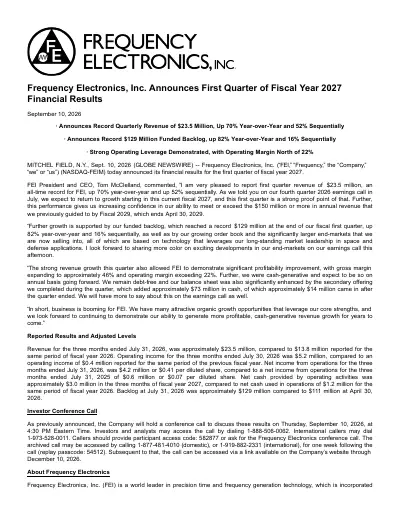
With me today is our Chief Financial Officer, Steven Bernstein. I'm very pleased to report first quarter revenue of $23.5 million, an all-time record for FEI, up 70% year-over-year and up 52% sequentially.
As we told you on our fourth quarter 2026 earnings call in July, we expected to return to growth starting in the current fiscal 2027, and this first quarter is a strong proof point of that. Further, this performance gives us increasing confidence in our ability to meet or exceed the $150 million or more in annual revenue that we guided to by fiscal 2029, which ends April 30th, 2029.
I'll have more to say about that target shortly. Steve will provide additional financial commentary later on the call, but I'd like to highlight a few items.
On our July call, we established three-year minimum margin targets of 50% for gross margin and 30% for operating margin, again, by fiscal 2029. In the fiscal first quarter we're reporting today, we generated gross margin of 45.8% and operating margin of 22%, substantial improvements and solid progress on our path towards our minimum targets.
As I've mentioned numerous times over the past few years, we did not expect our progress to be perfectly linear on a quarterly basis, whether in revenue or profitability, but the trends we see in revenue, backlog, and pipeline, as well as the internal improvements we've made that we discussed last quarter and the operating leverage we should generate with increasing revenue, position us well to meet or exceed those minimum targets. As for backlog, it grew to a new record of $129 million, up approximately 82% year-over-year and 16% sequentially.
This continued increase in backlog gives further support to our ability to add meaningful growth to FEI in the years to come. As we've discussed before, we expect continued growth in our core space and defense markets, while also seeing additional growth coming from new markets, such as space, defense, proliferated satellites, quantum sensing, space exploration, and alternative position, navigation, and timing.
Today, I'd like to provide some additional color on several of these markets, all of which build upon our core timing and frequency generation capabilities. I'm sure you're all familiar with GPS satellites, part of the traditional space business we have sold into.
On April 21st of this year, the final GPS III satellite was launched, which included FEI's newly developed digital rubidium atomic frequency standard, or DRAFS, atomic clock. This enhanced DRAFS clock is currently operational on the GPS satellite, is on order for use on other global navigation satellite systems, and is targeted at future GPS satellites, including the upcoming GPS IIIF, or follow-on, launches.
This advanced atomic clock is an example of the company's important capabilities, not just to provide the precision time and frequency devices that we've been delivering for the last 65 years, but also our capability to deliver state-of-the-art products with capabilities fueling future technological innovations. You've no doubt seen the news flow over the past several months about the critical need for missile replenishment, with government plans to significantly expand production by 2030.
We've spoken with you before about our content that goes into missile batteries for programs such as Patriot and THAAD. We expect to generate revenue from those programs in 2027 and for years beyond that, coming from existing orders, more orders to come, and additional orders to meet the needs of allied countries.
In addition to this missile battery related work, we're also now bidding on additional missile programs, with components that go directly onto the missiles themselves. In some cases, we're being asked to bid on these on-missile programs in order to potentially displace incumbents.
There is a secured communication program for the military that we're producing that is a good example of both the higher-rate production programs we have spoken about and the push by our customers to deliver more, sooner. In this case, we're working on a production contract for over 1,000 systems.
In addition, the customer on this program is now asking us to increase monthly production by more than 50%, while also promising additional follow-on orders. In other words, we're expanding the total size of an already high-rate production program.
For another example of our ability to use internally developed technology for expanded use cases, we're currently exploring potential uses of our mercury ion atomic clock for naval applications. Strategic submarines are a potential use case for advanced atomic clocks because they need to be underwater for months at a time, and their timing cannot be updated from GPS satellites while they're underwater.
They'll need a different technology for certain use cases that require very highly accurate timing, and our advanced mercury ion clocks may be the solution. We believe this is also a good example of our ability to participate in long-term programs for higher-priced systems and to do so with external funding.
In quantum sensing, we're making rapid progress in the development of advanced sensors for magnetic navigation in GPS-denied environments. We just recently delivered a sensor and associated electronics to the Army Research Laboratory for additional testing.
Development is ongoing at FEI to make smaller, more capable magnetic sensing systems for alt-PNT applications. Finally, I'd like to discuss the capital raise that we completed right at the end of the first quarter and how that may impact our long-term guidance.
We've told you previously that we have sufficient capital in place to meet the minimum $150 million revenue target by fiscal 2029. Numerous customers, however, are asking us to do more for them and to do it more quickly.
To meet this customer-driven business expansion, we decided to pursue a secondary offering of our common stock in July, which raised approximately $73 million and also brought several excellent, long-term oriented new institutional investors into our shareholder base. Approximately $14 million of the total came in after the quarter ended, as the greenshoe was exercised.
We remain debt-free with a very strong cash position, and we anticipate being free cash flow generative on an annual basis going forward. We would like to thank Morgan Stanley, our lead bankers on the transaction, and Craig-Hallum, who served as book-running managers, for their hard work on this successful transaction.
The capital we raised will allow us to pursue capacity expansion to help meet these additional customer requests, which may have the effect of our both reaching the $150 million minimum target sooner and making that target a substantially larger number by fiscal 2029. We also expect that some of our customers will pay for capacity expansion in certain cases.
We expect this additional revenue growth that derives from capacity expansion to be organic, and it is likely that if we were to make any acquisitions, they would be small tuck-ins to add to our vertical manufacturing capabilities. In other words, we do not intend to buy revenue, frankly because we don't need to given the strength of our backlog, pipeline, order book, and prospects.
There's an exceptional amount of growth and value creation to be gained by focusing on what is in front of us, without getting distracted by a larger acquisition. We should be able to superserve our customers with this extra capital, resulting in additional profitable growth that should benefit our shareholders as well.
With that, I'll turn it over to Steven for some financial commentary, and I look forward to taking your questions in the Q&A portion of the call. Steven?
Steven Bernstein
Thank you, Tom, and good afternoon. As Tom highlighted, it's a great start to our fiscal 2027 and a strong start to achieving our three-year targets.
For the three months ended July 31st, 2026, revenue from commercial and US government communication satellite programs was $11.8 million and accounted for approximately 50% of consolidated revenue, compared to $6.5 million and approximately 47% of consolidated revenue during the same period in the prior fiscal year. Revenue is recognized primarily over time under the percentage of completion method.
Revenue from the satellite market are recorded in the FEI New York segment. Revenue from non-space US government Department of Defense customers, which are recorded in both the FEI New York and FEI-Zyfer segments, were $11.1 million and accounted for approximately 47% of consolidated revenue for the three months ended July 31st, 2026, compared to $6.9 million and approximately 50% of consolidated revenue during the same period in the prior fiscal year.
Other commercial and industrial revenue for the three months ended July 31st, 2026 and '25 accounted for approximately 3% of consolidated revenue and were $605,000 and $439,000, respectively. The revenue for the three months ending July 31st, 2026 was significantly higher in both segments and in consolidation by approximately 70% or $9.6 million over the same quarter of the prior fiscal year.
Revenue from commercial and US government communication satellite programs increased $5.2 million and over 80%, and revenue from non-space US government Department of Defense customers increased $4.2 million and over 61% over the same period in the prior fiscal year. For the three months ended July 31st, 2026, both gross margin and gross margin rate increased compared to the same period in the prior fiscal year.
The increase in gross margin is attributable to the $9.6 million increase in revenue compared to the same period in the prior fiscal year. The 9% improvement in gross margin rate is attributable to higher production levels driving efficiencies in labor, overhead allocation, product mix, and also partially due to efficiencies recognized as programs mature.
For the three months ended July 31st, 2026 and '25, selling, general, and administrative expenses were approximately 18% and 26%, respectively, of consolidated revenues, a decrease of approximately 8%. However, the actual expenditures increased by half a million.
The increase in SG&A expenses during the three months ending July 31st, 2026 related mostly to compensation expenses. SG&A as a percentage of revenue decreased 8% over the same period in the prior fiscal year, demonstrating positive operating leverage given the higher revenue base and because the prior year included strategic head count additions and process optimizations that were implemented to support growth in fiscal 2027 and beyond, which caused SG&A as a percentage of revenue to be higher in fiscal 2026.
Research and development expenditures represent investments intended to keep the company's products at the leading edge of time and frequency technology and enhance future competitiveness. Fluctuations in R&D expenditures will occur in some periods due to current operational needs supporting ongoing programs.
The company plans to continue to invest in R&D in the future to keep its products at the state of the art. For the three months ending July 31st, 2026, operating income was $5.2 million or 22% of revenue, an increase significantly compared to the prior fiscal year period's $364,000 operating income due to the higher revenue, gross margin, and operational efficiencies described above.
The majority of the approximately $0.1 million of investment income for the three months ended July 31st, 2026 was from interest income and unrealized gains on assets held in the Frequency Electronics deferred compensation trust. This yields a pre-tax income of approximately $5.2 million for the three months ending July 31st, 2026, compared to approximately $557,000 pre-tax income for the three months ending July 31st, '25.
Consolidated net income for the three months ending July 31st, 2026 was approximately $4.2 million or 41 cents per share, compared to $634,000 or 7 cents per share for the same period in the prior fiscal year. Our fully funded backlog at the end of July was approximately $129 million, a new company high, compared to approximately $111 million for the previous fiscal year ending April 30th, 2026, and compared to approximately $71 million in the year-ago period.
The company's balance sheet continues to reflect a strong working capital position of approximately $90 million and a current ratio of approximately 5.3 to 1, helped by the company's stock offering, which increased further following the exercise of the greenshoe after the quarter ended. Additionally, the company is debt-free.
The company believes that its liquidity is adequate to meet its operating and investing needs for the next 12 months and the foreseeable future. I'll turn the call back to Tom, and we look forward to your questions.
Thomas McClelland
Thanks, Steve. We're now ready to take questions.
Operator
Thank you. At this time, we will be conducting a question and answer session.
If you would like to ask a question, please press star one on your telephone keypad. A confirmation tone will indicate your line is in the question queue.
You may press star two if you would like to remove your question from the queue. For participants using speaker equipment, it may be necessary to pick up your handset before pressing the star keys.
One moment, please, while we poll for questions. The first question today will be from Jeff Van Rhee from Craig-Hallum.
Jeff, your line is live.
Jeff Van Rhee
Great, thanks. Thanks for taking the questions, guys, and congrats across the board.
Just looks like a fantastic quarter here. Maybe a few for me.
Tom, maybe touch on TURBO. I know, obviously, interesting form factor, a lot of useful applications.
Could you just give us a little update in terms of what you're seeing there, in particular, from the new bookings side, strength of bookings, any quantification of where revenue is going, maybe insights into the use cases, just how it's being deployed? Just sort of a broader update on TURBO would be great.
Thomas McClelland
Sure, Jeff. We're just beginning to deliver production-rate TURBO units at this point in time, relatively small quantities still, but we anticipate things will be picking up in the near future.
Currently, the applications are all aircraft applications, manned aircraft applications, although we have discussions with some companies regarding drone applications, which is one of the areas that we're most excited about. We are also starting some initial efforts in terms of updating the development of the TURBO units for use in space, primarily that involves radiation hardening of those devices.
Jeff Van Rhee
Got it, that's helpful. Then maybe just a couple quick on the numbers front, Steve.
The percent of the backlog that's 12-month, and then also, if you could, just any color around funded. I know you only report in total backlog the portion that's funded.
I'm wondering how the ratio of funded to total has changed maybe compared to, say, a year-ago quarter.
Steven Bernstein
I'll answer the first question. All the reported backlog is fully funded.
That is fully funded. We don't report the non-funded part, the options or things.
Tom has explained numerous times we get a contract just for $10 million, maybe 10% or 20% of it is funded, only a million or two would go into backlog. We don't report that other $8 million or $9 million until it becomes funded.
Jeff Van Rhee
No, understood. What I'm asking is you've got visibility to what the rest of that backlog is, but you're only reporting funding.
I'm asking the ratio of what's visible to total and how it's changed. Then the second part of the question is what portion is the next 12 months?
Steven Bernstein
I think it's multiple times of it, the unfunded portion of it. As for the 12 months, it's about 60-some-odd percent, 65% approximately.
Jeff Van Rhee
Okay. Tom, you referenced again on this call, and you talked about it last call as well, obviously, the order book is full, and you've got to figure out how to allocate and which orders to take, but one of the responses has been to ramp production.
Just talk a little bit about where you are in that volume production ramp, that build-out. Are you hitting your throughput goals?
It's a challenge to keep up with this level of growth. Curious how you're doing on that volume production shift.
Thomas McClelland
It's a really good question, Jeff. I think that's certainly one of our biggest challenges at this point.
We are ramping up our production on a number of fronts at this point. There are some challenges and limits to what we are able to achieve in that regard.
I think one of the management challenges is being able to thread the needle appropriately, so that, of course, we never like to turn down additional business. On the other hand, it's very important for us to deliver what we say we're going to deliver and to do it on time.
In some cases, we are not signing up to some of the more ridiculously optimistic schedules that some of our customers are asking for because we don't feel that it's possible. I think it's important for us to stand firm on that kind of a thing.
We're walking a tightrope in this regard at this point. Let's just put it that way.
Jeff Van Rhee
Yep. Understood.
Then maybe two other quick if I could. On the proliferated LEO opportunity, I think you commented last quarter 90% win rates in space, and, in particular, we've seen some real interesting call it green shoots in terms of proliferated LEO and the ability to win.
Just curious any updates there last 90 days, things that have influenced your conviction, what you're seeing in the pipeline there, observations on pLEO opportunity would be great.
Thomas McClelland
I think the opportunities are really good. I think that big arena for us is the classified satellites, which the architecture is very aggressively moving to the proliferated satellite model.
It is still in the early stages of that transition, but we're kind of at the point where we're moving from demonstrating capabilities to initial production on those programs. We're getting involved in more programs every day at this point.
That's really pretty exciting. I think there's a tremendous amount more to come in the future.
We hear a lot of talk about data centers in space, but that hasn't materialized quite yet. I know there's talk about that happening in 2027, but I think that's probably a little bit overly optimistic.
That concept is definitely happening, and we are in the thick of it and very excited about that. Sort of a variant of that, we're, of course, actively involved in some of the lunar missions that get a lot of press at this point in time.
In some ways, it's similar to the proliferated satellites. In some ways, it's different.
We're not really talking about hundreds or thousands of devices heading toward the moon, but I think a lot of the approach is similar to the proliferated satellites, where we're looking for a lot smaller, cheaper, faster production of things. I think that that's important involvement for us because it helps to get our feet wet in this smaller, cheaper, faster arena.
Jeff Van Rhee
Very helpful. Last one maybe on gross margin.
Tom, I know you pay a lot of attention to which contracts you take and which you don't, and there are a lot of variables that can affect your gross margins, whether they're follow-on orders versus new and a variety of other things. Just as you look at the order book and what is to come over the next few quarters, any notable call-outs in terms of you put up a great gross margin print here this quarter quite a bit ahead of us, things that would drive it higher or lower?
I know you're not going to call a specific quarter, but as you look out over the next two or three, anything to call out about what's in that pipe and going to turn into revenue and whether those are, in particular, upward or downward pressure on gross margin?
Thomas McClelland
I don't see any particular either upward or downward pressure on things at this point in time. I guess what I'd say is it's really part of our strategy at this point, and we've talked about it before.
That there's so much growth in our basic markets that it puts us in a really strong position. We can be a little bit picky.
I think for us, the strategy is to be disciplined, to make sure that we bid things such that we can be very profitable and maintain our high margins. Of course, part of that strategy is being willing to lose some things if the competition is extreme and the margins that we would necessarily need to accept in order to get those programs are a little bit lower.
We're in a really good position, and we are staying disciplined. I think we've talked about it previously, the proliferated satellites, especially in the early stages, are ones where we are willing to accept somewhat lower margins in order to get involved in those programs.
At this point, there's not a major move in that direction in the sense of having to accept lower margins. We are seeing activity in the proliferated satellites, but we haven't really seen a lot of pressure on our margins.
I think it's pretty optimistic on the margin front. I will say that we shouldn't interpret that as a straight line upward necessarily as we go.
Jeff Van Rhee
Yep, got it. Congrats, and understood.
Obviously years of good decision making getting you guys to this point, congrats to the whole team.
Thomas McClelland
Thanks, Jeff.
Operator
Thank you. The next question will be from John Siegmann from Stifel.
John, your line is live.
John Siegmann
Hey, good afternoon. Thank you very much for taking my question and congratulations on the momentum in the business.
Thomas McClelland
Thanks.
John Siegmann
The company's got a long history of relationships with the larger traditional companies. You've made reference in earlier calls about bidding with some of these new companies.
Clearly, some success sounds like it's percolating on the space side. Can you talk a little bit about any penetration and success you've had with the new defense tech companies?
Thank you. A
Thomas McClelland
very good question. Yes, I think it's true that at this point in time, most of our success in this arena is in the space environment.
I have to be very careful about talking about specific programs, but we've had conversations with a number of the newer space companies on a variety of different programs: Intuitive Machines, Astranis, and a number of others. In the defense arena, we don't have a whole lot of success in this area yet, although we are certainly pursuing things with a number of different companies.
Of course, Anduril, in particular, is one that we've had communications with. Let me just leave it at that.
John Siegmann
That's great. Then, well, maybe just on the traditional side, the Patriot and THAAD production increases, understand you're more on the battery side versus the interceptor side, but is there any way to frame how much increases that could be for your business if we're tripling production rates for those programs?
Thank you again.
Thomas McClelland
It's very significant. Obviously, you don't build new batteries every time you shoot off a couple of missiles, but the bottom line is we're seeing a tremendous amount of business for both THAAD and Patriot.
I think to put that into context, I think there's a lot of activity in Ukraine talking about additional missile batteries and things. I think that the more missiles are shot off, it tends to mean that batteries are needed in additional locations, and this translates into more business for us these applications.
For whatever reason, I think the bottom line is it's a thriving business for us at this point.
John Siegmann
Thank you.
Operator
Thank you. Once again, it will be star one if you wish to ask a question today.
The next question will be from Steve Levinson from Big Rock Research. Steve, your line is live.
Steve Levinson
Thank you very much. Good afternoon.
Thomas McClelland
Hi, Steve.
Steve Levinson
I've enjoyed watching your progress over the last few years, and I'm curious about a few things. You talked about using some of your new capital to expand manufacturing, and I imagine a lot of your work is sort of manual bench work, and I'm wondering if there's an opportunity to enhance margins by using some automation or is that impractical for the sort of assemblies you make?
Thomas McClelland
It's a very good question. That it's certainly not out of the question.
In fact, we are looking at that very carefully, especially quartz crystal manufacturing is an important part of what we do, and I guess I should emphasize that this is part of our vertical integration. We do all the manufacturing of quartz resonators starting from raw quartz crystal material.
The production there is certainly one of the challenges that we face at this point in time, and we are looking at putting in place additional equipment that has higher throughput capabilities. We tend to think of our production facility as sort of a boutique facility because in general, the quantities that we work with are relatively small for space applications and so forth and so on.
Relative to quartz crystal manufacturing for consumer watches and things of that sort, our production will remain relatively small going forward, but it is nonetheless increasing, and so we are looking at putting in place equipment that can increase the throughput. In addition to that though, there's a lot of equipment that is needed just in general.
Most of the products that go into space need to be tested in a space-like environment, so-called thermal vacuum environment where we can modify the temperature to be similar to what units experience in space. Obviously, that's an environment which is normally not encountered on Earth, and there's a lot of special test equipment in order to be able to test them in those kind of environments, so that's another thing that we're looking at adding additional capacity for.
Of course, there's a lot of other things that we're looking at at this point in time. Those are just kind of a couple of straightforward examples.
Steve Levinson
Great. That's helpful.
Thank you. My other question would be, in terms of proliferated satellite constellations, is there an application for the quantum sensor to gather data for the World Magnetic Model?
Is that something that could be done using that device from space or is that more a terrestrial item?
Thomas McClelland
It definitely is something that meaningful measurements can be made from space, and I know there is definitely some talk and some ideas for doing just that. I think that in terms of overall quantities, I think that would remain relatively small, but it is definitely something that we're interested in pursuing.
Steve Levinson
Great. Thank you very much.
I'll be watching your progress along the way. Thanks.
Thomas McClelland
Okay. Great.
Thank you.
Operator
Thank you. The next question will be coming from Michael Eisner, and Michael is a private investor.
Michael, your line is live.
Michael Eisner
Hey, great job. One quick question or two.
In space, is there a specific area you see the most revenue coming from or opportunity?
Thomas McClelland
I think no. The simple answer is I think we're seeing increasing revenue from just a variety of different directions, and that's really what's so exciting and unique about this time, relative certainly to a decade or two decades ago.
It's just, I think we've commented on it recently, whereas a decade ago, there were something like a hundred launches in a year. I think in the last year, the United States launched something like 3,700 objects into space.
So 100 objects launched into space, objects being satellites and things like that, and now 3,700. Tremendous growth anyway you look at it.
The traditional satellite activity is booming. We have a lot of work going on right now, but the new proliferated satellite stuff is also very active, and we have a lot of programs that we're getting involved in, and as we demonstrate success on those programs, we see more and more coming in the front door.
Pretty exciting.
Michael Eisner
That's good. I like the answer.
What's the book-to-bill for this at this time?
Thomas McClelland
Steve, you got those kind of numbers?
Steven Bernstein
The book-to-bill is about 1.76 to 1 for the quarter.
Michael Eisner
1.76 to 1. All right, excellent.
Thank you for your time.
Thomas McClelland
Okay. Thanks, Mike.
Operator
Thank you. The next question will be from Robert Smith from the Center of Performance Investing.
Robert, your line is live.
Robert Smith
Thank you for taking my questions. Congratulations on the ramp.
It's a thrill to see.
Thomas McClelland
Thank you.
Robert Smith
My first question is, could you give me the current R&D figure, and how do you see R&D as a percent of revenue going forward, considering the large targets that you have for growth?
Thomas McClelland
A good question. I think a couple of qualitative statements first.
I think, and we've talked about this in the past, but one of the overall strategies for the company is to try to get as much external funding for R&D as possible. I think this is really important in the kind of products that we specialize in because the primary customer for our products is really the US government.
When the US government funds research, it's always because they're funding applications that they're interested in. Of course, that's what we want to focus our research and development on, what our customers are interested in, as opposed to stuff that might be intellectually interesting, but doesn't necessarily lead to profitable products down the road.
That's the first thing is to try to get external funding for as much research and development as possible. Talking about the internal R&D, I think that like a lot of things, you have to understand that there will be fluctuations, and so I don't want to make statements that will be held to on a quarter by quarter basis.
I think that we anticipate the internal R&D funding to stay under 10% of revenue at this point in time. I think that we will see in an absolute sense some additional R&D expenditures over the next couple of years as our revenue grows.
I hope that gives at least a bit of an answer to your question.
Robert Smith
It does. My second question is, would you at all consider the initiation of a small cash dividend to attract any number of institutions that won't buy the security without a cash payment?
Thomas McClelland
We've done so in the recent past, and I think we certainly will consider that going forward. I'm not making any promises at this point, but yes, definitely something that's on the table.
Robert Smith
Thanks very much. Good luck.
Thank you.
Thomas McClelland
Thank you.
Operator
Thank you. There were no other questions at this time.
I will now like to hand the call back to Thomas McClelland for closing remarks.
Thomas McClelland
Thank you. Thanks for taking the time to listen and participate in today's earnings call, and we look forward to providing further updates in the coming months.
Thanks.
Operator
Thank you. This does conclude today's conference.
You may disconnect your lines at this time and have a wonderful day. Thank you for your participation.