Frequency Electronics, Inc.
Q3 FY2026 · Earnings Call TranscriptMarch 11, 2026
Operator
Greetings, and welcome to the Frequency Electronics third quarter fiscal 2026 earnings release conference call. At this time, all participants are in a listen-only mode.
If anyone should require operator assistance during the conference, please press *0 on your telephone keypad. As a reminder, this conference is being recorded.
Any statements made by the company during this conference call regarding the future constitute forward-looking statements pursuant to the safe harbor provisions of the Private Securities Litigation Reform Act of 1995. Such statements inherently involve uncertainties that could cause actual results to differ materially from the forward-looking statements.
Factors that would cause or contribute to such differences are included in the company's press releases and are further detailed in the company's periodic report filings with the Securities and Exchange Commission. By making these forward-looking statements, the company undertakes no obligation to update these statements for revisions or changes after the date of this conference call.
It is now my pleasure to introduce your host, Thomas McClelland, President and Chief Executive Officer.
Thomas McClelland
Good afternoon, and thanks for joining Frequency Electronics' third quarter fiscal year 2026 earnings call. With me today is our CFO, Steve Bernstein.
On our second quarter fiscal 2026 earnings call in December, I discussed our vision for how we see the growth in our company developing in the coming years. Specifically, I told you that the exciting growth prospects we have in large and growing end markets, which are larger than our historical addressable markets, will come in addition to continuing strength and growth in our ongoing businesses in space and defense.
These new markets, such as quantum sensing, proliferated satellites, and alternative position, navigation, and timing programs, are built upon our industry-leading capabilities in our core space and defense programs. I also told you on that December call that we anticipate multiple awards in the coming months, some of which are as large or larger than the biggest ones we have historically announced.
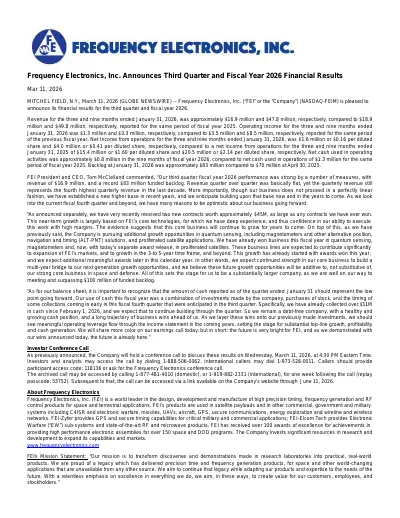
Today, we're very pleased to report significant progress on all of these fronts. In a separate press release that came out at the same time as our earnings report after the close of market today, we announced that we were awarded two contracts valued at approximately $45 million.
One of these contracts is in the domain of FEI's traditional space satellite programs, and one is part of the new proliferated satellite paradigm. Customer confidentiality prevents us from discussing these with greater specifics at this time, but there are two important points to consider.
First, of course, is that these contracts reflect our ability to continue to win meaningful contracts in our traditional space business, while also winning significant business in our next-generation markets at the same time. In other words, while our business is never perfectly linear, we are definitely not projecting a dislocation in which the traditional business wanes while the new business replaces it.
Rather, they'll both grow and pave the way for us to become a substantially larger company. Second, we're already actively working on additional contracts of similar magnitude in both our traditional and new business lines, and anticipate additional awards in this calendar year.
On the December call, I also told you that while backlog in any given quarter can fluctuate given newly funded awards and what is converted into revenue in a given quarter, based on what we're seeing coming down the road, we believe it is reasonable that we could see backlog north of $100 million in the not-too-distant future. Our January quarter-end backlog was at $83 million, a new record for FEI, and, of course, this backlog amount was prior to the award of the contracts announced today.
This new business announced today will start to enter backlog in this current fiscal fourth quarter, which should help us make further progress towards the $100 million mark in the near future. Now that $100 million level, by the way, is not meant to indicate a ceiling, but a level we're currently building towards.
Adding more awards like the ones we announced today could push us well past that over time. Steve will provide more financial details a little bit later, but I would like to make a few financial comments here.
For the third fiscal quarter, we reported revenue of $16.9 million, essentially the same as the second fiscal quarter. This revenue number is down year over year because of the particularly strong execution we exhibited in fiscal 2025, which allowed the company to produce revenue on certain programs in fiscal 2025 that we had originally expected to produce over a much more extended period of time well into fiscal 2026, essentially pulling forward some revenue, as we've discussed in the previous calls.
Nonetheless, this was still the fourth highest quarter of revenue in the past 10 years, with the only three higher quarters having occurred within the past four quarters. As we said on the December call, though our business does not proceed in a perfectly linear fashion, we have established a new higher base, and we anticipate building upon that base now and in the years to come.
Before I turn things over to Steve, I would like to make a few comments on the current state of the world and how it relates to FEI's business. Obviously, most immediately, our country is now at war.
As we've discussed on previous calls, we're involved in numerous defense programs, including Golden Dome, Patriot missile system, B-2 bomber, and Terminal High Altitude Area Defense missile system, the THAAD system, as well as other multidomain defense systems. Missile systems and interceptors have been in the news quite a bit over the past two weeks, and I would like to remind you of remarks we've made previously on our calls.
Our exposure on major missile programs is principally in the missile batteries, which are ground-based units used to detect, track, and intercept incoming threats, generally by firing missiles at those threats. As the government increases the deployment of these batteries, our business will expand along with that, and we've already seen evidence of that in the current quarter.
Further, the early days of this war, as well as the action earlier this year in Venezuela, have shown an increased reliance on traditional jet fighters and naval fleets, as opposed to next-generation defense technologies. Similar to our discussion earlier on our space positioning in traditional and emerging markets, we believe this military deployment is a good example of how there remains strong opportunities in our traditional defense business, even as we are engineering products for next-generation modalities.
We expect defense to continue to be a meaningful and growing business for FEI for many years. Meanwhile, in the Ukraine-Russia war and in the Strait of Hormuz, GPS jamming has become ubiquitous, creating dead zones that threaten civilian aircraft, telecom, and financial systems, shipping firms, and NATO allies.
The need for alternative position, navigation, and timing systems, alt-PNT, including the use of quantum sensing and magnetometers, is paramount, and we expect to be a part of that solution set in the years to come. In fact, this current fiscal year, we've already won some new business in both magnetometers and other quantum sensing, including business won out of our new Colorado facility.
We expect a lot more alt-PNT business in the years to follow. Our technology is used in systems and programs that play critical roles in keeping our country and our military safe.
We're very proud of this work, and it creates an additional sense of mission for our team. I would like to thank our employees, our customers, and our shareholders, all of whom we serve by carrying out this important work.
Lastly, we will be participating in two investor conferences in the fiscal fourth quarter, and we look forward to meeting with a number of you at the Craig-Hallum NewSpace Conference on March 25th and the Morgan Stanley Golden Dome and National Security Innovation Summit on June 15th. Now I'll turn the call over to Steve to provide some more financial details, and I look forward to taking your questions during the Q&A following Steve's remarks.
Steve?
Steven Bernstein
Thank you, Tom, and good afternoon. For the three months ended January 31st, 2026, consolidated revenue was $16.9 million, compared to $18.9 million for the same period of the prior fiscal year, and substantially similar to the second quarter of this fiscal year, as Tom mentioned earlier and which we have described on the past several calls.
The components of revenue are as follows: revenue from commercial and US government satellite programs was approximately $4.2 million, or 25%, compared to $11.2 million, or 59%, in the same period of the prior fiscal year. Revenues on satellite payload contracts are recognized primarily under the percentage of completion method and recorded only in the FEI-NY segment.
Revenues from non-space US government and Department of Defense customers, which are recorded in both the FEI-NY and FEI-Zyfer segments, were $12.5 million, compared to $7.4 million in the same period of the prior fiscal year, and accounted for approximately 74% of consolidated revenue, compared to 39% for the prior fiscal year. Other commercial and industrial revenues were approximately $180,000, compared to approximately $367,000 in the prior fiscal year.
The revenue for the three months ending January 31st, 2026, were lower than the revenues in the prior period partly as a result of certain space programs in the FEI-NY segment during the prior fiscal year that were being expedited during the period due to very aggressive schedules. In addition, several new space bookings anticipated for the three months ending January 31st, 2026, are now anticipated in the fourth quarter of fiscal 2026.
For the three months and nine months ending January 31st, 2026, both gross margin and gross margin rate decreased compared to the same period in the prior fiscal year. The decrease in gross margin and gross margin rate were attributable to a change in the mix of high-margin production satellite programs in the prior-year periods versus lower-margin programs with significant non-recurring engineering efforts during the three months ending January 31st, 2026.
Going forward, the mix of programs will vary in any given quarter, but in general, we expect our gross margin to move up over time, particularly as we add more business with higher rate of unit production and follow-on business from successful programs. For the three months ending January 31st, 2026 and '25, selling, general, and administrative expenses increased by approximately $213,000 and were approximately 21% of consolidated revenue, up from 18% in the prior year.
The increase in SG&A expenses during the three months ending January 31st, 2026, was due to fluctuations in various expense accounts that make up SG&A. R&D expense for the three months ending January 31st, 2026, increased to approximately $1.8 million from $1.4 million for the three months ending January 31st, 2025, an increase of approximately $327,000, and were approximately 10% and 8%, respectively, of consolidated revenue.
Fluctuation in R&D expenditures will occur in some periods due to current operational needs supporting ongoing programs. The company plans to continue to invest in R&D in the future to keep its products at the state of the art.
In total, operating expenses increased approximately $540,000, but this includes approximately $500,000 of non-recurring expenses, we anticipate showing more operating leverage going forward as additional revenue should expand at a much faster rate than expenses. For the three months ended January 31st, 2026, the company reported operating income of approximately $1.3 million, compared to an operating income of approximately $3.5 million in the prior fiscal year.
Operating income decreased due to lower revenue, lower gross margin, and increased SG&A described earlier. Other income expense, net, is derived from various sources.
The majority of the approximately $0.2 million of investment income for the three months ending January 31st, 2026, was from interest income and unrealized gain on assets held in the Frequency Electronics deferred compensation trust. This yields a pretax income of approximately $1.4 million for the three months ending January 31st, 2026, compared to an approximately $3.6 million pretax income for the three months ended January 31st, 2025.
For the three months ending January 31st, 2026, the company recorded an income tax benefit of approximately $127,000, which includes a discrete tax benefit of approximately $568,000. The discrete income tax benefit is primarily due to stock compensation windfall deductions.
For the three months ended January 31st, 2025, the company recorded an income tax benefit of $11.8 million, which included a discrete income tax benefit of $11.9 million. The discrete income tax benefit in the comparable period is primarily due to the release of the valuation allowance.
Consolidated net income for the three months ended October 30th—sorry, January 31st, 2025—was approximately $1.6 million, or 16 cents per share, compared to approximately $15.4 million, or $1.60 per share, for the same period of the previous fiscal year. Our fully funded backlog at the end of January 2026 was approximately $83 million, a new all-time high for FEI, as compared to approximately $70 million for the previous fiscal year ended April 30, 2025.
The company's balance sheet continues to reflect a strong working capital position of approximately $32 million at January 31st, 2026, and a current ratio of approximately 2.6 to 1. The amount of cash reported as of the quarter-end January 31st should represent a low point going forward, which is a combination of investments made by the company, purchases of stock, and collections coming in early in the fiscal fourth quarter that were anticipated for the third quarter.
Specifically, we have already collected over $11 million of cash since February 1st, 2026, and we expect that to continue building through the quarter. Additionally, the company is debt-free, and the company believes that its liquidity is adequate to meet its operating, investing needs for the next 12 months and foreseeable future.
I will turn the call back to Tom, and we look forward to your questions shortly.
Thomas McClelland
Thanks, Steve. We're now ready for questions.
Operator
Thank you. At this time, we will be conducting a question-and-answer session.
If you would like to ask a question, please press *1 on your telephone keypad. A confirmation tone will indicate your line is in the question queue.
You may press *2 if you would like to remove your question from the queue. For participants using speaker equipment, it may be necessary to pick up your handset before pressing the star keys.
One moment, please, while we poll for questions. Once again, please press *1 if you have a question or a comment.
The first question comes from Jeff Van Riel with Craig-Hallum. Please proceed.
Jeff Van Riel
Great. Thanks for taking the questions.
A couple for you here, guys. Tom, the proliferated win, talk to me about what you're learning out in the marketplace and your ability to win in these proliferated constellation deals.
I know this is something you've sort of felt your way through. Looks like you've got some success and you're sort of guiding to continued success.
Where do you have the right to win? Where do you win?
Where do you not have a right to play? Just what have you learned there?
Thomas McClelland
I think when we can provide some technical edge, we're very successful. We're seeing that, and that's what the win that we announced today reflects.
When there are systems that have minimal technical requirements and all of the emphasis is just on the lowest possible cost, then it's a much bigger challenge for us.
Jeff Van Riel
Realizing your hands are somewhat tied, talk to me to the degree you can on the $45 million. I think you said there's a couple wins in there.
Are these roughly equal in size? I know you said one was proliferated, one wasn't, but just rough proportion of what's in there?
Thomas McClelland
I'm going to dodge that one a little bit, Jeff, but let me just say they're both significant.
Jeff Van Riel
Okay. In terms of the coming into funded backlog, I think that the phrasing was they will start to come into backlog.
Can you give us some swag at how quickly that's going to play into the backlog?
Thomas McClelland
Yeah. Just a reminder that we talk about funded backlog, it's a question of the funding profile on each of these programs.
The reality is that will be pretty significant in the quarter that we're in currently. I don't think I can say a whole lot more than that at this point.
Okay.
Jeff Van Riel
Steven, on the cost structure, it was a little unclear. I think you referenced there were some unusuals in there.
Obviously, R&D has bumped up considerably over the last few quarters. I'm trying to understand what the steady state OpEx levels are going forward.
Just what was in there for this quarter that was one-time and not?
Steven Bernstein
We have in the general operating expenses, we still have investments that we're making. Colorado is the largest piece of that, and once that's done, it should normalize pretty much.
That was the larger piece of it.
Jeff Van Riel
When you say normalize, are we going to go up from this level as we go forward into future quarters or was there unusual in here and we should step down from here?
Steven Bernstein
Again, operating expenses in general, unfortunately, there's always some bump, whether it 3%, 4%, 5% based on just the normal growth of normal expenses. Unless something changes, I don't see a large increase, but I don't see a large decrease.
Jeff Van Riel
Maybe last for me, Tom, with respect to TURBO, I know you had given some color commentary in a few prior quarters that you felt it had the potential to go from a couple million to maybe $20 million in the out year if things go right. Just your updated thinking on TURBO based on market reception, pipeline, etc.?
Thanks.
Thomas McClelland
I think if anything, we're more optimistic about TURBO. We're beginning to see significant revenue at this time, and every indication is that this is going to grow dramatically even over the next couple of quarters and definitely over the next couple of years.
Jeff Van Riel
Got it. Thanks so much.
Operator
Our next question comes from Chris Witkowsky, private investor. Please proceed.
Chris Witkowsky
Hello. Thank you for taking my questions, and congratulations on the new wins.
Could you clarify what exactly is a proliferated satellite? Is that the Starlink-type satellite?
I'm not asking if it's Starlink or not, just if it's that type of satellite.
Thomas McClelland
Yeah. It's actually a pretty good question.
I'm not sure I really like that term, proliferated satellites, but it is one that is being used out there. I think the distinction we're trying to make is between what we call traditional satellite systems, where there are maybe three to five satellites in a constellation, often times in geosynchronous orbits, versus these newer satellite systems that are being envisioned at this point in time, often, but not always, in low Earth orbit, but consisting of many, many more satellites, typically from 300 to, in some cases, many thousands.
SpaceX is now talking about a constellation of a million satellites. I think the real distinguishing feature is the thought process that goes behind these systems.
What's become very clear recently is that satellites are vulnerable from our enemies, and this has been demonstrated recently that both the Chinese and the Russians, in particular, have capability to destroy other satellites. When we have a satellite system that has only a couple of satellites in it, if one of those satellites gets destroyed, it's a huge loss for us.
It can represent billions of dollars, in fact. The idea is, instead of having a couple of satellites worth a billion dollars each, to have a system where there are many more satellites, but the individual satellites are much, much less costly.
A simple way I like to look at it is that the system itself may overall cost the same amount of money, but instead of those costs being distributed over a few satellites—three, four, five satellites—it's distributed over 300 or 1,000 satellites. In order to make that approach work, obviously, the individual satellites have to cost a lot less.
That's what we end up looking at. We look at individual satellites, the contribution that we make in our products to an individual satellite has to cost a lot less than what we would deliver for one of the traditional satellites.
Then, of course, another important feature is that if you're going to launch 300 satellites instead of three, you need to do it at a much more rapid pace than is necessary for the three satellites. The production rate has to increase dramatically.
This lower cost and more rapid production makes for a significantly different manufacturing approach than with traditional satellites. We're actually investing in order to really get involved in a very significant way in this new kind of satellite business.
One of the attractive features is that on an ongoing basis, many of these systems are envisioned to have just a continuous, ongoing production of satellites. The idea is that the individual satellites are intended to have a shorter lifetime, instead of 15 years for traditional satellites, maybe three to five years for the newer satellites.
We get into a production mode where we are delivering on a scheduled basis, say, the first 300 satellites in a 300-satellite system. As soon as we're done delivering the 300 satellites, we have to start all over again because the first satellites that were launched are nearing the end of life and have to be replaced with new ones.
It makes for potentially a much more continuous kind of production, and that's something that we think makes for a much more predictable business and it's also, in many ways, a more attractive business than the traditional satellites, where we would have a large-scale production activity over a couple of years, and then when we're finished with three or four satellites, we're done, perhaps for the next decade until people are talking about potentially replacing those satellites. Anyway, probably a more long-winded answer than you wanted, but let me leave it at that.
Chris Witkowsky
That was very appreciated. Please feel free to be as long-winded as you want.
It seems like there'll be some headwinds and some tailwinds for gross margins. I'm sure having continuous production would really help gross margins, but then having a new satellite program which requires limited costs, that might hurt gross margins.
Do you think you will be able to keep your gross margins on this new proliferated satellite program, and is there going to be a learning period where gross margins will be lower? Yeah.
Thomas McClelland
It's a good question. It's something we've talked about on previous calls.
I think we do anticipate, in the short run, somewhat lower gross margins on the proliferated satellite business as it gets refined in the initial years. At the same time, and it's really one of the things we're trying to emphasize today, is that the traditional satellite business is still alive and well, and that is a business that our gross margins are very strong.
Whereas we have to invest to some extent in the proliferated satellites, we have really good gross margins with the traditional satellites. I also want to emphasize that in the long run, we anticipate very strong margins for the proliferated satellite business as well.
Chris Witkowsky
You mentioned that in this current quarter, these $45 million, some of it is going to the funded backlog. Are you allowed to tell us when actual production would start?
Thomas McClelland
That's something I think I'm not prepared to get into. It's very early stages of these programs, and the schedules are being worked out now with our customers.
Chris Witkowsky
All right. Thanks.
Good luck.
Thomas McClelland
Thank you.
Operator
Next question is from Michael Eisner, private investor. Michael, please proceed.
Michael Eisner
Congratulations on the two contracts and future contracts. Most of my questions are answered.
Can you comment on Golden Dome?
Thomas McClelland
I don't think there's a whole lot I can say. From our point of view, Golden Dome is just sort of being defined at this point in time.
We have spoken specifically in the past and earlier today about some of the programs, Patriot missile and THAAD, which I think are in some ways of thinking considered part of the Golden Dome concept. We're also involved in several other missile programs which we can't talk about in specific.
We're very, very involved in a number of things that are part of the Golden Dome concept. Of course, satellites are also a very, very important part of the Golden Dome concept, and we're very involved in that also.
Other than that, Michael, I don't think I can really get into any specifics. Comment.
Michael Eisner
Frequency Electronics has been around for 60, 70 years, and Frequency is a nice name, good name, respected name. Did you ever think of adding to Frequency, maybe Frequency Quantum Sensing, for example, or Timing?
That's what the company actually does. Oh yeah.
Thomas McClelland
Sure. We have thought about it, and there have been all sorts of suggestions along the lines that you're suggesting right now and quite a number of other ones also.
I don't think I want to say a whole lot more than that, but at the moment, we're sticking with the 65-year-old name that we have.
Michael Eisner
I just thought cuz it does so much Frequency from years ago, it does so much more now. It sounds like from this call, we're getting involved with more stuff in technology.
Thomas McClelland
They could say
Michael Eisner
technology company.
Thomas McClelland
Yeah. The one thing I'll say, we've given some thought to this kind of thing, and I'm not going to say one way or the other what the future will bring, but I think we've just been talking about it, there's a tremendous amount of business that we're looking at at this point in time and we're anticipating very, very significant growth.
I think the important thing for us to do is concentrate on executing that business effectively. That's what we're focusing on, and we feel that's way more important than the name we provide to the company.
Michael Eisner
That's fine. Thank you.
Thomas McClelland
Yeah.
Operator
Once again, if you have a question or a comment, please press *1. We have a follow-up coming from Jeff Van Riel with Craig-Hallum.
Please proceed, Jeff.
Jeff Van Riel
Great. Thanks.
Just a few for me, guys. In terms of the script, Steven, and I might have missed it.
I thought you had said you had some bookings push-outs, and I didn't quite catch it. I think you said Q1 went to Q4.
Just recap that for me, and then, Tom, I know you've been talking about $100 million backlog you thought in the relatively near future. Sounded like slightly different verbiage here, maybe it's not quite as near as you thought it had been.
Just connect those two dots for me and help me understand what's going on there.
Thomas McClelland
I think that, again, we can't really get into quantitative specifics, but I do think that the $100 million mark is going to be breached relatively quickly. I think our backlog is up from what it was last quarter slightly, and we just announced today $45 million of new contracts and that's going to be hitting the backlog, beginning to hit the backlog this quarter, and there's more in the input pipeline.
We're very quickly approaching the $100 million mark.
Jeff Van Riel
Understood. Just back to the original question, Steve, did you reference contracts pushing out from Q1 to Q4, and if so, could expand on that?
Steven Bernstein
No, I said they pushed from Q3 to Q4, and that's why some of the revenue was down and dropped because of that. That's all.
Thomas McClelland
I think very specifically, the contracts that we just announced.
Steven Bernstein
So
Thomas McClelland
One of the frustrating things in the satellite business
Jeff Van Riel
is
Thomas McClelland
our wonderful government. They like to get their satellite hardware as quickly as possible, but they're not so fast in executing contracts.
Jeff Van Riel
To say the least. Okay.
Thanks so much.
Thomas McClelland
All right.
Operator
Next question comes from Robert Smith with Center for Performance Investing.
Robert Smith
Hi. Good afternoon, Tom.
Thomas McClelland
Hi. Steve.
Robert Smith
I just wanted to congratulate you, Tom, on you're transforming this company and positioning it for future growth, and I'm hopeful that you can continue to execute, and I think you're doing a wonderful job and kudos to you. Grateful to be aboard.
Thanks so much.
Thomas McClelland
Hey, appreciate it, and we'll do our best.
Operator
Our next question, we have a follow-up actually from Chris Witkowsky, private investor. Please proceed.
Chris Witkowsky
Hello, thanks for taking my follow-up. I wanted to ask if you can expound a little bit on the alternative position and navigation.
Now, obviously, there's GPS jamming all over the place, and how do you help address that, and would that lead to your devices being actually deployed in kind of the terrestrial, in the boats and cars, and so on?
Thomas McClelland
Okay. For alternative navigation, there dozens or more things that people are considering.
I think it's maybe worth just a little bit of discussion about this. We all have come to depend on GPS, Global Positioning System, over the last couple of decades.
The one thing that distinguishes GPS is the G part of it, the global. It's available, literally any place on the surface of the Earth.
When people talk about alternatives to GPS, sometimes they talk about other satellite navigation systems, which are potentially also global in reach. In general, people like to talk about things that are not satellite systems.
The whole idea is that the satellite Global Positioning System is vulnerable. The satellites can be destroyed or damaged by our enemies in particular, and also the signals can be jammed.
If you just replace one satellite system with another satellite system, you have essentially the same problems that you had with the original system. People talk primarily about non-satellite alternatives.
In general, the non-satellite alternatives are not global in reach, and that means that if you're not talking about satellite systems, usually when you talk about alternatives, you're talking about employing multiple approaches to navigation. One alternate may work in a particular environment, say, an urban environment, and another approach will work over the ocean or in the middle of the desert someplace.
With all of that preliminary being said, there are a couple of things that we're involved in and think are going to become important over the next couple of years and probably over the next decade. One of them that we're working on very actively right now is so-called magnetic navigation.
The idea here is that the magnetic field around the surface of the Earth is not exactly constant. It varies by small amounts, and the exact magnetic field and direction is location sensitive.
If you have a very accurate map of the magnetic field in a region on the surface of the Earth, then and you have a means of measuring the magnetic field, then you can compare your measurements to the magnetic map and locate yourself with really quite precision, probably not at this point in time with the same precision that we get from GPS, but in under the right conditions, it can be pretty close to that. That's something that we're pursuing.
We're pursuing the magnetometer end of this, the sensor for measuring the magnetic field. Of course, that by itself isn't going to allow you to navigate.
You also have to have the magnetic maps, which, by the way, is something that we're looking at helping to improve the existing magnetic maps of the surface of the Earth. Another alternative to GPS that is considered is really a similar kind of concept, but you can imagine using a combination of fixed terminals on the surface of the Earth and drones, and those fixed terminals and drones effectively act as a mini GPS system.
The drones are equivalent to the GPS satellites, and in a localized area, that kind of configuration provides a means of very, very precise localized navigation. These are just a couple of things that Frequency Electronics is actually involved in in terms of alternative navigation.
There of course many other things that people talk about, various detecting radio frequency signals from radio stations and using that to navigate, there's inertial navigation, and various other things. I'll just leave it at that for now.
Chris Witkowsky
Thanks for the thorough answer. Are you getting NRE revenue right now?
I guess production revenue will be a couple of years out.
Thomas McClelland
We are because the US government is very interested in developing these technologies, and they're funding development activities. We're getting revenue from those development funds.
We anticipate over the next decade, instead of development revenue, turning that into product-based revenue.
Chris Witkowsky
All right. Thanks again.
Operator
The next question is from Sam Nelson, private investor. Sam, please proceed.
Sam Nelson
Hi, Tom. Thanks for taking my question.
I was just trying to get a better idea of, with the new contracts, how that award might ultimately flow through the backlog. I think on previous calls, you had described how ultimately the impact might be like 10x the initial value that's realized on the backlog.
Just to clarify, I was wondering if we could look at these new contract awards in a similar way, where the initial realized amount of the contract that's falling in backlog, could we 10x that, or what might the impact ultimately be? Yeah.
Thomas McClelland
I think without making specific kind of statements, that 10x approximation, I think, is reasonably valid here. The contribution to backlog depends on the initial funding on these contracts.
Something along those lines. Again, not providing specific guidance.
Sam Nelson
Okay. Thank you.
Operator
We have no further questions in the queue. I'd like to turn the floor back to management for any closing remarks.
Thomas McClelland
Okay. Thank you for taking the time to listen and participate in today's earnings call, and we look forward to providing further updates in the coming months.
Thank you.
Operator
This concludes today's conference, and you may disconnect your lines at this time. Thank you for your participation.