Glaukos Corporation
Q3 FY2026 · Earnings Call TranscriptOctober 28, 2026
Operator
Welcome to Glaukos Corporation's third quarter 2026 financial results conference call. Copies of the company's press release and quarterly summary document, both issued after the market closed today, are available at www.glaukos.com.
After today's prepared remarks, we will host a question-and-answer session. If you would like to ask a question, please press *1 to raise your hand.
To withdraw your question, press *1 again. This call is being recorded, and an archived replay will be available online in the Investor Relations section at www.glaukos.com.
I will now turn the call over to Chris Lewis, Vice President of Investor Relations and Corporate Affairs.
Chris Lewis
Thank you and good afternoon. Joining me today are Glaukos' Chairman and CEO Tom Burns, President and COO Joe Gilliam, and CFO Alex Thurman.
Similar to prior quarters, the company has posted a document on its Investor Relations website under the Financials and Filings Quarterly Results section titled Quarterly Summary. This document is designed to be read by investors before the regularly scheduled quarterly conference call.
To ensure ample time and opportunity to address everyone's questions, we request that you limit yourself to only one question. If you still have additional questions, you may get back into the queue.
Please note that all statements other than statements of historical facts made on this call that address activities, events, or developments we expect, believe, or anticipate will or may occur in the future are forward-looking statements. These include statements about our plans, objectives, strategies, and prospects regarding, among other things, our sales, products, pipeline technologies and clinical trials, US and international commercialization, market development efforts, product approvals, the efficacy of our current and future products, competitive market position, regulatory strategies and reimbursement for our products, financial condition and results of operations, as well as the expected impact of general macroeconomic conditions, including foreign currency fluctuations on our business and operations.
These statements are based on current expectations about future events affecting us and are subject to risks, uncertainties, and factors relating to our operations and business environment, all of which are difficult to predict and many of which are beyond our control. Therefore, they may cause our actual results to differ materially from those expressed or implied by forward-looking statements.
Please review today's press release and our recent SEC filings for more information about these risk factors. You'll find these documents in the Investors section of our website at www.glaukos.com.
Finally, please note that during today's call, we will also discuss certain non-GAAP financial measures, including results on an adjusted basis. We believe these financial measures can facilitate a more complete analysis and greater transparency into Glaukos' ongoing results of operations, particularly when comparing underlying results from period to period.
Please refer to the tables in our earnings press release available in the Investor Relations section of our website for reconciliation of these measures to their most directly comparable GAAP financial measure. With that, I will turn the call over to Glaukos Chairman and CEO Tom Burns.
Tom Burns
Thank you, Chris. Good afternoon and thank you all for joining us today.
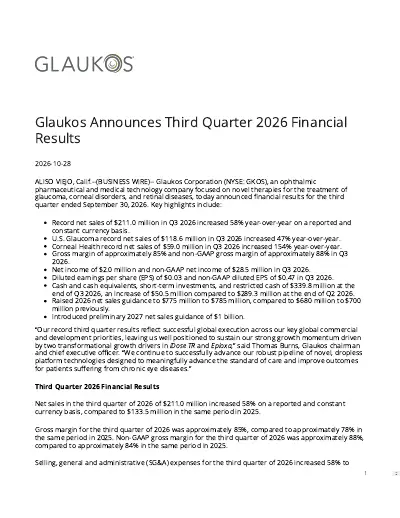
Today, Glaukos reported record third quarter consolidated net sales of $211 million, up 58% versus the year-ago quarter. As a result of our third quarter outperformance, we are raising our full year 2026 net sales guidance to $775 to $785 million, an increase of $90 million at the midpoint over our prior guidance of $680 to $700 million.
We are also introducing highly preliminary 2027 revenue guidance of $1 billion. This preliminary outlook factors in our expectations as it relates to the continued commercial rollout for Epioxa and iDose TR, the surgical MIGS landscape, and our international glaucoma franchise.
We expect to refine this guidance range and provide additional commentary as appropriate in the future. Our record third quarter results reflect strong performance across our global commercial and development priorities, underscoring the successful execution of our teams, the strength of our differentiated technology platforms, and our continued evolution as an increasingly diversified leader in ophthalmology.
Looking ahead, we believe we are well-positioned to sustain this momentum, driven by two transformational growth drivers, including the further advancement of the interventional glaucoma treatment paradigm with iDose TR and the launch of Epioxa, establishing a new standard in interventional keratoconus and rare diseases. Together, these compelling and durable market opportunities reinforce our confidence in our ability to deliver a best-in-class growth and margin profile well into the next decade.
We are also encouraged by the tremendous progress across our P&L in the third quarter, reflecting the increasing scale and diversification of our business. Highlights included nearly 400 basis points of year-over-year non-GAAP gross margin expansion to approximately 88%, continued operating leverage, more than $50 million in cash generation, $28.5 million in non-GAAP net income, and non-GAAP earnings per share of 47 cents.
While we believe our business is increasingly well-positioned to deliver sustained cash generation and profitability as we scale, we remind investors that our primary focus remains on maximizing near- and long-term revenue growth and capitalizing on the significant opportunities in front of us. Accordingly, we remain committed to investing strategically across our industry-leading pipeline, commercial infrastructure, and market development initiatives to advance our innovative platforms, expand our addressable markets, and drive sustained top-line growth.
We will continue to manage the business thoughtfully, balancing these strategic investments with disciplined expense management, capital allocation, and a focus on operational efficiency. Ultimately, we believe this approach best positions us to bring transformational therapies to patients, strengthen our financial profile, and drive sustainable, substantial long-term growth and shareholder value.
Now let's discuss our third quarter results in more detail. Starting with our corneal health franchise, we delivered record third quarter net sales of $59 million on robust year-over-year growth of 154%, driven by Epioxa net sales of approximately $53 million.
We remain very encouraged by the early progress of our commercial launch of Epioxa. As the first and only FDA-approved epithelium-on corneal cross-linking therapy for keratoconus, Epioxa has generated strong interest from surgeons and the broader ophthalmic community, reinforcing our confidence in its potential to redefine the treatment paradigm for this rare, sight-threatening disease, which we believe remains significantly underdiagnosed and undertreated.
Our launch priorities remain centered on expanding patient access, building awareness, optimizing referral networks, and driving earlier diagnosis. We continue to make meaningful progress across each of these areas, supported by the ongoing expansion of our site-of-care network, growing market access, and continued development of our specialty pharmacy and patient support infrastructure.
First, we have successfully established and continue to selectively expand a broad-reaching site-of-care network. Our acquired O2N systems are already actively deployed across locations serving roughly 90% of the US population, with a pipeline progressing through various approval processes that we expect will expand our treatment center reach to more than 95%.
Next, we continue to make considerable progress with payers to secure access pathways and policy coverage for Epioxa, with access pathways now established for approximately 90% of commercial lives in the United States, including through the five largest payers, and more than 80% of Medicaid lives, reflecting encouraging receptivity of Epioxa's clinical value. We remain committed to securing access pathways with the remaining smaller and regional plans as we increasingly focus on pathway optimization and improving the time to treatment for patients.
Following the July 1st effective date of Epioxa's product-specific J-code, J2789, we made encouraging progress during the third quarter in optimizing the operational processes supporting reporting and reimbursement. We remain focused on working with providers and our specialty pharmacy partner to further refine these workflows and facilitate a more efficient and predictable reimbursement process for Epioxa.
Clinically, we continue to be encouraged by physician feedback and the outcomes they are seeing with Epioxa in practice. These real-world clinical observations are consistent with the positive results from our recently announced three-year Phase 3 extension study, which demonstrated sustained improvements in corneal shape, meaningful visual acuity gains, and a favorable long-term safety profile following a single Epioxa treatment.
Together, these findings further reinforce Epioxa's potential to provide durable clinical benefits for patients living with keratoconus and meaningfully advance the treatment paradigm. During the third quarter, we took another important step in our efforts to expand the keratoconus market with the launch of our Could It Be KC?
disease awareness campaign in partnership with NBA champion Stephen Curry. Stephen's personal experience living with keratoconus, combined with his extraordinary platform and reach, gives us a unique opportunity to increase awareness of this underdiagnosed disease and to drive earlier detection and diagnosis.
We view this as an important long-term investment in the KC market and an important component of our commitment to addressing the significant unmet need across the keratoconus care continuum, with additional campaign activities planned for 2027. Complementing these efforts, we remain focused on deepening engagement with the optometric community, which we believe plays a critical role in identifying and referring patients with keratoconus.
We remain on schedule to launch our KC screening device as we enter 2027, which we intend to leverage to raise disease awareness, facilitate more accessible screening and diagnosis, and to enable earlier identification of patients who may benefit from treatment. Together with our broader disease awareness initiatives and strengthened advocacy partnerships, we believe these efforts position us to meaningfully advance the KC care continuum and expand patient access to treatment.
Finally, we continue to enhance and optimize our patient and physician support services, including our co-pay assistance program for eligible patients to help facilitate access to Epioxa and to support patients throughout their treatment journey. While we still remain in the early stages of the launch, we're encouraged by the solid progress we're making against our core launch priorities and remain very excited by the significant potential Epioxa offers to KC patients.
Moving on, our US glaucoma franchise delivered record third quarter net sales of $118.6 million on strong year-over-year growth of 47%, driven by growing contributions from iDose TR, which generated sales of approximately $76 million in the third quarter. iDose TR continues to deliver strong clinical outcomes that meaningfully improve patients' lives, resulting in strong physician interest and adoption while helping to accelerate a broader treatment paradigm shift towards earlier interventional glaucoma care.
From an execution standpoint, we remain focused on our key initiatives, including expanding our base of trained surgeons and active accounts, increasing utilization, broadening market access, scaling targeted commercial investments, and expanding the robust body of clinical evidence supporting iDose TR. To that last point, we recently announced positive top-line results from our Phase 4 randomized controlled trial evaluating iDose TR in combination with cataract surgery.
The study achieved its primary endpoint, demonstrating statistically significant superiority and a clinically meaningful IOP reduction compared to cataract surgery alone, with an 11.1 millimeter mercury mean reduction in IOP and a 3.6 millimeter mercury incrementally superior treatment effect at three months. These results further strengthen the extensive body of clinical evidence supporting iDose TR's efficacy, durability, and safety while reinforcing the versatility of the therapy across different treatment settings.
Additionally, we continue to monitor developments related to the proposed local coverage determinations for iDose TR. We have engaged in the process to ensure the therapy is appropriately understood within the Medicare coverage framework while preparing for a variety of potential outcomes.
We believe the strength of iDose TR's clinical evidence, real-world outcomes, and broad stakeholder advocacy supports appropriate Medicare coverage that preserves physician decision-making and patient access. Finally, our international glaucoma franchise delivered net sales of $33.4 million on a year-over-year growth of 13% on a reported basis and 15% on a constant-currency basis.
The strong growth was once again broad-based as we continue to scale our international infrastructure and execute our plans to drive MIGS forward as the standard of care in each region and major market in the world. Shifting to our pipeline, we continue to advance a broad and differentiated clinical pipeline across our five novel therapeutic platforms, encompassing 14 publicly disclosed programs and additional undisclosed assets supported by a robust portfolio of active clinical and Phase 4 studies.
Within our iDose platform, we're advancing a Phase 2b/3 clinical program for iDose TREX, our next-generation iDose therapy, and a Phase 3b clinical program for iDose Trio. We're targeting FDA approval for iDose Trio by the end of 2027.
We also continue to advance various additional Phase 4 studies. Within our iLink platform, in addition to our KC screening device, we are preparing to commence a Phase 3 clinical program for our third-generation customized, tomography-guided cross-linking therapy in 2027.
Within our iStent surgical glaucoma platform, we have completed patient enrollment of both the PMA pivotal trial for iStent infinite in patients with mild-to-moderate glaucoma and the 510(k) pivotal study for the PRESERFLO MicroShunt and are now advancing patient follow-up in both of these studies. Within our Allution platform, we completed patient enrollment in a Phase 2 study for Demodex blepharitis and expect to have top-line results by the end of this year.
Finally, within our retinal platform, we recently announced an exclusive licensing agreement with RevOpsis Therapeutics for RO-104, which was assigned Glaukos development code GLK-901, a first-in-class trispecific biologic, as well as exclusive rights to the proprietary Rev-Med platform to discover and to develop up to four additional next-generation multispecific biologics for retinal diseases. This agreement represents an important strategic step in the continued expansion of our retinal franchise and is highly complementary to our ongoing retinal R&D initiatives, including the ongoing first-in-human wet AMD clinical development program for GLK-401, our intravitreal multi-kinase inhibitor program.
We believe each of these novel differentiated platforms have the potential to generate transformative therapies that significantly improve the existing treatment paradigms for patients suffering from chronic eye diseases. In conclusion, at Glaukos, we are in the business of pioneering new marketplaces within ophthalmology.
Our record third quarter performance highlights the strength of our strategy and execution as we continue evolving into an increasingly diversified ophthalmic leader with multiple transformational growth drivers in iDose TR and Epioxa as we advance our mission to transform vision therapies for the benefit of patients worldwide.
Chris Lewis
With that, I will open the call to questions. Operator?
Operator
We will now begin the question-and-answer session. Please limit yourself to one question.
If you would like to ask a question, please press *1 to raise your hand. To withdraw your question, press *1 again.
We ask that you pick up your handset when asking a question to allow for optimum sound quality. If you are muted locally, please remember to unmute your device.
Please stand by while we compile the Q&A roster. Your first question comes from Tom Stephan with Stifel.
Your line is now open. Please go ahead.
Tom Stephan
Great. Hey, guys.
Thanks for taking the question. Congrats on the really nice print here.
Just on 2027 revenue, really appreciate the early look. Joe, maybe for you if possible, would love any initial color on how Epioxa and iDose layer into the $1 billion, notably with potential iDose LCDs looming, and then obviously with Epioxa very early days.
Then as a tack-on, can you talk a bit about the decision to guide now, what went into that decision, and what gives you the confidence today to guide, notably given, again, the Epioxa ramp is early days? Thanks again.
Joe Gilliam
Thanks, Tom. This is Joe.
As I think you heard Tom say in the prepared remarks, as it relates to getting granular around the different franchise puts and takes, like we often do, we'll hold off on doing that to a future call and moment as we enter next year. What I will say is, and it's kind of tied into your second question as well, the confidence we had was that we evaluated all the scenarios that we're aware of thinking about next year, and as we looked at all those, including, quite frankly, downside scenarios with any iDose LCD, that we saw the paths lead to $1 billion of revenue.
As we evaluated that, we felt confident that we could actually put that number out there for you all to digest. Part of the thinking around it is indeed probably related to a certain extent about Epioxa and looking at the historical track record, even with our iDose launch, where the investment community took obviously some of the enthusiasm around the launch and got out a little ahead of what the realities on the ground are in terms of building a new product.
We thought it was prudent to provide an early look as to how we thought about 2027 unfolding, so that everybody has something out there to measure against as you build your models around Epioxa and hopefully continued expansion of that and our other franchise alongside it.
Tom Stephan
Makes sense. Thanks again.
Joe Gilliam
Thanks, Tom.
Operator
Your next question from the line of Adam Maeder with Piper Sandler. Your line is now open.
Please go ahead.
Adam Maeder
Hi. Good afternoon.
Thank you for taking the question, and I'll echo the congrats on a nice quarter. Multi-part question for me on the Epioxa launch.
Would just love to get more color on the launch itself and hopefully some metrics, things like number of accounts that did an Epioxa case in 3Q, would love to understand prior auth approval dynamics, how quickly those are going, payer approval rates, and can you just remind us if the market awareness initiatives have started yet? Thank you.
Joe Gilliam
Adam. I'm going to do my best.
I think that was actually more like a six-part question, and I'll work through it. I get the heart of it really is an update of kind of where we stand today on the Epioxa launch and as we move forward here.
Obviously, we continue to be encouraged by the momentum, the $53 million that it contributed in the third quarter, really our first quarter, as with the J-code having been formally established. Probably more encouraging for us is the progress that we have on the core underlying fundamentals, and you hit on several of the most important ones.
Tom did as well in the prepared remarks, but I'll cover it again. Fundamentally, a site-of-care network is where it starts.
As you heard, we now have systems deployed in the third quarter that serve about 90% of the US population. If you translate that, we exited the third quarter with more than 200 established sites of care.
I'll also add that we currently have executed contracts for additional deployments that are going to extend that network to greater than 300 sites, and it's growing. In fact, the outperformance there has, quite frankly, put pressure on our operations and our field support teams, where we're continuing to scale up rapidly to meet that demand that was above what we were forecasting at this stage of the launch.
The second thing you referenced was around the payer dynamics. As we've talked about for a while, establishing payer access is first and foremost, and then ultimately over time you'll shift into optimizing it.
You heard that we're now thankful to have open pathways for 90% of commercial lives and 80% of Medicaid lives, the latter of which is something we never achieved with Photrexa in the past. I think it really does speak to the clinical value of Epioxa and the overall importance of treating KC.
Our teams are increasingly focused, of course, still on the smaller regional plans in establishing access pathways, but their attention is really turning towards optimizing that access, optimizing the pathways, the adjudication timelines that you referenced alongside other initiatives. Whenever you're in the early days of a launch like this, the timelines are varied, payer by payer.
The processes associated with them are varied, payer by payer. The mechanics and the things that you have to go through are far from streamlined.
Our goal all along at this stage of the launch was to start driving increased efficiencies across that, whether that be within our own hub, our specialty pharmacy network, or the payers themselves and how we get access to that. I have to say that obviously with the results that you're seeing out of the third quarter, we're pretty pleased with the progress that we've made out of the gate in that first quarter post the J-code.
We're seeing these get approved, we're seeing it across a variety of plans throughout the United States, in line with those overall statistics. As we turn the page into the fourth quarter and certainly into 2027, these things start to enable the last part of your question, which is our ability to start to invest in a more meaningful way towards one of the pillars of this launch, which is changing the disease awareness paradigm for these patients, Stephen Curry being an important component of that, but there's a lot more as well behind that.
I think you'll see a significant investment from us as we make our way into and through 2027 on that front.
Adam Maeder
Thanks for all the color, Joe.
Operator
Your next question from the line of Larry Biegelsen with Wells Fargo. Your line is now open.
Please go ahead.
Larry Biegelsen
Good afternoon. Thanks for taking the question.
I'll echo my congratulations on obviously a really impressive result here. Joe, just given the momentum in Epioxa, I'm wondering if you think you can get back to the 18 to 20,000 eyes by as early as 2028, and the 50 to 100,000 potentially eyes per year you've talked about, what's the epidemiology data underpinning that?
Thanks for taking the question.
Joe Gilliam
Thanks, Larry. Obviously, it's a hard and long leap for us to go from what are encouraging early results in the third quarter here to the precision around timing of when we'll get back to treating the 18,000-plus eyes that we saw with Photrexa, or even as you pointed out, that broader 50 to 100,000 patient or eye opportunity that I think sits out there as we find out whether this is a true rare disease or just a rarely diagnosed one, as many of our customers certainly believe.
I'll stop short of giving a timeline prediction on it. I think we've always said, based upon the history here with Photrexa, the clinical dynamics around Epioxa, we'll get there, and that we'll ultimately grow the market beyond [unclear] differently in different ways, but they range from fully progressive or serious keratoconus to more mild disease that informs that broader 50 to 100,000 patient estimate.
Larry Biegelsen
All right. Thanks so much.
Operator
Your next question from the line of Ryan Zimmerman with US Bancorp BTIG. Your line is now open.
Please go ahead.
Ryan Zimmerman
Good afternoon. Thanks for taking the question.
When Photrexa was out there, I think it was Avedro's nature to kind of go broad and maybe a little shallow, if you want to characterize it in terms of user adoption and the number of systems out there. When I read your comments about O2N being within say 90% of the patient population that you want to target, I guess what I want to understand from you, Joe, is kind of how you think about that next layer of growth, maybe going a layer deeper on the user base, if you will.
It seems like you're more focused on really the higher-volume cornea surgeons and corneal specialists, and I'm just curious kind of at what point you take that to that next level that was similar to what we saw with Photrexa.
Joe Gilliam
Thanks, Ryan. First, I can't comment obviously on the Avedro launch strategy or dynamics.
I wasn't a part of that. What I can say in terms of ours, and hopefully it's consistent with what we've said before, we tried to be very methodical and targeted in terms of where we went and when to our existing and other potential customers.
We really did it with a focus on both their skills and capabilities as you referenced, their volumes, but also the geographic reach attached to make sure you've got centers. At the stage of a launch, especially for a rare disease category like Epioxa and keratoconus, you don't want to go too broad, because it's critical that you're able to establish the right support for each of these customers as they get going, and they go through the processes, especially the complicated and often nuanced and challenging processes associated with getting access to care for these patients.
You really want to be prepared to support and hand-hold your customers and those patients through that. We tried to be very disciplined around where we went from a site-of-care perspective.
Even with that, given as I said earlier, the overall demand and enthusiasm around the product in the category, we've seen it move more quickly than what we had necessarily intended as we entered into 2026. From that standpoint, we're there.
Now, having said that, if you look at other categories over time, you certainly will move treatment centers from that initial concentration into more and more geographies that get closer and closer to patient populations as you move forward. I certainly expect that will be the case for us here.
While at the same time, it's important when you're looking at treatment centers, we also have detection centers that we've been establishing, and we're north of 700 of those already throughout the United States. That's a great place for these patients, as they initially might think that they have keratoconus, to go and get screened, and ultimately to the extent that they have a diagnosis or a positive risk factor, that they're then triaged over to our site-of-care network that's out there today.
Ryan Zimmerman
Got it. I feel like Alex is often ignored on these calls, we spend too much time talking on Epioxa and iDose, but the gross margins obviously stand out.
There was a one, some one-timers in there in terms of recognized adjustments, but that aside, Alex, what do you think about margin durability here at these levels, and what you can do as we think about '27 and so forth?
Alex Thurman
Ryan, first of all, you know I love you. Thank you so much for recognizing me.
It's great. Thanks for the question.
As it pertains to gross margins, you're right. Certainly, and we've been saying it for a while throughout the year, we expected to see expansion in the gross margin as both iDose and Epioxa, quite frankly, became a larger share of the mix of our revenues.
We've seen that come to fruition, the third quarter being really, really strong at almost 88%. As far as durability, we wouldn't expect it to not be durable, given the fact that Epioxa and iDose continue to be the two most transformational revenue growth drivers, and our expectations are those will continue to be a larger share of our mix as we go through the rest of this year and next year.
Ryan Zimmerman
Thank you.
Operator
Your next question from the line of Allen Gong with JP Morgan. Your line is now open.
Please go ahead.
Allen Gong
Thanks for the question. Kind of piggybacking on the cost discussion, I think you're talking about a lot of commercial activities to make sure that you're getting Epioxa the kind of support that it needs to succeed, and clearly we're seeing that work in third quarter.
Despite that, you seems like you didn't really have to spend too much on SG&A. It sounds like you have some other projects maybe in the works for the rest of the year, maybe into 2027.
How should we think about SG&A for fourth quarter and also just in 2027 and going forward? How should we think about growing that on a dollar basis?
Joe Gilliam
Allen, it's Joe. I'm going to start off and then let Alex comment beyond that.
To clarify, the context of the third quarter and kind of where we're at in the commercial investment cycle, yeah, clearly we've been making a series of investments throughout our organization, sales force, marketing, market access, and related for some time. I'm not sure that that particularly changed in a meaningful way in the context of the third quarter.
What I was referencing really is, the success that we had in the third quarter was really in advance of a material pick-up in the kind of both disease awareness and brand awareness initiatives that we have planned for 2027, both for keratoconus as well as interventional glaucoma, Epioxa and iDose. The results you're seeing are a little bit ahead of those activities and those investments that we plan to make going into next year.
Alex Thurman
Then, Allen, I'll just add on there for the rest of this year, and I think you were alluding to that, you can expect our operating expenses to continue to grow in the fourth quarter. I would guide you to say that growth rate should be 25 to 30%, we would continue to maintain operating leverage in the model.
Then that would land your full year 2026 operating expenses somewhere around plus or minus $630 million. That translates to just over 30% year-over-year growth, again, still showing that operating margin.
Then we'll get to 2027 in a later call and give you more granularity about operating expenses at that time.
Allen Gong
Thanks. Then just, when you kind of think about Glaukos, the pipeline, the commitment to internal R&D is definitely one of the major things that stands out.
You're going to be building up potentially a lot of cash with the launches of Epioxa and iDose, and while there's a lot to reinvest into organically, I'm kind of curious from an inorganic perspective, what makes an opportunity something that you'd want to develop in-house? What's an opportunity that you would maybe be looking out externally to invest into?
Thank you.
Tom Burns
Allen, this is Tom. I'm happy to take that question.
When you think about it, we've got 14 disclosed development programs underway as we speak. Those have to be fed and nurtured to commercial fruition over the next years toward the end of the decade.
Most importantly, some of the new initiatives that we've taken on will both be extraordinarily important for incendiary growth longer term, but will take some pretty significant capital to bring to market. Let's take our two major initiatives that we've taken on in retina.
One, as I've said all along, we have the temerity to believe we're going to become a retinal company, and indeed, we're making progress towards that. First, we have the tyrosine kinase inhibitor, axitinib, which is now really going through its Phase 2 clinical apparatus.
We'll have data by the end of the year to see where we are there. We have a second-generation TKI under development.
Then you see the work that we've taken on with RevOpsis, looking at this trispecific anti-VEGF compound, which is really a first-in-class to be able to enter that marketplace. Each one of these projects really, just from a clinical perspective alone, exceeds $100 million in investment.
These are extraordinarily expensive, but extraordinarily important products as we look for catalysts for growth beyond both the work that we're doing within iDose TR, our work in rare disease, and our work in Part D pharmaceuticals, which we haven't even begun to fully talk about, led by the Demodex blepharitis compound, which is physostigmine, a acetylcholinesterase inhibitor, which we'll have data by the end of this year. It's an extraordinary pipeline.
I guess I'd put it up against any company in ophthalmology. It will take resources to get there, and we're going to be able to command the resources to be able to internally grow our way into, I believe, a massive, comprehensive strategic leader.
Joe Gilliam
Allen, obviously you've known us for a while, it shouldn't come as a surprise that us now generating cash flow isn't going to change the operating strategy or DNA that's gotten us here, and that's what you're hearing from Tom, that we're an organic development company first, and even where we do deals outside, they fill into that pipeline nicely, and I expect that to be our strategy as we move forward.
Operator
Your next question from the line of Richard Newitter with Truist Securities. Your line is now open.
Please go ahead.
Chris Lewis
Hey, Rich, you may be on mute. We can't hear you.
Freda, can you go to the next question, please?
Operator
Your next question from the line of Mason Carrico with Stephens. Your line is now open.
Please go ahead.
Mason Carrico
Hey, guys. Appreciate the question here.
I was wondering if you could give us some insight into percentage of Epioxa volumes that came via the buy-and-bill channel in the quarter. I guess how is the buildout of that channel tracked to your internal expectations?
Really, how do you think about the growth of that channel to accelerate adoption of Epioxa moving forward?
Joe Gilliam
Thank you. I will tell you, as we went into this launch, we expected the buy-and-bill related dynamics to certainly lag that of our specialty pharmacy channel, if you will.
I will say, our network of sites that are buying and billing Epioxa has been increasing rapidly, and particularly over the last 30 to 60 days, and it's really been a combination of customer types, strategic accounts that have affiliated clinics as well as individually owned physician offices alongside the hospitals and larger institutions that you'd expect. It remains still relatively early in those days, but an important contributor as we exited the third quarter and going into the fourth.
As we go forward here, we've been very encouraged by the receptivity and ultimately the execution of our customers to make sure that they're providing access for those patients who have to receive the drug via the buy-and-bill pathway.
Mason Carrico
Got it. Thank you, guys.
Operator
Your next question from the line of Michael Sarcone with Jefferies. Your line is now open.
Please go ahead.
Michael Sarcone
Hey, good afternoon, and thanks for taking the question. I guess, maybe switching to iDose, can you talk to us about the trends you were seeing in 3Q and maybe what your expectations are now for the full year this year?
I guess, part B of that would just be to the extent we do get an LCD update before the end of this quarter, and it is restrictive, do you expect there'll be some kind of accelerated buy-ahead or pull-forward from docs who want to get some of the volumes in before the LCD takes effect? Thanks.
Joe Gilliam
Sure, Michael. Obviously, in the third quarter we saw $76 million of revenues, and that was driven in particular by growing contributions from the fee-for-service population in the NGS jurisdiction alongside growing contributions from Medicare Advantage and commercially insured patient populations, which is aligned with what you've been hearing from us in terms of strategic imperatives as we entered this year.
The growth dynamics were softened, I'll call it a touch by summer seasonality, but we were encouraged still grow despite that. We feel like we continue to be on an encouraging trend there.
As you think about the remainder of this year and you do your models, inside of our guidance implies an increase from prior expectations, which we had communicated were $275 to $280 million, to now iDose we expect to reach into the low $280s, which represents of more than doubling of our 2025 performance as we continue to move forward here with this launch. As it relates to any potential LCD, to the extent that that came out, there's restrictions, it's possible that some customers, but it's also important to remember that the fourth quarter is a pretty busy one for many of our customers.
Their surgery schedules are full, and so their ability necessarily to make a hard pivot in advance of any LCD coming into play would be challenged by that fact.
Michael Sarcone
Great. Thanks, Joe.
Operator
Your next question from the line of Joanne Wuensch with Citi. Your line is now open.
Please go ahead.
Joanne Wuensch
Good evening. Thank you for taking the question.
It sounds like there may be an LCD, there may not be an LCD. Is that the right way to hear it?
If so, is there a go/no-go timeframe, like if by X date we don't get something, we don't have something? Help me understand when I have to stop thinking about this.
Thank you. [laughter]
Joe Gilliam
Well, I think in the world of reimbursement, you never get to stop thinking about all the various scenarios that can emerge, whether that be from commercial payers or in this case the government in the form of the MACs. At this point, we don't have any new updates to share.
To the heart of your question, the only statutory obligation that the MACs have is one year from the date of their draft, which was May, to act or abandon the LCD. Obviously, if they do propose a final LCD, then it has a 45-day awaiting period or cooling-off period before it gets enacted.
At this point, we continue to believe the MACs are digesting the significant evidence that the physicians and societies and patient groups and Glaukos presented during the comment period. We continue to think it validates the clinical value that's been objectively proven in a pretty wide patient population.
We watch and wait like you all do, and we'll monitor it accordingly.
Joanne Wuensch
Thank you.
Operator
Your next question from the line of Richard Newitter with Truist Securities. Your line is now open.
Please go ahead.
Richard Newitter
Hi, can you hear me?
Chris Lewis
Yes, we can.
Richard Newitter
Great. Thanks, guys.
Congrats on the quarter. Sorry, not sure what happened before.
Just two very quick ones for me. The first, just as we think about Epioxa ASP, can you just give us a sense for kind of where that shook out or where we should be modeling that for the back half of '26 and maybe even for 2027?
Then the second question, just piggybacking off Joanne on the LCD here, how does a study like you just talked about on the call and a few weeks ago press released, how does a study like that factor in to the LCD decision process? Is that something that you can just pile on and the evidence accumulates and they'll consider that, or does it need to be socialized for a longer period of time or in a peer-reviewed publication?
Just trying to get a sense for how something like that might actually influence the decision to the extent that it still can before the LCD finalizes. Thanks.
Tom Burns
I'm happy to take, and then Joe, you can add some color. I'm happy to take the question, Richard.
The study that we had really was a prospective, multicenter study, a level one study that compared cataract surgery alone versus cataract surgery plus iDose, and I'm extremely pleased with the results. The 3.6 millimeter additive effect of using iDose versus cataract surgery alone, and over 11 millimeters reduction in intraocular pressure.
Now having said that, the study was done really for twofold reasons. One, to the extent we're ever challenged on the use of using iDose in combination with cataract surgery, we would have robust data to show that we indeed had an additive effect.
It appears, as you've seen, that the MACs have taken the position that they are okay today with the use of iDose in combination with cataract surgery. We expect that to continue.
We did this kind of as an insurance policy, but what it also adds is the ability for us to then go to our customers and be able to validate and show what the incremental advantage of using iDose in combination with cataract surgery is. That's very important.
I think to the heart of your question, what we're doing, too, which I'm hoping is prescient, is to have a study that compares iDose plus iStent infinite versus iDose alone. The goal there is to the extent that MACs, if there is an LCD that's issued, restricts the use of the combinatorial use of iDose with MIGS procedures, we would have the ability to have a robust, prospective, level one study to show that there indeed is an incremental effect of using iDose in combination with iStent infinite versus iDose alone.
To the extent there is a restriction, we then have the ability to then ask for a reconsideration request that we would submit, and then be able to move forward with an appeal, much like we've done the readministration side with the FDA when we got readministration of iDose approved. We'd do the same thing with the MACs for reconsideration.
I think we are about as prepared as we can be and armed both to have robust adoption in the marketplace and to protect our flanks from any movements that the MACs may take.
Joe Gilliam
I think as a technical matter, as I referenced earlier, the comment and submission period for this LCD consideration is over. They're in the process of digesting everything that's already been submitted to them and the robust body of evidence that was done as a part of that process.
That doesn't mean that society or physicians or even Glaukos might not try to make sure that they get a view of important publications like what Tom was just talking about, or any other that may come out during the course of the next several quarters, but as a technical matter, they've got the body of evidence in front of them that they're digesting in the context of any potential LCD that they may or may not propose. As it relates to Epioxa ASP, which I think was the first part of your question, I think we've been pretty consistent in saying that to assume in your models a $65,000 to $70,000 net ASP.
We have no reason to give you different direction at this stage. It's still early, and in the early days you'd expect a trend towards the higher side of that from an overall realized net ASP perspective, and we'll continue to give you guys feedback on that if it changes as we move forward.
Richard Newitter
Thank you.
Operator
Your next question from the line of Steven Lichtman with William Blair.
Steven Lichtman
Thank you. Evening, guys, and congratulations.
Joe, you mentioned the KC screening device launch in '27. Can you talk a little bit more about how you'll deploy and leverage that?
Will it go into optometrists' offices, into screening centers, I think you mentioned? Just overall, it seems like this is the opportunity to further accelerate the referral pathway into the centers, and I'm curious how you're building that network and how the screening device fits in.
Joe Gilliam
Look, as we think about that next stage of the Epioxa and overall keratoconus launch, as you move past those sort of foundational investments and layers that I spoke to earlier, you really get into the three core areas that we're trying to execute on to transform the patient journey, if you will, in the ecosystem around these KC patients. The first of which is we need to double and triple down on investing and really elevating awareness.
You heard us talk and Tom talk about in the prepared remarks the investment we made with Stephen Curry, and that's really just the beginning. As we think about the detection centers and the KC screening device, the job there is to democratize screening, right?
The idea that you can bring a simple, straightforward device to hopefully the masses across optometry. Unlike what we're talking about here in our treatment centers, where we're measuring those in 200 to 300s, there are 50,000 optometrists in the United States or more.
We want to make sure that we're deploying technologies that can be utilized by as many of those as possible to at least screen for keratoconus. When they do get a positive screen, that they're able to refer those to centers and get those patients definitively diagnosed and hopefully treated as quickly as possible.
The last thing really is then once they have been, are we optimizing our support of that patient journey? That comes into everything we're trying to do from the patient perspective of supporting them and our hub and our specialty pharmacy and the things in and around those activities.
Steven Lichtman
Great. Thanks, Joe.
Operator
Your next question from the line of David Saxon with Needham. Your line is now open.
Please go ahead.
David Saxon
Great. Good afternoon.
Thanks for taking my questions and obviously congrats on the quarter. Joe, my question is just around 2027 and the LCDs.
Joe, I think in the past you've talked about iDose revenue being flat in '27 if the LCDs are in fact finalized. Relative to the kind of low $280s you talked about earlier on the call for '26, is that still how you're thinking about the impact if those LCDs are in fact finalized?
Then relative to the billion-dollar guide for '27, what's assumed in that in terms of how the LCDs play out? Thanks so much.
Joe Gilliam
Thanks, David. I'm going to go in reverse of the way that you asked that.
First, as it relates to the billion-dollar preliminary expectations for 2027, we've really factored in all the scenarios, including scenarios where the LCD is proposed or finalized close to as proposed today and then the impact that that would have on iDose and our overall US glaucoma business. We remain confident that we could still achieve that $1 billion revenue number in the year, and that's large part of what gave us the confidence to put that out there at this point in time.
As we get more specific on that, I'm not sure I've ever tried to give a point estimate around next year. I think when asked, I've said, if it helps you to keep in that frame of mind, to hold that sort of constant and not get ahead of yourself in terms of the roll-forward of the success we're having in 2026 into trends in 2027, I thought that was a safer place to be.
We'll hold off on giving anything more specific until we actually see what transpires in the form of an LCD and when it transpires, so that we can analyze that properly and give a more thoughtful commentary on its impact on iDose.
David Saxon
Great. Thank you.
Operator
Your next question from the line of Anthony Petrone with Mizuho. Your line is now open.
Please go ahead.
Anthony Petrone
Thanks and congrats on the quarter here. Two on Epioxa.
I guess one is on prior authorizations, just some channel checks hearing that even though we're seeing a good pull-through from buy-and-bill, you're still having some plans that have this extended prior authorization process, but the demand is there. What actually opens that up?
What type of communication do you have with some of the commercial payers to ease up on prior auth? Then second real quick would just be when we think about Epioxa CareConnect, is one of the ways to sort of loosen that logjam up is to push more through specialty pharmacy, which then will have some hand-holding through Epioxa CareConnect?
Thanks.
Joe Gilliam
Anthony, I think maybe I'll address that all as one question, which is at this stage of a launch, you expect, as much as it's not welcome, elongated periods of time from initial diagnosis and attempt to access the therapy to when you ultimately get those prior authorizations approved and the drug shipped, if you will. That's an ordinary course process for all pharmaceutical launches, in particular any rare disease one that's there, because the prior authorization process in some ways is designed for the payer to learn themselves.
While some of us might feel like that's a fairly intentional activity they put that through to delay that access to care, the reality is they use that information they're gathering through the prior authorization process to inform their own internal processes. Ultimately, the way you get to a place where it operates more efficiently is through volume, right?
It's through the time and the processes to where these payers start to recognize that the providers are putting through bona fide claims for patients who are worthy of treatment from Epioxa, and that they're approving it. At that point, they'll start to focus on their own efficiencies over, I'll call it, this early process of educating.
We saw this play out with Photrexa over the course of many years, where they went from a lot of hurdles to fewer hurdles, and ultimately got to a place that access was a bit more streamlined. We would expect that same thing to play out here over time.
Our job is to continue to fill the funnel with the patients seeking access to therapy and then supporting our customers and those patients through that approval process and journey, if you will. That incorporates our hub, Epioxa CareConnect, as you referenced, that incorporates our specialty pharmacy partner, and it incorporates our customers who seek to buy and build the pharmaceutical to get that access.
It's really all of the above, and we're hyper-focused, now that we're getting through the initial days of the launch, on trying to get more and more efficient so these patients can get access to that therapy faster and faster.
Anthony Petrone
Thank you.
Operator
There are no further questions at this time. I will now turn the call back to the company for closing remarks.
Tom Burns
Okay. I want to thank you all for your time and attention today.
Thank you for your continued interest and support of Glaukos. Goodbye.
Operator
This concludes today's call. Thank you for attending.
You may now disconnect.