Hagerty, Inc.
NNYSE:HGTYQ1 FY2026 · Earnings Call TranscriptMay 6, 2026
Operator
Ladies and gentlemen, greetings, and welcome to the Hagerty First Quarter 2026 Earnings Conference Call. At this time, all participants' lines are in a listen-only mode.
A brief question-and-answer session will follow the formal presentation. If anyone requires operator assistance during the conference call, please signal the operator by pressing * then 0 on your telephone keypad.
As a reminder, this conference is being recorded. It is now my pleasure to introduce your host, Jay Koval, Head of Investor Relations.
Please go ahead.
Jay Koval
Thank you, operator, and good morning, everyone. Thank you for joining us to discuss Hagerty's results for the first quarter of 2026.
I'm joined this morning by McKeel Hagerty, Chief Executive Officer and Chairman, and Patrick McClymont, Chief Financial Officer. During this morning's conference call, we will refer to an accompanying presentation that is available on Hagerty's Investor Relations section of the company's corporate website at investor.hagerty.com.
Our earnings release, slides, and letter to stockholders covering this period are also posted on the IR website as well as our 8-K filing. Today's discussion contains forward-looking statements and non-GAAP financial metrics, as described further on slide 2 of the earnings presentation.
Forward-looking statements include statements about our expected future business and financial performance, and are not promises or guarantees of future performance. They are subject to a variety of risks and uncertainties that could cause the actual results to differ materially from our expectations.
For a discussion of material risks and important factors that could affect our actual results, please refer to those contained in our filings with the SEC, which are also available on our Investor Relations website and at sec.gov. The appendix of the presentation also contains reconciliations of our non-GAAP metrics to the most directly comparable GAAP measures that are further supplemented by this morning's 8-K filing.
With that, I'll turn the call over to McKeel.
McKeel Hagerty
Thank you, Jay, and good morning, everyone. Spring has finally arrived in northern Michigan, and with it comes the unmistakable sound of engines turning over after a long winter's rest.
Our members have been pulling their cars out of storage, checking all the fluids and tire pressures, and getting back out onto the open road. I, for one, drove a 1963 Corvette split-window into the Hagerty headquarters this morning, and I am smiling ear to ear.
One Team Hagerty has been right there with them, and with me, ready to welcome a record number of new members in 2026 as the driving season gets underway. Let me jump to the headline.
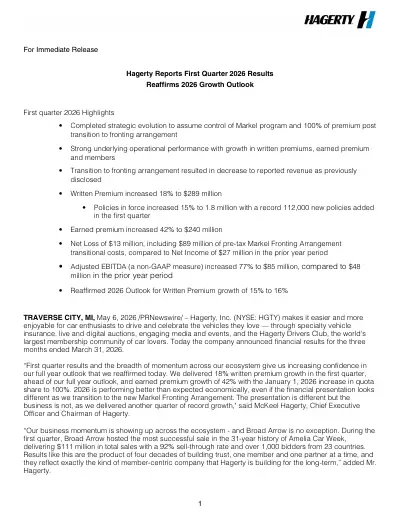
We are off to an excellent start to 2026. Written premiums increased 18% in the first quarter, ahead of our full-year expectations.
This marks 13 consecutive quarters of executing on our strategy to deliver compounding top-line growth while making investments in our team, technology, and members that should sustain high rates of growth in the years to come. As we discussed last quarter, 2026 marks the first year in our history that we control 100% of the economics on our own US book of business.
This structural milestone shows up clearly in our results: 42% growth in earned premium and a 77% jump in adjusted EBITDA. The GAAP presentation of revenue, down 5%, and our net loss of $13 million are temporarily different due to the new Markel fronting arrangement, but the underlying business performance has never been stronger.
GAAP profits in 2026 are negatively impacted by the amortization of deferred ceding commissions paid to Markel in 2025 for policies written before January 1st. Think of it as settling the tab on the old structure.
These deferred acquisition costs were $89 million in Q1 and wind down to zero by the year-end 2026. With that, let me walk through our first quarter results shown on slide 3.
We added a record 112,000 policies during what has historically been a seasonally light quarter for us. Top cars added are not surprising, as they are the bread and butter for Hagerty: Mustangs and Miatas, C10 pickup trucks, and Camaros.
We are also seeing a rapidly growing contribution from more modern enthusiast vehicles, including German and Japanese imports, sought after by the rising generations of drivers. Our written premium growth has been and will continue to be powered by new business count, unlike the broader industry that fluxes with the cycle.
PIF growth jumped 15% as our retention rate remained steady at an industry-leading 89%. Retention at that level is not an accident.
It is the product of decades of delivering on our brand promise to members who genuinely love their cars and trust Hagerty to protect them. We are delivering this growth with a careful focus on maintaining high-quality underwriting.
Hagerty Re's combined ratio was 87%, and we took down our reserves by $6 million in the first quarter. Our underwriting team is one of the best in the industry, and we have been strengthening the capabilities of our in-house claims team.
Our sustained market share gains are impressive and indicative of the enormous B2B opportunity for us. We are diligently working on additional partnerships as well as deepening existing relationships by earning the right to ask for more business.
Hagerty is uniquely positioned to help protect the carriers' classic car book of business with automotive expertise and excellent service, and we are making the necessary investments to lengthen our lead. State Farm Classic+ is a great example of a tightly integrated partnership where both parties win.
We now have an accelerating growth engine with expectations for their 19,000 agents to be selling new business in 40 states by year-end. The conversion of State Farm's existing 525,000 collector car policies to the Hagerty platform is also progressing well, and we remain on pace to convert most of these members to the new Classic+ program by the end of 2027.
In addition to the white space with national carriers, our independent agency channel with 50,000 agents is ripe with potential. We are investing to make it easier for these agents to do business with us, including straight-through processing and the automated tools that help them identify enthusiast vehicles already sitting in their existing books of business, likely insured as daily drivers.
Our addressable market of 36 million vehicles expands every year, and we want to empower these agents to think of Hagerty as the best solution for their customers. Let me move on to something that genuinely stopped all of us in our tracks during the first quarter.
In March, Broad Arrow Auctions hosted a two-day sale at Amelia Car Week in Jacksonville, Florida, and the results were historic: $111 million in total sales, 50% higher than any prior Amelia auction, and with a 92% sell-through rate. The top lot was a 2003 Ferrari Enzo that sold for over $15 million, and we set 12 pricing records.
The market for modern enthusiast vehicles has never been stronger, and every car that trades hands at a Broad Arrow auction is a potential Hagerty insurance policy. That is the flywheel in action.
Our marketplace is not only a rapidly scaling profit center, but it is also a customer acquisition machine that gets cheaper with every car sold. I want to put that into context.
In just 4 years, and through the hard work of an exceptional global team, we have become one of the world's leading collector car auction houses. When you combine Broad Arrow's deep expertise with the Hagerty brand, our global community of members, and our unmatched proprietary valuation data, you get results that surprise even us.
Those results tell us something important about the health of our market. International demand for the finest cars is strong.
Values on great cars continue to appreciate. Buyers from 23 countries do not show up to an auction in northern Florida unless they trust Hagerty and Broad Arrow.
That is all good news for Broad Arrow's transaction revenue. It is also good news for Hagerty Re.
As insured values rise, do written premiums. Approximately 20% of our per-policy premium growth over the last 15 years has come from our members voluntarily choosing to insure their appreciating vehicles for higher guaranteed values.
Our customers want their coverage to grow because their cars are worth more. That alignment between asset appreciation and insurance economics is absent from the standard auto market, where vehicles tend to devalue or depreciate, and it is a structural advantage that compounds every year for Hagerty, augmenting our PIF-driven written premium gains.
Over the same 15-year period since 2010, our regulatory rate increases for Hagerty Re has averaged only 1.5% per year, bolstering our consumer-friendly value proposition. We saw robust auction demand continue at the Porsche Air|Water auction in April, with sales up 30% year-over-year and a sell-through rate of 84%.
In May, Broad Arrow will once again serve as the official auction partner of the Concorso d'Eleganza Villa d'Este with the BMW Group on Lake Como, Italy. This will be our second year at Villa d'Este, widely considered to be one of the most prestigious concours events in the world, and we expect to build on last year's inaugural event as Broad Arrow is increasingly recognized as the trusted brand in auctions across major European markets.
In summary, our first quarter results were not only ahead of expectations, but they were far and away the best first quarter we have ever delivered. While it is only May, we are highly encouraged by how we are tracking towards our full-year outlook.
With that, let me turn it over to Patrick to walk through the financial details.
Patrick McClymont
Thank you, McKeel, and good morning, everyone. Before I dig in, let me reiterate the headline.
The underlying business is performing very well. Written premiums increased 18%, ahead of full-year expectations, with record new member additions.
Adjusted EBITDA jumped 77% to $85 million, including a $6 million reserve reduction due to favorable prior-year development. Hagerty Re's combined ratio was 87%.
This is what a healthy, compounding specialty insurer looks like when firing on all cylinders. As McKeel mentioned, the GAAP presentation this year requires a brief reminder of what we shared on our fourth quarter call.
Starting January 1 of this year, Hagerty Re assumed 100% of the underwriting risk on our US book, a great economic outcome for us given the bump in underwriting profits and investment income. Under the new structure, the MGA commission revenue and the associated ceding commission expense that previously appeared gross on our P&L now eliminate against each other in consolidation, i.e., they net to zero.
This is why reported revenue declined 5%, even though written premiums grew 18%. Additionally, there are $89 million of costs in the first quarter from the amortization of deferred ceding commissions for pre-2026 policies that result in a GAAP net loss of $13 million.
This charge burns off entirely by year-end. With that, let me walk through the financials shown on slides 6 and 7.
Written premium in the first quarter was $289 million, up 18% versus the prior-year period. This is ahead of our full-year guidance of 15% to 16%, an acceleration from last year's 14% growth driven by our omnichannel approach combined with 89% retention.
Earned premium jumped 42% to $240 million, reflecting the 100% quota share retention in our US book of business plus written premium growth. This is the structural improvement in our reinsurance economics that we have been working towards for a decade as we evolve our partnership with Markel.
Commission and fee revenue in the quarter was $16 million. As I noted, this line is no longer comparable to prior periods given the elimination of Markel-related commissions.
As State Farm conversions continue during the next 2 years, commission revenue inflects upwards, and unlike the prior Markel commission structure, State Farm MGA fees carry no offsetting ceding commission expense, falling through more cleanly. Marketplace revenue was $26 million, down 12%.
We delivered record auction results at Amelia this year, but had lower inventory sales as we compared against last year's one-time sale at the Academy of Art University. Amelia cemented our position as a leader in the high-end auction market.
We are investing significantly to position Hagerty as the undisputed global leader in both live and online sales. Membership and other revenue was $22 million, reflecting steady growth in Hagerty Drivers Club paid memberships and ancillary revenue streams.
Net investment income came in at $10 million, benefiting from our now larger investment portfolio at Hagerty Re that enjoys steady returns with low volatility thanks to our focus on high-quality fixed-income investments. Moving on to expenses, let's start with losses.
In 2025 and into 2026, we are seeing declines in frequency and favorable development from prior years that allowed us to reduce reserves by $6 million in the first quarter. Hagerty Re's loss ratio was 38%, resulting in a combined ratio of approximately 87%.
We deliver high rates of written premium growth with excellent underwriting discipline thanks to more than 40 years of proprietary data on 40,000 distinct makes and models, increased efficiency in acquiring and serving members, and selecting members who take exceptional care of their toys. With the new Markel fronting arrangement, we've also adjusted our presentation of our expenses to allow investors to track and model our core insurance operations the way other insurance companies disclose their results.
We will report the balance of the year consistently with our first quarter disclosures. After adjusting for the amortization of the ceding commission for policies issued in 2025, the underlying business showed significantly improved profitability, which can be seen in our adjusted EBITDA of $85 million.
We believe that adjusted EBITDA is the best metric to focus on, as it reflects the true operating momentum of our differentiated business strategy. We are growing quickly and efficiently converting premium growth into cash flow.
I would point out that operating cash flow of $16 million was lower than the prior year's $44 million. With the new Markel fronting arrangement, we are paying claims directly, while under the prior structure, Markel paid the claims and we reimbursed Markel with a lag.
In Q1 of 2026, we made both the direct payments and the reimbursement for Q4 2025 claims of approximately $65 million. This normalizes during the balance of 2026.
Adjusted for this doubling up of payments, operating cash flow increased roughly in line with adjusted EBITDA growth in the quarter. First quarter loss before taxes was $21 million and includes $89 million of deferred acquisition costs.
First quarter net loss was $13 million, and net loss attributable to Class A common shareholders was $7 million. GAAP basic and diluted loss per share was 6 cents for the quarter, based on 101 million weighted average shares of Class A common stock outstanding.
Adjusted diluted loss per share, defined as adjusted net loss divided by 361 million fully diluted shares, was 4 cents for the quarter. We ended the quarter with $212 million in unrestricted cash, total investments of more than $1.1 billion, and total debt of $229 million, which includes $110 million of back leverage for Broad Arrow's portfolio of loans.
Given the strength in our first quarter results and momentum as we head into the summer driving season, we are reaffirming our full-year 2026 guidance and are trending toward the high end of these ranges. This includes anticipated written premium growth of 15% to 16%, adjusted EBITDA of $236 to $247 million, and a GAAP net loss of $41 to $51 million.
As has been our practice in prior years, we will revisit our full-year outlook on the second quarter call, but we are increasingly confident in our ability to deliver great 2026 results for shareholders. Looking forward a year, 2027 should be a more normalized year for Hagerty's P&L post the 2026 complexity, where revenue growth more closely tracks written premium growth.
We anticipate another year of mid-teens growth in written premium, while we continue to make multi-year investments in member growth and other initiatives. These include increased capabilities around the Markel fronting arrangement, technology investments in our B2B distribution, build-out of our product and Broad Arrow teams, enhancements to our digital marketplace, as well as expansion of our special investigation and material damage units.
Early indications point to these being high-return investments that will fuel member LTV in the years to come. That wraps up our prepared remarks.
Operator, we can open the line for questions.
Operator
Thank you. Ladies and gentlemen, we will now begin the question-and-answer session.
If you would like to ask a question, please press * and 1 on your telephone keypad. A confirmation tone will indicate your line is in the question queue.
You may press * and 2 if you would like to remove your question from the queue. For participants using speaker equipment, it may be necessary to pick up your handset before pressing the star keys.
Ladies and gentlemen, we will wait for a moment while we [unclear]. We take the first question from the line of Pablo Singzon from JP Morgan.
Please go ahead.
Pablo Singzon
Hi. Thank you.
Is there any seasonality to consider for EBITDA through the balance of the year? Or as you'd pointed out Patrick, right, it seems to me that at least through 1Q you're running above your full-year guide and I'd expect revenues to increase through the balance of the year.
I'm just not sure if there's any offsets, maybe, I don't know if you're considering cats in the third quarter or some pickup in expenses that might sort of derail the simplistic math of just annualizing the 1Q number.
Patrick McClymont
Thanks. I think the business is seasonal, and so the seasonal pattern has not changed, you should always consider that in your modeling.
Then we are investing in the business, and we talked about that on the last earnings call. Some of that ramps up over the course of the year.
We have the normal dynamic of inevitably in the first quarter you don't end up filling all the headcount slots that are open. It just takes a little longer than expected.
We would expect to see some ramp-up of expenses embedded in the full-year guidance. I wouldn't just annualize the first quarter.
Hopefully that's helpful. That gives you a direction.
Pablo Singzon
Yep, thanks for that. Then the second question I had, just a broader topic, right?
Competition in personal auto is increasing. I'm wondering how that's affecting dynamics in your core classic car insurance business.
Then maybe just to tack on something to that, how is the current environment affecting your thinking about the rollout of Enthusiast Plus? Thanks.
McKeel Hagerty
Thanks, Pablo. It's McKeel.
As you may recall, we've discussed this in some of our previous calls, that when rates are going up, for example, in standard auto, it tends to create shopping behavior that we've actually benefited from. As we're in a different kind of cycle now with standard auto, where standard auto carriers are holding pretty steady right now, if not down.
We're seeing very strong year-over-year PIF growth in the core business, not just because of the additional new partnership counts that are coming in from State Farm and others. In this case, I think the flywheel effect of the business is holding our momentum strongly into this year.
We're not in any way negatively affected by the fact that the standard auto carriers are kind of in a lateral-moving year from a rate standpoint.
Pablo Singzon
Thank you.
McKeel Hagerty
You bet. Thank you.
Operator
Thank you. We take the next question from the line of Michael Phillips from Oppenheimer.
Please go ahead.
Michael Phillips
Thank you. Good morning.
You've talked a bit in recent calls about your European expansion for the auction business. I guess and given the flywheel that exists in your overall business, just remind us of your appetite for expansion internationally for insurance business?
McKeel Hagerty
Thanks, Michael. It's a topic we've discussed for years.
We've had an international business for over 20 years with our first entry outside of the country was actually in the UK. We still have that business.
It's growing. It's doing well.
I think this order of things that we've really discovered by unlocking these very successful sales in Europe with Broad Arrow is helping us to understand the market differently than just sort of starting with insurance and then deciding whether membership is added and then thinking about marketplace later, is that the order of things for us first is understand the market with these European auctions, getting that kind of sales team in place, understanding the event environment, and then deciding whether insurance is something that needs to be added on the back. Something we have discussed in the past is that when we started our UK business back in the day, the UK was sort of a golden place to be able to operate throughout Europe selling insurance.
Our MGA structure over there, we were able to consider writing directly into the European continent without having to create an additional entity. After Brexit, that became much more difficult.
Right now we are still just operating in the UK. We write a little bit of some larger collection business in Europe, but we're looking at opportunities, but right now focusing on just rounding out that auction schedule on the continent.
Michael Phillips
Okay. Thank you, McKeel.
I guess I was hoping you could expand a little bit more on you mentioned the strengthening of your in-house claims team and kind of what's happening there and why, how much of that's related to the change in the structure that started this quarter, how much of that is related to, I know you want to expand more enthusiast market, kind of a different book of business that's coming. You talked about that in-house claims team, and what's happening there and why and how it's related to the changes that's happening in your overall business.
McKeel Hagerty
I'll take the high end of it, and if Patrick wants to follow on, I'll let him. We've always done claims in-house.
It was a real differentiating thing for us even when we were just operating as an MGA. Of course now, having 100% of your risk, you want to be paying attention to every dollar you spend when it comes to claims while maintaining a very high level of NPS and customer satisfaction and sort of overall claim service rates.
Even though this is a low-frequency claim business, the bigger you get, you will have more claims. We decided we really needed to make the investments to upgrade that team.
We have some incredible leadership on the claims side who bring sort of the best of big auto industry claims expertise, but that understand the unique nature that repairing the types of vehicles we insure in our core book is very different than repairing of sort of standard auto where you can just bolt on a brand-new part. Because in many cases, repairing a vintage car, it takes time.
You got to find the right kind of shop. You have to sometimes fabricate parts, or parts have to be sourced from a variety of different places.
We have teams of people who help find those parts, very different than a standard repair shop. I think what we're doing just sort of structurally is bringing best practices from standard auto claims in kind of turnaround times and all the things that you can do to contain the leakage that can happen around claims practices while maintaining the high quality of work that our customers expect.
Because you want to pay fast, but you don't want to rush so that they're concerned about the quality of the repair. That's the sort of maybe structural piece, and I don't know how much it's affecting the math specifically, Patrick, or we just.
Patrick McClymont
The claims organization, they've changed the mix, right? They've meaningfully increased the number of claims that are dealt with in-house versus using independent adjusters.
Every time they've increased that baseline, they've proven that the return on that is pretty compelling. We sit down and decide to increase the baseline again.
That's what happened over the last couple of years. That return comes from when you're processing things in-house, velocity increases, the customer service is better, and the ultimate economic outcomes are better as well.
The overall frequency and severity trends for the industry have been positive. We think we've got more tailwinds behind that because of this strategic decision to really invest in that capability.
We view it as a differentiator because these cars are different. They need a different level of expertise, and it's driving real value.
Michael Phillips
Great, thanks, guys. Appreciate it and congrats.
Patrick McClymont
Thank you.
McKeel Hagerty
Thank you.
Operator
Thank you. We take the next question from the line of Elyse Greenspan from Wells Fargo.
Please go ahead.
Elyse Greenspan
Hi, thanks. My first question is just on PIF.
How should we just think about seasonality during the year? I think in some years, right, Q1 tends to be the lowest growth quarter of the year.
Would you expect to see similar trends this year as we think about PIF growing during the year?
Patrick McClymont
So, this year last year, this year, next year, we we do have the impact of of the State Farm conversions. That's driving a meaningful increase in in PIF.
That is not seasonal, right? That's based upon the rollout schedule with our partners at State Farm.
That's meaningful and attractive. You have to kind of put that aside from a seasonality perspective.
Then we're seeing the same trends that we typically would see. The The first quarter typically is a lower quarter for us in terms of PIF growth.
We ramp up, starting kind of in April and now into May and through the summer months, and you see it ramp down again in the fourth quarter. We're seeing those same that same underlying dynamic.
Right now, we're also seeing a very attractive, healthy growth in that traditional core business.
Elyse Greenspan
Thanks. Then my second question.
You guys I think have typically, right, waited to Q2 to update full-year guidance, but I think you made some comments that said you're trending towards the high end of the ranges. It does seem like based on the Q1, right, that you're trending favorable to most items.
Anything that we should think about reversing? I guess I'm more interested just in thinking about adjusted EBITDA, right, and written premium growth, but really any components of guidance, or is it just being somewhat conservative and just waiting to provide an update with Q2?
Patrick McClymont
It's just waiting to provide the update. That's our approach on this.
We've been consistent. We've concluded that not enough chapters of the book have been written at the end of 3 months, and so we'll do our first update after the second quarter.
Elyse Greenspan
Okay. Then I think you said with State Farm that you would be active, I think, in 40 states by the end of the year, and then would you expect to add the additional states in '27 to be at full capacity?
Is that how to think about that?
Patrick McClymont
Pretty much. There could be states that stretch a little bit beyond that just because they're more challenging from a regulatory standpoint.
By the end of 2027, we should be selling in almost all the states, and then we'll still have a little bit of the tail in terms of the conversions, right? There's always that lag where we sell new business first, make sure that everything's working, and then start the conversion process.
Elyse Greenspan
Thank you.
Operator
Thank you. We take the next question from the line of Gregory Peters from Raymond James.
Please go ahead.
Gregory Peters
Good morning, everyone. McKeel, in your opening comments, it's quite envious of your description of driving the Corvette into the office this morning.
I guess I'm going to go down a path that's probably unexpected, but I recently leased out a Model Y, the Tesla Model Y. I know this isn't in your classic car addressable market, but I find the experience with it shockingly positive.
I'm just curious, because you're a car enthusiast, what you think of these new electric cars with the self-driving feature?
McKeel Hagerty
Thank you. It's a super fun drive to drive the Corvette.
I'm reminded why they made some significant changes in 1964 after 1963 when you drive it. It's a fun car, which you can't see out of the review mirror.
Gregory Peters
Right,
McKeel Hagerty
I'm a huge fan of electric cars. Some car people who view it as some sort of dogmatic war going on, I don't view it that way.
I think we're going to have more and more electric cars. I own an electric car.
I have one of the Porsche Taycans, and I'm a big fan. I drive that year-round.
Like you said, shockingly impressed. They're just great.
They're great, they're simple, they're fast, they're quiet. They do a lot of great things.
I think you'll see more of them, and I think we'll be insuring more of them in years to come. For us, there's always this sifting process, right?
Even with the cars that we insure today were daily drivers some number of decades ago or some number of years ago. There's a sifting process where people decide, "I like this one, I don't like that one."
The ones that survive are the ones that we end up insuring. There is no doubt, as we do now insuring Tesla Roadsters, that we will be insuring certain Teslas out there in the future.
Finally, just on the self-driving thing, I also took my first Waymo ride, for what it's worth, a couple of weeks ago, and I thought it was really cool. I played my own music in it and all that stuff.
I think we're going to have more self-driving cars as well. I think there will be a world where there are human-driven cars, I think there'll be self-driving cars.
I think as that technology becomes safer and safer outside of cities—right now, I think it's better off in cities, personally—that it'll be part of our world. We're going to be the ones out there advocating.
We're the company that was built by drivers like me for drivers, and we'll be advocating for those people. We recognize that we will be surrounded by self-driving cars.
Gregory Peters
Great. I know it was a little bit off-topic, but
McKeel Hagerty
not really.
Gregory Peters
It's a great car. Not really.
It's on-topic.
McKeel Hagerty
Yeah.
Gregory Peters
It's a great product. It's not in your classic car sweet spot yet, but I'm sure it will be at some point.
All right. Listen, I know you spent some time in your prepared remarks and maybe in the follow-up Q&A talking about the PYD, the prior-year development.
Can you just revisit that, just walk us through what's the source? Is it lower severity?
Maybe take the result that you reported. Is there any read-through as we look forward on how the reserves are seasoning?
Patrick McClymont
Sure. The prior year is about $6.5 million reduction that we had in the first quarter.
If you recall, in the fourth quarter, we had about a $20.5 million reduction in reserves. This is a continuation.
The $6.5 million, it was predominantly the 2025 accident year. We were starting to see that development in the fourth quarter, and that influenced what we did in the fourth quarter.
It's just matured, continues to mature in a very attractive way for us. What we're seeing is a combination of, from severity standpoint, we're in a good spot, continue to be in a good spot.
We talked about frequency before. We've talked about what we're doing in terms of claims outcomes.
It's really just looking at the historical book of losses, and as those are maturing and layering into that, what we've done to make sure that we're delivering from a claims standpoint, it's all adding up to that we end up in a better position. That's our market to market as of right now for prior years.
We'll see how the balance of this year unfolds, but we think we're in a solid position right now.
Gregory Peters
Got it. Thanks for the answers.
Patrick McClymont
Thanks, Greg.
McKeel Hagerty
Thanks, Greg.
Operator
Thank you. We take the next question from the line of Mark Hughes from Truist Securities.
Please go ahead.
Mark Hughes
Thanks. Good morning.
McKeel Hagerty
Good
Patrick McClymont
morning.
Mark Hughes
Patrick, you had mentioned that you'll probably see another year of mid-teens growth in written premium next year. Any early thoughts on EBITDA growth when we think about expenses that may be either ramping up or being leveraged?
How should we think about EBITDA in 2027?
Patrick McClymont
No, no early thoughts on that. Our we're going to stick to sort of the focus on the prompt year in terms of guidance.
Hopefully what came through in those comments that this is a business that continues to grow at that sort of very credible mid-teens-type rate, we feel good about that. It's also a business that we have demonstrated that we've been able to expand margins over time.
Then it's also a business that we're choosing to invest in to make sure that we deliver that growth, not just for the next year or the next 2 years, but for the long haul. That's the balance that we're constantly striking.
Then
Mark Hughes
McKeel, you talked about the higher guaranteed value, that that is a benefit over time. Is there a specific number that you would throw at that?
Is that kind of a low single-digit tailwind, or how should we think about how much that helps year
McKeel Hagerty
to year? Thank you.
What's interesting to compare it against is that when I think of the few times in my career where the market has taken some sort of dip, so, for example, all the way back to, believe it or not, the .com crisis, the Great Financial Crisis, we know COVID was had the exact opposite effect, is that you're always sort of looking at, okay, which cars kind of held steady and which cars kind of went up. We've certainly have seen for the last 15 or so years where sports cars, sports racing cars, Ferraris, Porsches, that sort of thing, of earlier generations were the ones that showed the greatest amount of increases year-over-year while the rest of the book kind of held steady, which is still differentiated from a standard brand-new daily driver book of business that would be depreciating over time.
Definitely what we're seeing right now is this sort of more modern supercar, hypercar segment that we're seeing in our Broad Arrow business. Those are the cars that are most sought after, and they're lifting everything around them.
When we were seeing cars from—so when I think modern supercars, I think cars from the '90s, even of 2000s, and these are Ferraris and similar types of cars that were that are just they're being purchased at a higher price point by new entrants into the market, but also by older, well-heeled collectors. It's that double effect where you get maybe new money deciding to come in there and pay 10, 15, 30% more than the car was worth, or in a few cases just multiples of that.
It's also that well-heeled collector that may had an earlier generation of cars who they step up and say, "Well, I don't want to be left without the new hot thing." I'm actually willing to lighten up on my other parts of my collection so I can go buy the latest and greatest, or they're just continuing to add to their collection.
In general, it's sort of single-digit steady growth on those types of cars, but you get these just wild examples of like the 2003 Enzo that we sold for $15 million. That was a $3 to $5 million car a couple years ago, and it's just astonishing.
Patrick McClymont
Mark, we've looked at all this data and, over the last 15 years, as McKeel described, on average, it ends up being low single digits. In those 15 years, there's only 2 years where it ticked down a little bit, and that can happen.
Then some years, it's mid-single digits or even high single digits, but in the long run, it ends up being that low-single-digit-type number.
Mark Hughes
Very good. I'll tell my own story.
I parked in church next to a Camaro Z28, and it looked sort of like a beater, but it was still in pretty good shape. When he pulled out, it had the license plate "ANTIQ AUTO".
McKeel Hagerty
It
Mark Hughes
was intriguing. Also, since I had that car when it was new, I felt a little antique as he drove away.
Anyway.
Patrick McClymont
We don't call that a beater. We say it has patina.
McKeel Hagerty
It has patina. Yes, those are wisdom marks.
As the '63 Corvette was, I must admit, a little slow cranking when I was turning it over, and then I realized, well, you're a couple years older than I am and I'm feeling a little slow cranking myself, huh? That's all right.
Mark Hughes
Fair enough.
Patrick McClymont
Appreciate it. Thanks.
McKeel Hagerty
You bet.
Operator
Thank you. We take the next question from the line of Michael Zaremski from BMO Capital Markets.
Please go ahead.
Michael Zaremski
Hey, thanks. Good morning.
Maybe just back to the excellent PIF growth and revenue growth question. It sounded like if you agree that underlying seasonality did take place, the kind of the overlay was the State Farm conversions.
I'm just trying to kind of help dimension the impact State Farm's having. Is that a fair way to think about it?
Patrick McClymont
Yep, that's accurate.
McKeel Hagerty
Yes.
Michael Zaremski
Great. I can see there was a $50 million in proceeds from a loss portfolio transfer in the quarter.
Any color on what happened there or any implications for capital return, etc.?
Patrick McClymont
That's part of the overall transition, evolution of our relationship with Markel. For the prior periods, we did a loss portfolio transfer, they transferred to us the $50 million.
We've assumed all those liabilities. Keep in mind, this is the 20% or so, cuz some of the prior years where we were taking a little bit less of the risk.
It really just represents that. It's risk that we already had.
We're just topping it up for those prior periods. We received that cash.
We put the liability on our balance sheet. If you go through the Q, you'll see that we're assuming that there's a gain associated with that.
Then that gain amortizes into the income statement over the expected settlement of those claims, which in the aggregate will take, I don't know, call it 4 years or so, but it's pretty front-end loaded. That'll flow through.
This is not a risk transfer transaction, it's a financing, and so it hits down on the other income and expense line item.
Michael Zaremski
Okay. Great.
Thank you.
McKeel Hagerty
Thanks, Mike.
Operator
Thank you. We take the last question from the line of Tommy McJoynt from KBW.
Please go ahead.
Tommy McJoynt
Hey, good morning. When we look at the mid-teens premium growth in the guide this year, is it a roughly even split between the core, legacy Hagerty business, State Farm, and Enthusiast Plus?
Or is there one of those contributing more than the others?
McKeel Hagerty
We're not going to kind of break it down by the different lines that you just described. What I will say is, this year, 2026, and then 2027 are going to be big years for State Farm conversion.
I think between new and converted, we're already in excess of 100,000 policies, but in total, it's 500-plus thousand policies. We're kind of in the thick of it right now.
That is a meaningful driver this quarter and will be this year and next year. Then the core business continues to grow at the kind of rates that it has been for the last handful of years.
Very consistent there. Then E+ is still very, very small, so that's not much of a driver at all right now.
Tommy McJoynt
Got it. Then switching gears.
As we track the large national carriers start to file for rate decreases in some instances, we understand that probably doesn't impact the core Hagerty business, but does that at all impact your outlook for Enthusiast Plus just where there's a bit more overlap with the daily drivers?
McKeel Hagerty
You're right for the core business, when we look at what our rate increases have been over the long haul, it's again low single digits, right? That's continued over the last couple of years.
We've done some things on liability front and addressed that, but our rate increases are pretty modest. As we think about the E+ business, it's hard to say because that's the current environment right now.
We're in one state, in Colorado, right? We're rolling this out over time, and we're learning in Colorado and we'll learn in the other states in terms of what the right approach is on pricing and what that means in terms of the profitability.
It's hard to say that the current market is heavily influencing our plans there, just because of where we are in the rollout plan.
Tommy McJoynt
Got it. Thanks.
Operator
Thank you. Ladies and gentlemen, with that we conclude the question-and-answer session.
I now hand the conference over to McKeel Hagerty for closing comments.
McKeel Hagerty
Thank you, operator, and thanks to everyone on the call for your continued support. I want to close today by coming back to where we started this morning.
Hagerty has never been better positioned to serve the community of auto enthusiasts who trust us to protect what they love. We have a fast-growing, recurring revenue model built around specialty insurance that delivers combined ratios of 90% year after year.
Our high-quality underwriting and rapidly scaling business allows us to price at a meaningful discount to traditional carriers. What we are building at Hagerty is incredibly unique in the insurance world, making us the partner of choice because there is no one else who can do what we do for their customers, helping their retention and protecting their bundled business.
We also have a fast-growing auction and marketplace business that did not exist 4 years ago and is setting world records all over the world. We have a membership community approaching 1 million paid members that love our member-centric products and services.
Thank you, One Team Hagerty. The results we deliver are the product of your passion, excellence, and hard work, and I cannot wait to see what this amazing team can accomplish over the coming years as we look to double PIF count to 3 million by 2030.
We look forward to seeing some of you at Villa d'Este in May, and we hope many of you will join us at our annual investor event in Greenwich, Connecticut, on May 29th, where we will share an update on our progress towards delivering compounding profit growth for our shareholders. Invites will follow, but please reach out to us for more details or to RSVP.
Until then, never stop driving.
Operator
Thank you. Ladies and gentlemen, the conference of Hagerty has now concluded.
Thank you for your participation. You may now disconnect your lines.