Hagerty, Inc.
NNYSE:HGTYQ2 FY2026 · Earnings Call TranscriptAugust 5, 2026
Operator
Hello, and welcome to Hagerty's Second Quarter 2026 Earnings Call and Webcast. At this time, all participants are in a listen-only mode.
After the speaker's presentation, there will be a question-and-answer session. To ask a question during the session, you will need to press *11 on your telephone.
You will then hear an automated message advising your hand is raised. To withdraw your question, please press *11 again.
I will now like to hand the conference over to Jay Koval, Head of Investor Relations. Sir, you may begin.
Jay Koval
Thank you, operator, and good morning, everyone, and thank you for joining us to discuss Hagerty's results for the second quarter of 2026. I'm joined this morning by McKeel Hagerty, Chief Executive Officer and Chairman, and Patrick McClymont, Chief Financial Officer.
During this morning's conference call, we will refer to an accompanying presentation that is available on Hagerty's Investor Relations section of the company's corporate website at investor.hagerty.com. Our earnings release, slides, and letter to stockholders covering this period are also posted on the IR website, as well as our 8-K filing.
Today's discussion contains forward-looking statements and non-GAAP financial metrics as described further on slide two of the earnings presentation. Forward-looking statements include statements about our expected future business and financial performance and are not promises or guarantees of future performance.
They are subject to a variety of risks and uncertainties that could cause the actual results to differ materially from our expectations. For a discussion of material risks and important factors that could affect our actual results, please refer to those contained in our filings with the SEC, which are also available on our Investor Relations website and at sec.gov.
The appendix of the presentation also contains reconciliations of our non-GAAP metrics to the most directly comparable GAAP measures that are further supplemented by this morning's 8-K filing. With that, I'll turn the call over to McKeel.
McKeel Hagerty
Thank you, Jay, and good morning, everyone. Summertime in the Midwest is something special.
The days are long, the roads are open, and the fun cars are out. Our 1.9 million members have been making the most of this year's driving season, from the Sunday morning canyon runs and cars and caffeine gatherings to track days and vintage car events.
One team Hagerty has been right there with them, delivering the service, coverage, and community that define what we uniquely do. We report our second quarter results this morning, and let me give you the headline.
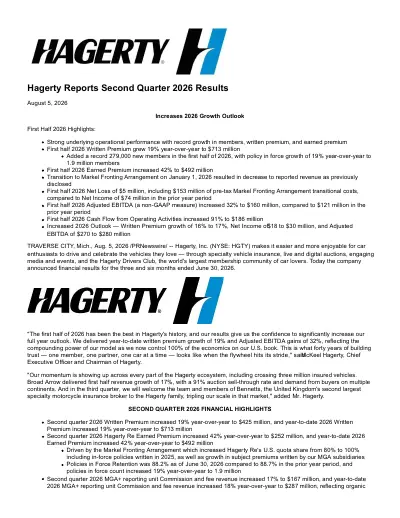
The first half of 2026 was the best in Hagerty's history, as measured by gains in policies in force, written premium, earned premium, and adjusted EBITDA. These are the metrics that best reflect the true vibrancy of our business.
We blew through the 3 million vehicle insured milestone in the second quarter as we added a record 279,000 new members. Importantly, we are delivering high rates of growth while simultaneously investing in our teams, technology, and member experience that will sustain growth as our compounding machine shifts into overdrive.
Written premium growth of 19% came in well ahead of our prior full-year expectations for 15% to 16% growth. Our written premium growth is powered by new business count rather than rate, unlike the broader industry that fluctuates with the pricing cycle.
Earned premium jumped 42% due to the strong written premium gains combined with the increase in economics under the new Markel fronting arrangement to 100%. Adjusted EBITDA grew 32% to $160 million due to the benefits of increasing scale combined with cost discipline.
Reported GAAP revenue in the first half was down 6%, and our GAAP net loss was $5 million, reflecting the accounting mechanics from the new Markel fronting arrangement that we have discussed on previous calls. While the GAAP presentation of revenue and net income in 2026 continues to look different from prior years due to this new Markel fronting structure, the underlying business performance is stronger than ever.
The key metrics above, policy count, written and earned premium, and adjusted EBITDA, are all running well ahead of expectations, causing us to increase our outlook for the year. More on that in a moment.
Let me run through some of the first half highlights in more detail shown on slide three, and Patrick will focus on the second quarter. The 279,000 new members added in the first half was a record for any comparable six-month period, boosted by State Farm conversions.
The breadth of vehicles joining the Hagerty family continues to expand. Our classic cohort, Mustangs, Camaros, C10 pickups, and Porsche 911s, to name a few, is growing quickly.
The fastest-growing segment is the modern enthusiast vehicles, 1980s to 2000s sports cars from Japan, Germany, and the US, as well as off-road vehicles. The incremental demand is coming from the rising generation of younger collectors that grew up coveting these fun vehicles, and now they have the disposable income to acquire them.
This is the Enthusiast Plus target demographic, and it is arriving as the demand from Gen X and millennials and Gen Z quickly ramps up. Year-to-date quote volume from these younger generations now exceeds 60% of total demand.
Our Enthusiast Plus program in Colorado is performing in line with revised pricing assumptions, and we are applying those learnings as we expanded into three additional states in July. Our high rates of PIF growth and industry-leading retention of 88% powers consistent compounding growth and provides us with excellent visibility into future revenue streams, particularly as we unlock our partnership opportunities by deepening existing relationships and adding new ones.
The rollout of the highly integrated State Farm Classic Plus program is accelerating. As of the end of the second quarter, State Farm agents are selling new Hagerty policies in 37 states.
New tranches of states are coming online as planned and on budget. The conversion of State Farm's existing 525,000 collector car policies to the Hagerty platform is also progressing well, with 14 states in motion, and we remain on pace to complete the transition by 2028.
We are also excited about our new partnership with Liberty Mutual, as well as the progress made on securing larger cohorts of vehicles with Progressive and trial programs with other national carriers that are performing very well. In our independent agency channel, we believe we have an opportunity to better inform and activate these 54,000 agents.
We are investing in straight-through processing and automated identification tools that enable agents to spot enthusiast vehicles already sitting in their daily driver books. We are also improving the educational resources that help agents understand what Hagerty can do for their customers, including enhancing customer retention.
The addressable market of 36 million vehicles expands every year, and most of these cars are currently insured at generic daily driver rates by carriers that neither understand nor value them the way that Hagerty can. Omnichannel distribution is a key competitive advantage to drive outsized growth, and we deliver these high rates of growth with exceptional underwriting discipline.
Hagerty Re's combined ratio for the first half came in at 88%, with a loss ratio at 41%. 40 years of proprietary data on 48,000 makes and models, combined with members that treat their cars with exceptional care, is a combination that others cannot replicate.
Let me turn now to our buy and sell business, Hagerty Marketplace, where total sales grew 17% to $65 million. Broad Arrow, our high-end live auction business, was the key driver of growth, with a first half sales increase of 74% and an exceptional 91% sell-through rate.
Private sales were down against the prior year period, which benefited from the sale of a large single-owner collection. The depth of demand we are seeing from buyers across multiple continents tells us something important about the health of our market.
Great cars continue to appreciate in value, and buyers who care about provenance, condition, and expertise are choosing Broad Arrow because they trust our process and our team. I want to remind investors of something fundamental about our marketplace business.
It is not just a revenue line. It is a customer acquisition machine.
Every car that trades hands is a potential Hagerty insurance policy, and every auction catalog that circulates through our global community of members reinforces the Hagerty brand as the most trusted name in collector cars. The flywheel is self-reinforcing, and it grows more powerful with every member-centric interaction.
Slide four is a useful reminder that the results we're reporting today aren't accidental. They are the output of a deliberate multi-year investment in distribution, technology, and the member experience.
The progress across each of these is exactly why we're raising our 2026 outlook. Let me close by stepping back for the bigger picture.
We are now halfway through 2026, our structural transition year with the new Markel fronting arrangement, and the business is performing well above the high end of the ranges we shared last quarter. Given the strength of our first half and robust business momentum, we are raising our expectations for full-year written premium growth to 16% to 17%.
With better-than-expected flow-through, we now expect GAAP net income of $18 million to $30 million in 2026 and adjusted EBITDA of $270 million to $280 million. Let me now turn it over to Patrick to run through the second quarter in more detail.
Patrick McClymont
Thank you, McKeel, and good morning, everyone. I will start by sharing some additional color on the second quarter's excellent momentum shown on slides five and six.
We delivered written premium growth of 19% in the second quarter and 19% during the first six months of the year, marking an acceleration from last year's 14% growth due to record growth in new members. Adjusted EBITDA jumped 32% during the first half.
This is what a healthy, compounding specialty insurer looks like when firing on all cylinders. As McKeel mentioned, the 2026 GAAP presentation reflects the Markel fronting transition.
Starting January 1st, 2026, Hagerty Re assumed 100% of the underwriting risk on our US book. A great economic outcome for Hagerty, thanks to the 25% step-up in underwriting profits and investment income.
Under the new structure, MGA commission revenue and the associated ceding commission expense eliminated against each other in consolidation. That is why first-half reported GAAP revenue of $667 million declined 6%, even as written premiums grew 19%.
Let me break down our second quarter revenue. Earned premium grew 42% to $252 million, reflecting the PIF count-driven written premium gains combined with the increase to 100% quota share in our US book.
This is the structural improvement in our reinsurance economics that we have been working toward for a decade with Markel. Commission and fee revenue for the quarter was $24 million.
As noted, this line is no longer comparable to prior periods given the elimination of Markel-related commissions in consolidation. As State Farm conversions ramp over the next two years, commission revenue inflects upward.
Second quarter Marketplace revenue was $40 million, up 48%, thanks to strong gains for both auction and private sales. Particularly at the high end of the market and for modern cars, demand had inflected higher since the start of the year and shows little sign of slowing.
Membership and other revenue came in at $21 million, reflecting 10% growth in Hagerty Drivers Club paid memberships. Net investment income was $11 million during the quarter, benefiting from our larger Hagerty Re investment portfolio and the steady returns from our predominantly fixed income allocation.
Turning to profitability shown on slides seven and eight, Hagerty Re's combined ratio came in at 90% in the second quarter despite inflationary pressures. We believe the investments we are making in our underwriting team and in-house claims capabilities result in better outcomes for members and lower loss costs for Hagerty Re.
Adjusted EBITDA in the second quarter was $75 million, resulting in first half EBITDA of $160 million, up 32% year over year. GAAP net income was $8 million in the quarter and includes the $64 million amortization of deferred ceding commissions for 2025 policies.
First half GAAP net loss was $5 million. During the first half of 2026, we incurred approximately $57 million in new acquisition expenses that were capitalized, of which only $16 million was recognized on the P&L.
This resulted in a $41 million cumulative benefit in the first half, $20 million of which was realized in the second quarter. We expect this benefit to diminish to $15 million in the second half, with none in the fourth quarter, as the new policy season and amortization catches up with costs.
This is incorporated in our full-year 2026 bottom-line outlook, and we anticipate that 2027 should reflect a clean, steady-state P&L as these acquisition expenses normalize. Back to the second quarter.
Net loss attributable to Class A common shareholders was $2 million. GAAP basic and diluted loss were both $0.02 per share.
Adjusted loss per share, based on approximately 361 million weighted average shares of Class A common stock outstanding, was also $0.02. We recorded an income tax benefit of $6 million in the second quarter versus an expense of $6 million in the prior year period.
The change in tax benefit period-over-period is driven by non-reversing differences between taxable income and pre-tax book income related to the Markel fronting arrangement, chiefly the ceding commission Hagerty Re deducts on its tax return, but that we eliminate in consolidation. Operating cash flow during the first six months was $186 million, almost double the cash flow from the first half of 2025 and a clear indicator of the vibrancy and improved economics of the new Markel fronting arrangement that also drove the accelerated movement of written premium to Hagerty Re under the new structure.
As of June 2026, we had $298 million in unrestricted cash and total debt of $216 million, which includes $88 million of back leverage for Broad Arrow's portfolio of collector car loans. After the quarter ended, we announced that we had acquired Bennetts, the second-largest specialty motorcycle insurer in the United Kingdom, for £34 million.
Our UK team has done a great job improving the performance of the business and returning to growth, and this opportunistic acquisition immediately triples our scale in an exciting market with a strong member-focused business model. We are excited to welcome the Bennetts employees and members to the Hagerty family and are looking forward to what the combined entity can do over the coming years.
A few investors have asked how we think about capital allocation following last year's secondary, let me share some thoughts. Our first priority is to make investments that create additional value for our members and generate high returns for Hagerty.
This means initiatives that expand our policy count, deepen the flywheel, improve unit economics, and create a compounding cash flow machine. Our second priority is to evaluate strategic acquisitions, such as Bennetts, that expand our presence in the ecosystem.
These tend to be modest in size and infrequent. The third priority is to return capital to shareholders.
This is not on the agenda over the near term given the high returns we can generate investing in our business. Let me close with our increased 2026 outlook shown on slide nine.
The metrics that best reflect our operating momentum, policy growth, written premium, earned premium, and adjusted EBITDA, are all tracking above expectations. Given the strength of our first half results and visibility into the second half, we are significantly increasing our full-year 2026 guidance.
We now anticipate written premium growth of 16% to 17%. We are also increasing our expectations for GAAP net income to $18 million to $30 million and adjusted EBITDA of $270 million to $280 million.
Investors who are following GAAP revenue and net income will get a cleaner picture with every passing quarter as we move toward normalized results in 2027. We expect 2027 GAAP revenue should more closely track our mid-teens written premium growth, and GAAP net income and adjusted EBITDA will be powered by our compounding profit machine that is no longer masked by the 2026 Markel fronting transition expenses.
The investments we are making in distribution, technology, and product, State Farm conversions accelerating, Enthusiast Plus scaling to additional states, Duck Creek delivering cost efficiencies, are designed to sustain premium growth and steadily expand margins in the years to come. That wraps up our prepared remarks.
Operator, we can open the line for questions.
Operator
Thank you. Ladies and gentlemen, as a reminder to ask a question, please press *11 on your telephone, then wait for your name to be announced.
To withdraw your question, please press *11 again. Please stand by while we compile the Q&A roster.
Our first question comes from the line of Tommy McJoynt with KBW. Your line is open.
Tommy McJoynt
Hey, good morning. Thanks for taking our questions.
The first one here is, heard your comments around pitching to independent agents. Has your strategy around that shifted at all as you think about getting more of the 54,000 agents integrated into helping sell Hagerty policies?
McKeel Hagerty
Hey, Tommy, good morning. Thank you for the question.
We think the independent agent channel is a really key piece of our growth strategy. The challenge is 54,000 that we've accumulated over a long period of time is a very large group, we've really put an incredible team together.
Just really have brought in Adam VanLoon to lead this whole effort and really is expert at thinking about, how are we going to focus on the ones that will help us produce the most? How do we think about the ones that we can sort of move the sort of zero to one strategy on the front end?
Then, how are we going to just take advantage of the fact that we have this larger ecosystem where we need to be communicating to agents that the idea of a classic car, sometimes the perspective that these are just very, very old cars, has really shifted. That's a big part of our strategy.
It's data, it's communications, it's education, it's all of the above. We want to be that partner in an agent's office when somebody like this comes in, not just with a really vintage car, but with one of these enthusiast vehicles that they need to send it to us.
Tommy McJoynt
Got it. Thanks for that.
Then a question around thinking about the transition kind of into next year once we have cleaner accounting. Obviously there's a lot of accounting noise this year around the Markel transition, and especially around the $199 million of transitional cost add-back and the accounting for policy acquisition costs.
Right now, just to help us with modeling, is it your expectation that adjusted EBITDA growth in 2027 can sort of keep pace with the written premium growth that you guys are contemplating? Just kind of helping us think about the impacts of this accounting noise this year.
Thanks.
Patrick McClymont
Sure. Obviously we don't give guidance for 2027 till we get into 2027.
What I would say is once we get through the complexity of this year, then the economics of the business are largely driven by insurance, and that will continue to grow in the mid-teens. That's the starting point.
Then, we'll figure out and communicate how much of our ability to drive margin expansion flows to the bottom line and how much of it we're going to invest back in the business. When I look at what's out there in terms of consensus, that's a reasonable starting point, and then we'll kind of give you our own point of view early next year.
Tommy McJoynt
Thank you.
Operator
Thank you. Please stand by for our next question.
Our next question comes from the line of Charlie Lederer with BMO. Your line is open.
Charlie Lederer
Hey, thanks. Maybe just following up on that last question.
If you think about the moving pieces, just from the accounting noise, I guess, would the only kind of dynamic next year from a comparison standpoint be that you have the increase in deferred acquisition costs amortizing in the P&L, particularly, I guess, in the first half? Thanks.
Patrick McClymont
The two things that will be different will be, one, the transition cost, the $199 million, is gone, right? That's fully amortized by the end of this year, and so that we don't have to worry about that next year.
The other is this dynamic on the deferred acquisition costs that we're putting on the balance sheet this year. We kind of started from scratch, and we're building up that balance over the course of this year.
That's been an add-back. That's been a good guy, right, because we're capitalizing that as opposed to running it through the P&L.
As we build that up and the amortization starts kicking in, it normalizes. That dynamic goes away pretty much by the end of this year, and next year will be in a steady state.
It'll grow, right, you'll continue to build up that balance. The relationship between what we're actually spending on a cash basis and what we're amortizing through the P&L will be much more consistent.
Was that helpful?
Charlie Lederer
Thanks. Sorry.
I guess I was thinking from an adjusted EBITDA standpoint. The DAC is in the adjusted EBITDA, but the transition costs are not, I think.
Is that correct?
Patrick McClymont
They are this year, they will not be next year. Those transition costs are in there this year.
What you'll see next year is zero under 2027.
Charlie Lederer
Then,
Patrick McClymont
prior year, too, we'll have to have the 20 the prior-year number in there, and then it just goes away entirely. It's truly a moment-in-time issue.
Okay.
Charlie Lederer
Thank you. Then, I guess, as for my follow-up, McKeel, you cited the Enthusiast Plus quote volume driving demand.
I guess is that what's driving the upside to guidance and the results in the quarter? I guess can you give us some color around the contribution between Enthusiast Plus, kind of legacy Hagerty, and then State Farm in the quarter?
Thanks.
McKeel Hagerty
No, thanks, it's a good question. This is just overall demand.
We came into this year with a lot of momentum. We know that when you get a lot of momentum building on a back half of the year, it tends to carry through.
We've seen this certainly through the first half. It's across the board.
Of course, we're absorbing this massive amount of State Farm business right now, which I mentioned is on pace in terms of both the new states that we're turning on for new business as well as the conversion states, and those will kind of continue through a cadence and then on through the next year, and what we hope is that we're fully live with State Farm by 2028. It's really across the board.
Almost every channel is firing on all cylinders, and E-Plus is a piece of it, but it's still very very new to us. We were in Colorado for a long time, we've turned on a few more states, we'll be turning on a few more this year.
The program itself is functioning almost in a startup mode. It's based on the fact that we get a lot of this demand for this business in the core program already.
It's not like a brand-new thing for us, it's just an extension of what we already know. All cylinders are firing here, and that's the bulk of what's attributing to the growth in the raised guidance.
Charlie Lederer
Thanks.
Operator
Thank you. Our next question comes from the line of Elyse Greenspan with Wells Fargo.
Your line is open.
Elyse Greenspan
Hi, thanks. Good morning.
You guys highlighted progress, I think you said you made on securing larger cohorts of vehicles with Progressive and then trial programs with other national carriers that I think you said were performing well. Can you just expand on those relationships and just kind of put some numbers on that, if possible?
McKeel Hagerty
We've had a number of these relationships up and running for a long time. Progressive is one that we're very proud of.
If you go to Progressive today and try to get a quote on their website for some sort of vintage car, that works through a workstream that we built together with Progressive. Progressive is, obviously, growing very very fast.
They're a huge insurance company, and they've turned on a wider spigot, I guess you could put it to us. We're seeing really really successful growth.
Then in terms of some of the other partnerships, we mentioned earlier, we have the Liberty Mutual partnership that we launched before and we're starting to turn that on and we'll be piloting more programs in the months to come that we'll be talking more specifically about. I guess what we're trying to say is our whole world is not just State Farm and turning on these great State Farm states.
We have a lot of new partnerships that we're working on, and that will be part of our growth picture in the years ahead when we talk more specifically about it.
Patrick McClymont
Elyse, just to give you on Progressive, one of the big changes recently is historically we were only seeing volume for those pre-1981 cars because the VIN issue that we've talked about. It was a static group of cars that we could see quotes on.
We've evolved that relationship, now that's 25 years old and older. We picked up just through that alone 17 years of additional cohorts that are out there, and now just kind of roll forward on a go-forward basis.
Elyse Greenspan
Thanks. Then as we think about just new business and just overall policy-in-force trends in the back half of the year, is there any seasonality that we should be considering?
McKeel Hagerty
The normal seasonality that we've talked about before, Elyse, is still in play. There's a kind of a big bell curve to our growth, kind of starts in March and April and kind of starts tapering off in October.
That pattern remains the same. Even though there are sunny-weather states that shouldn't be the case, it just seems it has been the historic pattern of this business going back for decades.
It remains, and the pattern is reflected in all of our past-year numbers that you have available to you, and we'll continue to see that happen the same. Even as we've turned on some of these new partnerships when large groups of policies become available for us, that same seasonality exists.
Kind of it's a springtime to fall-time activity, and that's when people buy cars and that's when they need their policies incepted.
Elyse Greenspan
Thanks. Oh, go ahead.
Patrick McClymont
I was just going to say, under the new accounting, it's evolved a bit, right, because it used to be that the commissions were showing up on the face of the P&L, and those were seasonal, right? Our big seasons were second and third quarter.
Now that we're eliminating those commissions and what's really dominating the revenue is the earned premium, that's earned out over the life of the policy, it has a smoothing effect relative to history.
Elyse Greenspan
Thanks. Then just on capital, right, you guys mentioned the recent Bennetts deal, and it sounds like, right, deals, I think you said, tend to be modest and infrequent.
How would you characterize, I guess, the pipeline of potential transactions today as you think about just the M&A component of your capital strategy? Thank you.
McKeel Hagerty
Thank you, and I think that language is about as specific as we can be at this point. Bennetts was actually not something that had been long on our radar, and we've long wanted to find the right kind of acquisition that could help boost the scale of our UK business, which we've had for a long time, but it's never been huge for us.
Bennetts kind of came onto our radar and we moved quickly at it, and we were able to make it happen. While we have a team that's very capable of analyzing and looking at these deals and making them happen, we've just always taken the approach of being very cautious for all the integration issues that companies see with absorbing employee groups and books of business and all that sort of thing, and we'll look very carefully out into the future.
We're not scrubbing the world looking for acquisitions. When they come up, we want to be able to act on them.
Our performance in the last year and what we think will be in the next couple years will make it easy for us to take things on like this. I think when you look at the big broad landscape at least in the insurance side of our business, there aren't great big ones out there to look at and to acquire.
When we see things like this, they'll be I think relatively modest, and we will be cautious.
Elyse Greenspan
Thank you.
Operator
Thank you. Our next question comes from the line of Mitchell Rubin with Raymond James.
Your line is open.
Mitchell Rubin
Hey, good morning. This is Mitch on for Greg.
Retention went down 50 basis points year over year and 30 point basis points sequentially. Could you talk about the trends you're seeing there and how much of that is on the core book versus mix from the State Farm book coming on?
Patrick McClymont
From a mix standpoint, the State Farm book is so young, it's converting at a very high rate because we're deep into conversions now in a bunch of states, and the new business that we did place over the last year-plus is also, retention on that is quite high. It's a little bit of a downtrend in the core book.
As we look at it, it's within the range of where we've been historically, there's nothing about it that gives us particular pause.
Mitchell Rubin
Thanks. I appreciate the color.
On the non-reversing tax difference you called out on the ceding commission deduction, does that benefit carry into '27, or should that run off?
Patrick McClymont
We're always going to have this dynamic just the nature of how the consolidation accounting works. It will be less impactful over time.
It will start to normalize as we get towards the end of this year, and then next year it'll still flow through, but it's not going to be as evident here. Then the other thing that's going on is, when you're in the neighborhood of kind of breakeven, from effective tax rate perspective, it looks quite large.
As that net income grows, right, next year we're going to get out of the Markel transition costs, that $199 goes away, we'll start producing more net income, and so the impact of this will be, kind of less visible in the tax line.
Mitchell Rubin
Got it. Appreciate it.
Thank you, guys.
Operator
Thank you. Please stand by for our next question.
Our next question comes from the line of Kevin Wijendra with J.P. Morgan.
Your line is open.
Kevin Wijendra
Hi, this is Kevin on for Jimmy. Thanks for taking my question.
The first is in relation to the guidance you issued. It looks like the increase in revenues versus EBITDA implies very high incremental EBITDA margin.
What's the driver of this?
Patrick McClymont
Oh, there's a few things going on. One, the overall performance year to date obviously is been quite strong, and ahead of our internal expectations.
That's reflected in the increase in guidance. Then part of what's going on is, from a cost standpoint, relative to our own internal plans, we're in a better spot.
We've done a good job in terms of realizing efficiencies, and so that is going to result in, kind of more flow-through, the point you're making. Then also the marketplace business is also contributing.
Again, better than what we had expected year to date, and some big sales coming up in the second half of the year. We had sort of planned for that, as you've seen in the disclosures, it kind of hovers around breakeven, and now it's actually producing more profitability.
That impacts it as well.
Kevin Wijendra
Great. Thanks.
Then, for my follow-up, there was a meaningful bump in new business count this quarter from 100k to 160. What was the driver of that?
Was there a discrete rollout?
Patrick McClymont
The traditional business continues to grow at a strong rate. Then the big bump is State Farm.
We are now into the conversion phase. I think it's 15 states that we're doing conversions in.
Recall that with State Farm, we launch a new state and initially we're just doing new business, and then after a period of months, once everybody's comfortable that everything's working, then we switch over and we start converting. We've talked about the fact that it's north of 500,000 vehicles that they have in their current program that end up getting converted over to Hagerty.
That's what's driving the big increase in new business count. That continues for the balance of this year and into 2027.
It's not until late 2027 or even a little bit into '28 for some states that we finalize that conversion process.
Kevin Wijendra
Thank you.
Operator
Thank you. Our last question comes from the line of Mark Hughes with Truist.
Your line is open.
Mark Hughes
Thank you. Good morning.
The modern enthusiast business, could you refresh me on any differences there in premium per policy or the loss ratio?
McKeel Hagerty
What do you mean by modern enthusiast, Mark?
Mark Hughes
Just the more recent vehicles you describe you've had good success in the marketplace. That's a separate topic, but the younger cars, newer cars, but still falling into vintage category.
Just the modern enthusiast business as opposed to your more traditional older vehicles. Is there any difference in premium per policy?
I think you made the point, some insurance companies just look at them as old cars, but you look at them differently. That being said, is there any difference in premium per policy versus your legacy business, let's call it, or in the loss experience?
Patrick McClymont
Okay. The way to think about the current business that we've always done, that will be driven largely by value, right, what the agreed value is upfront, and then our underwriting.
It kind of depends, right? If we're talking about something that is truly that special car, then the rates are going to be pretty consistent with what we've talked about.
Again, it really depends on value. I think what you're kind of headed towards is Enthusiast Plus, and there what we're talking about is, cars that are typically going to be utilized more and we're also having different underwriting around storage, those are going to come with higher premiums.
That's, as McKeel described, a startup, and so it's in its early stages. Over time, that will start to flow through into the P&L.
Mark Hughes
Fair enough. Are your existing relationships with carriers, is the productivities there or the kind of flow-through rate, is that improved?
Obviously, you've got Bennetts in terms of new business with State Farm, but how is your experience with your other relationships, other referral relationships?
McKeel Hagerty
Hey, Mark. As I might have mentioned earlier on a previous answer, we're really firing on all cylinders.
All of our partnerships are being really well managed, and those carriers are seeing the same opportunities that we are. Not only do new cohorts of cars kind of come into view each year, but in many cases, we're just getting greater penetration into their distribution networks year over year.
A lot of that is just call it the kind of ground war, time on task, or just reps of us getting out there, meeting with their field teams, meeting with their territory managers, activating at agent events, all of that sort of thing. Both the independent agency side of the house and the kind of carrier partnership side of the house, they're all contributing to our great growth trajectory right now, and really grateful for these partnerships.
They're very sticky. Our oldest partnerships are over 20 years old, and yet we're still turning new ones on.
That's a pattern that we're going to work really hard to keep going.
Mark Hughes
Appreciate that. Thank you.
McKeel Hagerty
Thanks, Mark.
Operator
Thank you. Ladies and gentlemen, I would now like to turn the call back over to McKeel Hagerty for closing remarks.
McKeel Hagerty
Thank you, operator, and thanks to everyone on the call for your continued support. I want to close by repeating where we started this morning.
Hagerty has never been better positioned to serve the community of auto enthusiasts who trust us to protect their special toys. We have the fastest-growing specialty insurance franchise in the collector market, with a powerful recurring revenue model, low volatility, combined ratios of 90%, and consumer-friendly rates.
Our business is rapidly scaling as we work toward 3 million policies by 2030. The path is clear, the team is exceptional, the market is ours to win as we are creating something genuinely unique in the insurance world.
Thank you, One Team Hagerty. These results are the product of your passion, your excellence, and your hard work.
I cannot wait to see what this team is capable of delivering over the next decade. We look forward to seeing some of you in California next week, where we will host our inaugural auction at The Quail, A Motorsports Gathering, and also at the Pebble Beach Concours, and our Motorlux gathering, and the Laguna Seca historic races.
We'll be all over the Monterey Peninsula, and we hope that you might be there to join us during Monterey Car Week. Until then, never stop driving.
Operator
Ladies and gentlemen, that concludes today's conference call. Thank you for your participation.
You may now disconnect.