Hooker Furnishings Corporation
NNASDAQ:HOFTQ4 FY2026 · Earnings Call TranscriptApril 16, 2026
Operator
Good day, and thank you for standing by. Welcome to the Hooker Furnishings fourth-quarter 2026 earnings webcast.
At this time, all participants are in a listen-only mode. After the speakers' presentation, there will be a question-and-answer session.
To ask a question during the session, you will need to press star one one on your telephone. You will then hear an automated message advising that your hand is raised.
To withdraw your question, please press star one one again. Please be advised that today's conference is being recorded.
I would now like to hand the conference over to your first speaker today, Earl Armstrong, Senior Vice President and Chief Financial Officer. Please go ahead.
Earl Armstrong
Thank you, Tanya, and good morning, everyone. Welcome to our quarterly conference call to review financial results for the fiscal 2026 fourth quarter and full year.
Our 2026 fiscal year began on February 3rd, 2025, and the fourth quarter began on November 3rd, 2025, both periods ending on February 1st, 2026. Joining me today is Jeremy Hoff, our Chief Executive Officer.
We appreciate your participation today. During our call, we may make forward-looking statements, which are subject to risks and uncertainties.
A discussion of the factors that could cause our actual results to differ materially from our expectations is contained in our press release and SEC filing announcing our fiscal 2026 results. Any forward-looking statement speaks only as of today, and we undertake no obligation to update or revise any forward-looking statement to reflect events or circumstances after today's call.
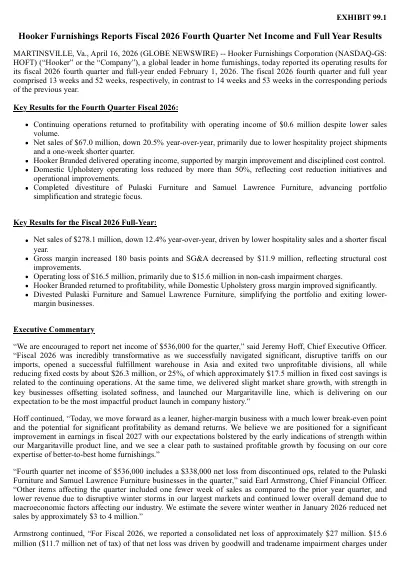
During the fourth quarter, we completed the previously announced sale of the Pulaski Furniture and Samuel Lawrence Furniture casegoods brands, part of our former Home Meridian segment. Consolidated net sales from continuing operations were $67 million, a decrease of $17.2 million, or about 21% compared to the prior-year period.
The decline was partially attributable to the current fourth quarter being one week shorter than the prior-year period, which reduced net sales by approximately $5.5 million based on average daily sales. The decrease also reflects lower sales in our hospitality business due to its project-based nature, as several large projects shipped in the prior year did not recur in the current year.
Additionally, we estimate severe winter weather experienced in January '26 in a significant part of the United States and in most of our largest markets reduced net sales for the quarter by $3 to $4 million. Despite lower net sales, we reported operating income of $629,000 for the quarter.
This was driven by operating income of $1.2 million in Hooker Branded and $617,000 in All Other, partially offset by an operating loss of $1.2 million in Domestic Upholstery. Notably, despite one week less of sales and severe winter weather, Domestic Upholstery reduced its operating loss by more than half compared to the $2.5 million loss in the prior-year fourth quarter.
Hooker Branded operating income was consistent with the prior-year period despite fewer selling days and the weather disruptions. Net income from continuing operations for the fourth quarter was $874,000, or 8 cents per diluted share.
Following the divestiture of Pulaski and Samuel Lawrence on December 12th of last year, results of these businesses are reported through that date. Discontinued operations incurred a net loss of $338,000 in the quarter.
Consolidated net income for the fourth quarter was $536,000, or 5 cents per diluted share. For the full fiscal year of 2026, net sales from continuing ops were $278.1 million, a decrease of $39.2 million, or 12.4% compared to the prior year.
This decline was primarily driven by lower sales in the hospitality business within All Other, and to a lesser extent, a shorter fiscal year and the severe winter weather we mentioned earlier. Gross profit declined in absolute dollars due to lower sales; however, gross margin improved by 180 basis points, reflecting margin improvements in the Hooker Branded and Domestic Upholstery segments.
Continuing operations reported an operating loss of $16.5 million for fiscal '26, primarily due to $15.6 million in non-cash intangible asset impairment charges recorded in the third quarter, triggered by our stock price as of the end of the third quarter. These included $14.5 million related to goodwill in the Sunset West division and $556,000 related to the Bradington-Young trade name, both within Domestic Upholstery, as well as $558,000 related to the remaining HMI business in All Other.
Additionally, continuing operations incurred approximately $2 million in restructuring costs, primarily related to severance, and to a lesser extent, warehouse consolidation, all as part of our completed cost-reduction initiatives. Net loss from continuing operations was $12.8 million, or $1.20 per diluted share.
Discontinued operations included approximately 10 months of activity in fiscal '26. Sales declined due to ongoing macro pressures and tariff-related purchasing hesitancy among its customers, particularly large furniture retailers.
Discontinued ops incurred a pretax loss of $19 million, including $3.9 million in restructuring costs, of which $2.4 million related to the Savannah warehouse exit, a $6.9 million loss from classification as held for sale, which included $2.6 million of trade name impairment, $3.5 million in fair value writedowns, and $735,000 in selling costs. Discontinued operations also incurred $1 million in bad debt expense related to a customer bankruptcy.
Consolidated net loss for fiscal '26 was $27 million, or $2.54 per diluted share. Now I'll turn the call over to Jeremy for his comments on our fiscal '26 fourth-quarter and full-year results.
Jeremy Hoff
Thank you, Earl, and good morning, everyone. We are encouraged to report net income of $536,000 for the quarter.
Fiscal '26 was incredibly transformative as we navigated significant, disruptive tariffs on our imports, opened a successful fulfillment warehouse in Asia, and exited two unprofitable divisions, all while reducing fixed costs by about $26.3 million, or 25%, of which approximately $17.5 million in fixed cost savings is related to continuing operations. At the same time, we delivered slight market share growth overall, with key strength in key businesses offsetting isolated softness, and launched our Margaritaville line, which is delivering on our expectations to be the most impactful product launch in company history.
Today we move forward as a leaner, higher-margin business with a much lower break-even point and the potential for significant profitability as demand returns. We believe we are positioned for a significant improvement in earnings in fiscal '27, with our expectations bolstered by the early indications of strength within our Margaritaville product line, and we see a clear path to sustained, profitable growth by focusing on our core expertise of better to best home furnishings.
Despite significant headwinds, we are encouraged to report that the Hooker Branded segment reported $1.9 million in operating income for the year, compared to a prior-year operating loss of $433,000. Additionally, despite a significant impairment charge in the third quarter, the Domestic Upholstery segment showed improvements in the fourth quarter, reducing its operating loss by more than 50% as compared to the prior-year quarter due to cost-reduction initiatives and operational improvements.
I'd like to also comment on import tariffs, which were a significant disruptor for Hooker and the industry in fiscal '26. After our fiscal year end in February '26, the U.S.
Supreme Court ruled that certain tariffs imposed under the International Emergency Economic Powers Act were not authorized by statute. In March '26, the U.S.
Court of International Trade directed U.S. Customs and Border Protection to implement a refund process for previously collected duties.
We are evaluating the potential recovery of these amounts. Additionally, the administration appears poised to pivot to new tariffs under different legal authority within the next few months.
We continue to monitor developments in this area. Now I want to turn the discussion back over to Earl, who will discuss highlights in each of our segments, along with our cash, debt, inventory, and capital allocation strategies.
Earl Armstrong
Thank you, Jeremy. At Hooker Branded, net sales decreased 2.9% for fiscal '26, with the decline entirely driven by a $5.5 million decrease in the fourth quarter, primarily due to one fewer selling week as well as supplier delays and weather-related shipping disruptions.
Unit volume declined, partially offset by a 5.7% increase in average selling price implemented to mitigate higher costs and tariffs. Despite lower sales, full-year gross margin expanded by 200 basis points, driven primarily by lower freight costs and pricing actions.
Operating income improved to $1.9 million for the year compared to an operating loss in the prior year, while fourth-quarter operating income of $1.2 million was consistent with the prior year despite reduced selling days. Incoming orders were flat year-over-year, while backlog increased nearly 26%.
Domestic Upholstery net sales decreased 2.7% for fiscal '26, reflecting lower unit volumes in certain divisions, partially offset by growth in contract, private label, and outdoor channels. Gross margin improved by 230 basis points for the full year, driven by lower material costs, reduced labor and overhead expenses, and benefits from cost-reduction initiatives.
The segment reported an operating loss of $16.9 million for the year, largely due to $15 million in non-cash impairment charges, compared to an operating loss of $5.4 million in the prior year. In the fourth quarter, operating loss was $1.2 million, reduced by more than half from the prior year, reflecting cost-reduction actions despite lower sales.
Incoming orders decreased slightly by about 2%, while backlog increased about 8% year-over-year. Regarding cash, debt, and inventory, as of the fiscal year end, cash and cash equivalents stood at $1.1 million, a decrease of $5.2 million from prior year end.
However, amounts due under our revolver decreased by $18.5 million to $3.6 million at year end. Cash generated from operations was used to repay $18.5 million of our former term loan, distribute $8.8 million in cash dividends, and fund $3.2 million in capital expenditures.
Inventory levels decreased by $17.5 million, from $66.2 million at year end to $48.7 million at fiscal year end. We received approximately $5.5 million in cash proceeds from the sale of the discontinued ops.
Despite these outflows, we've maintained financial flexibility with $62.8 million available in borrowing capacity under our amended and restated loan agreement as of fiscal year end; this is net of standby letters of credit. As of yesterday, we had over $12 million in cash on hand, with over $64 million in available borrowing capacity, net of standby letters of credit, with $0 outstanding on our credit facility.
Regarding capital allocation, late last year we announced that our board authorized a new share repurchase program under which the company intends to repurchase up to $5 million of our outstanding common shares beginning in fiscal '27. In connection with the repurchase authorization, the board recalibrated the annual dividend to 46 cents per share, which began with the company's December 31st, 2025, dividend payment.
As Hooker transitions to a more focused, growth-oriented company, the new share repurchase program, together with the adjusted dividend, enables us to return capital to shareholders while maintaining the balance sheet flexibility needed to invest in the business. We believe these actions appropriately balance capital returns with liquidity while supporting long-term shareholder value.
Now I'll turn the discussion back to Jeremy for his outlook.
Jeremy Hoff
In Hooker Branded and Domestic Upholstery segments, incoming orders have increased year-over-year for three consecutive quarters, adjusted for the extra week in last year's fourth quarter. Housing activity and consumer confidence remain weak, and the Department of Commerce's February advance monthly estimates reflect that reality, showing that retail sales for furniture and home furnishings decreased by 5.6% as compared to the prior year and lower than January of '26.
We don't anticipate near-term, meaningful improvement in conditions; however, with a more efficient cost structure and a streamlined portfolio, we believe we are positioned to report improved results even if current market conditions persist. Our advantage is a clear focus on our core businesses, with the organization fully aligned to drive organic growth and deliver more consistent, sustainable earnings over time.
Margaritaville product and gallery commitments continue to scale, with shipments expected to begin in the second half of fiscal '27. This ends the formal part of our discussion, and at this time, I will turn the call back over to our operator, Tanya, for questions.
Operator
Certainly. As a reminder, to ask a question, please press star one one on your telephone and wait for your name to be announced.
To withdraw your question, please press star one one again. Please stand by while we compile our Q&A roster.
Our first question will come from the line of Anthony Lebiedzinski of Sidoti. Your line is open, Anthony.
Anthony Lebiedzinski
Thank you, and good morning, everyone. Thanks for taking the questions.
Certainly nice to see the return to profitability in the fourth quarter. First, looking at the Hooker Branded segment, you had a gross margin of over 39%, which was certainly much better than what we had expected.
Was there anything unusual that helped the quarter in terms of the gross margin, and how should we think about the sustainability of your gross margin at Hooker Branded?
Earl Armstrong
Sustainability, I believe we said in the call just now, gross margin, 200 basis points better, or an improvement. Your question was, how do we look at it going forward?
Jeremy Hoff
He's saying the 39%.
Anthony Lebiedzinski
Was it and what and yeah, and was there anything unusual, in terms of the the fourth quarter 39% versus 32% a year a year ago for for the quarter?
Earl Armstrong
No, we can't think of anything unusual for the quarter that would be driving that, really, other than the things we've mentioned.
Anthony Lebiedzinski
Okay. Okay.
Th- that that sounds sounds good. Oh and then so so so going forward, you it sounds like you you you expect continued strong margins at Hooker Branded, right?
Jeremy Hoff
Yes.
Anthony Lebiedzinski
Okay. Sounds good.
Then switching gears to the Domestic Upholstery segment, you had a nice year-over-year improvement there though it was lower than what it was in the third quarter. Maybe if you could just kind of talk about the various puts and takes impacting the gross margin and at Domestic Upholstery, and are you seeing any increases in costs there?
There's been some talk of foam prices costs going up there. Maybe if you could just touch on what you're seeing as it relates to foam and other raw material costs.
Jeremy Hoff
Yeah. Domestic Upholstery, when we talk about Domestic Upholstery, I'm going to talk about Bedford and Hickory, which is has been Sam Moore and Bradington-Young.
That Shenandoah is a different part of that, of course, and then you get Sunset West that's under that same reporting name. Regarding B-Y and Sam Moore, we announced recently that we're combining both of those to become Hooker Custom Upholstery, which is part of a larger strategic initiative that's a part of Collected Living, which is means just putting really everything together and showing all of our strengths in one collection, for example, which we've we believe we figured out is a much more powerful stance moving forward.
As we've done that, we're combining things like frames that can cross over from fabric to leather, to different factories. Factories have become a capability that can be utilized for the strength of the Hooker Custom line versus a silo here that makes leather, another one that makes fabric, it's a very powerful, unified message.
Now in doing that, we've changed such a big part of that strategic direction that, in the timing of revenue with what's going on macro, revenue's really our only challenge in those divisions. The efficiencies of those factories are significantly improved, which is why you're seeing the improvements in the profit.
We're not there yet, and we need more revenue, which we're working on, and that's why we're doing the entire strategy that I just described. We feel really good about the direction, and we feel, actually, as good as we've felt about that part of our Domestic Upholstery really since we've purchased them.
Anthony Lebiedzinski
Got you. Okay.
Just to follow up on as far as that any are you seeing given the in- The foam,
Jeremy Hoff
sorry. The foam part.
That the addition— Yeah, sorry. The additional cost are definitely coming at the industry.
The foam in specific, there was a there's been some disruption. There was a fire in a major Texas facility that affected the entire indus- not I can't say the entire, but much of the industry was affected from that supplier that had the fire.
There's some things going on that are driving cost up in that way, and then, of course, the Middle East war going on has driven different chemicals and oil up and different things that are going through raw materials, and that affects not just foam and what you referenced, but it affects overseas as well. There's a lot of balls in the air with different cost that are rising, and but we don't have enough data right now to really me-, really tell you substan-, exactly what that could be, but it's definitely [unclear].
Okay.
Anthony Lebiedzinski
This sounds good. Yeah.
Then with respect to Margaritaville, sounds like you're still well on track to start shipments in the back half of the year. Can you just expand maybe a little bit more as far as what the interest level you're seeing from retailers since your last call?
Has that increased, or been kind of as you expected? Just wondering about that as far as placements and whether this could be even better than what you maybe had originally expected?
Jeremy Hoff
Yeah. Our I believe we reported that we had over 50 committed galleries last call, and that numbers has grown.
We're we feel even better than we did about where it's positioned and how it's going to impact our our organic growth second half and beyond of next year, or this year, excuse me. Then, when you look at when you think about the fact that at High Point Market, not all dealers come to every market.
It's it's actually probably a little over over half come to each market, so, a good number have not even seen Margaritaville yet from our from as far as in our showroom, and so we we continue to be even more optimistic about where that's going to go and and how that's going to help our growth.
Anthony Lebiedzinski
All right, well sounds good. Best of luck and thank you very much.
Jeremy Hoff
We appreciate it, Anthony. Thank you.
Thank you.
Operator
Our next question will come from the line of Dave Storms of Stonegate. Your line is open, Dave.
Dave Storms
Morning, and thank you for taking my questions. Just wanted to start with maybe some of the weather disruptions that you mentioned.
How much of that is recoverable and maybe just changes the timing and maybe makes Q1 look a little stronger than it normally seasonally would?
Earl Armstrong
We had the same experience in Q1, unfortunately, in early February with a storm that was a little more severe than this, but I would expect by the end of Q1 that backlog should be mostly caught up, the shipping backlog at least.
Dave Storms
Great. Perfect.
Thank you. Then just with shipping, just given all the conflicts, are you seeing any second-order impacts to your shipping lanes and maybe just any commentary around the general supply chain environment?
Jeremy Hoff
We really are not.
Dave Storms
Perfect. Thank you.
Then the last one, and I know you touched on this in your prepared remarks around tariffs. We can obviously all see the headlines, but I guess on the ground with some of these Section 122 tariffs, my understanding is they only have a 150-day runway.
Are you seeing participants in the industry kind of look through this, or did you see a bunch of ordering ahead? I guess, maybe any thoughts around what you saw on the ground with regards to this changing tariff environment?
Jeremy Hoff
I think that due to the kind of somewhat, obviously, disruptive nature of what has happened where, I think people unfortunately maybe have become used to the up and down, and I feel like that our industry is somewhat used to the disruption, if that makes sense. It's it we it is what it is, we're managing through it as an industry, and we none of us pretend like we know what is going to happen next.
We know that something is brewing for we think something is brewing for how he'll replace, the tariffs that the Supreme Court shot down, but obviously no one knows what that is.
Dave Storms
Understood. Thank you for taking my questions.
Jeremy Hoff
Thank you.
Operator
As a reminder, if you would like to ask a question, please press star one one. Our next question will be coming from the line of John Deysher of Pinnacle.
Your line is open, John.
John Deysher
Good morning. Thanks for taking my questions.
it seems like a lot of heavy lifting was done over the past year or so, and I was just curious if there's any other future potential divestitures or plant closures, warehouse closures, or anything like that that might be forthcoming in the future.
Jeremy Hoff
Thank you. No, we're really we feel very good about our position and the companies that we have at this point and the capabilities that we have, and it If you look at our overall strategic focus on better and best in the home furnishings industry, the companies we have are exactly that.
We feel good about where we are. We don't feel like we have anything that is not eventually sustainably profitable and a great part of our strategic direction.
John Deysher
Great. That's good to hear.
Regarding the tariffs, some companies have disclosed what the amount of the rebate they are seeking is. I was just curious if you could put a number on the rebate that you might be attempting to recoup.
Jeremy Hoff
It's material. We're not going to disclose that at this point.
John Deysher
Okay. Then I guess finally, what was the backlog at the end of the year, and what was the total number of orders for the year versus a year ago?
Earl Armstrong
Order backlog at the end of the year was roughly $36 million. What was the second question?
John Deysher
Total orders for the year versus a year ago.
Earl Armstrong
I don't have that in front of me....
John Deysher
Did you have orders for the quarter?
Jeremy Hoff
I think so he does.
Earl Armstrong
Total orders in '26 were $256 million...
John Deysher
Mhm.
Earl Armstrong
...just slightly higher the prior year at $257 million.
John Deysher
257. About even.
Great. Thank you, and good luck.
Earl Armstrong
Thank you.
Jeremy Hoff
Thank you.
Operator
I am showing no further questions at this time. I would now like to turn the conference back to Jeremy Hoff for closing remarks.
Jeremy Hoff
I'd like to thank everyone on the call for their interest in Hooker Furnishings. We look forward to sharing our fiscal '27 first quarter results in June.
Take care.
Operator
This concludes today's program. Thank you for participating.
You may now disconnect.