HSBC Holdings Plc
Q3 FY2026 · Earnings Call TranscriptOctober 27, 2026
Operator
Welcome to the analyst and investor presentation on the third quarter results for HSBC Holdings plc. This webinar is being recorded.
I will now hand over to Pam Kaur, Group CFO.
Pam Kaur
Welcome, everyone. Thank you for joining.
It has been another positive quarter. We are confident in meeting the targets we set out to you at the full year and are on track to meet all our guidance, which remains unchanged today.
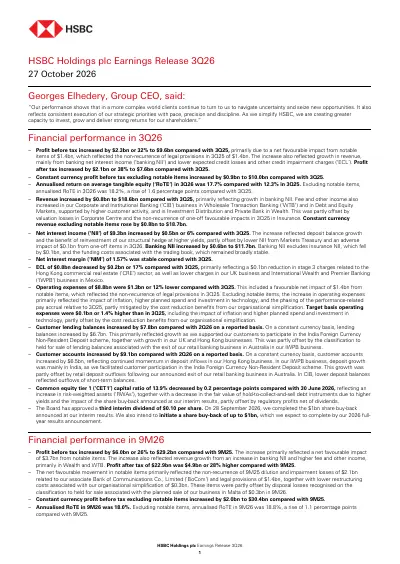
On performance, revenues are up 5% and profit before tax was strong, up 10%, excluding notable items. I'll talk more about these shortly.
Our continued discipline saw us action $0.2 billion of simplification saves, taking us to $1.9 billion of the $2 billion we set out at the half year. We announced an up to $1 billion share buyback.
Let's turn to the income statement. My comments will exclude notable items, which adversely impacted profits by $0.4 billion this quarter.
These are set out on slide 28. The comparisons I will make, unless otherwise stated, will be year on year on a constant currency basis.
I'm pleased with the performance in the third quarter. Revenue grew 5% to $18.7 billion.
This was broad-based across businesses and income lines. We delivered strong profit before tax growth, up 10% to $10 billion.
Earnings per share, excluding notable items, is up 17%, in part benefiting from the reduction in minority interests following the privatization of Hang Seng Bank. Deposits increased $105 billion, including held-for-sale balances.
Annualized return on tangible equity was 18.8% year to date, 1.1% higher than last year. Our CET1 ratio is 13.9%.
Today, we are giving you our estimated Basel 3.1 impact of 40 to 50 basis points, which will apply from 1st January 2027. Turning now to our business segment performance.
All four of our businesses grew deposits. Each delivered annualized return on tangible equity in excess of 17%, excluding notable items.
Revenue grew 5%, showing the breadth of our franchise and consistent execution of our strategy. IWPB revenue fell slightly year on year.
There are two things I will call out here. First, the $0.1 billion impact of our strategic transactions.
We set this out on slide 20. Second, this time last year, I highlighted the positive one-off impacts in insurance in the third quarter of 2025 of around $0.1 billion.
As expected, those did not recur. Taken together, both more than offset revenue growth in IWPB.
Our other three businesses grew consistently in the quarter, with CIB the standout. This broad-based performance across all four businesses shows that our strategy is very much on track.
Moving to banking NII. Banking NII increased $0.6 billion year on year to $11.7 billion.
The quarter-on-quarter increase reflects continued balance sheet growth, both in loans and deposits. It also reflects $0.1 billion of one-offs, a $0.1 billion benefit from our structural hedge, and $0.1 billion from day count.
We benefited from a couple of rate hikes, although I would say that these were in line with expectations a few months ago. As you would expect, our structural hedge is being reinvested at higher yields.
In terms of emerging trends, in Hong Kong, we saw increased time deposit margin pressure this quarter. Most of our strong growth has been in time deposits.
In the UK, the deposit market has become increasingly competitive. We have the lowest loan-to-deposit ratio of the major banks and the highest portion of instant-access deposits.
This leaves us well placed to manage changing competitive market dynamics. As you look forward, I would also just remind you of the impact of our strategic transactions.
We reiterate our full-year banking NII guidance of at least $46 billion. Next, wholesale transaction banking.
The strength of our franchise has been demonstrated over the last 12 months, and again in this quarter. We grew fee and other income 11% year on year as customers continued to turn to us to help them navigate market complexity.
Our balance sheet and franchise strength are particularly valuable in times like these. In the quarter, trade fees grew 5%, driven by continued growth in guarantees in Asia and the US.
We are gaining market share in Asia. This is a core strength of the firm and lies at the heart of our network business.
Payments increased by 4% on higher volumes and increased card fees. While this slide focuses on fees, I would point you to the databook.
Wholesale transaction banking revenues, which give you the full picture of our world-leading trade and payments franchises, are up $0.8 billion and 12% year on year. In Securities Services, we grew fee and other income 3%, reflecting new mandates and higher market valuations.
Some of this growth was offset by strategic transactions. Foreign exchange had a particularly strong quarter, up 19% as we saw client demand in a period of higher market volatility.
Next to Wealth. Wealth net new money at $38 billion in Asia this quarter brings our year-to-date flow to more than $95 billion.
We set this out on slide 24. Our Wealth business continues to perform, and as you'll see on slide 23, we saw good inflows of new-to-bank customers in the quarter.
Fee and other income itself was flat year on year. Investment distribution performed well, up 7% on higher mutual fund and structured product sales.
This reflects the strength of our customer franchise in Hong Kong. On insurance, as I mentioned, we had a one-off impact in the third quarter of last year.
Together with the strategic transactions, notably UK Life and French Life, the $0.2 billion dominated the year-on-year comparison. Private Banking grew 16%.
We are really pleased our strategic focus is paying off. This quarter, we saw growth in mandates and higher trading activity.
In Asset Management, AUM growth was offset by margin compression. The consistent investments we are making in our wealth products, distribution channels, and customer experience are translating into real results.
Turning next to credit. Our third-quarter ECL charge was $0.8 billion, equivalent to an annualized charge of 31 basis points as a percentage of loans and advances.
In Hong Kong commercial real estate, we had a very low net charge in the quarter. Overall performance remains broadly stable.
You will see our usual detailed breakdown on slide 27. We maintain our full-year 2026 credit guidance of around 45 basis points.
The fourth quarter runs longer, but there is nothing of concern we are calling out today. Next to costs.
We continue to take a disciplined approach to cost management. Cost growth this quarter is 1% year on year on a target basis.
We are on track to achieve our target of 1% cost growth in 2026 compared to 2025 on a target basis as we continue to deliver the benefits of our organizational simplification savings through the remainder of the year. Updating for FX, the target cost baseline is $33.9 billion.
As we said at the half year, if our strong business performance continues, we may consider increasing variable pay, which would increase costs modestly. Turning next to customer deposits and loans.
Our deposit growth continued, with $105 billion, including held-for-sale balances, over the last 12 months. In the quarter, Hong Kong saw another strong performance, with $21 billion of growth.
Following the privatization of Hang Seng Bank, we have announced the combined management team and are now building common technology platforms to simplify operations, improve efficiency, and deliver a better experience for our customers. We are benefiting from being full owners of the two iconic banks, from the growth of Hong Kong, and from our focus on protecting our leading market position.
In the UK, as I referenced, we are seeing strong competition for retail deposits. Time deposit rates in the market are often above policy rates.
Given our loan-to-deposit ratio, we have a range of choices to match market presence with profitability. A stable book this quarter reflects these choices.
In CIB, I said at the half year that about half of the CIB deposit growth in the second quarter was large and short-term, that these balances come and go. Indeed, we have seen some of those balances flowing out this quarter.
The $42 billion year-on-year growth is more representative of the profile of CIB. For IWPB, we were pleased to be the largest international participant in the Reserve Bank of India's Foreign Currency Non-Resident bank deposit scheme, the second-largest bank overall.
We captured $14.5 billion of FCNR deposits, and you will also see growth in the related loans on the other side of this slide. Against this strong inflow, we saw more run-off of the Australia book, which we expect to continue following our announcement to wind down our retail banking business.
Next, lending. We continue to grow in Hong Kong.
The housing market is up 14% year on year, which is translating into mortgage growth, where we have a competitive range of fixed and floating products. In the UK, we are particularly pleased with the 13% commercial lending growth year on year.
You will hear more from our UK team in November, including how our leading position with UK companies provides us with great opportunities. CIB continued to grow with balance sheet discipline, particularly in Asia.
In IWPB this quarter, you can clearly see the move of our $26 billion Australian retail portfolio to held for sale. This was partly offset by the Indian FCNR lending I just mentioned.
Next to capital. Our CET1 capital ratio was 13.9%, down 20 basis points in the quarter.
Our regulatory profits were again strong. We generated 90 basis points of CET1 in the quarter.
As usual, we accrue a 50% dividend. You can see the impact of last quarter's buyback and strategic initiatives.
We grew RWAs as we put capital to work in the business. I previously flagged negative movements through other comprehensive income from our hedge portfolio.
Today, we are giving you the anticipated Day 1 benefit from the adoption of Basel 3.1 in January next year. Based on our latest modeling, this benefit should be 40 to 50 basis points.
This remains an estimate, which is subject to changes in portfolio size, composition, and further model refinements, including regulatory permissions prior to adoption. As always, we judge our capital position on a current and forward-looking basis.
That positions us to deliver a further up to $1 billion buyback today after continuing to provide the resources to support our growth. Let's now turn to targets and guidance.
First, targets. We are confident in our targets.
As Georges and I previously said, we are always pleased to exceed them in any given year, should circumstances be supportive. To remind you of those targets: revenue rising to 5% year-on-year growth by 2028, excluding notable items; return on tangible equity of 17% or better, excluding notable items each year; dividends 50% of earnings per share, excluding material notable items and related impacts.
Finally, all our other guidance set out on this slide remains unchanged. To conclude, the intent with which we are executing our strategy is reflected in our third-quarter performance, which is broad-based.
It shows discipline, performance, and delivery: discipline in the way we are applying strong cost control and investing to deliver focused, sustainable growth. We are on track to achieve our target of around 1% cost growth in 2026 compared to 2025 on a target basis.
As we said at the half year, should strong performance continue, we may consider additional business-performance-related pay, which would increase 2026 costs modestly. We are reallocating costs from non-strategic or low-returning businesses towards growth opportunities while upgrading our operating model.
Performance: in our earnings, all four of our businesses grew deposits, and each also delivered annualized return on tangible equity in excess of 17%, excluding notable items. Delivery: our third-quarter results show we are creating a simple, more agile, growing HSBC.
That is why we remain confident in delivering against our targets or exceeding them if circumstances allow. With that, I'm happy to take your questions.
Operator
Thank you, Pam. As a reminder, if you would like to ask a question today, please use the raise hand function in Zoom.
When you are invited to ask a question, please accept the prompt to unmute your line. If you find your question has been answered, you may remove yourself from the queue by lowering your hand.
Our first question today comes from Guy Stebbings at BNP Paribas. Please accept the prompt to unmute your line.
Guy Stebbings
Hi, morning, afternoon, everyone. Thanks for taking the questions.
The first one was on net interest income and on Hong Kong deposits, really. I appreciate it's very hard to predict depositor behavior, but if you could give us a sense as to how that's evolved through the quarter and into Q4.
It felt like you may be a little bit more upbeat on NII momentum back in August, early September than today. I'm just wondering if that implies the mix dynamics were a bit more of a feature later in the quarter, or whether it was just evenly spread.
Then sort of conceptually related to that, your rate sensitivity to an upwards move in HIBOR is very limited, assuming a static balance sheet. If you overlay that with negative mix, it suggests you could even be sort of negatively geared to HIBOR going up.
I'm just wondering if that is a fair description. It feels a bit different to what we're used to, if I can put it that way.
Then the second question was on capital. I was wondering if you could break out that 40 to 50 basis points benefit from Basel 3.1 at all.
There's also an asterisk saying related reductions to firm-specific capital requirements are not expected to be significant, but it still sort of suggests directionally they would be helpful as well as a favorable move in RWAs. I'm just trying to work out if that's the correct way to interpret it.
Thank you.
Pam Kaur
Thank you, Guy. Firstly, in terms of deposit behavior, when interest rates are higher, we have seen also in previous times that there's a shift to more time deposits.
That proportion of a shift of sort of 2 percentage points this quarter came more increasingly towards the end of the quarter as interest rates got higher. Just to give you a context, when the interest rates were high, we saw an increase to time deposits of up to 40% as opposed to 30%, 38% we have now.
We can never predict customer behavior precisely, but that just gives you some sort of a context. Now, in terms of HIBOR sensitivity, yes, we have reduced it, but directionally, when HIBOR is higher, it is always positive for us.
Interest rate increases are positive for banking NII. What really shifts or changes is the rate to which that incremental increase to banking NII happens.
Just to remind everyone, I've always said the 3% to 4% interest rate is at the peak of the sweet spot for banks, even though beyond that, we continue to grow banking NII, albeit at a slower rate. Now, in terms of the RWA's question, the impact of the 40 to 50 basis points from our Basel 3.1 really comes from a range of areas.
The way sovereign risk gets lower RWAs, also there's an impact with regard to how SME exposures are calculated, as well as foundational IRB when it comes to large corporates, for example. I'm glad you pointed out the footnote.
The footnote really relates to Pillar 2A requirements, which are firm-specific. For us, this is also beneficial, but the benefit is not as significant as the 40 to 50 basis points RWA impact benefit to CET1, but it is still a benefit.
Thank you, Guy.
Operator
We will take our next question from Ben Toms at RBC. Please accept the prompt to unmute your line.
Ben Toms
Morning, Pam. Thanks for taking my questions.
The first one is on cost of risk. Guidance for the year is for 45 basis points.
The print in Q3 is a lot lower than expectations, and year to date, the run rate implies quite a big step-up in Q4. I think you said in your prepared remarks that you're not seeing anything that concerns you.
Is the reiteration of guidance just some conservatism? Then, given the high-rate environment, would you expect 2027 to go back to the 30 to 40 basis points through-the-cycle range?
Then, the second question is, do you think that consensus is now adequately reflecting the revenue headwinds and tech cost tailwinds from disposals across '27 and 2028? Thank you.
Pam Kaur
Thank you, Ben. Firstly, from a cost-of-risk perspective, we were very pleased with the performance of our portfolios in Q3, and as of now, I see nothing of concern for the fourth quarter.
Of course, when we give a guidance of 45 basis points around that range, it can very much be lower, too. As a matter of conservatism, given the length of the quarter, we keep the books open right till the end of January, therefore, that's the only reason why we are not changing with regard to the guidance on the ECL charge.
We are not making any comment on impairments for 2027. It'll be fair to say, over the past many years, our risk appetite has been around the 30 to 40 basis points cost of credit.
Now, with regard to the higher rate environment, the only thing I would bring to mind to remind is, of course, a higher rate environment is beneficial when our balance sheet is growing, both in terms of deposits and lending, as well as it is beneficial in terms of the reinvestment of our structural hedge, which we will continue to do. We saw some benefit this quarter.
We'll see in Q4 and next year as well. The only thing to kind of bear in mind, and I think as consensus works this through, is that firstly, you can't have the same proportion of time deposits and beta in a high interest rate environment as opposed to lower.
Sensitivities are always on an average 50 basis points. I think that's factored in.
I'll just remind you that on disposals, and we have that on our slide 20, that there is a $2.2 billion cumulative impact on revenue of disposals. That's 50% banking NII, 50% fee-related.
In this year, i.e., in 2026, the impact was $700 million, but more skewed towards fee. Next year, it'll be $900 million incremental, which will be more balanced towards banking NII.
As you go further out into 2028, the final $600 million will be more skewed towards banking NII.
Operator
Today's next question comes from Joe Dickerson at Jefferies. Please accept the prompt to unmute your line.
Joe Dickerson
Hi. Thank you for taking my question.
I also have a question on the Hong Kong deposit mix given it's such a large contribution. I guess, [laughter] in a weird way, you're being penalized for having the best funding position in the market.
I guess, is there a threshold to the TD mix that beyond which you would feel uncomfortable? Pam, you mentioned you hit 40% at one point in the quarter.
The industry mix is 50 56% at last reading, so that's quite a wide gap. I presume you don't want to go there.
Then, I guess, conceptually, it seems like this quarter we've had a shift from the dynamic between deposit growth leading AIA formation and therefore NII. If I look out in the out years, I think consensus has 4% deposit growth next year and 6% NII.
Is that a relationship that you're comfortable with in terms of those growth rates? Many thanks.
Pam Kaur
Thank you, Joe. Firstly, I just want to clarify the time deposit 40%, which I called out, was the highest that we saw a few years ago.
In this quarter, it was 38%. That was just giving you a context of where we are and where it could be based on what we have seen.
Of course, our CASA balances have always been better than the market average, the time deposit being lower, and I expect that to also continue. I also just want to remind you that from a Hong Kong deposit mix perspective, from a NII perspective, it continues to remain positive and incremental.
In that sense, we are very comfortable with that, and even though marginally, the contribution reduces. There's nothing from a deposit growth perspective that we are particularly worried about or want to slow down.
We will, if history repeats itself in terms of customer behavior, we will continue to have that better than market time deposit mix. In terms of sort of deposits overall, as I said, what we are very comfortable with is that overall across all markets, we remain NII-positive with regard to our deposit growth, and we will continue to participate strongly there in our home markets.
Having said that, our loan-to-deposit ratios stay in a very comfortable space, we are not doing this rush just to meet the additional loan demand. We are just doing this to stay in line with our market share and indeed our role in the market.
As long as it's positive, we are very comfortable.
Operator
Our next question today comes from Aman Rakkar at Barclays. Please accept the prompt to unmute your line.
Aman Rakkar
Hi, Pam. Thanks very much for that.
Can I just ask two questions? One on net interest income, but in the UK.
I see you're flagging a bit of a step-up in deposit competition in the UK, but the strength of your kind of liquidity position from here. Could you just delve a bit deeper into your expectations around term deposit migration from there?
I think you're calling out a relatively high proportion of instant access within your mix. Is it right you're kind of anticipating a material shift in term deposits in the UK?
Then, I guess, does that in any way influence your appetite to pursue the asset growth in the UK? Obviously, you're growing your commercial loan book very strongly.
Are those two concepts linked, i.e., the marginal cost of funding going up, and your appetite or propensity to pursue growth in the UK, is that linked in any way? The second question was on Wealth, please.
I know that the year-on-year comp is impacted by a bunch of one-offs, but this kind of 10% growth in wealth year on year is a fade versus some of the kind of more outsized growth rates that we've seen in recent quarters. There's a lot going on in terms of the forward look, be it lower market levels, weaker sentiment, obviously, some of the kind of policy dynamic in some of your key markets is shifting.
I'd be keen to kind of get a sense of the kind of run rate for wealth going forwards from here. Thank you so much.
Pam Kaur
Thank you, Aman. You're right that there is some shift in competition on deposits in the UK market, but I just want to say that for us, the real sort of material impact comes more from the Hong Kong market rather than the UK from a banking NII perspective.
Don't read something similar to the UK as the impact in Hong Kong. That's the first.
Now, in terms of our asset growth, we've always said, whether it's mortgages, whether it's commercial lending, we always have some very strict discipline on our risk return hurdle rates and overall risk appetite. We will continue to lean in for our asset growth as long as it's within our risk appetite and on hurdle rate.
I don't see any shift there, and there is enough room given where we are in terms of the balance sheet to be able to continue to participate specifically in some of the growth sectors, as well as pursuing some of the work that the UK government has done on growth with regard to trade agreements that play very well to our global network. You're right on Wealth.
It's not so much as an year-on-year or quarter-on-quarter comparison. I do want to really bring to bear that wealth is a long-term strategic growth opportunity for us.
We do not give whether it's double-digit, high, low, or high single targets or guidance for the year. We didn't do this year either.
We do believe that if you look at a number of starting points, firstly, if you see where we have invested, like on the Private Bank, 16% growth is a very strong number. You look at the net new money numbers, Asia $38 billion, globally overall $41 billion.
All those are the, what I would say, building blocks for continued growth in wealth. Yes, quarter on quarter, product mix can change.
Quarter on quarter, the impact on banking NII versus individual fee-generating products can change, but the overall direction of travel, whether you look in terms of net new customers, individual business line, investment distribution, the range of products we have which we have grown in when equities are soft, like mutual funds and structured products, the net new moneys that we are gathering not just in Hong Kong, but as you can see, the strength of our franchise also in India, where we were the largest international bank participating in the FCNRs and only slightly behind to be the second overall bank compared to a very strong local bank, that gives me tremendous confidence, both from the macro growth opportunities, but HSBC's unique role in participating in the growth of wealth. I would not be at all concerned about that in an annual basis or from an outlook perspective.
Yes, there'll always be quarter-on-quarter fluctuations.
Operator
We will take our next question from Andrew Coombs at Citi. Please accept the prompt to unmute your line.
Andrew Coombs
Morning. Just a couple of follow-ups, please.
Firstly, on the 40 to 50 basis points of capital relief on Basel 3.1, have you earmarked that for anything? Does that give you additional capital flexibility, and if so, where do you plan to deploy?
Secondly, on the slide 20 that you referenced, you provide the savings attributable to business divestments. You also provide the revenue attrition to that, and the cost reallocation.
I guess the one thing missing from that slide is the revenue benefit from that cost reallocation. Could I just, I guess, ask whether you think the marginal return on reallocating that cost base will generate more, or notably more, than the $2.2 billion of revenue attrition that you've earmarked?
Pam Kaur
Thank you, Andrew. Firstly, from a Basel 3.1 capital relief, we will get that starting from the 1st of January.
The starting point from the capital, in addition to the capital we generate in Q4, where we remain very confident in terms of our targets and guidance, will give us a strong position going into 2027. The deployment of that capital that we have both vis-a-vis our target operating range and our needs in terms of distribution will be the same.
There's the 50% dividend payout ratio, then there is organic growth opportunities, and last but not least, very committed to share buybacks as the residual preferred way of distributing capital. Nothing really changes in that context.
Now, in terms of the revenue benefit, yes, of course, given that we are deploying those costs in businesses where we have scale businesses, where we have the right to play and the right to win, and you can see from our four global businesses, given where they stand on the return on tangible equity, I feel very confident that we will make that revenue and more very quickly. That should be an upside.
However, I'll remind you that there will inevitably be a very short time lag, quarter on quarter, in terms of how the revenue that has been reduced in one space gets picked up in another deployment. Because there are known areas where we are accelerating investment, there's not a too much of a time lag.
Operator
Today's next question comes from Kian Abouhossein at JPMorgan. Please accept the prompt to unmute your line.
Kian Abouhossein
Yes, thanks for taking my questions. The first one is regarding monthly customer acquisitions in Hong Kong.
As they have slowed down, I wanted to get an understanding how we should think about if there's any underlying changes in how we should think about customer acquisitions, or is this more seasonal? In that context, if you could just give us an update on ODI, if it has any impact or had any impact on the quarter from your perspective.
Then, the second question is related to transaction volumes, clearly declining in Hong Kong, and I'm just trying to understand how that impacts not so much the corporate bank, but more the Hong Kong franchise, if we should think about declining market as well as lower transaction volumes having some impact potentially on your flows into markets, on the retail side, but also potentially transaction volumes in that context.
Pam Kaur
Thank you, Kian. Firstly, our monthly customer acquisitions, if you look at an average for the first half of this year or even last year, have stayed pretty steady at about 100,000 per month.
That continues. It is fair to say that in the second quarter, when some of the enforcements in terms of regulatory compliance and guidance came through in May and June, given that some of the other competitors were upgrading their compliance onboarding and other requirements, we saw additional new-to-bank customers coming to us in May and June because we were already at that level of compliance when those further guidance came.
Clearly, once that pause had been lifted by the competitors, we reverted back to what we would consider to be a normalized level, and I would look at the around 100,000 per month normalized level. We haven't seen anything different from there.
Now, from a mix perspective, it's right to say, in HSBC, we had, if you remember, the beginning of the year put on some fee in terms of smaller balances. We didn't see much change even based on that.
What we have seen is that there has been more than doubling up of the account opening in Hang Seng from Chinese mainland customers, either directly or from other banks, as we have deployed technology and made customer journeys better. For us, it really means that across our two iconic banks and brands, we stay at the same level.
The mix may shift a little from month to month or quarter to quarter. That's the first.
Now, in terms of the Chinese regulation impact, we have not seen any specific change in either product mix or customer behavior as a consequence. Some of the product mix changes that have happened where maybe an endowment product in insurance because of high interest is a less attractive, that's more macromarket-driven.
Or indeed, if because of slower and sluggish equity markets, quite rightly as you call out, transaction volumes and brokerage is lower, but then you see more in terms of mutual funds and structured product sales. Overall, that's kind of the picture in terms of the impact of the Chinese mainland regulation.
I just want to also remind you, the role of Hong Kong as a major global international financial center and the window to the world from a mainland perspective has been reiterated both in the Chinese five-year plan and in the first Hong Kong five-year plan. I see no shift in that direction of travel, and these updates have only happened very recently in terms of the new five-year plans.
Transactional volumes, you're right. We've always called out, depending on what the market environment is, we see some shift in the transaction brokerage fees and the transaction volumes.
Operator
Thank you, Pam. Our next question comes from Melissa Kuang at Goldman Sachs.
Please accept the prompt to unmute your line. You may still be on mute, Melissa.
Melissa Kuang
Hi. Thank you for taking my question.
Just again just a follow-up on the deposit side in Hong Kong. Just wanted to understand a little bit, you've seen deposit migration from CASA to TD, but at the same time, TD growth as well.
In terms of the competition per se, how intense has that been? Do you think that will kind of hold through until just the end of this year, or will it go into next year in terms of that?
Then, just looking at your net new money, which was very strong and very encouraging this quarter, is that number sustainable, or does that have some part coming from India that perhaps is just a one-time uplift that we are seeing, especially in the Asia portion? Maybe a bit of color from that will be helpful.
Thank you.
Pam Kaur
Thank you, Melissa. Firstly, the CASA to TD migration always happens when interest rates are higher.
We saw that around two years ago, so that sort of trend is always observable, hence my earlier comment. The time deposit proportion can move from sort of low 30s to right up to 40, there's nothing surprising there.
Now, in terms of the time deposit margin pressure, that's a nature of the competitive focus in Hong Kong. Some of that has actually come through because there is more lending growth.
When there is more lending growth, especially those banks which have, compared to us, a different loan-to-deposit ratio, they would lean in more, and therefore, there'll be more pressure on the deposits. From our perspective, yes, you have some impact on the deposits, but you also get the opportunity from the lending growth as well in Hong Kong.
I see that to be more a mix of how the loans and deposits grow, and the margins thereof, but nothing really unusual to call out beyond this year or next year. In terms of the net new moneys and FCNR, we are very pleased that where we have that presence, and our wealth story is not just a Hong Kong story, we can attract new deposits.
I just want to remind you that this quarter, as much as we had FCNR coming up, we had the Australia deposits going down. That sort of balanced itself off.
Going forward, of course, we will continue to have the benefit of this FCNR for the coming three to five years, and most of our book is at the five-year end, but that FCNR uplift has now closed. It closed at the end of August, there'll be nothing new.
From my perspective, the net new money that we are very encouraged with, and that trend continues for a number of reasons: we have improved customer journeys, we get net new money from our customers with whom we do multiple products, when customers do less wealth products by definition, they sit with us in terms of deposits. That trend, and particularly the investment we've made also on the Private Bank side, is going to continue to be a very good source of net new money for us going forward, albeit from a lower base, but the growth is really quite quite remarkable and promising for the future.
Operator
Today's next question comes from Rob Noble at Deutsche Numis. Please accept the prompt to unmute your line.
Rob Noble
Morning. Thank you for taking my questions.
Just a couple on capital, please. Why are you happy running below your capital target this quarter?
I presume the Basel 4 update gave you some of that confidence. Should we expect you to pay down to 14 the lower end of your capital target pro forma the Basel benefit at year end?
Then on the fair value moves that negatively impact the capital, it seems to hit you more than generally the other European banks. Why do you hold so much in the held to collect and sell book?
If we went back to, I think it was 2022, it was a sensitivity you said you'd reduce. Are you happy with that, the current structure of that book, and the exposure you have to higher rates through that at the moment?
Thanks.
Pam Kaur
Thank you, Rob. Firstly, coming back from a capital perspective, I would reiterate our target operating range is 14% to 14.5%.
We feel very comfortable given where our books, our risk profile is, and our capital outlook is. Basel is just one part of that.
We mentioned to you also the Pillar 2A. We feel very comfortable that at the lower end of that capital range also, we can confidently do share buybacks and nothing changes there.
I wouldn't use that just as a one-cliff edge. We said sort of around the 14%.
With all these factors, we feel very comfortable. From an HTCS perspective, I just want to draw your attention that on slide 16, we made it clear, in terms of the structural hedge, the HTCS portion is only one-sixth.
That HTCS portion and the duration at around the 3, 3.2 years is similar to what we have in hold to collect. In addition, we have some HTC and S, which is for liquidity management, which goes beyond our structural hedge, and that number is a bigger number, but it's at a much shorter duration, so far less sensitive.
Of course, when we see spikes in the bond yields, we can dynamically adjust that number. Overall, our sensitivity is at a very different level than it was in 2022.
It has been a well-thought-through number. It's a number which we, when we look at some of our US peers rather than our American peers, it's more akin to somewhere in the middle given what you saw with some of the US peers, what their sensitivity was to the HTC and S equivalent.
Given the shape and size of our balance sheet, which is much more global in nature, we are very comfortable with that positioning, and that will continue. All I can say is this is a mark-to-market.
What goes off in September comes back also in October, we just obviously bear that in mind.
Operator
We will take our next question today from Amit Goel at Mediobanca. Please accept the prompt to unmute your line.
Amit Goel
Hi, thank you. Firstly, just got a couple of follow-ups.
One just again coming back on the deposit competition. I think at Q2, the group and that you were mentioned you're happy to kind of step back a little bit because there was a bit of quarter-end intensification of competition then.
This time, it seems like it's having a bit more of an impact, and that the language has changed a bit. Just curious how again you kind of think about that and why that then has changed.
Then secondly, in terms of some of the incremental, I guess, CIB-related cost or costs coming in Q4 for variable comp, how are you thinking about, or how should we think about that from perspective of what is the process, what is the timing, how much incremental revenue would you need to see, or what should we be thinking about on that piece? Thank you.
Pam Kaur
Thank you, Amit. Firstly, when it comes to sort of quarter-end spikes of pressure on margins, we don't participate, whether it's some lumpy wholesale or indeed retail.
What we're seeing this quarter is a greater sensitivity from our customer base throughout the quarter to move their money from CASA to time deposits, where then there is pressure because of the high interest rates. They're two different things.
I wouldn't necessarily align them. We are not going to go and compete in a negative NII space to garner deposits just at a quarter end because, frankly, we don't need to given where our loan-to-deposit ratio is.
Having said that, we absolutely want to participate in our home markets in terms of the growth of both sides of the balance sheet, deposits and lending. Now, from a CIB perspective, firstly, CIB from a fee perspective has had a standout quarter, particularly wholesale transaction banking.
Of course, we will see how that performance continues through into fourth quarter, and indeed, the performance of all our businesses. As we say, we work to deliver on our targets and guidance, but we don't stop working there, and we often do exceed our targets and guidance, and we will continue to do so.
Then, in January, once we have the full numbers, we may consider, depending on a range of factors of the performance, the markets overall, where we need to add more to the variable pay. Only if we need to add, will we add.
That is a consideration that can only be made in January. What it does in total terms is that it becomes a rounding thing.
If you're without that VP uplift, you're running down to a 1% cost increase. If you add to that VP, because of rounding, you may round up to the next percentage point.
That's kind of how I would look at it, and nothing more material than that.
Operator
We will take our next question today from Ed Firth at KBW. Please accept the prompt to unmute your line.
Ed Firth
Thanks very much. Is that all right?
Can you hear me, Pam?
Pam Kaur
Yes, I can. Thank you, Ed.
Ed Firth
Oh, perfect. Slightly just following on from Amit's question, but I guess looking into next year as well.
Just to sort of simplify the question, but based on consensus revenue, would you expect to pay the variable extra, I guess, is my question? Because if I look at consensus, people are about $300 million ahead of your target.
I'm just not at all sure. Are you comfortable with that?
Is that the right sort of number based on the revenue that we've got in consensus? That's my first question.
Then the second one is, if I look at consensus costs for next year, 2027, it's looking like somewhere around 5% growth. If I adjust for the disposals, it's probably more like 7%.
That feels like a really very punchy number, particularly after a 1% growth this year or an underlying 1%. Am I missing something?
Is there something that you're planning next year that I've missed, or would you agree that as an underlying growth rate of 7% for costs feels like quite a big number?
Pam Kaur
Thank you, Ed. Firstly, we are not giving any guidance on costs for next year.
As of now, of course, at the full year, we will have that update. Just to give you a perspective, when you look at any gross numbers, and then you look at the simplification, the benefits, we had the same situation when you looked at inflation-related, investment-related costs, and then we took off that the simplification.
Now for next year, yes, the simplification are already on the baseline built in. The question really is, what will be the inflation investment cost, and then the rest would be the redeployment of the existing cost base coming from the disposals into businesses where we want to accelerate investment.
Nothing new, all on strategy and accelerating. Then, over time, you can see some of the synergistic benefits, obviously, from Hang Seng will also come through, firstly in '27 as well as in '28.
That gives you the full picture. In terms of the revenue, we don't decide variable pay based on consensus or otherwise.
We decide variable pay based upon what is in our financial resource planning, to what extent there is outperformance, what kind of outperformance is it, is it purely rate-related versus if it is fee-related. It's both the quantum of the outperformance on the individual lines, as well as the quality of it, and then in line with the market, we review our overall compensation.
Operator
Today's next question comes from Alastair Ryan at Autonomous. Please accept the prompt to unmute your line.
Alastair Warr
Morning, Pam. Thanks for taking our questions.
If I could just return to Wealth for one of them. Our view on your new-to-bank accounts does look quite a bit lower in the quarter than in certainly the peak months of Q2.
We had this NDRC document from China on Friday. It is mostly about ODI, I take the point, but it does seem to mention individual investors having to register investments with provincial governments.
Are you comfortable that document doesn't really change the story a whole lot from May and June, and it's really mostly about ODI? Then, separately, if I could just go back to UK deposits, could you add a little bit of color on what you were expecting, any past yardsticks for migration rather than competition for and terming out for UK deposits?
Should we just be assuming on the competition front you let the LDR rise a bit and leave some share on the table in deposits? Thank you.
Pam Kaur
Thank you, Alastair. Firstly, from a Wealth perspective, you're right.
I would look at May and June as more sort of extraordinary months because we were capturing a lot of the new-to-bank customers because some of the competitors had paused while they were upgrading their compliance to the guidelines that had come through. We didn't have to, therefore, we were still open and continuing.
Now, what has happened is it's almost normalized back to where it was before that uplift. I think that sort of net new money as well as the customer behaviors coming through, nothing new.
I would just reiterate all the guidance we are seeing coming is actually further guidance to continue to comply with existing Chinese regulatory requirements. That's really the stance with which we would take.
We actually welcome that when there is a level playing field and clarity because we don't want to lower our compliance standards to attract more new customers. When the market is more level, it works to our benefit.
From a UK deposit perspective, there is no specific guidance. We are in a very strong deposit position in the UK.
Both in the UK, we have the lowest loan-to-deposit ratio in the UK because we not only have the good retail business, but also corporate in CIB. It's the ring-fenced and the non-ring-fenced bank, and we also have a good SME business, which is primarily a liability-driven business.
That proportion of retail in the UK and its impact on the overall is nowhere near as material as the shifts that you have seen from a Hong Kong perspective.
Operator
Thank you, Pam. Today's next question comes from Xinyu Wang at China Securities.
Please accept the prompt to unmute your line.
Xinyu Wang
Thank you. Thank you for taking my question.
I have a question about wealth. I noticed that there are $38 billion net new money flow in Asia in Q3.
What were the key source of this strong net new money growth? For the future in the long term, how do you expect wealth management revenue going forward?
Which means we just forgot some high base influence year on year or quarter on quarter.
Pam Kaur
Thank you, Xinyu, for your question. The net new money which we saw in overall of $41 billion and Asia $38 billion, it included the $14.5 billion from the India FCNR position, but also there was the Australia deposits which have been reducing.
Those were the two sort of moving parts there. Overall, we saw net new money across all other geographies in Asia, and that trend, as I've mentioned earlier, other than the impact which we have from disposals where it comes off like in Australia, we do see a very strong position in terms of growth of net new money across the board.
I would be very comfortable that given this net new money and wealth comes from our customers with whom we do multiple products, this is not just a product-led proposition. Therefore, even in India, we had a lot of wealth which came from existing customers, but of course, we picked new customers through the process with whom we expect to do more.
It's a much more broad-based space.
Operator
We will take our next question today from Kendra Yan at CICC. Please accept the prompt to unmute your line.
Kendra Yan
Hi. Thanks for taking my question.
My first question is about loan growth. Could you please elaborate on the composition of loan growth, especially what portion of it is linked to the AI industry chain?
Looking forward, as there's uncertainty regarding the growth of AI-related financing and also other lending demand amid higher market rate, could you please share your perspective on the sustainability of loan growth going forward? The second one is about deposit growth.
Given intensifying competition, would management consider moderating the pace of deposit gathering? In other words, will future asset growth be constrained by the rising cost of deposits?
Thanks.
Pam Kaur
Thank you, Kendra. Our loan growth is very broad-based, and our loan growth, for example, overall, like $7 billion quarter on quarter came from Hong Kong, mainly retail lending, and that's mortgages.
UK business, we said year on year, there was a 13% growth in commercial, and then we have had CIB growth across Asia, and particularly, we've got very strong growth coming from our trading businesses in terms of operating lending that comes linked to trade. Our data center lending is very small.
We are not a big player at all in the US in terms of data center lending, and also in Asia, this is not a significant part of our growth story. We get growth from a range of areas: innovation banking, infrastructure lending, also sustainability-related lending, and then broad-based growth.
We do not see that any concerns on data centers is going to be a headwind for us because we are very comfortable operating within the risk appetite we have, and we are not having to shift that risk appetite down. In terms of more broadly, we are also very encouraged that we've had this growth despite the fact that we had moved also some bits of our business, like say the Australia mortgage book, into held for sale, $33 billion, and then we still have good loan growth.
That just gives you the breath of our franchise as well as the multiple growth drivers we have. From a deposit basis, again, it's very broad-based growth.
We have had deposit growth trends, which is across retail and commercial coming from Hong Kong. UK has been broadly stable, but we start with a very strong loan-to-deposit ratio.
In CIB, it has stayed pretty steady. Yes, we saw some reversal of short-term deposits from Q2, and then IWPB, just the FCNR deposit growth just shows how deep our franchise is in markets across Asia.
We do not see that in any way or shape our deposit growth is facing constraints. Yes, they were our NII-positive overall.
The margin may be different, as I've already discussed. Our deposit growth trajectory will not be a restraining factor on our lending.
Lending has to be within risk appetite and at the right hurdle rate. That's going to be the determining factor.
Operator
Thank you, Pam. We will take our last question today from Katherine Lei at JPMorgan.
Please accept the prompt to unmute your line.
Katherine Lei
Hi, Pam. Thanks for allowing me to ask the last questions.
My question is still regarding deposit growth. Understand that you have talked a lot about this topic, but then my question is on if we look at the Hong Kong time deposits, I think now it's closer to the last peak, which is roughly around 39%.
However, if you look at Fed fund rate or the rates movement, it's still far from the last peak, right? My question is that did we change our strategy in terms of deposit competitions?
Because in the last round, we gave up some market shares to maintain the deposit cost. Is there a changing strategy, number one?
Number two, do we think that the deposit migration from CASA to time deposit is front-loaded? I.e., if there's a continue rate hike expectation, but do you think that this migration will slow down just as from the perspective of a depositor behavior perspective?
Thank you.
Pam Kaur
Thank you, Katherine. Firstly, we are very mindful that now that we have invested in Hong Kong with the privatization of Hang Seng, we want to be fully participating with the growth in Hong Kong.
Yes, we are growing our deposit base more than we had a few years ago, but on the other side, we have good lending growth starting for the first time in Hong Kong. That's the difference in context aligned with the strong trajectory for GDP growth as well as from a credit risk perspective, normalization on Hong Kong commercial real estate side.
The percentage that you quoted, around 40%, that's just I gave as a context. Now, customer behaviors does change.
I also think that, as equity markets and wealth opportunities become more open, some customers may have moved from the longer end of the time deposits to the shorter end, which case they're not that sensitive to margins because in Hong Kong, you even have seven-day time deposits, and then it's a different mix. I would not take a trend as a continuing trend, but there's a just general view that when interest rates are higher, there are more time deposits, but depending on other market factors, they can come down as well.
Yes, overall, we very much intend to continue to support growth in Hong Kong on both sides of the balance sheet because it is and will continue to be margin accretive. You can see that even from the very strong number we have printed in terms of return on tangible equity for Hong Kong in this quarter, even after the margin compressions.
Operator
Thank you, everyone, for joining. That brings us to the end of today's call.
You may now disconnect.