Intellicheck, Inc.
NNASDAQ:IDNQ1 FY2026 · Earnings Call TranscriptMay 12, 2026
Operator
As a reminder, this conference is being recorded. It is now my pleasure to introduce our host, Gar Jackson of Investor Relations.
Please go ahead.
Gar Jackson
Thank you, operator. Good afternoon, everyone, and thank you for joining us today for Intellicheck's first quarter 2026 earnings call.
Before we get started, I will take a moment to read our forward-looking statement. Certain statements in this conference call constitute forward-looking statements within the meaning of the Private Securities Litigation Reform Act of 1995 as amended.
When used in this call, words such as will, believe, expect, anticipate, encourage, and similar expressions as they relate to the company or its management identify forward-looking statements. These statements are based on management's current expectations and beliefs about future events.
As with any projection or forecast, they are inherently susceptible to uncertainty and changes in circumstances, and the company undertakes no obligation to update or alter its forward-looking statements, whether resulting from new information, subsequent events, or otherwise. Additional information concerning forward-looking statements is contained in the company's filings with the SEC.
Throughout this call, we may reference certain financial metrics that have been rounded for ease of discussion. Statements made today are as of May 12th, 2026.
Management will use the financial terms adjusted EBITDA and adjusted gross margin. Please refer to our press release issued this afternoon for further definition, reconciliation, and context for the use of these terms.
We will begin today's call with Bryan Lewis, Intellicheck's President and Chief Executive Officer. He will be followed by Adam Sragovicz, our Chief Financial Officer.
Following their prepared remarks, we will take questions from our analysts and institutional investors. Today's call will be limited to one hour, and I will now turn it over to Bryan.
Bryan Lewis
Thanks, Gar, and good afternoon to everyone, and thank you for joining us today. I'll start by doing something I always try to do: be direct about what drove the quarter, which was impacted in part by the macro environment.
Then I will get to the numbers that showed significant EBITDA growth, marking our fourth quarter in a row of positive EBITDA and our third quarter in a row of positive net income. The first quarter of 2026 played out against one of the more challenging macroeconomic backdrops that we have seen in several years.
The military conflict in Iran, which intensified in the first quarter, created a genuine economic ripple effect across virtually every sector of our economy. Oil prices surged, pushing gasoline prices toward $4 and above in many markets.
This is one of the factors that impacted consumer confidence and, consequently, affected our retail customers. Additionally, as evidenced by reporting on multiple news outlets, mortgage rates climbed to their highest levels in 7 months as financial markets absorbed the geopolitical shock.
Consumer confidence, which as I just noted was already trending in the wrong direction, deteriorated further. Inflation, which had appeared to be normalizing at around 2.4% early in the quarter, reaccelerated sharply to 3.2% year-over-year in March.
For Intellicheck specifically, these forces created headwinds in 3 of our verticals. In retail, that is now approximately 30% of our revenue, consumer belt-tightening continued to weigh on transaction volumes.
Our retail clients scan fewer IDs when foot traffic declines, and foot traffic clearly slowed in Q1 for our customers as consumers pulled back, in addition to the normal Q4 to Q1 holiday decline. In automotive, U.S.
auto sales are estimated to have fallen 5% to 6% year-over-year in Q1 as high borrowing costs, record vehicle purchases, and economic uncertainty kept buyers on the sidelines, impacting scanning volumes at some of our auto dealer clients. On the title insurance side, the combination of rising rates and geopolitical uncertainty slowed mortgage origination activity.
Despite all of these economic factors, I am pleased to report that Intellicheck continued its growth trajectory with growth of approximately 13% year-over-year. I believe this underscores the wisdom of our decision to expand into other verticals.
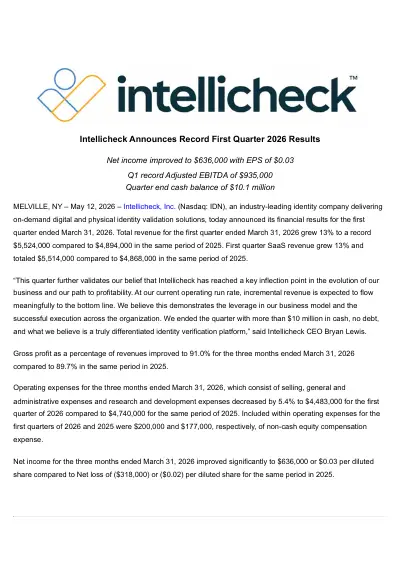
Our first quarter revenue was approximately $5.5 million versus $4.9 million in Q1 2025. We delivered adjusted EBITDA of $935,000, representing a EBITDA margin of approximately 17% versus our adjusted EBITDA of negative $17,000 one year ago.
This marks our fourth consecutive quarter of positive adjusted EBITDA. This is a milestone that I believe speaks directly to the operating leverage we have built into this model.
We had earnings per share of 3 cents, marking our third quarter in a row of profitability, and ended the quarter with over $10 million in cash and 0 debt. I will tell you delivering 13% revenue growth in this macro environment with 17% EBITDA margins is something I am genuinely proud of.
Now let's walk through our vertical performance. Banking and lending remain our core growth engine and represented over 50% of our quarterly revenue, growing strongly in Q1.
This mix shift has fundamentally changed the resilience of this business. Our largest regional banking client, with a 3-year contract valued in the very high 7 figures, is now fully implemented throughout all their bank branches.
Their team is not just ramping volumes; they are in active conversations with us about expanding the use of Intellicheck's technology in additional use cases and departments. The ROI on fraud prevention at these banks is not subtle.
Account takeover losses average approximately $2,300 per incident. Some clients tell us they experienced monthly fraud losses north of $40,000 before they implemented Intellicheck.
The payback on our technology is often measured in days, not months. In addition to stopping fraud, we also help them onboard good customers faster, a significant and valuable attribute that I believe is frequently overlooked.
Beyond our major bank relationships, our new desktop delivery method is opening meaningful new doors with smaller banks and credit unions. This clearly reflects the benefits of our desktop delivery of our core services.
This delivery service requires no integration with the bank's core platform, and implementation is immediate. You may recall that credit unions and smaller banks have historically been hampered by long technology integration queues with their core technology providers.
I am pleased to report that we are seeing strong inbound interest for our desktop product that is designed to address this issue. We believe this product has the potential to materially expand our addressable market without requiring a third party to facilitate the growth.
Implementing this desktop technology, we have signed 3 new clients, with several others in review. While these are smaller deals, they can get up and running quickly.
That being said, bank platform partnerships are also very important. I am also excited to share that our new partnership with Alloy is starting to generate early traction.
Our partnership here is a valuable one given it is one of the leading identity and fraud prevention platforms in the banking and fintech space. Their customer network is substantial.
We believe being embedded in their platform significantly reduces buying friction for institutions already operating within the Alloy ecosystem. These kinds of strategic partnerships are an important element in how we grow this component of the banking vertical from here.
Retail represented approximately 30% of 2025 revenues and, as I discussed earlier, was certainly challenging during the first quarter. We saw year-over-year declines in scanning volumes that was similar to the sequential periods last year, and we believe that it is entirely consistent with the consumer confidence and macro headwinds I described.
Through our active diversification efforts, we are no longer dependent on retail for growth. If consumer sentiment improves as the macro picture settles, any recovery in retail volumes will be an incremental upside for us.
Also as I previously discussed, our title insurance vertical was impacted in Q1 by the mortgage rate environment. However, I want to call out a milestone that I am genuinely excited about.
First American Title successfully launched their digital e-commerce identity verification capability in Q1. You may remember we told you this was coming on the last quarter's call.
This is a meaningful expansion of how our technology is embedded in their platform. It is exactly the kind of deepening of the relationship that drives long-term value.
When rates normalize and real estate volumes recover, we believe this vertical has substantial upside potential. We're also seeing growth in our other verticals.
Our age-related and background check verticals continue to grow steadily. The nationwide rollout with our food manufacturer client addressing cargo freight fraud is showing good progress as well.
That account is now running in the low 6-figure annual contract value range. Additionally, our foreign auto manufacturer clients and their supplier networks continue to expand.
In the stadium concessions market vertical, we added a few additional clients, although these are starting at very low volumes. While this remains a long-term opportunity, we are building the foundation for further growth.
On the product and technology front, our team continues to execute at a high level. As I shared with you, our desktop application is gaining solid traction.
We're also seeing progress with our mobile SDK, hub reporting console, and portal delivery method. As a reminder, our customers like our hardware-free solutions that are quick and easy to implement.
Here's the thing I keep coming back to: our core differentiation is unique, and it is durable. We can verify the authenticity of a government-issued ID in less than a second with 99% decisioning.
We do this by checking against the exact barcode specifications embedded by each state DMV at the time of issuance. Keep in mind that no competitor has access to these specifications.
This is because we continue to be the trusted test lab for state DMV systems, a relationship we've had for more years than I can count. This exclusivity is key as we see threats continue to evolve at an extraordinary pace.
AI-generated fakes are becoming more sophisticated every quarter, which I believe will become an increased problem for our competitors. Synthetic identity fraud skyrocketed 300% in just the first quarter.
Deepfake-driven fraud was up over 1,000%. Visual template checks, which is what most of our competitors rely on, cannot stop these fakes.
We can. That is not going to change, and it gets more valuable every year.
Our marketing initiatives are continuing to make a difference as they continue generating lead activity. The agency we brought on board is sharpening our messaging and building brand awareness.
Our ID&Threat Report has been an effective thought leadership piece across banking, title, automotive, and the cargo freight audiences. This original data documenting the fraud trends we observed in 2025 positioned us as a credible source of industry data and intelligence.
Our podcast content, white papers, and industry conference presence continue to build Intellicheck's brand as the definitive authority in real-world ID verification. In closing, I'm continuing to be mindful as to how 2026 is unfolding.
Clearly, the macro environment remains uncertain. The Iran conflict, elevated interest rates, and consumer caution are real factors that will continue to influence some of our verticals in the near term.
We are watching that carefully every day. Here's what gives me added confidence: our banking and lending vertical is driven by fraud prevention.
This is mission-critical, non-discretionary spending for every bank and credit union we work with. This category does not soften in a difficult economy.
If anything, it becomes more urgent. Keep in mind this is now more than half of our business.
We believe that we have opportunities to continue growth with our existing clients, in addition to signing new clients. We believe that we are at the inflection point in our business model to profitability.
At our current run rate, virtually every incremental revenue dollar flows meaningfully to the bottom line. We have over $10 million in cash, no debt, and a product that we believe genuinely cannot be replicated.
Without providing formal guidance, we believe EBITDA margins will remain positive, and we see potential acceleration in the back half of the year. Looking forward, we believe that we are well positioned to deliver positive net income for the full year 2026.
This would be a significant milestone for this company. We also continue to advance our investor relation initiatives and expect to participate in a number of upcoming investor conferences, including the Sidoti Micro-Cap Virtual Conference next week; in June, we will be participating in the RBC Financial Technology Conference in New York, the D.A.
Davidson Conference in Nashville, and the Planet MicroCap Showcase in Las Vegas. These events provide valuable opportunities to further expand awareness of Intellicheck and communicate our strategic priorities and long-term growth objectives.
In addition, they provide valuable platforms to keep you, our shareholders, informed while at the same time engaging with the broader investment community. The headwinds we faced in Q1 are real, but so is the trajectory we are on to maintain and expand profitability.
We are a fundamentally different company than we were 24 months ago, and I am confident in where the business is going. Now I will turn it over to Adam.
Adam Sragovicz
Thank you, Bryan. We are off to a strong start in 2026, and I want to take a moment to put that in context.
Bryan described the macro backdrop, and against that backdrop, I'm genuinely pleased with what we've delivered. Total revenue for the first quarter of 2026 increased $630,000, or 13%, to $5,524,000 compared to $4,894,000 in the first quarter of 2025.
SaaS revenue grew $646,000, or 13%, to $5,514,000 from $4,868,000 in the same period of 2025. The growth was driven especially by financial services and banking, where identity fraud pressures remain elevated and customers continue to deepen the use of our platform.
Gross profit as a percentage of revenues was 91% in the first quarter of 2026 compared to 89.7% in the first quarter of 2025, a 130 basis point improvement. On an adjusted basis, excluding non-cash amortization of capitalized software costs, adjusted gross profit margin was 93.4% compared to 91.8% in the prior-year period, representing a 160 basis point improvement.
Both measures reflect the continued operating efficiency we have achieved with our cloud infrastructure. Our cost of revenue, excluding amortization, was $362,000 in Q1 of 2026, down from $399,000 in Q1 of 2025, even as revenue grew 13%.
Non-cash amortization allocated to cost of revenues was $137,000 in Q1 of 2026 compared to $103,000 in Q1 of 2025 as previously capitalized software development costs continue to amortize through the income statement. As we noted on our last call, our capitalization of new software costs has declined to near-zero levels, which means this amortization headwind will diminish over the next several years as earlier vintage capitalized assets roll off.
Operating expenses decreased $257,000, or 5%, to $4,483,000 in the first quarter of 2026 compared to $4,740,000 in the first quarter of 2025. In 3 of the past 5 quarters, including the last 2, operating expenses have declined year-over-year while revenue grew at double-digit rates.
SG&A expenses decreased $211,000, or 6%, to $3,242,000 compared to $3,453,000 in Q1 of 2025. The reduction reflects continued discipline across personnel costs, marketing spend, and professional fees.
R&D expenses decreased $46,000, or 4%, to $1,241,000 from $1,287,000 in Q1 of 2025. I would note that R&D costs are now almost entirely cash expenses, given the near-elimination of software capitalization.
The GAAP number and the cash number are effectively the same, which makes our R&D line more straightforward to interpret than in prior years. As a result of these dynamics, we reported operating income of $542,000 in the first quarter of 2026 compared to an operating loss of $348,000 in the first quarter of 2025, an $890,000 year-over-year improvement at the operating line.
Other income was $94,000, primarily consisting of interest earned on our cash balances compared to $30,000 in the prior-year period. The increase reflects both the higher average cash balance we carried and favorable short-term rate positioning.
Net income for the first quarter of 2026 was $636,000, or 3 cents per diluted share, compared to a net loss of $318,000, or 2 cents per diluted share, in the first quarter of 2025, a swing of nearly $1 million year-over-year. This marks our third consecutive quarter of positive net income.
The weighted average diluted share count was 20.9 million for Q1 of 2026 compared to 19.8 million for Q1 of 2025. Adjusted EBITDA for the first quarter of 2026 was $935,000 compared to a loss of $17,000 in the first quarter of 2025, representing a year-over-year growth of $952,000.
This is our fourth consecutive quarter of positive adjusted EBITDA, and I want to remind everyone that Q1 is seasonally our softest quarter given the absence of a certain holiday retail uplift we see in Q4. To put that in perspective, one year ago we were essentially at breakeven on an adjusted EBITDA basis in Q1.
This quarter we generated nearly a million dollars and delivered an adjusted EBITDA margin of approximately 17%. Depreciation and amortization was $193,000, and stock-based comp was $200,000 in Q1 of 2026, consistent with recent trends.
For the first quarter of 2026, we recognized no income tax provision. We continue to carry a full valuation allowance against our net deferred tax assets of approximately $6.7 million, which GAAP requires as long as our 3-year cumulative taxable income position remains negative.
As I mentioned on our last call, the prior years' losses keep that cumulative test negative for now, but the window is improving as each profitable quarter is added and loss periods roll off. At March 31st, 2026, the company had cash and cash equivalents totaling $10,062,000, an increase of $412,000 from $9,650,000 at December 31st, 2025.
The first quarter is typically a period of cash usage given the seasonality of our business, generating operating cash flow of $444,000 in Q1 is a strong result. We have no outstanding debt, which means our balance sheet is entirely equity and business-financed.
Working capital at March 31 of 2026 was $11,119,000, total assets were $27,109,000, and stockholders' equity was $21,533,000. Accounts receivable grew to $5,740,000 at March 31st compared to $3,365,000 at December 31st.
This increase is largely a timing artifact of our Q1 billing pattern. Annual contracts that renew in the first quarter generate substantial invoicing in the first weeks of the year, with collections sometimes completing in Q2.
Our allowance for credit losses remains stable at $157,000. Our capital requirements remain modest.
Capital expenditures were only $33,000 in Q1 of 2026. Our product improvements are expensed as incurred rather than capitalized, and our infrastructure runs on major cloud platforms rather than owned hardware.
We are encouraged by how the year has started. The combination of consistent revenue growth, improving margins, and the first profitable Q1 in company history tells us that the operating model changes we've made are working.
Looking ahead, we expect gross margin profile to remain in the 90% to 91% GAAP range, with adjusted gross margins continuing to run in the 92% to 93% range. The non-cash amortization of capitalized software costs will remain a small headwind in the near term, but will diminish over time.
On the expense side, we remain committed to growing operating expenses at a rate below our revenue growth rate. That discipline is what drives the operating leverage we are seeing.
Finally, I want to briefly address capital allocation. Our cash position gives us flexibility.
We are investing in the business, especially in marketing, in sales capacity, customer success, and in product at a level we believe is appropriate given our growth targets. We will continue to regularly evaluate how to deploy that capital in ways that create long-term value for shareholders.
I'll now turn the call over to the operator for questions.
Operator
Thank you. Ladies and gentlemen, if you would like to ask a question, please press star one on your telephone keypad, and a confirmation tone will indicate your line is in the question queue.
You may press star two if you would like to remove your question from the queue. For participants using speaker equipment, it may be necessary to pick up your handset before pressing the star keys.
One moment, please, while we poll for questions. The first question comes from the line of Mike Grondahl with Northland Securities.
Please proceed.
Mike Grondahl
Hey guys, thank you. For the retail vertical, do you guys have what revenue was 1Q '25 and 1Q '26?
A
Bryan Lewis
good question, Mike. I didn't run those numbers.
It roughly runs in line with, obviously, transactional volume. If you remember, generally, we drop at least 10% Q1 to Q4 to Q1, just for the seasonality of the holidays, and we still have 2 of our major clients who have a lot to do with retail, who are not on a straight-line revenue model yet.
They saw the seasonality, but we did see, I'm going to say, another good 5% to 10% drop, which I'm going to say is probably economic factor.
Mike Grondahl
Got it. Then, any trends you're seeing on pricing or transaction volume overall?
Bryan Lewis
Pricing, we continue to see upticks in pricing. I think it's also very much dependent upon the market.
Again, if you think about our largest clients all renewed last year, and they go into 3-year contracts with CPI-kind of adjustments every year. As the new markets that we're going to, we continually are able to show pricing power.
Those new sales are moving up. We're also really starting to price, a lot of things that we're changing is minimum to play.
Again, one of the things we look at is, for example, the suppliers to some of the automotive companies that we're dealing with. It's like, look, we're not even going to deal with you without paying X, right?
That means the price per transaction is relatively high, but we're saying we need to do that to factor in what it costs to support you. Overall, we're seeing, what I feel is people are understanding that we are a differentiated product that deserves a premium because, again, I've said this a million times, just about everybody else does it the same way: take a picture, compare to a template.
They do not have the authoritative data that we have on the barcode, and that deserves a premium.
Mike Grondahl
Got it. I'll leave it at that.
Thanks, guys.
Bryan Lewis
Thanks, Mike.
Operator
The next question comes from the line of Rudy Kessinger with D.A. Davidson.
Please proceed.
Rudy Kessinger
Hey guys, thanks for taking my questions. With the kind of headwinds to the scan volumes in a few of your verticals, just if we operate under the assumption that those persist in Q2 and likely throughout the second half of the year, how should we think about your potential growth profile throughout the rest of the year?
Bryan Lewis
Right, look, I'm just going to go back to some of the numbers that we did. We still grew 13% year-over-year.
I think that has to do with other verticals that we're bringing in. I'd say the desktop delivery method is opening new markets.
It's not just banking. The desktop is working in the background check part of our business.
It's working in the cargo part of our business because those folks generally don't have big IT staffs, and they don't need it. They can get centralized reporting and instant implementation.
I think our expansion into new markets and expansion into new delivery methods is going to allow us to have continued growth throughout the year. Then the other thing that I say is that, and I'm sure maybe you macro economic guys have a good idea of where things will go.
What we talk about a headwind, and we've seen it, right, when the market got good, all of a sudden we get a tailwind from those markets. Our customers continue to expand and bring on new retailers.
However, until consumer confidence gets up there, and I think interest rates go down, we've got some of our credit card customers are up around 35%, 39% on interest rates. That bums people out.
Now when that changes, I think it picks up and in a way just through being good stewards of our customers and the business that they're bringing in, that's a massive tailwind. I'm happy with what I'm seeing in terms of pipeline, sales progress, and then keep that going.
Plus, hopefully, the economy turns around in short order. I'm excited.
Rudy Kessinger
Got it. Then, talk to me about the pipeline.
What does that look like both from a new logo standpoint and then also do you have any of your large financial customers that are set to renew this year? If so, any expectations for expansion on those contracts?
Bryan Lewis
The majority of our large customers renew on 3-year contracts. One of them is still in the kind of buying buckets, and they are expanding because they have been bringing on new retailers.
One of the things that I like about them is part of the way they win business away from their competitors for credit card programs is they can offer better rates, and we know this because we've been on some of their sales calls, offer better rates on the program if they implement Intellicheck, which does 2 things for the retailer: lower rates and faster adoption of customers. They've been bringing on more clients.
That's why part of what they've been doing is, it has been expanding with us, and generally every year they think they buy a bucket that's going to last them the year, and it never does. Overall, anybody that's big is locked in and/or growing.
Then from the pipeline standpoint, like we said in the prepared remarks, I'm very, very happy with what the marketing crew we brought in have been doing. Really good leads, new RFPs that probably we would not have seen before.
I'll be quite honest, through too, through some banking relationships, we're getting introduced to new prospects that they know could use our product. All in all, I'd say good team, good prospects, and really good customers.
Rudy Kessinger
Great, that's very helpful. Thanks for taking my questions, guys.
Bryan Lewis
Thanks, talk to you later, Rudy.
Operator
The next question comes from the line of Jeff Van Rhee with Craig-Hallum Capital Group. Please proceed.
Jeff Van Rhee
Great, thanks for taking the questions. A couple from me.
First, maybe just in terms of the quarter, how did it play out monthly? If it feels sort of normal, January, February, fell off March, got ugly April.
Just kind of curious. Obviously, we're now into May.
Now you're well into Q2, just kind of curious how each of those months has strung together. Have we hit a bottom?
You've got pretty good visibility through the scan volumes. Just any commentary there on a more of a real-time month-by-month basis?
Bryan Lewis
I'd say that banking was growing. Retail was, and when I say retail, consumer credit, credit cards, in that regard were lower than we've seen in previous quarters.
Again, I think that has a lot to do with consumer confidence certainly picked up more when the whole Iranian conflict kind of got heated up, and I think the price of oil, which runs everything, went up, offset a little bit by bringing on some new customers or existing banking clients expanding their usage and their volumes. I think you can look at the numbers.
I don't think consumers are any more positive in May than they might have been in March or April.
Jeff Van Rhee
Should we think then, if I look at the last 3 years, I think your average Q1 to 2 sequential growth is 5%. It sounds like from what you're saying, we should be thinking more like flattish.
I know you don't give guidance, but we need to get at least in the ballpark. Just are we closer to flattish than your typical 5% growth quarter?
Then just while you're on that, you mentioned being happy with the pipeline. Any particularly large, needle-moving deals or is it a lot of onesies, twosies?
Just a little more color on the pipeline.
Bryan Lewis
I'd say there's a couple of things. One is, and I think I mentioned this on the last call, there is a sort of a shortage of scanners out there that banks need.
We have a couple of these banking clients who want to be able to do passports in addition to just driver's licenses, which means they're all looking to upgrade their scanning devices. If you just go look at what it takes and the timeframe to get them, that will be, I think, sort of one of the determining factors on how fast our revenue grows and in which quarter.
It'll depend on delivery of those scanners to several of our signed customers who want to get moving. That's completely out of my control.
Customers are signed, the customers believe in us, the customers want to be up and running as fast as they can, and that's with this desktop product, which doesn't mean we don't have to be integrated to any of those core banking platforms that take forever. That's out of my control.
What I can say is the customers have signed and are ready to go.
Jeff Van Rhee
Just the second part of the question then on pipeline. You commented on good pipeline.
I just sort of wondering is there any meaningful assuming volumes stay bleak, the economy stays bleak, oil prices stay elevated, I'm trying to figure out where the growth comes from. If it's not volumes, I'm wondering what opportunity there is in the second half for major, needle-moving customers like what you put up in '25, and seemingly every year, year and a half.
Just what does that mega-customer pipeline look like?
Bryan Lewis
We always have customers in that kind of pipeline. It's just, they take a very long time, and they are what I'd say stop and start all the time.
Now what I like about this new sector that we've really gone into that we get through with desktop, they're smaller, they're nimble, they might not be worth $4 million a year, but they might be worth a quarter million dollars a year. They can be up and running in 3 months.
They're much easier. You get 10 of them, I'm just as happy.
While we're always going after the whales, we're also looking at the banks that are smaller. Then there's a ton of other different opportunities, different market sectors that are coming to us.
I didn't think about cargo, right? The average loss of a tractor trailer is $300,000, and it's happening all the time.
That's a huge sector for us, and we've got some of the biggest names in manufacturing who are recommending us to other people, their competitors, because they all feel it because it's the same companies ripping them off. There's a lot going on.
I don't need to have one whale every year if I can make sure that I'm hitting a bunch of doubles all the time.
Jeff Van Rhee
Last thing for me then, just in terms of actual signings in the quarter, the bookings of new business versus expectations, how'd you fare?
Bryan Lewis
For Q1, I think that we signed everybody we expected but one, who signed quite shortly after the quarter ended. Just a timing issue on their lawyers and our lawyers.
Jeff Van Rhee
Got it. Thank you.
Bryan Lewis
All right, thanks.
Operator
The next question comes from the line of Scott Buck with Titan Partners. Please proceed.
Scott Buck
Hey, good afternoon, guys. Thanks for taking my questions.
Bryan, if I look at the year-over-year revenue growth, what of that of the $600 or so thousand is coming from new logos versus just expansion of service with existing or legacy customers?
Bryan Lewis
I'd say for this quarter, and by the way, congratulations on the new spot. I'd say that for this quarter, the majority of it was expansion of existing clients, which kind of typically is our Q1 anyway.
Given that almost nobody in banking or retail wants to touch their systems in Q4, even banking has a tad of seasonality to it. They don't want it to go down.
Generally it has been, we'll sign people, but they're not going to come up live because they're not doing anything in Q4 that could impact their core system that interacts with their clients. I'd say that, I think that the mix is kind of typical for what we have seen over the years that I've been with the company.
Scott Buck
Perfect. That's helpful.
Then my second question, I just want to ask about title insurance. How many partners in that space do you have?
I guess if you were to put you're touching X percent of the market or have access to X percent of the market, what does that look like today?
Bryan Lewis
The last time I ran numbers on who we have as direct clients, that would represent about 43% of the title market. If you just do a quick search like, who controls the title market?, and ChatGPT gives you percentages of the market of each of the major names, that added up to 43%.
Scott Buck
Okay. Wow, you already have fairly significant scale in that vertical.
Bryan Lewis
Talking to the other big guys that we don't have currently. We have the who's who pretty much of title.
Scott Buck
Perfect. That's all I have, guys.
I appreciate the time.
Bryan Lewis
All right, thank you, Scott.
Operator
The next question comes from the line of Logan Hennen with Northland Securities. Please proceed.
Logan Hennen
Hey guys, this is Logan jumping back in for Mike. You kind of touched on a bit already, but if you could just give some additional color into the pipeline opportunity with new and existing customers in the banking and lending vertical, that'd be great.
Thank you.
Bryan Lewis
I'm sorry, Logan. Can you clarify that question for me?
What were you looking for?
Logan Hennen
Some additional color on the pipeline opportunity with new and existing customers in the banking and lending vertical.
Bryan Lewis
Okay. For existing customers, there's always new expansion.
Pretty much all of our clients have been talking to us about where else they can use us. I'd say there's one of our clients, I don't know where else they could put us.
It's probably the way I'd put it. They're the one that have been growing a lot by taking credit card programs away from some of their competitors.
The rest always are talking about how do we expand, what could we do different? Sandra, who now is my Chief Commercial Officer, and I have meetings this week and next week with two of what I call our super regionals so that we can discuss how we get partnered better with them at their request, right?
They want to see what we're doing. Through the partnership with Alloy and then also the amount of inbounds that I'm seeing through marketing, again, smaller deals, maybe $100,000 to $250,000, but quick to implement, no cost to implement, and basically immediate revenue.
That's where I'm seeing a lot of interest and inbound interest as these smaller credit unions and smaller banks that get hit at the exact same proportion. Right?
I run these stats all the time, and the percentage attempts of fraud are no different at these smaller places than they are at the largest nationwide banks that we have. They get hit, and the losses are the same, and it hurts them probably even more because they have fewer assets.
Logan Hennen
Got it. That was helpful.
Thanks, guys.
Bryan Lewis
Thanks, Logan.
Operator
Thank you. This concludes the question and answer session, and I'd like to turn the call back to Bryan Lewis for closing remarks.
Bryan Lewis
Thank you all for your time today. I'd say in closing, as I'm sure is the case for every CEO, I am very focused on the macro environment, which is challenging right now.
I think we can all agree on that. I want to leave you with this: we are a fraud prevention company that also at the same time speeds up the acquisition of great customers, and that is in a backdrop of a world where fraud is exploding, okay?
We believe we have the best technology in this space, the right customers, and the financial foundation to execute on our multi-year growth trajectory. I want to reiterate: $10 million in the bank, no debt, right?
That frees us up to be able to do, I believe, some good things. We look forward to updating you on our progress when we report on our Q2 results.
With that, thank you all and have a great evening.
Operator
Thank you. This concludes today's conference.
You may disconnect your lines at this time, and we thank you for your participation.