PT GoTo Gojek Tokopedia Tbk
Q3 FY2026 · Earnings Call TranscriptOctober 29, 2026
Joel Ellis
Hello everyone, this is Joel Ellis, Head of Investor Relations. Welcome to the PT GoTo Gojek Tokopedia Tbk third quarter 2026 earnings conference.
Please be advised that today's conference is being recorded. On today's call, Hans Patuwo, our President Director and Group Chief Executive Officer, and Simon Ho, Group Chief Financial Officer, will deliver prepared remarks.
Following their commentary, we will open up the call for questions and be joined by Sudhanshu Raheja, our Group Chief Operating Officer, along with members of GoTo's Board of Directors. We would like to highlight that the information presented today has been prepared solely based on unaudited consolidated selected financial information for the three-month period ended September 30, 2026.
As a reminder, today's discussion may contain forward-looking statements about the company's future business and financial performance, as well as certain non-Indonesian Financial Accounting Standard measures as complements to the Indonesian Financial Accounting Standard disclosures. Before using and/or relying on these measurements and forward-looking statements, please take note of our disclaimer and cautionary statements disclosed in our earnings presentation and press release.
During the earnings call, we will review the results of our operations and earnings presentation, which can be found on our website. Our reporting currency is the Indonesian rupiah, and we will denote the US dollar equivalent by applying an exchange rate of 17,998 rupiah to $1 US dollar based on the middle rates published by Bank Indonesia as of the end of September 2026.
We will also refer to adjusted free cash flow, which is adjusted operating cash flow minus capital expenditures. For more information and additional disclosures on our recent business and financial performance, please refer to our earnings press release and supplemental presentation, which can be found on our IR website.
With that, I will turn the call over to Hans.
Hans Patuwo
Thanks a lot, Joel. Hi everyone, and thank you for joining us today.
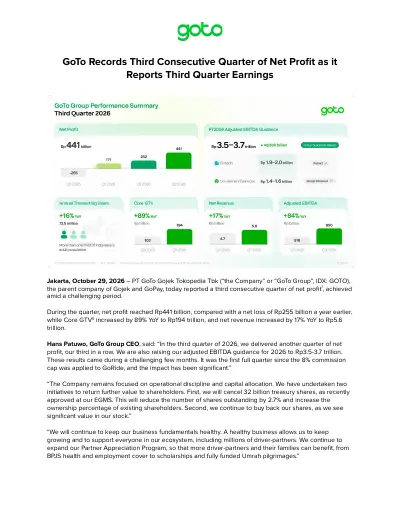
This was a very eventful quarter, and we will unpack it on today's call. In the third quarter of 2026, GoTo delivered a net income of 441 billion rupiah.
This is an improvement of almost 700 billion rupiah versus a year ago, and also our third consecutive quarter of net profit. Operating income, which is the profit we earn from core day-to-day operations, reached 351 billion rupiah, rising more than 400 billion rupiah from a year ago.
Furthermore, our adjusted EBITDA reached 950 billion rupiah, up 84% year on year. Please note that this is after absorbing the lower 8% commission cap on GoRide, our two-wheel transport business, which took effect on July 1st.
On top-line performance, we continue our strong double-digit growth, with core GTV rising 89% to 194 trillion rupiah, and net revenue rising 17% year on year to 5.6 trillion rupiah. On the back of this performance, we are now raising our full-year guidance for group adjusted EBITDA.
We now expect 3.5 to 3.7 trillion rupiah, up from 3.2 to 3.4 trillion rupiah. For On-Demand Services, we are widening the range to 1.4 to 1.6 trillion rupiah, up from previously 1.4 to 1.5 trillion.
This wider range allows for uncertainty around the 8% commission cap. As for fintech, which continues to perform well, we are raising guidance to 1.9 to 2 trillion rupiah, up from previously 1.7 to 1.8 trillion rupiah.
Next, let me turn to our business units, starting first with On-Demand Services. Earlier this month, more details regarding the presidential regulation was made available.
Beyond the 8% commission cap, it classifies our driver partners as micro-entrepreneurs rather than employees. We believe that this is an accurate representation and is a positive, welcome development.
Regarding how the 8% commission cap might affect our delivery business, we are currently awaiting follow-on regulations from the Ministry of Communication and Digital Affairs. We are actively engaging and will update as soon as the regulation is final and available.
However, regulations are not the entire story for On-Demand Services in Q3. We are pleased to share that our mass market strategy began showing positive results in Q3, with completed orders increasing 9% year on year.
In fact, Gojek's total completed orders in Q3 was the highest since 2019. Now we did this while growing adjusted EBITDA 3% year on year, even as we absorbed the 8% commission cap on GoRide for the full quarter.
Specifically in mobility, completed orders grew 10% year on year, driven by higher frequency as our mass market initiatives scale up. As we bring in more mass market riders, average order value is reduced, which is the tradeoff we had expected from this strategy.
Adjusted EBITDA was 159 billion rupiah, down 16% year on year, with margin at 2.5%, down 50 basis points. We would like to point out that this decline is entirely due to the 8% cap.
Back in July, we had released guidance that the 8% cap would have a negative impact of 300 billion rupiah in 2026. That's about 150 billion rupiah per quarter, give or take, and Q3 came in very much in line with our previous guidance.
Without it, mobility adjusted EBITDA would have been about 300 billion rupiah, up roughly 60% year on year, and margins would have been around 5%, up from 3% a year ago. The underlying business is healthy; the pressure on EBITDA comes from the 8% cap, not from the mass market strategy.
Having now absorbed the commission cap's impact, we are confident that the initial growth driven by our mass market strategy will build further in the coming quarters. Last but not least, we have also made progress on GoRide profitability.
During our last earnings call, we mentioned that GoRide has turned adjusted EBITDA negative in July, which was the first month of the 8% commission cap. Over the past 2 months, it has improved and is now trending towards breakeven.
Shifting gears to deliveries, completed orders increased by 7% year on year. Very similar to our mobility segment, our mass market strategy naturally leads to smaller basket sizes and lower average order values.
This is again in line with our expectations of driving higher transaction frequency with smaller individual order values from mass market consumers. Furthermore, as the 8% commission cap did not apply to delivery, these results offer a clearer picture on how the mass market strategy is performing.
Not only did the completed orders grow, adjusted EBITDA also grew, up 20% year on year to 227 billion rupiah, while at the same time, margins expanded 33 basis points to 2.1%. Hence, our delivery business is growing both orders and profit at the same time, which is what we are aiming for across all of On-Demand Services as we strive to have product-driven growth led by innovation rather than discounting.
Turning now to fintech, we continue to grow rapidly both in top line and profitability. Transactions climbed 86% year on year to 2.8 billion.
Net revenue also rose 49% to 2.3 trillion rupiah. Profitability also increased as adjusted EBITDA rose more than 300% year on year to 550 billion rupiah.
More people are using more of our services and doing so more frequently. This in turn is driving the increase in our loan book, which expanded by 51% year on year, reaching 12 trillion rupiah.
We remain, however, extra prudent on credit risk. As we shared in our last call, we preemptively tightened credit in Q2 for our highest-risk cohorts.
This is paying off as in the third quarter we saw only a very limited deterioration in credit quality. We remain very vigilant and continue to rely on our ecosystem advantage, where we lend exclusively to existing users in our ecosystem, and the short tenor of our loans lets us adjust quickly as conditions change.
Finally, I would like to address our share price and our capital allocation strategy. We are acutely aware of the recent pressure on our share price following the IDX removal of the 50 rupiah price floor, and this is something that we take very seriously.
That pressure is driven by macro and technical factors, including the share overhang from index funds due to our deletion from the MSCI and FTSE indices earlier in the year. This is in contrast to our operational performance, which remains solid, as our results today show.
At these levels, management believes that our shares are undervalued. Because we see such a deep discount in our stock, we have been actively buying back shares.
Since the removal of the 50 rupiah price floor, we have deployed 985 billion rupiah to repurchase 36 billion shares, amounting to around 3% of the company. This leaves 2.5 trillion rupiah available under our current buyback authorization, which runs through to June 2027.
Furthermore, at our recent extraordinary general meeting of shareholders on October 14th, shareholders approved the cancellation of 32 billion treasury shares bought during previous buyback exercises. This represents around 2.7% of all outstanding shares, and retiring these shares permanently ensures our share buybacks translate into improved shareholder value.
Both these actions, buyback and cancellation of treasury shares, return value to our shareholders and reflect our disciplined capital allocation. To conclude, this was a quarter of resilience.
We absorbed a full quarter of the 8% commission cap on GoRide while still delivering our third consecutive quarter of net profit. Growth is returning in our On-Demand Services business as our mass market strategy takes hold, and our fintech business is going from strength to strength.
Both business segments are profitable, and our core fundamentals continue to strengthen, as reflected in our increased guidance for the year. Beyond executing our operational strategy, we have also returned value to our shareholders.
For sure, challenges remain. However, we remain focused on what we can control and will continue doing the best we can.
Thank you, and I will now hand it over to Simon.
Simon Ho
Thank you, Hans. Moving on to our financial results, my commentary today will focus on year-on-year comparisons for the third quarter of 2026.
We delivered robust top- and bottom-line growth in the third quarter, demonstrating the resilience of our model even as we absorbed the impact of the 8% commission rate cap on GoRide. At a group level, net revenue grew 17% to 5.6 trillion rupiah, or $309 million US dollars, led by strong performance in fintech.
Importantly, our cash recurring fixed costs grew by just 5%, reflecting a much slower pace than our revenue growth. This combination of strong top-line expansion and sustained operating efficiency drove our adjusted EBITDA up 84% to 950 billion rupiah, or $53 million US dollars.
These operational gains flowed directly through to our bottom line. Operating income, which includes share-based compensation, depreciation and amortization expenses, and also non-recurring items, improved by 402 billion rupiah to reach 351 billion.
It is worth noting that this quarter included an additional tax provision of 230 billion rupiah related to one-off tax examinations. Excluding this provision, our operating income would have been higher at approximately 581 billion rupiah.
Ultimately, we achieved a net profit of 441 billion rupiah, or $25 million US dollars, which includes our 164 billion rupiah share of Tokopedia's net profit. Even if we exclude this gain from Tokopedia, our net profit remained positive for the third consecutive quarter, a significant milestone for our path to sustained profitability.
Now let's turn to our specific segments. In On-Demand Services, both our top and bottom lines improved year on year despite the 8% commission rate cap on GoRide that took effect on July 1st.
Net revenue increased 3% to 3.3 trillion rupiah, or $184 million US dollars, while mobility revenue declined 5%, primarily due to the commission cap. Delivery revenue grew 6% in line with the growth in completed orders.
Adjusted EBITDA for the segment increased by 3% to 347 billion rupiah, or $19 million US dollars, with the year-on-year improvement in delivery offsetting the decline in mobility due to the impact of the commission rate cap. Moving to fintech, our growth momentum remains very strong.
Net revenue surged 49% to 2.3 trillion rupiah, or $128 million US dollars. This was fueled by strong user growth, rising payment transaction volumes, and the continued expansion of our loan book.
As a result, fintech adjusted EBITDA reached 550 billion rupiah, or $31 million US dollars, an increase of more than four times year over year. In e-commerce, service fees from Tokopedia increased to 235 billion rupiah, or $13 million US dollars.
Given our strong year-to-date execution, particularly the strong performance in fintech, we are updating our guidance. We are raising our 2026 adjusted EBITDA guidance for the group to 3.5 to 3.7 trillion rupiah, up from our previous range of 3.2 to 3.4 trillion.
For fintech specifically, we are raising guidance to 1.9 to 2 trillion rupiah, up from 1.7 to 1.8 trillion. This upgraded fintech outlook fully absorbs the impact of new Bank Indonesia regulations, which came into effect on October the 1st and which lowered the merchant discount rate to zero from 0.7% for QR code payment transactions that are under 100,000 rupiah.
While we estimate this will impact fourth quarter revenue and EBITDA by roughly 50 billion rupiah, the underlying strength of the fintech segment still allows us to raise our full-year expectations. For ODS, we are widening our 2026 adjusted EBITDA guidance to 1.4 to 1.6 trillion rupiah from the prior 1.4 to 1.5 trillion.
This reflects our current positive operating trends while prudently allowing for potential uncertainty around the 8% commission cap for deliveries, which was highlighted in the presidential regulations that was made available on October 8th. Before I close, I want to direct your attention to a new disclosure in our investor presentation that highlights the significant intrinsic value of our business.
When evaluating our business from an enterprise value perspective, we believe our shares are currently trading at a steep discount. If you back out the net cash on our balance sheet and the current value of our stake in Bank Jago, our core operations are trading at only 3.3 times our 2026 midpoint EBITDA guidance.
This is materially below the EBITDA multiples of our peers, which trade at roughly about 13 times in the fintech and ODS space, and this also implies a valuation discount of roughly 75%. We hope this new breakdown clearly illustrates the fundamental value and the substantial upside potential we see in our shares.
In closing, this quarter's strong performance underscores our disciplined execution and our ability to successfully navigate regulatory shifts. We remain highly confident in our full-year outlook and our continued ability to drive long-term, profitable value for our shareholders.
With that, I will turn the call back to Joel.
Joel Ellis
Thank you, Simon. We will now open the call for questions.
As a reminder, we are joined for this session by Sudhanshu Raheja, our Group Chief Operating Officer, along with members of GoTo's Board of Directors. If you would like to ask a question, please use the raise hand function on Zoom, and we will call on you in turn.
When your name is called, please unmute yourself and state your name and the firm you represent. Our first question will come from Ari of Macquarie.
Ari, please unmute yourself and go ahead.
Ari Jahja
Thanks, Joel, for taking my question. Hi, Hans, Simon, GoTo team.
Congrats on a strong quarter. I have two questions.
First, on the regulation, GoTo seems to have absorbed the 8% cap on the two-wheeler mobility pretty well so far. Can you talk us through what's helped offset the impact, and looking ahead, how should we think about the downside if similar caps were to be extended to four-wheeler or food delivery?
That's the first question. Then secondly, on On-Demand Services growth, if we look at GTV, it was up just 1% year on year despite a stronger order growth.
How much of that is simply the shift towards more affordable products versus underlying demand, and then how should we think about the GTV growth going forward? I'll stop here.
Thank you.
Hans Patuwo
Hi Ari, thanks a lot for your question. Maybe I can take the first part around the potential impact of commission caps into other product services, then maybe Sudhanshu, if I could get your help on the levers as well as on the GTV growth.
Ari, on the potential commission caps, right, the 8% commission cap for two-wheel transportation is clearly in effect. Our understanding of the presidential regulation is that four-wheel is excluded from the regulation.
We do not expect at this time any commission caps on the four-wheel transportation business. On the food delivery business, there is language in the presidential regulation that includes that, and we have been in active discussions with Komdigi, which is the Ministry of Communications and Digital Affairs, who have been mandated by the presidential regulation to write follow-on, more detailed regulations regarding this.
The discussions has been pretty open, pretty good, and are still ongoing. We certainly cannot comment until the regulations are published and made available, but the sense is that everyone is aware that we have to do what's best for the good of the entire ecosystem and then that is very important to making sure that the entire digital ecosystem continues to thrive and do well.
Net-net, we don't really know exactly what the impact is going to be; that will still pending the regulations. However, we are in very active discussions, and we will certainly inform everyone and do a disclosure as soon as that becomes available.
With that, Sudhanshu, over to you.
Sudhanshu Raheja
Thank you, Hans. Thanks for the question, Ari.
Maybe let me start off with the impact on 8% on two-wheelers and what we're doing about it. The 8% change on ride is now fully implemented and is completely in line with the regulation.
I'm also happy to report that driver earnings have gone up as a result. Now the financial impact of this change is completely in line with the guidance that we shared, which is roughly 300 billion across the two quarters.
What happened as a result of this change was that effective prices on the more affordable products went up, discounts went down across the industry. That helped reduce some of the drop coming in from the lower revenue, but it obviously didn't fully offset the revenue reduction from the 8% change.
More importantly though, demand held up. Our completed orders grew faster in this quarter than the previous quarters, and mobility itself is up 10% on completed orders year on year.
That definitely helped us bear through some of the impact by increasing the number of orders on the ecosystem. Now since the changes came in, we've continued to adjust our pricing, and that has improved ride's profitability throughout the quarter.
Over the next few quarters, we're on a path to making ride EBITDA positive again. To be clear, on 8%, we are done with the changes, the impact is exactly as we guided, and we see a significant increase in orders.
All in all, we're in a new normal, and we don't expect any further surprises from two-wheeler. Now moving on to GTV, now the GTV impact that you see is coming because of two structural changes, and both are deliberate.
The first is the pricing model change on two-wheeler following the 8% regulation. We changed some headline pricing and incentives, gross booking value is lower per trip.
Now this is a one-time reset, and it's now behind us. The second is the mass market strategy.
Since the start of the year, we've been building capabilities that lower our cost to serve, and we've talked about this multiple times, such as our pooling and our zoning strategy. This unlocks a much larger set of customers, but those orders coming in from mass market users carry a lower average order value.
Hence, orders are growing faster than GTV. Now our goal with mass market is always the same: grow orders and adjusted EBITDA.
It seems to be working. We grew completed orders at about 9% year on year in third quarter, up from 3% last quarter.
It's also profitable. Now the mobility impact is mixed with the 8%, but if you look at deliveries, orders grew by 7%, but adjusted EBITDA went up by 20%.
Now going forward, we plan to keep building capabilities and products. We expect that the order growth will continue, and GTV growth will converge over time.
Our focus stays the same: grow orders and grow absolute adjusted EBITDA. Thank you.
Ari Jahja
Got it. Thank you, Hans and Sudhanshu, for the color, and all the best for GoTo team.
Hans Patuwo
Thanks, Ari.
Joel Ellis
Thanks, Ari. Our next question comes from Ferry Wong at Citi.
Ferry, please go ahead.
Ferry Wong
Hi. Thank you for the opportunity.
I have two questions. The first one, could you please provide an update on credit quality across your loan book, and how are you managing risk and funding costs given the current Indonesia macro environment, and especially if Bank Indonesia well, continued to hike rates yeah, several more times?
My second questions, your loan book grew by 51% on a year-on-year basis in the third quarter. What is the trajectory of your lending growth going forward, yeah, basically for 2027?
Thank you.
Hans Patuwo
Hey, Ferry, thanks a lot for your question. Sudhanshu, do you mind walking us through this?
Sudhanshu Raheja
Sure, Hans. Thank you.
Thanks for the question, Ferry. Starting off with your first question, yeah.
On credit quality, this has been an industry-wide issue. According to OJK data, DPD 90+ has risen significantly across the industry over the last quarter.
As we explained in the previous two earnings, we saw this coming, and we started taking proactive steps from Q2 itself, especially in the higher-risk and lower-income segments. Now in the third quarter, we saw some further deterioration in those segments, which shows up in the delinquency rates that we shared, though it's still within our expectations and completely manageable.
Our response to the changing macro has been to focus less on the loan book growth and more on tightening our credit policy incrementally. The loan book still grew 51%, but we are deliberately growing it a lot more carefully.
We're realistic that this environment may not end soon, and we're ready to manage a prolonged period of macro changes. Now we have three structural advantages which helps us manage this better.
First, we lend almost entirely to users in our ecosystem, where we have strong data to assess them. In fact, we're doing close to a billion transactions a month now, which really helps in us being able to assess those users.
Second, our tenors are short, we can adjust fairly quickly. Third, most importantly, our acquisition costs are incredibly low, which keeps the cost base low.
That gives us a strong operating leverage, the business stays highly profitable even as the credit costs change. This is why we are raising our fintech guidance to 1.9 to 2 trillion.
Coming over to the loan book growth again, we're growing our loan book, as you can see we're up about 51% year on year, but at a time like this, our risk management comes first, and I want to start there. Delinquency rates are up, and we have been tightening our lending proactively since the second quarter.
Going forward, what I expect is we expect to focus more on the asset quality than on loan book growth, which means we are trying to keep our risk stable. Over the coming quarters, we expect loan book growth to be slightly slower than where we are today, though it depends on the macro.
If conditions improve, we obviously have a lot of potential to be able to go pick it up again. In terms of the scope, again, we are still mid-low digits in terms of fintech app penetration, and we have a lot of data to be able to score better.
Hopefully, as the market gets better, the macro gets better, we can continue growing the loan book further. Thank you.
Simon Ho
Thank you.
Joel Ellis
Thanks very much for that, Ferry. Also, I would just like to remind everyone, if you do want to ask a question, please just use the raise hand function on Zoom, and we will call on you in turn.
Our next question comes from Ryan from Indo Premier. Ryan, please go ahead.
Ryan Winipta
Thanks, Joel, and GoTo management team. I have two questions from my side.
I think the first question is I think related to the potential downgrade of Indonesia to the standalone market as well as GoTo being removed from the MSCI and also FTSE earlier this year. Just wondering if there is any overhang from the index funds left over.
I think the second question is also related to the buybacks, just wondering what we should expect in terms of the pace of the buybacks going forward and is there going to be a price ceiling as well. Will the newly repurchased shares be canceled, too?
How are you balancing the buybacks with the future business growth? That's all from me.
Thank you.
Hans Patuwo
Thank you. Thanks very much for the question, Ryan.
Simon, could you help take this one?
Simon Ho
Sure. Thanks, Ryan, for the questions.
On the first question about index overhang, as as you're aware, GoTo was removed from the FTSE index in June and also the MSCI MSCI index in August. The index funds that were tracking these benchmarks previously accounted for about 9% of our total shares.
We have seen that these holdings have since declined very significantly and it's now, standing at a relatively very low level. The remaining overhang is is now much reduced and very low.
Of course, in mid-October, we also we all have seen that MSCI announced a consultation regarding obviously the potential downgrade of Indonesia to a standalone market. Now since we have already been excluded from the index, this potential downgrade will not have a material direct impact in terms of passive selling index funds that are passively selling our shares.
Of course, we do recognize that this is still a headwind for the broader Indonesian market, and we will continue to focus on what we can control and delivering results. As you as you can see, our results continue to be solid.
On your second question about the share buyback, the share our share buyback program is an active part of our capital allocation strategy. As Hans mentioned, I just want to run through some numbers.
After the removal of the 50 rupiah price floor, we moved very quickly on buybacks, and we've spent 985 billion rupiah to date, and we've bought back 3% of all outstanding shares. We still retain ample remaining authorization of 2.5 trillion rupiah, which is valid through June 2027.
This continues to give us significant flexibility. However, after the accelerated phase of buybacks in October, we do expect our execution to moderate to a more normalized pace going forward.
We are continuing continuing to take a very prudent approach to our balance sheet, and we continuously monitor macroeconomic conditions to ensure that our buyback activity properly balances shareholder returns with also the broader resilience of our business and our balance sheet. With regards to your question on, whether we intend to cancel these treasury shares that we've just bought back, we we would like to and we would intend to go and ask for, approval and go through all the regulatory processes when the timing is correct.
Obviously, everything is subject to shareholder approval. Thanks, Ryan.
Hope this helps.
Joel Ellis
Thanks very much, Ryan. Really appreciate your question.
I just wanted to repeat: if anyone wishes to ask a question, please simply use the raise hand function on Zoom. Once again, if you do wish to ask a question, just simply use the raise hand function, and then we will call upon you.
Jason Low
Hello, hi. Can you hear me?
Joel Ellis
Hi Jason, please go ahead.
Jason Low
This is Jason from Bloomberg Intelligence. Thanks for taking my question.
My question is with regard to 4Q 4Q EBITDA. Based on the reported earnings, 9-month EBITDA, adjusted EBITDA is about call it 2.8, 2.9 trillion rupiah, and based on the guidance, we actually the implied 4Q EBITDA is actually lower than 2Q and 3Q.
What is driving the step-down? Is it just guidance being conservative, or are there headwinds that we should be aware of?
That's my question. Thanks.
Hans Patuwo
Thanks a lot for the question, Jason. There is some conservativeness built in given some of the uncertainty around the 8% commission cap, but maybe Simon, will ask for your help to further elaborate.
Sure. Thanks, Jason.
By and large, I just want to maybe share with you a few trends that you should be aware of in the fourth quarter. The service fee that we receive, if you track this on a quarter-on-quarter basis, it is possible that fourth quarter could be a bit lower than the third quarter.
That is primarily because the fee rate that we are receiving on this GMV actually should be lower on a quarter-on-quarter basis. This is part of the fee rate mechanism agreed with Tokopedia, in which sort of the fee rate is on a sliding scale as the GMV level hits certain levels, the fee rate actually steps downwards.
There is this mechanism, and if you look back over previous years, this has also been a trend. Secondly, maybe tempering some of the growth in fintech, we have seen very strong sequential growth in the fintech EBITDA numbers, but as I called out, in the fourth quarter, we should see some impact coming from the Bank Indonesia regulations on the MDR for small QR code payment transactions.
As we called out, that's going to have a 50 roughly 50 billion impact on both the top line and the bottom line. That will temper some of the momentum that we expect to see in the fintech business.
Just to call out a few things that you should be aware of. Thank you.
Jason Low
Got it. Macrowise, being based not in Indonesia, maybe can help us understand, right?
Macrowise in Indonesia, how would 4Q and also 2027 look like? Is it a case of there is stabilization and therefore we should think about growth in 2027 for both On-Demand Services and of course fintech?
Maybe you can give us some sub-color on that.
Hans Patuwo
Sure thing. I think what we're seeing in the more macro consumer space Indonesia is maybe a slightly tale of two cities.
What we're seeing in the everyday products, the mass market everyday products, I think that's continuing, the demand continues to be resilient. I think it's also particularly evident not just on the fintech space, but also in the on-demand space.
We are, however, seeing some moderation in some of the shall we say less mandatory, more disposable income, discretionary type of spending. We see that segment, demand from that segment is somewhat moderating, not to a very large degree, but that is indeed something that we have seen.
I think we'll have to take a look to see what happens in Q4 before we can have a decent view into 2027. One other thing to note as well, Jason, is that Q1 next year is particularly choppy because right after we come off from the year-end holidays, there is going to be Lunar New Year, but then there's also the fasting season, and the Lebaran break that traditionally has been in Q2 now has been brought forward toward the middle of March.
My sense is we'll get a decent sense of how 2027 will pan out right around kind of April, May timeframe once we are done through the Q1, which has a tremendous number of holiday events. I hope that helps, Jason.
Joel Ellis
Thanks very much, Jason. Appreciate your questions.
Our next question is going to be from Piyush at HSBC. Piyush, please unmute yourself and go ahead.
Piyush Choudhary
Hi. Good evening.
Thanks Joel for the opportunity. Two questions.
Firstly, on the fintech segment, as the loan book is growing, could you remind us your strategy on on-balance sheet and off-balance sheet, going forward, how much of your own capital would be used towards growing the loan book? That's the first question.
Secondly, in ODS, are you seeing any kind of market share shifts after the commission rate caps? If you can just give us some color on how the competitive landscape is also panning out after the commission changes.
Thank you.
Hans Patuwo
Thanks for the question, Piyush. Sudhanshu?
Sudhanshu Raheja
Sure, Hans. Hi, Piyush.
Let me start with the fintech question. Now as we grow our loan book, right, our strategy always has been that we try to channel out most of our loans.
A very big part of it, close to about 2/3 of it, is channeled out and is not on our balance sheet. Roughly about 1/3 or a little under that is usually on our balance sheet.
As we continue to grow, and our expectation is that we don't expect a significant increase in the on-balance sheet percentage. In fact, that should keep trending lower with time.
This is primarily as we keep growing to be able to conserve cash better and to be able to work with our banking partners and the channeling partners to be able to route or channel a lot of the loan book there. Even for next year, we don't expect a significant change.
We, in fact, expect a growing reduction in on-balance sheet share of our loan book. Second, coming over to ODS.
Now for Gojek, the market, I think, has always been competitive, has, in fact, been very competitive, and I don't think that has changed since the 8% cap came in. What we are seeing in the market is we are seeing an increase in, as Hans mentioned, users going for use cases that are much needed on a daily basis, like going to office, you see an increase in mobility and other segments.
We're seeing some decrease in terms of the discretionary spends, which means the kind of merchants that people go and order at is usually different. Overall, we're not seeing a very significant change in the market share since the commission rate cap change.
However, as our mass market strategy evolves and we're able to continue to grow over the next few quarters, we might be able to see if there is an overall change on it. Otherwise, as far as we stand, it's not a significant change.
Hans Patuwo
Thank you, Sudhanshu. If I can add some color to that, I think the observation here is that the 8% impact has made everyone in the industry kind of react in a similar fashion, thereby there's no major new competitive dynamics, to speak.
At the same time, we are also quite excited, and we are seeing some of the early shoots of the increasing transactions, the number of transactions everywhere we have. I think it's early days, no major shifts in the market because of 8%, and well, let's see.
Still early days.
Joel Ellis
Thanks very much, Piyush. Really appreciate your questions.
Piyush Choudhary
Thanks. Thanks, Joel.
May I ask one more question? We saw Catherine Hindra has resigned.
Has there been any appointment on her replacement, or how is the kind of management bandwidth lining up?
Hans Patuwo
Oh, sure, I can take that one. Catherine has been with us for a very long time.
She and I have been shoulder to shoulder on so many things over the past 9 to 10 years. Her departure has been well planned for quite some time, and it is for personal reasons.
The minus-ones have been well groomed up over time. We're not expecting to replace that position because this has been part of an orderly transition, and we have had the time to make sure that the relative team leaders below her are well prepared.
We're not expecting to have a replacement, Piyush.
Piyush Choudhary
Got it. Thanks a lot.
Hans Patuwo
Sure thing.
Joel Ellis
The next question is coming from Angus Mackintosh at Aletheia. Angus, please go ahead.
Angus Mackintosh
Yes, thanks. Thanks very much for the presentation.
All very interesting. I wonder if you could possibly give us a bit more color on the origination of the loan book.
Where are those loans coming from? Are they coming from Tokopedia?
Are they coming from GoPay? A bit more idea on that and the mix.
Which cohorts are seeing the biggest sort of rise in delinquency, and where have those borrowers come from? That'd be great.
Thank you.
Hans Patuwo
Thanks for your question, Angus. Sudhanshu?
Sudhanshu Raheja
Thank you. Thanks for the question, Angus.
To start off on the origination of the loan book, so as of the last quarter, close to a little over 60% or around 2/3 of our loan book actually originates on the Gojek and the GoPay apps, and roughly about 1/3 comes in from outside the ecosystem directly. When we look at outside the ecosystem, that primarily comes in from Tokopedia.
Where are we seeing the highest growth? In fact, we are seeing fairly high growth across both of our apps.
Gojek is a generally more affluent segment of users, where we see generally better delinquency rates, and GoPay app is a more mass market segment, which is where we've done more tightening as we've gone ahead to scale up. On the affluent user side, I think we're doing okay.
There is some change, but not very significant. On the lower grades, we are seeing a higher or a faster increase in delinquency rates, which is where we're actually doing more tightening.
I think that's where we are.
Hans Patuwo
Maybe I can add a little bit more to that. Thank you, Sudhanshu.
I think, Angus, if you look at it, when we first started many years ago, it was really driven by the Gojek app as well as the Tokopedia app. Since we've launched the GoPay app 2023, I think that is the fastest-growing source of origination.
Now the type of loans are quite different. If you take a look at buy now, pay later, that is coming mostly from the TikTok Shop/Tokopedia space, followed by Gojek.
Whereas when you take a look at the unsecured cash loan lending, that's coming predominantly from both the Gojek as well as the GoPay apps. I think where we have started to tighten on the cohorts kind of across the board, but really those users who have been with us in any part of the ecosystem for the least amount of time.
I hope that adds some color for you.
Angus Mackintosh
No, that's very useful, yeah. Thank you very much.
Hans Patuwo
Thanks.
Sudhanshu Raheja
Thanks very much, Angus.
Joel Ellis
We'll take our final question from Steven from J.P. Morgan.
Steven, please go ahead.
Thanks, Joel, and thanks a lot for the opportunity, management team. Congratulations for the strong quarter.
Just a couple of questions from my end. Number one, with your strategy on the mass market product launch for ODS, which intentionally would open up new market, right?
How do you prevent a degree of cannibalization or downtrading from the existing customer cohort into the newer mass market products, right? That's question number one.
Have you seen that behavior sort of coming up with the launch of the mass market products? The second question is more housekeeping stuff.
I see that in the adjusted EBITDA, there is a non-recurring cost of around 360 billion rupiah. Just want to get more color if you can share what are the key components in that that is being adjusted.
Thank you.
Hans Patuwo
Great. Thanks, Steven.
I can take the first one. Sudhanshu, you can feel free to jump in if anything to add, and then maybe Simon, you can help the next one.
To your question about potential downtrading, I think the main thing we try to do here is there are two parts. Number one is to make sure that the services are differentiated.
If you provide the same service at a lower price, then of course everybody will go there and there'll be cannibalization. That's never the intention.
We have streamlined our product services, and we make the consumer choose. It's a tradeoff.
For example, do they want something fast, or do they want something cheap? If they want something fast, then it will not be cheap, right?
Because we will have to pool the orders, and so on and so forth. Or they want a great amount of assortment from this particular unique shop somewhere halfway across the city, then that maybe will cost more versus a more generic availability that is the assortment that is a little bit more generally available.
Without going to too much detail, the point what we're trying to do is to ensure that the services we provide presents a real choice that a consumer have to make. Now, we are seeing some downtrading, but not a whole lot, and we're actually okay with that because if a consumer is downtrading, then maybe the downtrade product is something that is fits their needs more.
Over time, that user will become stickier, and they will transact more, and their CLTV is going to be higher than if they were using a product that maybe is more beneficial for the company in the short run, but could actually, over the long run, may not meet the needs of that consumer as well. That's a little bit of what we're doing.
The other way to think about this is also a lot of the demand is very different by sub-geography, right? At the neighborhood level, you have affluent neighborhoods, you have university neighborhoods, you have more mass market neighborhoods.
The more granular we become, and by tailoring our services based on the needs of specific neighborhoods, that is also another lever we have to make sure that we minimize across-the-board kind of cannibalization. With that Simon?
Simon Ho
Sure. Thanks, Steven.
Your question about the non-recurring costs, 356 billion in the third quarter, actually, the vast majority of that is a one-time tax provision, the 230 billion that I called out. It's mainly for a one-time tax provision.
This is resulting from a tax examination that we just completed. Usually we have restructuring costs.
We also have certain professional fees that are not related to sort of the operating business. Sometimes they are corporate action-related, etc.
That's really it.
Got it. Sorry, just one follow-up question on the restructuring cost.
Sorry, but I'm not aware of any restructuring. Maybe you can give some color on that.
Oh, this, we we would
Simon Ho
ongoing, we would always be, doing reorganizations, etc. This is pretty much a it's a it's a regular activity that we would have.
Got it. Thank you very much, Hans and Simon.
I don't have any more follow-up question.
Simon Ho
Thank you.
Joel Ellis
Thanks for that, Steven. That concludes our question-and-answer session and brings us to the end of today's call.
Thank you all for joining us and for your continued interest in GoTo. A replay of this call, together with our earnings press release and presentation, will be available on our investor relations website shortly.
If you have any further questions, please do not hesitate to reach out to the investor relations team. On behalf of Hans, Simon, Sudhanshu, myself, and the entire GoTo team, thank you and have a good day.