Infineon Technologies AG
Q4 FY2026 · Earnings Call TranscriptNovember 10, 2026
Florian Martens
Good morning, everyone. It's great to see you here, spectators, the audience in the livestream, my dear colleagues and coworkers.
Welcome to the annual press conference for 2026 of Infineon Technologies AG. It's great to see that you all got up so early to join us here at the trade fair booth at the electronica in Munich and also online.
We also look forward today for the first time to host you at our annual press conference at our trade show booth before the trade show officially opens its doors to the public. We would like to give you a view of the business performance of Infineon and show you some specific applications of our technology.
Jochen Hanebeck, our CEO, will start by giving you a review of fiscal 2026, he will give you an outlook on 2027, and he will lay out to you the opportunities that present themselves for Infineon. Following that, the entire board of management will be available to answer any questions you may have, and I'd like to welcome all of the members of the board of management as well.
For those of you, journalists and analysts, who are joining us online, you will see a link and a QR code on the screen, and that will take you directly to our question tool. You can ask your questions there before the event even starts and also during the event, and when you do so, please mention your name and the media outlet you're representing.
We will try to address all questions answered here on site and in the livestream. The press conference will end on time at 9:00 a.m.
This brings me to the end of my introductory speech, and I now like to hand the floor over to our CEO, Jochen Hanebeck. Jochen, the floor is yours.
Jochen Hanebeck
Good morning, dear members of the press, viewers, representatives of the media. Welcome to Infineon's annual press conference.
I'm very pleased that you could join us here today, here at electronica and via livestream. Electronica, of course, highlights a development that is transforming our markets for the long term.
Artificial intelligence is reaching all areas of our lives and is increasingly becoming a part of physical systems. There is, of course, growing debate about expanding AI infrastructure, but one thing is clear: AI delivers real value, and its importance will only grow.
Above all, this requires high-performance, energy-efficient, safe, and secure semiconductor solutions. This is precisely where Infineon's strength lies.
At electronica, we are showing how Infineon translates semiconductor technologies into real-world applications, from power supplies for data centers to software-defined vehicles, robotics, and edge AI. These developments are also clearly reflected in our business performance.
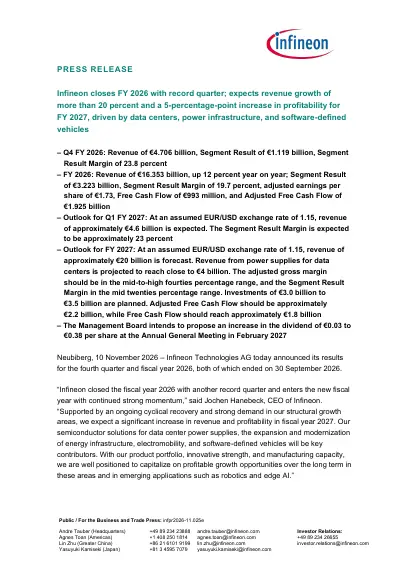
Infineon closed fiscal 2026 with a record quarterly revenue. Our company generated annual revenue of €16 billion 353 million, which represents an increase of around 12% year on year.
At constant exchange rates, growth was even higher at 15%. Now, these developments are behind this growth: the cyclical recovery in semiconductor markets gained strength and breadth; at the same time, demand in our structural growth markets increased sharply.
The revenue gap between the first quarter, which was our weakest, and the fourth quarter, which was our strongest, exceeded more than €1 billion. Artificial intelligence is spreading rapidly and is opening up new applications all the time, thus increasing the need for computing power.
New generations of AI processors require higher power densities and new data center architectures. At the same time, physical AI is emerging as an additional growth area.
AI therefore remains a key driver of our growth and profitability, but more on that later. Industrial applications are experiencing a broader recovery.
Power infrastructure remains the strongest structural growth driver. Demand is supported by the expansion and transformation of power grids, the integration of renewable energy, and the expansion of AI-related infrastructure.
From our automotive customers, we are currently seeing solid order intake. The long-term trends driving semiconductor growth remain unchanged.
Electric vehicles are gaining traction, especially in Europe, India, and Southeast Asia. Rising gasoline prices and more affordable models are supporting this development.
Now, at the same time, automakers in all major regions of the world are bringing more advanced software-defined vehicle architectures to the market. With the significant increase in group revenue in the 2026 fiscal year, our profitability also improved over the course of the year.
We achieved a segment result margin of 19.7% compared with 17.5% in the prior year. Adjusted free cash flow matched to €1.9 billion, and this figure adjusts for acquisitions and investments in large front-end buildings, in particular, of course, the acquisition of the center portfolio of ams OSRAM and investments in buildings for our Smart Power Fab in Dresden.
Adjusted free cash flow represents 11.8% of group revenue and is therefore in line with our target operating model. We owe these positive business results to the dedication of our teams worldwide.
They consistently responded to market changes in a flexible manner while advancing our strategic development at the same time. On behalf of the entire management board, I would like to thank our employees around the globe.
Thank you very much. Infineon enters the new fiscal year with continued strong momentum.
The market environment is favorable. Our structural growth drivers, such as data centers, power infrastructure, and software-defined vehicles, are providing tailwinds.
The ongoing cyclical recovery is adding further support. We expect to increase revenue and profitability significantly.
For the 2027 fiscal year, we forecast revenue of around €20 billion. This would represent an increase of more than 20% year on year.
Revenue growth will be accompanied by a strong increase in profitability. We expect the segment result margin to be in the mid-20s percentage range.
This would correspond to an increase in profitability of 5 percentage points. We are also continuing to invest consistently in Infineon's future.
In fiscal 2027, we expect investments in our fabs between €3 and €3.5 billion. In addition, we plan to spend around €2.8 billion on research and development.
The key point here is that our profitable growth is not simply the result of changing market conditions. We have laid the groundwork ourselves.
This includes a clear organizational structure, as well as targeted investments in our manufacturing and in the development of leading technologies for our most important growth areas. Now, let's start with our organization.
Our customers are increasingly thinking in terms of systems, and that's exactly how we are aligning Infineon. Since July 1st, we have therefore organized our business into three divisions.
Automotive focuses on software-defined vehicles and electromobility as growth drivers. Edge Systems connects the physical and the digital worlds in areas such as, for example, robotics, edge AI, and smart living.
Power Systems addresses the growing need for efficient power supplies from power infrastructure and AI data centers to industrial applications. This new structure brings us even closer to our customers.
We are combining expertise, accelerating decisions, and bringing innovations to market even faster. However, innovations alone are not enough.
What matters most is that we can also deliver new products reliably, at the required scale, and in the best quality. We are therefore making targeted enhancements in our global manufacturing network so that we can continue to meet our customers' demand, which is growing, in a reliable manner.
Our investments in Dresden, Villach, and Bangkok show what this means in practice. In Dresden, we open our Smart Power Fab this summer.
It provides large additional capacity for applications with long-term growth potential, from power supplies for AI data centers to software-defined vehicles and renewable energy. Once fully built out, it will double our production capacity at the site.
Now, in Villach, we are investing approximately €1.1 billion in our global Center of Excellence for power semiconductors. The site will host the world's first high-volume production of gallium nitride power semiconductors on 300 wafers.
This will allow us to manufacture gallium nitride much more efficiently and at greater scale. It will also enable us to meet rapidly growing demand for particularly high-performance power supply solutions, including for AI data centers, power infrastructure, electromobility, and robotics.
In addition, we announced yesterday another technological milestone from Villach. Our colleagues there have successfully processed 300 silicon carbide wafers into functional power semiconductors.
Infineon is therefore the first company in the world to reach this innovation milestone in a full-scale semiconductor fab using existing manufacturing equipment. This further strengthens our leadership in power systems.
Our new back-end hub near Bangkok strengthens the resilience and regional flexibility of our production network further. It focuses on assembly and test, putting chips into protective packages and then testing them.
The key point here is that our investments follow a clear logic. We consistently align our capacity and manufacturing network with our structural growth areas, which, of course, gives us ever greater economies of scale.
I would now like to take a closer look at three of these growth areas: power supplies for data centers, software-defined vehicles, and robotics for industrial applications. Let's begin with power supplies for data centers.
This is a particularly clear example of how a structural growth driver translates into tangible business. Demand for our power supply solutions is growing rapidly.
We significantly expanded this business in the 2026 fiscal year by ramping up production, even though we were unable to meet all customer requests. Revenue from power supply solutions for AI data centers rose to €1.7 billion in the 2026 fiscal year, which means we more than doubled revenue once again in this area.
It now accounts for slightly more than 10% of group revenue. In addition, our power supply business for classical data centers, those not focused on AI training and deployment, generated around €500 million in revenue.
For 2027, we expect revenue from our power supply solutions for AI and classical data centers to grow from €2.2 billion to reach close to €4 billion. We thus anticipate another year of tremendous strength.
Leading customers from across the ecosystem are entering into multiyear supply arrangements and capacity reservations with us. The combined revenue volume of these agreements, both those already signed and those currently under negotiation, has now exceeded €10 billion.
This shows that customer demand is not only strong, but also long-term. The next generation of AI data centers is reaching power levels in the gigawatt range.
Each new generation makes one question more and more important: how do we deliver ever larger amounts of energy to the AI processors as efficiently as possible? One key here is a high-performance 800 V direct-current architecture.
It reduces power loss, takes up less space, and enables more efficient power delivery as power requirements ever increase. In addition to efficiency, reliability is critical.
AI data centers have to operate around the clock without interruption. This requires solutions that detect faults quickly and protect the hardware.
Here you can see a semiconductor circuit breaker from Siemens featuring Infineon technology. Now, what is the secret sauce in this particular device?
Of course, we have silicon carbide switches included in this device, coupled with a smart algorithm. These switches actually, thousands of them, are being used in data centers.
For example, should there be a outage or a shortage in the power supply, these circuit breakers are used to switch things off reliably, which, of course, has to happen very quickly. These semiconductor-based circuit breakers are 1,000 times faster.
It only takes one microsecond to switch things off, which, of course, in turn protects the entire infrastructure tremendously effectively. In addition to ensuring reliable data center operation, we face the challenge of delivering more and more power in as little space and with as little loss as possible.
Infineon collaborates, of course, with NVIDIA on a gallium nitride-based power conversion systems. GaN enables higher power density with lower loss, which is a decisive advantage for the next generation of 800 V AI data centers.
With our expansion in Villach, we are creating the production capacity needed to meet growing demand for GaN solutions. Now, from the power grid to the AI processor, Infineon provides the critical technologies along the entire energy chain for efficient power delivery and safe, reliable operation.
Ladies and gentlemen, the benefits of AI extend beyond just the data center. It increasingly is being deployed in physical systems in the real world.
Now, this is particularly evident in software-defined vehicles, where AI is becoming more and more important in processing sensor data for driver assistance systems, in-cabin sensing, as well as automated driving. It can also help improve vehicle dynamics, range, and battery life, as well as identify maintenance needs at an early stage.
Functions previously distributed across numerous electronic control units are gradually migrating to centralized zonal computers. Software updates therefore allow new functions to be added and improved throughout the vehicle's entire life cycle.
Now, turning AI into reliable vehicle functions, however, takes more than just computing power. Power supply, real-time control, connectivity, safety, and security have to all work seamlessly together.
This interplay is crucial in making modern vehicle architectures possible, and Infineon makes a decisive contribution. Our semiconductors turn raw computing power into safe and reliable vehicle functions.
They supply power to the central high-performance computers, provide safe real-time control, connect systems, and protect them against failures. At our trade fair booth, we are demonstrating how this works in practice with a Mercedes-AMG GT 63, all-electric, accelerating from 0 to 100 km/h in 2.4 seconds.
Now, this is, of course, based on the AMG platform, same as the one that, of course, Mercedes has been establishing. Now, central computing units control this vehicle, and Infineon semiconductors provide safety, reliability, and real-time control.
Our AURIX microcontroller handles vehicle dynamics control; driver assistance functions use AURIX as a safety companion alongside our BrightLane Ethernet solutions. Our OPTIREG chips ensure a reliable power supply to the systems.
The Mercedes-AMG is therefore a tangible example of how Infineon is accelerating the transition to a software-defined vehicle. Now, Infineon is the global number one in automotive microcontrollers.
Our market share in 2025 was at 36%. We are building on the strong position.
Our AURIX RC1 platform is an important building block for next-generation software-defined vehicles. Here, we are introducing an entirely new microcontroller platform based on the open RISC-V standard.
The platform combines safe, energy-efficient real-time control with a common, scalable microcontroller foundation for different vehicle functions. We are redefining real-time computing and control for software-defined vehicles with this platform.
Both our capabilities extend beyond just the car. Our broad product portfolio for automotive and industrial applications also lets us contribute decisively to robotics.
Few fields currently demonstrate more clearly how AI is moving into real-world applications than robotics. Robots have to perceive their surroundings, process information, and then execute movements precisely.
Many of these technologies, which, of course, we have developed for automotive and industrial applications, can also be used in robotics. Our portfolio of sensing, computing, power supply, connectivity, and security solutions enables us to support all of these functions.
Together with customers and partners, we are bringing these solutions into industrial applications. Infineon and Agile Robots, two technology leaders both based in Munich, are demonstrating here at electronica 2026 how semiconductors and physical AI are transforming the future of industrial manufacturing.
I am now very pleased to welcome founder and CEO of Agile Robots, Dr. Zhaopeng Chen, to the stage here today.
We will conduct our conversation in English. Zhaopeng, welcome.
Great to have you here.
Zhaopeng Chen
Thank you.
Jochen Hanebeck
Hey, Zhaopeng. Our cooperation from your point of view, what are we trying to achieve together?
Zhaopeng Chen
I think we I think from Agile Robots to Infineon, we the biggest common ground we have is share we share the ambition of bring physical AI into industrial applications. That's reason why we start the project together to to explore the intelligent robot into industrial cases and try to use a mobile platform which is on the booth to to try to evaluate the possibility of using it in our Infineon manufacturing.
For robots in our world, chips and semiconductors is basically the backbone of of our next generation of robots. The chips actually allow our robots being able to perceive, to think to for decision-making and then eventually for execution of the tasks.
In the meanwhile, I think manufacturing of the chips is probably one of the most complicated and the most difficult process in the world. That's also reason why we're actually exploring the possibilities of bringing physical AI into semiconductor fab to accelerate the innovation.
Jochen Hanebeck
I think right here we have an example at our booth behind there, but also here in our video. It shows one of your robots in a back-end module manufacturing.
Why does it fit to the capabilities of your robots?
Zhaopeng Chen
If you look at our video, basically what the robot is trying to do is to handle the power modules of Infineon and to handle the power module, the tray, and uploading, unloading the bonding machines and handling the bonding machines with controls. The two-arm systems provides basically the flexibility and adaptiveness for the task execution.
The mobility is providing the connection between the handling processes to the rest of the process procedures. What we are trying to evaluate here right now is to evaluate the precision, repeatability in real industrial conditions, and also to check the potential of the physical AI system to be reusable in different use cases.
Jochen Hanebeck
What I hear from our manufacturing guys, they love it and they would, of course, like to scale it, right? That's always the challenge.
Now, what does it take to get from this pilot project to really industrial scale, what we're all dreaming of?
Zhaopeng Chen
That's a really good question. From our point of view, I think there are a couple of things we have to think about.
One is that the repeatable and stable and transferable performances in a whole workflows. Also economically viable operations, because cost is really important.
The last is to been able to integrate the physical AI system into existing workflows, because otherwise you cannot really integrate in. On the other hand, you mentioned about scaling.
Scaling is also really important. Scaling, from our point of view, is basically reusable and adaptive robot platforms.
Those systems has to be adaptive enough across the whole different tasks and use cases. If you still have those features in mind, then we see actual possibility to extend the current conventional automation into a much more complex, much more adaptive, much more flexible use cases in different tasks.
With that, I think this is the only way to enhance and strengthen the industrial flexibility and stability.
Jochen Hanebeck
I love to hear this. Zhaopeng, I think Infineon and Agile Robots, the two of us, we share the same vision.
Thank you very much for stopping by
Zhaopeng Chen
and
Jochen Hanebeck
love to hear more about tangible results out of our cooperation.
Zhaopeng Chen
I think we will have results real soon. Thank you.
Jochen Hanebeck
Zhaopeng Chen, CEO and founder of Agile Robots, thank you very much. Ladies and gentlemen, this example shows that physical AI emerges when different technologies and areas of expertise come together.
Our broad portfolio and strong partners let us shape the robotics ecosystem. In doing so, we are opening new growth opportunities for Infineon, and that is exactly what Infineon is focused on: bringing our technologies into real-world applications and turning them into growth.
Let me close with three points. First, in the 2026 fiscal year, Infineon benefited from a broader market recovery and structural growth drivers.
We also accelerated revenue growth and increased profitability over the course of the year. Second, we enter the 2027 fiscal year with tailwinds and expect a strong increase in revenue and profitability.
Third, our company has everything it needs to further expand its leading position in promising markets of the future, from data centers and energy infrastructure to software-defined vehicles and to AI and robotics. Thank you very much for your attention, and now, together with my fellow management board members, I will be happy to take your questions.
Florian Martens
Thank you so much, Jochen Hanebeck. Ladies and gentlemen, this brings us to the questions that you have for us.
To this end, in a couple of minutes, I would like to ask the remaining members of the board of management to come up to the stage. Before we continue, let me give you some housekeeping remarks.
For those of you participating online, as I mentioned before, you can continue to ask your questions in writing. Please use the question tool that you can see on the website of the livestream.
The journalists and other members of the audience here in person will also be able to ask questions, and before you take the floor, please mention your name and your media outlet. Now, the Q&A session is opened.
I'd like to ask all of the members of the board of management to come up to the stage: Dr. Sven Schneider, CFO; Elke Reichart, who is responsible for sustainability; we have our Chief Marketing Officer; and Alexander Gorski, our Chief Marketing Officer.
We're all ready to field any questions you have. Mr.
Hofer was very fast to raise his hand first, all we need to do now is to wait for a roving microphone so that Mr. Hofer from Handelsblatt can ask his question.
Thank you.
Joachim Hofer
I have two questions. At the last quarterly call, you spoke about €30 billion in order backlog.
How has that figure developed through to the end of the quarter? The second question: one can interpret the figures as follows: you don't base them on the AI bubble, but rather on business that is sustainable in the years ahead.
Could you give us your take on that, perhaps? Thank you.
Florian Martens
Yes, Sven Schneider, perhaps you can talk about the backlog.
Sven Schneider
Good morning, Mr. Hofer.
The backlog is just one KPI of many. We have decided, in line with the other companies of our sector, to no longer report these figures, because when viewed isolatedly, this KPI can only show you a limited picture.
I can only confirm what we have said in the past, but if I were to report the backlog, it would be higher than in the previous quarter. Moving on to the other question, Infineon is broad-based.
AI is a strong growth driver. From €2.2 billion to €4 billion is a big step jump, but we can also tell you one thing: in the fourth quarter of the past fiscal year, we generated €800 million in revenue with AI, from the run rate, we didn't assume extreme growth in AI, but we did assume solid growth.
If you look at the other sectors, the automotive sector, for instance, is also growing in mid-10 percentage territory ranges, we're dependent not only on AI, but rather on a much broader growth portfolio.
Florian Martens
Thank you for the first round. Let us continue here and then move on to the online questions.
Kathrin Werner
Kathrin Werner from Spiegel. Good morning, gentlemen.
I would like to know more about the business with data centers with AI and classical activities. How much is coming from Germany and other parts of the world like the United States?
What is your take on the global backlash among the population, especially in the United States? Now,
Sven Schneider
with respect to the distribution of AI business, what I can tell you is that a good portion of our AI business takes place with US customers. In the USA, we are linked up with the who is who of data center operators, but it doesn't end there.
The AI business is a global activity. Data centers based on AI are being built worldwide.
Of course, the focal point is the United States right now, but there's added momentum outside of America as well. Moving back to the geopolitical ramifications that we're facing now, Jochen, maybe I could hand back to you?
Jochen Hanebeck
Yes, thank you. When it comes to resistance, especially in the United States, to the expansion of AI data centers, what I have to say is that this is a rather American-centric topic.
Of course, the world over, there are concerns voiced by people who live in the direct vicinity of AI data centers, but around the globe, there are many regions that are very sparsely populated, I think this is a counterreaction. I believe that the operators of these data centers and the American hyperscalers will find areas that aren't necessarily all located in the United States, perhaps also in other countries, where AI data centers can be built.
In this context, I would also point out that there's a strong expansion of AI data centers in China as well, but not just there. India is also focusing a lot of on that, the Arabian Peninsula as well, Australia, we have projects in Europe.
I believe the expansion of data centers will diversify on a regional basis, and I believe that that is a good trend over the extended future.
Florian Martens
Thank you for the next round. This brings me to the next round, but I would now like to insert a question from Hakan Ersen from Thomson Reuters.
He says: Amovio recently spoke about a price explosion for automotive semiconductors. What is your assessment of this forecast, and do you plan to increase prices?
Maybe our COO can answer this question.
Alexander Gorski
As has been said repeatedly, we are moving in a very, very dynamic environment that is being characterized by demand. Order backlogs are increasing incessantly, and it's no secret that in this entire context, we have experienced major bottlenecks and scarcity, especially for semiconductors driven by the growth momentum in AI and also power infrastructure, which is another example.
A lot of grid infrastructure is being upgraded. Power supply needs to be beefed up, especially for AI data centers, and this momentum has led to spillover effects in associated and related product segments, which means that the scarcity is going far above and beyond power semiconductors.
In 2026, we have already seen two price increases, which we have enforced on the market, as you all know, one being in April and the other one being in July. These increases were for power semiconductors first and foremost, and we're now in volume and price negotiations with a lot of our major OEMs.
In 2027, we will see a positive price environment. I don't want to cut to the chase to the end of the negotiations.
They're all a matter of discussion, and as soon as these negotiations have terminated, we will announce the results. I'd like to add that in view of the significant expansion of capacity that is now occurring and is becoming effective, we are now in the situation that we can serve all of the markets.
We are not going to make a mass redistribution. We are, of course, going to continue our successful activities in the automotive sector and support our customers in that area, and we're capable of doing this because our capacity expansion has been timed to perfection.
Florian Martens
Thank you. Looking out into the audience in person on the right-hand side.
Hans-Peter Siebenhaar
I'm Hans-Peter Siebenhaar from Focus Money. I have two questions for you.
One question relates to the share price. How dissatisfied or satisfied are you with the share price?
Now, from its peaks at the end of June, it has been nearly cut in price. At the same time, however, the analysts have mentioned a target of up to €100, what is the sentiment in the company?
The second question relates to the alleged case of espionage at NVIDIA. To what extent does espionage constitute a challenge for Infineon?
How are you protecting yourself from such activities in view of the current situation? Thank you very much.
Sven Schneider
Of course, I will field the question on the share price. Now, I have become accustomed to not comment on what the market says, because the market is always right, it's difficult for me to make an assessment.
If we look back into the past, historically, we have seen share prices hovering around €20 or €30. Indeed, there was then a phase of very strong increase in multiples due to AI, bringing us up to the peak.
I think that this morning we moved back above €50. Maybe I can point out another thing that we will communicate tomorrow, and that may give you an indication that we believe that the share price does have upward potential: we always have to consider how the multiples develop in relation to the peer group, the other semiconductor companies, that is, and here we have made a big comeback, which means that we do have potential.
Moving on to your second question, well, I don't have any detailed information on the NVIDIA case, but I can tell you that for us, intellectual property, IP for short, indeed, is extremely important to Infineon. Therefore, we do everything to make sure that we protect this IP.
This is because we train our employees to this end, we carry out certain developments on site at the various locations around the world to make sure that IP is very well-protected. This is the major measure that we take in order to prevent IP leakage.
Florian Martens
Thank you. Moving back to the online tool, Joachim Hofer from Börsen-Zeitung would like to revisit the topic of data centers in the United States after the Democratic election win in the midterm election.
Do you believe that this will slow down growth for Infineon?
Jochen Hanebeck
The question will be how token usage in unit numbers develops. You can see, if you look around the world, that it is growing very steadily in terms of units.
This is the decisive question, because this demonstrates whether the company and consumers are willing to use AI. If I look into our company, what I can tell you is that there is not a single week that passes where we don't find or discover new opportunities with AI, and I'm talking about our core areas, in manufacturing, in development, in go-to-market.
Indeed, if I may use this expression, this is mind-boggling. Everything that backs this up is related to issues where, as before, we see very high volatility.
We'll see what models will prevail, how much people are willing to pay for what models. The price of a token may commoditize.
We are seeing that established graphics processing unit manufacturers, GPU manufacturers, are building GPUs, but also other manufacturers are doing the same. They have a different cost position.
We also see the regional aspects, as I mentioned earlier. I expect that AI data centers will broaden their geographic footprint, but the AI data centers that are being built in the United States will focus even more on energy efficiency, I assume, at least, which would play into our cards, and maybe more and more AI tasks will be processed at the edge, another growth area for Infineon.
We will see this volatility, and we'll also see the volatility on the capital market, tacking on to the question that was asked before, because the capital market is trying to identify the profit pools of the future, which are not necessarily going to be the same ones as today, and this is what leads to volatility.
Florian Martens
The next question is just for the sake of clarification, Hakan Ersen from Thomson Reuters: what products are responsible for the order backlog of €10 billion?
Sven Schneider
By and large, these are power semiconductors, products from the different silicon material systems, silicon carbide, but also more and more gallium nitride in this context, of course. Here we're really talking about Infineon solutions from grid to core, as Jochen Hanebeck did mention in his speech.
This is truly along the entire power supply chain. We, of course, need power semiconductors in order to provide cost-efficient power to where it needs to be.
This is the inferencing process, the GPU, it's the TPUs, and basically power semiconductors are what really make the big difference here, and that also really have an impact on the cost per token of the large data center operators, which, of course, we have signed agreements with.
Florian Martens
I think there was a question, yes, Mr. Riemer by dpa, and then the gentleman over here.
Good morning. A follow-up question on the data center topic.
You mentioned that you might go into other areas, you, I believe, alluded to China and India. If the data centers move from the US, does this not matter to you as Infineon, because wherever people need power semiconductors, you will supply them?
Or, for example, particularly when it comes to China, are you afraid that they would be using proprietary Chinese solutions and you could lose some business?
Jochen Hanebeck
I think we can say that globally we are very well positioned. Of course, we do have competition.
Really depends on the region, of course, but we do see that we are set up really well, even in Chinese data centers, with our power semiconductors.
Toto Roy from Hamburg University. To you, if you are now Germany Chancellor, what will be the first important decision should be issued in order to improve the semiconductors market in Germany, with the long-term of reaching the capacity of production in United States?
Jochen Hanebeck
We always think in global markets, but let me interpret your question: what could the federal government do in order to change the semiconductor ecosystem or improve it and support it further? On the one hand, we have to say a lot is happening, there are definitely tools like the European Chips Act and the Important Projects of Common European Interest.
They are important tools at our disposal. However, we would wish there to be less bureaucracy connected to these tools.
I think you know our example of the factory in Dresden. The building carcass was already finished by the time the subsidies were granted, I think as a German company, you run a certain risk.
I believe as a company abroad, you might be less impacted and therefore also less interested in these subsidies. We have to be much faster, which, of course, has to do with a reduction of bureaucracy, especially when it comes to these sort of subsidy applications.
The volume from a German perspective is certainly nothing to sneeze at, but I believe in an international comparison, you have to acknowledge that other countries are producing a lot more. I do want to make it very clear that we, just like other industries in Germany, are absolutely demanding the general framework conditions in Germany have to improve.
This has to do again with bureaucracy, it has to do with the cost structures, and it also has to do with the fact that we, as Europeans, are damned to continue further into building the European market in order to make it so that the market is more comparable with other markets around the globe, and I believe we don't really separate ourselves too much from the demands of other industries.
Florian Martens
Thank you very much. There are no further questions online, let me just look around on site.
Is there another question? Yes.
Luca Schönauer
Good morning, Luca Schönauer from Automobilwoche. Another follow-up question on the semiconductor prices and the shortages.
Stellantis plants in Italy, there's bottlenecks, production has to be wound down. Do you feel the same?
Is that the next crisis in waiting?
Jochen Hanebeck
I cannot comment on the specific case. I don't believe that's an Infineon product, which already commented on this, of course.
We've seen a tremendous demand from the AI area, but we're also ramping up capacities by a lot. What I at least have heard from customers in the automotive sector is that Infineon is really good at supplying, and so I am not aware of any incidents, but of course, I can't speak for the competition.
Thank you. Right,
Florian Martens
back to our colleague from Spiegel magazine.
Kathrin Werner
Yes, I have another question, if I may. You were speaking about the AI tokens.
What's your forecast here? How is this going to develop?
Are the large industrial customers always going to take the largest, most expensive models, or for day-to-day applications, would a smaller, older, maybe even European model now do?
Jochen Hanebeck
Handing to you, want to?
Elke Reichart
Sure, happy to answer this. Thank you very much for the question.
In fact, we do see a mixed environment. Of course, there are applications where you're always required to have the highest performance model, but we also see applications where this is not the case.
Of course, here we do supply this also with our own internal IT to make sure that we always provide the model that is the appropriate one in order to create some head space to use the tokens where they definitely provide the best return on value. Let me add, we all started with AI for knowledge management, I believe we all use this, and then we automated parts, right, certain workflows that are now AI-supported.
We do see the opportunity in the R&D area to expedite chip design by way of AI agents. Of course, that is a whole different volume of tokens that is being used there.
Today, the largest consumption of tokens in our area, for example, is in the software area, like with many other companies, but we do also see it coming in the hardware area, meaning these data points, and of course, I cannot speak for the whole world, but I can speak for ourselves, the token costs are increasing significantly, and of course, we as a company also want to make sure that we see an increase in productivity in turn. I am absolutely optimistic that the teams will bring that productivity.
Florian Martens
Mr. Hofer.
A microphone is coming, here it is.
Joachim Hofer
I'm curious, in light of this strong growth, you're, of course, expanding the factories in your three locations. Will that be it?
Do you maybe also need another site in the United States to tackle this growth? The second thing, this AI supply chain, you read time and time again that not just the chip manufacturers can't deliver, but also the suppliers, raw materials, that maybe they are not available at all.
How does this challenge impact you?
Jochen Hanebeck
Thank you very much, Mr. Hofer, for this question.
I would love to answer this. For one, on our manufacturing network, we've, of course, done a lot in the last few years in order to scale our manufacturing landscape to become more competitive.
We have invested a lot. The clean rooms already, we are fully focused on making sure that these clean rooms spaces can be filled with the respective machinery in order to make sure that the capacities and revenues can be realized for our customers.
At the moment, we are very well set up, and we are not really thinking about what the next factory could be. Of course, there are always certain considerations, and of course, this sort of topic can also play a role in the future, but we do also work together with partners, particularly in the US.
We are using different manufacturing partners in order to cater to the US market as best as we can. The second part of the question, how do we hedge the supply chain in general, even here, very early on, we sat down together with our important suppliers, communicated our demands and requirements, have hedged what we needed to, and of course, we're also doing strategic multisourcing, meaning we are usually not depending on one single supplier.
We are working together with different suppliers around the globe, so that so far, we don't really see any issues. We are really well set up.
Maybe to just come back to that first aspect, economy of scale in the semiconductor industry is a crucial factor for success. This, of course, applies to the go-to-market, but then also in the R&D and in the manufacturing processes.
We will always be tempted to expand our existing manufacturing, because by way of doing that, just naturally speaking, we will get bigger economies of scale. With that, of course, we can see this pattern for success that has brought our industry to where it is in the last 50 years.
That's just what it is. Potential tariffs are just one small element in this entire equation.
Right, thank you very much for this very diverse array of questions. Thank you very much to all of you for your interest, for your questions.
I do not see any other questions, neither online nor offline. With that, I would like to close our press conference.
Until the next time, thank you very much, and goodbye.
Florian Martens
Right, and ladies and gentlemen, to all of our colleagues here and all the guests here on our trade fair, I would cordially like to invite you to stick around. We have some Bavarian pretzels, coffee.
You can also chat to the board of management. They will be, of course, at your disposal for an off-the-record exchange.
The official part is now over. Then from 9:15 onwards, we will invite you to really get to know our trade fair booth.
We also have our division presidents here: Adam White, Peter Schiefer.
Jochen Hanebeck
Please use the time, enjoy your stay, and if you would like, feel free to get a demo of our technology. Thank you very much.
It was a pleasure to have you here. Great to see you here at electronica.
Enjoy the day, and see you next time at Infineon. Goodbye.