Illumina, Inc.
Q3 FY2026 · Earnings Call TranscriptOctober 29, 2026
Operator
Good day, ladies and gentlemen. Welcome to the third quarter 2026 Illumina earnings conference call.
At this time, all participants are in a listen-only mode. After the speakers' presentation, we will conduct a question-and-answer session.
Please be advised that today's conference is being recorded. I would now like to hand the call over to Head of Investor Relations, Conor McNamara.
Conor McNamara
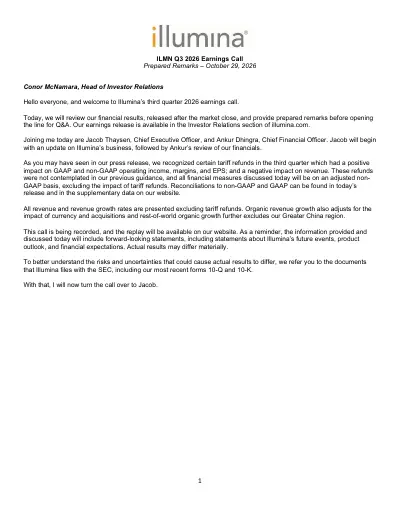
Hello, everyone, and welcome to Illumina's third quarter 2026 earnings call. Today, we will review our financial results released after the market closed and provide prepared remarks before opening the line for Q&A.
Our earnings release is available in the Investor Relations section of illumina.com. Joining me today are Jacob Thaysen, Chief Executive Officer, and Ankur Dhingra, Chief Financial Officer.
Jacob will begin with an update on Illumina's business, followed by Ankur's review of our financials. As you may have seen in our press release, we recognized certain tariff refunds in the third quarter, which had a positive impact on GAAP and non-GAAP operating income, margins, and EPS, and a negative impact on revenue.
These refunds were not contemplated into our previous guidance, and all financial measures discussed today will be on an adjusted non-GAAP basis, excluding the impact of tariff refunds. Reconciliations to non-GAAP and GAAP can be found in today's release and in the supplementary data on our website.
All revenue and revenue growth rates are presented excluding tariff refunds. Organic revenue growth also adjusts for the impact of currency and acquisitions, and rest of world organic growth further excludes our Greater China region.
This call is being recorded, and the replay will be available on our website. As a reminder, the information provided and discussed today will include forward-looking statements, including statements about Illumina's future events, product outlook, and financial expectations.
Actual results may differ materially. Better to understand the risks and uncertainties that could cause actual results to differ, we refer you to the documents that Illumina files with the SEC, including our most recent Forms 10-Q and 10-K.
With that, I will now turn the call over to Jacob.
Jacob Thaysen
Thank you, Conor, and good afternoon, everyone. We had a great third quarter with strong clinical sequencing demand and elevated NovaSeq X placements, driving revenue, margin, and EPS above our guidance range.
Our strategy is working, and I'm proud of what our team delivered for our customers and shareholders. Our continued disciplined execution and business momentum allow us to raise our fiscal year guidance, and we remain on track to achieve our long-range financial targets.
Before I go into details on our results, I want to highlight a few ways our innovation is helping customers answer new questions about biology. Early in 2026, we introduced the 1 Billion Cell Atlas to address one of the biggest bottlenecks in applying AI to biology: the lack of functional datasets.
AI models need large amount of data to learn from. In biology, those models only work if the data is accurate, standardized, and reproducible.
These datasets don't exist at scale. There is no internet of biology.
Our 1 Billion Cell Atlas was designed to help address these limitations. Now over halfway complete, the atlas is advancing toward an unprecedented AI-ready perturbation dataset that helps biopharma partners connect genetic signals to cellular mechanisms, strengthening target validation, improve disease understanding, and enable accelerated drug discovery.
By working directly with biopharma, we're integrating their input to ensure the proprietary dataset is relevant and built to maximize value for both our partners and Illumina. GSK is the latest biopharmaceutical company to join the 1 Billion Cell Atlas consortium to accelerate drug discovery, and we are seeing growing interest from other companies seeking access to the completed atlas.
We've learned a lot from our partners about how to build these datasets for AI, and we see multiple opportunities to address additional bottlenecks across drug discovery and development. We see this as a large, long-term opportunity and look forward to sharing more about our strategy in the coming quarters.
Earlier this month at ASHG, we brought together our assays, sequencing platforms, and software to show how customers can benefit using the Illumina Insight ecosystem. The most compelling examples came from customers themselves, who showed how combining genomics, transcriptomics, methylation, and proteomics is helping them see biology they could not see before, with work spanning bulk, single-cell, and spatial approaches.
What is resonating with customers is that we are looking at their work from start to finish, making it easier to obtain all the components they need to drive high-quality insights while bringing down the total cost of the workflow. On the analysis side, we launched the BioInsight platform, which brings our analysis application, AI models, and curated biological data together in one place, reducing the need for customers to assemble and manage separate software tools.
Through the platform, customers can also access SpliceAI-2, our new AI model that predicts how genetic changes affect RNA splicing. In rare disease research datasets, it identified 17% more disease-relevant splice variants than other splicing models.
I'm proud of the innovation our teams continue to deliver. Our view is that the next era of life sciences innovation will be powered not only by sequencing, but also by the software, AI, and differentiated data that unlock the power of the genome.
Through BioInsight, Illumina is building the base for AI biology, enabling more powerful foundational models and virtual cell models with the potential to improve our ability to understand and predict biology. As we move nearer to predicting biology, we see a path to using those insights to move healthcare toward a more proactive future, identifying risks sooner, preventing disease where possible, and intervening earlier.
Now let me expand on our financial results, starting with our performance in the quarter. Customer demand for the NovaSeq X platform remains at very high levels.
In the quarter, we placed over 80 instruments. This equates to approximately 360 X placements over the last four quarters, more than in our first year of launch.
This demand is being fueled by broader adoption of sequencing-based diagnostics and more sequencing-intense assays. As these instruments go live, they will support additional consumables revenue for years to come.
End-market growth rates for rest of world sequencing consumables were similar in Q3 and Q2, with clinical growth of 14% and research and applied declines of 6%. We continue to expect mid-teens clinical growth and mid- to high single-digit declines in research and applied sequencing consumables for rest of world for 2026.
Let me now turn to our outlook for the rest of the year. We are raising our full year revenue outlook to reflect Q3 outperformance and a stronger Q4, driven by an increase in sequencing consumable revenue on a larger NovaSeq X installed base.
We are also raising our full year margin and EPS outlooks, and now expect operating margins of approximately 25% in the second half of 2026, up about 400 basis points versus 2024. I'm extremely proud of how our teams have managed investments through a challenging environment.
With each quarter that passes, it becomes more clear our strategy is working. We are achieving what we set out to do in 2024 and capitalizing on emerging opportunities to drive growth for the years to come.
I want to thank our teams for the hard work and commitment to Illumina, and our customers for the trust they place in us. I look forward to sharing our 2027 guidance during the fourth quarter earnings call.
With that, I'll turn it over to Ankur to walk through our results and updated outlook.
Ankur Dhingra
Thank you, Jacob, and good afternoon, everyone. I will walk through our third quarter financial results, provide additional color on revenue, earnings, and cash flow, and then discuss our updated outlook.
As Conor mentioned earlier, all of our financial metrics will be on a non-GAAP basis, excluding tariff refunds. The reconciliations are provided in our financial disclosures.
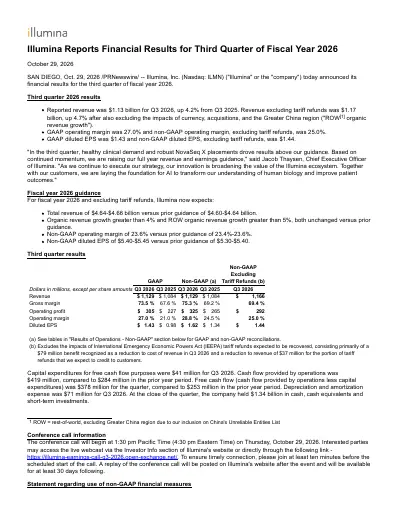
On a high level, our Q3 revenue and earnings came in ahead of our expectations and guidance. Rest of world organic revenue grew 5%, operating margin was 25%, 100 basis points above our guidance, and diluted EPS of $1.44 grew 7% year-over-year.
Now turning to the details. During the third quarter, Illumina's revenue was $1.17 billion, up 4.7% year-over-year on a rest of world organic basis, with currency and acquired revenue together contributing just under 3 percentage points to our reported growth.
Sequencing consumables revenue of $792 million was up 6% year-over-year and up 5% on an organic rest of world basis. High-throughput volume drove most of the revenue growth as the NovaSeq X install base continues to expand and clinical customers continue to bring their instruments online.
Sales in clinical markets grew 14% on rest of the world, and we continue to expect mid-teens growth for clinical consumables in 2026. Sequencing consumable sales in research and applied markets declined 6% for rest of the world, and year to date trends have remained consistent with our outlook entering the year.
Revenue has grown sequentially each of the last two quarters, and we are seeing signs research activity is stabilizing. We continue to expect mid- to high single-digit declines for research and applied consumables in 2026.
Moving to the NovaSeq X transition, approximately 84% of high-throughput volume and 60% of revenue is now on the X. In research and applied markets, 90% or greater volume has been on the X for each of the last five quarters, signaling the conversion to X is largely complete.
Thus, we expect minimal transition pricing headwinds from these customers going forward. In clinical, 78% of volume is currently on the X, and we have seen the pace of conversion slow in recent quarters.
This is the dynamic you've heard us talk about: certain clinical customers are keeping current on-market assays on the 6K while adding X capacity for new tests. We anticipate clinical conversion to reach 80% to 85% in the coming quarters, and as such, we expect the year-over-year pricing headwinds from the X transition to be lower in 2027 than in 2026.
As the X conversion is nearly complete, we believe these charts are becoming less relevant in showing the price and volume dynamics impacting our revenue growth. As such, we plan to discontinue showing this slide in our quarterly earnings presentations after Q4 2026.
As it relates to sequencing activity, gigabase output growth on our connected high- and mid-throughput instruments remained above 30%, showing that demand remains strong. Sequencing instruments revenue of $106 million was down 2% year-over-year in Q3 on a rest of world organic basis.
Higher NovaSeq X placements were offset by weaker instrument sales in our Europe, Middle East, and Latin America region. X placements were up year-over-year in both clinical and research markets.
Instrument sales still account for over 90% of our X placements, though we're seeing an increasing level of interest in lease-type arrangements with certain research customers. Demand for the NovaSeq X remains elevated, especially among some of our largest clinical customers, where we saw several multi-unit capacity expansion orders.
This is a testament to the value of our customers' place on the Illumina ecosystem today and for years into the future. Sequencing service and other revenue of $158 million was up 8% on a rest of world organic basis.
As Jacob mentioned in his prepared remarks, we are gaining traction in our 1 Billion Cell Atlas program as we continue to deliver data, converting more of our backlog to revenue. The pipeline and interest in our programs is very strong.
Microarrays and other revenue of $110 million was up 2% on a rest of world organic basis and included SomaLogic revenue that outperformed our initial deal model. Moving to the rest of the P&L, gross margin of 69.4% was up 20 basis points year-over-year.
Operating margin was 25% for the quarter, 100 basis points above our guidance, driven by higher revenue and disciplined investments. EPS of $1.44 per diluted share came in above the high end of our guidance range and was up 7% versus Q3 of last year.
Year to date, EPS is up 12% versus 2025. Moving to cash flow and the balance sheet, our cash flow from operations was $419 million, and we generated $378 million of free cash flow in the quarter.
We repurchased $9 million worth of stock in the quarter, and at quarter-end, we had approximately $1.8 billion remaining under our current share repurchase authorizations, and we intend to continue to repurchase shares opportunistically. We ended the quarter with approximately $1.34 billion in cash, cash equivalents, and short-term investments, $1.79 billion in total debt, and a leverage ratio of approximately 1.4 times gross debt to last 12 months EBITDA.
Overall, we had a great third quarter, allowing us to raise our full-year guidance and reinforce our confidence in the progress we are making towards our financial targets. Now turning to our full-year 2026 guidance, starting with revenue, we are raising our revenue guidance by $30 million at the midpoint to $4.64 to $4.66 billion.
This reflects our Q3 outperformance and increased expectations for sequencing consumable sales in the fourth quarter. We still expect rest of world organic growth greater than 5%.
Product revenue guidance ranges are unchanged, and we expect rest of world organic sequencing consumable growth of mid-single digits and low single-digit instrument growth in 2026. We now expect operating margins of approximately 23.6% at the high end of our previous guidance.
With our higher revenue expectations for the year, this equates to diluted EPS guidance of $5.40 to $5.45, an increase of 8 cents at the midpoint versus our prior guide, and represents year-over-year growth of 12% to 13%. For our fourth quarter of 2026, we expect revenue of $1.22 to $1.24 billion and rest of world organic growth of approximately 4.5%, similar to Q3.
We expect EPS of $1.51 to $1.56, and operating margin of approximately 25%. We have made tremendous progress this year.
Adoption of sequencing across a wide range of clinical applications continues to grow, and our rapidly growing X installed base provides for a strong consumables revenue stream for years to come. Revenue and customer interest in our 1 Billion Cell Atlas are both expanding, and we're just getting started on the large AI-based predictive biology opportunity that lies ahead.
Our strong balance sheet and cash flows give us the flexibility to invest in areas of strategic growth that complement our innovative tool set. We are excited about our long-term outlook.
In closing, I want to thank Illumina team for their continued focus and disciplined execution throughout the year. Thank you for joining our call today.
I now invite the operator to open the line for Q&A.
Operator
Thank you. At this time, if you would like to ask a question, please click on the raised hand button, which can be found on the black bar at the bottom of your screen.
To give as many analysts as possible the opportunity to ask a question, please limit yourself to one question. If you have additional questions, please raise your hand again to be put back into the queue.
We will now pause a moment to assemble the queue. Thank you.
Our first question is from Tycho Peterson from Jefferies. Please unmute your line and ask your question.
Tycho Peterson
Hey, thanks, guys. Want to probe a little bit on the clinical consumable numbers.
Any stocking order to call out? You had that last quarter obviously.
Then 4Q implies, I think, low double-digit clinical growth. Is that the right jumping-off point as we think about next year?
Jacob Thaysen
Thanks, Tycho. First and foremost, we are continue to be pleased with the overall clinical performance.
We see ourselves for the full year in the mid-teens. Q3 looked very much like Q2 with a 14%, 15% growth in clinical, and we continue to expect that to continue.
We will serve our customers, continue to serve them. There are always puts and takes in the quarter, but we feel good about how we see also Q4 coming along.
Tycho Peterson
Okay. Then obviously
Ankur Dhingra
Tycho, to your question on the Q4, overall, let's say, raising the guidance for Q4 consumables, our expectations there are going up, given the strong placements that we continue to have. In terms of your growth rate question, I'll recall last year Q4 was a 11% growth rate quarter on the sequencing consumables.
We're still expecting a pretty good 5%, 6% growth in Q4 overall for the consumables, so that's still a good growth on top of one of the more unique compares throughout last year. That would be one of the factors there, but our expectations are improving for Q4.
Operator
Thank you. Our next question is from Vijay Kumar from Evercore ISI.
Please unmute your line and ask your question.
Vijay Kumar
Hi, Jacob and Ankur. Thank you for taking my question.
I guess I had a two-parter, if you will. Your Q4 jump-off here, I think it implies something like close to 6% for rest of the world.
My question is, with that being the jump-off, what's the right framework for '27? Are the LRT targets still intact?
Just given the strong instrument placements so far, could instruments become a headwind next year? How do you offset it?
Thank you.
Jacob Thaysen
Vijay, thanks for that. I I can't believe you had to go into question number two before we had a question about '27 here.
Let me let me share a few points here. First and foremost, we will come out with a full guide in our Q4 earnings call.
You've got to wait with the with the details. We we are still operating very healthy market environments, especially the clinical market is is strong, and we anticipate that clinical will be a growth driver for the company for the foreseeable future.
On top of that, there's now also opportunities in what we are seeing with our multiomics capabilities, especially when the research market is coming back. We're very well positioned for for taking advantage of that.
On top of that, the AI market is just we're just scratching the surface on that, but there's no doubt that is that is a substantial requirement and need for large dataset to really train models. We can talk more about that later also.
That's the overall framing for how we see the future. What I will leave you with is that and how I think about the next year is that we have over the last quarters in this year each quarter we have been growing our consumables above 5%, we we think that's a that's a good starting point here.
We also see ourselves, of course, with what we talked about when we put the strategy in place in '24, is that we see ourselves starting to move ourselves into growth, and the main driver was that we would make the X transition, thereby also lapse the price impact of that. We are definitely on the latter end of that, as Ankur also spoke to in the prepared remarks.
Then what we are seeing with the elevated placements of of X is that that will of course continue to be a driver also for the growth. That's how we we think about it right now.
I'll leave you with that.
Operator
Thank you. Our next question is from Doug Schenkel from UBS.
Please unmute your line and ask your question.
Doug Schenkel
Good afternoon, and thank you for taking my questions. Regarding NovaSeq X demand, you've had several quarters of solid X placements, now above 80 this quarter.
Are you seeing any indication that recent strength reflects pull forward in terms of what you might have expected in the future versus last quarter and this quarter? Or is the sustainability of the purchasing cycle still pretty strong right now?
Building off of that, how would you characterize the mix of demand this quarter between capacity expansion tied to clinical volume growth versus transitions and replacements? Thank you very much.
Jacob Thaysen
Thanks, Doug. First and foremost, I don't think there was any pull-forward.
I think this is a normal course of business. Overall, as also mentioned, we are very pleased with the placements we have done over the last four quarters, which was outperformed the act of the first year of X placements when we launched.
It really speaks to a few things. It speaks to that, as I mentioned also, the market conditions we're in and the opportunity, especially in the clinical space, is very healthy.
The new assays that is putting in place are very sequencing-intensive. I think we haven't even seen what is coming.
There's a lot more coming here. The intensity will continue to increase.
I think we will continue to see a strong demand for the X's going forward. Secondly, as you probably recall, at AGBT, we were out showcasing the innovations that we're bringing to the X platform.
I also think that our customers are seeing that this is the platform to bet on for the future, and much more innovation will come out, both in terms of quality of sequencing, but turnaround times and capacity of sequencing, plus all the multiomics assays that is coming on. We feel good about where we sit and also for the future.
Operator
Thank you. Our next question is from Puneet Souda from Leerink.
Please unmute your line and ask your question.
Puneet Souda
Hi. Jacob, Ankur, thanks for the question here.
Just wanted to understand the dynamic on the sequencing consumable side. Is this a function of placing a number of instruments in the clinical space and applied and obviously research that is driving sort of a shift, lower cost per gigabase elasticity?
Is that what's playing out here in the quarter? Then, just wanted to understand, on '27, is the high single-digit framework still intact?
Just want to get your thoughts there. Thank you.
Jacob Thaysen
I'm not sure I fully understood the first question on how the dynamic of sequencing consumables
Puneet Souda
Yeah, just in terms of are you seeing sort of a lower cost per gigabase from the labs coming to you essentially, just because you're placing a new instrument, that is providing them cheaper sequencing essentially right away in the first six months?
Jacob Thaysen
I think how we think about it, obviously, is that with the transition from the 6K to the X, that was a price step down, obviously, but also generated substantially more volume. That volume continues, it's not only a six months volume gain we're seeing in the logic of a fixed budget.
We actually do see that, especially in the clinical space, that we see that our customers, as we've talked about before, are building bigger assays, also getting a better competitive positioning and continues to drive growth and introduction or further advancement of especially in the oncology space of testing. I think that is playing out, and that will continue to play out.
We feel good about how our growth is sitting with consumables, and we think that's going to continue. I will say, of course, is that, as many other companies, if you come to Illumina and are willing to sign up for large volume, we, of course, very willing to also talk about what the right price point is for that.
That's a conversation I like to have with the customers. If they come with new assays they would like to put in place that require substantially more sequencing, we are absolutely more than willing to have that conversation and find how we both companies can be successful.
That works well. From '27, as you mentioned, all the way back in 20 2024, is that our strategy is to walk ourself or walk into growth, and we were predicting mid-single here for '25, and we still are on the track to deliver on the '27 of high single digit in that range.
Operator
Thank you. Our next question is from Subbu Nambi from Guggenheim.
Please unmute your line and ask your question.
Subbu Nambi
Hey, guys. Thank you for taking my question.
Thinking ahead to 2027, I have two questions. First, do you still believe that new products to have the potential to contribute one to two points of growth?
Second, recognizing that you're going to exit 2026 at an operating margin of 25%, is that the right launch point, keeping in mind more progress towards operating improvement and improving mix as you move past pricing headwinds? Thank you.
Jacob Thaysen
Subbu. Let me start with the first one and just a reminder, we're still very much in Illumina operating in Q4, and we want to deliver Q4 before we go into details of '27.
I will say that what we talked about in '24 about that we would add also new growth drivers through both our new assays that will come out and obviously also data, is playing out well. We have come out over the last 18 months with a very, very significant multiomics portfolio, and also with the acquisition of SomaLogic, we're very well-positioned in that space, and that has momentum.
Obviously, from a low base, but this will start to actually reflect in our numbers, both here in '26, but particularly in '27 and beyond. We feel good about that.
I think related to our operating margin, again, if you look over the last few years, we have increased or improved our margins with 400 basis points, and we feel really good about what the team has achieved over the past years. We have had a lot of headwinds that we didn't anticipate, and I think the team have shown that we can deliver.
This year, electronic component pricing, shipping cost, and obviously also some tariffs has been big headwinds, and we have been able to deliver expansion on our margins. I feel good about where we are, and I think there's more to come in the years to come, and also in '27.
Operator
Thank you. Our next question is from Luke Sergott from Barclays.
Please unmute your line and ask your question.
Luke Sergott
Great. Thanks.
Sorry, I was muted. I just wanted to follow up on the implied growth here of the exit rate on the clinical sequencing.
How to think about what in next year you got all the liquid biopsy players, you're seeing a strong growth in all their samples, and then you have the conversion there from a lot of them converting to the X. How does that play out with initial reading coordinated studies and then when that starts to flip back on to the X?
Jacob Thaysen
I think it is playing out as we expect. What we've been very pleased with over the last four quarters is the elevated placements of the X.
As we are in a razor-blade logic in the company. The more instruments we place, nobody buys an instrument to put in the corner.
They all put it there to generate more revenue. Obviously, whenever time we place an X, that is an revenue generator for the years to come.
With that and with the elevated placement, we feel good about the growth opportunity in the consumables also for the years to come. As I mentioned before, the clinical market is very healthy.
I know many of you wants to sit and have a conversation about whether we grow 14%, 15%, or 16% in clinical. What the takeaway is, that this is a strong market.
There's still a lot of application that is just coming online. We feel good about that, and we see that has legs.
If you just look at a great point here is the US Can business that has continued to grow very, very strongly over the last four quarters in the clinical, and we don't think that will stop.
Ankur Dhingra
That's well covered on the clinical growth side. Luke, to your point about the clinical, the only thing I would add is still look at the number of tests that have recently come on market, the volume growth of on-market tests, and the number of clinical trials that are still expected to read out over the next one year, implying the new tests that would be coming to the market.
That's a very rich pipeline.
Operator
Thank you. Our next question is from Dan Arias from Stifel.
Please unmute your line and ask your question.
Dan Arias
Yeah. Hi, guys.
Thanks for the question here. Jacob Yep.
Can you hear me?
Ankur Dhingra
Yes. Go ahead.
Dan Arias
Thanks. Jacob, as you guys try to tap into this training model, virtual cell, AI opportunity, can you just talk about how you see genome pricing playing into that?
Obviously, you think that the X is the box to bet on, but there are some pretty cheap genomes that are being talked about out there, pushing down to 50 bucks. To what extent do you think that you might need to revisit the price elasticity discussion in order to make sure that you really take those large projects?
Can you win those with the current pricing scheme? Or do you think it takes whatever the new 35B flow cell might bring on genome cost?
Jacob Thaysen
First and foremost, we feel really good where we are. I think AI models is way beyond what a whole genome pricing.
There's a lot going into this. Let me just try to frame this a little bit.
First and foremost, I think we see a big opportunity in what I would call the predictive biology. If you want to step into that new logic of world, which could have a substantial impact on everything we do both in our space, but if you think about life science as a whole, this could revolutionize our understanding on biology, and it could definitely also have big disruption into overall the healthcare industry.
Where Illumina is very well-positioned, because it's not only about the price of sequencing here. It's about the ability to develop and create large datasets across both the genome, the transcriptome, the methylome, and of course also the proteome, combine that together, look in that from a bulk, single-cell, and also spatial context.
There's no other company in this industry that have the broad portfolio and also have the ability to create those datasets. We started with the 1 Billion Cell.
It's a great example of a functional dataset that is not only looking at something in time, but when you try to see what is happening to a cell when you knock up or downregulate a gene. I think these are types of the datasets that you want to look for.
We feel good about where we are. Look, Illumina has been in a world for many years to deal with elasticity.
We love elasticity. We can address any opportunity that we need to, and we see this market could be much, much bigger.
We have both the capabilities, but also innovation pipeline to be very strong player in that. Both developing the datasets ourselves, but also looking at flywheel that we, together with our customers, we create datasets, our customers can add onto those datasets, and we can create a bigger and bigger datasets for training those models.
We're excited about that, and I'm not super concerned about what others are doing right now.
Operator
Thank you. Our next question is from Kyle Mikson from Canaccord Genuity.
Please unmute your line and ask your question. Kyle Mikson from Canaccord Genuity, please unmute your line and ask your question.
We'll go to our next question, which is Dave Westenberg from Piper Sandler. Please unmute your line and ask your question.
Dave Westenberg
Hey. Thanks, guys.
Sorry to belabor the same clinical sequencing question, but I think we're all kind of trying to get at the same thing. Clinical is 70% of consumables, and how fast can it grow to kind of get you into that long-term high single-digit kind of growth rate?
As we're looking at the Signateras, the Shields, etc., we want to know, even in the X transition, what kind of pricing, like discounts or kind of thing, growth that you can get from these customers net of that discount as we get into the '27s, '28s, '29s, because we know you are kind of stuck on this X. We also want to know, when we're looking at that 25%, 30% volume kind of growth rate on that, how much can Illumina continue to grow, because we are confident that you're going to participate.
We just want to know and kind of the magnitude of that participation. Thank you.
Jacob Thaysen
No, thanks, Dave. That's very specific into where we could go pricing-wise.
I would leave you with that is that, as I mentioned before, we work very closely with our customers. I think many of our customers are seeing, of course, opportunities to build bigger assays that goes for therapy selection, MRD, and also, of course, now MCED coming alive.
What we are seeing is that, obviously, we will continue to have conversations. We will continue to make sure that both we can grow in alignment with our customers.
There might always be some certain difference between the different growth rates, but what we are taking away is that when our customers are growing, we're also growing very healthy. We believe there's more opportunities in that space.
We think there's more growth opportunities for Illumina. I think we have proven over the last few quarters or a few years that we can step back into growth.
The conversation 18 months ago was very, very different. I think all of you was questioning whether we could grow at all.
Now we sit with a mid-single growth in consumables. Now you're questioning how much we can take that.
I think you should see that we have a track record that show that we can continue to expand our growth rate in those ranges for consumables.
Ankur Dhingra
One thing I would add there is that last quarter we added about the overall consumables growth rate in US Canada, which is a proxy of some of the customers that you're talking about. Within our US business, the growth rate within that clinical is well above the 14% that you're talking about.
Reasonably well indexed that ways. Always remember, the big customers make up a reasonable part of our business, but Illumina's business is global, and it both benefits, otherwise, from the clinical activity across the world.
Within our US business, that growth rate in the clinical is well above that 14%.
Operator
Thank you. Our next question is from Kyle Mikson from Canaccord Genuity.
Please unmute your line and ask your question. Hey,
Kyle Mikson
thanks, guys. Sorry about that before.
Congrats on the quarter. Wanted to ask about different way to ask about the '27 beyond, I guess, congratulations on the kind of executing on the strategy day from 2024 sort of numbers and the framework and all that.
Is there upside to the high single-digit growth going forward? I think, obviously, as was discussed before, you got AI, multiomics, maybe a research inflection, clinical.
I feel like that could peak kind of longer-term as well. Could you approach double-digit growth perhaps while expanding operating margin to the high 20s?
What could that take really?
Jacob Thaysen
Look, Kyle. I think, yeah, this is absolutely not impossible.
There's definitely upside to a high single-digit growth. Remember a few things here.
When we were laying out our strategy in '24, we were in a negative growth arena, and now we have stepped ourselves into mid-single-digit growth. I think we want to also show we can do high single-digit before we go beyond that.
You can also see over the last few years there's been a lot of headwinds that this industry and Illumina specifically had to deal with. You can pick your one you want to talk about, but there's been plenty.
We think that we are operating in a significant market opportunity space, particularly in clinical, and we think that is going to continue to expand over the years. We are very well positioned when the research segment is coming back with our multiomics portfolio, where we see a lot of grants being moving in that direction right now.
Then, of course, the whole AI space, where there will be substantially data sets generated and look for. I think that is something that with our 1 Billion Cell Atlas shows that we are very well committed.
It's not about just selling sequencers anymore in that space. Our customers and the broad spectrum of customers is looking for companies like Illumina that can actually generate those datasets.
They're much more interested in what those datasets can generate, and obviously the models, how they can perform, rather than the sequencing itself. We're very well positioned, and there's certainly opportunities to grow beyond that.
Operator
Thank you. Our next question is from Dan Leonard from RBC.
Please unmute your line and ask your question.
Dan Leonard
Thank you a bunch. Jacob and Ankur, you talked a bunch about BioInsight.
When would BioInsight become more visible in the P&L? Would that be as soon as next year, or is that a farther out event?
Jacob Thaysen
I think, first of all, we've actually established BioInsight approximately a year ago, which was the combination of our software part, which is actually doing extremely well also. I think, for those of you who visited our booth and at our symposiums at ASHG, we really presented how important software is for the ecosystem.
Very excited about that. We combined that with the data, because there's a lot of synergies between the two.
You have to generate data, but you also have to develop models on top of that. As we mentioned in '24 also, is that the data and, of course, the multiomics business would start to generate 1% to 2% in the latter part of here in '27 of our strategic period, when we looked in '24.
That is playing out very well. I think, depending on how that AI opportunity plays out, which looks very, very promising, this could be substantially bigger.
Maybe, Ankur, you have comments on that also?
Ankur Dhingra
I think our view right now is somewhere in 2027 there should be some sort of color we should be able to begin to add. The 1 Billion Cell Atlas, and then the second chance we talked about it expanding to 5 billion cells, certainly would be one of the first drivers within that.
Jacob mentioned we actually have a very broad spectrum of customers in discussion about the cell atlas and several other new bio-AI-based applications that they're working on. We anticipate that somewhere in 2027, it does become more visible.
The whole point around the new products and BioInsight adding 1 to 2 points of growth for 2027 would certainly be an area.
Operator
Thank you. Our next question is from Casey Woodring from J.P.
Morgan. Please unmute your line and ask your question.
Casey Woodring
Great. Thank you for taking my questions.
I guess two just quick cleanups on 4Q. Could you quantify what the extra selling week means in terms of a tailwind to the quarter?
Then, are you expecting a budget flush? That's the first part.
Then, just there's been some noise this week on US trade restrictions on some of your Chinese competitors. Meanwhile, you guys are still dealing with China regarding the unreliable entities list.
Just curious, has there been any change in your position with the Chinese authorities? Now that you've returned to growth year-on-year in the region in 3Q, what are you seeing on the ground with customer comfort given geopolitical concerns?
Thank you.
Jacob Thaysen
Thanks, Casey. First and foremost, we are, of course, very pleased to be back to growth in China.
Our focus has been all the way through this time to work closely with our Chinese customer, continue to drive innovation, and obviously also work with the regulators in country to make sure that we have a path for the future. We feel good.
We are very committed to China and to serve our customers. We believe there's a huge opportunity there.
We learned about this situation, as many of you did, yesterday morning, and, of course, we're trying to better understand what the impact is. That's what I know at this point.
From a budget flush perspective, we are not anticipating any specific budget flush besides what's normal for Q4. Ankur, maybe you take the other
Ankur Dhingra
Yeah, let me cover the Q4 question there, Casey. Jacob covered the budget flush side, we haven't assumed anything meaningful there.
If there is indeed a stronger budget flush, that would be a potential upside into Q4. Now, regarding your question about the extra week, let me contextualize that.
For everyone, Illumina reports on a fixed number of weeks per quarter basis usually, which means that once every four years, we end up with an extra week to complete the cycle and come back into a consistent 13-week cycle there. The extra week in Q4 has always been part of our guidance throughout this year.
That extra week falls during the holidays and very early part of January, the actual impact on revenue is quite minimal. That's not the window where we see a lot of top-line activity.
Fairly minimal impact on revenue. On the expenses side, of course, we have our people cost for one extra week.
Both of those have been part of our guidance and thinking all throughout the year. Just to be clear, our raise of consumables expectations for Q4 is entirely from the strong placements and the customer demand that we've seen so far.
Operator
Thank you. Our next question is from Dan Brennan from TD Cowen.
Please unmute your line and ask your question.
Dan Brennan
Great. Thank you.
Maybe just one on AI. I know there's been a lot of discussion there so far, but if we think about the next say three-plus years or so, is the opportunity more on the service side for Illumina through BioInsight, or is it going to be substantial, or opportunity on the placing boxes in traditional flow cells?
I'm just wondering how that splits out. Then related to that, you talk about the 1 Billion Cell Atlas, is the way to think about it right now from what you're seeing in your pipeline and backlog, is it more going to be on single cell and multiomics versus traditional whole genome?
Then a quick follow-up just on Nova X pricing in the quarter, just if you can give any color on that, that'd be helpful. Thank you.
Jacob Thaysen
Good question, Dan. I think how we think about the AI opportunities, as I mentioned, the industry right now is looking for some huge dataset that is both reproducible and standardized.
The problem is, when you have individual PIs or individual postdocs or others that is sitting and building small datasets, these are quite noisy, and it's very difficult for models to actually train well on those. We have seen many times that they are better in predicting where the data is coming from, rather than predicting the biology what the experiments were actually telling you.
That's why we're seeing a big demand and a big ask for customers that would like us to help generate large datasets that can help build those, because we can, when we do those large datasets, obviously, we also spend time on ensuring they're reproducible, standardized, and so on. I think, there's a big demand for that.
There's certainly a huge opportunity for Illumina in what you can call in a service business format. At the same time, we are, of course, in the business of placing instruments.
You could imagine there's a lot of customers saying, "We can get access to the Illumina datasets. Can we augment that with our own data that we might want to keep to ourselves because of various reasons?"
I think we will see a lot of demand for that also. It'll be a blend, but versus how we traditionally think about it, we also think there's a big service opportunities.
This plays extremely well to Illumina where we're sitting today. The capabilities we built up over the last few years in this space is probably not fully understood, but we have really become experts in how to think about or how to do perturbation for different cell lines, and what it takes to build that quality.
That's what some of our customers are really seeing a lot of benefits in.
Ankur Dhingra
Let me add just couple more things on the BCA and the way to think about it. Jacob covered it extensively, the power of our portfolio by having significant part of the multiomic workflows is that the pathway where we stand today looks like combination of whole genome and proteomics, combination of single-cell and transcriptomics, combination of spatial and transcriptomics.
All of those combinations based on either specific organs where the research or specific disease pathways where the research is happening. That combination of different multiomics would vary, but that's what different types of datasets could be.
As we've said, our 1 Billion Cell Atlas is a starting point, which is helping prove causality in many areas already. We do see a pathway for multiple combinations, as I was describing, of additional datasets that can be very meaningful and powerful going forward.
Operator
Thank you. Our next question is from Dave Westenberg from Piper Sandler.
Please unmute your line and ask your question.
Dave Westenberg
Oh, whoops! I didn't even know I was going to be back on.
Maybe I'll just ask a quick one on China. Did I see that right, that was growth in the quarter?
One was reported and one was organic seven and double digits? What happened there, I guess?
Then secondly, how should we think about China on a go-forward basis? We obviously had the unreliable entity list, but we also didn't kind of expect that.
Again, I'm sorry if that was a bad question. I didn't even know I was going to be back on.
Thank you.
Jacob Thaysen
Dave, we always like to hear from you, thank you for the additional question. I think, as I mentioned before, how to think about China is that we believe I think we have been committed, shown that we are committed to find a path forward in China.
I think we have good relationships there. First and foremost, we are focusing on what we can control, and what we can control is to continue to support our customers, continue to drive innovations.
We see a lot of interest for a lot of our innovations in China, and we believe the opportunity in China is big. I think the Chinese customers wants to see Illumina play in the marketplace, and we will continue to do our best to have a future in China.
Operator
Thank you. Our final question is from Tycho Peterson from Jefferies.
Please unmute your line and ask your question.
Tycho Peterson
Hey, thanks for taking the follow-up. Ankur, you called out more operating leases.
Understand that was in context of the research market, but can you maybe elaborate there, and any chance it spills over to clinical?
Ankur Dhingra
Great question, Tycho. Both the entire operating leases as well as reagent rental models, we have had them on the offer for a fairly long period of time.
The demand there has been growing, both in the research as well as for clinical customers as well. We haven't seen that a whole lot with our largest clinical customers, who have been in extensive capacity expansion.
When you look at the mid-sized clinical laboratories all over the world, including in US and in Europe, that's where we've seen interesting demand pickup in that space. That offering is available to all our customers globally.
Tycho Peterson
Thank you.
Operator
Thank you. This concludes the Q&A section of the call.
I would now like to turn the call back to Conor McNamara for closing remarks.
Conor McNamara
Thank you for joining us today. A replay of this call will be available in the Investor section of our website.
This concludes our call, and we look forward to seeing you at upcoming events.