Incyte Corporation
Q3 FY2026 · Earnings Call TranscriptOctober 29, 2026
Operator
Greetings, and welcome to the Incyte third quarter 2026 earnings call. At this time, all participants are in listen-only mode.
A question-and-answer session will follow the formal presentation. You may be placed into question queue at any time by pressing *1 on your telephone keypad.
We ask that you please ask one question then return to the queue. As a reminder, this conference is being recorded.
If anyone should require operator assistance, please press *0 on your telephone keypad. It's now my pleasure to turn the call over to Alexis Smith, Vice President, Head of Investor Relations.
Please go ahead, Alexis.
Alexis Smith
Thank you. Good morning, and welcome to Incyte's third quarter 2026 earnings conference call.
Before we begin, I encourage everyone to go to the Investors section of our website to find the press release, related financial tables, and slides that follow today's discussion. On today's call, I'm joined by Bill, Pablo, and Suky, who will deliver our prepared remarks.
Steven, Dave, and Mohamed will also be available for Q&A. I would like to point out that we will be making forward-looking statements, which are based on our current expectations and beliefs.
These statements are subject to certain risks and uncertainties, and our actual results may differ materially. I encourage you to consult the risk factors discussed in our SEC filings for additional detail.
I'll now hand the call over to Bill.
Bill Meury
Thanks, Alexis, and good morning, everyone. As we look at the first nine months of the year, we've made meaningful progress against the strategy we've laid out for Incyte.
That strategy has two fundamental components: scaling the core business beyond Jakafi and advancing our late-stage pipeline to drive the next phase of growth. The core business is the foundation.
It gives us the scale to navigate the '29 transition and fund R&D. Layering the pipeline on top of that gives us the opportunity to build a significantly larger company over the next decade.
We now have several compounds in Phase 3 development, including a mutant CALR antibody for MPNs, a protein S modulator for von Willebrand disease, a G12D inhibitor for pancreatic cancer, a TGF-beta by PD-1 bispecific antibody in colorectal cancer, a CDK2 inhibitor for ovarian cancer, and a JAK inhibitor currently under regulatory review in HS. We have increasing confidence in the biology behind these programs and believe we've taken meaningful risks out of them as they've advanced.
That does not mean the risk is zero, but increasingly the risk we are managing is execution risk: running high-quality Phase 3 programs, enrolling them on time, and achieving the regulatory milestones in front of us. Those are things we directly control, and that is our focus today.
We are fully funding and resourcing these opportunities, leaving nothing to chance, and if we deliver against them, we believe the value creation potential is substantial, and that is how we should ultimately be judged. Now, we'll frame the quarter around three themes.
First, key business performance. Every product grew year-over-year.
Jakafi had another strong quarter with growth across all indications, and sales from our core business excluding Jakafi increased 37% from prior year. Second, we achieved important regulatory milestones, including the approval and launch of Opzelura for moderate AD in the EU in the third quarter.
In parallel, the NDA reviews for Monjuvi in frontline DLBCL and povorcitinib in moderate to severe HS [clears throat] are well underway. Third, we continued to advance our late-stage pipeline, including trial initiations and expansion efforts for key programs like G12D, TGF-beta by PD-1, and 989.
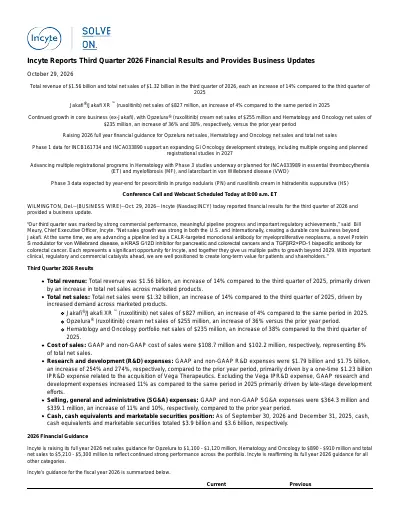
I'll now cover the quarter in more detail and then hand it to Pablo to expand on the progress across our pipeline. Total revenue for the quarter was $1.56 billion, representing growth of 14% year-over-year.
Total net sales in the quarter were $1.32 billion, up 14% versus the prior year. Growth was broad-based and led by Opzelura and our hematology and oncology franchise, while Jakafi remained a significant contributor.
Jakafi franchise net sales in the third quarter were $827 million, up 4% year-over-year. Underlying demand remained strong, increasing 12% with growth across all indications, led by PV.
Net sales growth reflects expected pricing dynamics during the quarter, including the impact of the CMS generous model. Formulary coverage is expected to exceed 80% by year-end.
The combination of increasing uptake here and expanding market access keeps us on track to achieve our full-year end target of roughly $50 million in XR net sales and supports our goal of retaining 10% to 30% of the Jakafi business by 2029. Now to our core business ex-Jakafi, which is one of the clearest indicators of transitioning the company.
Net sales from our core business excluding Jakafi were $490 million, representing a 30% increase versus prior year, reflecting contributions from key growth brands, namely Opzelura, Niktimvo, Zynyz, and Monjuvi. The growth across brands and geographies strengthens the outlook for the company as we see this business growing to $3 billion to $4 billion by 2030.
Opzelura net sales were $255 million in the quarter, an increase of 36% over prior year. Net sales were driven by increased demand across geographies and favorable US pricing dynamics resulting from the agreement with CMS related to the Opzelura line extension.
On a pro forma basis, which adjusts the third quarter of '25 for the favorable impact of the Medicaid line extension settlement, total Opzelura net sales increased 21% over the prior-year period. Now, I'll break down the US and international performance.
US net sales in the third quarter were $208 million, up 45% year-over-year, and international net sales were $47 million, up 7% year-over-year. Outside of dermatology, Niktimvo delivered $14 million in net sales, and Monjuvi and Zynyz contributed $35 million and $30 million respectively, demonstrating the momentum of our broader portfolio.
I'll now hand the call over to Pablo to review our clinical pipeline. Thank you, Bill, and good morning, everyone.
Starting with our mutant CALR program, 989, we continue to make significant progress. As Bill mentioned, we have advanced 989 into Phase 3 development in myelofibrosis, and the registrational program is progressing well.
In the Phase 3 study, we are evaluating 989 as a monotherapy in patients with myelofibrosis who have failed or are intolerant to JAK inhibitors. The primary endpoint is SVR35 at week 36.
Pablo Cagnoni
The week 36 assessment allows additional time to capture the full magnitude and durability of treatment benefit, consistent with a targeted treatment approach that we believe has the potential to address underlying disease biology. These are established endpoints consistent with those used for current approved therapies in MF.
Notably, we're also evaluating a composite endpoint as a key secondary endpoint. The composite endpoint is designed to capture the benefit we have observed beyond spleen and symptoms, including improvements in hemoglobin, platelet counts, and blasts in peripheral blood.
This allows us to further characterize the potential benefit of a disease-modifying therapy on key manifestations of MF. The study is powered to evaluate efficacy in patients with type 1 mutations, who represent more than 70% of the CALR-mutated MF population and have experienced the most robust clinical responses to date.
We will also continue to generate data in patients with non-type 1 mutations to further characterize the potential of 989 across the broader CALR-mutated population. Looking ahead, we expect to share the first clinical data for 989 in frontline MF by year-end, both as monotherapy and in combination with ruxolitinib.
This data will help define the role of 989 in an earlier treatment setting and inform our development plans in 2027. Additionally, we plan to share preclinical data on our next-generation mutant CALR antibody, which we will be progressing into the clinic in early 2027.
Together, these efforts reflect our strategy to build a broader portfolio of mutation-directed therapies with the potential to meaningfully change the treatment paradigm for patients with MPNs. Beyond MPNs, we continue to advance important programs across our hematology pipeline.
The FDA's review of tafasitamab in frontline diffuse large B-cell lymphoma, or DLBCL, is ongoing, with approval expected in the first quarter of next year. In chronic graft-versus-host disease, we are evaluating axatilimab in earlier lines of therapy.
This includes a Phase 2 study of axatilimab in combination with ruxolitinib, with results expected at a medical meeting early next year, and a Phase 3 study evaluating axatilimab in combination with steroids, with top-line results anticipated in 2028. We also expanded our hematology pipeline this quarter through the acquisition of Vega Therapeutics and its lead therapy, latarcimab.
This novel protein S modulator has the potential to be a transformative non-factor replacement treatment for von Willebrand disease. The pivotal Phase 3 study is underway, with top-line data expected in early 2029.
We also plan to share additional data from the Phase 1 open-label extension later this year. Turning to oncology, we have advanced our solid tumor programs from early clinical development to a growing late-stage pipeline.
A year ago, we established clinical proof of concept across several novel mechanisms and tumor types. Today, we have pivotal programs underway for our KRAS G12D inhibitor, our TGF-beta receptor 2 by PD-1 bispecific antibody, and our CDK2 inhibitor, with expansion efforts planned for next year.
As we reviewed at ESMO earlier this week, our strategy is to advance novel mechanisms in high-incidence cancers where outcomes remain poor, with a particular emphasis on building a leading gastrointestinal franchise anchored by 734 and 890. Starting with 734, our G12D inhibitor, our conviction in this program continues to grow, and we are rapidly expanding its development across tumor types, treatment settings, and novel combinations.
At ESMO, we presented Phase 1 data evaluating 734 in combination with standard-of-care chemotherapy in frontline pancreatic ductal adenocarcinoma, or PDAC, and in combination with cetuximab in heavily pretreated patients with colorectal cancer. In PDAC, 734 showed encouraging activity in combination with both standard-of-care chemotherapies, with a safety and tolerability profile consistent with the established regimens.
Objective response rates, confirmed and pending, were 58% for 734 plus gemcitabine and nab-paclitaxel and 81% for 734 plus modified FOLFIRINOX. We also see promising signals of durability, with six-month landmark PFS of 80% and 90% respectively.
The depth of response, early signs of durability, and consistent tolerability across both chemotherapy backbones reinforce our confidence in the ongoing Phase 3 DAWN-303 study in frontline PDAC and support moving 734 into earlier stages of disease, with a Phase 3 study in adjuvant PDAC planned to start in 2027. Turning to colorectal cancer, 734 in combination with cetuximab produced a 36% objective response rate in heavily pretreated patients.
This is notable because anti-EGFR therapy alone has historically produced response rates below 5% in late-line colorectal cancer, which suggests a synergistic combination. This data informs the design of our Phase 3 DAWN-302 study in previously treated colorectal cancer.
We reached alignment with the FDA on the design this quarter and plan to initiate the study in the first half of next year. Beyond these registrational programs, we recently announced clinical collaborations enabling evaluation of 734 with novel combinations.
These include petosemtamab, an EGFR by LGR5 bispecific antibody, in frontline colorectal cancer; navtemadlin, a MDM2 inhibitor, in PDAC; and SMB-1521, a PARP1 inhibitor, in solid tumors. These Phase 1 studies will begin next year.
Turning to 890, our TGF-beta receptor 2 by PD-1 bispecific antibody, we believe 890 has the potential to serve as an immunotherapy backbone, starting in microsatellite stable colorectal cancer, or MSS CRC, a disease that has historically been resistant to immunotherapy. At ESMO, we presented Phase 1 data evaluating 890 in combination with standard-of-care chemotherapy in frontline MSS CRC.
890 in combination with FOLFOX and bevacizumab showed encouraging antitumor activity, with an objective response rate of 71%. Importantly, responses were observed across patient subgroups, including an objective response rate of 83% in patients with liver metastases, a population historically associated with poor outcomes and reduced responsiveness to immunotherapy.
We also see early signals of durability, with a six-month landmark progression-free survival of 81%. We look forward to sharing more mature progression-free survival data next year.
This data supports our ongoing Phase 3 NEXERA-303 study in frontline metastatic MSS colorectal cancer, which is well underway, with top-line data expected in 2029. We're also moving 890 into earlier treatment settings, including a proof-of-concept study in patients with circulating tumor DNA-positive disease following surgery and adjuvant chemotherapy.
Finally, turning to 667, our CDK2 inhibitor, based on the evolving treatment landscape, we are focusing our development on frontline maintenance in cyclin E1-overexpressing ovarian cancer, where we believe the opportunity for 667 is greatest to offer a more meaningful treatment option for patients and physicians. As a result, we have deprioritized development efforts in platinum-resistant ovarian cancer.
The open-label Phase 2 MAESTRO-1 trial remains ongoing; however, we have made the decision to stop additional site activation and discontinue future enrollment in the randomized Phase 3 MAESTRO-2 study. This was not an easy decision, and we are grateful to the investigators and patients who participated in this study.
Stepping back, in a short period, we have moved from established proof of concept to advancing multiple registrational programs in oncology. We have done so by following the data, and we will continue to deliberate about where we invest.
With our approach, we believe we are well-positioned to build multiple oncology franchises over time. Turning to IAI, where we continue to build on our leadership in dermatology across topical and systemic therapies.
In July, the European Commission approved Opzelura for adults with moderate atopic dermatitis, or AD. This approval makes Opzelura the first steroid-free topical JAK inhibitor available in Europe for this population and expands its EU label into a second indication.
Povorcitinib, our oral JAK inhibitor, received a positive CHMP opinion for the treatment of moderate to severe HS in adults who have had an inadequate response to anti-TNF therapy. We anticipate a potential approval in Europe by year-end.
In the US, the NDA is under review, with an anticipated approval in the first quarter of 2027. We also expect several important Phase 3 readouts by year-end, including top-line results from ruxolitinib cream in mild to moderate HS and povorcitinib in prurigo nodularis.
Together, these programs position povorcitinib for potential approval in multiple indications, including HS, PN, and vitiligo, building on the foundation Opzelura has established in dermatology. To close, the pipeline we have today looks very different from a year ago.
We have moved multiple novel programs into registrational development, and we have done so deliberately, guided at each step by the data. With a more mature and diversified late-stage pipeline, supported by the discovery and clinical engine behind it, we are well-positioned to deliver meaningful innovation for patients and support sustainable top-line growth heading into the 2030s.
With that, I will turn it over to Suky for a financial update on the quarter.
Suky Upadhyay
Thank you, Pablo, and good morning. I'll begin with comments on our third quarter results and then turn to our updated full-year outlook.
As Bill mentioned earlier, we delivered strong net sales, managed expenses well, and executed across all areas of the company. Total revenue for the quarter was $1.56 billion, an increase of 14%.
Total net sales were $1.32 billion, reflecting 14% growth versus the prior year, driven by strong product demand. Total GAAP expenses for the quarter were $2.27 billion, an increase of 146% compared to the prior year.
This includes a $1.23 billion IP R&D expense related to the closing of the Vega acquisition. Total cash consideration for the transaction was approximately $1.27 billion, including $1.25 billion for the upfront.
When we exclude the Vega-related IP R&D expense, total operating expenses for the quarter grew 12%. GAAP cost of goods sold was $109 million, representing approximately 8% of total net sales.
This is in line with our expectations, and we expect COGS to be approximately 8% for the full year. Our GAAP R&D expenses were $1.79 billion for the quarter, an increase of 254% versus the prior year, driven by the Vega acquisition and continued investment in our late-stage development assets across hematology and oncology.
Excluding the Vega acquisition, GAAP R&D expenses increased 11% for the quarter. Moving to SG&A, GAAP SG&A expenses were $364 million for the quarter, increasing 11% year-over-year, driven by pre-launch activities for povorcitinib.
Lastly, we ended the quarter with $3.9 billion in cash and cash equivalents. Now turning to our outlook for the remainder of the year.
For net sales, we are raising our full-year guidance for Opzelura, hematology and oncology, and total net sales based on the strong performance delivered through the first nine months of the year. For Opzelura, we are raising full-year 2026 net sales guidance to $1 billion 100 million to $1 billion 120 million, reflecting continued growth in both the US and international markets.
For hematology and oncology, we are raising full-year guidance to $890 million to $910 million, reflecting the performance across key growth brands. As a result, we are increasing total net sales guidance to $5 billion 210 million to $5 billion 300 million.
We are also maintaining our full-year operating expense guidance. While unchanged based on our year-to-date R&D investment and expected spend in the fourth quarter, we expect total R&D and SG&A expenses to be towards the middle of our full-year range, reflecting advancement in our late-stage development pipeline and pre-commercialization efforts.
To close, we are pleased with our performance for the quarter and the first nine months of the year, and we remain confident in our outlook. With that, I'll turn the call back over to the operator and open it up for Q&A.
Operator
Thank you. We will now be conducting a question-and-answer session.
If you would like to be placed into question queue, please press *1 on your telephone keypad. A confirmation tone will indicate your line is in the question queue.
You may press *2 if you would like to remove your question from the queue. As a reminder, we ask you please ask one question then return to the queue.
Our first question is coming from Tazeen Ahmad from Bank of America. Your line is now live.
Tazeen Ahmad
Hey guys, good morning. Thanks for taking my question.
I just wanted to ask you, what are the key items we should be focusing on for the update for 989 mCALR in the frontline MF study coming up this quarter? Thanks.
Bill Meury
Thanks, Tazeen. Pablo will take the question.
Pablo Cagnoni
Good morning, Tazeen, and thank you for the question. At ASH, we're going to present, as promised, an update on the frontline data.
Now, just as an aside, you remember that at EHA, we presented data in patients that were ineligible for Jakafi, and that data looked quite good in our opinion both on SVR35 and TSS50 as well as the anemia improvement that we've become accustomed to see in patients treated with 989. To complement that or to expand on that, at ASH we're going to have about a total of 55 patients in frontline.
Of those, about 20 are in that group of ineligible, and the other 40 or so are in true frontline patients that would have been eligible for Jakafi. Those are split between single agent and combination with ruxolitinib, about 2/3, 1/3 approximately.
Importantly, we have quite a bit of follow-up in those patients at this point. In fact, one of the things that I think it's important to highlight is the data in the abstract are much more immature than the data in the presentation.
In fact, the data cut in the presentation is about four months later than the data in the abstract. I would ask you, when the abstracts come out, which is in the relatively near term, that we wait for the data in the presentation because that's the truly relevant data.
I think it's a pretty comprehensive update. I think it will give a clear idea of the role of 989 potentially in frontline MF, and we look forward to sharing the data with you.
Bill Meury
Thanks for the question, Tazeen.
Operator
Thank you. Our next question today is coming from Etzer Darout from Barclays.
Your line is now live.
Good morning. This is Gustavo on for Etzer.
Thanks for taking our question. My question is on the second-line MF pivotal for 989.
How will prior JAK inhibitor treatment be defined? Would the patients need to be resistant, refractory, or intolerant?
Is there a minimum duration of treatment or dose for those? Thank you.
Bill Meury
Great. Pablo?
Pablo Cagnoni
Thank you for the question. The definition is pretty standard, in the fact that patients don't achieve ideal SVR35 or ideal spleen or symptom response to Jakafi, or usually the reason for intolerance is either thrombocytopenia or anemia in most patients.
The physicians make that determination. There's some language in the protocol, but the physicians will make that determination.
There's no minimum duration. I don't believe I would have to confirm with the protocol.
I don't believe there's any minimum duration of treatment or dose of Jakafi. The dose of Jakafi prior to entering a second-line study is not predetermined in a second-line study at all.
Bill Meury
Thank you for the question.
Operator
Our next question today is coming from Jessica Fye from J.P. Morgan.
Your line is now live.
Hi, this is Silvia on for Jess Fye. Thank you for taking our question.
Can you elaborate on the strength you are seeing in Opzelura, and are you able to quantify the gross-to-net you saw this quarter and how that differed from third quarter '25? Thank you.
Bill Meury
Yes, it's a good question. I'll make a few comments, and then Pablo Mohamed can expand on them.
At the start of the year, we made a very deliberate strategic decision to expand the sales force, increase promotion to NPs and PAs, and to improve access quality, which required an investment. If you look at the results this quarter, you focus on two key metrics: underlying prescription demand and new patient starts.
It's been strong now for several months. I think it's an important indicator of the strength of the business, not just to finish the year, but in 2027.
Opzelura has a very large prescriber base of 20,000 physicians. We have extensive formulary coverage, and we have probably north of a quarter of a million people receiving Opzelura today.
That is a moat around the business. Our job right now is really really simple: keep the pressure on, keep our foot on the gas pedal.
This business could represent over a third of our core business ex-Jakafi when we hit the transition in 2029. Mohamed and his team has done an excellent job managing this product for the past several quarters.
Mohamed, do you want to add anything?
Mohamed Issa
Maybe just to quantify a few of the points that you mentioned, Bill. Thank you.
Just to reiterate, in the US, we grew net sales 25% on a pro forma basis, which basically accounts for the GTN benefit that you would have seen from the line extension settlement that we declared. On top of that, right, that 25% was driven by a 24% overall demand growth year-over-year.
The majority of the pro forma growth was driven by demand, and actually there was a little bit of a price downside on that when you look at it on a pro forma basis. The growth of the business is really, really healthy, and a lot of the growth, as you can see, is coming from the brand's underlying health of the business, which is demand.
Like Bill mentioned, new patient volume, which is really the best measure of competitiveness, grew 2x market when you think about AD and vitiligo. Not only are we growing, but we're growing and we're outpacing the market, which is a really good indicator of not only the health of the business, but our competitiveness overall.
Bill Meury
Silvia, just to add one thing to what Mohamed just said, when you think about price for Opzelura, 2026 was a year of investment to improve the quality of formulary coverage. When we look out 2027 and beyond, think about price as a maintenance strategy.
There's a cost to maintaining coverage, but we don't expect significant headwinds as it relates to average selling price for Opzelura. Thanks for the question.
Operator
Thank you. Our next question today is coming from Salim Syed from Mizuho.
Your line is now live.
Hi, this is Eric on for Salim. Congrats on the quarter, and thanks for taking our question.
One on axatilimab in GVHD, it looks like the first-line axa plus rux readout got pushed out from 4Q 2026 to 1Q 2027. Just curious about the puts and takes on that and how that is impacting filing timelines or expectations.
Thanks, Eric. Pablo will take that.
Thank you for the question. Look, the study is fully enrolled, and the data are maturing nicely.
The reason for the shift is simply timing
Pablo Cagnoni
for submission to an earlier meeting. We don't want to just show the primary endpoint, we want to show you durability of the response, we want to show you subsequent therapy, a comprehensive review of the safety profile.
We want to present that at a meeting, at a scientific meeting, and the most appropriate one is in the first quarter 2027. That's the only reason for shifting the timeline a little bit.
Bill Meury
Thanks for the question.
Operator
Thank you. Our next question today is coming from Brian Abrahams from RBC Capital Markets.
Your line is now live. Oh,
Brian Abrahams
hey there. Good morning.
Thanks for taking our question and congrats on the continued progress. Maybe one on 989.
I guess I'm curious, what monotherapy or combo activity do you think you would need to see and KOLs would want to see to warrant development of 989 as a frontline alternative or add-on for treatment-naive CALR-mutated patients, just given the known benefits of Jakafi, but also the known AEs? Thanks.
Bill Meury
Great. Go ahead, Pablo.
Pablo Cagnoni
Thank you for the question. Let me give you a little bit of a more comprehensive answer here because I think it's important.
I know it's in everybody's mind. We need two two pieces of data to finalize the design of a frontline study in MF.
Let's go back to a comment I made a few minutes ago. We know from the EHA data in ineligible patients that the efficacy of 989 in untreated, rux-untreated patients with MF is substantial.
You all remember the SVR35 and TSS50 data that we showed, and the really striking effect on anemia improvement. What we need now is a more comprehensive dataset with longer follow-up, which we will have at ASH, including single agent and combination with Jakafi, as you pointed out.
We need to see that data in order to decide the final decision on the design of the frontline study. The other event that needs to happen is we will have a meeting with the FDA, with a Type C meeting with the surrogate endpoints team, to discuss, continue the conversation that we've had on the use of a composite endpoint to try to shift away from SVR35 and TSS50, because we believe disease-modifying therapies like 989 need to be looked at differently.
We need to address the fact that this medicine basically shifts hematopoiesis back to normal, and that is represented by improvements in anemia, reduction of fibrosis, reduction of mutated megakaryocytes in the bone marrow, etc. That needs to be addressed.
Once we complete those conversations with the FDA and once we have the full dataset, we will make the decision on the frontline study. Going directly to your question, we do know that Jakafi produces rapid improvement in symptoms and an SVR35 in CALR-mutated patients in frontline of approximately 20% to 22%.
We think there's a lot of room for improvement there. Whether we need a combination arm in the study or not, we'll decide based on the points that I just made.
We do think there might be a role, in which case we'll launch a three-arm study, which would be rux versus rux plus 989 versus 989 alone. That's a perfect, legitimate study.
Patients and physicians will have two options to treat their MF, either single agent 989 or combination with rux. All that will be decided in the next few months, and we'll update you early in 2027.
Bill Meury
Thanks for the question, Brian.
Operator
Thank you. Our next question today is coming from Evan Seigerman from BMO Capital Markets.
Your line is now live.
Evan Seigerman
Hi guys, thank you so much for taking my question, and great to see you earlier this week. Just taking a step back, the pipeline progress that Incyte has accomplished over the past year has been impressive.
Can you just level-set kind of remind us what you've accomplished over the past year, and then looking forward, aside from mCALR at ASH, what are some things that we should be focused on over the next year so that when we get to the 3Q call, we can discuss those as well? Thank you all.
Bill Meury
Thanks for the question, Evan. I agree with you.
I think the shape and maturity of the pipeline has changed over the past 12 months. I also believe it has the right balance of risk and reward.
In other words, pipeline is not consumed, on one hand, by moonshots and, on the other hand, by safe, low-return bets. We sort of have a combination of products that can deliver what I would describe as outsized returns potentially, with products that can deliver incremental, but reliable growth over time.
More specifically, we have six assets right now in Phase 3. They're not all equal when you think about them on a sort of risk-adjusted value basis.
Povorcitinib, 989, 12D, and latarcimab are comparatively higher-PTRS projects. TGF-beta by PD-1, the fifth asset, is different: significant potential value, but more biology risk.
In our strat plan, it has the widest range of possible outcomes, whereas the other three or four anchor franchises for us. CDK2, the last one, I would describe as an incremental opportunity.
That's how we view it. I don't think the pipeline thesis for Incyte is trading on any one opportunity.
I do believe that the pipeline we have right now has the potential to support our target growth rate post-2029. Now, is it enough?
If we execute, I think the answer is yes, but as these are probabilistic opportunities, and attrition is a fact of life. Our job is to sort of keep this product line moving.
We can't declare victory yet. Over the next 12 to 18 months, you will receive updates on many of these programs, at least Phase 1 updates, as we're running the Phase 3 programs, and you will receive updates on how we are expanding each program: the initiation of studies, and Pablo talked a great deal about our GI oncology program at ESMO, and we'll provide you and everyone else with visibility into how we are advancing this pipeline so that there's more clarity on the growth potential of Incyte post-'29, on top of the core business.
Thanks for the question, Evan.
Operator
Thank you. Our next question today is coming from Andrew Berens from Leerink Partners.
Your line is now live.
Andrew Berens
Congrats on all the progress. It was great seeing you guys in Madrid.
I don't know about you, but I'm practicing my Spanish as an insurance policy against next week. Maybe a bit of color on the decision to deprioritize PROC for the CDK2.
We noticed it wasn't a focus at your event on Monday, but we thought it really looked pretty good relative to some of the other oral programs in the same setting. Was it that the trial wasn't enrolling well, or something else that you saw?
Then, if I could just sneak in a little more on the MF program and the endpoints. I know you did give some color, but what's your sense of the regulatory buy-in, or the potential to get a biomarker-driven endpoint eventually in the frontline setting?
Thanks.
Bill Meury
Thanks, Andy. Pablo will take the question.
Pablo Cagnoni
Thank you, Andrew. Good to see you earlier this week.
It's the competitive landscape, mainly. Look, we like 667.
The data in combination with bev, as you saw, and you pointed out, we thought looks pretty strong. 48% response rate in the late-line population.
The data that has continued to accumulate in platinum-resistant ovarian cancer with ADCs, convinces that, number one, the study would be very challenging to accrue, and number two, the commercial prospects in that indication were limited. Now, we continue to believe that there will be a role for an oral option for these patients, particularly in molecularly targeted population.
The maintenance study continues, and we do have a large dataset in platinum-resistant disease that we'll discuss with FDA. Now, I think the probability of accelerated approval on that basis is very, very small because there's very clear evidence that A, randomized trials can be run in that disease, and B, the efficacy has been superior to what we've shown with 667, to be very frank.
That's been the basis for discontinuing that one study. On MF, look, a surrogate biomarker endpoint would be ideal.
I don't think we're there, and I don't think we're there mainly because I'm not sure what that endpoint would be today. We talked about VAF, and VAF is an interesting way to monitor to some extent the progress, but it's far from an ideal endpoint because, as VAF in peripheral blood measures a lot of cells that are not relevant to the treatment effect of 989 or any CALR antibody.
What we do believe, however, is that it's time in MF to consider alternative endpoints to SVR35 and TSS50. That is incorporating different measures of normal hematopoiesis: hemoglobin, platelets, as well as blasts in peripheral blood, as well as spleen volume, quite honestly.
That is a better way to characterize a treatment response to a drug like 989. Those factors are better predictors of long-term survival in MF patients than simply using SVR35 and TSS50, and that's why we want to continue that conversation with FDA.
Operator
Thank you. Our next question is coming from Salveen Richter from Goldman Sachs.
Your line is now live.
Salveen Richter
Thank you. Good morning.
Could you speak to what you'll share with regard to preclinical data for your next-generation antibody at ASH, and how we should think about the profile of this asset versus 989 and competitors, and then also how you would position your bispecific given the similar pathway? Thank you.
Bill Meury
Thanks for the question, Salveen. Go ahead, Pablo.
Pablo Cagnoni
Thank you, Salveen. Good to see you earlier this week.
Let me make two points that I think are really important. Based on the preclinical data that has been disclosed by our competitors and the preclinical data that we have on hand, I think our next-generation CALR antibody is the best-in-class CALR antibody out there.
The reason for that is we've optimized every property that we thought we had to optimize on 989. This novel medicine is 70 times more potent against non-type 1 mutations, and it has a much longer half-life.
You'll see the details at ASH, but it will allow at least for monthly subQ injection, maybe even less frequent, depending on what we see in patients. It will be subQ obviously from day one.
We expect that the dose that's going to be required is going to fit in a pen, we really believe that this will address some of the limitations that 989 has, and as excited as we are getting 989 approved for patients with ET and MF, we think that this next-gen will be very helpful in the longer run. Just I know you didn't ask about that one, but we're also going to present data on the next-gen V617F inhibitor.
We think this drug addresses a lot of the limitations that we had with our previous entry in this space, we look forward to sharing that data with you. Regarding the bispecific, as we've discussed a couple times over the past year, I need to see more data to understand exactly where the bispecific will be positioned in patients with MF.
Efficacy and safety will determine what kind of a role this medicine potentially can play in this disease. I think possibly in patients with more accelerated MF that need a more rapid tumor reduction, but if the data with 989 continues to look better and better, one could argue that the space for the bispecific could become a little bit more limited.
Bill Meury
Thanks for the question, Sal.
Operator
Thank you. Our next question today is coming from Jay Olson from Oppenheimer.
Your line is now live.
Jay Olson
Oh, hey, congrats on all the progress, and thanks for taking the question. For 734, what are your plans for combination strategies in PDAC and CRC, especially with the positive news from petosemtamab?
How are you thinking about moving 734 into earlier lines in combination with petosemtamab? Thank you.
Pablo Cagnoni
Thank you, Jay. The combination that we announced is, in fact, to study 734 in combination with petosemtamab and mFOLFOX, in patients with colorectal cancer.
Obviously, you need to do a Phase 1 study first, but the idea is to move to frontline therapy as quick as possible. We reviewed the landscape of novel EGFR inhibitors.
We decided, and I think the data that was released yesterday confirms that that was the right choice, we believe that petosemtamab is the best next-generation EGFR inhibitor, and that's why we put that collaboration in place.
Operator
Thank you. Our next question is coming from Ash Verma from UBS.
Your line is now live.
Ash Verma
On the G12D program, can you talk about your enrollment strategy for Phase 3 given daraxonrasib availability, and how you manage crossover or post-progression therapy? ends
Pablo Cagnoni
if a lot of daraxonrasib gets used in patients that progress, and whether that treatment effect of daraxonrasib post-progression is different in the two arms of the study. We've done extensive statistical modeling.
We're going to track that in the study, and we can potentially shift to countries where daraxonrasib is not approved if we see that that's happening in a lot of patients. I would say at this point, we already have more than enough patients enrolled in the US to be sufficient for an FDA submission.
I have no concerns about not having enough US patients. What we will monitor, though, is post-progression daraxonrasib use to make sure that that doesn't impact the post-progression of PFS2 in a way in one arm more than the other, and if there is a need for intervention, we will shift to countries where daraxonrasib is not approved.
Operator
Thank you. Our next question today is coming from Gavin Clark-Gartner from Evercore ISI.
Your line is now live.
Gavin Clark-Gartner
Hey, guys. I wanted to ask on the second-line MF mCALR study.
Are there any limitations on the percent of patients that can receive a JAK inhibitor in the best available therapy arm, and what are your expectations for what that number will be? Just to clarify on the primary endpoint, so that's type 1 only.
When you do hierarchical testing, do you go look in the ITT population, or do you specifically then look in the non-type 1 population? Thank you.
Pablo Cagnoni
Thank you, Gavin. No, there's no limitation in the percentage of patients that can receive a JAK inhibitor.
I do know, if you look at the data, one has to be careful to looking at studies that allow versus did not allow washout after first-line therapy, the prior-line therapy prior to entering a second-line study. The SVR35 is as low as 8% in patients, depending on whether they did or did not have washout.
Our data that we presented at ASH, which is close to 40% SVR35 and about 40%, 45% TSS50, is in patients with no washout, that always are expected to do worse. That's important to remember.
We feel very confident that all the approved therapies in second line are substantially inferior to what we've seen with 989 so far. The only comment I'm going to make about the statistical testing is that the primary endpoint is in type 1 patients.
We thought that was the right way to run this study, to ensure success, and to get this medicine approved for this patients, which are about 2/3, if not a little bit higher, of the patients with CALR mutations. We will collect the data in non-type 1 patients, obviously we'll have it available, but the primary analysis of the study is in type 1 disease.
Bill Meury
Thanks, Gavin.
Operator
Thank you. Our next question today is coming from John Newman from Canaccord Genuity.
Your line is now live. Hi,
John Newman
thanks for taking my question, and congrats on all the progress. You previously stated that at least at this point in time, you probably won't pursue combinations with your G12D, and a pan-RAS inhibitor.
I'm just wondering, outside of the work that you're doing with your G12D, have you considered at all licensing a G12V as in victor? It seems like an area where there are a few competitors, but maybe not quite as many as G12D.
Thanks.
Pablo Cagnoni
Great question. On the pan-RAS, we don't rule out doing a combination with a pan-RAS.
We are continue to scan the landscape to see if there's an option that is suitable for us. We're not ruling it out, let me be very clear.
We've done preclinical work, and we think there's value in the combination. In terms of G12V, we are interested in expanding our KRAS franchise.
Also we would not rule out, at some point, addressing patients with G12V mutations.
Operator
Thank you. Our next question today is coming from Michael Schmidt from Guggenheim Securities.
Your line is now live.
Michael Schmidt
Hey, thanks for taking my questions. I just had another follow-up on 989, just thinking about the possible registration strategy in frontline MF patients.
Will the focus there also primarily be on type 1 patients, with a 36-month endpoint, or would that include a broader opportunity? How will you position the next-gen CALR antibody relative to 989 in that context?
Thanks.
Pablo Cagnoni
Thank you, Michael. On the first part, we'll see what the data takes us.
Right now, we continue to develop 989 to try to address the needs of all patients with CALR mutations. We made a decision in second line, as we just discussed; in frontline, the data will guide that decision.
Let's talk at ASH, and then, once we both have the data in front of us, we can see what that looks like. Now, remember, a potential path in frontline, as I discussed a few minutes ago, is a three-arm study with Jakafi in combination with 989.
In that case, that calculation might change a little bit, let's keep that in mind as we review the data at ASH. On the next-gen, right now, the positioning is get into clinic as fast as possible, get into pivotal trials as fast as possible.
We think that if we reach an agreement with FDA on the starting dose, our current understanding of this target will allow us to have a very short dose-escalation period. If you remember 989, we had to start at 50 to 70 milligrams, and we had to escalate all the way to 2,500.
That took a long time. It is not going to be the case with the next-generation program.
We think we can get to the recommended Phase 2 dose much faster, and our goal is to start pivotal trials with next-gen in 2028.
Bill Meury
Thanks, Michael.
Operator
Thank you. Our next question is coming from Mitchell Kapoor from H.C.
Wainwright. Your line is now live.
Hi, this is Ahmed on for Mitchell. Thank you for taking our question.
I guess looking at 734 and DAWN-302, what's the push for 734 and cetuximab combo replacing second-line chemo? Will DAWN-302 second-line cohort be large enough to establish benefit independently of third-line results?
Thank you.
Pablo Cagnoni
Let me see if I understand the question. You're asking about the design of the 302 of the colorectal trial?
I was just wondering if it would be able to distinguish benefit in second-line versus third-line patients.
Pablo Cagnoni
It's a good question. In general, let me put it this way, I expect that the study will enroll predominantly third-line patients, because the control arm will allow Lonsurf-bev, which was a winning arm of the SUNLIGHT study, as well as regorafenib and fruquintinib.
When you put those options in the control arm, you're more likely to end up with a third-line shifted population. Whether the data at the end are sufficient for a broad label, time will tell, depends on the population enrolled, depending on the results of the study.
Based on the control arms, that's what we expect. Now, I wanted to use this question to address one point also which I think is very important about the DAWN-302 study just to make sure we're all clear on what the expectations are for the control arm.
The SUNLIGHT study had a PFS of about 5.6 months, and that was cited by several as the benchmark. Importantly, in the SUNLIGHT study, bev-exposed patients had a PFS of 4.5 months, which is substantially lower.
DAWN-302 will be in bev-exposed patients, we expect the control arm overall will underperform the overall SUNLIGHT study. The other point that's important is we run a real-world analysis with Tempus showing that the SUNLIGHT study population, and patients with KRAS mutations do worse on Lonsurf-bev than patients that are wild-type.
Based on that, we think that reassures us that the probability of success of DAWN-302 is quite high, considering the expectations for the control arm.
Bill Meury
Thanks for the question.
Operator
Thank you. Our next question today is coming from Derek Archila from Wells Fargo.
Your line is now live.
Morning, and thanks for taking our question. This is Jacob on for Derek.
Could you provide us some of your thoughts on label scenarios for povo in HS, and what analogs would you point to there for the launch?
Bill Meury
I think there are two basic label scenarios. We studied both a pre- and post-biologic population, and so that would be clearly the preferred label scenario.
The other is just simply a post-biologic population, and there are JAK inhibitors, for example, in AD that have an indication, different dataset, different indication, post-biologic. I think that they're both workable paths.
I think the biggest opportunity for povorcitinib is it can be used at earlier inflection points: a moderate to severe patient diagnosed with HS who has been only receiving antibiotics and steroids, which are imperfect solutions, that's a large pool of patients; and then after a biologic for patients who have active disease, aren't achieving consistent pain relief, or a loss of response, which has been well-documented especially with TNF-alpha. We are in discussions right now with the FDA, and as part of planning for this launch, we plan for both plausible outcomes.
We've not seen the label. We expect that the data will support a broad label, but I'm laying out the range of possibilities.
I'll let Mohamed comment on how to think about analogs.
Mohamed Issa
I think, Bill, really not much to add. The analogs that we've seen so far really dictate, based on the data, and we believe we have a broad label that supports a broad indication.
Different analogs I think in the marketplace today suggest the same based on the datasets that were submitted in their pivotal programs. We'll wait and see, but like Bill said, I think the most important point is that both scenarios are very workable, and we're very optimistic about the opportunity.
Bill Meury
Thanks for the question.
Operator
Thank you. Our next question is coming from Eric Schmidt from Cantor Fitzgerald.
Your line is now live.
Imogen Mansfield
Great. Hi, good morning, everyone.
This is Imogen on for Eric. There's a trial on ClinicalTrials.gov for an antibody in MPNs, INCA036978, that started enrolling earlier this year as monotherapy and in combo with standard disease-directed therapy.
Could you just tell us a little bit about that program, and is it targeting CALR or something else? Then one question on povo, in the mild to moderate HS population, we've heard very encouraging feedback from KOLs here if this ends up being a positive set of Phase 3 studies.
Where do you think that peak sales could get to for Opzelura in HS?
Bill Meury
Great. I'll turn over the first part of your question, Imogen, to Pablo.
Pablo Cagnoni
Thank you for the question. At this point, we're not going to disclose the target.
All I would say is that the antibody is a mutation-agnostic antibody for patients with MPN, it can potentially target CALR as well as V617F as well as MPL mutations. We'll disclose the actual target at the right time, Imogen.
I'm sure you'll understand.
Bill Meury
Imogen, I think your question was about Opzelura in HS, and I think the backdrop here is really important. There's no FDA-approved oral anti-inflammatory, and there's no FDA-approved topical.
Now, the study we did was in mild to moderate HS, and so there's some overlap with povo, but not a lot. Our math is there's a couple hundred thousand patients, roughly, maybe 300,000 in that mild to moderate segment, and if you picked up 10% to 15% of that or more, it could be a 5% to 10% lift on Opzelura.
We have to wait for the data in the fourth quarter, but it could produce $50 million, $100 million in incremental sales, I think is not a heroic assumption. We'll wait and see what the data looks like, and it'll be a part of the growth story.
It's not necessarily built into our models right now. We're just waiting for the data.
Thanks for the question.
Operator
Thank you. Our final question today is coming from Tara Bancroft from TD Cowen.
Your line is now live.
Tara Bancroft
Hi. Good morning.
Thanks for taking my question. I was hoping maybe you could tell us the timeline to the clinic for 954, the V617F, and what we should focus on in the preclinical data that's most indicative of potentially improved clinical profile versus 958.
Thanks so much.
Pablo Cagnoni
Certainly. The entering the clinic for next-gen V617F, 954, will be early 2027.
We never disclose the exact date, but it's going to be in the early part of 2027. The main things that we wanted to address here compared with our previous entry was improving the selectivity, and important in this case to always remind ourselves that what matters is selectivity between wild-type and V617F-mutated cells.
This is not a JAK1/JAK2 selectivity question. It's wild-type versus mutated cells.
We've run extensive preclinical studies that you'll see at ASH, and we think the selectivity of this molecule is substantially better than our previous V617F inhibitor, we feel much better about that. The second is we worked the formulation ahead of time.
If you remember, we had to do a lot of work in the formulation of 954. Now, the formulation that we're going to enter the clinic, we feel much better about.
Both the formulation side and the selectivity of the molecule and the margin in preclinical tox studies are much better than 054, we're really excited about moving this program forward.
Bill Meury
Thanks for the question, Tara.
Operator
Thank you. We've reached the end of our question-and-answer session, and ladies and gentlemen, that does conclude today's teleconference and webcast.
You may disconnect your lines at this time, and have a wonderful day. We thank you for your participation today.