Ivanhoe Mines Ltd. Class A
Q3 FY2026 · Earnings Call TranscriptNovember 4, 2026
Operator
Good morning, ladies and gentlemen. Welcome to the Ivanhoe Mines Limited Third Quarter Earnings Call.
At this time, you are in a listen-only mode. Following the presentation, we will conduct a question-and-answer period.
This call is being recorded on Wednesday, November 4th, 2026. I would now like to turn the call over to Tommy Horton, Vice President, Investor Relations and Corporate Development.
Please go ahead.
Tommy Horton
Hello everyone. My name is indeed Tommy Horton and I'm the Vice President of Investor Relations and Corporate Development for Ivanhoe Mines, and it is my pleasure to welcome you to our third quarter 2026 conference call.
This call is being recorded on Wednesday, November 4th, 2026. On the line today from Ivanhoe Mines, we have Ivanhoe Mines founder and co-chairman, Robert Friedland; President and Chief Executive Officer, Marna Cloete; Chief Financial Officer, David van Heerden; Chief Operating Officer, Tom van den Berg; Executive Vice President for Projects, Steve Amos; Executive Vice President for Corporate Development, Alex Pickard; and Executive Vice President for Technical Services, Simon Bottoms.
We'll finish today's event with a question-and-answer session. You can submit a question using the Q&A box on the webcast page as well as through the conference operator via the phone line.
If we run out of time and we are unable to answer your questions, please do follow up with our Investor Relations team and we will endeavor to get back to you. Before we begin, I'd like to remind you that today's event will contain forward-looking statements and may involve risks and uncertainties that may cause actual events to differ materially from those in the forward-looking statements.
Details of our forward-looking statements are contained in the Q3 2026 financial results press release, which you can find on SEDAR+ as well as on our website at www.ivanhoemines.com. It is now my pleasure to hand over to Ivanhoe Mines founder and co-chairman, Robert Friedland, for his opening remarks.
Robert, please go ahead.
Robert Friedland
Good morning. I just am taking off from California to Florida, and this is the first time I've done this from an aircraft.
I want to welcome everybody to this call. We're at a turning point today in so many different ways, both politically and lots of concerns about war and peace and a new administration in the House and Senate, lots of uncertainty, but never a better time to buy Ivanhoe Mines.
I'm extremely confident in the turnaround and the vision of our management team, and I'm very anxious to get everybody to listen carefully because this is one of those rare opportunities, I can unabashedly say, the time to accumulate shares in Ivanhoe Mines for your kids and your grandkids is now. With that, I'll turn this over to Marna, and we have a fantastic story to tell.
Thank you.
Marna Cloete
Thank you, Robert, for those encouraging words. On my opening slide, we see a picture of the widening of Platreef Shaft 2 shaft, where we are busy widening it from 3.1 meters to 10 meters.
Once...
Tommy Horton
Sorry Marna,
Marna Cloete
I'm
Tommy Horton
just going to interrupt you. Operator, there seems to be an issue with movement of the slides.
It's moving on my side, but it doesn't seem to be showing up on the main deck.
Marna Cloete
Okay. Thank you.
Yes, that's the correct slide. I can see it moved on my side.
Thank you.
Tommy Horton
All right, Marna, go ahead.
Marna Cloete
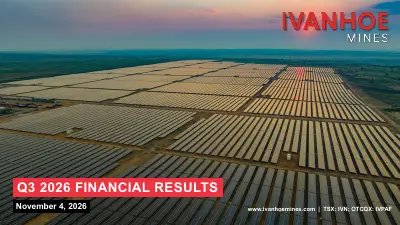
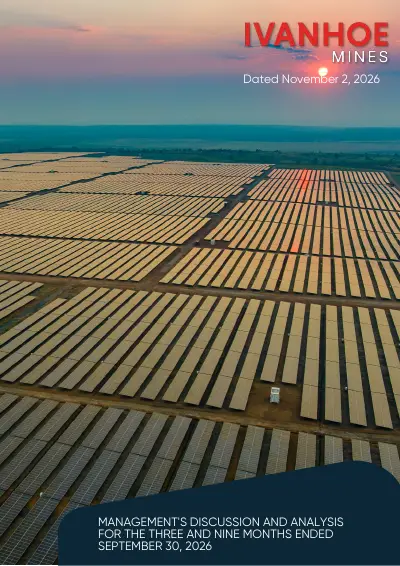
No problem. When Robert was speaking, the picture in the background and on our opening slide is a picture of our solar farm that we've just commissioned at Kamoa-Kakula.
Robert Friedland
Let's go back. Let's show that opening slide.
Marna Cloete
It's a
Robert Friedland
really nice... Just go back to it.
Oh, there we go. Thank you.
Yes, exciting.
Marna Cloete
That's the battery storage
Robert Friedland
and
Marna Cloete
it's very impressive, and we are very impressed with the delivery of the 60 megawatts and what it's done. We'll tell you a little bit about it when we get to Kamoa-Kakula about how we're using the solar to reduce our diesel costs.
Let's move into today's presentation. We start off on a sad note.
We've lost one of our key team members in the Ivanhoe family, Ivano Manini, over the weekend. Ivano passed away at home.
He will leave a massive gap. He was the Managing Director at our Kipushi project.
The site's very sore at the moment. We will have a memorial and a funeral for Ivano on Friday.
Our condolences to his family, to our team members. Everybody is very inspired to ensure that we build on his legacy.
I've printed the key statistics for Kipushi for this quarter, and Ivano has made such an impact. If I look at all the records that Kipushi achieved, it's 1, 2, 3, 4, 5, 6, 7, 8, 9, 10 records for one quarter.
To name a few, our feed grade was in excess of 41%. Our zinc recovery was in excess of 96%.
What makes this even more meaningful is that the full plant at Kipushi is operated by DRC nationals, there's not a single expat working on the plant at Kipushi. I think that's a very impressive record.
Our payable zinc tons produced was in excess of 77,000 and sold in excess of 69,000. We also had record EBITDA at Kipushi in excess of $108 million.
Ivano ended his career at Kipushi on an absolute high note, and the team there have taken it upon themselves to improve on that even further as a show of appreciation for everything that Ivano has meant for them. We can now move into the third quarter highlights.
At Kamoa-Kakula, we've produced in excess of 67,000 tons for the quarter. Our cash costs for the year to date was $2.80 per pound of copper and we maintain our guidance for the year.
Our margins was also supported by a 47 cents per pound of smelter benefit, and we'll unpack that a bit further down in the presentation. We're tracking well to achieve guidance towards the bottom end of guidance for this year, and we also revised our 2027 guidance, and we've put out a bit of a taster in terms of what we're seeing these study results culminating in.
We know that that is probably what everybody on the call is most interested in, just after this introduction, Simon Bottoms will take you through our revised thinking at Kamoa-Kakula. As Robert indicated in his opening remarks, we are confident that that is a solid plan to create a sustainable Kamoa-Kakula for the future.
We know that we are on the right track. A lot of technical work and technical data is going into this turnaround plan, and our team is confident that we will deliver on this plan.
Also at Kamoa-Kakula, we sold in excess of 109,000 tons of sulfuric acid at an average price of $950 per ton. Our Q4 contracts were well over $900 a ton, so that's an increase of over 100% for the year to date.
I've mentioned the solar plant earlier. It's been an absolute success.
We plan to increase our capacity to 120 megawatts by late 2027 and then increase it even further thereafter. I've mentioned Kipushi in the context of Ivano.
There we have narrowed our guidance towards the upper end of our guidance limit to between 270 and 290,000 tons of zinc. Then earlier this quarter, we've also announced that we've grew the Western Foreland resources by 30% to over 12 million tons of contained zinc.
That ranks us the largest and highest grade discovery in the past decade. A lot of good news together with more clarity on our turnaround strategy at Kamoa-Kakula.
If we move over to the next slide, our team has really focused this past quarter on health and safety, and we've launched the 1 Ivanhoe, 1 Road to Zero campaign. This campaign drives zero harm, healthy people, every shift.
We want to make people aware that no task is so urgent that it cannot be done safely. If you feel that you are embarking on an unsafe activity, you should have the confidence and support to say, 'I will not do this task.
This is not a safe environment for me to operate in.' This campaign consists of a three-phase strategy.
We will do a gap analysis and implementation as well as verify and audit the outcomes of everything that we are implementing. Our initial focus is to improve our training as well as the implementation of a fatal risk control protocol and safety culture that we will embed across the organization.
We will focus on areas of high occupational risks such as fall of ground and the handling of equipment. With that as an introduction, I will now hand over to Simon to take you through our revised thinking.
Thank you, Simon.
Simon Bottoms
Thank you, Marna. Good afternoon, good morning everyone.
Firstly, we wanted to start by giving you an insight into the progress we've made with the ongoing technical studies, and how we see that impacting and changing the direction of the Kamoa-Kakula complex going forward. If you progress to the next slide, please Tommy.
Firstly, one of the core focuses of our life of mine planning and technical work has been to reposition Kamoa-Kakula to deliver a flexible, fully integrated top-tier copper producer with optionality for production, rather than being heavily reliant upon single sources within the life of mine plan. As a result of that, you'll see we've introduced the commencement of multiple shallow, high-grade open pit starter pits into the mine plan, commencing immediately in quarter one next year.
Along with this, we've also rescheduled and re-sequenced a number of the underground mines, and updating a lot of our geotechnical, geological, and hydrological parameters, which is enabling us to deliver a lot more flexibility and have a lot more optionality in our production plans relative to the plan you saw earlier in the technical report in March this year. Obviously, the key outcomes are that we expect to fill the concentrator capacity by the second half of 2027, and we expect to start utilizing all of the smelter capacity, producing both copper anode and sulfuric acid by the last quarter of 2027.
This combined, particularly with the introduction of the open pits, not just as the initial starter pits, but the later in life larger pits, we feel provide the foundation and really unlock and justify the incorporation of that Phase 4 concentrator expansion, which ultimately returns the complex back to that steady-state production of 500,000 tons. I'll give you a bit more detail about that in the upcoming slides.
If we progress to the next slide, Tommy. Firstly, we're not turning our backs on Kakula.
We're still very much focused on the redevelopment and the repositioning of Kakula. The development of the peripheral ore drives around the periphery of the ore body is still underway.
Despite hitting a linear advance rate of some 127 meters per crew per month in quarter three, the development has still been slower than anticipated, and so we're not yet getting round that eastern barrier pillar in time to be able to incorporate those high-grade stopes into the 2027 production. As a result, those stopes, as you see the initial stopes in green blocks on the right-hand side of the schematic graphic, they are now delayed out to 2028.
Additionally to this, you'll have seen that our grades have been very low, and the reason for this is we've taken a look at the current copper prices, and given that with these peripheral drives, both long-term and mid-term accesses, are actually developing through marginal ore material. Looking at that processing cutoff, we've made the decision and have been feeding all material above 0.3% copper.
This provides obviously extra copper production in terms of marginal ore, but also enables us to get better utilization of our current concentrators. As a result, as you've seen in the quarterly numbers, the concentrator grades have been lower than normal.
Now turning to the high-grade starter pits. In the first quarter of 2027, we expect to start commencement on mining on two small, high-grade starter pits, where between 2027 and 2028, we expect to mine some 3.5 million tons at 2.5%.
This is spread across four pits, with variable strip ratios, from some at quite high levels of 11:1 with some at quite much lower strip ratios. The key being though is that these open pits provide an initial start, an easy, low-capital, low technical risk start to high-grade copper tons, which sit only 50 meters below the surface of the current surface, and allow us to start rebuilding stockpiles, filling the concentrators, and provide a lower-cost source of ore relative to even the cheapest underground, to fill up our concentrator feed and rebuild a stockpile, which will give us operational flexibility.
These starter pits, as you can see in the graphics on the right, even the deepest portion of them has a highwall of some 90 meters depth, they are by no means a significant technical undertaking. Drilling has already commenced on the starter pits to infill-drill them to a grade-control spacing prior to commencement of any production.
At the moment, we're still updating those open pit forecasts as those results come in, and these grades and forecasts are based on the updated mineral resource models that we've completed through the course of this year. What this means for the complex is, as you've seen in our quarterly release, is we have reset the production guidance for 2027, as we've reduced that reliance on the Kakula tons, we've incorporated those initial, shallow, higher-grade starter pits into 2027, with pre-stripping starting in the first quarter, and then first ore expected to come in from August, filling the entire mill capacity across all of the concentrators by Q4.
The result of this, though, this repositioning gives us a lot more flexibility, buys us more time to reset Kakula, but does mean that we've restated that production guidance intentionally to reflect the variability in the timing of the development for accessing of those higher-grade blocks within Kakula. Whereas the open pits, we feel provide a stable, steady-state, consistent feed for the production profile.
Then, as you see into the pre-Phase 4 capacity, as we step forward into 2028 and beyond, we see those open pit grades increasing, as well as the proportion of the overall concentrator feed increasing substantially from that coming from those open pits. Next slide please, Tommy Horton stepping away from the starter pits, looking forward to the larger pits, we see that the starter pits will provide an initial concentrator fill for our Phase 3 concentrators.
Then as we push back into the larger pits, they effectively unlock the Phase 4 concentrator, with a significant return on capital, very short-term payback, and provide and unlock a lot of that work that was put in place previously with significant synergies with the existing Phase 3 circuit. We're still updating and finalizing our technical studies, and we have engineering designs for a range of Phase 4 expansion scenarios, but we're expecting to add somewhere between 5 and 6.5 million tons per annum process capacity to Phase 4 as the open pits progress from those initial starter pits pushing back to the larger pits.
We expect to indicate some selection of some options with our final technical report updates and our life of mine updates in March this year, but immediately thereafter, we'll be commencing detailed engineering and costing of that selected options. Turning to the next slide, if we take a look at what the open pits are that we see longer term are potentially unlocking this Phase 4 expansion, indicated on the graph on the right-hand side, we've taken a benchmark of all global copper operations scaled by annual production and grade, and we've highlighted the area where we see the potential for the Kamoa open pits situating.
As you can see, they're in a globally standout position with significantly high grades as well as significant production levels. These production levels, we expect to step up to about 40% of the overall feed after the Phase 4 expansion.
It's not just one open pit, there are a number of open pits, which initially start as small, high-grade starter pits, pushing back to much larger, laterally extensive pits, but still only with the deepest pit at the moment that we've been modeling and designing being 190 meters deep, still representing a very low technical risk. Added to this, the incorporation of open pits into some of the resources which were previously reported as underground resources, but also unlocking some resources that were previously excluded from underground resources, it enables us to lower our cutoff grades, which adds significantly more metal and improves the extraction ratios substantially from that of the underground areas, where, as many of you will be aware from the updated geotechnical designs, we'd previously limited the underground extraction ratios to about 67 65%.
The open pits will be extracting up to 97% of the ore situated within their pit designs. As well as this, even with current costs, we've utilized a $4.50 a ton mining cost for our open pit evaluation, assuming an initial contractor operation, even with these quite high costs given the current diesel price environment, we still expect the ultimate operating costs of these open pits to be substantially lower than that of the neighboring underground mines.
Therefore, these pits provide a very quick return on capital and have a lower longer-term sustaining capital cost than equivalent underground mines. Now, I'll pass you back over to Alex for the operational results.
Oh sorry, David. Sorry.
David van Heerden
Thank you, Simon, and good morning and good day to everyone joining the call. If we move to the next slide, please Tommy.
Kamoa-Kakula sold just over 67,000 tons of payable copper in the third quarter, and that's up nicely from the 61,000 tons sold in Q2. Copper in concentrate produced was up by almost the same amount quarter on quarter, and with the additional tons in slag concentrate and high-grade fines designated for sale, there was a slight increase in copper in inventory on hand to 43,000 tons at the end of the quarter.
Kamoa-Kakula's quarterly revenue exceeded the $1 billion mark for the first time. The record revenue for Q3 was up more than 17% from the previous quarter because of the increase in tons sold, the higher copper price, and the increase in revenue from sulfuric acid, which actually increased to over $100 million for Q3, up from $56 million in the second quarter.
That was with an average price for the third quarter of $915 per ton. The average realized copper price for Q3 was $6.12 per pound of payable copper, but this was actually applicable to a relatively low number of tons, with 62,000 tons still provisionally priced at the end of the quarter and remeasured at the end of Q3 at the quarter-end closing copper price of $6.55 per pound.
The stronger revenue performance translated into meaningful improvements in EBITDA and margins, as we can see on the next slide. Firstly on the cash costs, the cash costs for the third quarter of 2026 was $3 per pound of payable copper.
Energy cost was again higher, and the copper grade of ore processed was lower in the third quarter, as Simon mentioned, leading to a cash cost increase on a per-pound basis. More details on that on a following slide.
The cash costs for the year to date of $2.80 per pound of payable copper is right in the center of our guidance range, and we maintain that range. While the quarterly costs number is elevated, two important structural mitigants are basically on our doorstep: the reduction of diesel needed in generation following the commissioning of the solar facility, and that's expected to be between 10 and 20 cents from Q4 onwards, and then the benefit of higher progressive grade and other mining efficiencies.
Kamoa-Kakula's EBITDA for Q3 was $478 million, which is the highest EBITDA since the first quarter of 2025 and an almost 25% increase in the previous quarter. The EBITDA margin increased to 46% from 44% in Q2.
That's a really strong outcome, given that the operation remains below its longer-term production capacity and continues to carry elevated power and mining costs at the current grade. Higher copper prices of course played an important role, and we continue to realize significant smelter benefits.
The next slide sort of isolates the benefits we're already receiving from the smelter. This slide is really just again a reminder why the smelter is so strategically and financially important for Kamoa-Kakula.
Compared to the second half of 2025, the smelter has delivered approximately 86 cents per pound of gross benefits in 2026 to date through three principal channels. The largest benefit is approximately 46 cents per pound from sulfuric acid byproduct credits.
This benefit increased to 68 cents per pound in the third quarter, and that's expected to remain as high in Q4 2026. We have also realized savings of approximately 30 cents per pound in logistics costs, as the copper anodes contain significantly more copper per ton shipped than concentrate, and a further benefit of around 10 cents per pound arises from avoided treatment, refining, and tolling charges.
These benefits are partially offset by the smelter operating costs of approximately 39 cents per pound. The result is a net benefit of approximately 47 cents per payable pound, even with the smelter currently operating at around 60% of capacity.
Mining and processing costs, mostly linked to higher diesel, have increased over the comparison period, which means the smelter benefit is not yet fully visible on the headline C1 number. Of course, without the smelter, current cash costs would have been quite a fair bit higher.
The next slide looks at the diesel price impact a little closer, as also the longer-term cost expectation. Between Q2 and Q3, C1 increased by 16 cents per pound, of which approximately 9 cents per pound resulted from the higher diesel prices.
Since the first quarter this year, the diesel component in C1 has actually increased from 34 cents to 61 cents per pound, an increase of 27 cents per pound. The balance of C1, excluding the diesel, increased more moderately from $2.24 to $2.39 per pound over the same period.
Importantly, the diesel costs shown are the direct diesel price impacts, doesn't include the secondary impact of higher diesel prices, like the increased logistics charges, which is also contributing to the remaining C1 increase. The diesel burden is of course not expected to be a permanent feature of the cost base, but the current levels have been assumed for the guidance ranges.
With the on-site 60-megawatt solar facility now fully operational, this is expected to reduce the energy cost by, as I mentioned, 10 to 20 cents per pound as the Kakula dewatering was switched over from being powered by backup diesel generators to the new facility in mid-October. For 2027, we are guiding to C1 costs of $2.50 to $3 per pound, and beyond the near-term recovery period, we see a clear pathway to below $2.50 per pound, supported by lower diesel consumption, improved operational performance, improved mining grades, and then greater fixed-cost absorption as production increases.
Despite the cost pressures in the quarter, the higher copper sales, copper prices, and the acid revenue generated a very strong quarter-on-quarter increase in EBITDA, and that can be seen on the next slide. This waterfall bridges Kamoa-Kakula's EBITDA from the $385 million in Q2 to the $478 million in Q3, an increase of $93 million.
Higher copper prices contributed approximately $59 million, while the stronger sulfuric acid sales contributed approximately $41 million. The increase in payable copper sales added a further $36 million.
These benefits were partially offset by changes in provisional pricing remeasurements, operating costs, and logistics charges. Kamoa-Kakula held approximately 43,000 tons of unsold copper at quarter end, compared with a longer-term target inventory level of around 25,000 tons.
Reducing the inventory levels represents a future working capital and cash flow opportunity, and is definitely a priority for the team. However, we're not assuming an immediate destocking of the full balance.
Together with the Kamoa-Kakula recovery, Kipushi is of course becoming an increasingly important source of earnings and cash flow, and that's exactly where we're focusing next. Kipushi delivered another record quarter, as Marna mentioned.
Revenue increased to $2.55, oh $255 million from $146 million in the second quarter, and that was supported by higher zinc sales and a realized zinc price of $1.73 per pound. Kipushi sold almost 70,000 tons of payable zinc during Q3, and that was up from 43,000 tons in the second quarter.
Payable tons sold was a little higher than produced, leading to a small decrease in inventory, which is sort of noted on this slide. The logistics constraints, which we noted in the second quarter, eased in Q3, allowing the on-site concentrate stock to reduce by more than 60% compared to the second quarter.
Some provisional revenue relating to that destocked inventory had not yet been received by quarter end, and creating a nice benefit for future cash receipts. Kipushi will always have a fair bit of inventory en route to port, and with the majority of the inventory now in transit at the end of the third quarter, we do expect that sales in Q4 will exceed production, probably by around 10,000 tons.
Another very good quarter for Kipushi expected in Q4. Kipushi is definitely no longer simply an operation in ramp-up, but is really a meaningful second earnings and cash flow engine for the group.
If we move to the next slide. The EBITDA more than doubled for Kipushi to $108 million, from $51 million in the previous quarter.
The EBITDA margin expanded to 43%, compared to the 35% in Q2, a nice increase there as well. This really represents a substantial improvement from the $27 million of EBITDA at a 21% margin generated in the third quarter last year.
Equally important, this performance is being delivered at a very competitive cost. Year-to-date C1 costs of 89 cents per pound of payable zinc remained just below the midpoint of our guidance range, and we keep the guidance range unchanged.
Keeping the cost this tightly controlled with a much higher than planned diesel price and other inflationary pressures, increased logistics charges, that has really just been excellent. Kipushi also recently secured an additional 10 megawatts of grid-supplied power from a third-party providers, which is then expected to reduce power instability at Kipushi, and as a result, reduce power costs from the backup diesel generators from the fourth quarter.
Kipushi generated around $150 million of operating cash flow for the year to date, and we plan to start upstreaming the excess cash from the DRC operating subsidiary to our Canadian parent bank accounts in this quarter. I think lastly, I'm confident that the Kipushi team will honor Ivano's legacy through just achieving even yeah, greater heights in the future, but I would also just like to add my voice to Marna's that Ivano will definitely be deeply missed.
If we move to the next slide. At the Ivanhoe Mines level, adjusted EBITDA increased to a record of $241 million for the quarter, from almost $180 million in the second quarter and $87 million in the third quarter of last year.
This reflects Ivanhoe's attributable contribution from Kamoa-Kakula, together with the strong improvement at Kipushi. The record adjusted EBITDA was achieved notwithstanding the increased investment in exploration expenditure of $44 million for the quarter, up from $15 million in Q2.
Alex will tell you a little bit more about exploration on the later on in the presentation. Profit after tax was $45 million, broadly stable compared to $46 million in the second quarter, and the Q3 result included $47 million of profit from Kipushi and $25 million from a share of profit from the Kamoa-Kakula joint venture.
This earnings picture is therefore really improving materially, and while Ivanhoe continues to fund future growth through exploration and project development. If we turn to our capital expenditure plans just on the next slide.
Firstly at Kamoa-Kakula, the year-to-date expenditure was approximately $800 million, and that's trending towards the lower end of the capex guidance range. We have therefore reduced the upper end of Kamoa-Kakula's 2026 total capital guidance by $200 million, and shifted that into 2027.
The range hasn't changed, but currently excludes the capex for the open pit which Simon mentioned, which we estimate to be between $100 and $200 million, but the work is yet to be tendered. At Platreef, the 2026 capital guidance has increased to reflect the weaker US dollar against the rand and additional operating costs capitalized while the Phase 1 concentrator progresses towards commercial production.
The spend at Platreef is accelerating quite nicely as the team approaches Phase 2 completion, which is expected in the fourth quarter next year. We do expect Phase 1 on Platreef to reach its commercial production either late this year or very, very early next year.
Platreef's funding position was strengthened by the senior project finance facility, and under that, we drew $187 million in Q3 this year. Kipushi sustaining capital remains relatively modest, relative to its growing cash contribution, and spent $48 million on that year to date.
Across the portfolio, our approach is to prioritize the capital that supports safe and sustainable operations, and restores Kamoa to its full earnings capacity, and of course to advance the development of Platreef while preserving the appropriate liquidity headroom. Maybe then on that note, move to the next slide.
Ivanhoe ended September with $643 million of cash and cash equivalents on hand, compared with $635 million at the end of Q2, an increase in cash. On a pro rata basis, including Ivanhoe's attributable share of Kamoa-Kakula, cash and cash equivalents was $785 million, and then the net debt on a pro rata basis was almost $1.7 billion, and that's up slightly from the $1.5 billion at the end of the second quarter.
The increase primarily reflects the drawdowns on the Platreef facility, which I mentioned and which took place during the quarter. Despite the increase in net debt, the stronger trailing earnings reduced the net leverage ratio from approximately 2.48 times to 2.26 times, and that further decreases to 1.75 times if an annualized Q3 EBITDA is used.
We remain well-funded with an appropriate focus on liquidity, but confident in realizing the expected growth in our earnings over the near term. With that, I hand over to Alex Pickard, our EVP Corporate Development, to start the operation section of today's presentation.
Alex Pickard
Thank you, David. It's Alex Pickard speaking.
What you're looking at here on the slide is a very nice photo of the concentrate thickeners for Project 95, which has been a big success story, which I will come back to. I just want to start quickly by reiterating some of the key points that Simon made earlier.
I think his line unfortunately was a little bit choppy, or at least it was for me. The first point is the shift to a combined open pit and underground mining operation we believe will be a complete game changer for the future of Kamoa-Kakula.
The open pits are a much more flexible, lower technical risk, and also the lowest-cost source of ore that you can find on the Kamoa complex. At a grade of in the range of sort of 2.5%, these are also some of the highest open pit copper tons that you will find anywhere in the world and at depths of, as Simon mentioned, starting from 50 meters.
The open pits are also very scalable, and they will support the future Phase 4 expansion and a long life of 500,000 tons of production, but we also have the flexibility to determine when we want to commence that expansion. We don't need to hurry into it if we don't have to.
Equally, if we have a strong operational and financial footing and the copper price maintains its strength, then we can move into that expansion very quickly. Then just to reiterate on the guidance, we will just about hit the low end of our 2026 guidance at 290,000 tons.
I think we fully acknowledge that there is disappointment on restating our 2027 guidance, but the new range that we are putting up of 300 to 350,000 tons of copper, I think has a much higher level of confidence. Really, what we are doing here is taking the turnaround of Kakula completely off the critical path, which is the most technically complex activity that we need to do at Kamoa-Kakula.
That said, with time, we are still fully confident that Kakula itself will come good in 2028 and beyond. It will deliver high-grade tons, which will allow us to increase the production rates up to 400 to 450,000 tons before we do the Phase 4 expansion.
I just wanted to start by reiterating those key points, but we can go to the next slide, please Tommy. In terms of the third quarter, and I know we're sort of running short on time, I'll be brief, look, I think it was a very solid quarter.
We actually achieved a 12-month high in terms of mining and milling rates, equivalent to 14 million tons, so that was up about 17 or 18% quarter on quarter. The grade of 2.2%, as Simon mentioned, we do have some very low grades coming in from development, but also supported by much more solid grades of 2.5%, 3% from the fresh run of mine.
The mining rates themselves increased 20% quarter on quarter to over 14 million tons. That was partly driven by an 84% increase in stoping, a lot more stoping in Q3.
I'm also happy to say that in October, we've also hit new records in terms of the tons coming from underground. Looking at the concentrators, we are at about 70% of capacity at Phase 1 and Phase 2, and we are well beyond 100% of the nameplate capacity, but now safely operating at 6.5 million tons from Phase 3.
We obviously have the benefits of the acid production, 118,000 tons for the quarter. As Simon mentioned, we want to be filling these concentrators completely from mid-2027.
Project 95, it's something that we've talked about very often over the last year or so, but we really want to report back some good news that it has been a very successful project. Since it was completed in June, we now have a really good sense from the operating data that the recoveries have improved by approximately 5% at the Phase 1 and Phase 2 concentrators.
We averaged 89% in Q3, but actually over the last couple of weeks, we've been achieving recoveries of 91, 92%, which is really, I think, quite incredible when you consider what we are milling today is a much lower feed grade. From a grade recovery point of view, I think achieving 92% off feed grades of 2.1, 2.2% copper is pretty stellar, and we're excited to try and push that up towards 95% as we start to get the feed grades up to where they're supposed to be.
With that, I think I'll pass to Steve on the smelter.
Steve Amos
Thanks, Alex. Smelter performing very well.
We're at 60% of capacity, and we are consistently performing at 60% of capacity. The only reason it's 60, not 100, is there's insufficient concentrate ahead of the smelter, 60% is what we can smelt.
Produced 76-odd-thousand tons of saleable copper in Q3 2026, and there's a fair amount of unsold inventory or stock in the smelter that we need to get rid of in the next couple of months. Planning a big shutdown in mid-Q2 2027, 35 days, rebricking and some repair on the tapholes.
Next, please, Tommy. I'll talk about solar at Kamoa.
It's been a huge success. We recently handed over 60 megawatts of continuous power to the mine.
The big advantage of the solar is the reliability, 95% plus reliable. Tariff is good, approximately 17 cents per kilowatt hour.
Another advantage is that during the day, they're producing significantly more than 60 megawatts because, obviously that's when the solar is really comes into its own, and we can buy that from the IPPs at a discounted rate as well. Two PPAs, power purchase agreements have been signed for Phase 2.
Phase 2 is basically a carbon copy of Phase 1, a doubling of the capacity from 60 to 120 megawatts. Plan that roughly by the end of 2027.
In addition to that, we are negotiating with the two IPPs from Phase 1. They have land available, which we've compensated, for an additional 15 megawatts each.
The plan is by mid-2028 to bring that additional 30 megawatts online, which will give us 150 megawatts. I think according to the energy balance, October is the first month that I can remember where we are not reliant at all on diesel generators, so that is good.
Then the point, I think, that David made as well is the diesel consumption has fallen significantly in September due to the solar. Next one, Tommy.
Sulfuric acid, yes, we've really benefited from one of the pros from the Straits of Hormuz issue. Very, very high sulfur prices landed in DRC, which means sulfuric acid is selling at a premium.
We producing about 40,000 tons a month. That is at our 60% capacity.
The market remains very tight in the DRC for the reasons that I've mentioned. Not only is sulfur expensive, a lot of the oxide producers have sulfur burners on site, burn sulfur, produce sulfuric acid, and use that to leach copper.
The supply is also constrained due to the issue in the Straits of Hormuz. If I remember correctly, back in the early days, we budgeted $150 a ton, and we well north of 900 now, which has been a nice little up-kicker.
Sales in October averaged 900 $950 a ton, which is great for us. Next one, please, Tommy.
Kipushi again, we've spoken about this at length. These guys are doing absolutely fantastically.
77,000 tons of zinc for the quarter. A mine grade of close to 42% zinc is astronomical.
The mill is running fantastically. The recoveries are running very well.
We're even seeing some small constraints in the concentrate filter, which is a good thing. I think Kipushi is, the shining star this year in fact.
We've actually trimmed the guidance range to the upper end 270 to 290,000 tons of zinc. That is the set to be the world's third biggest zinc mine, so that's going very well.
Also looking at solar at Kipushi, they are running a fair amount of diesel in the background. We're looking at a 10-megawatt hybrid solar PV facility, with battery storage as well, pretty much a carbon copy of Kamoa, and we hope to bring that in Q2 2028.
We'll sign the PPA Q1 2027, probably February 2027, so that's very positive for Kipushi. It'll obviously reduce the operating costs as well there.
Next one, please Tommy. I'll talk a bit about Platreef, Phase 2 projects at Platreef going very well.
Shaft 3 was successfully handed over at the end of March this year, we busy ramping that up. That has more than enough capacity to feed the Phase 1 concentrator and it has capacity to feed the Phase 2 expansion.
We've had a few hiccups on the Phase 1 concentrator with the tailings filter. We've installed an additional filter.
Those hiccups are over, and we plan to meet nameplate capacity early 2027, if not earlier. Construction of Phase 2, the Phase 2 concentrator going very well.
We started that in March, April-odd this year. Our target completion date is Q4 2027, if not earlier.
Of course, that really brings Platreef alive, a milling capacity in that mill of 3.3 million tons per annum. The Shaft 2, so that's the big shaft, the one you can see in the picture in the background, 8-million-ton hoisting capacity, one of the biggest shafts in Africa.
We busy with what we call the slide-and-line, or the widening of the shaft. Marna mentioned that earlier, from 3.1 meters to 10 meters.
The plan is to bring that on for men and material late 2028. That takes significant pressure off Shaft 1, which is currently the only shaft that is used for men and material, and of course we slinging a lot of material underground for the construction.
That going well as well. I think Platreef Phase 2 project going very, very well.
Thanks, Tommy.
Alex Pickard
Thanks, Steve.
Steve Amos
I think it's over to Alex now.
Alex Pickard
Thanks Steve. I'll close out with a quick update on where we are with exploration.
Western Foreland, I think we had a really good quarter, with the mineral resource update, as Marna mentioned, we're up to about 12 million tons of contained copper across inferred and indicated, an increase of 30%, maintaining our record of discovering copper at an industry-leading low cost of less than $10 per ton, and we're now by far the largest and highest-grade discovery of the last decade, and I would wager we will be in production before probably any of these projects. We're very excited about what's happening at the Western Foreland broadly.
I think we have a couple of slides just to take you through the near-term drilling plans. Actually, on that note, I would just recommend that anybody that missed the webinar on the Western Foreland that we did in September after the resource updates, you can listen to that.
There should be a link on our website. Look, the drilling now is really in sort of two separate parts.
We are still doing some expansionary drilling, but then there has been more of a shift in focus to infill drilling to prepare for development and mining activities. In terms of the expansionary drilling, we did leave a lot of drilling on the table that wasn't in the cutoff for the resource estimates, we think that we have at least a couple of million tons additional copper.
That's really in the zone that is marked as 3 on this map, the eastern extension to Makoko East, but we also have some more work planned in between sort of Makoko and Kitoko, highlighted by the Zone 2, and also some thick zones that are between Makoko West and Kitoko that require some further drilling. The growth story is still alive, but if we move to the next slide, what we really focused the bulk of our drilling this year on is infill, starting with 63,000 meters, which is infilling the shallow mineralization less than 200 meters in depth.
That is highlighted by, I think, the pink triangles and the yellow triangles at the sort of top end of the map. Then once we have that drill data, we've already started that work in September, but once we have that drill data next year, that will really underpin the start of mine planning and a scoping study that we will move into in 2027.
Then we also have more drilling to delineate the slightly deeper mineralization, but still less than 600 meters in depth, which is in two additional phases highlighted in red and in blue. Look, we're really excited about what's happening with the Western Foreland and this Makoko district in particular.
We've also been spending, I think David mentioned we had quite a high exploration spend for the quarter, we've been busy with relocations to prepare for open pit mining, those are very well-advanced, I think over 90% complete. Then we've also been building a new camp for the Western Foreland, which will really become the sort of base of the project and the future base of operations.
That camp will be fully functional by Q2 of next year, a lot going on. Then closing out with some of our drilling on our new horizons, I've focused this time just on Zambia and on Kazakhstan.
Starting in Zambia, these are licenses that we acquired around a year ago. We've completed about 6,000 meters of drilling in the quarter, so that was really our first proper quarter of drilling, but I'm pleased to say that we've already confirmed an iron oxide copper gold, or IOCG, hypothesis.
We've had several very promising intersections of albeit relatively weak, but chalcopyrite, which we're seeing across intervals of 100 to 150 meters from depths of only 70 meters. That's a very nice place to start, and we just need to try and vector in on where the grades are going there.
Then moving a long way away, but across to Kazakhstan and our joint venture properties in the Chu-Sarysu Basin, we've done a lot of drilling there, 17,000 meters completed through Q3, and we have had also our first real notable intersect of weak chalcopyrite mineralization and a big intersect, 270 meters, but also sort of relatively deep at 670 meters. That being said, that doesn't put us off.
We're actually very buoyed by the first significant demonstration that we are onto a sedimentary-hosted copper basin, it also gives us something to start vectoring in on, and we're quite excited by what is going on there. Drilling is also continuing in Angola and elsewhere, but that's the focus of the presentation today.
I think we've run over slightly. I'll hand back to Tommy for Q&A, as I think we could maybe take some more time.
Tommy Horton
Absolutely. Thanks Alex.
We'll now begin the question-and-answer session and yeah, we'll obviously be allowing extra time for the webinar to accommodate the questions that have come in. Covering analysts, you can submit your questions to the operator by the phone line.
Questions can also be submitted through the webcast. As mentioned at the top of the call, if we are short on time and unable to address all the questions, then please do get in contact with our Investor Relations team and we'll endeavor to follow up.
Operator, we'll start by clearing the phone lines, and then afterwards, we'll run through the message boards. Thank you.
Operator
Thank you. Ladies and gentlemen, should you have a question, please press the star, followed by the 1 on your touchtone phone.
You will hear a prompt that your hand has been raised. If you wish to decline from the polling process, please press star, followed by 2.
If you are using a speakerphone, please lift the handset before pressing any keys. First question from Orest Wowkodaw with Scotiabank.
Please go ahead.
Orest Wowkodaw
Hi, good morning. Could you please give us some more color around Kakula?
Specifically, the release talks about a reduction in the estimated maximum mining rate. Can you please elaborate sort of what you mean by that and in terms of where you think ultimately Kakula can supply with respect to ore feed here?
Simon Bottoms
Sure. Simon here.
The reason we've been looking at a slightly different strategy with Kakula is as we've been going through some of the optimizations with the updated geotechnical and hydrological models, we've been repositioning the pillars, and that a lot of the mining will be refocused on the high-grade core. We're actually able to position some of the pillars in some of the lower-grade areas, and which enables us to extract a little bit more of the high grade.
Ultimately, with the supplementing of the open pit, yeah, we will be potentially reducing that Kakula production rate, especially once we bring Phase 4 online, Kakula comes down to just under 20% of total ore feed post-Phase 4 completion. It's more of a revenue optimization, looking at both the pillar positioning and in terms of geotechnical stability and also hydrological inflows.
There's some key areas within Kakula where we've been able to identify as potential high-inflow zones, and so therefore we're adjusting the mine plan to try and avoid those areas for as long as possible in the mine plan before then extracting in the final years of Kakula's life. So...
Orest Wowkodaw
Is it correct if I look at your Figure 1 in the release, that it sort of doing some of the math, that you think Kakula can get to now only about 5 million tons a year in terms of source or contribution ahead of any Phase 4 expansion?
Simon Bottoms
No, we haven't capped it at specifically at 5. We do have some years where it does exceed 5, especially once the stoping is active.
Once the stoping is active, though, you'll see those tons do lift substantially, but whilst it's in more of a developing phase, yes, the production rates are closer to 5. It's, yeah, I think that the reason we put that graph is in the immediate obviously we've pushed out that stoping access to those high-grade stopes.
It's no longer in 2027, now sits in 2028, and it'll only be later in 2028 when you start to get a full advancing stoping phase in that eastern block. Only really in 2029 do you see a full year of higher production rates coming out of Kakula.
Orest Wowkodaw
Just finally, does that mean that '29 would be the first year we should expect copper production to be in that 400 to 450 range? No.
Simon Bottoms
No, not at all. No, that's that's why we're saying 20 given the '27 guidance, and then 20, the the guidance thereafter being in that 400 to 450 because that really being supported by the open pits more so than than Kakula,
Orest Wowkodaw
so... You think '28, that's realistic.
Simon Bottoms
Yep. That's where we're
Orest Wowkodaw
targeting, so... Thank you.
Operator
Thank you. Next question from Daniel Major with UBS.
Please go ahead.
Daniel Major
Hi. Thanks very much for the questions.
The first one, you gave a similar message of confidence in the updated mine plan in the second quarter, and you've obviously cut the medium-term outlook again. What's different this time?
Is it the inclusion of the open pits that's lower risk? Why should we be confident now when the message was the same in Q2?
Simon Bottoms
Daniel, yeah, look, definitely inclusion of the open pits definitely provides a big de-risk for us, but don't forget in Q2, we started these mine designs and mine plans with geotechnical redesigns off of old models and old data. We said we were embarking upon a massive data collection process.
We've been going through that process this year, and we're continuing that process. What we're putting out now is I suppose we wanted to put it out early in response to criticisms that things were out too late before, even in advance of our technical report and this is what we're seeing in terms of the updated combination of resource, geotechnical, and hydrological models.
We do see the open pit as a substantial de-risking on that production profile, and then any advancements on Kakula become an upside rather than a dependency in terms of those production rates. I think as I said earlier, we're by no means trying to say, oh, we're turning our back on Kakula or are we saying we're not going to achieve the recovery plan, that's not the messaging at all, but we acknowledge we are tracking behind, particularly with that redevelopment to establish that eastern stoping block, and so with that, we were in a position where everything was pointing us towards, well, we needed to make the reset, and we were getting that updated data, and so we wanted to provide as much disclosure as possible whilst staying within the realms of 43-101 compliance.
Daniel Major
Thanks. Then maybe the second question, obviously the whole strategy has pivoted a bit more towards the open pits, sort of three questions.
Is there any permitting needed to access the ore tons you've got in the mine plan particularly for 2028? Is there any difference in the metallurgy and the oxidation?
It seems quite quick that these are brought into the mine plans. How well-defined is the kind of geology and the mine plan to give you the confidence to include about 20% of all feed in 2028 from these open pits?
Simon Bottoms
Starting with your first question. Permitting, no, there is no permitting requirements for us to start the open pit.
The original Kamoa-Kakula permits included open pit mining and did envisage that as part of that. As we progress beyond 2030, there will need to be some amendments to the permits in order for us to mine in a northern district where there wasn't necessarily previously open pit mining included, but that we have plenty of time to be able to incorporate that.
We have commenced and are in the middle of a relocation process across the initial open pit mining area, and that the government moratorium has been issued, the compensation has already commenced, households are already being relocated as we speak, and that process will be completed by the new year to enable us to start the open pits. Now, the reason we sequenced the open pits the way we have is the first starter pit might not naturally be the first choice, but it doesn't require any relocation, any community movement, we have full access to that open pit now, we're grade-control drilling now, with geotechnical drilling, we've actually started surface clearance and construction of some of the ROM pads and waste dump areas.
In terms of metallurgy, any material in the open pits that sits above 40 vertical meters, we've zeroed out in terms of the current assumptions, we've treated them as if there would be no mineralization or no recoverable mineralization in that area. We know that is very conservative.
We know from the other box cuts in the immediate vicinity with sort of less than a couple of hundred meters away from some of the open pits, that those box cuts have started feeding fresh material within about 35 to 40 vertical meters. However, where there are significant structures that truncate the larger pit, we know that depth of oxidation will be deeper, but from the starter pit perspective and from 2027 and 2028, there are four basically 2027 consists of two starter pits, 2028 consists of another additional two starter pits, they are all part of indicated resources and existing underground reserve areas, they're quite well-defined.
We're obviously updating our geotechnical assumptions and parameters around them, but for now, what we've done is just assume very conservative slopes on the single highwall that remains in each of those open pits, and we expect to be able to try and steepen that as we get some of the data in. In terms of the immediate ramp-up for the open pit, no, I think we're quite well-defined, and we've got infill grade-control drilling already underway, and our strategy is to have them fully grade-control drilled before we even start any stripping, there will be no surprises, nothing unexpected.
With that grade-control drilling, we will be doing metallurgical test work in the top 40 meters to see if we can bring any additional material into the feed plan. Then stepping out longer term as we go in and over the course of the next couple of years whilst we're doing the detailed engineering on Phase 4 and the sizing as I discussed, we'll also be doing some step-out drilling and quite a lot of work on the additional bigger pit pushbacks, and that will need a bit of extra definition work, but I fully expect that to meet potential reserve criteria in terms of our year-end update this year, so...
Daniel Major
Great, thank you.
Operator
Thank you. Next question comes from Craig Hutchison with TD Cowen.
Please go ahead.
Craig Hutchison
Hi guys. Just question on the 2027 guide of 300 to 350.
It's based on saleable production. Can you give us a sense of what the actual mine production is coming from Kamoa-Kakula versus how much you guys plan to draw down from inventory?
Maybe just as a follow-up on that, what sulfuric acid price are you guys using when you set your cash cost guidance? Thanks.
Simon Bottoms
Firstly in terms of mine production, look, that production guidance is based upon purely on mine production at the moment. We do expect by the very end of 2027 to start building a small stockpile.
By 2028, we expect to be building a much more substantial stockpile, and one of the key strategic targets of our new life of mine plan will be to build up over the course of the next few years a three-month full-grade ore, full plant process feed stockpile, so that we do restore that flexibility in terms of the process feed control. We haven't assumed any destocking at the moment in that current guidance range.
That's additional optionality. That guidance range is based on pure mining production.
Then in terms of the sulfuric acid assumptions, I'll just pass you over to David.
David van Heerden
Happy to take that. Obviously our guidance is a guidance range, to get to the range, we've looked at different prices on the up and the downside.
We're in the sort of fortunate position that the sulfuric acid has been a hedge to the higher diesel prices. We've assumed current diesel prices in our guidance range, but probably catered for a bit of a reduction in the sulfuric acid prices just as a sensitivity on defining that range.
We are confident that if there is a reduction in the sulfuric acid rate, that's likely to be in an environment where there's also a reduction in diesel prices.
Craig Hutchison
Great. Maybe just another follow-up.
Just in terms of the grades for the second half of this year, you guys were focusing, I think grades were going to be around 2.6, 2.7% on average, but it came in quite a bit lower in Q3. Are you seeing negative grade reconciliation the second half of the year?
Is there a risk into Q4 just based on the lower grades we've kind of seen in Q3 to date? Thanks.
Simon Bottoms
No, the grades have been a function of us taking the decision, the operational decision to feed that marginal ore, not just from Kakula, but we have also fed additional marginal ore from Kansoko. The grade into Q4, we do expect to lift slightly with respect to this quarter, but it will be lower grade as we are feeding marginal ore material.
Anything that is capital development that we have to develop through to access higher-grade stopes, it only has to meet a marginal threshold, which is essentially just the processing break-even, we're feeding anything above 0.3 that we are developing through anyway. There's quite a bit of extra tons that we've been putting through the process plants, that were not in this year's forecast that it's better off milling them when we've got process capacity than sitting them on a marginal ore stockpile,
Craig Hutchison
so... Thanks guys.
Operator
Thank you. Next question comes from Dalton Baretto with Canaccord.
Please go ahead.
Dalton Baretto
Thank you, Operator. Thanks for taking my questions.
I want to stay on this open pit pivot here. Those are some really high-grade open pits.
The grades look like they're in line with the Kamoa underground, and you're going to put them in production in sort of 6 to 9 months. I'm just wondering, why weren't these part of the mine plan right from the beginning?
Thank you.
Simon Bottoms
Sure. I suppose there's been two key pivots in terms of the open pit strategy.
Open pits had been evaluated before. As I mentioned earlier, they've even been included in the original Kamoa-Kakula licensed permitting process and in ESIAs.
The first I suppose change was from an economic tradeoff, obviously with the updated geotechnical regimes last year that we've put out in March, that the extraction ratios are much lower in the underground than they were assumed to be previously. Then secondly and perhaps more importantly is the influence of the concentrate grade and our exposure to transport costs.
Prior to having the smelter commissioned, obviously transport costs of the concentrate were a significant component of our costs, and so that the concentrate grade and maximizing the concentrate grade was a key criteria of the operations. From that perspective, the open pits weren't necessarily the highest priority.
Obviously the starter pits are starting on some of the highest-grade areas, some of them obviously slightly higher strip, we start two start two pits, starter pits, one with 11:1 strip ratio, one with a 7:1 strip ratio, but with very good grades equivalent to the underground, because the starter pits are mining out previous underground resource and reserve areas. Those pits then push back onto additional shallow mineralization, some of which was excluded from the underground designs, but really that the incorporation of the smelter has removed that bottleneck from the project economics of needing to focus on concentrate grade, we're now able to accept the lower concentrate grade and actually then smelt it without a massive impact.
There is an additional benefit, which I perhaps neglected to mention during the presentation, with the open pits, there is an overlying unit that is very high in pyrite content, we will increase the sulfide content in our concentrate quite substantially, again that has an additional marginal benefit on the smelter costs because we will have a much higher sulfide feed to the smelter from our concentrate. At the moment, the economics that we've run for first decision tradeoffs have excluded all of that, treated all of that as waste and actually treated that as a cost for potentially acid-generating material, and the open pits are clearly much more economic and even at current diesel prices make a much better operating margin than the equivalent underground for those shallow areas of the ore body.
Given that kind of clear positioning in the tradeoff, we're now working through building in those additional benefits into the economics for those mine plan updates that we plan to put out in March, so...
Dalton Baretto
Great, that's good color, thank you. Then maybe switching gears to the first question from Orest on the mining rates at Kakula.
I understand that there's sort of geotechnical conditions and water management and so on and your development rates are slow, but I don't think I heard an actual number in terms of what the production rate could be at steady state once you're stoping.
Simon Bottoms
Look, it goes through a peak. We do peak just above 6 million tons, but then we do back off again as the stoping phase advances.
In all honesty, look, we're redesigning Kakula right now, we've got detailed designs for the first few years, which is what we've put out at the moment, and I do expect we will be looking to put together, as we put larger, wider pillars in the lower-grade areas, I expect we will be increasing the grade of Kakula resources and reserves, but probably decreasing the overall metal content and perhaps shortening the life shoot there. That hydrological model is going to be one of the key components that I suppose influences that long-term steady-state rate, but right now, yeah, anywhere between 4 and 6 million tons is reasonable for that assumption.
We will certainly be looking at, because of the significant pumping costs, we'll be looking to truncate any production tails, where you see in the previous mine plans, you saw quite substantial tails. Now whilst as you're in any typical mine in the last few years of its life, and you would see that in the prior Kakula profiles, you'll see it reduced down to 2.5 million tons and carry on for a few years.
There's quite a overhead cost that you're carrying to continue the pumping on, we'll be looking at that from a tradeoff perspective of whether we can shorten the life or actually whether we are better off cutting off the pumping and shortening and leaving some of that material behind, particularly if it's in the lower-grade areas.
Dalton Baretto
Understood, thank you. That's all for me.
Operator
Thank you. Next question comes from Fahad Tariq with Jefferies.
Please go ahead.
Fahad Tariq
Hi, thanks for taking my question. For the underground at different zones, can you just talk about where the ore feed is coming from next year?
The western section, the mature extraction zone, and the further eastern side? Thanks.
Simon Bottoms
Sure. The majority of the ore production from Kakula is coming from the northwestern side.
There is some as that mining front is progressing into the center. I don't if you've listened to some of the webinars and looked at the videos previously, that the western side is much more like if you imagine take a cereal bowl, cut it in half, that's what the ore body actually looks like in three dimensions.
The biggest production front is in the northwestern corner, where I think we even pointed to some stoping blocks in that slide. We'll then be progressing across to that central area and there's some access development coming across there, it really is the western side that drives the 2027 production, not the east.
The eastern side in production is very much focused on development of those long-term and mid-term accesses, getting around that eastern pillar so that we can set up for that stoping. There are no stopes in that eastern section included in 2027 now, which is one of the reasons why we've updated the guidance,
Fahad Tariq
so... Okay.
I just want to clarify, the 500,000 tons per year, which was the kind of previous steady-state target, is there any year in which that is achievable without the Phase 4 concentrator?
Simon Bottoms
With the new strategy, no, it would be achievable, but we would have to really high grade and we'd have to incur substantial costs to do that. We've been re-optimizing the whole life of mine plan on an NSR revenue basis, and so no, we're not targeting to exceed that 500,000 tons at any point without the Phase 4 production,
Fahad Tariq
so... Then finally on the Phase 4 capex, I know the detailed engineering is going to begin, but is there any way we should be thinking about what that capex may look like, just what the level would be, broadly speaking?
Thanks.
Simon Bottoms
It's similar to some of the prior expansions. As we pointed out on the slides, there's a lot of synergies there.
There's a lot of infrastructure already in place. Even when we use sort of a 15% escalation on the prior concentrator costings, you still end up in the region of sort of 400 to $450 million for the concentrator installation, plus then the subsequent upgrades to install the next, effective Project 95 that we call Project 92 for additional recovery.
Again, some of this we're going through. We haven't even locked in the ultimate capacity at this point, so that there's still a lot of value engineering to be done and work through with that, but yeah, I think if you take a 15% escalation on those prior costs, it gives you a reasonable number, so...
Fahad Tariq
Thank you.
Operator
Thank you. The next question comes from Andrew Mikitchook with BMO Capital Markets.
Please go ahead.
Andrew Mikitchook
All kinds of great questions have already been asked and capably answered by the team. Just wanted to come back to the smelter with the next year's 35-day shutdown.
Was that in line with expectations, sooner, later, normal course of affairs? How should we understand that?
Simon Bottoms
We actually took the decision, Andrew, to bring that shutdown forward because we wanted to have it in the first half of the year whilst we weren't filling the concentrators, it made complete sense to have it in the first half of the year. Originally, it was scheduled to be more towards the tail end of the year, I think it's fair to say we brought that shut forward by between 4 and 5 months in terms of the schedule.
It's just linking it up with the mine sequencing, so...
Andrew Mikitchook
And 35 days is just normal state of affairs for a smelter of this scale and there's nothing surprising there from what you guys have seen?
Simon Bottoms
Yep, it's a planned shut with a number of upgrades. Steve, do you want to comment in?
Steve Amos
It's totally normal. To rebrick, 35 days is normal, yeah.
Andrew, it's nothing untoward.
Andrew Mikitchook
Yep. Thank you, I'll pass the microphone on to the next person.
Thank you.
Operator
Thank you. We have no further questions on the line.
You may proceed. Tommy?
Tommy Horton
Wrapping up the phone lines, let's just run into a few from the message board. We've got a few minutes to go to the top of the hour, and I think that's probably a reasonable time to draw a line on the call.
This is question for David. Given the change in sort of production profile and cost profile, capex at Kamoa-Kakula most notably, but also capex increase at Platreef, are there any concerns around funding?
Is there a sort of a target debt-to-equity split that you would aim to maintain on a go-forward basis?
David van Heerden
Thanks Tommy. Maybe just in terms of our cash flow requirements over the next few years.
We definitely expect Kamoa-Kakula to generate sufficient cash flow from its operations to fund its own cash flow requirements. At Platreef, that's a key draw and has been a key draw on our cash flow facilities, but we are only funding 1/3 of the required Phase 2 expenditure because of the senior debt facility we've got in place.
It's a decrease in what we need just to get that up and running. Then the cash flow and EBITDA from Phase 2 operations at Platreef is really on the doorstep.
A good positive there. You would have seen, we are now receiving quite substantial cash generated from Kipushi, and obviously we hope for that to continue.
Depending on our exploration expenditure and at what level we sort of put a line on that, then it gives us quite a bit of flexibility around whether we actually need any additional funding or not. We are pretty much the masters of our own destiny, to speak.
It is something that we obviously constantly look at and manage. Just in terms of the debt level that we feel comfortable with, we have said we would like a 1 times net leverage ratio through the cycle, and that's of course still our target.
If we don't take on additional debt, with the forecasted increase in EBITDA from Kamoa-Kakula, with Platreef coming online and Kipushi operating at these levels, we get there pretty quickly over the near term. There's room for us to take on additional debt if required, but it's not needed just yet with our quite comfortable cash balance.
Tommy Horton
Look, we're almost time, but there's just one more question in and sort of a follow-up to that, in terms of Platreef and what our internal expectations are in terms of contribution to earnings, once Phase 2 is ramped up.
David van Heerden
That is obviously still very, very metal-price-dependent, Tommy, but yeah, we definitely think that Platreef, already from 2028 onwards, will be a nice, substantial contributor to our EBITDA and pass Kipushi quite comfortably.
Tommy Horton
Thanks David. I think we're at time.
It's top of the hour, I'm going to say this concludes Ivanhoe Mines' third quarter 2026 financial results conference call. Thank you all for attending, and attending all the way through, and for your various questions.
We look forward to speaking with you again soon. Thank you very much.
Operator
Ladies and gentlemen, this concludes your conference call for today. We thank you for participating, and we ask that you please disconnect your lines.