Janus Living, Inc.
Q3 FY2026 · Earnings Call TranscriptNovember 3, 2026
Operator
Good morning, and welcome to the Janus Living, Inc. Third Quarter 2026 Conference Call.
All participants will be in a listen-only mode. Should you need assistance, please signal a conference specialist by pressing the star key followed by 0.
After today's presentation, there will be an opportunity to ask questions. To ask a question, you may press star then 1 on your touch-tone phone.
To withdraw your question, please press star then 1. Please note this event is being recorded.
I would now like to turn the conference over to Jonathan Hughes, Senior Vice President, Finance and Investor Relations. Please go ahead.
Jonathan Hughes
Thank you. As a reminder, certain statements made during this call may be deemed forward-looking statements in the meaning of the Private Securities Litigation Reform Act.
Although Janus Living believes any forward-looking statements are based on reasonable assumptions, the company can give no assurances that its projected results will be attained, and we do not undertake a duty to update any forward-looking statements. Factors that could cause actual results to differ materially from those in the forward-looking statements are detailed in the company's filings with the SEC.
We will refer to certain non-GAAP financial measures during this call, which are reconciled to the most directly comparable GAAP measure in an exhibit to the 8-K we furnished with the SEC yesterday in accordance with Reg G. I will now turn the call over to our President and Chief Executive Officer, Scott Brinker.
Scott Brinker
Good morning, and welcome to our 3Q earnings call. Our third quarter results highlight that Janus Living is a unique and differentiated growth story: a pure-play focus on U.S.
senior housing, deep relationships to drive proprietary opportunities, a small denominator so that acquisitions move the needle on earnings, and the cleanest balance sheet in the REIT sector, with zero debt at quarter end. The execution of the plan has been equally strong.
We more than doubled the asset base this year without sacrificing quality or returns, and consistently increased guidance. FFO per share at the current midpoint is up about 6% from what was implied in our original guidance in February, and the midpoint of same-store growth is up 750 basis points from February.
That same-store portfolio is comprised entirely of our irreplaceable Life Plan Communities, which are the foundation of Janus Living. The assets cater to an active senior with an 8 to 10-year average length of stay and extremely high barriers to entry.
In early 2020, we acquired the remaining 51% interest in those communities to gain full control of the portfolio. We immediately changed operators to LCS, who has been amazing partners, and invested strategic capital to create a compelling product in each local market.
Revenues and entry fees have grown substantially since our acquisition, with cash NOI up almost 75% since 2019, even including the COVID downturn. The implied value of those assets today is many multiples of our purchase price on the JV buyout.
It's a phenomenal success story that speaks to our ability to create value in the sector. We've had some questions about the impact of the housing market, I want to mention that we smashed our entry fee records for the third quarter, including the number of sales, and that average price is 11% above the prior year.
We've created strong demand with our product offering, and it's broadly affordable, with net entry fees equal to about 60% of the median local home value. Plus, home equity is far from the only source of payment, given seniors' net worth.
Cash entry fees have exceeded the amortized amount we recognize in earnings for 22 consecutive quarters, and by $17 million last quarter alone, which is more than 5 cents per share of earnings. The excess of cash entry fees over the amortized amount is the reason that our AFFO has been consistently higher than our FFO.
I'll wrap up with a few comments on acquisitions. When doing the business plan for Janus Living a year ago, we identified a select group of trusted operators who we wanted to do business with.
We've had incredible success bringing that select group into our portfolio. We now have 13 operating partners, with a few more in the pipeline.
Onboarding has been seamless, as the underlying Healthpeak platform is built for massively more complexity than anything Janus Living can throw at it. From a growth and opportunity standpoint, JAN resembles a start-up, but from an infrastructure standpoint, JAN is a highly sophisticated owner, with as much experience as anyone in the sector.
Year to date, our operating partners helped us source and close $2.9 billion of acquisitions. We're focused on acquiring single assets and small portfolios, so that we can be super disciplined about the asset quality and returns for every building that comes into the portfolio.
On a blended basis, we're conservatively underwriting year-one yields in the low 6s, improving to 7.5% or better by year three. Our cost basis on the acquisitions is about $350,000 per unit, which is well below replacement cost.
Three closing comments on questions we've heard across the sector in recent weeks. First, the increase in interest rates recently should be good for us, as it takes pressure off cap rate compression, especially from levered buyers, and it makes new development that much harder to pencil.
Second, across our entire portfolio, occupancy in 3Q was just 86.5%, we still have significant upside to capture on occupancy. Third, given our small denominator and deep relationships, our opportunity set is many multiples of our current size.
I'll turn it to Jonathan to share color on our 3Q results and improved outlook.
Jonathan Hughes
Thank you, Scott. We had another strong quarter on both the operational and capital allocation front.
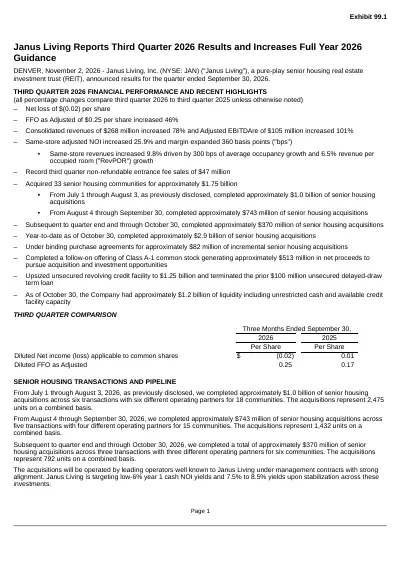
For the third quarter 2026, consolidated revenues increased 78% year-over-year, adjusted EBITDA increased 101%, and FFO as adjusted per share increased 46%. Moving to performance, same-store revenues increased 9.8% year-over-year and 2.4% sequentially.
This was driven by 300 basis points of year-over-year occupancy growth, led by independent living. Sequentially, same-store occupancy increased 110 basis points.
Occupancy is approaching 90%, and we expect continued gains given the favorable supply-demand dynamics. RevPOR increased 6.5% year-over-year, or 4.4% excluding nonrefundable entrance fee amortization, as our operators continued to deliver quality resident care and value.
We also achieved record third quarter nonrefundable entrance fee sales of $47 million. Same-store expenses increased 4.6% year-over-year, and on an expense per occupied unit, or EXPOR basis, increased 1.7%.
As occupancy grows, we expect to show continued operating leverage given the large scale of our Life Plan Communities and more independent living focus. Same-store NOI increased 25.9% year-over-year, and margin expanded by 360 basis points year-over-year and 80 basis points sequentially.
Within the non-same-store portfolio, occupancy was approximately 84% and includes communities acquired this year and transitions. Occupancy is starting to stabilize across the 18 community transition portfolio as those new operators execute community-specific business plans.
Shifting to the balance sheet and capital allocation, in August, we completed a follow-on offering of Class A1 common stock, generating $513 million in net proceeds. In September, we upsized our unsecured revolving credit facility to $1.25 billion and terminated our $100 million delayed draw term loan.
We continue to source opportunities directly from our deep network of operator relationships. Year to date, we've completed $2.9 billion of acquisitions.
During the third quarter, we completed $1.75 billion of acquisitions. Subsequent to quarter end, we completed an additional $370 million of acquisitions, and we have another $82 million under binding purchase agreements.
Year-one cash NOI yields across completed acquisitions are in the low 6% range, improving to 7.5% or higher by year three. As of October 30th, we had approximately $1.2 billion of available liquidity, including unrestricted cash and available credit facility capacity.
Ending with guidance, we are increasing our 2026 FFO as adjusted guidance range from 95 cents to 98 cents to 97 cents to 99 cents per share. We are also increasing our same-store adjusted NOI growth guidance range by 250 basis points at the midpoint to 16% to 19%.
The updated midpoint is 750 basis points higher than the initial guidance range provided by Healthpeak for the same portfolio in February, driven by outperformance across occupancy, rate, and expenses. Our updated guidance now includes $2.3 billion of capital sources from our IPO, follow-on offerings, and credit facility, and $2.3 billion of post-IPO acquisitions.
The momentum at Janus Living has only accelerated since our March IPO. Our priorities remain unchanged and focused on partnering closely with our operators to elevate the experience for our residents and staff, and adding high-quality, durable communities to our portfolio that are built to perform through every cycle.
With that, operator, please open the line for Q&A.
Operator
We will now begin the question-and-answer session. Please limit yourself to one question.
To ask a question, you may press star then 1 on your touch-tone phone. If you are using a speakerphone, please pick up your handset before pressing the keys.
To withdraw your question, please press star then 1. In the interest of time, callers will be limited to one question.
At this time, we will pause momentarily to assemble our roster. Your first question comes from the line of Ronald Kamdem with Morgan Stanley.
Ronald, your line is open. Please go ahead.
Ronald Kamdem
Great, thanks. Look, the 26% same-store NOI, clearly a big upside surprise in the quarter.
I guess I'd love to double-click on that and get some thoughts on both in terms of occupancy and pricing, just what you see going on in the portfolio and how sustainable that is as we flip the calendar to next year. Again, occupancy and pricing, thoughts on what's happening and thoughts as you flip the calendar.
Thanks.
Jonathan Hughes
Ron. It's Jonathan.
On occupancy, you continue to see improvement there. The supply-demand dynamics are pretty well known and speak for themselves, and I think the value and lifestyle provided by our Life Plan Communities is very attractive to that resident cohort.
Supply is very low. I would say, on the rate side, you saw a pick up there from last quarter, even excluding entrance fees.
That's again reflective of the supply-demand backdrop. As we look ahead to next year, we're not providing guidance yet.
We'll provide that in a couple months. Everything is continuing to run pretty similar, and we would expect similar metrics for next year.
Scott?
Scott Brinker
Yeah, 3Q was really high. Our midpoint of 26 same-store is 17.5%.
3Q at 26.5%, it was a phenomenal quarter. Don't get me wrong.
Phenomenal on all aspects. We also had a fairly low comp in 3Q of '25.
It was plus 10%. It was our easiest comp, too.
That does play a factor. It's a relatively small portfolio.
It's just the 15 Life Plans. Now, all these acquisitions that we've made in 2026, those will start to come into the pool in 2027.
The composition will change. The growth profile of those acquired assets should be relatively similar just given the occupancy in place around 86%, 87% for those acquired assets.
They should have similar dynamic to what we're seeing in the Life Plan portfolio right now.
Operator
Your next question comes from the line of Farrell Granath with Bank of America. Farrell, your line is open.
Please go ahead.
Farrell Granath
Hi, thank you for taking my question. I just wanted to dig in a little bit deeper, especially about the stabilized NOI yields that we're seeing across the quarters.
It took a step down in this 3Q, the 7.5% to 8.5% targeted NOI yield for the volume that you disclosed. Just curious about what are some of the puts and takes or composition of what was acquired that maybe drove that yield lower, and if you have more confidence at that stabilizing at that level, just given current interest rates.
Scott Brinker
Our underwriting really hasn't changed. There's going to be quarter-to-quarter volatility just given the size of the company.
We're buying single assets, small portfolios. Each one is going to be a little bit different in terms of asset quality, how much risk we're taking.
Generally speaking, we're doing everything at a 7.5% or better by year three. That's just kind of the base-case underwriting, in addition to a market that we like, a price per unit that we like, and obviously an operator that we want to do business with.
I wouldn't say the underwriting has really changed at all. Frankly, the spreads have gotten better as our cost of capital has improved, there may be a quarter-to-quarter differential in stabilized returns.
If anything, the spread on investment today is even better than it was in 1Q, certainly when we did the IPO. We feel pretty good about the ability to make an impact on earnings through external growth right now.
Operator
Your next question comes from the line of Jamie Feldman with Wells Fargo. Jamie, your line is open.
Please go ahead.
Hey, good afternoon. This is Jesus on for Jamie.
Thanks for taking the question. You guys previously expected the transition communities to build momentum in the second half.
Can you just talk about the progress that portfolio made, I guess, during the third quarter?
Scott Brinker
Happy to do that. I'm glad we made the change.
We always wish we could have done it sooner. There's always some short-term disruption, but we did have the JV partner, when we bought them out in the first quarter.
We were able to then complete the operator transition. We saw the noise that you would expect.
It looks like occupancy is starting to stabilize. We're expecting some progress through year end and into 2027, but it takes some time: technology, in some cases leadership teams, but just different cultures and facility-specific business plans.
We're making good progress, and there's a lot of upside to capture in that portfolio. Most importantly, just we think providing a better environment and product to those local markets.
Next question.
Operator
Your next question comes from the line of Michael Carroll with RBC Capital Markets. Michael, your line is open.
Please go ahead.
Michael Carroll
Thanks. Scott, how many of the acquisitions in 3Q '26 does Janus plan or did they actually do an operator transition?
Then, in those cases, how do you underwrite the disruption when that happens? Do you underwrite that, with that a new operator, there's a small disruption at the beginning before they pull it back up?
I'm assuming that's reflected in their yields, but just trying to get a better understanding of that.
Scott Brinker
Thanks, Mike. For the most part, our acquisitions are being sourced by our operating partner, and in most cases they are the incumbent operator.
They're just looking for a recap of a building that they're already in. Plus or minus, 80% of the acquisitions year to date have no operator change.
In the situations where there is a change, we're obviously less aggressive in year one on the underwriting, in some cases backing down occupancy fairly meaningfully. For the most part, that isn't something we have to worry about.
The vast majority of the time, the operator is bringing the deal to us and staying in. Next question.
Operator
Your next question comes from the line of Sydney McEntee with JP Morgan. Sydney, your line is open.
Please go ahead. As a reminder, make sure to unmute yourself locally.
Sydney, your line is open.
Sydney McEntee
Hi, sorry.
Operator
No worries.
Sydney McEntee
I just wanted to ask about how you're thinking about the funding options in front of you between debt and equity. What right now would make you tap the debt markets and give up that debt-free stat?
If you were to tap the debt market or term loan market today, where do you estimate your current cost of debt would sit relative to the 6-ish initial yields you're seeing on acquisitions?
Kelvin Moses
Hey, Sydney. This is Kelvin.
I'll jump in on that one. I think we've been successful and supported in the equity markets, which has allowed us to do three transactions on the equity side including the IPO this year.
That continues to be the primary source of capital to help us fund our external growth. We'll certainly utilize the balance sheet strategically, and we've positioned ourselves to have more capacity on balance sheet.
You probably noticed the upsize of our revolving credit facility to $1.25 billion that gives us a considerable amount of flexibility on an interim basis to utilize that. Then, going into 2027, we will pursue an investment-grade credit rating for the business to provide incremental options and more flexibility on balance sheet as we think about long-term financing options for Janus Living.
Quite a bit of optionality that we'll have in front of us. We'll continue to utilize equity as a source of capital.
With regards to the cost of term loans, I think, simplistically, the swapped term loan would be in the, call it, mid-5s. That's probably a good indication of where that debt would price, but it still would be accretive relative to our initial yields on acquisitions in that kind of 6% area.
A lot of optionality for us, a lot of flexibility with the balance sheet being largely unlevered today.
Operator
Your next question comes from the line of Austin Wurschmidt with KeyBanc Capital Markets. Austin, your line is open.
Please go ahead.
Austin Wurschmidt
Great, thanks. Scott, as you guys continue to scale the platform, can you just talk about sort of the approach towards technology and just the operating efficiencies and things that you're doing to drive those efficiencies?
I know you made some hires recently. Would just love to know kind of some of those initiatives and efforts that are underway.
Thanks.
Scott Brinker
This is one area where Janus Living, as a relatively small company, is benefiting from the affiliation with Healthpeak, who has made significant investments in technology, people in particular doing a phenomenal job. I won't add to the AI commentary of how it's redefining business, but, frankly, it is.
We're using it in just about every area of our business imaginable. We did a presentation to our operating partners at the NIC conference a week or two ago, and I think they were pretty well blown away by the things that we're doing that will become available to them.
We're not jamming it down their throat. They don't have to use it, but it's available to them.
I think we'll get a pretty strong uptake rate because it's pretty phenomenal. I think the most amazing thing in my view is that technology that would have taken years and years to build and cost an awful lot of money and require a lot of data is just not necessary anymore.
The speed at which you can build a phenomenal project that's completely tailored to what you want is mind-boggling. In some ways, we benefit from being a start-up, in that we don't have the existing bowl of spaghetti technology that we have to work our way around.
We can actually start from scratch, and just given where technology is today, that may actually turn out to be an advantage. We're pretty excited about what we're working on and the team that we've hired, and it's ability to differentiate Janus Living from a number of the peers.
We'll find the right avenue to share that progress with the public markets like we did with the operators a couple weeks ago. Next question.
Operator
Your next question comes from the line of Michael Stroyeck with Green Street. Michael, your line is open.
Please go ahead.
Michael Stroyeck
Thanks, and good morning. I know you mentioned entrance fees are up double digits.
Is that similar on more of a same-property basis, or is that impacted by the mix of assets that are seeing more move-in activity? Then, I guess, how does that rate growth on entrance fees vary across the communities?
Maybe some color on growth for the higher-occupied facilities versus lower-occupied would be helpful.
Scott Brinker
It is the same portfolio, it's not like there's a change in the mix. It's the same 15 Life Plan Communities throughout, it's a pure apples-to-apples comparison.
You do have various price points throughout the portfolio. We have projects in suburban Washington, D.C.
at a higher price point than what you would find in, say, Orlando or Tampa. You have one-bedrooms versus three-bedrooms, there are things that will impact the price change from quarter to quarter.
The reality is we had phenomenal sales throughout the portfolio on both a number of sales, but also the price point in 3Q. Congrats to well, LCS as the on-the-ground operator.
That's five years in process to create that outcome, and investments that we made into the portfolio, both the units as well as the amenities, and then, obviously, the programming on the ground by LCS. That doesn't happen overnight.
That's multiple years of work to get from where we were to where we are today.
Operator
Your next question comes from the line of Rob Simone with Compass Point. Rob, your line is open.
Please go ahead.
Rob Simone
Hey, guys. Thanks for taking the question.
With the acquisitions in 3Q, the bed mix shifted a little bit more towards AL and memory care. I guess, as you guys continue to scale the platform, in your mind's eye do you have kind of a targeted bed mix between IL and AL, memory care?
Anything you could share there would be really helpful. Thanks a lot.
Scott Brinker
We do not have a targeted mix in mind. I think the difference between the two product types is sometimes less significant than what the words on the page might suggest in terms of what the resident profile looks like or what the building looks like.
What we do like is the bigger communities. We've averaged plus or minus 150 units per building that we've acquired, and the vast majority have some level of continuum: at least two service types, if not all three.
That's more the criteria. Today, we do have a heavier skew towards independent living than maybe most of the peers, closer to 50/50.
That's not by design. That's just the types of projects that were presented to us that made sense from a pricing and returns standpoint.
There's no predetermined mix. We actually like both, and preferably to have both service types on one campus.
Operator
Your next question comes from the line of Dave Rodgers with Raymond James. Dave, your line is open.
Please go ahead.
Dave Rodgers
Hey, guys. Just wanted to follow up on acquisition volumes.
I know you don't really give a target in the outlook, but just given that you've gone from the two to the 13 operators now, how many of those operators do you want to continue to grow with or might they have another decent-sized portfolio that they're operating where you can grow? Seasonality-wise, what are you seeing
Scott Brinker
kind of coming to market at this point in time? Every one of them.
Dave, every one of them. We wouldn't bring them into the portfolio if we didn't have a growth expectation, and that's one reason they have a desire to work with us: we help them grow, they help us grow.
Mutually beneficial. Across the board, that's one reason that our pipeline is only getting bigger as we add new operators to the portfolio.
There's a few more in the pipeline. That's an important part of the business plan.
At the same time, probably, plus or minus, 20 is the at least near-term game plan. There are benefits to having that number versus the two that we started the year from just from a diversification standpoint, more growth opportunity, with more partners bringing us opportunities and acquisitions.
At the same time, we don't necessarily want 50 operators. That, at some point, at least for a company our size, you start to hit diseconomies of scale, and operators tripping over themselves, and conflicts in local markets.
We'll be thoughtful, but we've been pretty amazed to go from two to 13 in essentially seven months, and we'll have a few more by year end. Most important is the quality of the groups that have come into the portfolio, really providing exceptional service on the ground to drive a sustainable business model, not just in this high-demand, low-supply environment, but throughout.
They're just people that we want to do business with. Probably the most rewarding part of everything that we've done year to date.
Next question.
Operator
Your next question comes from the line of Marc Akinbi with Barclays. Marc, your line is open.
Please go ahead.
Marc Akinbi
Great, thank you for taking the question. At the beginning of the call, you mentioned that same-store RevPOR growth excluding entrance fees accelerated.
How much of that was due to contractual rate increases relative to CPI versus changes in market rate pricing?
Jonathan Hughes
CPI, the Life Plans, for existing residents, you're capped at CPI plus 2%. You did see inflation accelerate.
It is a bit of a lagged calc, but inflation has moved a little bit hotter and higher this year, so that's a benefit to that number you're seeing there. I think importantly, the demand for the product in the third quarter, it was a record in terms of sales in dollars of entrance fees.
It's effectively a private-pay business, and so there's all this demand in there. If you're more fully occupied, you can charge a better price and higher price.
Of course, the care and the value has got to be there in terms of delivering, but the strong demand is what's reflected mostly within that RevPOR growth figure.
Scott Brinker
We don't have a lot of turnover. It's an 8 to 10-year length of stay, for the most part that RevPOR is driven by in-place residents, just given the long length of stay.
There's only so many new residents in the portfolio in any given year. Next question.
Operator
That concludes the Q&A session. This concludes today's conference call.
Thank you for your participation. You may now disconnect.