James Hardie Industries plc.
Q2 FY2027 · Earnings Call TranscriptNovember 5, 2026
Operator
Welcome to the James Hardie second quarter fiscal year 2027 earnings call. After today's prepared remarks by management, there will be an opportunity to ask questions.
If you would like to ask a question, please press star one to raise your hand. To withdraw your question, press star one again.
I would now like to hand the call over to Bill Seymour, VP of Investor Relations. Please go ahead.
Bill Seymour
Thank you, Operator, and thank you to everyone for joining today's call. I am joined today by Aaron Erter, CEO of James Hardie, Ryan Lada, CFO, and Jon Skelly, President and General Manager, North America Building Products.
Before we begin the call, please note that during prepared remarks and Q&A, we may refer to non-GAAP financial measures and make forward-looking statements. You can refer to several related cautionary and other notes on slide two of our earnings presentation for more information.
Forward-looking statements made during today's conference call and in the earnings materials speak only as of the date of this call. Forward-looking statements are subject to risks and uncertainties that could cause actual results to differ materially from those in the forward-looking statements.
Accordingly, investors are cautioned not to place undue reliance on forward-looking statements. In addition, non-GAAP measures should not be considered in isolation or as a substitute for results prepared in accordance with GAAP.
Reconciliations of non-GAAP measures discussed today can be found in our earnings presentation, which is posted on our website. Also, unless otherwise indicated, our materials and comments refer to our continuing operations excluding Europe, following the announcement of our planned divestiture of our European segment and its corresponding reclassification into discontinued operations.
Further, unless otherwise noted, figures are in US dollar and any comparisons made are to the corresponding period in the prior fiscal year. With that, I'll hand the call to Aaron.
Aaron Erter
Thanks, Bill. In my remarks, I'll cover what drove our second quarter performance and the progress we are making against the commitments we laid out for fiscal 2027 and reinforced at Investor Day.
Then I'll hand it to Ryan to walk through the financials and guidance in more detail. Q2 was a strong quarter against a challenging housing market backdrop.
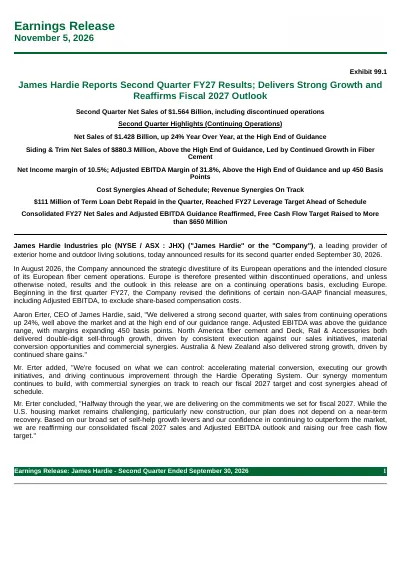
Net sales from continuing operations grew 24%, driven by strong sales performance across each of our segments. Reported growth included some expected timing benefits, which we'll separate out today, and you'll see that our underlying performance remains well ahead of the market.
We delivered this by staying focused on what we can control: material conversion, commercial execution, cost discipline, and continuous improvement through our Hardie Operating System. Let me get into the quarter.
The housing and macro backdrop remains uncertain and has weakened versus our May assumptions. Multiple indicators are pointing to softer conditions, especially in new construction and, to a lesser extent, repair and remodel.
Based on external estimates and our own market intelligence, we now expect the market, using our blend of 60% repair and remodel and 40% new construction, to decline by a mid-single-digit percentage in total this year, compared to our May estimate of a low-single-digit blended decline. Within that, we expect repair and remodel to be down low single digits and new construction down high single digits, which means we expect the market to decline more in the second half than it did in the first half.
Despite that, we continue to expect to outperform the market in both the second half and for the full year. Looking at the second quarter, even excluding channel normalization and the net impact of the distribution changes, our sales growth and sell-through were well above the market, and in excess of the 4% to 7% of annual above-market growth we targeted at Investor Day.
Siding and Trim net sales were up 15% and above the high end of our guidance range. This performance and growth above market primarily reflected continued traction from our sales initiatives.
Multi-family growth was also strong, reflecting our share gains in this category and its relative affordability in this environment. In Deck, Rail and Accessories, sales were up 51%, in line with our expectations, driven by share gains, execution against material conversion opportunities, and the positive impact of distribution changes.
The decking market continues to outperform the broader market, and demand remains resilient in the premium end of repair and remodel, where we are very well positioned. Australia and New Zealand delivered another strong quarter, with sales up 21%, driven by continued share gains.
Product innovation remains a highlight. Our new Hardie Gravis AAC panel, launched in June, extends our reach into mixed material facades, and TimberTech by James Hardie decking is bringing these products to the region as we expand into outdoor living.
Earlier this year, we laid out five clear fiscal 2027 commitments: return fiber cement to growth, outperform the market across our portfolio, expand adjusted EBITDA, deliver cost and revenue synergies, and drive a step up in free cash flow to support deleveraging. Halfway through the year, we're pleased with our progress against each of these.
First, returning fiber cement to growth. North American fiber cement revenue grew 15% in the quarter.
Our fiber cement growth plan is focused on three conversion priorities: converting vinyl siding, winning against wood, and expanding our premium products. On vinyl, our trim-over method is moving the needle, opening up lower-priced homes that have historically been harder for fiber cement to reach, particularly in the Northeast and Midwest, where repair and remodel wood and wood-look siding alone represent an approximately $1 billion conversion opportunity.
Trim-over, which surpassed 16 million installed square feet in the quarter, significantly lowers on-the-wall costs and improves contractor economics. The rollout of Hardie ProLab is turning that value proposition into strong momentum.
On wood conversion, as we outlined at Investor Day, we continue to focus on the $1.3 billion fire code opportunity in the West. In premium products, sales of our higher-price, higher-margin ColorPlus fiber cement siding products grew 22% in the quarter, helped in part by our program to improve product availability for contractors at the job site.
This contributed to strong positive mix in the quarter. Second, market outperformance.
Our model is working. We're not waiting for the market to get better.
We're using our own levers: a $23 billion material conversion opportunity, growth initiatives, and commercial synergies to drive growth above the market. Third, adjusted EBITDA expansion.
Adjusted EBITDA margin was nearly 32% in the quarter, up 450 basis points, showing the earnings power of our model. Fourth, revenue and cost synergies.
On commercial synergies, momentum continues to build. We are on track to reach both our fiscal 2027 target of $125 million in run-rate commercial revenue synergies and our total $500 million target.
Our expanded distribution partnerships with Boise and our regional distributors are a foundational driver. The bigger opportunity is what is happening now: cross-selling to builders, dealers, and contractors across the combined portfolio.
On cost synergies, we remain ahead of schedule, having realized $90 million cumulatively since deal closing. As we reiterated at our Investor Day, we expect to achieve our three-year target early, exiting fiscal 2027 at a $125 million cost synergy run rate.
We don't intend to stop at $125 million. We see additional opportunities from extending the Hardie Operating System into our Deck, Rail and Accessory plants, procurement scale, formulation work, and systems consolidation.
Finally, free cash flow and deleveraging. Based on strong first half performance, we are raising our full year free cash flow target.
That cash generation, together with $600 million of Europe sale proceeds earmarked for debt repayment, keeps us well on track to reach our leverage targets. With that, I'll turn it over to Ryan, who will walk you through our financial results and outlook.
Ryan Lada
Thanks, Aaron. Before I get into the results, let me cover a few technical items.
Beginning in the second quarter, the Europe segment is classified as held for sale and presented as discontinued operations. Europe's results are now excluded from our net sales and adjusted EBITDA from continuing operations.
Instead, they appear as a single line on our income statement. Prior periods have been recast on the same basis.
This affects consolidated results only, not segment results. Both our prior guidance and today's guidance are on a continuing operations basis, excluding Europe.
As a reminder, beginning last quarter, adjusted EBITDA and our other non-GAAP measures exclude share-based compensation expense. Finally, with the AZEK acquisition now fully lapped, we will no longer reference pro forma or organic growth metrics for quarterly comparisons.
Now to the results. Net sales from continuing operations for the second quarter were $1.43 billion, up 24%, at the high end of our guidance range.
Adjusted EBITDA was $455 million, up 44%, above our guidance range. Adjusted EBITDA margin was 31.8%, up 450 basis points.
The strong margins were driven by volume, price and mix, and HOS savings, offset by general inflation and higher freight costs. Incremental flow-through was approximately 45% in the first half, above our 35% plus Investor Day framework.
Adjusted diluted EPS from continuing operations was 42 cents, up 68%, driven by the increase in operating income and lower interest expense on debt. We expect incremental cost pressure in fiscal 2027 to be at the high end of our prior $80 to $100 million range, primarily from freight, raw materials, and energy.
Roughly two-thirds of that impact is in North America. Freight remains the larger source of pressure, compounded by higher diesel prices, and North America fiber cement is the most affected.
Raw material costs are still a factor, but they have moderated as expected. These pressures are reflected in our guidance.
On freight, as we've previously discussed, approximately 90% of our lanes are contracted, with the remainder priced at spot, where we have seen considerable pressure. We are contracting additional lanes now, targeting increased contracted coverage by the start of fiscal 2028 to materially reduce our spot exposure.
On the other side of the ledger, cost synergies and footprint optimization are delivering benefits on our quarterly results, helping offset inflation alongside pricing realized this year. The Hardie Operating System, now introduced across the legacy AZEK footprint, supports disciplined cost management as volumes change.
We will continue to align our cost base with market conditions. In Siding and Trim, net sales were $880 million, up 15% and above our guidance range.
Fiber cement growth was approximately half volume, with the remainder driven by price and mix. Sell-through was up low double digits, well ahead of declining end markets.
Siding and Trim adjusted margin was 34.6%, up 540 basis points, reflecting volume leverage, price and mix, continued plant and HOS savings, and the manufacturing footprint optimization work. In Deck, Rail and Accessories, net sales were $387 million, up 51%.
Of that growth, approximately 21 percentage points came from the distribution changes at Boise and other distributors, and 16 points from channel inventory normalization after Q1. That leaves you with approximately 14 points from underlying growth.
Sell-through was up low double digits, well ahead of the overall market decline. Sell-through was strong across both pro and retail channels.
Adjusted EBITDA margin was 33.3%, up 260 basis points, driven by higher volume and pricing, and production returning to normal levels after the first quarter. Despite all the changes with our distribution partnerships, channel inventories ended the quarter at healthy levels, aligned with demand, for both Siding and Trim and DR&A.
In Australia and New Zealand, US dollar net sales were $161 million, up 21%, and up 12% in local currency. EBITDA margin was 35.3%, reflecting strong flow-through on higher volumes, manufacturing efficiencies, and lower input costs.
Free cash flow was $535 million in the first half, driven by higher earnings, lower CapEx, lower integration expense, and improved working capital management. Free cash flow conversion of adjusted EBITDA is expected to be over 40% this year, modestly ahead of our 38% target we set for fiscal 2027.
We repaid $111 million of term loan debt in the quarter, bringing total debt repaid since closing the AZEK acquisition to just over $1 billion. Net leverage ended the quarter at 2.3 times, already ahead of our 2.4 times fiscal year-end target.
We will continue to focus on debt paydown, and fully expect to achieve our leverage target of below 2 times by fiscal Q2 2028. Turning to our outlook for the third quarter and fiscal 2027, both excluding Europe.
In Q3, we expect net sales from continuing operations of $1.058 to $1.14 billion. We expect adjusted EBITDA of $298 to $320 million.
For the full year of fiscal 2027, we are reaffirming our outlook. On a continuing operations basis, we expect full year '27 net sales of $4.99 to $5.133 billion, or growth of 6% to 9%, and adjusted EBITDA of $1.45 to $1.534 billion.
Our guidance at the midpoint implies consolidated net sales in the second half of fiscal 2027 will be down slightly year-over-year, still outpacing the market. In Siding and Trim, two factors drive the decline from the first half.
First, we now assume the new construction market weakens further in the second half, and will be down high single digits for the year. Second, first half fiber cement results benefited from the comparison against last year's destock.
In DR&A, there are three drivers. First, we expect the R&R market will be modestly weaker in the second half than in the first, and down low single digits for the year.
Second, the third quarter is seasonally the lowest quarter for DR&A, as customers traditionally reduce inventory heading into calendar year-end. Third, the first half included one-time benefits, most significantly the load-ins at Boise and other distributors associated with the distribution changes.
Across both segments, given the uncertain macro environment, we are being deliberate about keeping channel inventories healthy. We continue to expect both Siding and Trim and DR&A to outperform the market in the second half, consistent with the framework we outlined at Investor Day.
Second half EBITDA for both segments is expected to be lower, reflecting reduced volumes, the incremental freight costs discussed earlier, and planned costs associated with distribution changes. We are raising our full year free cash flow target to more than $650 million, up from $600 million or more.
Two things are driving that increase: first, our financial outperformance in the first half; and second, favorable working capital, mainly from inventory reduction. A few other modeling notes: our adjusted effective tax rate was 21.8% in Q2, and we expect about 22% going forward.
Weighted average diluted shares were 586 million, and should remain broadly consistent throughout the year. Adjusted net interest was $58 million in Q2, and we expect about $55 million per quarter for the rest of the year.
A quick update on the Europe divestiture: the sale process is on track, and we continue to expect to close the transaction in the first half of calendar year 2027. The wind-down of our European fiber cement business is also on track, and we expect to complete it prior to close.
With that, I'll turn the call back to Aaron.
Aaron Erter
Thanks, Ryan. Before we open it up to questions, let me leave you with a few thoughts.
At the halfway mark, we're delivering against the commitments we made for fiscal 2027. Fiber cement is back to growth.
We're outperforming the market. We're expanding adjusted EBITDA.
Revenue synergies are building momentum, and cost synergies are ahead of schedule. Free cash flow is driving deleveraging, giving us more future optionality and how we allocate capital.
We're focused on what we can control. We have a clear strategy, a broad set of self-help growth levers, and a team that is executing.
Looking ahead to the rest of this year, we believe our outlook is prudent in light of the current market environment. We're not assuming a near-term housing recovery, and we don't need one to execute our plan.
When the market does turn, we're well positioned to capitalize. Finally, I want to thank our teams across James Hardie for their hard work, focus, and commitment to our customers every day.
We're proud to have been recognized by Forbes as one of the world's best employers in 2026, and that recognition belongs to our people. None of this happens without them.
With that, Operator, please open the line for questions.
Operator
We will now begin the question-and-answer session. If you would like to ask a question, please press star one to raise your hand.
To withdraw your question, press star one again. We ask that you pick up your handset when asking a question to allow for optimum sound quality.
If you are muted locally, please remember to unmute your device. Please stand by while we compile the Q&A roster.
The first question comes from Michael Rehaut with Melius Research. Please go ahead.
Mike Rehaut
Hi, good afternoon. It's Mike Rehaut.
Thanks for taking my questions and congrats on the quarter. First, I'd love it if you could kind of walk through kind of a regional review, how the markets are doing, anything standing out more positively or negatively.
Obviously the macro is changing, and you talked about that in your remarks, but just would love to understand how things are going and how they progressed throughout the quarter.
Aaron Erter
Sure. I got that one.
Hey, Mike, thanks for the question. Let me try to keep this as succinct as possible, but we'll take you a little bit of a tour.
Start with the macro and then go into some of the regions. Look, I think the first thing that we mentioned on the call several times, and what's important, is we're outgrowing the market, even though the backdrop is weaker than when we guided in May.
We think, and third-party sources confirm, we think R&R has softened a bit further, approaching mid-single-digit decline versus low single digit in May that we talked about. New construction has really gone down from mid-single digits to what we think is high single digits.
New construction is soft, as I mentioned, and we're particularly seeing that in areas like Texas and the West. R&R in total is holding up better than new construction, but still down.
Higher-end work is the strongest, particularly in areas like the Midwest and Northeast, which really plays right along with our strategic priorities here. The other piece I'll mention when we think about the segments is multi-family.
The market is choppy, but with affordability keeping buyers out of single-family homes, we're seeing good growth for us in that segment. Let me just hit on a couple of the regions here.
I mentioned South Central in Texas, and that remains, even though we're positive there, that is our weakest-performing region, and that is because of some of the challenges we're seeing in new construction. If I look at the Southeast, the Carolinas remain a structural bright spot.
That's driven really by the in-migration, and we believe we're growing above the market and really taking share with our trim-over product, and we continue to see good progress there. If I look at the West, the West is probably the weakest region.
If you look at completions and new home sales are both down double digits. Builder confidence remains low.
Affordability remains a key concern. Even with that said, our West volumes still grew significantly, and we think we're taking share out there in the West.
Then I mentioned before the Midwest. Repair and remodel is doing well in the Midwest, which is a bright spot for us, certainly in decking, and we're also continue to make significant progress when we think about our ColorPlus and trim-over product.
If we look, and I know we've quoted this before, if we look at some of our fiber cement volumes, we're growing low double digits, and with ColorPlus, we're up close to 20% on conversion from vinyl. If you remember, that is the pilot region we really started with the trim-over, so, good proof point there.
Let me just sum it up here. The Northeast is really the weakest region for new home starts, but really strong from a remodeling standpoint, and we're certainly seeing that in the favorability with our Deck, Rail and Accessories business, but also our ColorPlus volumes.
Our revenue in the Northeast were up 35%. As you look at the macro, you look at some of the regional, I think the big takeaway is we are outgrowing the market, even with the softness.
If you think about our strategy, we're really executing well.
Mike Rehaut
All right, that's a great review. Thank you for that, Aaron.
Second question, maybe kind of a slight two-parter. In one, just to clarify, talked about growing in excess of your 4% to 7% above-market target, I just wanted to get a finer detail on what you estimated that was for the quarter.
Secondly, on the margin or EBITDA profit dollar reiteration, just wanted to get a sense. It seemed slightly lower in Siding and Trim, slightly higher on Decking and Rail.
What's allowing you to offset the higher cost inflation coming in at the higher end?
Aaron Erter
Mike, I'll take the first, then I'll hand the margin question over to Ryan. We're really confident when we think about in Investor Day, we said, "Hey, our target is 4% to 7% above the market."
If we gauge the market being down, call it, and certainly a full year has to play out, but we think mid-single digits, if you look at fiber cement, we were up about 15%. Half of that is from price and mix, the other from volume, we're certainly outpacing the market almost from a double-digit standpoint.
We would say really the same thing as we look at DR&A. Ryan, you want to take the margin question?
Ryan Lada
As you think about the $80 to $100 million cost pressure, when we guided the year, we've held that consistent throughout the year, we weren't really ever planning for a relief, and I think it was prudent that we did so. When you think about kind of how we offset it, right, we continue to focus on HOS savings and other network optimization, deploying HOS across AZEK to help offset that.
We're applying HOS to SG&A as well. Then we did do a modest mid-year price increase that was pretty selective across certain products, and that helped absorb some of the pain as well.
From a whole-year perspective, we've been maintaining that range, and nothing's really changed. We still expect the cost exposure to be roughly in that $100 million range.
The buckets have just shifted a little bit.
Mike Rehaut
Great. Thanks so much.
Aaron Erter
Thanks, Mike.
Ryan Lada
Thank you.
Operator
Your next question comes from Lee Power with JP Morgan. Please go ahead.
Lee Power
Thank you all. Thanks for the time.
Aaron, maybe just on the Boise rollout, I think you said a few times around healthy inventory in the market. It'd just be interesting to see how your approach to that changed through the period, if at all, because you obviously wanted to succeed, but it's a kind of a tough environment to do it where you've got, as you said, an end market that's kind of deteriorating at the same time.
Aaron Erter
Lee, look, I don't think anything has changed for us. I think what we're being very cognizant of, and John's in here and the team and continually looking at, is we want to make sure we're getting our two-step partners like Boise stocked up, but also with that said, being cognizant of making sure we're not overstocking with inventory.
As we look, and Ryan talked about some of the numbers, if you look in the back half of the year, we are focused more on sell-through, right, which is going to be better than what we think is sell-in. We're on track with Boise and all of our regional distributors as far as getting them stocked up, certainly Boise the largest one when we think from a Deck, Rail and Accessories standpoint.
I think for where we're at in the season and what we're preparing to do, we would reiterate the inventories are at expected levels for us.
Lee Power
Perfect. Then just a follow-up, as a bit of a broader question, is there a scenario where you think R&R can be up and new construction down in the kind of the current backdrop?
Clearly both of you said have deteriorated. I'm just trying to think, as we go forward, is there a scenario, a lot of your peers have obviously chatted to new construction being down, but return in calendar '27, do they have to move in lockstep, do you think, the markets in the current backdrop, or is there a scenario where one can be positive and one can be negative?
Aaron Erter
Look, I think what we would say, Lee, and this is from talking to a lot of our customers, and certainly things can change, is we don't see much of improvement or any help from a market standpoint. What we can focus on is how we perform in those markets, and certainly our focus is outperforming the markets, 4% to 7% like we put out there from a growth algorithm standpoint.
Certainly repair and remodel, we're not seeing as impacted like new construction. If you think about our mix now as a new company, we're 60% repair and remodel and 40% new construction, but certainly that decline in new construction, we think, is real and continues to grow, and we see an impact of that.
Lee Power
Appreciate it. Thank you for the call.
Aaron Erter
Thank you, Lee.
Operator
Your next question comes from Phil Ng with Jefferies. Please go ahead.
Phil Ng
Hey, guys. Congrats on [unclear] decking, right?
Decking tends to be more resilient in general.
Aaron Erter
Hey, Phil, we're losing you. You keep going in and out.
Phil Ng
Can you hear me better now?
Aaron Erter
We got you now.
Ryan Lada
Yep.
Phil Ng
Okay. On the decking side of things, it tends to be more resilient.
Curious what your contractor survey work, web traffic is telling you. Also from a inventory standpoint, I think you said you guys were fine, but I think Boise actually came out and said perhaps inventory in the channel is a little more heavy.
Is that a consideration in terms of your outlook for the back half for decking? It feels a little more muted versus perhaps your biggest competitor who's talking about an acceleration in the terms of sell-out trends.
Aaron Erter
Look, I'll start out with your first question when you think about decking being more resilient. Certainly as you look across the platform here of some of our competitors here, you've seen pretty good results from a decking standpoint, and that would say that decking is bucking the trend.
We think decking is positive, but with that said, we continue to outpace the market. If you look at our DR&A business, we're up, call it, 14%, 15% for the quarter.
I think the other thing that's important to note, and you do see some of our competitors talking about, we think it's good that the trend is up, but if you look at the legacy TimberTech business, and I look at this really on a two-year growth stack, we're up about 21%. If you look at that versus anyone else, we continue to outgrow the market, and we expect to continue to do that even with the market being positive in decking.
Phil, what was your last question? Was it about Boise?
Phil Ng
Inventory levels in the channel.
Aaron Erter
John, you want to hit on inventory levels here?
Jon Skelly
Yeah. Phil, the way this works is you immediately want to get Boise in business, right?
What you want to do is you want to accelerate the load-in at the inventory, because once you make the announcement, you want to put them in a position where they can immediately start to build customer relationships and take orders. You inject a high amount of inventory, and we gave you all the figures in terms of the amount of growth this quarter that came from that load-in.
You're doing that at the same time where the distribution partners you've exited are burning down the inventory, right? Our expectation is that all of our go-forward distribution partners are aligned with us during this early buy period, where we're out meeting with customers and getting ourselves positions for next year.
Then what you'll see is we flip into the next calendar year, Boise will start to sell through all that inventory that we've placed with them, and we will have exited our former distribution partners at that same time.
Aaron Erter
Yep. Good.
Phil Ng
Okay. It sounds like the load-in and draw-downs creating some noise in your guide for the back half.
Helpful. Perhaps a question for Ryan.
Certainly a lot of inflation right now. Can you give some perspective in terms of what pricing actions you have out there?
Then siding, you guys have announced increases for January, but any color in terms of net realization, and have you guys announced anything on decking and railing as well?
Ryan Lada
To give you context on the quarter, right, I don't think we quoted what the DR&A realization was, but on fiber cement when we had about 15% growth, we said half was volume, half was price and mix. You think about probably 30%, 35% of that was mix.
We continue to see solid traction on ColorPlus sales. Those were up 22% in the quarter year-over-year and are now 25% of our fiber cement portfolio, we are seeing a nice contribution from the mix piece.
In the financial year, right, we did our normal 1/1 increase, and we had a modest selective product increase at the end of April that went into effect for 7/1. We did announce a new increase, which is our traditional annual increase for 1/1 on both sides of the business.
We would expect to see roughly 3% or so, consistent with our framework on fiber cement, and then DR&A in that kind of 2% to 3% range like we've quoted before. Those are our typical annual increases.
We stay consistent with those. That's kind of where we're at.
Any other questions on that matter?
Phil Ng
Is that enough to offset the inflation as we kind of head out to next calendar year?
Ryan Lada
From what we're seeing right now, yes. As we've quoted earlier, right, we have the freight contracts coming up for renew, this year we're trying to expand what we have under contract versus spot.
Then next year as we negotiate those contracts here for the beginning of the calendar year, we will have more under spot, which will reduce some of that exposure from freight,
Aaron Erter
right? Hey, Phil, just to add on to that, look, the other thing that we're benefiting from and we continually talk about is our HOS savings.
The Hardie Operating System, that's the efficiency in which our plants run, that's formula optimization. We've been doing that for years with James Hardie, and we rolled it out to our Deck, Rail and Accessory plants as well.
Obviously, from a pricing standpoint, we'll take price if we need to, but we also rely on that as well.
Phil Ng
Okay. Appreciate all the color, guys.
Thank you so much.
Aaron Erter
Thanks, Phil.
Operator
Your next question comes from Nathan Reilly with UBS. Please go ahead.
Nathan Reilly
Can you hear me?
Aaron Erter
We got you, Nathan.
Nathan Reilly
Great. Hey, I was just looking for a little bit of help.
Can you just help me sort of understand the lower or the declining revenue implied guidance for decking and rail in the third quarter? Just trying to piece together obviously your comments around the market, your price assumptions, but also just the impact of channel load-in.
I just wanted to get a bit of an understanding in terms of what's driving that lower revenue growth for this year, please.
Aaron Erter
You want to take that, Ryan?
Ryan Lada
I can start out, yeah. Historically, Q3 calendar Q4 is Deck, Rail and Accessories lowest seasonal, we have a lot of seasonality there, so that's a seasonal low for us from a quarter perspective.
You do see that decline naturally going into the back half. That's really driven by a lot of our channel partners try to reduce their inventory position by calendar year-end to prepare for early buy and restocking in the spring.
That's one of the major drivers of the drop. Then as we hit on a little bit earlier, right, anytime you have a load-in, the goal is to ensure our end customer demand from a contractor and dealer perspective isn't affected and that we're monitoring sell-through.
We do believe we will work through kind of that additional load-in that we had with Boise through the back half of the year and that normalizes. Those are really the two major reasons to see that there is a decline from the first half to the second half.
I don't know, John, if there's anything you'd add to that.
Jon Skelly
Just what I'd add again, I think the most important equalizer of the load-in trends is sell-through, right? We had really strong sell-through in the quarter.
We've had really strong sell-through all year. The most recent quarter was double digit.
As we start to unpack this current quarter, we continue to see sell-through above our initial guidance for the year, which was mid-single digits. We're continuing to drive strong demand and strong sell-through in the market.
We're just in this one period of low seasonal demand from distribution, coupled with the load-in. Once we work through that at the end of the year, then you get into next calendar year, you start to see sell-through and sell-to equal each other, and we continue to drive really strong demand there.
Aaron Erter
Hey, Nathan, I think it's important, and John mentioned it, and those who haven't covered DR&A before, is Q3 is generally the slowest time. To John's point, what we go through right now is early buy, and we're trying to make sure that we're keeping the inventory clean and we're loading up distributor partners, and then as you get into Q4, you start to see some of that sell-through or our selling and sell-through pick up.
Okay. Thanks, Nathan.
Nathan Reilly
Sure. I was just going to ask just in relation to the PCP, the third quarter guide is obviously quite low relative to the third quarter of '26.
It does sound like that distribution realignment's the key swing factor there in terms of what's driving that lower overall revenue guide
Aaron Erter
versus
Nathan Reilly
the PCP?
Aaron Erter
Yep, that's correct.
Nathan Reilly
Got it. Okay.
Aaron Erter
Thank you. Come on.
Nathan Reilly
Thank you.
Ryan Lada
Thank you.
Operator
Your next question comes from Jeffrey Stevenson with Loop Capital. Please go ahead.
Jeffrey Stevenson
Hey, thanks for taking my questions today, and congrats on the nice results. How big of an opportunity is there for share gains against tier 2 composite decking competitors over the next one to two years who've lost previous stocking positions as a result of the shake-up at composite decking two-step distribution this summer?
Aaron Erter
I'll start out here, and then John can take it from here. Look, when we think about what we're trying to get after from a composite decking standpoint, it is wood.
That is the primary competitor that we're looking to displace out there. John, you want to talk a little bit about some of the opportunity?
Jon Skelly
Again, I think consistent to what we covered at our Investor Day, we've got a downstream strategy and execution model that's working, right? We're, as Aaron mentioned, we're expanding our channel positions, we continue to convert wood to our types of products, and we continue to become better, more efficient from our sales and marketing perspective.
That's what's been enabling us to outgrow the market significantly here over the last multiple years, and this past quarter was a continuation of that. We're not seeing anything slow down there, and we'll continue to see the opportunity to take additional share in the marketplace and grow above market.
We're going to keep executing that strategy. The primary target is wood, but if it also enables us to take share from weaker competitors, then so be it.
Jeffrey Stevenson
Understood. Thanks, John.
When you look at next year in your decking and rail business, do you think you'll need incremental pricing actions to offset cost inflation headwinds you're seeing from continued diesel and transportation headwinds?
Aaron Erter
We're not guiding for next year yet. Ryan mentioned some of the pricing actions that we'll take January 1st, and so right now we believe those are going to be able to cover any type of expected inflation.
Jeffrey Stevenson
Great. Thank you.
Aaron Erter
Thanks.
Operator
Your next question comes from Sam Seow with Citi. Please go ahead.
Sam Seow
Morning, all. Thanks, guys.
Appreciate you taking my questions. Just a quick one on the FY27 guide.
Appreciate you highlighting the change in your underlying market assumptions. I was just wondering if there was any destocking assumption in there as well, or is that implied kind of second half guide just strictly the change in market and inventory levels largely the same?
Thanks.
Aaron Erter
Hey, I'll take that. Look, I think number one, we would say that the guide is prudent, given some of the macro that we talked about.
As I mentioned before, we still believe we're going to be able to outperform the market. What is contemplated in that guide is pretty much everything that we can control and the actions that we're taking with our distributor partners right now.
No major destocking in there, but everything is contemplated in that guide.
Sam Seow
Got it. Then maybe if we think about FY28, appreciate you've given us that nice scenario framework at the Investor Day.
I was just wondering if that includes or excludes the benefit of the load-in this year. If not, what should we assume reverses or doesn't recur again, both in siding and decking?
Thanks.
Aaron Erter
Sam, nice try there. We're not going to give any guidance for FY28.
What I would say, though, is when we think about year-over-year, it is going to be the 4% to 7% outperformance. That's what we're going to stick with.
Sam Seow
Okay. Thanks, guys.
Appreciate the question. See ya.
Operator
Your next question comes from Adam Baumgarten with Vertical Research Partners. Please go ahead.
Adam Baumgarten
Hey, guys. Can you talk about quarter-to-date sell-through in siding and decking, what you've basically seen for the last month, month and a week?
Aaron Erter
John, you want to take that?
Jon Skelly
We continue to see healthy sell-through above market. We're not going to quantify at this point.
Again, the trends that we've seen throughout the year, we've seen continuing into this quarter so far.
Adam Baumgarten
Great. Thanks, guys.
Okay.
Operator
Your next question comes from Harry Saunders with E&P. Please go ahead.
Harry Saunders
Hi, Aaron, Ryan. Thanks for taking my questions.
Just firstly, wondering if you could actually quantify the dollar overall load-in benefit booked in the quarter and then the net benefit sort of after factoring in exits of other distributors. I noticed you sort of did 51% DR&A growth versus a low double-digit sell-through, is that sort of a indication there the delta of close to 40%?
Or am I missing something in that? Then a follow-on, should we then exclude whatever this benefit is in our sales base when we're looking at the comps for next year?
Thanks.
Ryan Lada
Harry, on the DR&A side, right, the 51% growth, I think when you normalize it, it's about 14% growth after removing about 21 points of that from distribution load-in. That would be your kind of normalization year-over-year in that quarter.
Then we had about 16 points from channel inventory normalization from Q1. If you recall, right, we were down about 5% in Q1 year-over-year in sell-in.
We saw much stronger sell-through than we anticipated, we ended Q1 pretty light from an inventory perspective. That normalized here in Q2 as well as with the Boise load-in.
The underlying growth in the quarter normalizes about 14%. We saw low double-digit sell-through as well.
Very in line from a sell-in through sell-out perspective ex the Boise load-in.
Harry Saunders
Understood. Are you able to give a sort of dollar amount there and it looks like siding and trim had a little bit of a load-in benefit as well, just so we can figure out what to strip out of the base when we're looking at next year's forecast?
Ryan Lada
I think a rough number would probably be roughly $35 to $40 million total, think of the majority of that being decking and then a few million on the fiber cement side.
Harry Saunders
That's presumably all sort of booked in this quarter, and then seems like a little bit of destock potentially in the next quarter is implied in decking?
Ryan Lada
Think of it as more of the transition, right? Anytime you load in, you have exiting partners that still have inventory.
Our goal is to ensure end customer still gets product, and that kind of bleeds out over the following quarters. I think that's consistent with what we highlighted during the announcement of the agreements and changes.
That would be kind of how we look at it, yep.
Harry Saunders
Understood. Just one more follow-on.
With the distribution changes, do you see the main benefits in terms of incremental sales being winning share from tertiary competitors, or is it sort of other factors you're thinking about?
Aaron Erter
Look, as we think about the national two-step distribution agreement we have with Boise and then having an agreement with some of the regional partners, the real benefit is the expertise and the service that we have from those partnerships. Certainly we've talked a lot about Boise, but also as we think about some of our regional partnerships, a lot of these came from legacy AZEK, where they proved themselves out from a DR&A perspective, and we brought fiber cement to them as well.
You have aligned partners that can offer the entire offering to our customer partners and therefore our contractor partners as well. If you just think of the example of Boise, for instance, one of the best in the business, is not only do we have 500-plus sales people that are on John's team, but they're working with 700-plus Boise representatives who are out there every single day training, educating, and trying to sell our complete lineup.
That's the benefit we see out there, Harry.
Harry Saunders
Understood. Thank you.
Operator
Your next question comes from Matthew Bouley with Barclays. Please go ahead.
Matthew Bouley
Hey, good evening, everyone. Thanks for taking the questions.
Wanted to ask on the commercial synergies, now that the distribution landscape is pretty set. Obviously you reiterated the $125 million by the end of the year.
My question is, when does the cross-selling kind of ramp, or in other words, maybe you won't give a hard number, but is this kind of happening evenly to get to the 125, or are you guys looking at it where near kind of end of the calendar year there's sort of a step-up coming and acceleration in those commercial synergies, and how would that kind of flow through into early next year? Thank you.
Aaron Erter
Matt, good question. Look, from the 125 standpoint, we certainly saw some early wins across the board, and we cited some of those with folks like Lansing, we talked about ABC, we talked about CBUSA, being able to have products in our lineup, our full lineup that they weren't carrying before, being able to be put in the mix, and we're certainly seeing the benefits from that.
The longer term and what is, we set the table or the chessboard so to speak for all of this is our ability to be able to cross-sell. Certainly some of these distribution partnerships, as I just talked about, the prowess that Boise has with these 700-plus reps out there teamed up with ours, that's starting to ramp and take place now.
It's not like you turn on a switch and it all happens at once. It takes time to get up and ramped up, and we're seeing that now.
We're seeing some of the benefits of that. We expect that as time goes on to continue to ramp and be in full swing here as we get through the rest of the year and into next year.
Matthew Bouley
Awesome. Great.
Thanks for that, Aaron. Then, secondly, continue on I guess the nuances with the distribution changes.
Was there any more load-in expected in the second half in terms of your guide, sort of just any more noise there? Secondly, I think I heard you say there were some planned costs with the distribution changes, any quantification there as we think about the model going forward?
Thank you.
Aaron Erter
Look, as we think about costs, and I think we mentioned this before, is, with all of these, there's puts and takes, and any type of cost we pretty much contemplated within our guide, and it is in there now. As far as the load-in, do you want to talk to any more of that, Ryan?
Ryan Lada
There still will be a modest build-up of inventory at Boise and some of the regional distributors, but the difference is the exiting distributors will no longer be ordering, you don't really feel there's a net effect of zero, right? It's not an incremental like it was in Q2.
We will still have some modest load-in, but it will be at the cost of the exiting distributors moving out.
Matthew Bouley
Got it. Thanks, guys.
Good luck.
Aaron Erter
Thanks, Matt.
Ryan Lada
Thank you.
Operator
Your next question comes from Peter Steyn with Macquarie. Please go ahead.
Peter Steyn
Hi, Aaron and Ryan. Thank you very much.
I just was keen to focus in on fiber cement, mid-single digit, but with a very strong performance in multi. In the face of ultimately a big builder market that's got very soft, you've obviously got a material exposure there as they're managing inventories.
Could you just sort of step us through a little bit of what you're seeing in your big builder exposures at the present and what risk that presents to perhaps the third and fourth quarters?
Aaron Erter
John, you want to take that?
Jon Skelly
Again, I think part of what we have here is a much more diversified business model, and Aaron talked a little bit about the split we now have between R&R and new construction. New construction, certainly we feel that, and Aaron did a nice job of highlighting the specific regions where you're seeing some pressure from a slowdown in some of that builder business.
What we've done is we've increased our execution against multi-family as a place to offset some of the single-family new construction weakness. Again, we have a great business model and a great team around that that's allowed us to get some additional wins.
Then we've ramped up our activity around repair and remodel, as we talked about, places like trim-over and vinyl conversion in the Midwest and Northeast, and we're seeing really good execution and really good results from those efforts. There's nothing that we can do in terms of forcing our new construction customers to build more, what we have to do is redeploy resources and get more focused on our execution around the areas where there's less headwinds.
That's what the team did last quarter and continues to do throughout the balance of the year.
Aaron Erter
Great.
Peter Steyn
Thanks, John. Could I just a very quick follow-up, how are you guys feeling about renewal of some of those relationships?
You've obviously got a couple of firm ones that are probably rolling over relatively soon. Just your perspective on that and what the possibilities are of them dual-sourcing a little bit on you?
Aaron Erter
Hey, Peter, a really good question. Look, we value those relationships, and they're very, very important to us.
We think we have the best team, and we do have the best value proposition. We feel very good about those relationships, but we got to prove ourselves each and every day.
That's what we're trying to do with our customer partners.
Peter Steyn
Yeah. Thanks, Aaron.
Appreciate it.
Aaron Erter
Thanks, Peter. Take care.
Peter Steyn
You too.
Operator
We have reached the end of the question-and-answer session. This concludes today's call.
Thank you for attending. You may now disconnect.