OrthoPediatrics Corp.
NNASDAQ:KIDSQ1 FY2026 · Earnings Call TranscriptApril 30, 2026
Operator
Good afternoon, and welcome to OrthoPediatrics Corp.' s First Quarter 2026 Conference Call.
At this time, all participants are in a listen-only mode. We will be facilitating a question-and-answer session towards the end of today's call.
As a reminder, this call is being recorded for replay purposes. I would now like to turn the call over to Trip Taylor from the Gilmartin Group for a few introductory comments.
Philip Taylor
Thank you for joining today's call. With me from the company are David Bailey, President and Chief Executive Officer, and Fred Hite, Chief Operating and Financial Officer.
Before we begin today, let me remind you that the company's remarks include forward-looking statements within the meaning of federal securities laws, including the safe harbor provisions of the Private Securities Litigation Reform Act of 1995. These forward-looking statements are subject to numerous risks and uncertainties, and the company's actual results may differ materially.
For a discussion of risk factors, I encourage you to review the company's most recent annual report on Form 10-K, which was filed with the SEC on March 4th, 2026, and its subsequent quarterly reports on Form 10-Q. During the call today, management will also discuss certain non-GAAP financial measures, which are supplemental measures of performance.
The company believes these measures provide useful information for investors in evaluating its operations period over period. For each non-GAAP financial measure referenced on this call, the company has included a reconciliation of the non-GAAP financial measures to the most directly comparable GAAP financial measures in its first quarter earnings release.
Please note that the non-GAAP financial measures have limitations as analytical tools and should not be considered in isolation or as a substitute for OrthoPediatrics' financial results prepared in accordance with GAAP. In addition, the content of this conference call contains time-sensitive information that is accurate only as of the date of this live broadcast today, April 30th, 2026.
Except as required by law, the company undertakes no obligation to revise or update any statements to reflect events or circumstances taking place after the date of this call. With that, I'd like to turn the call over to David Bailey, President and Chief Executive Officer.
David Bailey
Thanks, Trip. Good afternoon, everyone, and thank you for joining us today.
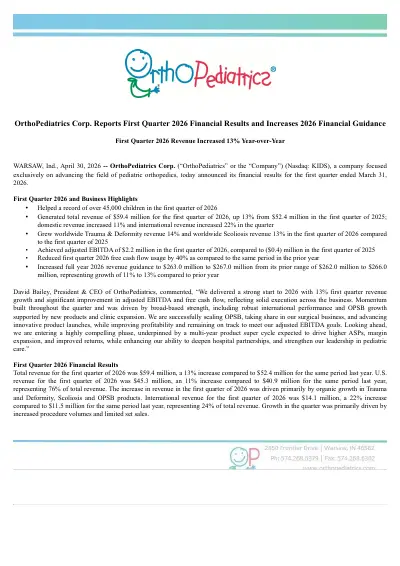
We are pleased to begin 2026 by highlighting our most meaningful metric: patient impact. In the first quarter, we supported the treatment of a record 45,000 children, extending our cumulative impact to nearly 1.4 million kids helped.
Pediatric patients have long been underserved by solutions not tailored to their needs. We at OrthoPediatrics are dedicated to changing that through focused innovation and a continued commitment to this most important patient population.
2026 started strong, with 13% first quarter revenue growth, further highlighted by significant improvements in adjusted EBITDA and free cash flow over prior year. As we look closer at the quarter, we saw a softer start to the first quarter due to weather-related shutdowns in many of our OPSB clinics in January and February, but trends rebounded in March, and since then, momentum remains strong and is carrying into the second quarter.
Growth remains solid across the business, with particular strength internationally and continued 20%-plus expansion in OPSB, driven by new products and clinic growth. Importantly, we are at the earliest stages of a multi-year innovation supercycle, consisting of what we believe is the most clinically significant and technologically advanced series of product launches in our history.
During the quarter, we began to see small contributions from recent beta launches, including 3P Hip and VertiGlide. These products are generating strong demand, and we are confident that as we move into the full market release and increase set deployments in the second quarter, we are positioned well for more meaningful impact in each of the upcoming quarters.
Early trends are reinforcing our expectations for higher ASPs, margin expansion, and improved capital efficiency as each of these products continue to scale. As we expand our portfolio and reinforce our core orthopedic platform from this unassailable position, we see a clear opportunity for continued growth.
Our consistent execution underpins our confidence in sustained revenue growth, expanding profitability, and achieving free cash flow breakeven in 2026. We continue to gain share across each of our businesses with our legacy product portfolio, and share gain will only continue to accelerate as we execute our supercycle and further expand OPSB.
Our powerful competitive position is becoming increasingly dominant and will only grow stronger as we further execute our strategy and demonstrate both top and bottom-line expansion in a way that is unique in our industry. We remain focused on enhancing shareholder value while advancing our cause of helping 1 million kids per year in the future.
Accordingly, we are raising our 2026 revenue guidance to a range of $263 million to $267 million in revenue, representing 11% to 13% growth, and reaffirming our expectations for approximately $25 million in adjusted EBITDA and full-year free cash flow breakeven, driven by continued share gains, OPSB expansion, and execution of our multi-year new product launch cycle. Turning to our T&D business.
In the first quarter of 2026, the T&D business grew by 14%, driven by increased sales of our flagship trauma and deformity systems and early returns from the beta launch of new implant and OPSB systems. We continue to see success in case volume growth as we move deeper into the launch of PNP Tibia and will pick up additional share as we launch 3P Hip.
We are also pleased to advance toward the beta launch of the next 3P system, 3P Small/Mini, which should kick off late in Q2. Beyond those products, we are advancing the next system within the 3P family, as well as the next PNP system, PNP Retrograde.
Looking closer at 3P. Our 3P Hip system has exceeded early expectations with limited set availability in Q1.
We will increase supply of the 3P Hip in Q2 and commence the beta launch of 3P Small/Mini. We expect a more meaningful impact on growth in the second half of the year.
We will also continue advancing additional systems over the next several years. The 3P platform is building strong momentum, and we believe it will become the most advanced and comprehensive pediatric plating system in our field.
Overall, T&D remains a key growth driver for the business, supported by consistent execution and a pipeline that is both highly clinically relevant and increasingly robust. We believe the depth and quality of our development efforts position us well to sustain innovation, drive future revenue growth, and reinforce our leadership position in the market.
Looking at our specialty bracing business. OPSB remains a key growth driver for the business and delivered over 20% growth in the quarter, contributing meaningfully to both the revenue expansion and profitability.
Our clinic expansion strategy continues to progress ahead of plan, supported by both greenfield openings and selective acqui-hires. Same-store sales growth remains strong, reinforced by ongoing new product introduction and continued sales force expansion.
Overall, we are on track to meet or exceed our goal of expanding to 27 territories by the end of 2027. Within OPSB, we are seeing the impact of our new product development engine.
We recently advanced the modular hip brace portfolio into commercial release and initiated the beta launch of the Traxio halo gravity traction system. Early feedback for Traxio has been strong, with initial customer engagement including multiple requests for quotes for this differentiated system.
In addition, we remain on track to beta launch the OP contracture management brace, which is designed to integrate directly with our Orthex external fixation platform, further enhancing synergies across our surgical and non-surgical offerings. OPSB is progressing as planned toward our goal of delivering 4 to 5 new product introductions annually, reinforcing a consistent cadence of innovation going forward.
We continue to execute effectively across our three-pillar OPSB strategy, which includes sales force expansion, targeted product innovation, and disciplined clinic growth. Overall, we are very pleased with the performance of the business and its increasingly important role within our broader growth strategy.
In scoliosis, we experienced 13% growth in the first quarter of 2026, driven by increased sales of RESPONSE and VertiGlide systems and revenue generated from 7D technology. Once again, we were particularly pleased with our EOS products.
During the quarter, we continued our push into the EOS space with RESPONSE Rib & Pelvic and the VertiGlide systems, which we believe provide a promising new, growth-friendly treatment option for young scoliosis patients. Looking more closely at this progress, we continue to see strong demand for VertiGlide despite very limited set availability, with approximately 80 surgeons now trained and additional training sessions scheduled.
This success is triggering our move to full market release of this important system in the second quarter, supported by additional set deployment to meet the rising demand. This growing adoption, along with 7D placements, is driving higher utilization of our RESPONSE fusion system, all ahead of the anticipated limited release of our next-generation scoliosis fusion platform, VoruXis, purposefully built exclusively for the treatment of pediatric spinal deformity.
Designed from the ground up for growing patients and the surgeons who treat them, VoruXis represents a step change in fusion technology by combining advanced implant design, streamlined instrumentation, and integrated digital planning into a single, cohesive platform, with first surgeries by year-end. In addition, we remain on track for first-in-patient procedures with Ellie, our third and most complex EOS product, in the fourth quarter.
As a reminder, Ellie is a next-generation smart electromechanical lengthening spinal implant designed to deliver consistent and reliable power through RF power transmission. We expect the first implantations of the Ellie device in late 2026.
We are proud of how far our EOS products have come, and they further bolster our belief that our EOS strategy is working. We believe that OP is continuing to establish an unmatched portfolio of pediatric scoliosis technologies, enabling clinicians to treat even the most complex and severe pediatric spinal deformities with a comprehensive set of advanced solutions.
Moving to our international business. OUS had a strong first quarter, with growth in excess of 20%, highlighted by great sales in EMEA and a nice performance in Brazil under our new agency structure.
Continued success in EMEA is being driven by increased sales of legacy T&D products in our agency markets and a small but rapidly growing scoliosis franchise. We're pleased to have received full EU MDR approval for our T&D portfolio, scoliosis products, and most recently, our external fixation devices.
We are now actively working to make these long-anticipated products available across our European markets, and we expect this expanded access to support improved EMEA growth in 2026. LatAm is building on our structural improvement in Brazil.
While we're still cautious, we do believe an improvement is on track, and over the next several quarters, we expect to turn this headwind into a potential tailwind. The structural improvements we've made in Brazil through the purchase of one of our Brazilian distributors will improve our cash collection and over time will normalize ordering patterns and allow for additional growth and market penetration.
In addition, we were once again the largest sponsor of the European Paediatric Orthopaedic Society meeting in Seville, Spain. In early April, we showcased a broad range of new products that had previously not been available in Europe under prior regulatory constraints.
These offerings were well received by both surgeons and distributors and are expected to contribute to revenue growth the second half of the year. Lastly, looking beyond our traditional segments, we are building on the success of our 7D experience and are kicking off the launch of our digital preoperative, intraoperative workflow management platform, Playbook, and expect deployment of beta launch sites in 2026.
Beyond that, we've completed the deployment and the first cases with the iotaMotion robot for pediatric cochlear implant placement and expect additional deployments throughout 2026 and beyond. OrthoPediatrics is also making deliberate, focused investments in artificial intelligence to drive meaningful clinical and operational impact.
We are advancing multiple AI initiatives, including embedding intelligence into our Playbook platform, leveraging AI-enabled tools to support pre-surgical planning, and evaluating opportunities to enhance patient care and efficiency across our OPSB clinics. Earlier this year, we completed an internal AI Flight School to build organizational readiness, and we have established a corporate objective to deploy 6 to 8 targeted AI agents to drive tangible efficiencies.
After prioritizing data security and foundational controls last year, our focus in 2026 is firmly on execution, moving from experimentation to scaled implementation that delivers real value to surgeons, clinicians, and our teams. In summary, we believe the company is entering its most compelling phase of expansion to date, supported by a multi-year product launch supercycle that will increasingly shape results over the coming years.
These new technologies are meaningfully more advanced and clinically differentiated, addressing significant unmet needs and supporting higher ASPs, improved gross margins, and stronger returns on invested capital. They also enhance our ability to bundle solutions across accounts, supporting broader contract opportunities in pediatric hospitals and reinforcing share gains across our legacy portfolio.
At the same time, OPSB continues to scale through both new product introductions and disciplined clinic expansion via greenfield openings and acqui-hires, a trajectory we expect to sustain over the coming years. Collectively, these initiatives are expected to drive significant improvement in profitability and cash flow generation over the long term.
More broadly, we believe our hospital and surgeon partners increasingly recognize the value of working with a dedicated, self-sustaining pediatric platform focused exclusively on improving care for children. Together, we are advancing innovation in a historically underserved area of healthcare and building a stronger long-term outlook for patients and the business.
With that, I'd like to turn the call over to Fred to provide more detail on our financial results. Fred?
Fred Hite
Thanks, Dave. Taking a closer look at the P&L, our first quarter of 2026 worldwide revenue of $59.4 million increased 13% compared to the first quarter of 2025.
The increase in revenue in the quarter was driven primarily by strong performance across trauma and deformity, scoliosis, and OPSB. US revenue was $45.3 million, an 11% increase from the first quarter of 2025, representing 76% of total revenue.
Growth in the quarter was primarily driven by trauma, deformity, scoliosis, and OPSB. We generated total international revenue of $14.1 million, representing growth of 22% compared to the first quarter of 2025, or 24% of our total revenue.
In the first quarter of 2026, trauma and deformity global revenue of $43.0 million increased 14% compared to the prior-year period. Growth was primarily driven across numerous product lines, specifically our trauma products, ExFix, and OPSB.
In the first quarter of 2026, scoliosis global revenue of $15.4 million increased 13% compared to the prior-year period. Growth was primarily driven by increased sales of RESPONSE and VertiGlide systems, and revenue generated from 7D technology.
Finally, sports medicine, other revenue in the first quarter of 2026 was $0.9 million, which stayed consistent year over year. Touching briefly on a few key metrics.
For the first quarter of 2026, gross profit margin was 73%, which is consistent year over year. Total operating expense increased $2.5 million, or 5%, compared to the prior-year period, to $51.7 million in the first quarter of 2026.
Sales and marketing expenses increased $1.9 million, or 11%, compared to the prior-year period, driven primarily by increased sales commission expense and an overall increase in volume of units sold, to $18.5 million in the first quarter of 2026. General and administrative expenses increased $0.7 million, or 2%, year over year, to $31.0 million in the first quarter of 2026.
The increase was due primarily to additional personnel supporting recent clinic expansions and other small-scale acquisitions, partially offset by savings being realized from prior restructuring actions. Research and development expenses decreased by $0.1 million, or 5%, in the first quarter of 2026, to $2.2 million.
GAAP net loss per share for the period was 45 cents per basic and diluted share, compared to 46 cents per basic and diluted share for the same period last year. Non-GAAP net loss per share for the period was 42 cents per basic and diluted share, compared to 39 cents per basic and diluted share for the same period last year.
Adjusted EBITDA was $2.2 million in the first quarter of 2026, compared to a loss of $0.4 million in the first quarter of 2025. We ended the first quarter with $50.9 million in cash, short-term investments, and restricted cash.
Set deployment was $2.3 million in the first quarter of 2026, compared to $3.6 million in the first quarter of 2025. As a reminder, although the amount of sets being deployed in 2026 is lower than historical years, these are primarily all new products being launched as part of our innovation supercycle and are generating a much higher level of revenue per deployed dollar than our previous legacy systems generate.
Free cash flow used in the first quarter of 2026 was $5.0 million, a 40% improvement as compared to $8.4 million used in the first quarter of 2025. Increased adjusted EBITDA, lower sets deployed, and improved working capital metrics all contributed to the year-over-year improvement.
On March 31st, we amended our existing credit agreement with Braidwell LP to add $20 million delayed draw term loan facility. This amendment enhances our financial flexibility by providing on-demand access to additional capital through June of 2027, while maintaining consistent economics and covenants within our existing term loan.
Importantly, this structure allows us to preserve liquidity and avoid dilution, as the facility is fully discretionary and interest-only through maturity in 2029. We view this as a prudent addition to our capital toolkit that further strengthens our balance sheet and positions us to opportunistically fund growth or strategic initiatives while maintaining disciplined capital deployment.
Turning to guidance. As Dave mentioned, we raised our expectation for full-year 2026 revenue to be in the range of $263 to $267 million, representing year-over-year growth of 11% to 13%.
We also continue to expect to generate approximately $25 million of adjusted EBITDA, deploy approximately $10 million in sets, and to achieve free cash flow breakeven in 2026. We would expect the EBITDA and free cash flow to exhibit similar quarterly seasonality patterns to 2025.
It is important to note some periods of free cash flow will be negative and others positive, but still cumulatively tracking to our annual guidance metrics. Operator, let's open the call for Q&A.
Operator
Thank you. As a reminder, to ask a question, please press *11 on your telephone and wait for your name to be announced.
To withdraw your question, please press *11 again. One moment for questions.
Our first question comes from Mathew Blackman with TD Cowen. You may proceed.
Mathew Blackman
Oh, great. Can you hear me okay?
Fred Hite
Loud and clear.
Mathew Blackman
Yeah. Oh, great.
Thank you for taking my questions. Good afternoon, guys.
I'm going to start with a question for Fred, and then I've got one for you, Dave. I heard you talk about the impact of weather, January, February.
Is there any way to quantify the impact on T&D from the OPSB weather-related headwinds? Is that revenue that you recapture or is it just lost?
Then I've got a follow-up question for Dave.
Fred Hite
That comment was specific to our clinics, which were shut down a week during January, a week in February. Typically, those appointments get rescheduled.
As Dave mentioned, we saw a nice rebound across the entire business in the month of March, and that's continued into April. I would say that the vast majority of those got cleared in the month of March, and now here in April, and it's all behind us by now.
Mathew Blackman
Okay. Some of it did sort of scoot into the second quarter, lost in the first quarter, though.
That's some of the takeaway, right? Okay.
Fair enough. Then, Dave, on the 3P platform, I heard you loud and clear.
Early days, but very encouraging. You're going to ramp from here.
Sounds like in the second half of '26, you'll be in a more scaled launch with 3P, maybe gaining some 3P Small/Mini momentum. Do you think that translates into a visible, at least to us, uptick in T&D second-half growth?
Or do we need more sets, more pieces of the platform beyond 3P and 3P Small/Mini to inflect US T&D growth? Does that happen in 2027?
Just trying to think about the moving parts here and when perhaps we see a visible, perhaps, inflection in that franchise. Thanks so much, guys.
David Bailey
Matt. Good question.
We have very few sets available on the 3P side at this stage. In fact, I think we have some opportunities to sell sets that we haven't done yet just because we want to make them available to more and more users as we're kind of moving those around through our loaner pool.
Additional sets hopefully coming here at the back half of Q2. Certainly, Q3 will and Q4 will be impacted by additional sets.
It's not a huge volume of sets, I do think that it's going to have some meaningful impact on the implant side of our T&D business. These rollouts take years.
You've seen over the last several years, even products like PNP Tibia, which I think now have been out 2.5 years, are still being rolled out and still impacting top-line revenue growth. I think what we really like to see about the early days with 3P is very strong ASP, in addition to extremely high demand, very strong margins, and consistent with what we've been telling the street for a while, this new product and VertiGlide as well on the scoliosis side, are dramatically more capital-efficient.
Requiring less capital deployment to drive top-line. Its impact is not just back half of the year in top-line revenue, but profitability, cash usage, everything.
We'll see more of that from the Small/Mini and more of that from PNP Retro and the new systems on the scoliosis side. It's just very encouraging what we're seeing early on with 3P and these other systems, and think it'll probably start to impact the growth of the implant side of our business here in the second half and really in 2027 and 2028.
Mathew Blackman
Okay. Thank you, guys.
Really appreciate it.
Fred Hite
Thanks, Matt.
Operator
Thank you. Our next question comes from Rick Wise with Stifel.
You may proceed.
Frederick Wise
Good afternoon to you both. Really is great to see that despite a challenging start to the quarter and weather and everything, that you finished strong and that momentum is continuing.
Now that I have paid you a compliment, I was hoping to just at a high level understand despite the outperformance in the first quarter, and everything we're hearing just on the execution front did just sound so great. Each part of the business working well.
Some of that last year's challenges worked through, is all turning into potentially a tailwind. The new product launches clearly well set up for a strong second half.
Why leave top-line guidance unchanged? Is there any particular reason other than just being careful as you set up the year?
Or is there anything that we should hear or understand about maybe some challenges ahead as you start the rollout here? Just help us think about you left the rest of your guidance unchanged, basically.
Fred Hite
Obviously, increased the full-year guidance by the million dollars that we did. Dave continues to talk about the supercycle, which is awesome, and we have more sets coming, which is great.
Those sets will be here in the second half, or really the end of the second quarter here, to help the second half of the year. As normal, we like to wait for those things to show up in the numbers before we get too far ahead of ourselves.
In traditional fashion, we'll continue to stay conservative and let the numbers speak for themselves when they show up, I think.
Frederick Wise
Sounds good. I'm sure it's the similar answer to the very strong performance on the adjusted EBITDA line.
I heard what you said, Fred, about some quarters a little better or stronger, given the demands of the business. It seems like you're set up there well with higher-margin products and just coming on, and volume, and leveraging the fixed cost base.
It just sounds like you're well positioned to do even better.
Fred Hite
We were very pleased with the leverage that showed up through the P&L here in the first quarter. 13% sales growth, G&A grew 2%.
That to us was very encouraging. Typically, first quarter is the lowest sales quarter that we'll see for the year.
If you add on some incremental revenue here in the second and third quarter in particular, which are typically our strongest, that should drop through very nicely to the bottom line.
Frederick Wise
Gotcha. Thank you very much, and great to see the excellent start to the year.
Fred Hite
Thanks, Rick.
Operator
Thank you. Our next question comes from Ryan Zimmerman with BTIG.
You may proceed.
Lindsay Caruso
Hi, everyone. This is Izzy on for Ryan.
Thanks for taking the questions. I just wanted to start with the international.
Saw that strong 22% growth for the quarter, and I was wondering if that's the right baseline to be at for the rest of the year, or if we think it could potentially be a little bit stronger as you start to see more contributions from the new products, especially as that EU MDR comes online?
David Bailey
Good question, Izzy. I'm not sure we're going to get too far ahead of ourselves on 22% growth.
Very pleased to see it. It was certainly an acceleration of growth over Q1 of 2025.
I think we came in at 19% in Q1 of 2025. I think the headline here is that we're seeing very consistent performance and consistent growth in these agencies with a lot of the legacy products.
As Fred mentioned, we don't want to get ahead of ourselves in terms of set deployment and how much revenue that set deployment of some of these new products generates. It is safe to say that we have a really nice opportunity here in the second half of the year as we start to deploy some of the sets that are now approved in Europe through EU MDR.
Timing of those sets coming into our warehouse and then getting out to our customers is a bit of the rate limiter, certainly not demand. As we see some of those sets come in, I think we'll be able to give some updated guide as to what we think we can see in the second half of the year.
It's early. Probably not going to get ahead of ourselves there yet.
It was certainly good to see that kind of acceleration in growth led by our agency markets. I think of note, very limited set sales.
We have been challenged over the last several years to balance margin and top-line against some of the lower-margin set sales. Most of that revenue, I would say in this quarter and hopefully in future quarters, is primarily just replenishment orders coming through our agencies and coming through our hospitals in Europe.
I think the acquisition of our Brazilian distributor we called out has certainly started to stabilize the markets in Brazil. I think we hope over the course of the next several quarters start to create a bit of a tailwind in a market where there's extremely high demand, but we needed to adjust our model to be able to extinguish some of that demand.
As we see that develop, it's possible that we could see growth accelerate. Hey, if 22% growth is very strong, I think we're very pleased with that.
If we could stay in that ballpark, I think it would be a great year.
Fred Hite
With that said, I would just say we do expect international to outgrow the domestic market for each quarter for the rest of the year. While it might not be 22%, we do think at this point that it'll continue to grow very nicely and probably outperform the domestic growth for the rest of this year and starting into next year.
Lindsay Caruso
Appreciate it. Thank you.
Then I saw the press release today and heard your comments about the launch of Traxio. I was hoping you guys could talk a little bit more about your plans there for the rollout and what we can look forward to going forward.
Thanks for taking the questions.
David Bailey
Traxio is, as it's aptly named, a halo gravity traction product. It's primarily designed in these children to help children and patients or in physicians who are taking care of very complex early-onset scoliosis products.
The initial launch is of a few sizes of the traction device. Those devices are sold as a capital purchase.
Then there is replenishment or repurchase of different components of that device inside the children's hospitals. Eventually, we'll be launching the surgical component of Traxio, which will be the actual halo itself that attaches to the skull of these kids.
I think what is exciting about it is number one, there's very high demand. We've gotten a lot of hospitals that have called us for quote.
There's really nothing like it available in the market. Most of the hospitals that do traction are having to kind of MacGyver their way through that, building a lot of these devices in-house.
You can imagine the demand that there is in hospitals, even from a pure risk management standpoint, to have an FDA-approved device that can take care of that patient population. It's also really encouraging to see its connection to our EOS business and then ultimately the fusion business.
We've talked about in the past treating the entire disease state of scoliosis, not just the end state for fusion. You can see Traxio and how that fits in, where patients may be going from bracing to halo gravity traction to ultimately our suite of early-onset scoliosis products, and then to the potential non-fusion products with ApiFix, and then ultimately the final fusion if required.
I think it creates a portfolio that is unlike any in the spine space. I think it's a very strong adder in terms of our value proposition to these children's hospitals within scoliosis.
Operator
Thank you.
Fred Hite
Thanks, Izzy. Thank you.
Operator
Our next question comes from Mike Matson with Needham and Company. You may proceed.
Joseph Stringer
Hey, guys. This is Joseph on for Mike.
Maybe just given the rapid growth that you guys have been calling out in OPSB just being an increasing part of revenue for the whole company. I'm just wondering if maybe you can provide more color on SG&A expenses, I guess just on a percentage of revenue basis from here.
Should we expect maybe some small gross margin improvement moving forward, with the real margin expansion coming here and on operating leverage moving forward?
Fred Hite
Absolutely. I think just like we saw in the first quarter, that the true leverage down to the EBITDA line is coming from G&A.
This year, it's both on the cash and the non-cash portion of G&A. I think the leverage we saw in the first quarter will be similar in the rest of the year in each of those quarters.
A little bit on the sales and marketing, but that's really not our focus. It's all really on the G&A side of the business.
The dollars may go up a little bit on G&A as the business grows in the second and third quarter pretty dramatically. The leverage will come through very nicely.
Joseph Stringer
Okay. That's great.
Then I guess maybe just pull-through for the scoliosis products. I know this may be early days, but you guys called out great beta launches, generating demands, RESPONSE growing really well.
I'm just wondering how that's compared to expectations prior. I could be wrong on this, but I believe you guys said the real pull-through driver for the scoliosis products would maybe be driven by Ellie.
Just wondering if that's still the case.
David Bailey
Certainly Ellie is the most complex and probably the largest opportunity on the early-onset scoliosis side. What I can say is that we have seen remarkable interest in VertiGlide.
Maybe more interest in VertiGlide and that particular type of technique for the EOS indication than we had expected when we launched. I'm very pleased with the fact that we have nearly 80 surgeons already trained, and at this point, we are having to have surgeons notify us well in advance when they schedule cases just to move inventory around.
What I'm also really pleased by, pointing to your your pull-through commentary, is that a number of surgeons and children's hospitals that aren't historically large users of our fusion platform, RESPONSE, are the the main users of the EOS product, VertiGlide. I think, what we called out in the script, this is exactly part of the strategy.
Certainly we want to to grow into this kind of blue ocean growth opportunity we have in early-onset scoliosis with VertiGlide and with Ellie and Ribbon Pelvic. I think it also brings about opportunities to show just how good we are on the scoliosis side to some of these major institutions where they may use a lot of our trauma and deformity products, but haven't had a ton of experience with with RESPONSE and our fusion system.
We are picking up pull-through already. You can imagine that's fairly small given the limited access to VertiGlide, but we are we are certainly involved with children's hospitals and physicians that historically weren't as exposed to our fusion platform.
That is one of the nice drivers we're seeing with with RESPONSE. I think what I'm, was calling out in the script and what will continue to to hopefully see here is that as the EOS portfolio more fully launches, we get more sets available to surgeons on the VertiGlide side, we launch Ellie, which as you know we just said is a little bit bigger opportunity, you follow that up with continued deployment of RESPONSE, but also the launch of our next-gen fusion system, VoruXis, that is a really just a really compelling set of technologies and value proposition for the hospital, not to mention the fact that you've got the bracing on top of that that provides some halo and synergies, as well as now the Traxio system on the EOS side.
It's it's a really good setup for us in the coming several quarters and really several years as those products roll out.
Joseph Stringer
Okay. Great.
That's all very helpful. Maybe just one quick one.
Now that you guys are finished with the EU MDR approval in Europe, are there other geographies that you guys are targeting for further catalog expansion, or maybe I guess is it time to be thinking about moving into China? Just wondering what you guys are thinking about there.
David Bailey
We haven't given specifics, but you could assume that we have a very, very small presence in Japan, essentially no presence in India, and no presence in China. While historically we have spent our dollars focusing on EU MDR, I think there is remarkable demand for our products in some of those markets.
You might expect that we're working towards how we go to market, particularly in a market like India, where we have strong surgeon connections, surgeons who have trained in the United States and Canada that are leading surgeons in India. While it's not a part of the guide, not a part of right now, any of our future revenue forecast, I think in time, it would be natural for us to extend into some of those bigger markets.
I think over the coming years, that could be a real great opportunity for us.
Joseph Stringer
Yeah. Makes sense.
Congratulations on the strong quarter.
Fred Hite
Hey, thanks. Thank you.
Operator
Thank you. Our next question comes from David Turkaly with Citizens.
You may proceed.
David Turkaly
Hey, good evening. I just wanted to follow up on that last one.
Did you give a timing for that VoruXis system?
David Bailey
We expect first surgeries for both Ellie and VoruXis by the end of the year.
David Turkaly
Does that mean that's domestically cleared, or what is your approval or process with that device? Is that a 510(k)?
David Bailey
Yes. It is a 510(k), and so we're working towards that at this point.
It is not yet cleared, but we would expect it in the back half of the year. Certainly, that's a bit of a wild card in terms of timing, but our success, particularly with these 510(k) products, has been very strong.
Generally, with all the testing, we get these things through pretty rapidly. Again, I don't expect VoruXis to have a huge impact on revenue in the second half of the year, certainly more of a 2027, 2028 rollout, but our goal is to get surgeons access to that product so we can start getting feedback in at some point in time in the fourth quarter, and I think we're on track for that.
David Turkaly
Great. Then I think you said OPSB grew 20% in the quarter, and I'm looking back at notes, I think you said six territories maybe this year.
I was wondering if you can give any color if you've done any of those, and maybe if you have or what you're expecting in terms of greenfield or acqui-hires specifically for '26?
David Bailey
Far the guide has been by 2020 by 2027, we would be at 27 of these markets. I think we're at or maybe a little ahead of that, and I would expect that we would reach the necessary six markets in 2026 for sure.
Continued demand here, opportunities for both greenfield as well as acqui-hire, and there is really even opportunities within some of the existing open territories to expand our clinic presence. Super to see same-store sales.
Clinic locations where we've had now for a year, that has gone extremely well. We're seeing increased revenue there, and then there's opportunities to get clinics in those territories more fully penetrate the territories we're already in, while we balance that against opening new territories.
Obviously, deeper penetration in our existing territories doesn't take as much expense base. When we've got opportunities to accelerate patient care and revenue in places where we're already at, we kind of have to weigh that against how much we would want to accelerate into new territories.
I think it's very safe to say that we are on track, if not ahead of track in 2026, and will meet or exceed our objectives for 2027.
David Turkaly
Thank you.
David Bailey
Thanks, David.
Operator
Thank you. Our next question comes from Caitlin Roberts with Canaccord Genuity.
You may proceed.
Caitlin Roberts
Hi, thanks for taking the questions.
David Bailey
Hi,
Caitlin Roberts
how's it going? In LatAm, you noted you purchased your largest distributor in Brazil.
Just curious how much of the LatAm business this distributor encompasses, and would you look to apply the same formula and acquire more distributors down there to continue to drive more consistency in the region?
Fred Hite
Historically, we've had about 15 or 16 stocking distributors. This was one of the larger, but not the majority of the sales down there, it's kind of 1/15 of our sales in Brazil.
The good news is, though, we now have a legal entity, we have an operating entity down there, and all of our other sales into the country in Brazil are going through this legal entity, which dramatically enhances our ability to collect cash in Brazil, to deliver them inventory on a more timely basis because we're now stocking inventory in Brazil, and to better serve those other stocking distributors. We do not at this time have big plans to buy additional distributors.
It's all about the ability to collect cash more efficiently and to better serve our partners down there so we can continue to grow that entire region in more and more procedures.
Caitlin Roberts
Understood. Just on VoruXis, what are your thoughts on the competitive landscape in pediatric spinal deformity as you look to launch here in the future?
David Bailey
Certainly the pediatric spinal fusion portion of our business is the most competitive. It always has been.
Most companies on the adult side have good deformity correction systems that kind of dual function, to speak, as pediatric deformities. I think what we see with VoruXis is a system that's built ground up with pediatric spine surgeons, not a system that's designed for adults.
I think when physicians see the development work there done by their colleagues from major children's hospitals, I think that the competitive position of that product in conjunction with products that we offer that aren't offered by really any of the other competitors, I think is a value proposition that is really hard to beat. We're excited.
Again, it's early. We haven't done first case, but I'm pretty excited to see how that stacks up against any of the other competitors.
The fact remains is that RESPONSE, which has been in the market for a number of years, continues to take share. Leapfrogging our own really best-in-class technology hopefully will even accelerate further the share taking that we've experienced over the last several years.
Caitlin Roberts
Great. Thank you.
David Bailey
Thank you.
Operator
Thank you. Our next question comes from Ben Haynor with Lake Street Capital Markets.
You may proceed.
Ben Haynor
Good afternoon, gentlemen. Thanks for taking the questions.
David Bailey
First off for me
Ben Haynor
on the almost 80 VertiGlide surgeons trained. Can you talk maybe a little bit about the number of folks that are doing these sorts of procedures nationwide?
Is there kind of an 80/20 where X surgeons are doing 80% of procedures? What is the total market kind of look like in terms of guys doing these things?
Gals.
David Bailey
Great question. This is a tough one, Ben, because I think that the technology that surgeons have had access to do some of these procedures has been so limited that in and of itself, the technology is a bit of a limiting factor to who would actually use the product like guided growth for spinal deformity correction.
It's fair to say that every children's hospital that does spinal deformity correction, which is 300 procedures, has at least one physician there, if not multiple, that takes care of these EOS products. Certainly places like Children's of Philadelphia, Boston Children's, WashU, these accounts plus several others are doing higher volumes of those very complex procedures.
In total, we think between Ellie, VoruXis, it's a sub-$100 million, maybe $80 million market opportunity with essentially very limited competition and a deep unmet need by our customers. I think what we're seeing from our customers is a recognition that we're willing to take on these complex things that they care about.
That's what we're seeing from the pull-through already on RESPONSE.
Ben Haynor
Makes sense. Then thanks for the color there.
Then on Traxio, just kind of It's obviously would improve the economics versus MacGyvering these sorts of things, but what do the economics look like for the hospitals that do make these sorts of capital purchases? Then how did the relationship with Syntec Group come about?
David Bailey
We got connected to Syntec through some other partnerships we have in Montreal. As we have an operation up in Montreal after the acquisition of Pega.
We were able to form a nice relationship with them as they have helped us with different products on the non-surgical side through our specialty bracing business. I think as the economics go, this is one of those products that if you do this procedure, this is a almost must-have for children's hospitals.
I would say that not all children's hospitals perform the procedure. It's you got to have hospitals that are willing to have patients that can stay in patient for several weeks.
Oftentimes, these kids get halo and literally live in the halo device for as long as 6 weeks or so before they ultimately have a surgical procedure. You can imagine that the economics are probably pretty strong for the children's hospitals where they have these patients in the hospital and then are doing multiple surgical procedures thereafter.
I would also argue that the Traxio, this is not a million-dollar PO the hospital is required to issue. It's not such a large capital purchase that we're seeing resistance to that.
It is, though, a further opportunity for us to partner Traxio with 7D, with VertiGlide, RESPONSE, some of these very, very novel systems that, frankly, you just can't get from any other company to leverage opportunities to bundle our services and our products. We are in more of those types of bundling discussions now at major children's hospitals than we have ever been in the history of the company, which I think as we develop that, and as some of these more differentiated products launch like Traxio, our position to have those negotiations only strengthens and, again, hopefully drives accelerating revenue in the next few years.
Ben Haynor
That's great. Then lastly for me, just thinking about the opportunities that you guys see outside of orthopedics within pediatrics, any kind of updates there, any conversations that are happening, anything that folks should expect the remainder of the year?
David Bailey
I don't think so. We have long walked alongside a number of technologies in other specialties in pediatric healthcare.
We'd like to think of ourselves as a bit of a beacon for other entrepreneurs who could help us in meeting some of these unmet needs that we see in a number of conditions in pediatric healthcare. I think when the time is right, as we've signaled, time's right and the right company with the right culture, where we could potentially help scale revenue globally, we would be quite opportunistic in that.
I don't think anything that we see right at the moment is pending. You never know.
We'll continue to do the work that we're doing to be good partners with people like iotaMotion, which is a little bit outside of our call point, and continue to help those companies commercialize. When the time is right, we'll probably step into some of the other subspecialties.
Ben Haynor
Got it. Excellent.
Thanks for taking the questions, gentlemen, and congrats on all the progress.
David Bailey
Absolutely. Thanks, Ben.
Operator
Thank you. Thank you.
As a reminder, to ask a question, please press *11 on your telephone. Our next question comes from Ravi Misra with Truist Securities.
You may proceed.
Ravi Misra
Hi, thank you for taking the questions. Good evening.
David Bailey
Just maybe a philosophical
Ravi Misra
question here. Good evening.
Just maybe kind of I'd love to understand the thinking at the company around how you're balancing this 11% to 13% growth outlook amidst what appears to be a pretty significant product cycle. You've talked in the past about competitors leaving this space, giving you opportunities as a pure play focused on pediatrics.
Then again, at the same time, set deployment is around $10 million this year. Sometimes I think about, okay, why don't wise management team really accelerate the set deployment to capture revenue?
Love to hear your thoughts on maybe that push and pull there, and are we underestimating the leverage potential from sets out in the field, or is it just something you're being conservative about and measured about in terms of how you think about this? Thank you.
David Bailey
That's a great question. There's certainly a healthy tension, I would say, within the organization as we think about how fast we would want to go to accelerate revenue versus generate positive free cash flow.
Then, when we inevitably generate positive free cash flow, and that starts to become a bigger number, how much of that positive free cash flow we would want to use to accelerate growth. You're right in saying we have a great opportunity in front of us to launch these new products and to continue to scale even some of our legacy products, given the evacuation in the market of some of the quasi-competitors in the space.
I think we have been on a quest over the course of the last few years to deliver increasing EBITDA and to deliver on free cash flow breakeven. Our commitment is unwavering there, and I think nothing will knock us off that path to be able to deliver that here in 2026.
Now, as we think in 2027, 2028, let's say through 2030 as the supercycle really starts to ramp, I'm not sure our strategy will be to maximize the capital that the business would ultimately generate. We would probably start utilizing some of the additional free cash flow the business would otherwise generate to be able to scale some of these products.
I think that would only be the smart, competitive thing when you have the opportunity that we have in front of us. In the short term, delivering on our commitments, balancing top-line revenue growth against our profitability expectations, as well as the drive to free cash flow breakeven, is what we have in front of us immediately.
Then I think we will have some bigger decisions to make and good opportunities to execute and maybe put out a little more inventory when we get more into even the first, second, and third inning of the supercycle. At this stage, we're in the batter's box, and so not having to face that right now.
As we get into 2027 through 2030, I think it's likely that we would want to put more inventory on the street, particularly inventory that has the kind of margin that products like 3P and VertiGlide have, and have the return on capital that is just so much better than our legacy systems.
Ravi Misra
Great. Thanks.
Then just one last one. On the kind of 80 surgeon base around VertiGlide, should we kind of be thinking of that as seeding the field a little bit for Ellie once that comes in, or is that going to be a different subset of pediatric specialists?
Thanks.
David Bailey
It's very astute. We talk about Ellie, at least in, obviously it's not approved, but we talk about it in theory, and the potential features of Ellie with the surgeons when we go through training.
Any surgeon who is training or interested in training on VertiGlide is most certainly a candidate for the use of Ellie, as well as our RESPONSE Rib & Pelvic, which is great news. You'll also see increased sales of our small stature systems on the RESPONSE side because, again, these are very young patients, and surgeons who treat those patients.
Again, astute question. The answer is absolutely yes, opportunity to talk about the pending Ellie launch.
I think it's important to note that Ellie is not a substitute for VertiGlide, and VertiGlide is not a substitute for Ellie. There's different indications within this very complex patient population that require Rib & Pelvic, that require VertiGlide, and will require Ellie.
Without question, being able to capture mindshare within the surgeons who treat that patient population is very good for our prospects in the future.
Operator
Thank you. I would now like to turn the call back over to David Bailey for any closing remarks.
David Bailey
Great. Thanks, operator.
We appreciate all of your time, and we'll be at a number of conferences over the course of the next several months, and we look forward to meeting with you all there. Thanks, and have a great evening.
Operator
Thank you. This concludes the conference.
Thank you for your participation. You may now disconnect.