OrthoPediatrics Corp.
NNASDAQ:KIDSQ2 FY2026 · Earnings Call TranscriptAugust 4, 2026
Operator
Good afternoon, and welcome to the OrthoPediatrics Corporation second quarter 2026 conference call. At this time, all participants are in a listen-only mode.
We will be facilitating a question-and-answer session towards the end of today's call. As a reminder, this call is being recorded for replay purposes.
I would now like to turn the call over to Tripp Taylor from the Gilmartin Group for a few introductory comments.
Philip Taylor
Thank you for joining today's call. With me from the company are David Bailey, President and Chief Executive Officer, and Fred Hite, Chief Operating and Financial Officer.
Before we begin today, let me remind you that the company's remarks include forward-looking statements within the meaning of federal securities laws, including the safe harbor provisions of the Private Securities Litigation Reform Act of 1995. These forward-looking statements are subject to numerous risks and uncertainties, and the company's actual results may differ materially.
For a discussion of risk factors, I encourage you to review the company's most recent annual report on Form 10-K, which was filed with the SEC on March 4th, 2026, and its subsequent quarterly reports on Form 10-Q. During the call today, management will also discuss certain non-GAAP financial measures, which are supplemental measures of performance.
The company believes these measures provide useful information for investors in evaluating its operations period-over-period. For each non-GAAP financial measure referenced on this call, the company has included a reconciliation of the non-GAAP financial measure to the most directly comparable GAAP financial measure in its second quarter earnings release.
Please note that the non-GAAP financial measures have limitations as analytical tools and should not be considered in isolation or as a substitute for OrthoPediatrics' financial results prepared in accordance with GAAP. In addition, the content of this conference call contains time-sensitive information that is accurate only as of the date of this live broadcast today, August 4th, 2026.
Except as required by law, the company undertakes no obligation to revise or update any statements to reflect the events or circumstances taking place after the date of this call. With that, I'd like to turn the call over to David Bailey, President and Chief Executive Officer.
David Bailey
Thanks, Tripp. Good afternoon, everyone, and thank you for joining us today.
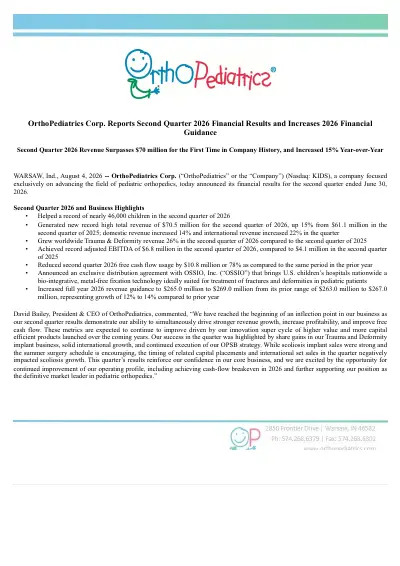
I'll start with our most meaningful performance metric, patient impact. In the second quarter, we helped nearly 46,000 children, another new record, increasing our cumulative impact to 1.4 million kids helped.
At OrthoPediatrics, we are entirely committed to improving clinical outcomes for kids through our dedicated technology, targeted innovation, and unrivaled level of focus on serving our pediatric patients. Our second quarter results further validate the strategy we have been executing over the past several years.
We continue to gain share across our core markets. OPSB is emerging as a meaningful driver of both growth and profitability, and our multiyear product launch supercycle is just beginning to contribute to results, with the largest opportunities still ahead.
Revenue increased 15% year-over-year, driven by an exceptional performance in trauma and deformity and OPSB, strong scoliosis implant sales, alongside healthy international growth, partially offset by zero 7D units sold in the second quarter of 2026 and significantly fewer OUS set sales in scoliosis. We finished the first half of the year with strong momentum, delivering robust revenue growth, meaningful adjusted EBITDA expansion, and significant improvement in our free cash flow profile.
Importantly, top-line strength in the second quarter across both our implant and OPSB businesses drove bottom-line adjusted EBITDA to a record $6.8 million. Our disciplined capital allocation and focus on higher-quality, more profitable revenue streams, combined with working capital improvements, reduced free cash flow usage by $11 million, or 78%, versus the prior year, demonstrating that our focus on profitability and free cash flow is paying off.
At this point, it's evident that we have reached an inflection point in our financial trajectory, and our results this quarter give us high confidence in our commitment to achieve positive free cash flow in the second half of 2026 and free cash flow breakeven or better for the full year. We believe the continued execution of our strategy reflects the strength of our competitive position, disciplined execution, and the material operating leverage potential embedded in our business.
As such, our updated outlook remains aligned with our progress and our long-term growth objectives, while also reflecting the disciplined approach we have consistently taken to guidance. Accordingly, we are raising our full-year guidance to a range of $265 to $269 million, representing 12% to 14% growth.
As we march through our high-volume summer season, we continue to see strong surgical volumes, and we would remind everyone that the procedures supported by our technologies are not elective. Before moving into updates of our businesses, I want to provide more color on the innovation supercycle of product launches we have introduced and its importance as a strategic growth, profitability, and free cash flow driver of OrthoPediatrics over the next several years.
First, it is important to emphasize that we are in the early days of the multiyear cycle. While we are starting to see very early contributions to growth from select product launches, we are only scratching the surface of the supercycle's impact on both the patients who this technology will serve and our business.
The supercycle pipeline is deep. The new technologies developed by our incredible engineering team will span all portions of OP, deepen hospital relationships, enabling bundling of solutions across accounts, support broader contract opportunities, and bolster share gains across our portfolio.
Importantly, these products offer stronger economics for OP than many of our legacy systems. The products generally carry higher ASPs, higher gross margins, require less capital deployment, and should generate better return on capital.
Many are highly differentiated, clinically relevant, and have limited to no direct competition. The bottom line is this is not just a product launch story; it's a multiyear growth, margin, and capital efficiency story.
Moving to our businesses. In the second quarter of 2026, the T&D business delivered 26% growth and was the primary driver of our total company performance.
The strength in the quarter was driven by increased sales across our core trauma and deformity implant systems, continued share gains, strong procedure demand, and early contributions from new platform launches, as well as continued strong growth from OPSB. Zeroing in on our Pediatric Plating Platform, also known as P3, we are pleased with the continued progress of the P3 Hip system.
P3 Hip contributed to incremental revenue growth in the quarter, and surgeon demand remains strong. That said, the more substantial impact of P3 Hip is still ahead of us, as meaningful set deployment did not occur until late June.
We expect P3 Hip revenue to continue to build and become an increasingly important contributor to T&D growth. Moving down the P3 pipeline, we also initiated a small beta release late in the quarter and performed our first P3 Small/Mini surgical cases, which couldn't have gone better.
P3 Small/Mini represents the second system in the P3 plating family. The early clinical feedback has been extremely positive, and we are excited about the long-term opportunity.
Contribution from this system will remain minimal until full-market release, which we currently expect in early 2027. More broadly, the P3 platform continues its push forward, and we are as confident as ever in our belief that it will become the most advanced and comprehensive pediatric plating system in our field.
We continue to advance additional P3 systems, and beyond P3, we're also excited about our plans for PNP Retrograde and PNP Skeletal Dysplasia, the next systems within our pediatric nailing platform. Additionally, in line with our mission to increase the scope of differentiated technologies we offer surgeons, we recently announced an exclusive distribution agreement with Ossio, bringing bio-integrative, metal-free fixation technology to children's hospitals nationwide.
Combined with our existing Bioretec partnership, we now have a wide-ranging portfolio of bioabsorbable implant products. These products expand treatment options within our portfolio and will leverage the same commercial model as our implants.
Taken together with the complimentary beta launch of P3 Small/Mini, this demonstrates our ability to leverage our specialized pediatric commercial platform while advancing product offerings in procedure areas that are newer to us, such as pediatric foot and hand surgery. Overall, T&D continues to serve as a core component of our growth engine, highlighted by exceptional strength in implant sales, OPSB, and a robust development pipeline.
Turning to our specialty bracing business. OPSB once again delivered an outstanding quarter with over 20% growth, and the business remains a major strategic catalyst for OrthoPediatrics.
Supported by strong clinic execution, same-store growth, volume growth, new product introductions from our supercycle, and disciplined clinic expansions, the business continues to contribute meaningfully to both revenue expansion and profitability. Within OPSB, our specialty bracing product development engine is producing a significant impact, and overall OPSB products are playing a pivotal role in our innovation supercycle.
DF2 is surpassing our performance expectations with adoption in over 150 children's hospitals and is quickly becoming the new standard of care for pediatric femur fractures in very young patients. The modular hip brace portfolio is progressing through ongoing launch activity and expanding our role in the treatment of pediatric hip deformities.
Additionally, we are advancing Mach 4, an upper-extremity prosthetic and orthotic platform that provides lightweight, modular, 3D-printed solutions intended for both function and play. The pending launch of TraxteriorFix, a specialty bracing solution designed to manage knee and ankle contractures by connecting the brace with our external fixation systems, and a number of other products expected to launch over the next several years.
We're also pleased with the early progress of the Traxio halo gravity traction system, one of our most clinically significant products to date. Traxio extends our role in pediatric spine care by supporting halo gravity traction therapy and helps position OPSB as a broader pediatric care platform.
This is another example of our strategy to develop clinically relevant solutions that are often overlooked by larger companies, but remain highly important to children's hospitals, surgeons, patients, and families. Overall, we continue to make progress across our three-pillar OPSB strategy by growing the sales force, advancing product innovation, and executing disciplined clinic growth.
In scoliosis, reported revenue was down 9% in the second quarter despite implant growth in the mid-teens. Growth in the US and European implants and OPSB was more than offset by the impact of zero 7D unit sales in the quarter compared to multiple units in the comparable period and significantly lower scoliosis set sales into Brazil.
Excluding these timing-related items, scoliosis revenue grew in the mid-teens on the strength of an extremely strong scoliosis summer schedule, which is continuing into Q3. Looking closer at some of the highlights within scoliosis, we continue to be very pleased with the early adoption of Vertiglide.
Vertiglide contributed to incremental revenue growth in the quarter, but similar to P3 Hip, the relative impact will continue to build as set deployments began late in the quarter and are ongoing. Early clinical feedback remains very positive, and we believe Vertiglide represents a highly differentiated growth-friendly treatment option for young scoliosis patients with complex pathology.
We have completed additional training and now have 124 surgeons trained on the system. Additionally, we continue to advance the development of Ellie, our next-generation smart electromechanical lengthening spinal implant, and remain on track to perform first-in-patient procedures with Ellie in late 2026, pending FDA guidance.
As a reminder, Ellie is designed to deliver consistent and reliable power to grow the rods through advanced RF power transmission, and represents our third and most complex EOS product. We are also continuing the development of Veraxis, our next-generation scoliosis fusion system.
Veraxis is being developed as a purpose-built pediatric deformity fusion platform designed from the ground up for growing patients and the surgeons who treat them. Together, Vertiglide, Traxio, Ellie, Veraxis, and our suite of pediatric bracing products and services deliver a truly unmatched portfolio of pediatric scoliosis technologies.
OrthoPediatrics is the only provider enabling clinicians to treat the entire scoliosis continuum of care, including the most complex and severe spinal deformities, with a comprehensive set of advanced solutions inside and outside of the operating room. Moving to our international business.
International revenue grew 22% in the second quarter, driven by a record performance in Europe, strong execution, and continued demand for OP's pediatric-specific technologies. We're in the early stages of benefiting from the EU MDR approvals for our T&D portfolio, scoliosis products, and external fixation devices.
With these approvals, we are beginning to provide European markets with products they have long been waiting for, and we expect broader access to these systems to support our growth over the second half of 2026 and beyond. This strength was partially offset by the previously noted significantly lower set sales in Brazil.
We remain confident that the structural improvements we've made in Brazil over the last 6 months, including the purchase of one of our Brazilian distributors, will continue to steadily improve cash collections, normalize ordering patterns, and support additional growth and market penetration over time. In summary, we believe OrthoPediatrics is entering the most compelling phase of expansion in our history.
Our momentum comes from multiple levers, including our legacy implant business, OPSB, and our innovation supercycle. With this in mind, we believe we have reached the inflection point where our sustained and durable revenue growth, improved profitability, dramatically improved cash usage, and stronger returns on capital positions us to progress toward our most meaningful mission of helping more children around the world every day.
With that said, I'd like to turn the call over to Fred to provide more detail on our financial results. Fred?
Fred Hite
Thanks, Dave. Taking a closer look at the P&L, our second quarter of 2026 record revenue of $70.5 million increased 15% compared to the second quarter of 2025.
The increase in revenue in the quarter was driven primarily by extremely strong performance across trauma and deformity and OPSB, robust underlying scoliosis implant and bracing sales, strong growth internationally, and continued execution across the business. US revenue was $54.8 million, a 14% increase compared to the second quarter of 2025, representing 78% of total revenue.
Growth in the quarter was primarily driven by strong performance in trauma and deformity and OPSB, partially offset by zero 7D unit sales impacting scoliosis growth. We generated total international revenue of $15.7 million, representing growth of 22% compared to the second quarter of 2025, and 22% of total revenue.
International growth was highlighted by record performance in Europe, partially offset by set sales timing in Brazil. In the second quarter of 2026, trauma and deformity global revenue of $52.6 million increased 26% compared to the prior-year period.
Growth was primarily driven by strong procedure demand, share gains across our core implant system, strong OPSB performance, and early contributions from new product launches including P3 Hip. In the second quarter of 2026, scoliosis global revenue of $16.9 million representing a 9% decline compared to the prior-year period.
Sales were led by strong implants and OPSB-related product demand in US and Europe, offset by the absence of 7D unit sales and fewer set sales. Importantly, the underlying fundamentals of the business remain strong, and excluding these timing-related items, scoliosis revenue would have grown in the mid-teens.
Finally, sports medicine and other revenue in the second quarter of 2026 was $1.0 million compared to $0.9 million in the prior-year period. Touching briefly on a few key metrics.
For the second quarter of 2026, gross profit margin was 74%, an improvement compared to 72% in the prior-year period. The increase was driven primarily by product sales mix, including strong growth in higher-margin areas and negative growth in much lower areas, such as 7D unit sales and international set sales.
Total operating expenses increased $1.8 million, or 3%, compared to the prior-year period to $56.4 million in the second quarter of 2026, driven mainly by increased sales commission expense, as well as additional personnel supporting clinic expansions and prior small-scale acquisitions. Sales and marketing expenses increased $2.2 million, or 11%, compared to the prior-year period, driven primarily by increased sales commissions and overall case volume growth to $21.3 million in the second quarter of 2026.
General and administrative expenses increased $2.4 million, or 8%, year-over-year to $32.8 million in the second quarter of 2026, primarily due to the additional personnel supporting clinic expansions and prior small-scale acquisitions. Second quarter of 2025 included $3.0 million of restructuring expenses, as compared to a nominal amount in the second quarter of 2026.
Research and development expenses were $2.3 million in the second quarter of 2026 compared to $2.2 million in the prior-year period. Total other expense was $2.9 million for the second quarter of 2026 compared to other income of $3.6 million for the same period last year.
The year-over-year change was primarily driven by unrealized non-cash translation impact of foreign exchange rates. Foreign exchange losses in 2026 were driven by changes in the euro exchange rate, as the euro declined in values in 2026 compared to the euro appreciation in 2025.
GAAP net loss per share for the period was 30 cents per basic and diluted share compared to 30 cents per basic and diluted share for the same period last year. Non-GAAP net loss per share for the period was 26 cents per basic and diluted share compared to 11 cents per basic and diluted share for the same period last year.
The year-over-year change was primarily driven by the unrealized non-cash foreign exchange rate differences. Adjusted EBITDA was a record $6.8 million in the second quarter of 2026 compared to $4.1 million in the second quarter of 2025.
This represents record adjusted EBITDA for the company and adjusted EBITDA margin of nearly 10%, driven by strong growth, gross margin expansion, and operating leverage, particularly in G&A. We ended the second quarter with $47.9 million in cash, short-term investments, and restricted cash, and still have another $20 million of term loan available to us.
Set deployment for the quarter was $2.9 million compared to $4.6 million in the second quarter of 2025. We continue to focus set deployment on high-return systems and remain disciplined in allocating capital to support growth.
Free cash flow used in the second quarter of 2026 was $3.1 million, a $10.8 million, or 78%, improvement as compared to $13.9 million used in the second quarter of 2025. Increased adjusted EBITDA, improved gross margin, disciplined set deployment, and working capital management all contributed to the year-over-year improvement.
Turning to guidance. As Dave mentioned, we are raising the top and bottom end of our range for full-year 2026 revenue by $2 million to be in the range of $265 to $269 million, representing growth of 12% to 14%.
We are also reiterating our adjusted EBITDA guidance of approximately $25 million. We continue to expect to deploy approximately $10 million in sets and to achieve free cash flow breakeven or better in 2026.
We expect positive free cash flow in the second half of 2026, resulting in free cash flow breakeven or better for the full year, driven by continued improved adjusted EBITDA, disciplined set deployment, and continued working capital improvements. As we've discussed previously, adjusted EBITDA and free cash flow can exhibit quarterly seasonality, but we remain confident that we are on track to our annual guidance.
Ultimately, we are building a company that can deliver strong revenue growth while also generating positive free cash flow, and our second quarter and broader first-half results demonstrate that our strategic and financial goals are achievable. Operator, let's open the call for Q&A.
Thank you. At this time, we will conduct the question-and-answer session.
As a reminder, to ask a question, you will need to press star one one on your telephone and wait for your name to be announced. To withdraw your question, please press star one one again.
Please stand by while we compile the Q&A roster.
Operator
Our first question comes from Rick Wise at Stifel.
Rick Wise
Good afternoon to you both, and it's great to see a solid second quarter. Help us think through a couple things.
There's so many interesting questions I'm sort of reflecting, but let's think about guidance maybe. Just at a high level before we get into the details, you're only guiding to 13% for the year.
I hear Dave's excitement at the supercycle just beginning. I hear how strong the business is.
It sounds like some of the pieces of business that weren't exactly where you wanted are going to get better in the second half and into next year. Why is that the right guide, and maybe help us think through what might make it better?
Guidance that
David Bailey
we feel highly confident in achieving. The business continues to be seasonal, and certain revenue streams, particularly the capital equipment, 7D placements, and international stocking distributors, can be timing-dependent.
We finished the first half very strong with great momentum, and have good visibility into the summer surgery schedule, which does give us high confidence. I think we continue to apply an appropriate level of conservatism, and as we continue to execute through the second half of the year, we'll feel more confident, obviously, in raising that in the third quarter, and then hopefully and over-delivering again in the fourth quarter.
Some of it's just timing, the seasonality of the business, and some of those variables that we've talked about in the past.
Rick Wise
Turning to supercycle, Dave, maybe you can unpack it further for us. What did the supercycle contribute this quarter?
It's just beginning to contribute. Is this going to be a very, very gradual process of contributing, or as you move into full launch and more products, or starting the second half, are we going to see more accelerated, more visible contribution from all the new products?
David Bailey
Certainly pleased with where we are in the supercycle launch. As we said in the call, contribution from the supercycle really was not as strong as it will be, certainly, in the coming quarters as those sets get deployed, and then they get adopted in hospitals and moving in the right direction.
I think certainly over the next several quarters, and into, frankly, the next several years, is where we'll see the impact of the supercycle. I'm not certain that we're going to see some major inflection point in any one given quarter.
We did start to see some growth from the supercycle products here in Q2, certainly in the second part of Q2. Really pleased with what we're seeing there because, generally speaking, we see higher ASPs, higher margin on those products, faster return on capital.
I think when we get those products to the market and get those placed in hospitals here, close of the second quarter and into Q3 and Q4, it'll have a bigger impact on the second half of the year and probably a bigger impact on 2027, 2028. I guess one thing I would also point out about the supercycle is it's not just a few products.
There are a number of products that we think we will be able to launch over the course of the next several years. I think that as we start to see the contribution from supercycle growth, it'll be something that's very durable for a long period of time.
Rick Wise
Great. I'm going to be selfish and ask one more on scoli.
Sales down 9%, but mid-teens implant growth says the business is healthy. Timing.
Help us think about what that means for the second half and the setup for '27. It seems to me that you believe, there's no reason not to believe that we shouldn't believe, scoli sales are coming back.
I'm not sure I understand the timing, but if it come back, it seems like assuming T&D stays strong, you could be approaching or exceeding 20% again. What's wrong with my thinking?
Thank you.
David Bailey
I like your thinking. I like that it's very hopeful and encouraging.
I guess we are very pleased with the performance of the scoli implant side of business. We obviously capture 7D revenue in the scoli numbers, and we sold zero 7D units.
As that's why we have guided this way, such that we can ensure that in quarters where we don't have 7D sales, we still have great quarters like we did here with 15% growth. Certainly, we expect to see some 7D sales throughout the balance of the year and into next year.
When those sales will actually occur, we're not here to speculate at this stage, but certainly we expect them to happen. I think what we're seeing on the implant side, and we saw very particularly in the month of June, which is one of our busiest scheduling seasons for scoliosis implants, we saw very strong summer.
That's extended into Q3, and we're extremely pleased with the fusion business, kind of the core fusion business, as well as the contribution we're seeing from Vertiglide on the EOS side of our business. Again, one of the things we like about EOS is these are high ASP products, high-margin products with really good return on capital.
To see the Vertiglide impacting the Q2 revenue, we expect it to impact strongly Q3, Q4 revenue as well. I couldn't be more pleased with how the scoliosis business overall is performing.
Certainly timing blunted that in terms of the headline number for Q2, but the baseline of how that business is performing is probably as strong as it's ever performed.
Rick Wise
Thank you for all that detail.
David Bailey
Thanks, Rick.
Fred Hite
Thanks, Rick.
Operator
Our next question comes from Caitlin Roberts at Canaccord Genuity.
Caitlin Roberts
Great. Thanks for taking the questions, and congrats on the quarter.
Would love to just continue with scoli, and maybe touch on the lower set sales in Brazil. Just any more color on, was this a market demand issue, or just kind of an execution challenges you work to implement some of the initiatives that you've been working on over the past 6 months or so?
Fred Hite
I would say it's not a demand issue. It is us balancing cash collections with the demand.
As we continue to focus on profitable revenue growth and less focus on the lower-profitable demand for sets, it's just us making the decision of when we're going to release some of those sets into the market, both in Latin America, and there was some into set sales in Europe as well.
Caitlin Roberts
Understood. You also talked to some of the fuller set deployment for new products coming late in the Q2.
For the balance of the year, how much more set deployment do you have left of the $10 million that you've guided to?
Fred Hite
We're about $5 million in at this point. The operations doesn't always comply with calendars, a lot went out the first week of July, as final parts were delivered, and so that'll show up in the third quarter, obviously.
We're still on track for our $10 million. A large amount of that will go out here in the third quarter.
The vast majority of it was already in hand and in our inventory, just waiting for the last instrument or specialty item needed to complete the set before it was released into the field and shows up as deployed dollars for us. The majority will go out here in the third quarter, and then a small amount in the fourth quarter to achieve the full $10 million for the year.
Caitlin Roberts
Great. Thanks so much.
Fred Hite
Thank you.
David Bailey
Thank you.
Operator
Our next question comes from Mathew Blackman at TD Cowen.
Mathew Blackman
Good afternoon, everybody. Can you hear me okay?
David Bailey
Loud and clear, Matt.
Mathew Blackman
Great. Thanks for taking the questions.
I got two. Maybe just appreciate some of the color on Vertiglide.
I think you said something to the effect of having trained 124 surgeons. I'm just curious what the denominator is for that opportunity, how far along are you in terms of surgeon adoption and training on that front?
Then I'll ask the follow-up, cuz it's sort of the same thread and similar line of questioning that Rick gave you at the outset. We've done quite a bit of work on Vertiglide and Ellie and with very modest penetration assumptions, you could see a pretty meaningful uptick in scoli, and even worldwide growth.
Something to the effect of a couple points of worldwide growth if you get 5 points of penetration of those products. I guess that the question is, so that makes sense, that math, I know that's really wide out there, sort of in the context of these two opportunities?
Then as we think about '27 and beyond, as these begin to scale, do we think about Vertiglide and Ellie being and I guess the EOS sort of portfolio as a whole being growth-sustaining for the scoli franchise, or could it be growth-accelerating? Apologize for throwing all that at you at once, but I'm here if you need me to repeat it.
No, that's
David Bailey
I think I understand the gist of your question. Listen, I think we're reiterating here, we're very early.
We're training surgeons. The majority of those surgeons are now looking for patients, trying to decide which patients make most sense.
As and we've talked, the early-onset scoliosis category is not one where surgeons are doing individually 50 of these things a year. Oftentimes, surgeons do a few of these procedures a year.
That said, at the ASP and the volume of surgeons that we have trained, you could assume that when Vertiglide is fully deployed, and we have the majority of surgeons trained, and surgeons know which patients that qualify for this particular technology, yeah, Vertiglide will definitely have a meaningful impact on growth, certainly impacting growth now, and will impact growth in the second half. I would expect that to continue into 2027.
You pile on top of Vertiglide with Ellie, and again, Ellie is not available now, but we're making great progress. I think Ellie is probably a bigger opportunity overall for us than Vertiglide.
On top of all that, Matt, what you have is these are the most complex surgical procedures that pediatric orthopedic surgeons are doing on the spinal implant side. I think for us to be able to bring these very unique technologies and be working with surgeons that, in many cases, are having some of their first experiences on the scoliosis side with OrthoPediatrics, and treating some of their most problematic pathologies with our technology, we're already starting to see nice pull-through with our Response Fusion Systems and our other scoliosis fusion products.
I think as we time all this out with Vertiglide, Ellie, and then the Veraxis system, which we expect to do first cases probably early into next year, it's just a really nice setup overall to see scoliosis growth continue to accelerate over the next frankly, over the next several years. That's why I guess you hear my optimism and the commentary with Rick.
I think we have a really good setup. We got to get these products out.
We're early, but it will definitely start to impact the scoliosis business in a bigger way here in second half of the year, and really through the balance of 20 2027 and 2028.
Mathew Blackman
Great. I appreciate that, David, and thank you for throwing in that sort of pull-through halo effect as well.
I think that's an important point. Appreciate it.
We'll get back in the queue.
David Bailey
It may be the biggest impact, honestly, Matt. It's probably as important as what we're seeing with the absolute growth we get with some of the EOS products.
Mathew Blackman
Got it. Thank you so much, guys.
David Bailey
Absolutely.
Operator
Our next question comes from Matthew O'Brien at Piper Sandler.
Great. Thanks.
This is Anna on for Matt. Thanks for taking our questions here.
I want to ask on the bracing business. It's been growing well over 20% for a while now, and you're at I think north of 45 clinics currently.
As this network of clinics continues to expand, just wondering how the growth algorithm is shifting, if a larger share of that growth is now coming from more mature same-store sales growth versus new clinics still ramping. Then with that in mind, does that change the durability or predictability of the 20% plus growth rate that we've seen historically?
Then I have a follow-up. Thank you.
David Bailey
That's a great question. I think growth is coming across the board here.
We're seeing growth as we're scaling some of these new clinics. Obviously, as we scale a lot of these new clinics, you're growing off a zero base, and so that's important.
Certainly seeing growth within our existing clinics in markets where those markets are less mature for us. Same-store sales strong, certainly new clinics strong.
I think what probably gets lost, and maybe I haven't done as good a job in the past of talking about the new product launches inside the supercycle. DF2 continues to grow very, very rapidly, and I think beside 150 of the 300 or so children's hospitals now are using DF2.
Again, this is a high-margin, there's no inventory for us here, we like that business, and so DF2 is growing very rapidly. There's just a welter of new products on the OPSB side that is contributing, and it's taken us a little longer to get that pipeline going.
We didn't have an R&D team inside OPSB when we started it, and now we've got a very good R&D team that's generating some pretty compelling technologies, like we said, DF2, we have the modular pediatric hip brace portfolio that's coming out, Mach 4 that's now out, the Traxio and TraxteriorFix. These are compelling products, and if they have a similar trajectory that we have seen with DF2, they will have a very substantial impact.
I think they all contribute to the synergies that we're trying to build between our implant business, the clinic side of our business, the OPSB new product business, and I think from a supercycle standpoint, they just have a huge impact, a compounding impact on one versus the other. I guess in short, yes, we're growing new clinics, we're seeding new clinics, and the new product launch side is probably going a little better than we would have expected.
All right. That's awesome to hear.
Then I guess sort of on that profitability point, profitability was really strong this quarter, and just wondering what the reasoning is for holding your profitability adjusted EBITDA target for the year, holding that constant in light of the outperformance we saw, and if that has to do with 7D and international sales potentially being made up in the back half, or just what the components are for the reiterated adjusted EBITDA guide. Thanks.
Fred Hite
Good question. First half of the year, we're at $9 million against the $25 million target.
We are up $5 million year-over-year in the first half of the year, and for the full year, we increased our 15 from last year up to 25 million for this year. It's a $10 million increase.
We're halfway there with the $5 million increase. We've got another $5 million to increase on top of the second half of last year, and we'll get to that $25 million.
I would say just more conservatism and making sure we have plenty of room to make sure we get there and deliver the numbers, the biggest reason.
Operator
Our next question comes from Ryan Zimmerman at US Bancorp.
Hi, everyone. This is Izzy on for Ryan.
Thanks for taking the questions. Fred, just to start, I wanted to touch on the gross margins for a little bit.
I heard your comments around what drove the strength in this quarter, but I was curious, as we start to see the supercycle start to contribute a little bit more and mix shift towards these higher ASP products, how much of margin expansion in the future will be driven by mix versus volume? Do you think that 73 is still the right target for the full year, or could we see further increases?
Fred Hite
Obviously, very pleased with the margin. It shows up when there's no 7D, which obviously we distribute that product, it goes out at a lower margin, and limited set sales.
With that mix, we could see something similar to that in the third and fourth quarter, potentially. I think we are still sticking to that 73 rate for the year, and we'll see what the second half of the year brings.
I would anticipate there will be some 7D sales in the second half of the year, which would put pressure on that number. Your first part of your question about the supercycle, you're absolutely correct.
Those products will, today it's a very small percentage of the total, but in the future, as that becomes a larger portion of the total business, particularly into '27 and '28, then yes, there may be an opportunity to see an increase in the future years.
Got it. Appreciate it.
Just to stick on the supercycle for a little bit. Dave, could you talk a little bit more about the Ossio distribution agreement, kind of your expectations around there and kind of what brought it to the table?
Thanks for taking the questions.
David Bailey
Good question. I think this is pretty exciting for us.
It's obviously a technology that we were not going to develop in-house with a bioabsorbable technology like that. We do have some experience with Bioretec, where we sell a fair volume of that product as well.
The advantages of a bioabsorbable implant are obvious for pediatric patients, cuz the majority of these implants are removed. In certain applications, I think surgeons are very interested.
I think what I really like about this is how this connects to our Small/Mini product launch here in early 2027 and kind of our beta launch here in the end of 2026, because the Small/Mini starts to move our portfolio into very small bone fractures and small bone osteotomies in the foot and hand, and that's where a product like Ossio is used quite frequently. I think it's very complementary.
We use the same commercial channel, our sales force is very familiar with this type of material and the surgeons who use it, and it's a great expansion opportunity. It also, given the fact that it's exclusive for us in children's hospitals, it's another point of leverage for us in contract negotiations, because we're the only company that offers these types of technologies.
When you combine that with P3, with P3 Small/Mini, with PNP Tibia, with all the products, our PEGA products, it's just a growing portfolio of products that really have no threat of substitute. That gives us a lot of leverage, a lot of confidence as we go into contract negotiations.
I think Ossio will certainly standalone be a growth driver for us in the future. I think combined with the full portfolio, it just strengthens our T&D portfolio substantially.
Operator
Our next question comes from Ravi Misra at Truist Securities.
Ravi Misra
Hi, good evening. Thank you for taking the questions.
I'll just ask both of mine upfront, please. Just on kind of the commentary around what you're seeing in 3Q, sounds like a pretty strong quarter.
Just how should we think about the cadence for the remainder of the year? I think the Street is a little bit below what you ended up doing in 2Q for 3Q.
Historically, you've done a little bit better in 3Q versus 2Q, should that still hold? Then second, I'd love to hear any kind of updates that you could provide around the MDR environment out in Europe.
It's been a little bit of source of an edge for you, I think, in recent quarters. Is that still the case?
Or any more detail there would be appreciated. Thank you.
Fred Hite
Absolutely. Right now we're forecasting third quarter and fourth quarter actually pretty equal to each other, as they were last year.
Third quarter and fourth quarter will be a little lower than what we saw here in the second quarter, is what we're forecasting right now. A couple million dollars lower than the second quarter.
I would say both May and June, the early summer months, were very, very strong. We feel good about July, obviously, with it in the books.
Right now, forecast is a couple million lower in the third and the fourth quarter. EU MDR, very exciting for us.
Similar to supercycle, I would say, early days. We got first approvals in the latter part of last year, a few more approvals here earlier this year.
Now we're getting some sets over there, and so we're getting our customers access to those new products, but very early days. Lots of opportunity for us to deliver more sets over there into the European market, and enable more and more surgeons to have access to it.
We did attend a conference earlier this summer, and showcased several of those products, and garnered a lot of excitement, I'll say. Now it's a matter of getting the cash, deploying the sets, and getting them into the surgeons' hands.
I would say we'll continue to see a little bit of an impact here in the second half of the year, like we saw in the second quarter, and probably a bigger impact in '27 and beyond, as we continue for the next couple of years to deploy sets over into that marketplace.
David Bailey
Ravi, just to amplify that point, yeah, I think an astute question, given what we've talked about about the competitive landscape due to the EU MDR. I think that we continue to see a landscape whereby many products didn't go through the MDR process.
Ours did, and so I think demand for the products that we have coming is very high, because again, there's no threat of substitute for some of those products. We're encouraged.
We have a lot of interest from both our agencies and our agency markets in Europe, as well as from stocking distributors in Europe. I think the next several quarters of product launch into those markets where, in some cases, we kind of run unopposed with some of these products will be very exciting.
Operator
Our next question comes from Mike Matson at Needham & Company.
Joe Sofen
Hi guys, thanks very much. It's Joseph on for Mike.
Maybe just continuing with EU MDR and maybe just international broadly. Another strong quarter, is 22% growth in the quarter, similar to last quarter.
I'm just wondering now is this kind of a baseline for 2026, and based off of your comments, it sounds like 2027 will be a much higher contribution in terms of the newer EU MDR products. Should we expect sequential improvement in the next two quarters, or just kind of similar to what Fred you had just noted that 3Q and 4Q maybe down sequentially?
Then I have another one after that.
David Bailey
We're very pleased, obviously, with international. If you look back last year, growth was more lumpy, I would say.
There's always the possibility of that. I don't know that we're ready to call 22% growth for the next couple of years, but very pleased with what we saw in the second quarter, and I think there's a lot of momentum building in that side of the business.
Joe Sofen
Great. Then maybe just two-parter on OPSB.
Was curious Q1 you guys had talked about some weather-related shutdowns. Was just curious if maybe the demand for that fully flowed through into Q2, or I doubt there's anything residual left, but maybe you could expound on that.
Then just international OPSB, could you guys maybe comment on how that's been growing? I believe it's just Ireland where there's a clinic, but maybe how that clinic's growing, and what's your current thinking on international expansion, what markets would they be, is this like Germany, UK, just curious on your thoughts.
Is this a 2026 potential addition or later on?
David Bailey
Sure. I would say we talked about it last call, but the majority of the weather-related things in Q1 were extinguished in April.
I would say that that held throughout the quarter, though. We saw strong volume in our clinics.
We saw nice volume in our clinics in June here through the summer, which was encouraging, cuz sometimes the surgical season can blunt a little bit of the momentum that we would see in clinic visits. I think overall that has been extinguished, and was primarily extinguished in April.
Nice to see a strong April, and that continued throughout the balance of the quarter. You are right about our opportunities in Europe being quite strong.
We have a clinic in Ireland, and now have a couple small clinics in the UK. What our strategy there has been primarily is to focus on areas where we also are driving strong scoliosis implant revenue.
We've got a kind of a building, small yet rapidly growing business in Ireland and the UK for scoliosis implants. We are kind of capitalizing on the scoliosis implant growth with surrounding those surgeons and those accounts with bracing products.
There is a lot of demand internationally for our DF2 product, for the hip bracing, for Traxio and TraxteriorFix. We are seeing growth outside of the United States in that, and you can imagine that we're way underpenetrated there compared to places like here in the United States, where we have 150 of the 300 children's hospitals already using DF2.
I think there is a robust opportunity for us outside of the United States. Again, right now, the focus has been Ireland and the UK, and then selling products to the end markets as opposed to setting up clinics in other countries outside of the UK and Ireland.
It's possible that we could scale into some of those other markets, but I think right now, we know we have our hands full here in the United States and the UK and Ireland.
Joe Sofen
Great. Much appreciate taking our questions, and congrats on a strong quarter.
David Bailey
Thank you.
Operator
Our next question comes from Ben Haynor at Lake Street Capital Markets.
Ben Haynor
Good afternoon, gentlemen. Thanks for taking the questions.
First off for me, just on kind of the supercycle and the halo effect you expect to get. Have you seen any kind of movement or proof points on some of these kind of sole-source negotiations, seeing anything on the margin already to this point?
David Bailey
Without question.
Ben Haynor
Yep.
David Bailey
Definitely seeing some of that, and I think that's some of what you're seeing in the strong trauma deformity sales numbers. Couldn't be more pleased with 26% growth on the T&D side.
You could assume that if P3 Hip wasn't a huge percentage of that growth, that we're pulling through a lot of legacy products. I would argue that, yes, we're definitely seeing our strategy play out well there in places where P3 Hip has been implemented, and seeing legacy pull-through there.
Again, we expect to see that continue. I think part of the supercycle strategy here isn't just to sell more of the supercycle products in isolation, but to make the full product portfolio more relevant, and to move to more single-source contracts, which is already starting to happen, which is really encouraging.
Ben Haynor
That's great. Then secondly for me, you mentioned being disciplined with the growth of OPSB, and not to be too flippant here, but with how that looks like it's going, why not get a little nuts there?
Fred Hite
It's back to the strategy of driving profitable revenue growth, driving improved EBITDA and cash flow or better breakeven for 2026. It's a balancing act that all three of those levers at the same time can make us slow some things down.
How fast we roll things out, how fast we go after some of the OPSB clinics to conserve cash is a balancing act. We're managing the business a little different today than we were a few years ago when it was revenue at all costs.
Ben Haynor
Okay. Fair enough.
Thought I'd ask. Thank you very much, gentlemen, and good luck progress.
Fred Hite
Thanks, Ben.
Operator
Our last question comes from Dave Turkaly at Citizens.
Dave Turkaly
Hey, good evening. Thanks for squeezing me in here.
Fred, when we look at the two scoliosis impacts, I was wondering if you might add a little color to the size. I think it sounds like the 7D was the bigger, but the Brazil part, I thought last quarter we talked about, I think, you acquiring one of your larger distributors there, which I would almost think might eliminate that impact.
Just I guess your thoughts on if that had anything to do with what happened in the quarter.
Fred Hite
So 7D in the second quarter of last year was very strong, a couple million bucks that didn't show up here this year in the second quarter. Pretty big impact on scoli in particular, but also on the overall business.
Then in Brazil, again, we're very pleased. In the fall of last year, purchased the largest distributor we had down there, and that business is doing very well for us with end-market pricing and market volumes.
We're now selling everything to our other stocking distributors through that entity and focused on collecting cash, which is a huge focus for us for the last 6 months and will continue to be for the next couple of years. We're making great progress, increasing the number of surgeries down there, and the timing of some of these set sales is somewhat at our discretion.
We're not overly upset about it, to be honest with you. It's just part of how we're managing the business.
The demand's there, when the timing is right, we'll release some of that as collections improve and receivable balances come down for some of our partners down there. Overall, very pleased with the contributions we're seeing in that business and confident that it'll continue to be a big growth driver for us in the future as we get things stabilized down there.
Dave Turkaly
Great. Then in terms of the guide, the 12% to 14%, and sort of your divisional performance, I imagine your commentary on scoli that the implants were kind of in that mid-teens, means that we should be looking at the back half, probably your divisions being kind of in that range, correct?
Like scoli back up to something like 12% to 14% in that range, and maybe T&D in that range as well, even though it was particularly strong this quarter. Would that be a fair way to look at the rest of the year?
Fred Hite
I think for the third quarter in particular, that's absolutely correct. I would call out that we did have some 7D sales in the fourth quarter of last year.
We did not have any unit sales in the third quarter. If there are none in the fourth quarter of this year, then again, that'll negatively impact the growth of scoliosis.
It won't hurt the margin, and it won't negatively impact our performance against our guidance, cuz we're confident in the numbers we've put out there.
Dave Turkaly
Thank you.
Fred Hite
Thank you. Thanks.
Operator
This concludes the question-and-answer session. I would now like to turn it back to Dave for closing remarks.
David Bailey
Great. Once again, thank you all for your interest in OrthoPediatrics, and I look forward to speaking with many of you at an upcoming conference.
Have a great day or have a great evening, and we'll talk soon.
Operator
Thank you for your participation in today's conference. This does conclude the program.
You may now disconnect.