Kingstone Companies, Inc
NNASDAQ:KINSQ3 FY2026 · Earnings Call TranscriptNovember 6, 2026
Operator
Good morning, and welcome to Kingstone Companies third quarter 2026 earnings conference call. As a reminder, today's conference is being recorded.
I'll now turn the call over to your host, Stefan Norbom, Kingstone's investor relations representative. Stefan, you may begin.
Stefan Norbom
Thank you, and good morning, everyone. Joining us today are President and Chief Executive Officer Meryl Golden and Vice President and Chief Financial Officer Randy Patten.
On behalf of the company, I would like to note that this conference call may contain forward-looking statements, which involve known and unknown risks, uncertainties, and other factors that may cause actual results to differ materially from projected results. Forward-looking statements speak only as of the date on which they are made, and Kingstone undertakes no obligation to update the information discussed, whether as a result of new information, future events, or otherwise, except as required by law.
For more information, please refer to the section entitled Risk Factors in Part I, Item 1A of the company's latest Form 10-K. Additionally, today's remarks may include references to non-GAAP measures.
For definitions and reconciliations of these non-GAAP measures to the most directly comparable GAAP measures, please see the tables in our latest earnings release dated November 5th, 2026, available at kingstonecompanies.com. With that, it is my pleasure to turn the call over to Meryl.
Meryl?
Meryl Golden
Thanks, Stefan. Good morning, everyone, and thanks for joining our call.
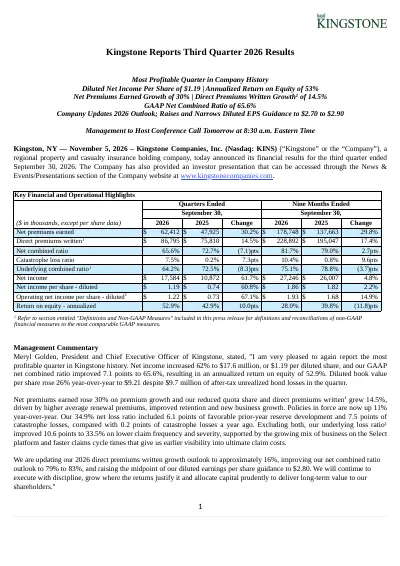
I'm really excited about our third quarter results, which topped the record we set just last quarter. Net income rose 62% to $17.6 million, or $1.19 per diluted share.
Diluted book value per share grew 26.5% over the prior year to $9.21. I'm proud of the improvement in our underlying business.
Our underlying loss ratio, which excludes both catastrophe losses and prior year reserve development, improved 10.6 points to 33.5. That improvement alone more than offset higher catastrophe losses of 7.5 points, which increased from 0.2 points for the benign storm season we experienced a year ago.
We also recognized $3.8 million, or 6.1 points, of favorable prior year reserve development. The low underlying loss ratio was mainly driven by better loss settlements due to improvements in our claims operations.
We rebuilt our claims organization over the last 3 years, hiring very experienced adjusters and leaders, and we are seeing the benefits in material cycle time improvements, leading to earlier visibility into ultimate property claims cost. In addition, overall personal lines non-catastrophe frequency for the quarter was lower than in the prior year quarter.
We attribute the frequency improvement primarily to our Select program, which now accounts for 65% of our homeowner policies, up from 54% a year ago. Turning to growth, direct premiums written grew 14.5% to $86.8 million.
Relative to the prior year quarter, new business policy count increased 10%, retention improved 2.9 points, average renewal premium increased 5%, and policies in force increased 11% to more than 86,000. We added more than 8,000 customers over the past year.
I'm particularly pleased that more of our policyholders are staying with us longer, as growth in retention will be a tailwind for both growth and profitability improvement in the future. As I mentioned on our last call, the New York market has gotten more competitive.
We've seen some carriers broaden their underwriting appetites and others raise producer compensation, as well as price more aggressively. As proven this quarter, we expect to continue to deliver top-tier growth and profitability even with increased competition.
Kingstone is a leader in the coastal New York market, as we have demonstrated our consistent appetite, stability, and commitment to our producers over many years. With broad and deep producer relationships, the segmentation power that Select provides, and an expense advantage, we are confident that we can continue to grow profitably across all market cycles.
We wrote little business in California this quarter. We entered the state to write risks with lower wildfire exposure at high returns given the capacity constraints in the market.
Many admitted carriers have reopened to new business since we launched, and there is a lot of capacity through excess and surplus lines entrants who have been reducing rates significantly. Many of the risks producers are quoting with us have higher wildfire exposure than we are comfortable with or don't meet our margin requirements, we chose not to write them.
We are going to intentionally stay small in California, scaling only where pricing and risk quality meet our underwriting and return requirements. In Connecticut, we began writing business in late September, as planned, with a small number of producers.
While it is still very early and Connecticut's contribution to our results will be modest this year, reception to our re-entry has been strong, and we are now focused on expanding distribution. These initiatives support our goal of $500 million of direct premiums written by year-end 2029.
New York is our core franchise and the main source of our growth, with measured expansion scaling over time. We are committed to diversifying our footprint, and while we recognize that it will take time for these new states to drive material volume, we are confident that diversification will result in more earnings durability.
Turning to our outlook, with 9 months behind us, we are raising and narrowing our '26 diluted earnings per share guidance to $2.70 to $2.90 from $2.20 to $2.90. We now expect full year return on equity of 29% to 30%, compared with 24% to 30% previously, and we have improved our GAAP net combined ratio outlook to 79 to 83 from 81 to 86.
We are also updating our outlook for 2026 direct premiums written growth to approximately 16% from our previous range of 16% to 20%, which keeps us on pace toward our $500 million goal. The higher earnings outlook reflects the results we have already delivered this year, including the favorable reserve development recognized through September.
We will continue to execute with discipline and grow where the returns justify it. You can see that discipline in this quarter's underlying results.
Net income grew 60% 62% and diluted book value per share increased 26.5%, even with $4.5 million more in catastrophe losses than in the prior year quarter. I remain extremely confident in Kingstone's trajectory.
I want to thank the entire Kingstone team for their execution, especially members of our claims organization who have provided exceptional service to policyholders with catastrophe claims this quarter, and our Select producers for their continued partnership. With that, I'll turn the call over to Randy for a more detailed review of our financial results.
Randy?
Randy Patten
Thank you, Meryl, and good morning again, everyone. From a net income and EPS standpoint, the third quarter was our second consecutive record quarter, with net income of $17.6 million, or $1.19 per diluted share, compared with $10.9 million, or 74 cents per diluted share in the third quarter of 2025.
Operating net income increased 68% to $18 million, and diluted operating net income per share was $1.22 in the third quarter of 2026, compared with 73 cents in the same quarter last year. Annualized GAAP return on equity was 52.9% during the third quarter of 2026.
Net premiums earned grew 30.2% to $62.4 million in the third quarter of 2026, driven by growth in direct premiums written and reduced quota share cession in 2026. As a reminder, we've reduced our New York personal lines quota share to 5% for the 2026 treaty year, compared with 16% for the 2025 treaty year, allowing us to retain more premium and underwriting profit.
Net investment income rose 50.3% to $3.8 million in the third quarter of 2026, driven by growth in invested assets and a higher average yield of 4.6%. Total investments were $337.1 million at September 30th, up 9% from year-end.
Turning to underwriting, the GAAP net loss ratio was 34.9%, compared with 44.3% in the prior year quarter, and our GAAP net combined ratio was 65.6%, compared with 72.7%. Excluding both catastrophe losses, which added 7.5 points, and favorable prior year reserve development, which reduced the net loss ratio by 6.1 points, the underlying performance of the book was strong in the third quarter of 2026, with an underlying combined ratio of 64.2%, which is an improvement of 8.3 points compared to the same quarter last year.
This has been an above-average catastrophe year. Third quarter catastrophe losses came from 9 of the 20 24 events so far, and two of those 9 events accounted for most of the losses, with one of those two events being the late September nor'easter, which contributed $1.7 million of losses.
The $3.8 million of favorable development in the quarter came primarily from our property lines, with a smaller favorable impact from our casualty book. Through the first 9 months, favorable development totaled approximately $6.7 million, or 3.8% of 9-month net premiums earned.
On expenses, our net underwriting expense ratio improved to 30.6% for the first 9 months of 2026 from 30.8% last year. In the third quarter, the ratio was 30.7%, compared with 28.4% in the prior year quarter.
Last year's quarter benefited from a $1.4 million favorable adjustment to the sliding scale ceding commissions, which lowered the third quarter of 2025's expense ratio by approximately 2.9 points. Excluding this adjustment, the third quarter 2026 expense ratio would have improved 0.6 points versus the same prior year quarter.
For the 9 months of 2026, direct premiums written increased 17.4% to $228.9 million, and net premiums earned increased 29.8% to $178.7 million. Despite elevated winter catastrophe activity in the first quarter of 2026, costing approximately $13 million in losses, we generated net income of $27.2 million, or $1.86 per diluted share, and operating net income of $28.3 million, or $1.93 per diluted share.
The 9-month GAAP net combined ratio was 81.7%, compared with 79% in the prior year period, and included 10.4 points of catastrophe losses, compared with 0.8 points last year. The underlying combined ratio improved 3.7 points to 75.1.
I will conclude my portion of the call today discussing our capital position. GAAP diluted book value per share was $9.21 at September 30th, up 26.5% from $7.28 a year ago, and 6% from June 30th, even after $9.7 million in after-tax net unrealized losses on our bond portfolio this quarter, which are recorded in other comprehensive income rather than net income.
Those losses reflect the rise in Treasury yields during the quarter, and not a weakening in the credit quality or credit risk of the underlying portfolio. Excluding accumulated other comprehensive income, diluted book value per share was $10.43, up 34.9% from $7.74 a year ago, and 12.5% from June 30th.
Our capital position is the strongest in our history. Stockholders' equity grew 11% this year to
Meryl Golden
Uh-oh.
Operator
Stand by, ladies and gentlemen. We'll resume in one moment.
Randy Patten
I'm back. Sorry about that.
I think I lost connection.
Operator
Line is ready. Please continue.
Randy Patten
Okay. Our capital position is the strongest in our history.
Stockholders' equity grew 11% this year to $136.7 million at September 30th. As a reminder, we have no debt at the holding company.
Our current catastrophe reinsurance program provides $500 million of total limit, up 14% from last year's program, with first event retentions at $3.5 million for wildfire, $5 million for named storm, and $6 million for winter storm. In California, a 30% quota share also limits our net exposures while the book is small.
Our capital priorities remain funding profitable growth first, followed by dividend growth, and then share repurchases, in that order. Our quarterly dividend is 6 cents per share, following the 20% increase in July, and we have authorization to repurchase up to 1 million shares through May 2028.
We will continue to allocate capital to support our strategic growth plans while maximizing long-term shareholder value. With that, operator, we are ready for questions.
Operator
Thank you. We will now be conducting a question-and-answer session.
If you like to ask a question at this time, you may press *1 from your telephone keypad, and a confirmation tone indicate your line is in the question queue. You may press *2 if you like to withdraw your question from the queue.
For participants using speaker equipment, it may be necessary to pick up your handset before pressing the star keys. One moment, please, while we poll for questions.
Once again, that is *1. Thank you.
Thank you. Your first question is from the line of Bob Farnam with Boenning Capital.
Please proceed with your questions.
Bob Farnam
Hi there, and good morning.
Meryl Golden
Hi, Bob.
Bob Farnam
I'd like to talk about the $500 million direct written premium goal. Now, I understand it's a goal, it's not guidance.
When you're talking about competition in California being a lot more than maybe expected, competition in New York picking up, I want to know what your thoughts are of actually keeping up to that number, because it may be much more difficult than you thought when you laid that out a year or two ago.
Meryl Golden
Sure, thanks for your question, Bob. We're in the second year of this 5-year plan to achieve $500 million, and so far we're on track.
This year's guidance of 16% keeps us on track to hit $15 million $500 million. We need to grow approximately 15% each year, and this is the second year we have achieved that.
New York is our core franchise and the main source of our growth, and with the measured expansion outside of New York scaling over time. We do recognize it's going to take time for these states to drive material volume, but we're confident that the diversification benefit is worth it, and at this point, we're still confident we can achieve the $500 million.
Bob Farnam
Okay. With your California expansion, can you give us an idea of the growth that you're seeing in California relative to the growth that maybe you thought you would see in the first year?
Meryl Golden
Sure. The growth we're seeing in California is very low.
What we had planned for the first year was $10 million, and we will be a fraction of that, intentionally, because as I said, what we're getting quoted on is not within our appetite, our wildfire appetite or our return appetite. We're continuing to focus on California.
We have various strategies because we are very supportive of the diversification benefit it will provide to the company. Far, it's a very small fraction of what we had anticipated.
Bob Farnam
Right. Okay.
In terms of the reserve development, I hear it's from property for the most part. I'm assuming that from accident year 2025 mostly, given the shorter-tailed nature of the claims?
Isn't it because the claims process improvements that you had, is that what's kind of driving the improvement there?
Meryl Golden
Yep. We had, as you mentioned, $3.8 million of favorable development in the quarter, and most of it was from property.
This is the first quarter where we've also had favorable development from casualty, we're really happy about that. Certainly, given the short-tail nature of property, most of the favorable development was for '25.
I want to point out I haven't really talked about the rebuild of our claims organization and what they really have done a great job with reserving the claim very quickly to its ultimate claims cost, and so we're seeing much less development, and that's really what is driving the favorable development this quarter and this year.
Bob Farnam
Great. One of my typical questions I ask is kind of pricing versus loss trends.
With pricing sounds like it's still going up, and loss trends, you're talking about claim frequency improving and claim severity improving. I'm going to assume that pricing is still ahead of loss trends at this point.
Is that accurate?
Meryl Golden
Yes. Right now, there's two ways to get rate.
One is the increase in replacement cost that really reflects inflation, and the other is filed rate changes with the department that would affect other trends. Right now, we have no rate in the department.
All of our rate change is from the increase in replacement cost, and it's slightly ahead of what we're seeing in terms of our loss trend. We feel very comfortable that our guidance of 74 to 75 in terms of our underlying combined ratio, that we can continue to achieve that even without needing to file rate in New York.
Bob Farnam
Good. The last question I have is just more of a detailed question.
For the fourth quarter, what do you have is your underlying loss ratio higher than another quarters? I'm trying to think about what goes on in the fourth quarter, and I don't know if you have increased fire losses or something or water losses going into the fourth quarter heading into the new year.
I'm just kind of curious in the fourth quarter, what should we expect in terms of the underlying loss ratio?
Meryl Golden
Yep. We have given guidance for the whole year that you can I guess figure out what we have planned for Q4.
We don't have any favorable development planned for Q4. We don't forecast that at all.
In general, the fourth quarter is an average cat quarter, we'll see what this year's weather brings.
Bob Farnam
It was probably more of a question of seasonality in terms of what the loss ratio obviously, you have first quarter is a big quarter for your underlying, but didn't know if there was something similar in the fourth quarter.
Meryl Golden
It all depends on the winter.
Bob Farnam
Depends on the winter. Okay.
That's it for me. Thanks.
Meryl Golden
Thanks, Bob.
Operator
Our next questions are from the line of Paul Newsome with Piper Sandler. Please proceed with your questions.
Paul Newsome
I just had one quick follow-up question from Bob's conversation on the California business. Is it just increased competition for the E&S products that is changing, or is this also a sign that we're seeing some movement back into the admitted markets in California, in your opinion?
Meryl Golden
It's really both. Again, the premise for Kingstone entering California was we thought we could write lower wildfire business at high margins because the admitted market was so capacity-constrained.
We have seen, particularly in the last quarter, many of the admitted writers open up for new business again. In addition to that, there has been many companies entering the E&S space and kind of a lots of rate decreases in that space.
It's really a combination. I think the market has changed rapidly and it's pretty volatile.
We'll see what the results of this insurance commissioner election bring. That could potentially change the market.
In general, for us, it's been that the admitted market has reopened, the type of business that we're getting quoted on is not within our risk appetite.
Paul Newsome
Right, that makes sense. Thank you.
Appreciate that help. Thank you.
Meryl Golden
Pleasure.
Operator
Thank you. As a reminder, if you'd like to ask a question, you may press *1 from your telephone keypad.
The next question comes from the line of Gabriel McClure, a private investor. Please proceed with your question, sir.
Gabriel McClure
Good morning, Meryl, and congrats on a great quarter again.
Meryl Golden
Hi, Gabriel.
Gabriel McClure
Hi. I wanted to just dig into kind of what Bob was asking you about with the favorable development.
You said a lot of the property development was from the year 2025. What was the other casualty development from?
Can you tell me what period that was from?
Meryl Golden
I honestly don't know the years offhand, but our casualty lines are longer-tailed than property, there's probably some favorable development from each of the years. I don't know specifically.
I can follow up with you after the call and let you know that.
Gabriel McClure
Thank you. That'd be great.
Then I wanted to ask about the underlying loss ratio. It moved down pretty dramatically.
It was already low and it's going lower, I didn't think it could be going lower, but is it you think it's going lower because more of the book is transitioning to the Select product, or is it because of what you're kind of talking about with your whole claims division just being a better engine?
Meryl Golden
I think it's both. Attritional frequency continues to be very low overall, and that we contribute to risk selection in the Select product for sure.
In addition to that, this rebuild of our claims organization and their focus on reducing cycle time is really leading to both better visibility and lower ultimate claims cost. They're really focused on providing timely and excellent service and ensuring that we're paying the right amount on every claim.
It is absolutely a game-changer for the company.
Gabriel McClure
Great. Then I had one for Randy, if I could.
Randy Patten
Sure. Hi, Gabriel.
Gabriel McClure
Hi, Randy. Looking at those unrealized bond losses...
Yes. I'm not sure I'm factoring this in the right way.
I think you said that in your remarks that you want to segregate those into AOCI. I guess $9.7 million would be about 67 67 cents if interest rates had stayed the same.
Is that the right way to think about it? If interest rates would have stayed the same, you'd add the 67 cents back to the $1.19 and come up with around $1.80, $1.85, or is that not the right way to think about it?
Randy Patten
Not quite the right way to think about it. Those are unrealized losses on our bond portfolio, so that $9.7 goes through other comprehensive income, which does not go through the income statement because they're unrealized.
What it really does is we provide you the book value without the adjustment for ex-AOCI, and then the adjustment for ex-AOCI. The delta between those two is really that majority of that is those unrealized losses.
That's how to think of that, and it really is interest rate driven for the spike that we saw in September.
Gabriel McClure
Right, okay. Very good.
Thank you.
Randy Patten
Thanks, Gabriel.
Gabriel McClure
That's all for me.
Operator
Thank you. As a reminder, to ask a question, you may press *1 from your telephone keypad.
Thank you. At this time, I'll turn the floor back to management for closing remarks.
Meryl Golden
Great! Thank you so much for joining our call.
Have a great day.
Operator
Ladies and gentlemen, thank you for your participation. This will conclude today's teleconference.
You may disconnect your lines at this time. Thank you for your participation.