Knightscope, Inc.
NNASDAQ:KSCPQ3 FY2025 · Earnings Call TranscriptNovember 13, 2025
Alison Schwanke
Welcome, everybody, to the third quarter 2025 Knightscope earnings call. My name is Alison Schwanke?]
, I'm the VP of Marketing here at Knightscope, and I'm joined by our Chairman and CEO and CFO. We're excited to go through the results and some exciting news for us here at Knightscope.
I'll hand it over to you, Bill.
William Santana Li
Thanks, Ally. Welcome, everybody.
We're live streaming from our brand spanking new Knightscope headquarters here in Silicon Valley. If you see some noise or stuff going on in the background, we're getting ready for our HQ night,
Alison Schwanke
to speak, to
William Santana Li
have friends and family here this evening. We're excited to get everyone to come visit the new facility.
The other important thing to note, we will not be covering any MNPI during the call, no material non-public information. If you ask a question after the discussion on the earnings, if we can't answer the question, we'll try to rephrase it so we can.
Ally's here to moderate and make sure we stay out of trouble.
Alison Schwanke
If you do have any questions, please use the Q&A feature inside of the webinar, and we'll make sure and line those up so we can answer after we address some of the initial findings.
William Santana Li
With that, we're going to turn it over to Apoorv, who's going to walk us through the third quarter.
Apoorv Dwivedi
Thanks, Bill. As we look into our third quarter financials, there's three primary themes that are emerging.
On one side, revenue, we saw modest revenue growth. Company is still largely early stage in an industry where there is a lot of excitement around robots.
However, the adoption is still uneven. We believe that we will be able to better penetrate existing markets and enter new markets with innovative technologies that the company is bringing forth in the near future.
On the margin side has been challenged as we continue to build scale economics in manufacturing, in the field servicing, and in our material manufacturing. Historically, our team has been exceptionally scrappy, doing whatever it takes to meet growing demand.
This scrappiness has been our superpower, but it doesn't scale. As we prepare for next phase of growth, we're completely overhauling how we build and deliver our products.
In Q3, we saw a temporary dip in our margins as a direct result of the deep dive we took in our manufacturing operations. Lastly, our investment in product development and innovation: we are investing in innovation and product development, and we believe that innovation will be a critical engine of our growth in the near future.
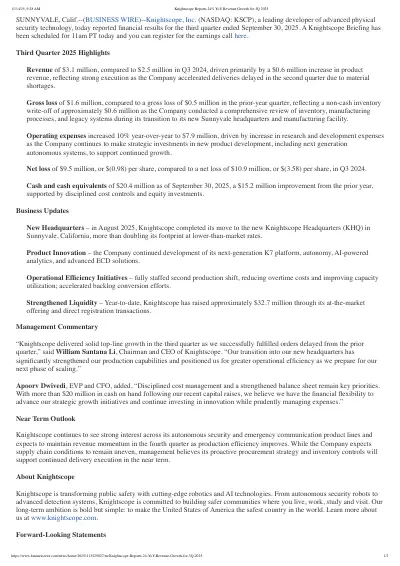
With that, let's jump into the financials. Total revenue of $3.1 million grew by 23.5% versus prior year.
This was driven by increase in both sides of the business. Services revenue grew modestly by 2%, while product revenue grew by 82%, largely as the company delivered higher production to catch up from prior quarters' component shortages.
Gross loss of $1.6 million is largely driven by $600,000 write-off of slow-moving and obsolete inventory that we identified as part of the move from Mountain View to Sunnyvale, in addition to recognizing higher material costs incurred to meet production demands of the third quarter. OpEx increased by almost 13% and ended at $7.9 million, largely due to intensified investment in R&D, primarily in the next generation 4-wheel K7 robot.
As such, our R&D investment increased by $2 million as compared to prior year. However, this was offset by cost savings of about $1.1 million across SG&A, primarily in lower third-party professional fees and in lower IR expense.
As a result of these dynamics, our loss from operations came in at $9.5 million as compared to $7.7 million prior year. Additionally, our net loss of 10—$10 million came in $1 million better than prior year, primarily due to the $3 million expense hit that we took last year as part of the change in fair values of the warrant liabilities, which are no longer on our books.
EPS came in at 98 cents—negative 98 cents as compared to a loss of $3.58 prior year. Finally, on a great note, our cash balance continues to increase as the company relies on its ATM as well as cost management, we ended our cash balance at about $20.4 million this quarter versus $5.3 million last year at the same time.
With that, I will pass it on to Bill for Q&A.
William Santana Li
Now, before we go to the Q&A, I really think we might have a video to show?
Apoorv Dwivedi
Oh, interesting.
William Santana Li
All right,
Apoorv Dwivedi
let's do it.
William Santana Li
Let's roll it. All right.
Hopefully, everybody enjoyed that. We've been working on the Knightscope K7 for a very long time.
We're excited to announce that we're going to start limited series production second half of '26, and we're in very good spirits here as, building on what Apoorv said, kind of resetting the stage and foundation for growth of Knightscope. I've never been this excited about the company's future even since inception.
Things are looking up here. Ally, you want to hit us with the easy questions first?
Alison Schwanke
Absolutely. The first one I already answered, but I'm going to go ahead and read it again.
Robin was excited for us to speak about what was coming. I think maybe that was the video that we referred to, but the earnings were released this morning, what other news is behind that?
William Santana Li
Literally behind us. [laughter] It's the all-new K7 autonomous security robot.
We're really excited about building a new foundation to be able to handle much larger environments at much higher speeds with a ton more capabilities, and I think you and I are going to be sharing a little bit more over the next coming months and drip feeding some exciting news ahead of the launch in the second half.
Alison Schwanke
Absolutely. There's a couple of questions here regarding some of the financials, let's go into those.
William Santana Li
Sure.
Alison Schwanke
Greg says, "Is the company building first, then selling the inventory, or building inventory and then selling products?"
William Santana Li
Oh, that's a great question. Hot
Apoorv Dwivedi
button.
William Santana Li
[laughter] Traditionally, we've sold the products first, then built them. However, as we kind of move forward towards scaling, I think one of the things we want to do is figure out how do we build to stock and then sell the inventory as demand comes in.
It's important for us to be able to, as we scale, to do that because that allows us to then turn the bookings into revenue much faster.
Apoorv Dwivedi
I think historically, if you look at the numbers, we at the peak had maybe $6 million worth of backlog. We've brought it down to about 1 or— $2, $2
William Santana Li
million now,
Apoorv Dwivedi
yeah. million.
We want to get that down as much as possible and start building finished goods inventory so that we can actually ship quicker, and actually the whole operations, the financials, everything get improved. That was one of the other reasons to move here to a much, much larger facility.
In Mountain View, we had about 13,000 square feet; here in Sunnyvale, we're at 33,000 square feet and a lot more capacity for us to continue to grow.
Alison Schwanke
Makes sense. There's a question here about the stock.
"The stock's down over 99% from the IPO price. How can you justify C-level salaries with such dismal performance?"
Apoorv Dwivedi
Look, the stock price is rarely an indication, especially for a company like our size, it's rarely a indication or a performance of the company itself. It's really more driven by market dynamics and what people think the stock and the company will do and what they're seeing.
Now, the salary expectations and the compensation is really driven by board. The board determines what they think we've done and how we perform and how we've done, and they determine that.
I think overall, the company's been in a really great point so far. It took us a lot to get here.
We're looking forward to the growth, and I think what we're seeing is the compensation reflects where the board feels that the company is going to be. Yeah.
Alison Schwanke
Fantastic. Let's talk a little bit about the K7 capabilities.
There's some questions here about what all can it do, what are the capabilities of the new K7?
William Santana Li
We're not going to unveil everything today, but it will go up to 10 miles an hour, so much faster than the K5. It'll handle much more difficult terrain, light duty off-road as well as kind of street level type of environments.
We're still working on this, it's not ready for prime time just yet, but we're going to work on off-grid capabilities for us to deploy these in much larger environments that don't have power infrastructure. That's another big R&D investment for the next year plus for us to be able to deliver on that capability, still at the R&D stage.
We have a few things up our sleeves, but remember what I've often said: we want to put 1 million machines in network that can see, feel, hear, smell, speak, and autonomously cooperate, and the K7, this next generation of technology, is a massive step towards that vision.
Alison Schwanke
One more quick thing to add is the amount of hours that we've now acquired in experience on the field of patrolling.
William Santana Li
I think if we would have tried to build this much earlier in our development cycle, it would have been that much more difficult. We've now operated well over 4 million hours fully autonomously across every time zone in the US and multiple winters and summers, and it's important to have that field experience.
That literally gives us a competitive advantage because we can see designs from science fair projects to startups and the like that might have an interesting thing to look at. One quick review, we know this is going to fail, that's going to fail, and this is going to fail, and they're going to find out real quick why they're not going to want to go down that path.
Having that intelligence and understanding from being out in the field is really, really important. You cannot develop this stuff in a laboratory.
Alison Schwanke
Absolutely. Let's pivot a little bit back to some shareholder questions.
We have a couple here about what we're doing to drive or specifically address shareholder value.
Apoorv Dwivedi
Sure. Shareholder value again comes from execution, right?
We as a team are going to have to figure out how do we execute and deliver on the promises of growth that we're giving to the shareholders. That's just a process.
It doesn't happen in a quarter, it doesn't happen in two quarters, it takes a while. The company, as we've talked about in the prior few calls, is going through a true transition period.
We grew for the last 10 years through being scrappy. Scrappy is great for innovation; however, in order for us to move forward to the next phase of growth requires us to set in processes, structure, and basically set up for scale.
To do that, we need shareholder support to continue to believe in us, but what we'll deliver in the future is higher revenues—we're focusing on that; we're focusing on penetrating new markets; we're focusing on driving our margins lower. Again, right now, it's kind of an interesting time because we have to clean up some backlog and some other just things that have happened in the past.
As we kind of go through that clean-up phase, as we set up for scale, that's how we add shareholder value: by showing growth and through innovating. I think maybe it might be worthwhile recapping what we've done over the last 2 years— Sure.
—and why we're excited. We've literally turned Knightscope inside out and upside down, going through every single functional area, every single department.
We brought in a new stellar board. We've got rid of about 40% of the management team.
We took about 30% of the payroll out and brought in new talent. We shut down a few facilities, moved into a brand new one.
We set up a new remote monitoring department, a new sales team, new accounting team, new CFO, new VP of Marketing. Now we've got a huge product launch that we're working on with the K7.
There's the K1 stuff that we'll talk about next year. It's focus on growth, but you need to kind of have a stable foundation, which I think Apoorv was trying to get at.
We literally changed everything in the building, including the address of the building, and if you haven't noticed, the actual logo of the company. No stone unturned to make sure that we're set up for success.
Our three growth strategies to be abundantly clear: one, organic growth is to grow the base business, the current business that we have, and all the blocking and tackling that needs to get done for that. Second is new product development-led growth: so new products, new technologies, new capabilities that give us a sustainable competitive advantage in the marketplace.
Then the last one, inorganic growth: a lot of focus on mergers and acquisitions that can build on that top-line revenue or give us additional technical capabilities.
Alison Schwanke
That actually is a good parallel to what's being asked here, which is, "Are you working on any M&A opportunities?"
William Santana Li
Never crossed my mind. [laughter] You want to cover that one, Apoorv?
Apoorv Dwivedi
Sure. We are absolutely looking at M&A opportunities.
There are two primary areas that we're focused on. The way you think about growth engine is really hardware, software, humans, right?
Those are three critical components of our growth in the future. On the hardware side, we have development here.
On the software side, we're looking for partners and/or companies to acquire that allow us things like perception AI or audio AI or sense AI. Those are the things that are going to help us become better at analytics and being able to give our machines the capabilities to perceive the environment around them in a better way.
Third part of it is a human side. We, as you guys know, as Bill just mentioned, this year or last year we invested in something called the RTX group, which put humans in the loop.
We do believe that really this idea that robots will somehow replace humans is the answer, it really isn't. The answer is you've got to pair humans with robots, you've got to augment them so humans can become better, right?
Humans can become faster at what they do. We're looking at industries, or at least companies, where we can find some great humans to work with us.
I think defining the next-generation augmented security guard is certainly a path that we're considering, the remote monitoring. At the end of the day, we had a large VIP client here yesterday.
At the end of the day, the clients don't care. They just, "Please fix my problem, and in a way that I can afford it."
All the solutions today really aren't delivering what clients actually need. What we're building is that solution that will be comprehensive to actually permanently fix the problem for the clients as opposed to pushing a certain technology or a certain strategy.
Alison Schwanke
This question plays into that a little bit, and it's about autonomous driving. The fact that it's already being adapted by much larger companies, was there consideration in teaming up with them in terms of incorporating Knightscope tech into one of theirs, or are we totally set on developing our vehicles or this vehicles from the ground up in-house?
I guess totally in-house was the clarifier there.
William Santana Li
Totally in-house. I think there's, as I often said, there's going to need to be a very large portfolio of technologies.
What's behind us is just the beginning, as was the K5 and the K1. A simple way to think about it is it's very different to secure and protect a school as it might be to secure an underpass of a bridge or a federal courthouse.
You can't have one single technology, and voila, that's just going to fix everything. If that were the case, then all the cameras been fixed something.
There's 85 million cameras in the US; I don't think it's fixing much. I think you need a large portfolio, and either we're going to do it ourselves, we may partner with folks, or we may buy it, but one way or another, we need to achieve the mission.
That ends up being a make-buy decision. In some cases, we know a little bit more than what's out in the marketplace.
We're in a little bit of an odd space, right? You've got the delivery robots making some good progress on sidewalks, less than 5 miles an hour on sidewalks.
Then you've got the autonomous vehicle folks and the trucking folks; they're primarily focused at 35, 50, 75 miles an hour on city streets and highways. That's a very different profile than 10 miles an hour around the perimeter of a security location that needs security.
We're still specializing, but we're certainly open to partnerships. We've been evaluating them as part of our M&A strategy or as part of our technology development.
Alison Schwanke
Fantastic. There's several questions here around government and government contracts, I'll group these together: and people asking do we have any government contracts that we're pursuing, or what has been the latest of some of the work you did on Capitol Hill?
William Santana Li
Yes, we have local, state, federal contracts in the stationary side, a good portion of them. The federal side, to be frank, as we always are, rather frustrating.
We're in the middle of a whole conversation, and then to have the government shut down is really not productive. We'll restart those conversations, but that certainly was a little bit of a setback.
At the same time, the problem still persists, right? All these military bases need to be hardened.
The 10,000 federal security—sorry, the 10,000 federal buildings still need improved security. I think the solutions that we're building, inclusive of us partnering with our friends over at Palantir to get our technology on their FedStart platform, is also a huge enabler for us to grow the federal side of things.
As I've said, this is a medium-long term type of thing. You're not going to all of a sudden have a significant growth on a client that moves very slowly.
Alison Schwanke
Speaking of, this may be related to that. How do we think about the K7 having applicability for border security?
Is it rugged enough?
William Santana Li
Light duty off-road is real important. The other reason we're looking at the off-grid charging, autonomous charging is also important because you don't necessarily have power out in the middle of nowhere.
I think the Department of Homeland Security is looking out to put a request for proposal on certain autonomous technologies to do that capability, to support our friends over at CBP. It's certainly on the road map for us.
Alison Schwanke
Great. What about the ability for us to share K7 pre-order numbers as part of future quarterly reports?
William Santana Li
[laughter] How about answering that?
Apoorv Dwivedi
Look, I think we traditionally just haven't been forward-looking. Again, the key is we want to execute first and then talk about what we've done, and I think that's going to stay our course for now.
I think over the years, we have a lot of existing clients and former clients that have expressed a great deal of interest. Re-engaging those folks is certainly top of mind, inviting them here, doing some beta testing at some of these locations, etc.
We wouldn't build this if we didn't think there was strong demand for it. I'll agree with Apoorv; we'll probably make sure these get deployed, and then we'll talk about the actual numbers.
Alison Schwanke
There is a waitlist open right now, if there is interest, people can go and it's on the website. Head under the Autonomous Security tab on the website; it's also on the homepage.
William Santana Li
Knightscope.com/
Alison Schwanke
/K7, or again, if you don't have any extra clicks in you today, just go to the homepage, and there's a button right on there, and you can go see it. Thanks.
Cool. Let's talk about how the K7, maybe the robots, K-lines, are made in terms of components.
Are key components sourced in relation to tariffs versus US made?
Apoorv Dwivedi
To be clear, we design everything, we engineer it, we manufacture it, we deploy it, and we support it. For a majority of our products, if not all of them, were BAA or Buy American Act compliant, and that is the strategy for these machines.
Need to be careful with other companies that love to import stuff from China and then have that surveilling your own property without the proper cyber controls or point of origination type of discussion. We're being very careful with that.
This is technology built and designed in America to protect Americans.
Alison Schwanke
Let's talk about the facility that we have here. We have a couple of questions on if it's available to come in for a tour if people aren't able to make it to the events.
William Santana Li
I think we're going to have to set that up because we get that request a lot. I haven't talked to you about this, but so April 4th or the April 4th—
Alison Schwanke
The first week in April.
William Santana Li
First week in April is probably the next time we'll do an event, so that will be our 13th-year anniversary. We'll work to have Apoorv do some karaoke that night and get you all here to visit us here at Knightscope.
What we want to do for prospective clients and existing clients is actually have the facility amenable to and set up properly for you to understand and view the technology. You can only PowerPoint and Zoom people to death and email them so much; sometimes they need to come and see and touch and feel and experience.
We'll be spending the next probably 3 to 6 months finishing up the setup of what's planned here for Knightscope headquarters, and we'll certainly have an invitation out for you.
Alison Schwanke
Robert has a question about our sales force. "Have you reassigned your sales force to specialize in different industries—federal, state, etc.—or local governments and education, kind of in the vertical strategy, I guess?"
Apoorv Dwivedi
Mixed bag. We've tried vertical only; sometimes has been successful.
We've done more regional. We just brought on a new director who specializes on local and state, kind of a mixed bag.
I think we'll continue to do that. Again, this is new technology.
No one in the history of mankind has done this before, there's a lot of experimentation. Something that works in one region may not work in a different region, or one vertical and another vertical, kind of working our way through that.
Alison Schwanke
Do you feel the new K7 will put our competitors, such as—I won't name the competitors specifically in this call, but will we put the competitors in the rearview mirror, and if so, how?
William Santana Li
What competitors?
Alison Schwanke
Do you want to name them?
William Santana Li
No. I don't acknowledge any viable products out in the field
Alison Schwanke
with
William Santana Li
millions of hours of operation. I'm kidding.
I'm kidding. I think, first and foremost, most people don't like the next assertion, but we're serious about making the US the safest country in the world.
Anyone and everyone who's trying with a new public safety technology, a new law enforcement capability, or physical security, we want to support them. We're not that company that's like, "Oh, well, everything's cutthroat.
It's a zero-sum game, and if we win, you lose, and you win, we lose." That's not the game here.
I want to make it miserable for anyone who wants to cause harm to an American citizen to re-understand that they can't do that here anymore. We want to be supportive.
We're always going to have some fun conversations with competitors and so-called competitors, but I think we're very confident in the K7 and its capabilities, and we're also excited to get it out on the road.
Alison Schwanke
Competitive-wise, one of the things that is important for us to remember that substitute competitors and our people's perceived behavior and the way that they've always done things is one of our biggest competitors.
William Santana Li
That's a great point. I think the actual real problem, kind of what I told Congress when I was on Capitol Hill, is the biggest fear I have of AI is not the technology.
The technology is moving very quickly and in an exciting fashion. The actual problem is humans.
Humans don't want to change, large organizations don't want to change. I don't think it's new news.
We've been arguing with the Department of Veterans Affairs for 5 years now. I literally went to go see the Secretary of the VA to continue to plead our case.
To spend half a decade to try to convince a client that you have a problem, you have a budget problem, you have a staffing problem, you have a security problem, and the organization continues to want to do business the old way is problematic. That's why I've been pushing for a National Robotics Strategy to basically be that catalyst for the federal government to unstuck this because this continues to happen.
It's not just us; it's everyone that's working on robots, or automation, or AI, or any kind of technology. You have an industry that doesn't want to change.
New news coming for you: it's going to change one way or another.
Apoorv Dwivedi
I think that's what I mentioned earlier when I opened up the financial themes. The adoption is uneven, especially in the safety and security world, right?
As you mentioned earlier, the more people, the more industries that are out there adapting and adopting to what robots and machines and technology can help them with, the easier actually it becomes for us to go out there and put forth our value proposition. Otherwise, we are competing against status quo, and sometimes that's the harder sell.
Actually, I'll go down a path. I think we shared this with the analysts; I think it'd be fair to share it with the audience here.
If I can have you visualize a bar chart, and if I put a very large bar here of top three guarding companies in the US, a third, a third, a third, plus or minus, these three companies alone generate what is it? $30 billion.
$30 billion worth of revenue and employ a half a million humans in the US alone. Now, if you go over here, and you make a little chart here, if you add up all the competitors, folks that have new technologies, anyone working in public safety, law enforcement, kind of technology, physical security, you're almost about 1% of this.
That's pretty much just stayed steady for a decade. That proves my point: folks don't want to change.
The country's addicted to video management systems running Windows, humans, and cameras. Then we're wondering why everything costs so much, and a violent crime occurs every 26 seconds and a property crime every 4 seconds.
The system's broken. You've got 1.5 million guards, 1 million law enforcement professionals, 85 million cameras, 300,000 cop cars—not working.
We need to change.
Alison Schwanke
This is a question that most likely a lot of companies like us receive, but it goes to you, Bill. "Some of these goals Bill has been saying for years, we've struggled to deliver on them.
Why will this time be different?"
William Santana Li
I live here in Silicon Valley. There are 22,000 startups here.
Literally 95% fail. The statistical probability of someone starting a company, getting it funded, growing it, taking it public, and still be alive and kicking, 12, 13 years later is almost near zero.
First and foremost, I want to thank our investors that have stayed with us all this time, our vendors or suppliers, the relentless Knightscope team, and all our supporters because what we're doing is technically very difficult, operationally it's extremely taxing, and there's an industry that doesn't want to change. That said, now that we've built that foundation that Apoorv was speaking of earlier, now we have that foundation to actually grow to the next level.
I think another thing to put in context, people take for granted that the autonomy side is kind of really easy to do. Okay.
Apoorv Dwivedi
About half a dozen folks have tried to literally do what we're doing and no longer exist and given up, and half of them were large corporations and half of them startups. I think on the self-driving type of thing, started in 2007, '13 started getting some traction, everybody will be in a self-driving vehicle by 2020.
Hey, folks, it's almost 2026. It's not scaling across the nation.
There's some great progress being done by the team over at Waymo, at Nuro, etc. By the way, the team at Tesla is doing awesome work, but it's extremely difficult problem.
If you think this is just going over one decade just miraculously appear and it's going to work, and Bill just keeps saying the same thing over and over again, well, you can take it two different ways: Bill's delusional, this will never work, you can try to bet against us, you will fail; or maybe he's on to something, and this is just going to take some time. If we can stick with it, crime's not going away.
There's not a market risk here, right? Technology, yeah, can it be improved?
Sure. The last part of the risk is execution, and that's what we really need to focus on.
Yes, I've been saying it for a long time. We're focused.
We're relentless, and because we're focused and relentless, we're going to get where we told everyone we're going to go. Is it taking longer than we want?
Sure. The team at Tesla's promised all kinds of things.
Eventually, they get there, and we applaud them for that effort, and we hope to follow in their footsteps.
Alison Schwanke
This question follows that up. It might be more in my territory, but Francis says, "What are some of the new marketing strategies?"
William Santana Li
New marketing strategy: go hire a VP of Marketing that's a genius. [laughter] So go for it, Ally.
Alison Schwanke
Sure. Thanks for that question.
There is a lot of foundational work that we are building right now. We have a lot of focus on data and integration of systems to see the whole entire customer journey across the knowing about the product to even creating demand and then eventually through the customer experience.
I've got a lot of things planned out for next year. Right now, we're seeing the K7 launch, as you've seen hopefully in your email and on social today, but we have a lot of vertical work that we're doing, pairing that with a lot of content, and then the new focus on how people are actually finding information online.
We've got search engines are changing, we're now looking at how that feeds into ChatGPT and AI discovery. Ultimately, you're going to see a lot more of us at the industry-specific presence next year.
We've got a big focus on trade shows and events and field sales as a lot of people are getting a little bit tired of that digital environment. We're going to see a lot of more faces in person.
Just like we had yesterday here on site with the group that came and toured, lots of excitement, and I think we're seeing the public wake up to the idea that robots are here, and we need to see them in person.
William Santana Li
Robots will be everywhere. Taking a little longer than we want.
We'll get there.
Alison Schwanke
We're also working on some content production, we're working on a podcast studio. This is a makeshift setup today to show you the K7, but we do have some details that we're working on so we can create content and actually use some of that AI.
I hear
William Santana Li
Apoorv on TikTok.
Alison Schwanke
[laughter] We already know that he knows how to do karaoke, but I'm really excited as a strategic marketer to build out a team that's really data focused. Apoorv and I speak the same language of if it's not a number and it didn't actually end up on a report, it didn't happen.
That's a big difference that I'm bringing to the team here.
William Santana Li
That's fun.
Alison Schwanke
All right. We have a couple of questions about drones.
This person has been following for about 8 years. "Now were we thinking in surveillance is is surveillance drones, are they possible?"
William Santana Li
There's a lot of companies that have been working on it. There's a few technical issues that folks are overcoming.
I think you still have the end-user desire not to change. There's some law enforcement agencies that have been using it, drone as a first responder.
I'm excited to see that work being done to kind of enable a different approach. I think eventually, there'll be drones flying out of these machines.
For persistent 24/7, it's not really yet a thing in the physical security side of things, which is different than law enforcement. I think on the law enforcement side, there's certainly a lot more traction.
I think the opposite on the federal side: it's not the drone or drone capability, it's the never-ending drones showing up on military bases that aren't supposed to be there. It's actually a more pointed approach on anti-drone technology, and it's getting to be a real serious problem for all the military bases.
I don't think this is kind of new news, but there's I won't give you the number, but there's thousands of foreign nationals that try to get on US military bases every year, and those bases need to get hardened not just from the human element, but from the drones as well.
Alison Schwanke
There's a question here about our goal of achieving 100+ K5s in the field, and "This was a goal several years ago, but it doesn't seem like we're there. What are the greatest obstacles?"
Apoorv Dwivedi
I think we have more than 100 total ASR devices out in the field. Really, the biggest challenge comes down to adoption, right?
It's the same theme that we go across when you have new technologies. We have certain early adopters that continue to renew and continue to expand, and then there are certain places where we still struggle because again, it's such a new territory for our potential clients that they just need to get more comfortable.
Again, it's just time, as you mentioned earlier, Bill. We just need time to be in the open.
We need time to be in front of customers and clients, and we need them to see our devices in front of them.
William Santana Li
I shared that with Ally when she first joined, and "Woe is me, we're having struggles with these type of clients, we're having struggles with these type of clients." And, "But I don't understand, we've had clients renew for 3, 4, 5, 6, 7, 8, I think we're coming on a ninth-year renewal with the same clients."
She's like, "I don't want to hear about the struggles. Who are the people that keep renewing for half a decade or almost a decade?
We need to go understand that better." That's the kind of right attitude and question to ask, and kind of where we're going to be very much focused.
Alison Schwanke
Some of the anecdotal feedback from the field is we're seeing a lot more adoption of the technology of what it can do versus it being sort of a shiny object. I'm really excited for that we're seeing a lot of that happen.
William Santana Li
Because there are a lot of investors on the call, I think one other analysis that Apoorv and I did when he first arrived is for those clients that did renew for 3, 4, 5, 6, 7, 8, 9 years, what do the financials look like for those units? Actually, it's lucrative and kind of what we planned.
We just kind of need to do a rinse and repeat on that type of approach.
Alison Schwanke
We have one question about maybe what can be done to overcome the fear of the robots.
William Santana Li
Congress asked me the same—
Alison Schwanke
A general question.
William Santana Li
I think there's one soft thing to do and then one harder thing to do. The soft thing to do is just communicate: spend the time, do the webinars, invite people over, do the lunch and learn, educate, put out the content, get people to share the content.
For places that we've been deployed for a long time, people are bored with it because it's, "Yeah, it's a robot. It's supposed to be here.
Fine, move on to the next subject." For a lot of places where we go, it's still a novelty, it's something from science fiction that's off the movie screen and now in front of me.
I think educating is probably one of the most important things to do. I think the harder thing, which is my ask of the administration and the folks on Capitol Hill, is we need to pass the National Robotics Strategy to basically have a mini mandate to require every department and agency to take 1% of their operating maintenance and service kind of budgets, and thou shalt use it for robotics, automation, and autonomy.
This is not an ask to increase expenditures for the federal government; it's actually to reduce it. Can you please stop being inefficient with our own tax dollars, and use commercially reasonable and commercially available technology that's already proven in the marketplace so we can save taxpayer dollars and you guys can go spend that money elsewhere?
If we can get Congress to actually put that mandate in, we can actually get some footing in this industry, which then has a bunch of positive repercussions.
Alison Schwanke
I'm going to put these two questions together. One is about who will be the customer of the K7, and then the other is a question about whether or not the red and blue lights are restricted to law enforcement only, seeing that on the video.
William Santana Li
There's no restrictions. You can go look at a security vehicle sometimes has those.
In terms of who the clients are, we'll not ready to disclose that yet, but probably the easiest sale you might ever get is from an existing client. We'll probably start there and do some good amount of beta testing before we do a wider release.
Alison Schwanke
Do you envision any entry into the K-12 education market?
William Santana Li
I struggle with the the K-12 situation, which is different than than higher education. Our country unfortunately can't pay our teachers properly.
The schools don't have enough budget to buy the appropriate computers and tools. Then someone's going to show up and say, "You need 6 or 7 figures to come out of nowhere to pay to properly secure this facility."
Like this is more of a, almost now defunct Department of Education discussion because the schools don't have the budgets to do this. That's kind of the first issue.
Second issue is we operate primarily very well in 24/7 operations, healthcare, casinos, airports, etc. work a lot better for us.
K through 12 don't necessarily run 24/7, and I think they should, but [laughter] they don't actually run 24/7. I think that's a challenge.
Where we've spent a lot more time is with universities and colleges. Sometimes there there is the actual budget; they run closer to 24/7 and is a is a better match.
It it's still a I think a sore point that needs to get addressed.
Alison Schwanke
Can you talk about the other side of the business? It is 2/3 of revenue.
I think they're asking that: is it, please clarify?
Apoorv Dwivedi
Yes, the ECD devices continue to be the primary driver of our revenue today. It's about 60% of overall revenue.
I think there, we talked about growth being organic, is just basically blocking and tackling, kind of the same approach. That said, I think we said earlier in the year that we're looking to revamp the K1 stationary lineup.
Today is about the K7. Perhaps sometime in the future, we'll have a Knightscope briefing on a new product launch to discuss the K1 separately.
If I can expand on that, Bill, the other part of it is the dynamics of how the how the revenue is recognized across both products. Right?
On the ECD devices, primarily we recognize revenue as we sell. It's a transactional sale.
On the on the robots, it's really the revenue is, over course of time, whether it's, every month is 1/12 of the annual revenue, or every year is, the full subscription price. As you think about that, obviously, the the one-time sales of the ECDs will will have a higher percentage will be a higher percentage of our revenue.
One of the things that the company is also doing very as we continue to grow is how do we grow more of our revenues to be recurring? Even on the ECD side, we are growing the services side of that business slowly but surely.
We're focused on things like, our HEMS that allows our customers and clients to see their the the health of their ECD devices in real time. We are expanding on the full services maintenance model that allows our clients essentially be hands-off and pay, monthly subscription fee or annual subscription fee for us to take care of their units for them.
We believe there's growth there, there's demand there, and there's growth there, so that's going to continue to happen. For now, because we the way we sell these devices, the revenue on the ECD devices continues to be higher.
Alison Schwanke
Kevin asks, "Given so many of our competitors have not been successful in this area, what should we be watching as an indicator that the market has matured enough for Knightscope to succeed?"
William Santana Li
What we've been talking about is adoption. Once again, if it's boring, would be a good thing.
At some point in time, there'll be a tipping point where if you don't have an autonomous security robot, you're the outcast weirdo. The insurance company is going to look at you and go, "You didn't want to pay the $5, $10, $15 an hour to properly secure your facility?
We're not going to underwrite this policy." At some point, it's going to have that tipping point no different than you don't build a building today without fire extinguishers and smoke detectors and fire detectors and that sort of stuff.
I think what you need to really kind of focus on is adoption and use cases, and that's kind of what we're working on.
Alison Schwanke
Real quick administrative thing: it sounds like your microphone is a little bit lower than Apoorv and myself, if you can adjust that for us, that would be wonderful. There's a question from Nathaniel, he references the PC was offered to the public, "Have we created anything for the home?"
William Santana Li
[sighs] So we intentionally started business-to-business because if you start with a new product business-to-government, you will fail or much higher risk of failing. We started business-to-business.
We've slowly been adding business-to-government, which is a different animal. Business-to-consumer is a widely different process, widely different marketing, sales, and service, distribution, price points, etc.
I think we are slowly getting in there, but not on purpose. We've had clients that have very large estates that look more like a business than a home, or an HOA or apartment complex and that sort of thing.
I think once we're comfortable with our operating in all 50 states, we're happy where we are with the federal side of things and the local and state government, we've got good penetration in all the rest of the business-to-business, I think we can start discussing business-to-consumer, but that's a very, very long time from now.
Alison Schwanke
Apoorv, I think this one is for you, financial question. Greg says, "What"—this might be a typo in here, but—"What was the company last fourth income versus the development expense investments?
If expense is greater than income, how is that sustainable?"
Apoorv Dwivedi
I didn't quite catch the first part, but the second part of the question is long term, it's not sustainable, right? That's what we have to figure out is how do we continue to drive business growth, to drive business margins, and then obviously drive EBITDA or net income so be positive cash flow.
The challenge is we're a hardware company. Software companies can develop a product and then put it out and get 70%, 60%, 90% margins.
As a hard-tech company, we have to scale. That's really what it comes down to is we've got to scale.
Once we scale large enough, we can use economics on the manufacturing side, on the vendor management side, on humans, and use that to then drive gross margin and EBITDA. That's really, it's an execution challenge, and it's an execution strategy for us.
That's really what we have to do. I take maybe a different, nuanced approach.
For 12 years, on every single call, "You guys don't have enough money, you're going to run out of money, you're going to hit the wall, it's never going to work." We've never missed a payroll, we've never run out of money.
We literally have the most cash on hand that we've ever had in the history of the company. We actually have the resources now to do what we had planned to do.
We're working on improving the gross margins. We're improving the product, our fixed cost bases, and everything else.
That's why we're excited, and that's why the board's excited is because we actually have a plan to move the company forward in a very exciting way. You don't get talent like this and the rest of the entire management team and the whole team to go work on a very difficult problem if you don't have a way to get from A to B.
We've got a way to get from A to B, and it's kind of exciting. That's not a conversation point anymore of, "Oh, well, you don't have enough cash on hand to make whatever next quarter type of" We're not having that conversation.
The conversation now is you have the resources, you have the management team, you need to focus on execution.
Alison Schwanke
There's a couple of questions around shareholder value from earlier investments, I'll group them together in: how is Knightscope helping early investors recover losses?
William Santana Li
Continue to be investors. I think this is a long game, right?
Over the long course, as we continue to again do the things that Bill talked about: new product innovation, growth in revenue, drive margins, drive EBITDA, drive execution, our share price will reflect that over time. Again, one of the first questions we asked is why is the share price where it is?
The share price isn't reflecting today where the company is and what things that we've accomplished. It's really more of there's certain players in the market that are able to influence the stock price to where it is, which is outside of our control.
That being said, the only way we can continue to combat that or to address it is to really execute. That's all we're going to focus on.
Alison Schwanke
There's also a couple of questions here about pairing drones or additional technology with land-based units or pairing those with police. I think the questions revolve around how might we be thinking about that, or what are your thoughts on those topics?
Apoorv Dwivedi
I would say we've got to focus on what we have today. That stuff is in the future, but [laughter] I'll follow your lead, Bill.
William Santana Li
I'll leave it there.
Alison Schwanke
Fantastic. There's a personal question for you, Bill.
"How are you doing as the CEO? There's been some dark times in the company history.
What makes you want to do this every day for so long?"
William Santana Li
Thanks for that. It's been a long 12+ years.
I think I've said this publicly, I'll say it again. I think the first 9 years, I was primarily very focused externally to just get the capital to do what we wanted to get done.
We didn't get the support here from all the VC establishment. We turned to 35,000 retail investors to give us the capital and invest the capital where we needed to at least get to this point, and we're forever grateful.
If you're upset with us, I'm upset too. We're not where we need to be.
I can't fix the past; I got to fix the future. If you're still a long-term hold with the team, I hope you continue to do so.
I think kind of the first point. The 2 years right after taking the company public were probably the two most miserable of my professional career.
I won't go into all the drama associated with it. One of our largest investors called me, and he basically said, "Hey, Bill, this is not a democracy.
Take control and go do what you need to go do." Then a couple of our executives, Mercedes and Apoorv, also pulled me aside like, "You need to go with your gut."
One of the things I hate about getting old is getting older, but one of the things I love is having all this experience. I think we're going to get out of the mess that was created and be an extremely, extremely exciting force in public safety.
What gets me up is I made a commitment that we're going to go try to make the US the safest country in the world. It sounds absolute freaking ludicrous, but what I told Congress and what I'll tell you is, now that we've worked the problem for 12 years, we actually have a plan of how to get there.
There's a line of sight of how to actually physically do it, so that gets me motivated and excited. I think the second thing that gets me motivated and excited is the people that I get to work with every day, and the technology that I get a chance to participate in.
I love what we're doing. I know down to my bone that we're going to be extremely successful.
It's been painful, but that's what will make the victory that much sweeter.
Alison Schwanke
We have a couple of questions about the K7 and just market. So— More
William Santana Li
questions about the K7?
Alison Schwanke
Yes.
William Santana Li
Do you think there's maybe something there? I don't know.
Alison Schwanke
We have a couple of questions about, "Could we use it in neighborhoods? How do you keep it from, let's say, people trying to do bad things to it or harm the device?"
William Santana Li
Similar to what we've done with the K5, you end up behind bars. We have all the evidence to prosecute to the fullest extent of the law.
We have, and we will continue to do so. You are not to graffiti a police car, you are not to knock over a law enforcement motorcycle, you are not to break a camera or break a fence or a gate.
If you mess with the security robot, you're going to end up a night in jail. Don't do it.
Alison Schwanke
"Has the IP been valued?"
William Santana Li
[sighs] Most people don't like this answer, but we have maybe a close to a dozen patents. I'm not a big fan.
I'm going to get in trouble with the next statement, but typically, investors on the East Coast have a lot more either actual or sentimental value with patents. Folks on the West Coast are like, "Technology moves so fast, it's not worth it doing."
We did some of the basics. If we would have just sat here and literally patented everything we could, there's probably 100, 120 patents we could have done, and we would have spent an arm and a leg and a massive amount of staff time is not worth the trip.
I'm kind of with the Tesla team in some cases, the technology's moving so fast, we actually want the country to be successful. "Here's our patents.
Go do what you need to do." It's not kind of very much where we're focused.
We're not like a pharmaceutical where we have the secret ingredients, and the ingredients change. 6, 12, 24 months, everything's completely redone.
Why do I want to use the recipe from last year?
Apoorv Dwivedi
I think the other part is, to your point, Bill, in a world where resources are constrained, where do you allocate the resources for the most result on your investment? Is patent protection the thing that's going to drive this company and give us returns we need?
I think our view is that it probably won't. We would rather invest that money in innovation, in people, and talent, and process, and that's where we get the biggest bang.
Alison Schwanke
Yep. This question is about the way the company is evolving, Michael says, "It seems like the company is still engineering-led.
At every shareholder meeting, we talk about R&D, new product development, new tech. Have we ever"—so I'll paraphrase this question—"Have you really achieved product-market fit or a repeatable business model?
Are we fundamentally too early or better off embedded in Google X or similar?"
Apoorv Dwivedi
I think it's a good question. We've talked about adoption problems, but I still go back to it's not a 99-cent download of an app.
You can get a client to pay you for 3, 5, 7, 10 years in a row full price and continue to renew. I think we got product-market fit.
You've just got to make sure that the sales team is aligned with the marketing team, is aligned with the client experience team, etc., to go after the market that has the best fit as opposed to trying to sell to everyone and every Tom, Dick, and Harry that would like a robot. I make fun of this, but to make the point, one of our worst clients we could ever have is the Chief Innovation Officer that has budget and needs a shiny object to show that he or she did a great job bringing in new technology, and then a year later, like, "I don't want to renew."
Why not? "Well, you didn't fix any problems."
You didn't have any problem in the first place, we shouldn't have sold you the technology. I think bringing Ally in to be super laser-focused on getting that accelerating where we do have product-market fit will alleviate that situation.
I think our first employee, Mercedes Soria, for the first I want to say 10 years, she literally was like, "We're too early, we're too early, we're too early, we're too early, we're too early." The last couple years, "We're right on time, but we'd better pick up the pace."
She's a lot more conservative in kind of business approach than I am, to me, that's a important gauge, as she focuses on our AI strategies and the like. It's been a long haul, it's been very difficult, but I'm telling you, this next 5, 10 years is going to be absolutely freaking epic.
To be honest, what company grows that doesn't invest in innovation? How do you drive growth?
How do you drive revenue? How do you drive market adoption if you're not constantly investing in R&D?
I would say, if anything, we should be doing more because that's exactly where we're going to get things like the K7 and all the things we want to do with the new sets of technologies we're bringing forth, right? That's right.
Alison Schwanke
One of the biggest pieces of the data work that we're doing is having that feedback loop actually then feed back into a lot of the engineering, I think that's going to help us position product-market fit even more effectively going forward. We have one question about if we have reached out, I'm going to read this verbatim: "Have you considered reaching out directly to President Trump?
Perhaps Congress was a waste of time, but our efforts might be received better elsewhere."
William Santana Li
Tried not to give play-by-play on a lot of the government relations type of things. I think there's a need for an executive order, and I know this administration has used it to great effect, and in some cases, maybe overused.
In this particular case, the problem needs to be both by legislation and by executive order. Remember, an executive order doesn't last; it's not a sustainable type of thing.
We'd probably want to do both, but it's very difficult to have those conversations when the government shut down.
Alison Schwanke
Sure. We have time for a couple more questions.
There's a couple questions here about expanding to the European market or perhaps Chile. What are your thoughts on expansion?
William Santana Li
Absolutely not. This gets some people on the team and our investors frustrated, but listen, when we've achieved our mission, which is to secure the US, we're operating in all 50 states, we've got $500 million cash on hand, we're bored out of our minds, and we have nothing else to do, we'll go work on Chile, and Argentina, and Japan, and everything else.
Having worked on four continents, I can tell you, forcing to go do that now, you're near 100% chance of a BCG—nearly a 100% chance of a business-terminating event. This is not just software that you just go plop over in South Africa or Japan and it's just going to work.
Tell me who's going to do all the translation, have you done all the customs stuff, have you done all the import-export things? Oh, great, now we've got to set up a subsidiary in Tokyo.
Do you understand the insurance requirements there? Have you done the market research?
We shouldn't be the arrogant Americans to think our technology, just stick it in Tokyo and it's going to work perfectly. We have the right font, we have the right radii on the products, and everything else.
Then he's going to be arguing about transfer pricing. Oh, great, now we've got to tell the auditors, "Hey, go audit the subsidiary in Tokyo."
Not doing that. It looks great on a PowerPoint, some bankers will push us to go do it: absolutely freaking not.
I work for the shareholders and the board, and I'm telling you, this is a good way to cause a massive distraction and a massive level of difficulty, so that is not in the cards in the short, medium, or possibly long term.
Alison Schwanke
We have several questions here that are more specific to maybe your individual situations, I'll encourage you to reach out to us if that can be answered offline. The last question we have, since we'll keep you at time here, is there's this concept you talked about, Autonomous Security Force.
Is that the same thing as the K7? What did that mean?
William Santana Li
I guess since I told Congress, I can tell all of you that tuned in. We've been hinting at it for the past year.
Apoorv has mentioned it on some remarks with the analysts, we've mentioned in some of our communications. I think in order for us to really bring a software plus hardware plus humans approach, we really need to build the nation's first Autonomous Security Force that can bring the entire portfolio of technologies to bear with almost every element of the human possibly involved that may or may not influence our M&A strategy.
If you're able to bring in a solution provider that actually has a solution to fix the problem, and you need to uniquely combine hardware, software, robotics, AI technologies, perhaps with a future augmented security guard, I think that probably is the right mix and one of the reasons we're very excited about our future. Now I'm going to put Apoorv on the spot and see if he'll elaborate.
[laughter] This kind of goes back to the question we were answering earlier about how do we look at M&A, how do we become a force multiplier? The reality is, when you're talking about that graph with the $30 billion and the $1 billion, it's one of the reasons why the technology firms continue to have a Challenge.
A challenge in growing is really each one of us are providing one part of a really complex solution, right? Somebody's got cameras, someone's got a robot, someone's got a lidar detector.
If you then go to a head of security, we've talked about this, they're like, "Well, now I don't know which dashboard to look at, I don't know which one's giving me the right information at the right time, and sometimes I miss things." We've come to the conclusion that really for us to be effective in the future, especially in the long run, we need to really create a fully perimeter secure solution that combines not just one or two things, but multiple things and multiple parts of the process of what it takes to secure a perimeter.
That includes, again, hardware, software, and humans. That's what the force is going to be.
It's going to be all three of those things, and under a platform of technology, data, insights that perhaps today they may exist, but they're definitely fragmented. That is what we plan to do to unstuck the adoption problem.
If the clients are unwilling to adopt the technology outright, we will put it in a format that they're more accustomed to doing and will be that much more effective, and us delivering what we're promising that we want to do from a long-term mission standpoint. We're well on our way.
There's, as you often say, more to come during 2026 and 2027 about that. Just think about those three words, and we've literally mean it: an Autonomous Security Force.
Alison Schwanke
All right. I think we've got some folks on the call that wanted to see more about this K7.
Would it be possible for you to give us a little bit of a walk-around? We've
William Santana Li
got to move the chairs?
Apoorv Dwivedi
Sure.
Alison Schwanke
I think that if we've got our producer, Eric, if he'd be able to give us
William Santana Li
You got promoted, man. You're a producer.
Alison Schwanke
If you have to log off, we will continue this, but we'll also have additional videos online. Bill, yeah, give us a tour of what's behind us.
Okay.
William Santana Li
This is the all-new Knightscope K7 autonomous security robot. Standing right in front of it, obviously, it's not too small, and it has a lot of capabilities, I'm going to cut this in half, maybe.
First, let's talk about the autonomy side of things. It's very important for us internally and operationally.
The clients don't care. The clients just want the technology to work and fix their problem.
We care because we need these things to run 24/7 and autonomously recharge and be completely hands-off. There's a unique combination of sonar technology, lidar technology, actually multiple lidars: one up front here, there's a GNSS RTK with a monocular camera that will help us with some visual odometry, a good amount of lidar technology, all the camera, all the wheel encoder stuff, and combine that so that we can patrol analogously to what a self-driving car might do.
This is a next-generation, all-new, complete do-over of the navigation stack, which we're really excited about. One of the things that I had mentioned is that we've learned a lot over operating 4 million hours, and in some cases, making mistakes is how you learn.
What we ended up doing is putting a kind of test procedure in place. There was one or two or more challenging client locations where with the K5 and the older technology navigation stack, we were having some difficulties.
We literally came up with a test procedure to see if we can get the right sensor stack for the K7 to be able to successfully operate that, and on top of that, do that both in the real world and in simulation. Really excited about the autonomous stack on here.
It's got four-wheel steering.
Alison Schwanke
Having some challenges with the sound. Just want to make sure, I know folks are staying a little bit late, would you just want to hold this near your mouth when you're speaking?
Would that be okay? There you go.
Yes. Folks that gave us questions or notes in the chat, let us know if that's a little bit better.
Yeah.
William Santana Li
Thanks, Ally. All right.
Then as you saw on the video, tons of lights. That's also a different way of doing the physical deterrence.
360-degree view, and what we'll do over the next few months is start sharing more about what the vehicle sees, how it operates, etc. I know some folks have already been asking, "Hey, I want to see what the detections look like," so we'll work on that.
A really loud public address system so we can do talk-down to broadcast messages, pre-recorded or text-to-speech. I mentioned it's four-wheel steering.
This will go up to 10 miles an hour. We'll work on higher speeds a little bit later.
This is intended to handle terrains that we haven't been able to patrol prior, gravel, dirt, sand—think of light duty off-road. We're not off-roading like Baja craziness type of thing.
Not a lot of crime going on in the middle of nowhere, but enough to be able to handle something like the border, or solar farms, or wind farms, really large environments. There's also, I forgot to mention here, there's a pan-tilt-zoom camera on here.
We're working on some capabilities for acoustic event detection. There's maybe some other sensors that we're going to add.
We'll talk about that later in a future briefing in terms of new products. This is going to be able to handle much, much larger environments at higher speeds, providing the physical deterrence.
Standard is RTS, risk and threat exposure monitoring, we will monitor because most law enforcement agencies or security operations centers are wildly understaffed. As one of my friends likes to say, "Do you have 1 million cameras and you're literally blind?
You can't see because you've got too much data." If we're able to help with that, it's going to be very important.
More to come. I don't know if it's huge, but we're going to see how big it's going to be this evening.
We've got a good amount of friends and family coming over to Knightscope headquarters to see the K7 in person and check out our new facility. You'll all get an invite for April for the unauthorized annual anniversary thing that our CFO hasn't signed off on.
I think other than that, we can do a wrap?
Alison Schwanke
That sounds good. We've had a lot of interest, I think, in people having touring of the K7, in the future, we will actually do more of a video about the K7, we've got some focus on that.
With that, closing comments, Apoorv?
William Santana Li
Thank you for joining us. We appreciate the opportunity to talk to you all about the financials and where we're going, and we're excited to keep you all updated.
To wrap it up, investors always ask, "Why should I be interested in Knightscope?" There's usually three risks: is there market risk, technology risk, operational risk?
As I've often said, there's not a market risk here; crime's not going away. Technology, we're at the bleeding edge of capabilities, and now we have a new strategy with that Autonomous Security Force approach that we think is going to be a big unlock.
On the execution side, I will bet on the Knightscope team every single time. Thank you very much.
Alison Schwanke
Thank you. Thank you.