Knightscope, Inc.
NNASDAQ:KSCPQ1 FY2026 · Earnings Call TranscriptMay 18, 2026
William Li
Welcome everyone to Knightscope headquarters here in Silicon Valley. Excited to walk you through our first quarter financials for 2026, but before we do that, we're going to get into the overall corporate strategy as we move to becoming a managed service provider.
Before we do that, Apoorv?
Thanks, Bill. This presentation contains forward-looking statements within the meaning of the Private Securities Litigation Reform Act of 1995, including statements regarding Knightscope's strategy, the Event Risk acquisition and integration, expected revenue, gross margin, operating expenses, addressable market, and the company's ability to fund operations and continue as a going concern.
Actual results may differ materially due to risks including operating losses and substantial doubt about the company's ability to continue as a going concern, the need for additional capital, integration of Event Risk, customer concentration, supply chain and labor conditions, competition, and NASDAQ listing requirements. Please see risk factors in the company's SEC filings at the sec.gov website.
Pro forma information is illustrative only. Forward-looking statements speak only as of today.
The company undertakes no obligation to update them, except as required by law. Please refer to the Q1 2026 Form 10-Q for the complete disclosure.
With that, Bill?
William Li
All right, let's get into it. We're really excited to talk about building the nation's first autonomous security force.
That is a unique combination of hardware, software, and humans in an orchestrated format. Let's talk a little bit about the escalation levels and the model behind that managed service provider.
Most folks may not know this, but 92%, 93% of alerts and the like are false in the security industry, the teams are inundated with a massive amount of noise. What we want to do is put that into a very thoughtful, let's call it seven-layer cake, which has three pieces: autonomous, remote command, and a physical response.
Let's see if we can on the autonomous layer basically have AI agents, autonomous robots, autonomous machines, and the like resolve ongoing items that humans really shouldn't be having to deal with. Then when and if a decision needs to be made, then you can move on to having that escalated to the remote monitoring team.
The remote monitoring then can review, approve, deny whatever changes need to be made, and if needed, then escalate it to the human agents, be them armed, unarmed, or law enforcement. We want to provide one managed service provider that again, combination of hardware, software, and humans in an orchestrated format, and that's going to be a new, profound opportunity for us to provide positive outcomes, improved outcomes, and hopefully lower costs for our clients that seek an integrated solution, and dealing with a lot of fragmented items today.
Visually what that looks like is basically what I just said: hardware, software, and humans. You've got stationary devices, autonomous machines and robots that patrol without remote control, and then augmented security agents that can then complement that entire solution.
One of the really exciting things about not only the financial impact of the acquisition of Event Risk is just designing and strategizing what that next generation security agent might look like. We have a small team working on a very exciting technology to take some of the capabilities that are on our robots today and actually put them on-person exclusively for our security agents to be able to not only have them do their jobs much, much more effectively, but then also provide that data into a really interesting piece of unique software that we're developing to get all of that combined into one field of view.
One of the other items similarly, not just on the human side, but the team's actively working on making very good progress on the K7 Autonomous Security Robot. This is intended to patrol much, much larger environments at higher speeds and be able to really secure that perimeter.
All of that gets combined into one field of view. If you've ever had a Ring doorbell camera or the like, and you're looking at the app, you actually can't see to the left of you, you can't see to the right of you, you don't know what's behind, and that's what you're asking a remote monitoring security analyst to do.
They've never been to the location, they've never walked the premises, and somehow they're supposed to secure the facility with one single field of view. What that Signals platform that the team is developing is to provide a eye in the sky view of the entire facility in three dimensions.
You're combining video gaming technology, digital twins, and then all the significant amount of data coming out of the stationary devices, the robots, and our augmented security agents to keep that digital twin up to date as much as possible so you can actually secure the facility and have that analyst be omniscient and omnipresent: know everything and be everywhere. We couldn't be more profoundly excited about this orchestration software that we intend to release for our own internal use here during the fourth quarter of this year.
Moving on, for the 2026 highlights thus far, we're very exciting time. We were able to put up some pretty serious numbers on the filing last week.
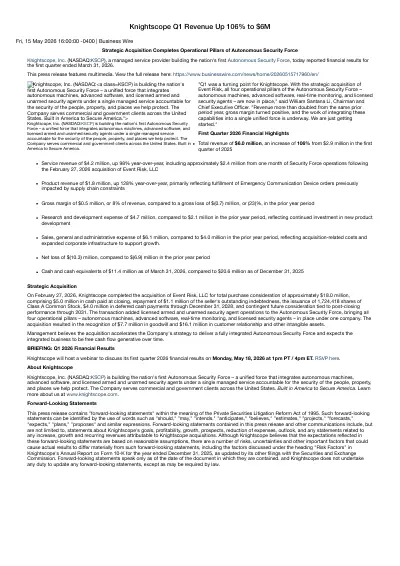
We've got revenue up 106% to $6 million for the quarter, and we're just getting started. One of the other wonderful opportunities with the acquisition is it now has all four pillars of what we want that autonomous security force to be, all included and in place.
You've got everything from autonomous machines, remote monitoring, orchestration software, as well as armed and unarmed licensed agents, and all that integration is underway so we can have one single, unified force. The image that you have there was a celebration there for Autonomous Security Force Day, our first annual, hopefully we can do that every year going forward on our annual corporate birthday.
The team is now very strong and growing. We're well over 400 employees, and that toast from that image was: one team, one force.
Very excited for what we hope to be a blockbuster 2026. Building the nation's first autonomous security force, this is intended to address that $230 billion total addressable market.
The strategic logic is basically add the increased capabilities, because technology can't do everything, humans can't do everything, but that combination is extremely powerful. This is that unlock for us to go after requests for proposals that normal technology-only companies would not be allowed to do.
This also is a very unique land-and-expand, where we hope to become a trusted technical advisor to our clients, and be able to implement additional technologies, again, to improve their outcomes and reduce their costs. Early validation: revenue's up, we've got positive gross margins, and the strategy has a lot of traction.
It's very interesting when the industry's excited, the team's excited, the board's excited, all our incoming recruits are excited. We're off to a very, very solid 2026.
With that, I'm going to turn it over to our trusty CFO, Apoorv. You want to take it away?
Apoorv Dwivedi
Thanks, Bill. Good afternoon, everyone, and thank you for joining us.
I'll walk through the financial details behind the highlights Bill just mentioned. We'll cover the Event Risk acquisition, the economics, and the operational performance of the business as a whole.
Please note that the figures in our financials are unaudited and presented in millions unless otherwise noted. For complete financial details, please refer to the Q1 2026 Form 10-Q filed last Friday.
Now. No, see again, you guys are moving.
I don't know why it's moving.
William Li
Oh, can you put it here so you can see...
Apoorv Dwivedi
No, but it says slide 13. I think he moved too early.
William Li
I had that...
Apoorv Dwivedi
When are you supposed to have the acquisition stuff up?
William Li
Right here.
Operator
Recording in progress. You want to pick it up?
Apoorv Dwivedi
Absolutely. Thanks, Bill.
Can you hear me okay?
William Li
Yep. We're good.
Apoorv Dwivedi
Good afternoon everyone and thank you for joining us. I'll walk through the financial details behind the highlights Bill just shared.
We'll cover the Event Risk acquisition economics and the operational performance of the business as a whole. Now, as announced, the Event Risk acquisition, it closed on February 27th, 2026.
To remind our investors, we wanted to provide the purchase consideration. The total purchase consideration in fair market net present value is approximately $18 million, comprising $5 million in cash at closing, the repayment of $1.1 million of seller debt, approximately $7.2 million in Class A common stock representing 1.7 million shares issued.
The balance is future deferred cash and contingent consideration. A working capital and non-compete adjustment of $1.4 million is reflected as an offset to the deferred purchase price.
Now on the top right-hand side, we've provided the accounting allocation of the purchase price. Important to note that this is preliminary and subject to measurement period adjustments.
Client relationships of $15.5 million represents the largest component and it amortizes over about 10-year life. From a financial performance perspective at the bottom right of the screen, in its first 32 days of contributions, the Knightscope Security Force delivered $2.4 million in revenue, $400,000 in gross margin at a 17.5% margin, and $100,000 of net income, accretive from day one.
In addition, the acquisition resulted in about $1 million of one-time transaction costs to SG&A in the quarter. We do expect to continue to incur additional expenses related to the integration in the near term.
Also happy to note that on a pro forma combined basis, the Q1 revenue would have been approximately $10 million versus the $7.2 million in Q1 2025, a 39% year-over-year increase. Turning to cash position, cash and cash equivalents stood at about $11.4 million as of March 31st compared with $20.6 million at year-end 2025.
This decline reflects approximately $6.1 million of cash outlay to fund the Event Risk transaction closing payment and debt repayment and the $1 million in direct transaction costs, as well as continued investment into Security Force operations. Our at-the-market facility remains active and continues to support our liquidity and operational flexibility.
Now, turning to the Knightscope combined company performance. Q1 2026 consolidated revenue was $6.0 million, up 106% year-over-year from $2.9 million in Q1 of 2025.
This is a record quarter and the strongest in company history. Service revenue was $4.2 million, up 98% year-over-year, driven primarily by $2.4 million of contribution from the acquisition.
Product revenue was $1.8 million, up 128%, driven by fulfillment of ECE orders that had been constrained, you'll recall, by supply chain conditions in the second half of 2025. Excluding the acquisition, the core technology revenue grew 26% year-over-year from $2.9 million to $3.7 million.
Gross margin turned positive in Q1 2026. This is the first positive consolidated gross margin in recent history.
Consolidated gross profit was $465,000, or 7.7% of revenue. This compares with a gross loss of $668,000, or negative 22.9% in Q1 2025, a $1.1 million year-over-year improvement in gross profit.
The acquired Security Force segment contributed $400,000 of gross margin at a 17.5% segment margin on its $2.4 million of Q1 revenue. Core technology, the margin inflected to a positive 1.5% from a negative 23% a year ago, driven primarily by volume and mix.
A note of caution: service costs do include $1.8 million of new contracted labor associated with the acquired business. Just point forward, this is expected to continue to be a recurring cost line.
While the inflection is encouraging, we are not yet at a sustainable run rate, and gross margin remains subject to supply chain variability. Total operating expenses in the quarter were $10.8 million.
R&D expense was $4.7 million, up $2.6 million or 120% year-over-year. This investment is primarily directed at new product development, including the K7 and the Next-Gen K1 portfolio.
SG&A was $6.1 million, up $2.1 million or 51% year-over-year. Approximately $1 million of that increase represents one-time transaction costs related to the acquisition: legal, accounting, and valuation services.
Other drivers include approximately $400,000 of additional investor relations advertising spend, $400,000 of professional services, $300,000 of acquired company G&A, and $200,000 related to the new Sunnyvale headquarters. Normalizing for $1 million of non-recurring acquisition costs, operating expenses were $9.8 million in the quarter, 59% above prior year run rate, reflecting our investment in future growth.
Now, on to net loss. The net loss for the quarter was $10.3 million compared with $6.9 million in Q1 2025.
The widening primarily reflects the higher operating expenses I just described, partially offset by the gross margin improvements and lower interest expense. On a per-share basis, the loss improved to 74 cents from $1.28 in Q1 2025, reflecting a 42% improvement per share, despite a 156% year-over-year increase in weighted average share count.
Excluding the $1 million one-time acquisition transaction costs, the quarter's normalized net loss would have been approximately $9.3 million. Following the acquisition, we adopted two reportable segments in Q1 2026.
The table on this slide summarizes our Q1 revenue, gross margin, and gross margin percentage by segment. These include Core Technology Development and Operations, which yielded about $3.67 million in revenue and $54,000 in gross margin; and the acquired Security Force segment, which added $2.4 million in revenue and approximately $400,000 in margin.
Now it is important to note that the two segments reported in Q1 are a GAAP requirement triggered by the acquisition. They do not reflect how Knightscope is managed and plans to be managed in the future.
As Bill described, once fully integrated, we plan to operate the company as a single, integrated Autonomous Security Force that provides managed services. We expect our reporting structure to evolve toward a product and services framework that better reflects how the business is run.
For complete segment disclosure, please refer to Note 9 of the Q1 2026 10-Q filing. Bill, that concludes the financial review.
Back to you for forward look.
William Li
Sure, and what's next? All right, looking ahead, the team has been burning the candle on both ends on the K7 side of things.
We've got a lot of great work accomplished, still a lot ahead of us. We're looking at deploying a limited release of the K7 to select clients we have identified later this summer, and to get some real-world deployment experience as another feed into the product development cycle.
We're making good progress there. This is probably the 25th company I've bought.
The deal, as I often say, is the easy part. The hard part is the integration, the day one and thereafter.
Fortunately, we have very like-minded folks and teammates. We're all getting to know each other.
We've primarily been focused on a few key areas, but so far so good. In some cases, I think if you asked Eric or myself, we might be a little bit ahead of schedule of where we wanted to be, but still a lot of work yet for the balance of the year.
GSX, we're going to be there in force. GSX is one of the top two major security conferences here in the US: September, mid-September in Atlanta.
We're going to unveil the Autonomous Security Force as one team and one force with one contract as a single managed service provider. Literally something all new for the industry that's never been done before, very excited about that.
Then towards the fourth quarter, we're looking to have an investor day here physically at Knightscope headquarters so you can come, feel, touch, see, talk to the team, see the technology up close, and obviously we'll invite all of you as well as our bankers and analysts and the like. Look forward to doing that.
We had a good amount of questions come in. For purposes of being a little bit more efficient, we condensed them down to a few key items.
I think the first one to Apoorv was around gross margin: how do you see that improving over time or what kind of pieces go into the puzzle here?
Apoorv Dwivedi
Absolutely, Bill. I think obviously the goal is gross margin improvement, and we believe that gross margin improvement will primarily come from a combination of operational scale, improved manufacturing absorption, supply chain normalization, and continued integration of our managed services platform.
On the technology side, we expect better utilization of fixed manufacturing and support infrastructure as volume increases, while the addition of the Security Force capabilities allow us to pursue larger, more comprehensive customer engagements, especially as we think about a land-and-expand strategy that combines technology, monitoring, and human response over time. We believe that the ability to cross-sell higher-margin software and technology, in addition to monitoring and the autonomous solutions into the broader managed services relationships, can help improve overall customer economics and margin profile.
William Li
I think the combination of humans and technology literally with AI, it's going to rewrite the economics for the industry and for us. There's all the stuff that you've just spoke of, but there's also the not glamorous part of how do you get a security operation to run that much more efficiently, and us building an all-new effectively operating system for humans to be profoundly more effective, and in combination with a good amount of AI agents and hardware and autonomous hardware, I think is going to make for some margin expansion over time.
We need to build all that stuff out, and then obviously integrate it and deploy it. We're heading in a very exciting direction.
That covers the first one. I think you had one on your side?
Apoorv Dwivedi
That's right, Bill. I think kind of expanding on what you just mentioned about the integration of the humans and technology, a lot of analysts ask about the Knightscope Security Force integration: where do we stand, how do you see it kind of coming to fruition in the short term as well as the long term?
William Li
I think there's likely kind of three steps. I think we wanted to do them in sequence over a much longer period of time, but they've gotten a life of their own.
There's the obvious financial, accounting, audit related items that are key for us to do our regular regulatory reporting and managing of the company. That has certainly been more than underway.
We have a component of information technology and human resources, and how do you combine systems, how do you think about recruiting profiles, employee handbooks, and there's a lot that needs to be done. Then the last piece, which isn't actually last, is the go-to-market.
We've been experimenting on how do you propose something to a prospective client, how do you spend time with an existing client on the Security Force side that could benefit greatly from the technology, and vice versa: someone that's already a technology client of ours, how do we add the human element to, again, improve overall outcomes and hopefully over time reduce costs? We have like-minded folks, a lot of work ahead of us, but things are going a little bit ahead of schedule, I would say.
We wanted to take the entire balance of the year, and there's some bits and pieces, there's always going to be issues, but we're working through it. Feeling good.
I think to put it in Wall Street parlance, if we were a private equity shop, what we bought was a platform company: a really strong management team that's grown the business from scratch, knows the economics, knows the recruiting process, knows how to think about culture and recruiting the right team. If you think about it, mostly staffing companies, they call them staffing companies, they're supposedly security companies, are 100% to 400% employee turnover rates.
You've got to ask the question, why is our Security Force at 6%? That maybe we recruited properly, maybe we trained them properly, health benefits, stock options, and what we intend to overlay is a significant amount of technology.
We are going to end up with a superior and elite team to deliver all of this. We're in good spirits, a lot of work ahead, but so far so good.
Apoorv Dwivedi
That's very helpful. Go ahead.
William Li
Yep, and I think the other question was around capital formation and cash burn, and kind of long-term view: how should we be thinking about the business?
Apoorv Dwivedi
Absolutely. We expect to continue investing through the remainder of the year in areas that we believe are critical to long-term scale and competitive positioning, right?
This includes product development, AI and software capabilities, operational infrastructure, and integration initiatives associated with the broader Autonomous Security Force platform. In the near term, some larger customer deployments may also include a meaningful human services component as we establish and expand those relationships.
However, I think that over time, we should expect operating leverage, improved utilization of our technology platform, and increased attachment of higher-margin recurring services to help normalize and reduce that cash burn.
William Li
I think put it a different way, if we're shooting for a billion dollars of annual recurring revenue, you're going to have to make some key long-term investments in order to get there. Kind of what worked with a few hundred employees is not going to work with a few thousand.
We're making the right long-term bets on both the external technology that's out in the field as well as our technology in-house to basically run the company. Our Chief Intelligence Officer is very much pushing the organization to become a fully agentic organization in the next few years, and that is literally rewriting not only the economics for the industry, but rewriting the economics and standard operating procedures and the like of what we do internally.
Think about how one would go about building effectively an operating system for an all-new security provider—I've got a blog I'm working on called "One Throat to Choke": is can you get one vendor to focus on hardware, software, remote monitoring, licensed armed and unarmed agents in one package so you can actually deliver what a chief security officer is looking for? That is the groundbreaking corporate strategy change that we're really excited about.
As one hedge fund said to me on a call is, "Oh, you're basically almost like a Trojan horse. You're coming in with the normal type of security operation that most chief securities would be accustomed to seeing, and then you're going to basically try to be a trusted advisor, a technical advisor, to then look at those operations, audit them carefully site by site, client by client, and then prescribe the right technical solution regardless of if it's hardware, it's software, it's sensors, it's some other capabilities, so that we can actually deliver on what the client's looking for."
That'll be the best marketing and client experience dollars we'll ever spend, is to actually fix the clients' problems.
Apoorv Dwivedi
That's absolutely right, Bill. I think we've talked about how the fragmented solution model makes it extremely difficult for clients to get the outcomes they seek, which is "I want to secure my perimeter, I want to promote safety," but I've got to cobble together different solutions from different vendors to make that happen.
I think this approach allows us to do so in a unified way.
William Li
Exactly. If you're a chief security officer, likely you've spent a significant amount of time in law enforcement, maybe ex-FBI or ex-military.
You're really focused on physical security, and then one vendor shows up and says, "Hey, would you like this radar?" Another vendor shows up and says, "Do you want this lidar?
You should use this robot. You should use this AI agent.
Do you think this sonar's appropriate?" You're kind of only trying to sell your widget to that person who really is not necessarily fluent in the latest technologies for physical security and getting them all to work together.
Your single-point solution might actually work for this one little thing, but what they really need is support and help. If CFOs continue to cut expenditures on the security side of things and not giving the team the tools to be able to reduce incidents, and the incidents keep climbing, there's literally a huge problem here which we hope to help be part of that solution.
I think the strategy's sound, team's excited, we just need to focus on execution.
Apoorv Dwivedi
Bill, a question came in based on this strategy and this path to revenue and margin growth. As you think about the broader strategic outlook, can you talk a bit about both commercial opportunities and how that's changed with this acquisition, as well as in the new Autonomous Security Force dynamic, government opportunities, and then M&A?
William Li
I'll take those in a slightly different order, but M&A. I've done a roll-up in the past life, and usually a roll-up, if you don't know what a roll-up is, basically buy the same type of company over and over again and make one big one.
You look at a very, very fragmented industry. I think there's maybe 6,000 guarding companies in the US that have more than 100 employees.
Most of them are owned by boomers that are retiring here in short order, and perhaps the kids don't want to take over the business. Perhaps those are too small for the larger three staffing companies to buy them.
That becomes a interesting kind of dynamic. We want to buy quality over quantity.
It's got to pass the sniff test, more than just the sniff test of what we just went through with our first acquisition, and that intended to be the platform to set that standard so that we can go after repetitive, additional acquisitions. I think other acquisitions that we're contemplating and looking at, and we've said this publicly before, is on the remote monitoring side of things, to see where instead of growing something organically, it might be better for us to do a bolt-on or carve-out.
We're working through that. We want to continue that inorganic growth and be very careful and methodical about how we go doing that.
I think on the government side of things, probably a couple two different aspects. One is, we cut a deal with Palantir last year.
The overall corporate strategy is I want cybersecurity to be actually not the cost center, but an opportunity for us to market things better. Long story short, can we get all our private sector, local, state government to all have federal-grade cybersecurity?
There's one standard across the nation, and that's what we're looking at, not only looking, actively investing in, is why the expenditures for R&D have gone up and will continue, is to rearchitect that technology portfolio on hardware, software, and how we operate into something that is federal-grade for the entire nation. I think that then brings cybersecurity to the forefront of a long-term, sustainable competitive advantage over anyone else in the marketplace.
I think a second, the really hard one, I've been trying for a very long time to see if we can pass a national robotics strategy. I think there's enough interest in the administration and in Congress that I'm hopeful—and I don't control this—I am hopeful that something will happen this year.
My controversial proposal, which some people get really excited about and some people get annoyed, is the US federal government has within its own authority to fix the problem. No one in Congress or the administration wants to lose the robotics war like we effectively lost the drone war.
What do we need to do? We need to kind of fix a lot of things.
Some of them just simply have to do with demand. What I've been proposing is for the federal government to dictate/mini-mandate to force every department and agency that thou shalt take 1% of your operating budget and you will use robotics and automation to stop wasting taxpayer dollars.
All we're asking, we're not asking for the government to spend more money, we're asking you to use commercially available technology to improve the efficiencies in your own operations. If you do that catalyst, then likely you could, with one fell swoop, fix the supply chain issues and all these other issues that several different committees are all working on independently with one paragraph that I've already written and given to staff over there of how you would actually cure the problem.
Big big ask. I think there's enough interest that something will happen, not sure what will end up coming out the other side, but at least the conversations are ongoing.
To end on that last point, maybe the eternal optimist, but in advance of hopefully that happening, we partnered with Carnegie Mellon University, one of the top robotics school of higher education in the entire world, to build a National Security Robotics Lab here at Knightscope. We signed a five-year deal with CMU, and we've already got five graduate students working on some cool, whiz-bang stuff for the upcoming K7.
We're in this for the long haul, and we're making those long-haul, long-term bets. We're in a very good position.
I've never been literally this excited about the company's future, and so more to come, as Apoorv often says.
Apoorv Dwivedi
Thanks, Bill. That's all the questions that we have today.
William Li
All right. Sorry everyone again for the small technical mishap.
We will be sure to get you a properly recorded version of this so you have it for your files. Thanks for tuning in and looking forward to seeing you next quarter, because there is more good stuff coming.
Thanks, everybody.
Apoorv Dwivedi
Thanks, Bill. Thanks, everyone.