Kits Eyecare Ltd.
Q3 FY2026 · Earnings Call TranscriptNovember 5, 2026
Operator
Good afternoon, and welcome to the Kits Eyecare third quarter 2026 results conference call. At this time, all participants are in listen-only mode.
Following the prepared remarks, we will open the line for questions from analysts. This call is being recorded, and a replay will be available on the Kits Investor Relations website.
I would now like to turn the call over to Olivia Evans, Director of Corporate Development and Investor Relations. Please go ahead.
Olivia Evans
Thanks, operator, and good afternoon, everyone. Thank you for joining Kits third quarter 2026 results call.
On the call today, I'm joined by Roger Hardy, our Chairman and CEO, and Ibrahim Kamar, our CFO. As a reminder, please note that remarks made on this call may include our expectations, future plans, and intentions that may constitute forward-looking information.
Such forward-looking information is based on estimates, assumptions made by management's perception of historical trends, current conditions, and expected future developments, as well as factors that they believe are appropriate and reasonable in circumstance. Actual results may differ from the conclusions, forecasts, or projections expressed by the forward-looking information.
We would refer you to the most recently filed management discussion and analysis and our annual information form, which includes a summary of the material assumptions as well as risks and factors that could affect our future performance and our ability to deliver on the forward-looking information. During today's call, all figures are in Canadian dollars unless otherwise stated.
With that, I'll turn it over to Roger.
Roger Hardy
Thanks, Liv. Good afternoon, everyone, and thank you for joining us.
When we founded Kits back in 2018, our mission was simple: make eyecare easy. That meant the best selection in the category, available 24/7, at the best prices, delivered faster than anyone else.
We've built this business the way an owner would, for the long term, around the customer of today. Let me start with the punch line: our third quarter delivered accelerating growth at category-leading rates, gross margin expansion, a growing base of repeat revenue, and a higher-margin glasses business expanding inside those customer relationships.
Gross profit grew nearly 1.5 times as fast as revenue. That is what pricing power and mix look like when they work together.
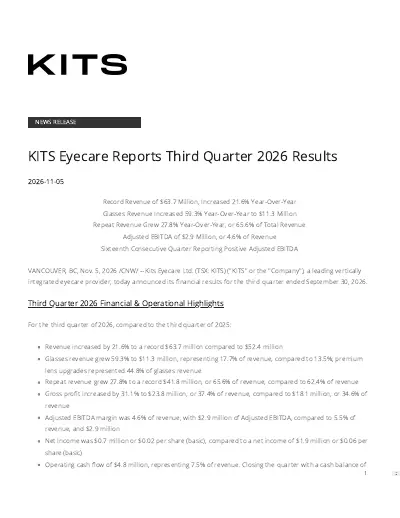
Revenue increased 21.6% to a record $63.7 million. Gross profit grew 31.1% to $23.8 million.
We generated $4.8 million in operating cash flow and ended the quarter with $30.6 million in cash and no debt. We fund our growth from the cash this business generates, not from the capital markets, which gives us tremendous freedom and flexibility in how we choose to grow.
We think about Kits as a simple, predictable, free-cash-flow-generative business, and our investment case rests on three drivers. First, customers come back, and repeat revenue compounds.
We have one of, if not the most loyal customer sets in the category. Second, glasses add a higher-margin category to each relationship.
Third, our integrated platform has the operating leverage to convert growing gross profit into earnings and cash flow that grow faster than revenue. I'll take each in turn as I walk through the quarterly results.
The most valuable asset we own is a customer who comes back. Repeat revenue grew 27.8% to a record $41.8 million this quarter, or 65.6% of total revenue, up 62.4% from a year ago.
Our two-year active customer base grew 14.1% to a record 1.175 million customers. This is the most valuable asset we own.
It's an installed base of 1.2 million active customers who need what we sell for the rest of their lives and who come back to buy it from Kits. Our moat is why they come back: the selection, price, and speed; we built a vertically integrated platform to deliver; and the convenience of a relationship that already knows them.
Finally, every one of those contact lens customers is a glasses customer we haven't fully served yet. The best evidence of durability is what customers do after their first order.
We track each year's new customers and measure what they spend with us afterward as a percentage of that first order. Customers we acquired in 2022 have spent an additional 187% of their first order in the four years since.
The right way to value a customer is over their lifetime, and in a business like ours, that lifetime is long. Measured on a 10-year view, which we believe is becoming the right horizon for a contact lens customer, the value of a customer becomes meaningfully higher than what it costs us to acquire.
Every dollar we spend acquiring a contact lens customer is an investment with an attractive return; it just doesn't necessarily show up in the quarter we make it. Glasses are, of course, earlier in that journey, but the signs are very strong.
Order values are rising, margins keep expanding, and our glasses cohorts are doing something we find very encouraging: within three years, customers who come back have spent more than 100% of their first order again. When a cohort's revenue grows after you've acquired it, you've built a franchise, not just a customer list.
This is why we judge marketing on multi-year returns rather than a single quarter. The $41.8 million of repeat revenue we earned this quarter is the return on acquisitions made in prior years.
Today's marketing spend is next year's repeat revenue. The market tends to price this business on the quarter, but as we see customers continue to return at higher order values, we're starting to run it on the decade, and we believe long-term owners will be rewarded for thinking about it the same way.
Contact lenses are the annuity at the core of the relationship, and this quarter they reaccelerated. Contact lens revenue grew 15.7% to a record $52.4 million, from 11.7% growth in the second quarter.
Replenishment is becoming more automatic for our customers. Our AutoShip program reached $29.6 million in annualized revenue and 14.1% of contact lens orders, up from 12.1% a year ago.
Every customer who moves to AutoShip turns a transaction into a recurring revenue stream. Our own brand is also growing inside that base.
Kits daily revenues grew 44% and now represent over 10% of Canadian contact lens orders. Private label inside a recurring customer base is one of the most powerful margin levers a retailer can have, and it's a defensible one.
A branded lens can be bought anywhere and is often shopped on price. Kits daily, however, can be bought only from us.
Once a customer is comfortable in a lens, they tend to stay in it. Every customer we move to Kits daily becomes a longer-lasting, higher-margin relationship.
We capture the brand owner's margin as well as the retailer's, and Kits dailies carry meaningfully higher gross margins than the branded lenses it replaces. Nearly half of first-time Kits daily buyers are existing Kits customers, we're growing margin inside relationships we already own at very little incremental acquisition cost.
Over to glasses: glasses are where the relationship expands and where the economics get even better. This is the part of our business I'm most excited about.
Glasses revenue grew 59.3% to $11.3 million on approximately 145,000 pairs of glasses, up 55.6%. Glasses are now 17.7% of revenue, up from 13.5% a year ago.
We're growing volume, order value, and margin at the same time, and that is truly a rare combination in retail. Through nine months, glasses revenue of $33.1 million has already surpassed all of 2025 sales.
New glasses customers acquired in Q3 2026 generated first-order values 63% higher than the comparable Q3 2025 cohort. We are attracting more valuable customers, and they are starting bigger.
Customers are trading up, choosing more premium products. Average glasses order values rose 32.5% to $151.
Premium lens upgrades were 44.8% of glasses revenues, and progressives grew 56% to $3.1 million. Progressives deserve special attention.
Nearly everyone eventually needs them. They are our highest-value product, and demand grows with demographics, not with marketing.
When customers choose to pay more and buy more, that is the kind of growth you can build on. It's earned, not imposed.
As we think about our younger contact lens customer set, we are genuinely optimistic at the future prospects. We are early.
Most contact lens customers have never bought glasses from us. That's a runway we already own as the contact lens customers generally mature into glasses and then later on into progressives.
Our business plan has thoughtfully started out with the most valuable customer in the category and chosen to take exceptional care of them, knowing that if we execute well, they will be with us for the long haul. When you own a business where customers come back for years and spend more over time, the highest-returning use of your capital is to acquire more of them.
That's why the most important capital allocation decision we made this quarter was to step up our investment in new customers. The business paid for that decision itself.
Gross profit grew by $5.7 million this quarter, and we reinvested about $3.5 million of it acquiring new customers, bringing marketing to 17.1% of revenue from 14.1% a year ago. We didn't borrow to grow, we didn't dilute to grow; gross margin expansion funded it, and we still added $3.2 million to our cash balance.
What matters is not how much we spent, but the quality of customers we are acquiring. We deliberately targeted higher-value customers, people buying glasses, progressives, and premium lenses.
They cost more to win, but they are worth considerably more. New customers generated $21.9 million of revenue this quarter, up 11% from 4% fewer customers.
That means each new customer brought in roughly 16% more revenue on their first order, and that's before the years of repeat purchases that are proven to follow. We would rather acquire a smaller number of customers who compound than a larger number who don't.
The customers we acquired this quarter will pay us back for years in repeat revenue, which funds the next round of growth. That is a self-funding, compounding machine, and it's exactly the kind of business we want to build and own.
Our accounting expenses the full cost of a new customer in the quarter we acquire them, while their value arrives over the years that follow. Every customer we acquired this quarter is a cost today and an asset for years to come.
We will keep making that trade as long as the returns are there, and we'll be happy to show you the returns. Keep in mind we've done this before.
We have a track record of turning mix into margins. Glasses have grown from under 10% of revenue in 2021 to nearly 18% this quarter.
Over the same period, gross margins expanded from the mid-20%s to 37.4%. That's more than 10 points of margin in five short years, earned by giving customers products they wanted.
The way I think about this business is simple: margins come first, cash flow follows, and earnings follow cash flow. We have delivered the first, we are delivering the second; through nine months, we generated $7.6 million in operating cash flow, including $4.8 million this quarter, while investing more in customer acquisition than at any point in our history.
We ended the quarter with $30.6 million in cash and no debt. Earnings are an opinion, and cash is a fact, and the cash is telling you the margin expansion is real.
Now our job is to prove the operating leverage, and the math is quite simple; three things will drive it. First, our marketing efficiency: intensity has come down for the past couple quarters this year, and we will manage it back towards our mid-teens base as new customer economics allow.
Second, our mix: glasses carry higher margins and are growing nearly four times faster than contacts, every quarter the business tilts further towards its most profitable category. Third, infrastructure: outside of surfacing, our lab and fulfillment capacity sit well ahead of current volume, incremental orders will flow through a largely fixed cost base.
We have already built the factory; now we are working to fill it. That means incremental margins well above our reported margins.
We're already seeing that leverage in overhead; through nine months, G&A excluding share-based comp fell to 5.4% of revenue from 5.8%. Put those three together, and you have a business where growth gets more profitable as it scales.
We've shown we can grow repeat revenue and expand gross margins. Frankly, that was the hard part.
Earnings are the next test. No one will hold this team to a higher bar than we hold ourselves to.
As I own approximately 30% of the company, I'm not thinking about it on a quarterly basis. I get paid the same way as you do; that's when the business is worth more.
Capital allocation is the most important job of the CEO, and we take it seriously. Our cash generation and debt-free balance sheet let us fund this growth from within.
Our priorities for that capital are, in order: customer acquisition, where payback is attractive; growth in glasses capacity and product; and beyond that, returning capital to shareholders or selective opportunities that extend our platform. Every dollar competes for the same thing: the highest long-term return per share.
This year, we put that last priority to work. In the second quarter, we purchased and canceled 89,000 shares for $1 million under our normal course issuer bid.
Subsequent to quarter end, we've purchased and canceled a further 49,400 shares for $0.8 million. We buy back shares when we believe that they trade below their long-term value, and we fund those purchases from cash the business generates without slowing our investment in growth.
The buyback also helps us manage dilution. We think about value on a per-share basis, and we want our shareholders to do the same.
As one of the largest owners, I have every reason to think that way. For the fourth quarter, we expect revenue of $64 million to $66 million, approximately 19% to 22% growth year over year, and an adjusted EBITDA margin of 4% to 6%.
That outlook assumes continued momentum in contacts and glasses through the year-end benefits and important holiday season, and continued investment in high-value customers managed against the cohort returns we see. A note on our leadership: as we announced in October, our co-founder, Joe Thompson, has moved into an advisory role.
Joe has been central to Kits from the start, and he remains a close partner to the company. Tye Scobie, our President, joined us in 2022 to run our operations, this is a continuity for our product, our lab, and our fulfillment teams.
Finally, let me leave you with this: after more than two decades in the optical business and having built one of the largest and most valuable online eyecare businesses in North America before this, I've learned that the best businesses combine a real customer advantage with disciplined reinvestment. Kits has both.
We've a growing base of customers who come back for years, a higher-margin category expanding inside those relationships, a platform built ahead of demand, and a balance sheet that lets us fund all of it ourselves. We want each dollar invested to build future earning power, and we judge spending by acquisition payback, customer contribution, and cash generation.
I'll now turn the call over to our CFO, Ibrahim, for a closer review of the financial results. Ibrahim?
Ibrahim Kamar
Thank you, Roger, and good afternoon, everyone. Roger laid out three drivers, and I will give you the numbers behind that: how much margin the model produced this quarter, what we chose to do with it, and what the balance sheet looks like after we did.
Gross margin was 37.4%, up 280 basis points from 34.6% a year ago, and gross profit grew 31.1% to $23.8 million, 10 points faster than revenue. That expansion was organic: a growing mix of glasses, premium lenses upgrades at 44.8% of glasses revenue, and disciplined pricing and promotion management.
Sequentially, gross margin eased from 37.9% to 37.4%, which is simply the mixed effect of contact lenses reaccelerating as both categories grew. Put simply, each revenue dollar is worth more to us than it was a year ago, and that gap widens as glasses grow.
Marketing was 17.1% of revenue compared with 14.1% a year ago, and down from 18.9% in the first quarter and 17.4% in the second quarter. We measure that spend on cohort payback, and the third quarter cohorts cleared it.
Contact lens growth reaccelerated to 15.7%, and new glasses customers generated 63% more first-order revenue than a year ago. Fulfillment was 10.4% of revenue, up 20 basis points from a year ago on carrier fuel surcharge that we chose not to pass on to our customers, and down 50 basis points from the second quarter.
Year-to-date fulfillment is 10.6%, unchanged from last year, even as the lab delivered 56% more glasses and we fulfilled roughly 294,000 orders, up 10%, at a record average order value of $217. Our own lab and fulfillment platform is absorbing more volume and higher fuel costs on the same cost base, which is exactly the fixed cost leverage Roger described.
G&A was 7.1% of revenue compared with 5.7% a year ago. The driver is non-cash share-based compensation of $0.9 million compared with $0.1 million.
Excluding that, G&A was 5.8% of revenue versus 5.6% as we invested in the team. Year-to-date G&A excluding share-based compensation improved to 5.4% of revenue from 5.8%, the overhead leverage is showing up as the business scales.
Share-based compensation is how we align the team building this business with shareholders. Putting that together, adjusted EBITDA was $2.9 million or 4.6% of revenue, our 16th consecutive quarter of positive adjusted EBITDA, delivered while growing revenue 21.6% and reinvesting the gross profit gain in customers whose value arrives over years, compared with 5.5% a year ago.
Year-to-date adjusted EBITDA is $10 million, up from $8.9 million. Net income was $672,000 or 2 cents per share compared with $1.9 million or 6 cents per share a year ago.
Two non-cash items more than account for the difference: share-based compensation increased about $0.8 million, and foreign exchange swung from $0.5 million gained last year to $0.1 million lost this quarter. Turning to the balance sheet: operating cash flow was $4.8 million, up 63% year over year and 7.5% of revenue, bringing year-to-date operating cash flow to $7.6 million compared with $5 million last year.
We ended the quarter with $30.6 million in cash, up from $27.4 million at the end of June, and no debt. Including our undrawn $15 million BMO ABL facility, accessible liquidity is $45.6 million with a further $5 million accordion.
We invested $1.4 million in property and equipment in the quarter, mainly the new surfacing line, which adds to our surfacing capacity once fully ramped. Year-to-date capital expenditure is $2.8 million.
Our stores are part of that investment too. Our Toronto flagship on Queen Street West opened at the start of the quarter and finished its first full quarter ahead of expectation.
The more important number is outside its walls. Online growth in the Toronto area trailed the rest of our Canadian business in the first half of the year, and since the store opened, it has outpaced it.
With Vancouver and Toronto proving the model, we have signed a letter of intent in Calgary and are scoping further locations for the first half of 2027. In a single quarter, we self-funded customer acquisitions and new surfacing line and still grew cash by $3.2 million with no debt.
That is why we can keep investing wherever the cohort returns support it as we close 2026. With that, operator, we are ready for questions.
Operator
Thank you. Ladies and gentlemen, we will now begin the question-and-answer session.
Should you have a question, please press star followed by the number 1 on your touch-tone phone. You will hear a prompt that your hand has been raised.
Should you wish to decline from the polling process, please press star followed by the number 2. If you are using a speakerphone, please lift the handset before pressing any keys.
A simple reminder to please ask two questions per participant. The first question comes from Gianluca Tucci with Haywood Securities.
Please go ahead.
Gianluca Tucci
Hi. Afternoon, team.
Congrats on the quarter. Two questions.
First, Roger, the company continues to show great growth back above 20 points this quarter. It's clear that it's coming from across the business, but, Roger, I'm curious if there's anything in particular that you're excited about as it pertains to the cohorts or their buying patterns.
Roger Hardy
Hey, Gianluca. Nice to hear from you.
We're super excited about the quarter reaccelerating. Of course, nice to see contact lenses reaccelerate up to 15, almost 16% growth, growing $5.1 million over Q2.
Nice to see that steady annuity base keep growing. As you saw, this is our third straight quarter of 50-plus percent growth in our glasses business.
In the nine months, we've already beaten the full year on 2025 for revenue and units in glasses. That's exciting.
Inside of units, there's all sorts of growth vectors that are interesting: repeat units are growing well; progressives, obviously the highest-value part of the optical category, growing well; premium lenses, those upgrades, important to revenue and earnings as we go forward. All these sort of opportunities have been planted over the past couple of years, and they're all continuing to produce.
I'm basically excited across the board to see all of the investments we've made, see the team executing, seeing the team making things happen, seeing the team moving the needles across every metric. It was a good quarter.
No, it's hard to pull out just one thing.
Gianluca Tucci
Appreciate that, Roger. Follow-up, as it pertains to the difference between a contacts and a glasses customer, is there any difference between the cadences of reordering of those two different customers?
If so, is there any downstream impact in that difference? Yeah.
Roger Hardy
Gianluca, very thoughtful question, and a good one to think about, especially as glasses has been inflecting over the past couple of quarters. You can imagine, and we don't break it out in great detail, but if I was to suggest that a contact lens customer comes back on average sooner than a glasses customer, you'd get a contact lens customer coming back, and a glasses customer that comes back a little bit later would show up on the immediate income statement almost like an increase in marketing as a percent of sales.
However, that glasses customer, their second order is coming back in a quarter or two down the road. If you look at that time delay, you'd see those type of estimates you could model.
I think it's a great question, something to think about. All things being equal, if all customers were contact lens customers, you'd have a bump of revenue in an earlier period or in an earlier quarter.
It's something we're watching. The upside of the glasses business, of course, is that long lifetime value, that higher-margin customer, and just a simple size of the category gets us excited just to think about how much greenfield, how much opportunity there is in that category.
We like building the business in both vectors, and we think they're quite complementary. Thanks for that, Gianluca.
Gianluca Tucci
Thanks, Roger. I'll pass the line.
Congrats again. Thanks.
Operator
Thank you. The next question comes from Matt Koranda with ROTH Capital Partners.
Please go ahead.
Joseph Gonzalez
Good afternoon, guys. This is Joseph on for Matt.
I guess just piggybacking off that first question, Ibrahim, just looking at the 4Q guide of 21% growth versus what industry metrics are suggesting, a broader category that's flat, where do you think you are taking the most share?
Roger Hardy
Maybe I'll start off, it's Roger, and then I'll pass to Ibrahim. As we look at Q4, we've got it pegged at $64 million to $66 million, right about that 19% to 22% growth rate, 4% to 6% adjusted EBITDA margins, so that'll put us on the full year at about $244 million to $246 million and 20% to 21% growth.
We are guiding one quarter at a time, and our framework is really around that 20%-plus growth rate while expanding gross margins and continuing to fund our growth from our own operations. As we think about the category, like you said, I think the contact lens category is growing about 4% in the latest Q, we're somewhere around four times the category in contacts.
In glasses, the category, we're growing more than 70% new customers, more than 50% in the Q. If the category is growing 10%, we'd be at least five times the category.
Growth rates seem good there, and again, just self-funding that growth, building an annuity stream from both businesses that continues to fund our growth and allows us to keep investing ideally in continuing to take share from both categories. E, if you want to jump in there?
Sorry, I did
Ibrahim Kamar
No, it's totally makes sense, Roger. Hi, Joseph.
We put out the numbers, growing between 19% to 22%, hitting that $244 million to $246 million, but in addition to that, the plan is to continue generating cash, be cash positive.
Joseph Gonzalez
Got it. I appreciate the color there.
Then, Roger, I guess, could you give us the team's thoughts on AI glasses and where we're at now, I guess whether they will become more important to growth in the next year or so, and near to longer term, what are your thoughts on that expansive category?
Roger Hardy
We like the category and we obviously participate across a number of different providers as well as offering our own solution for people who want to be in the category. It has been a growth vector for the last couple of years, probably the last two years, and of course we were in early, have generated a number of different options, have worked through different variations, from just hearing to hearing and seeing to having cameras and including AI and so there's a lot of interest around those categories.
If we look at just the macro picture, the macro has slowed down a little bit in some of the other offerings, but what we like about it is that no matter who is producing these glasses, they still need to go into a lab. 75% of people still have vision correction, for us, that's where our huge value add comes in.
Of course, the Kits lab is vertically integrated. It's right here where we can put lenses in, get them out to customers in a very timely way.
Our brand proposition is really all around making eyecare easy. It includes making AI glasses easy.
We can make the lenses here. We've got a selection of lenses that's wider and more broad than any other retailer, more than 25,000 total frames in our selection, and in AI we've got the widest selection as well.
We can put any type of lens in those, and so, yeah, it's an interesting category. If I had to guess, I'd say a lot of growth came in Q1 and Q2, and that the category itself of AI glasses has seen a slowdown, but it's still an interesting category.
It's still early days, and when I say slowdown, it's still growing more than double digits year on year, and we're of course taking share in that space as well.
Joseph Gonzalez
Got it. Appreciate the color.
We'll go ahead and take the rest offline. Thank you.
Operator
Thank you. The next question comes from Doug Cooper with Beacon Securities.
Please go ahead.
Doug Cooper
Hey, good evening, guys. Terrific work on the quarter.
I just wanted to get into something, Roger, I don't know if you can provide much color, but I wanted to dig into the 1.2 million customers, 1.175 million active customers. Do you have any idea what the split is between contacts and glasses?
What I'm trying to get at, I guess, is how many latent customers are there in contacts that you think can eventually move over to glasses? I'll tell you that I've met probably a handful of people, just in casual conversations with them saying, "Oh, I'm a auto-subscriber of Kits contacts, but I didn't even know they sold glasses."
Roger Hardy
Doug, that's a really thoughtful question. We've got the active customers, two-year, at 1.175 million, almost 1.2 million customers continue to grow.
We don't break out from the standpoint of contacts to glasses, but what I can tell you is, and as the majority of our orders today remain contact lenses. It's very early in our LTV, I would say, we're seeing repeat revenue grow, we're seeing customers who buy contacts come back, and each time, every contact lens wearer owns a pair of eyeglasses somewhere in their life.
That's why Kits started with this very valuable customer. Each time we take the opportunity to make an offer of glasses, sunglasses, prescription glasses, and over time we expect those customers will also need progressives.
We don't break it out in that way, but it certainly tells us that we have a very interesting customer database today, and that over time, our expectation is that a larger and larger number of percentage will come into glasses. Of our existing customers, they're coming back for contacts.
Our expectation is over time, they will all eventually need a pair of eyeglasses, and we expect to be there. It really is the biggest opportunity inside our customer base, and we already own it.
As no acquisition costs on the conversion, higher margin when they do it, and that customer becomes worth about two over two times what our regular customer is worth. Those are all things that the team is working hard on, and I look forward to reporting on that as we progress.
Doug Cooper
Thank you. Just a second question, Ibrahim, you mentioned the impact of the Toronto store on online orders from the Toronto region.
Can I just dig into that a little bit more? Do you have any actual data?
You said it's leading or outpacing the online orders from other regions. Can I just dig into that a bit more?
Ibrahim Kamar
Hi, Doug. For sure.
We're quite excited about that Toronto store. They finished their first full quarter ahead of our expectation.
Before the store, as mentioned before the store, Toronto online growth trailed the rest of Canada. Since the opening, it's outpaced it by about 20 28 points.
The model is working. Stores are bringing a high-intent glasses customers.
They are attaching and upgrading premium lenses, and they are lifting the online sales around that area and that market.
Doug Cooper
So 28% more than the rest of the country in aggregate. In terms of order flows, it's Toronto first now, Vancouver, and then rest of country?
Is that the way to think about it?
Ibrahim Kamar
All cities are growing fast, same as Canada. Canada grew in the quarter 25%.
Roger Hardy
We don't break it out to that level at this point, Doug, but it's definitely enhanced that market, for sure.
Doug Cooper
Got it. Then just on Calgary, then, when would you expect to open that store?
You said it's kind of imminent. When would we expect that?
Ibrahim Kamar
We're expecting that early Q1, early to mid-Q1.
Doug Cooper
Perfect. Thanks, everybody.
Operator
Thank you. The next question comes from Frederic Tremblay with Desjardins Capital Markets.
Please go ahead.
Frederic Tremblay
Hi, thanks. With early Black Friday promotions currently running on the website, I was wondering if you could share any thoughts on initial customer activity and purchasing behaviors around that.
Maybe as a follow-on on that, are you historically noticing any differences in the likelihood of these customers becoming repeat customers, meaning are Black Friday customers, let's call them, more likely to stay within the platform, or is it pretty much the same throughout the year? Thanks.
Roger Hardy
Thanks for the question. Good thoughtful question.
I think you're right. I think the team this year wanted to be ahead of the Black Friday noise that can come up as this quarter progresses.
It's obviously an important quarter for Kits and all the team here. As we think about how we're acquiring customers, you can look at this past quarter, Fred, as an indication of how are we resonating with customers.
Sales are growing, but gross profit is growing nearly 1.5 times as fast as revenue. The value proposition is gaining lots of traction.
Acquisition is working well, and it's not really impacting on the gross profit side. As I think about customers, our focus is on acquiring the very best customers.
We are specifically targeting the best glasses customers. We acquired this quarter, they spent 63% more on their first order than last year's cohort.
Customers in '26 are spending more, they're coming back faster. All of that to say, it's our expectation those trends continue into Q4.
We have been growing our glasses business fairly quickly over the past four quarters. It is a step-up this Q.
The team has to be executing, and they look to be doing that. It's a good start to the Q.
The numbers are material, delivering 144,000 pairs of glasses, up almost 60%; repeat units growing 62% to 80,000; premium lens upgrades up 44%; digital progressives up. Across the board, average order sizes that are higher, more customers in market as the year finishes out.
There's a lot of moving parts in there, Fred. We've got a great team executing on all of them, and look forward to reporting as this Q comes together in the new year.
Frederic Tremblay
Great. Maybe just a quick question on premium lenses.
The growth there, is that coming more naturally from the existing customer base moving up the value chain, or does that require marketing investments? I guess I'm just trying to figure out if there is such a thing like the marketing intensity of premium lenses, as it is a pretty high margin category, just trying to figure that out.
Thanks.
Roger Hardy
We did continue to see glasses customers growing aggressively and trading up and into the right product. Like I said, repeat units grew, progressive units grew, premium lenses was up 45% of glasses revenue, and those of course carry the highest margins.
What we're seeing is the newest cohorts, they keep improving on their initial order, and that means, from all the modeling we've done and all the experience we've seen, that over time those lifetime values will be even higher than the ones we have today. With glasses at 17% of revenue, it's still quite early.
We expect the mix shift to continue for a number of years. We're going to be growing our glasses business, it's going to be higher-margin customers, the existing customers are going to be returning, each time they return, we're going to be adding new and interesting opportunities to them.
We've got a whole new set of lenses that have just come in and just launched, tints, different types of tints, so that when you're out on the town, you can have a different color, whether it's blue, pink, tan lenses. These are a hot item right now.
Frankly, all kinds of interesting things happening inside the category that again the marketing team is all over, introducing those both to new and existing customers. Anything I missed there, E?
Ibrahim Kamar
Hi, Fred. To answer your question, too, also, first customers are coming and trying us, and then we are seeing repeat customers coming and seeing the quality.
They're spending more, upgrading, buying the second and third pair with different type of lenses, as Roger mentioned, too, we continue to add more to our offering and the lenses on our site to serve those customers.
Frederic Tremblay
Very helpful. Thank you very much.
Operator
Thank you. The next question comes from Eric Zhu with Canaccord Genuity.
Please go ahead.
Eric Zhu
Thank you very much. This is Eric on for Luke Hannan.
My first question is perhaps on, you mentioned you're trying to build out this surfacing line. Could you help us to think about the unit economics of this?
Ibrahim Kamar
Hi, Eric. Good to hear from you.
On the surfacing line, usually when we think about equipment, we would like to make sure that we are ready before we need them. We did acquire these new surfacing line, we're excited about them.
They're actually just finished installing them last week, and they're in production this week. This will add to our capacity of specialty lenses, as mentioned a bit earlier, our specialty lenses continue to grow, and that's where we want to make sure that we are serving the customer quicker, faster, get the product in their hands.
We invested in these machines that will add another 60% of capacity in these premium lenses.
Roger Hardy
Eric, just so that everyone understands, because you're obviously quite advanced in understanding that the surfacing line primarily drives towards progressive and fulfillment of progressive, digital progressives, in a highly automated way. When we see our progressives growing like they grew this quarter, when we see that that's an opportunity for Kits where the market prices that digital progressive anywhere from $800 to $1,100 for a pair of digital progressives, and Kits is anywhere from $149 to $199 for that lens, literally 10x the value for a customer.
That's probably part of why our progressives are growing so quickly and part of why we want to invest ahead of the curve here and make sure that we can serve that customer. From a unit economic standpoint, we're making that investment based on what we're seeing, that customer is a very valuable customer, they keep coming back to us, they're one of the happiest customers we see serve, based on our surveying them on an ongoing basis.
That's how we think about that, and we can assure you that the automated digital progressive is highly accretive from a unit economic standpoint.
Eric Zhu
Thank you very much. I appreciate that.
Then my follow-up is just marketing spend. I know you, and I appreciate that we should be thinking more long term for the business, and you are still acquiring very high-value customers, but is it safe to assume for Q4 the guidance implies more or less the same rate of marketing spend as Q3?
Do you anticipate this to be tailing off moving into 2027? Thank you very much.
Roger Hardy
A good question, Eric, again. As we think about marketing over the past couple of quarters, it has been getting a little more efficient, but you see that new customers made up a significant amount, 34% of revenue.
With new glasses customers' first orders up so much, we're really buying a high-quality customer that's investing in a higher-quality product with our AOV reaching a record number. Again, as we measure that on dollar, longer-run cohorts, the base just keeps compounding.
From our standpoint, yes, we are going to continue to gain efficiency in marketing over time; that will get more efficient. We also expect leverage in fulfillment over time.
We also expect leverage in G&A over time. All those things, and frankly, we've gotten some of that efficiency in the past, we expect to get it again.
We're seeing positive trends inside our business, and we're excited about the number of customers we're acquiring, the quality of customers we're acquiring, and the price at which we're acquiring them. As Gianluca pointed out or asked earlier, which was a good point, you do see a little bit of a lag in that glasses customer returning, and so from time to time, it could look to somebody looking on a quarterly basis as though marketing as a percent of sales increases.
As glasses normalizes to a rate, our expectation is that kind of mid-teens level, 15, 16% of marketing will be the right range. Probably the last thing to point out, it's nice when gross margins are going up and we're able to fund marketing and we're able to fund a number of different activities all from our cash flow.
The cash balance goes up, cash flow went up, and all of those we consider constructive as we're trying to build a great business here.
Eric Zhu
That's great. Thank you very much.
I'll pass the line.
Operator
Thank you. There are no further questions at this time.
I will now turn the call back to Roger Hardy for closing remarks. Please go ahead.
Roger Hardy
Thank you all for your questions today and for your interest in Kits. Let me leave you with why we believe Kits is a business worth owning for the long term.
Vision correction is not a trend; it's a lifelong need, and nearly everyone develops one eventually. Contact lenses create a replenishment relationship that compounds year after year.
Glasses expand that relationship into a category with higher margins and a long runway inside a customer base we already own. Our integrated platform lets us deliver better value to customers while getting more efficient as we grow.
That combination is hard to build and harder to copy. This quarter proved the foundation: record repeat revenue, glasses growing nearly 60%, and gross profit growing nearly 1.5 times as fast as revenue.
The cash is following. We funded our growth ourselves and ended the quarter with more cash than we started.
Our task now is the final step: converting a larger gross profit pool into earnings and cash flow per share that grow faster than revenue. That's a scorecard we'll report against, and we expect to be held to it.
I've spent my career in this industry. I own a significant part of the company because I believe in where it's going.
We are building Kits to be worth meaningfully more in five years than it is today, and we are managing every dollar with that goal in mind. Thank you again, and we look forward to speaking with you after the next quarter.
Operator
Thank you. Ladies and gentlemen, this concludes today's conference call.
Thank you for your participation. You may now disconnect.