Gladstone Land Corporation
Q3 FY2026 · Earnings Call TranscriptNovember 11, 2026
Operator
Good morning, and welcome to Gladstone Land Corporation third-quarter 2026 earnings call. At this time, all participants are in a listen-only mode.
A question-and-answer session will follow the formal presentation. If anyone should require operator assistance during the conference, please press star zero on your telephone keypad.
Please note this conference is being recorded. I will now turn the conference over to Mr.
David Gladstone, Chief Executive Officer. Thank you, sir.
You may begin.
David Gladstone
Thank you, Cherie. That was a nice introduction.
This is David Gladstone, and thank you for calling in today. First we'll hear from Catherine Gerkis.
She's our Director of Investor Relations, and she'll discuss certain regulatory matters that are involved with us. Catherine, go ahead now.
Catherine Gerkis
Thanks, David, and good morning, everyone. Today's call may include forward-looking statements, which are based on management's current estimates, assumptions, and projections.
There are no guarantees of future performance, and actual results may differ materially from those expressed or implied in these statements due to various uncertainties, including the risk factors set forth in our SEC filings, which you can find on the Investors page of our website, gladstoneland.com. We assume no obligation to update any of these statements unless required by law.
Please visit our website for a copy of our Form 10-Q and earnings press release, both issued yesterday, for more detailed information. You can also sign up for our email notification service and find information on how to contact our investor relations department.
We are also on X @GladstoneComps, as well as Facebook and LinkedIn. The keyword for both is The Gladstone Companies.
Today we'll discuss FFO, which is funds from operations, a non-GAAP accounting term defined as net income, excluding gains or losses from the sale of real estate and any impairment losses on property, plus depreciation and amortization of real estate assets. We may also discuss core FFO, which we generally defined as FFO adjusted for certain non-recurring revenues and expenses, and adjusted FFO, which further adjusts core FFO for certain non-cash items, such as converting GAAP rents to normalized cash rents.
We believe these metrics can be a better indication of our operating results and allow better comparability of our period-over-period performance. Now, I'll turn it back to David Gladstone.
David Gladstone
Oh, thank you, Catherine. That was very nice.
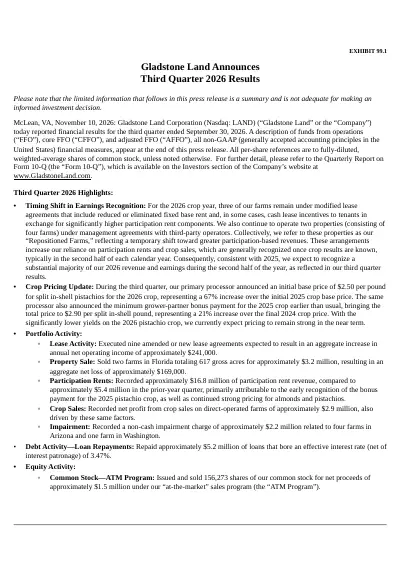
Let's start out with just letting you know we currently own about 98,000 acres across 143 farms. Nearly 56,000 acre-feet of water, and that's about 18 billion gallons of water that we have, it's mostly out in California.
The farms are in 14 different states, and our water assets, well, they're all in California where they needed to be. We are acquiring one property subsequent to quarter end, but that was not a good news rather than part of and positive is kind of a ending to a negative.
We are in a forbearance agreement with one of our tenants and they defaulted. This was a small row crop country farm in Washington state that served as collateral for the lease and was transferred to us partially satisfy the outstanding rent obligations.
During the quarter, we sold a property consisting of two citrus farms in Florida, about $3 million, good positive income. We currently have two other properties under contract to be sold worth a little about $30 million.
This assume the transaction stays on track, and I think it will. People are coming back in and buying up some properties.
One of them should close in Q4, which we're in now, really. The other there's going to be in Q1 of next year.
Last time we checked, they were still on going forward, and so we should receive that cash in over the next two quarters. In each case, we look to use most of the proceeds to pay down debt and buy back preferred stock.
We're still evaluating these and other opportunities at this time. We continue to take a disciplined approach to acquisitions and staying active in the market.
We're ready when conditions improve and it makes sense for us to start growing the portfolio again. When it does, we'll jump in.
We want to make sure that we're they only addition to the right kind of assets at the right prices. In terms of leases, we discussed in prior calls some of the updates in the leasing activity.
Due to the market conditions affecting certain permanent crops, particularly nuts and wine grapes, we modify the lease structures in a handful of farms to reduce the grower's fixed cost while allowing us to participate very strongly in the upside through higher crop share participations. We also continue to directly operate two properties.
Look there. Who's on the phone that keeps butting in?
Need to mute out. That's all.
David Gladstone
No. Can you mute whoever it is that's bleeding into my conversation?
As we've discussed in prior calls, due to the market conditions affecting certain permanent crops, particularly the nuts and the wine grapes, we modified these lease structures on a handful of farms to reduce the grower's fixed cost while allowing us to participate more in the upside through higher crop share participations. We also continue to directly operate two properties with the help of third-party managers.
Our group's not managing the farms, but they're hiring people who know how to manage these farms. Overall, in 2015, almonds and pistachio harvest were very strong, with results generally exceeding all of our expectations, and quite frankly, of most people.
They underestimated how strong they were going to be, both in terms of yield and in pricing. Final pricing on 2025 pistachio crop is expected to be at least 21% higher than 2024, and initial pricing on the '26 crop has already been announced at 67% above the initial price for the 2025 crop.
With overall yields on the 2026 crop coming in significantly lower, we expect pricing to remain strong, which should help partially offset the negative impact of the lower yields, but may not fully make up for the shortfall. Given the uncertainties around the 2026 crop results, which impacted our 2027 earnings, the advisor has waived its incentive fee earned during the third quarter, and our priority remains preserving the dividend for our shareholders during this time.
This is a time of a lot of uncertainty. Of course, with regard to farming, the United States government is giving a lot of money to the big farmers to keep them going.
We made enough last year, probably one of our best years. We entered into similar arrangements for most of these farms that we own for the 2026 crop as well.
We expect to see smaller earnings pattern next year with the majority of our related revenues and earnings again being recognized during the second half of the year. We got a ways out before we can give you much information about what's going on in the crops.
I also want to remind everyone that crop insurance continues to play an important role in our company as it helps to limit the downside risk on these farms where we have a lot riding on the production of nuts and other things. Our goal is still eventually to translate these forms back to more traditional leases structures, which is fixed base rent.
Timing for that will depend on several factors, such as crop production and as well as pricing and interest rates. When we got in this business, we were borrowing at I think 3.5%, the best we could make on it was about 7.5%, and all hell broke loose in the farming business.
Looking ahead, seven leases scheduled to expire over the next 6 months. Total, these represent about 6.8% of our lease revenue year to date in 2026.
We currently in discussions with both the existing and prospective tenants, and we expect to be able to renew the leases prior to the expirations. I think that'd be just go along as it did last year.
In addition, subsequent for the quarter end, we entered into two agreements with solar companies, granting them options to purchase up to 5,600 acres of farmland in California both for potential solar development. That's becoming a big thing in California.
The agreements had terms of 5 to 6 years with the combined annual option payments starting at about $331,000, and they'll be increasing over time where we're going to get a lot of money back. This if they work out and no reason they won't work out because everybody needs electricity and unlike so many of those companies that are building things to produce electricity, we remain in place and have not had to pay much for our land.
We also are pursuing several other alternative revenue opportunities, including all our water leases, fallowing programs, and solar leases. I think solar leases is going to be a big thing.
Wouldn't it be nice if we had solar leases on all of our vacant properties and problem? Discussions continue to progress, and we hope to have some more of these agreements in place over the coming months.
Probably in our portfolio about 10 of these farms that could be converted to producing electricity. Folks from New Jersey know this well because New Jersey has a lot of farms that were taken out of farming and put into producing electricity.
Now I'll give a quick update on some of the ongoing tenancy matters that we're working through. Currently has seven farms that are wholly or partially vacant, and we're actively working towards solutions to get these farms back into stable paying leases.
In compounding situations is where we want to be because we're dividend payers. Hopefully, we can get some of these situations resolved over the next few months.
We also currently recognizing revenue on cash basis for leases with four tenants. We've received some cash rent payments from a couple of these tenants during the quarter, but we'll keep them on a cash basis until we see the rest of the payments come in.
I'll note that these figures include two properties we currently have under contract to be sold, we get rid of some of the problems and keep going. I'm going to stop here and turn it over to Executive Vice President, Bill Raynolds.
Bill, why don't you come on and give us your report?
Bill Reiman
Thanks, David. Good morning, everyone.
The third quarter of the year for us is it's always exciting with harvest in full in full swing. Some of our minor crops such as cherries and figs are harvested early in the year, but the harvest of our major crops such as almonds and pistachio well, almonds typically begin in August, sometimes late July, pistachio generally begins around Labor Day, and wine grape harvest typically starts in September, as well.
Overall, the season got started with a major heat spell in early spring, which caused crops to develop earlier than usual. Some crops responded well to that, while others, such as pistachios, were negatively impacted.
The damage to the 2026 pistachio crop was felt across the entire industry with production expected to be among the lowest levels we've seen since 2015. Unfortunately, our orchards were no exception, and we also had lower production across the board.
However, our farms are well insured, and we expect to receive significant insurance proceeds, as David mentioned, related to our 2026 pistachio crop. We also expect crop insurance proceeds from some of our wine grape blocks, where we experienced lower production, as well.
On a more positive note, the almond crop came in strong across the board. Although we're still processing what was harvested, the trend is for our yields to be up.
The almond market is very stable, pricing continuing to strengthen slightly, and and remaining at profitable levels. Final pricing for our 20 25 crop came in significantly higher than projected, and we expect even higher prices for the 2026 crop.
Combination of strong yields and stable pricing is is really a welcome feeling after several several challenging years. We expect these trends to continue as bearing acreage continues to decline, and no significant signs yet of of any increase in new plantings.
Even if plantings were to increase, it'd be several years before the bearing acreage actually contributed to total almond production increasing. We definitely feel the tailwinds in the almond business.
The pistachio market, as one would expect given the significantly smaller crop this year, is very strong. Once the extent of the damage from the spring heat wave became apparent, prices really jumped.
That helped us close out the 2025 crop at much higher than projected prices. Although the 20 although the 2026 crop is is very small, pricing will be significantly higher than for the 2025 crop.
Despite these higher prices, the smaller crop will result in much lower trailing revenue numbers for us over the next 12 to 15 months. Crop insurance proceeds will help offset this decline, but most of those proceeds are expected to be recognized in Q4 2026, leaving less revenue from the 2026 crop to be recognized in 2027 than in a typical year.
The 2027 crop is expected to be another strong production year, and we're hopeful that current pricing strength will carry into 2027, potentially making it even more profitable year than 2025 was. Because the alternate-bearing nature of pistachios, we like to compare on years with on years and off years with off years.
We're watching how 20 27 shapes up relative to 2025. Now we're into November, with harvest behind us, the planning for the 2027 crops becomes the really becomes the focus of our ops team.
Budgets are being finalized, any new management or modified lease agreements are being put in place, we don't miss a beat with late fall and winter preparations. Though trees and vines go dormant in winter, there's a surprising amount of work that still needs to get done.
The wine grape market hasn't changed much. Crop yields were significantly lower across the Western U.S., though with the industry still facing oversupply, there hasn't been much relief on pricing.
Vineyard removals are accelerating, and we expect that to continue for the foreseeable future. The industry's facing significant challenges, with several large producers going out of business, wine assets selling at substantial discounts, and increasing number of properties coming to market.
We're seeing I'll say a lot of consolidation on the production side, declining acreage, wine labels increasingly concentrate amongst larger producers. It's going to be real interesting to see how the industry emerges from this period of restructuring.
We do see we do see some signs in the wine market some shortages, some particular varietals. This is the first positive signs we've seen in a couple of years.
Hopefully that's this is the beginning of the recovery. We're continuing to evaluate our wine grape assets and explore ways to position them you know to maximize value and profitability.
Although most of our vineyards have remained under lease allowing us to fare better than many others in the industry thus far, we may take several vineyards under direct operations in the near future. We do remain hopeful that market conditions will improve soon and put us in a better position to realize the long-term value of these assets.
A few words on real estate, on the general real estate markets. I'd say overall we're generally flat.
The trifecta of interest rates being where they are, crop inputs experiencing inflation, and crop prices generally being flat, outside of tree nuts, is the main driver of land valuations. We do see some areas gaining strength driven mostly by the strong crop prices in areas where crops can be grown with plentiful and inexpensive water.
There's a strong divergence in values around water cost and availability in California, particularly. Areas with riskier water profile are seeing continued depression of land prices, while properties with good cash flow potential are getting positive attention.
Last quarter we reported that we were seeing a little more lending activity. That is still the case, although lenders remain cautious and they're looking for more security with the money they're putting to work.
Banks are looking for strong cash flow and equity to secure loans and get deals done. Both aspects are tough to find, but they are out there, but it's it's like an Easter egg hunt.
I'll I'll end this on some thoughts about water. The new water year began October 1, this is somewhat quiet time of the year as far as water goes, particularly in California.
There was a recent late-season allocation increase, but it wasn't super impactful for most growers. It should result in lower costs for current wet water available, but some folks will be able to store a little more, but overall the impact will be minimal.
Most irrigation is done for the season, and we're all watching the weather forecasts. Strong El Niño in place, everyone's getting ready for the impact no matter where they are.
Much of the Pacific Northwest expects to be drier, while most of California and the southwest southwest expect to be wetter. Of course anything could happen, we'll prepare for what we think is likely, but stay ready for the opposite.
We are finding some good water purchase opportunities. However, we remain diligent and conservative of what we go after.
Our goal is to only acquire water at prices that fit the economics of our crops in a particular area. Should El Niño result in significant floodwater, we could see ourselves grabbing as much of that as we can to store in our water banks.
As we've stated before, our strategic water goals is really to strengthen the overall water security of the portfolio through both long- and short-term strategic water purchases, continue to invest in water delivery and storage infrastructure, and identifying opportunities to create synergies across our farm assets. That's it for me.
Now I'll turn it over to our CFO, Lewis Parrish. Lewis?
Lewis Parrish
Thanks, Bill, and good morning, everyone. I'll start with a brief update on our recent financing activity.
We did not secure any new borrowings during the quarter, but we did pay off two mortgages totaling about $5 million, and one of which was paid off in connection with the property sale that David mentioned earlier. Given where our stock has been trading, we've had very limited activity under the ATM program lately, issuing just about $1.5 million of common stock at an average cost of capital of about 5.7%.
We've also continued to execute on our preferred repurchase program. Since July 1st, we've repurchased about $13 million of our preferred stock under the program at an average repurchase yield of 7.3%, resulting in a total gain of about $1.3 million on those repurchases.
Turning to our operating results, for the third quarter, we recorded net income of about $11 million and net income to common shareholders of $6.1 million, or 14 cents per share. Adjusted FFO for the third quarter was $15.1 million, or 35 cents per share, compared to $1.4 million, or 4 cents per share, in the same quarter last year.
Common dividends declared were 14 cents in both quarters. The improvement in AFFO was primarily driven by an earlier than usual announcement of the 2025 pistachio crop bonus by our primary processor, and that allowed us to recognize certain revenue amounts sooner than usual.
Higher almond and pistachio prices also contributed to increased participation rents and profits from direct farming operations. These increases were partially offset by higher operating and property expenses.
I'll also note that 2025 was a bit of a transition year for us as we shifted certain farms to modified lease structures or direct farming operations. So, 2026 represents our first full crop cycle under these new arrangements.
Year-over-year, fixed base rents decreased by about $400,000, and that's primarily due to lost revenue from vacant and non-accrual properties, as well as property sales completed over the past year. Participation rents increased by about $11.4 million due to the early announcement of the bonus payment for the 2025 pistachio crop, as well as continued strong pricing for almonds and pistachios.
Direct farming operations also generated a net profit of about $2.9 million during the quarter, largely driven by those same factors. On the expense side, our recurring cash operating expenses increased by about $1.1 million, primarily due to higher property operating expenses.
The increase in property operating expenses was largely driven by supplemental water costs we incurred on one property pursuant to our lease obligation, higher professional fees associated with protecting water rights on certain farms in California, and additional costs related to properties that were vacant, direct operated, or on non-accrual status. Total net related party fees remained relatively flat compared to the prior-year quarter, and G&A expenses increased slightly, primarily due to higher professional fees.
Finally, cash flows from operations increased, largely as a result of higher cash receipts from participation rents and crop sales, a decrease in cash allowances paid to certain tenants, and lower interest payments. Turning to liquidity, we currently have over $105 million of immediately available capital, and over $110 million of unpledged properties that could be used as additional collateral.
About 92% of our borrowings are currently at fixed rates, and on a weighted-average basis, these borrowings bear interest at 3.57% for another 2.1 years. Looking at upcoming debt maturities, we have roughly $34 million of loans maturing over the next 12 months.
Given the value of the underlying collateral, we don't anticipate any issues refinancing these loans should we choose to do so. In addition, we have about $16 million of scheduled principal amortization payments due over that time.
We also have about $132 million of loans with fixed-rate terms that are scheduled to reset during the next year, although the loans themselves are not maturing. This includes about $130 million of loans under our MetLife facility that are scheduled to reprice in January 2027.
We are in discussions with MetLife about refixing these rates, and we're also exploring financing alternatives with other lenders, as well as other options, including using proceeds from potential property sales to pay down a portion of these notes. Finally, regarding our common distributions, in October, we declared a monthly dividend of 4.67 cents per share for the fourth quarter.
At our most recent closing stock price of $6.88, this represents an 8.1% annualized yield, which is well above the REIT sector average. With that, I'll turn the program back to David.
David Gladstone
Thank you, Lewis. Overall demand for prime row crop farmland remains relatively stable across most of our regions, and particularly along the coast of California.
We also starting to see some signs of improvements in certain permanent crops, mostly in the price and the permanent crops, as well as broader economics around these crops. We're hopeful that the worst may be behind us now.
It's still too early to say. This year will say a lot to us about where we're going, and I expect it to be different from the past, but strongly in our favor.
In closing, over the long term, we expect inflation, particularly in the food sector, to continue to move higher, and we expect the values of the underlying farmland to increase. If we start selling some more land, it'll be to rid ourselves of some more of the preferred stock.
We expect this to be especially true in the healthy foods, such as fresh fruits and vegetables and nuts, long-term trends toward healthier eating continues to grow. Now, I'll open up for some questions.
Those who are listening, operator, would you please come on and help our listeners ask questions?
Operator
Thank you. If you would like to ask a question, please press star one on your telephone keypad.
The confirmation tone will indicate your line is in the question queue. You may press star two if you would like to remove your question from the queue.
For participants using speaker equipment, it may be necessary to pick up your handset before pressing the star keys. Our first question is from Gaurav Mehta with Alliance Global Partners.
Please proceed.
Gaurav Mehta
Thank you. Good morning.
I wanted to ask you on the participation rent's expectations for 4Q. Are you able to provide some color on what you're expecting for 4Q?
Is it going to be similar to what you guys received in participation rent last year?
Lewis Parrish
Sure. It might not as we said, we did recognize some crop share rents that would typically be recognized in Q4 early in Q3 because of that earlier announcement.
I don't know that we'd say it's going to equal Q4 of last year. It's really made up of three components for us.
We have the crop share rents from our standard leases, we have net crop sale profits from our direct operated farms, and then we have insurance payments, which are expected to play a much larger role in the '26 crop. I guess if we're just talking about the crop share from standard leases and the profits from our direct operations, I'd probably say we might be similar to where we were at Q3 of last year.
The wild card here is the insurance payments. As Bill mentioned, we might be able to recognize a lot of that in Q4.
Some of it could come into Q1 next year. If it all comes in Q4, it could push us to where we were in Q4 of last year.
We're not sure of the exact timing of those payments quite yet. I think on the low end, similar to Q3 of last year.
On the high end, maybe similar to Q4 of last year.
Gaurav Mehta
Understood. Second question on the balance sheet.
You talked about some fixed-rate term resets expected next year. Can you remind us where are the interest rates on the debt that's expected to reset, and where do you expect the new interest rate to be?
Lewis Parrish
Yes. Right now, 98% of that repricing amount are the MetLife loans.
Right now, that's about $128 million, $130 million that's going to reprice in January. Right now, the weighted-average freight on those loans is about 3.5%.
Today we'd probably be looking at roughly 250 basis points of an increase if we were to refix those right now. Again, we are continuing discussions with MetLife and also talking with other lenders to try to get some competitive bids.
As I mentioned, we're also looking at alternatives of maybe using proceeds from potential property sales to repay all or a portion of those notes.
Gaurav Mehta
All right, thank you. That's all I had.
David Gladstone
Operator, would you come on and see if there's some more questions?
Operator
Yes. Our next question is from Craig Kucera with Lucid Capital Markets.
Please proceed.
Craig Kucera
Hey, good morning. Of the $17 million of variable lease payments that were made this quarter, can you give us a breakout of what was related to the 2025 pistachio bonus versus other crop types?
Lewis Parrish
I don't have exact breakout in front of me, but if I had to give a guess, it's probably close to 70% of that amount.
Craig Kucera
That's helpful. Just as we think about 2027, given your commentary about kind of comparing on years versus off years, can you give us a sense of what the yield was off of the '24 crop for pistachios and how that compared to 2025, understanding that pricing's going to be much higher, of course?
Lewis Parrish
Bill, you want to take that one?
Bill Reiman
Yeah. Could you repeat that question?
Craig Kucera
I want to make sure I caught that. I'm just trying to figure out when you have a down year with pistachios on your farms, what the yield would be relative to what it was off of the '25 crop, just for thinking about future revenue from the pistachios.
Bill Reiman
It's it's really it really runs the gamut. Not to sound not to sound elusive, but it really it really depends.
We've seen it's inconsistent. We've seen down years be, 25% of an on year, and we've, '26 is, is is overall California's overall production's going to is about 800 million pounds versus, 1.6 billion the previous year, it was half, generally speaking.
Then you have to factor in the impact of the pricing, right? Does the percent that the yield goes down by, does the price go up by, a signifi- a significant enough percentage to fill it in?
Sometimes it does, sometimes it doesn't. It's really hard to just kind of place a, place a general percentage on it.
I don't know if that helps.
Craig Kucera
[unclear]
Bill Reiman
your question.
Craig Kucera
No, that actually was perfectly what I was looking for. You ramped up asset sales or are looking to sell more.
Certainly assets held for sale. Are those related to the impairment charges you took in Arizona and Washington, or are you looking to sell farms from other parts of the country?
Lewis Parrish
Yes, the impairment was related to those sales.
Craig Kucera
Great. Let's see here.
As you're going through leasing here in fourth quarter, are you expecting any additional modified lease agreements, or do you anticipate that the three that you have will kind of be the ones that remain under modified leases?
Lewis Parrish
No. We're not looking at any additional changes towards modified leases at this point.
Right and I'll let Bill speak to this, but it's a smaller property, but we're planning to take one property out of the modified lease structure and put it into more of a traditional lease. That's a small almond farm.
Bill, any more color you want to give
Bill Reiman
on
Lewis Parrish
that one? Yes.
Bill Reiman
Yeah. We don't anticipate any other modified leases.
We have been getting inquiries going back to traditional leases. Lewis Lewis said, we have one smaller almond farm that is going back to a traditional.
It's coming off the modified lease with us and going back to a standard lease. We just kind of evaluate it, case-by-case basis, weighing those returns.
Just one less going into next year. I don't anticipate any new ones for 2027.
Craig Kucera
Craig,
Lewis Parrish
one thing I'll add there, Craig, is on the direct operated side, related to the tenant that was in default, David mentioned, we acquired one property as part of a forbearance agreement. They operated a couple of vineyards up in the Pacific Northwest.
We might end up having to take those back under direct operations. Not modified lease, but we might have a couple of vineyards added to the direct operated bucket next quarter or in the fourth quarter.
Craig Kucera
Got it. With the third-party solar agreement, did you say that was on vacant land or that's land that's currently being farmed?
Bill Reiman
It's on both. Actually, they're both leased, they aren't vacant.
They are on farms.
Lewis Parrish
One was vacant last quarter though, right?
Bill Reiman
That's true. Yeah.
Lewis Parrish
Yeah. One was leased, and the other one is now also leased, but on top of that there's the solar purchase option agreement.
Craig Kucera
Got it. Okay.
That's it for me. Thank you.
David Gladstone
Operator, can you give us the last question?
Operator
Yes, sir. Our last question is from John Massocca with B.
Riley Securities. Please proceed.
John Massocca
Good morning. Maybe thinking about the kind of overall farm transaction market in terms of acquisitions and dispositions, sorry.
How is that being impacted by the move in interest rates, if at all? Is that kind of changing any kind of strategy you have around maybe selling some underperforming assets and using proceeds to kind of pay down parts of the capital stack?
Just kind of curious how that's progressing.
David Gladstone
Lewis, go ahead.
Bill Reiman
Why don't Lewis,
Lewis Parrish
you want to start,
Bill Reiman
Bill? It's a buyer's market for most farmlands at this point in time.
It's difficult to get things sold, and particularly difficult to get things sold at a value that is helpful to us. For example, our farm in Arizona we had under contract just yesterday the buyer canceled, right?
We had a pricing that we liked, but after doing their due diligence they determined that what that was going to cost them to operate it was too expensive. They backed out.
It's really really difficult to get transactions closed. Right now the buyer pool is really just strategics.
Very, very few investors. Institutional activity is really at a very low level.
Going out and selling a bunch of properties to free up capital, that is not a quick process. At this time, it's going to be a grind.
I would say that that process of liquidating assets to redeploy that capital and so it's going to be slow, and it's going to be slow for a while.
John Massocca
Okay. Are you seeing movements in kind of cap rate to kind of compensate for that, or is there just a buyer-seller disconnect out there given where kind of interest rates have moved?
Bill Reiman
That's a great question because that's what happens, right? Interest rates go up, cost of money goes up, transactions slow down, profitability starts to come back, right?
We definitely see in certain crops, crops that have good profitability, almonds and pistachios, yeah, we're definitely starting to see cap rates coming back, right, to compensate for that. We expect those trends to just kind of gently continue.
The one positive with interest rates is they came up, and we're adjusting to that, but for the last 18 months, it's relatively stable, right? That stability gives confidence in the industry, and so then we can get to build profitability back in.
Then as guys like in the wine grape market, as it cleans up, it is kind of sad with people losing their jobs and companies going out of business, but, that's capitalism, right? As it cleans itself up, that we expect that profitability to come back, and it will come back.
We were watching all of those things and to figure out how our assets play into that and what we can do to position ourselves so that we maximize values and returns in the future.
John Massocca
Okay. Then on a more technical level, you mentioned some crop insurance in certain crop types.
Can you give maybe a little more color on the seasonality? I think some of that's going to hit in 4Q, but then the impact from terms of lost kind of crop revenue is in '27.
Just kind of curious how we should think about that impacting the top and bottom line both in 4Q and in '27.
Bill Reiman
Go ahead, Lewis. Go ahead, Bill.
No, I was just going to say that, generally speaking, the crop insurance proceeds, let's compare those to the normal crop revenue, the crop insurance proceeds come right away, right? They come right after harvest.
In fact, we've received some payments already. Comparing to the typical crop revenue on those crops that lags 12 to 15 months, sometimes longer, it shifts that revenue stream.
Now, crop insurance obviously is kicking in when you've had a problem, right? The profitability, if you're getting crop insurance payments, then whatever that was for, a particular crop, or in some cases just a particular block, one block out of one farm, it could be that specific.
Means that you had, probably lower yields and had to make a claim because what level of revenue you were insured to, you're dropping below that. Your overall profitability obviously is taking a hit wherever you're cuz we're insuring to a level that covers our costs, covers our investment in the crop.
We're not insuring profitability. I think that's probably, I don't know, Lewis, what you can add to that.
That's probably the best way I can describe it.
Lewis Parrish
No, I think that pretty much covers it. Nothing to add here.
John Massocca
Okay. Then last one, maybe for Lewis.
How are you thinking about the preferred stock repurchase program kind of going forward? Is that something we should just expect to kind of steady utilization of, or could that be a little more variable based on where kind of capital needs are in any given quarter?
Lewis Parrish
Definitely the latter. Our line of credit, we're using that right now and that's going to reprice again in January, and every reprice is every 3 months.
We'll weigh the cost of that versus the cash needs versus the cost of the preferred or what yield were able to buy it back at. Frankly, right now, based on last night's closing price, it's yielding a little bit higher than the preferred.
We're going to weigh the best use of any funds that we have available versus other needs. Possibly some acquisitions, although I don't see that in the near term, trumping either one of these repurchase options.
If things stayed how they did during Q3, then yes, I would expect it to continue. We'll have to see where interest rates go and what the yields on all of our securities look like.
John Massocca
Okay. I appreciate all that detail.
That's it for me. Thank you very much.
David Gladstone
How are we doing on any more questions?
Operator
There are no further questions at this time.
David Gladstone
We're disappointed. We like it when people ask us a lot of questions.
Just get ready for the next one, and give us a lot of questions about our business, and we'll do our best to answer them. That's the end of this, and we thank you all for being with us, and we'll see you next quarter.
Operator
Thank you. This will conclude today's conference.
You may disconnect your lines at this time, and thank you for your participation.