LandBridge Corporation
Q3 FY2026 · Earnings Call TranscriptNovember 5, 2026
Operator
Ladies and gentlemen, thank you for joining us and welcome to the LandBridge third quarter 2026 results call. After today's prepared remarks, we will host a question-and-answer session.
If you would like to ask a question, please press star one to raise your hand. To withdraw your question, press star one again.
I will now hand the conference over to Mae Herrington, Director of Investor Relations. May, please go ahead.
Mae Herrington
Good morning, and thank you for joining LandBridge's third quarter 2026 earnings call. I'm joined today by our Chief Executive Officer, Jason Long, and our Chief Financial Officer, Scott McNeely.
Before we begin, I'd like to remind you that in this call and the related presentation, we will make forward-looking statements regarding our current beliefs, plans, and expectations, which are not guarantees of future performance and are subject to a number of known and unknown risks and uncertainties that could cause actual results to differ materially from results and events contemplated by such forward-looking statements. You are cautioned not to place undue reliance on forward-looking statements.
Please refer to the risk factors and other cautionary statements included in our filings with the SEC. I would also like to point out that our investor presentation and today's conference call will contain discussions of non-GAAP financial measures, which we believe are useful in evaluating our performance.
These supplemental measures should not be considered in isolation or as a substitute for financial measures prepared in accordance with GAAP. Reconciliations to the most directly comparable GAAP measures are included in our earnings release and the appendix of today's accompanying presentation.
I'll now turn the call over to our CEO, Jason Long.
Jason Long
Thank you, May, and good morning, everyone. We delivered another record-setting quarter, reflecting strong performance across each of our core revenue streams and the continued scalability of our business model.
This momentum, together with the expected contribution from recent acquisitions, gives us the confidence to raise our full-year 2026 adjusted EBITDA guidance. Our strategy has not changed.
We actively manage our land to maximize what happens on it, and we collect long-term fee-based revenue from the companies that build and operate there. This quarter showed that model working in three ways.
First, we continued to grow our acreage position through acquisitions. During the quarter, we added significant new acreage to our land position, totaling approximately 25,000 surface acres across our position.
This brings our total acreage to more than 350,000 surface acres. The new acreage includes fee surface and mineral-classified surface interests, which enables the surface owner to participate in the upside of the minerals production.
More importantly, these acquisitions add attractive, undeveloped pore space positioned outside the over-pressured injection zones close to the state line. That is exactly what the E&P operators need as a responsible, long-term alternative for produced water disposal, and we are already in active discussions with operators about it.
Our approach to acquisitions is consistent: we buy strategic acreage at accretive multiples, and then we work to blend that multiple down through commercial development. The land we have acquired this year was purchased at approximately 10 times EBITDA.
We have line of sight to bring that below six times through near-term pore space monetization alone, with expectations to bring investment multiples at or below three times over the long term through further commercial efforts, including digital infrastructure, alternative energy, and general industrial development. Second, the pore space opportunity is getting larger.
Disposal capacity along the state line is shrinking, and our contiguous, low-pressure pore space is positioned to help meet that need. That demand for pore space is showing up in our results.
Surface use royalties and revenues increased again this quarter, driven by higher produced water handling volumes across our acreage, including volumes from WaterBridge's ramping Speedway Phase 1 pipeline. Third, our digital infrastructure strategy has moved from discussion to construction.
In September, PowerBridge exercised its option on an initial 825-acre portion of the approximately 3,400 acres under option for the Alpha digital campus in Reeves County. We entered into a long-term ground lease and a power royalty agreement for power generated on the site.
PowerBridge has received initial permits and has commenced construction on Alpha Phase 1, which is expected to include more than 300 megawatts of the planned 2-gigawatt campus, with first power delivery anticipated in the fourth quarter of 2027. We encourage you to follow PowerBridge for more details on Alpha and their other ongoing efforts.
Alpha is an important proof point of our digital infrastructure strategy, and it shows why we believe the model we offer is built to last. Power for Phase 1 is generated on-site behind-the-meter from local natural gas.
It is fully off-grid, it does not draw from ERCOT or add costs for residential ratepayers. Cooling water is supplied from non-potable brackish sources, it does not compete with communities or agricultural for fresh water.
We have worked closely with local leaders and residents in Reeves County throughout this process. Developments like Alpha bring jobs and meaningful new tax base to the region.
Put simply, LandBridge offers the full suite of what a data center needs: large, contiguous sites, behind-the-meter power, non-potable water, fiber connectivity, and a community that supports our projects. Each one answers a concern that has begun to push back against data center development elsewhere.
Projects near major metro areas which compete for grid capacity, drinking water, and residents' acceptance face growing headwinds. We believe sites like ours, which take on those issues directly, will be where this next phase of digital infrastructure gets built.
That view is reinforced by our ongoing discussions with counterparties and by the commercial progress we've already made, starting with Alpha, and we are well positioned to keep capitalizing on this demand as the market evolves. Our financial results and commercial progress this quarter demonstrate the strength of the LandBridge model, with a growing core business, disciplined expansion of our land portfolio, and increasing opportunities to generate additional value through active land management.
We're excited about the business and the opportunities ahead of us. I will now turn it over to Scott McNeely.
Scott McNeely
Thank you, Jason, and good morning, everyone. Our results this quarter underscore the continued strength and scalability of our high-margin, asset-light business model, and the expected contribution from recent acquisitions beginning in the fourth quarter supports our decision to raise our full-year 2026 guidance.
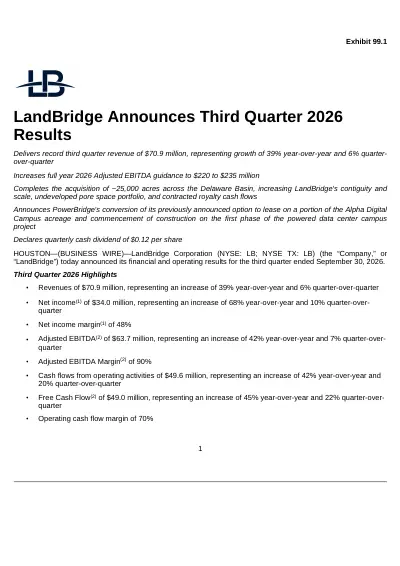
We now expect adjusted EBITDA between $220 and $235 million for the full fiscal year, compared with our prior range of $210 to $230 million, which raises the midpoint to $227.5 million. Revenue in the third quarter was a record $70.9 million, representing growth of 39% year-over-year and 6% sequentially.
Given the acquisitions discussed by Jason closed at the end of the third quarter, our outperformance was driven by organic growth across all of our key revenue streams. Surface use royalties and revenues were $54.3 million, an increase of $2.1 million sequentially, driven by higher produced water handling volumes across our acreage, including increased volumes from the ramping Speedway Phase 1 pipeline, as well as an increase in pipeline easement revenue.
Resource sales and royalties were $12.5 million, an increase of $1.4 million sequentially, primarily driven by higher caliche and water sales, as well as an increase in sand royalties. Oil and gas royalties were $4.1 million, an increase of $0.5 million sequentially, as net royalty production rose from 773 barrels of oil equivalent per day in the second quarter to 917 in the third.
Our direct commodity exposure remains limited, with oil and gas royalties representing approximately 6% of our third quarter revenue. Adjusted EBITDA for the quarter was $63.7 million, an increase of 42% year-over-year and 7% sequentially, with a margin of 90%.
Free cash flow was $49 million, an increase of 45% year-over-year and 22% sequentially, with a free cash flow margin of 69%. Our capital requirements remain modest, with capital expenditures of approximately $0.6 million.
Net cash used in investing activities was $267.4 million, including approximately $266.8 million for the acquisitions Jason described. Our strong free cash flow reflects the fundamental strength of the LandBridge model.
As activity on our acreage continues to build, we participate through royalties, leases, and other long-term contracted revenues while our customers fund the underlying infrastructure. This high-margin, asset-light business model allows us to grow cash flow while maintaining very modest capital requirements.
Turning to our capital allocation strategy, we continue to operate with discipline across three priorities. First, we continue to pursue accretive acquisitions that expand our fee surface position, with the focus on pore space, produced water infrastructure growth, and scaled power and digital infrastructure projects.
Our proven active land management strategy is anticipated to create value above underwriting targets over time. Second, we remain focused on maintaining a strong balance sheet and an efficient capital structure, with a long-term net leverage target of 2 to 2.5 times.
At quarter-end, total liquidity was $126.8 million, including $16.8 million in cash and approximately $110 million of available borrowing capacity under our revolving credit facility. Total borrowings outstanding were $765 million, compared with $545.2 million at the end of the second quarter, reflecting the funding of the third quarter acquisitions.
Our covenant net leverage was three times at the end of the third quarter, compared to 2.5 times last quarter. During the quarter, we amended our revolving credit facility, increasing commitments from $275 to $375 million, with the ability to increase by another $100 million, and we reduced our borrowing costs by 25 basis points across the pricing grid.
On October 1st, we also issued an additional $125 million of our 6.25% senior unsecured notes due 2030 under the existing indenture, bringing total principal amount of these notes to $625 million, and we used the net proceeds to repay a portion of our revolver borrowings. Pro forma for those October transactions, our liquidity was approximately $252 million, and we continue to have no debt maturities until 2030.
Finally, we maintain our ability to return capital to shareholders. The board declared a dividend of 12 cents per share, payable on December 10th to shareholders of record as of November 25th.
The $50 million share repurchase program authorized earlier this year also remains available through December 2027, and we can deploy it opportunistically. One final milestone of note: we recently completed our previously announced conversion and redomestication of LandBridge from a Delaware limited liability company to a Texas corporation.
The conversion and redomestication was approved by our board earlier this year following approval by a special committee of independent directors. As discussed last quarter, we believe this conversion and redomestication has the potential to further expand our investor base through broader index eligibility and support long-term shareholder value creation.
To close, this quarter demonstrates what the LandBridge model is designed to do: grow revenue across diversified recurring revenue streams, convert that growth into outsized free cash flow at a 90% adjusted EBITDA margin and a 69% free cash flow margin, and reinvest that cash flow to expand our acreage position, compounding value for shareholders over time. With strong organic growth, attractive margins, and free cash flow, we're confident in our outlook and well positioned to continue executing on the opportunities ahead of us.
Thank you. Operator, you may now open the line for questions.
Operator
We will now begin the question-and-answer session. Please limit yourself to one question and one follow-up.
If you would like to ask a question, please press star one to raise your hand. To withdraw your question, press star one again.
We ask that you pick up your handset when asking your question to allow for optimum sound quality. If you are muted locally, please remember to unmute your device.
Please stand by while we compile the Q&A roster. Your first question comes from the line of Michael Furrow of Pickering Energy Partners.
Your line is open, please go ahead.
Michael Furrow
Hey, good morning, and thanks for taking our questions. Look, maybe we could just start with the recent election results, particularly in Texas.
Wanted to offer you guys an opportunity to kind of voice your opinions on how you see this impacting West Texas data centers and potentially the Alpha digital campus. I think the conventional wisdom has been that it might benefit behind-the-meter, but it could also just delay projects altogether.
Any thoughts there would be helpful.
Scott McNeely
Hey, good morning, Michael. Appreciate the question.
You're right. If anything, this creates more of a tailwind for projects like ours.
If you recall, Governor Abbott had his audit several months ago, and then now Governor-elect's campaign. It's all coming from the same place.
Texans are concerned about the grid, their power bills, or water supply, and the impact on the communities. This bar for data center development in Texas has already been going up.
As Jason alluded to in the prepared remarks, we've designed our offering to easily clear that. Just to recast, first on the grid, our projects are structured behind-the-meter, collocated, or ultimately net exporters.
We don't have that kind of negative impact on ERCOT, rather we would add to it. Second, on the water side, we are supplying non-potable brackish, and ultimately treated produced water, not the municipal or freshwater supplies that these policies are really meant to protect.
In the scenario that the governor-elect has highlighted that data centers are going to be competing with households for water, that just simply isn't part of our model here. Lastly, on community impact, again, our sites are on these large contiguous tracts of our own acreage well away from municipalities.
Just as important, how we've approached it from the start, we prioritized transparency. We've engaged directly with local elected officials, with community leaders, with key stakeholders, and that's why the local support for our projects is very real, and that isn't true in many other markets even within Texas.
Ultimately, we strongly believe data centers, if developed the right way with real thought given to power, to water, to community impact, and in close coordination with those local leaders, they should be a huge positive. They bring jobs, they bring tax revenue, they diversify the local economy, and they provide long-term investment.
These shouldn't be viewed as a compromise, but they should be celebrated locally because it's a massive win both locally and for the state of Texas. Ultimately, to the extent there is a new policy that continues to raise the bar, it only strengthens our competitive position because very few sites out there can really address all of these very valid concerns the way ours do.
Michael Furrow
Appreciate the detailed response. Just following up on the Alpha digital campus, specifically on the revenue timing, noted that the ground lease and power royalty agreements are signed.
When should LandBridge begin recognizing revenue, and what are the kind of key milestones that would ramp up royalty payments on the path to a 2-gigawatt campus?
Scott McNeely
No, good question. We're obviously excited to see them exercise that option and convert the first 825 acres to a lease.
Real material cash flow will start impacting first half of next year. We're not disclosing any of the details on economics just yet, but I would say that they fall within that framework that we've previously provided as it relates to that $10 to $20 million per gigawatt.
More details to come there as it relates to both the counterparty, as well as the timing ramp for full 2 gigawatts. We're obviously very excited.
It's a great validation of the thesis, and I think there's a lot of good news around the corner there.
Michael Furrow
Great. Thanks for your time.
Scott McNeely
Thank you.
Operator
Your next question comes from the line of John Mackay of Goldman Sachs. Your line is open, please go ahead.
John Mackay
Hey, team. Thank you for the time.
Maybe we'll start on the recent M&A. Appreciate the color on kind of the multiples and where you can get that kind of multiple down to over time.
Just curious if you can talk about kind of the broader opportunities that's here. When you're looking at all the incremental potential M&A you can do on the acreage side, how do we think about what can get you to a $3,000 revenue per acre in terms of how much acreage is out there that can be of that quality versus maybe something a little lower?
Said differently, if you're guiding to buying, and if you did 10 times on that acquisition price, which point gets to three times eventually, how deep is that opportunity set? Thank you.
Scott McNeely
Hey, good morning, John. Obviously very excited about acquisitions.
We've a very active ground game, and continue to see that M&A pipeline just very robust ahead of us here. When you think through the economics, still able to get deals done at a blended average around this 10 times.
When you think through what does it take to get that down to three times, just monetization of the pore space alone could achieve those numbers, both the multiple number as well as the 3 figure that you just referenced. Being intentionally conservative as we think through the timing of monetizing that.
The obvious kind of takeaway is when you look at all of these ancillary revenue opportunities that exist on the surface, that would just further drive that acquisition multiple down sub-three times in addition to the opportunity set delivered by just the pore space alone. We think there's still just a very deep market in terms of actionable M&A.
There's obviously a variety of strategies we're pursuing, from the pore space piece to more traditional enablement of oil and gas, to your broader power and digital infrastructure, and just the broader industrial ecosystem that's needed to support that. It is truly a sprint for us right now, but we remain incredibly thoughtful about the commercial opportunities that exist on each one of these targets that we're looking at to ensure they meet our underwriting criteria.
We think, again, the opportunity set's robust, and we plan to continue working through that.
John Mackay
That's great. Thank you.
Second one for me is just maybe a clarification on Alpha digital. Understand, it's not a ton of detail you guys can share right now, but would it be fair to assume that, if they're executing this lease with you and are comfortable moving forward, they're at least close to the finish line on kind of signing their anchor customer, and maybe that's something we could hear about relatively soon?
Scott McNeely
I would expect that to be a more near-term announcement. My expectation there would be not converting this to a lease unless there was a healthy amount of confidence that they're close.
John Mackay
Understood. Thank you for the time.
Scott McNeely
Thanks, John.
Operator
Your next question comes from the line of Derrick Whitfield of Texas Capital. Your line is open, please go ahead.
Derrick Whitfield
Good morning, guys, and congrats on a very strong quarter and update.
Scott McNeely
Hey, good morning. Morning.
Derrick Whitfield
Wanted to start on the water disposal side of your business. Given the changes we've seen at the Texas Railroad Commission, do you anticipate any changes in the regulatory environment on water disposal?
Then just another comment, I want you to these two as well, but as I recall, you guys have largely led regulatory tightening within that body. Effectively, a new administration could strengthen your competitive position in the market.
Is that a fair assessment?
Scott McNeely
Hey, morning again, Derrick. A great kind of joint LandBridge, WaterBridge question there.
We don't expect any abrupt change in how produced water is regulated, but to your point, if anything, this is going to kind of further strengthen our position here, and that's largely due to our historically conservative approach to permitting and then on the WaterBridge side, constructing infrastructure. If you just go through just a real quick handful of very relevant points, first, when you look at how these Texas regulatory bodies are actually structured, they're built for continuity, they're built for stability, and so even an election like we just saw is really not going to lead to some kind of drastic change in policy at all in the near term, whether that's within the Railroad Commission, the TCEQ, or any other state regulatory bodies.
It takes time for change to happen, and we're still a long ways away from even knowing if there's change coming. Second, and I think this is important, is we, both LandBridge and WaterBridge, have built an outstanding relationship with all of these regulators and all of these regulatory bodies, and we don't see that changing as the result of an election.
We'll continue to stay transparent, we'll continue to work with them and coordinate with them, and that has typically led to great results for us. Third and most importantly, we've always been very conservative about how we thought pore space should be managed and how ultimately operators should permit, select, and build their infrastructure.
I think to your point, forcing operators to spread their footprint across a wide geographic footprint is just a responsible way to go about business, to avoid introducing risks such as pore pressure and other risks, and ultimately, we see just much more responsibility and longevity that comes with that approach. When the Railroad Commission last year even tightened its permitting guidelines, we put out very public support endorsing that change because it really reflects how we, both WaterBridge and LandBridge, operate.
To summarize, still too early to know whether there's any change coming, but to the extent it does come, I think we're incredibly well positioned relative to other operators who have just been toeing the line and have much more exposure to even small changes in policy. Given that we operate so well inside those limits, it should ultimately drive, I think, more success to LandBridge, as it is just delivering, candidly, a much more responsible platform for water disposal relative to other options.
Derrick Whitfield
Great. Then for my follow-up, I wanted to focus on the recent surface acquisitions.
While I realize you're holding back the exact location for competitive reasons, maybe if you could just speak to when you might be in a position to discuss the growth initiatives you have from that surface, and further, the market opportunity you see for additional surface acquisitions in the Delaware.
Scott McNeely
I'll start with the second. As I mentioned to John's question, we still see just a very robust M&A opportunity set ahead of us and are continuing to move down that as quickly and prudently as we can, which is what's leading us to being somewhat sensitive in terms of the success that we've had so far.
Now, when will we divulge or disclose more information? I think that's something we're just going to have to evaluate on a quarter-by-quarter basis.
I think we're very eager to share our success, be transparent with the market about everything related to our business with the caveat that we need to remain mindful of just commercial sensitivity. The last thing we want to do is hinder the success of our business by over-disclosing unnecessarily.
It's a bit of a balancing act, but we understand the market's desire to learn more. We're excited to share that when we can.
Derrick Whitfield
Appreciate that. Thanks for your time.
Scott McNeely
Thanks, Derek.
Operator
Your next question comes from the line of Alexander Goldfarb of Piper Sandler. Your line is open, please go ahead.
Alexander Goldfarb
Hey, morning down there, and I guess maybe I'll say welcome to living in New York, given how the election went there. Sorry, just a little New York humor.
Two questions here. The first one just goes to the election.
Appreciate your responses on the data centers and pore space, but if we think about potential for a windfall tax, or tougher regulations on oil companies, etc., are you concerned at all that the activity in the Permian dials back and therefore there's less demand for water, for what you guys provide? I'm just sort of curious on that.
Obviously, I'm taking sort of an extreme, but the way the market is reacting, I think that's the way the market is thinking. Just kind of understand sort of what a worst case could be, and maybe if you frame it on what you've seen historically under prior heavy Democrat administrations, whether it's locally or out of Washington.
Scott McNeely
Hey, good morning, Alex. Obviously, it's been a bit here in Texas since we've had a different political party at the helm, but can point to some analogs, I think, in Washington.
At the end of the day, I think Texas is an oil and gas company through and through. I don't think that is a partisan issue necessarily.
We're obviously keeping a close eye on how all of the various impacts of this recent election could ultimately flow through, but we don't see any kind of reaction from any of our customers at this point, appreciate in early discussions that suggest any concerns about things slowing down. We will continue to watch, obviously closely there, but historically speaking, these E&P operators, which obviously we are ultimately exposed to their activity volumetrically, are going to be driven by economics.
As long as the commodity price environment is constructive and that's being driven by quality of demand and other factors, I think we'll continue to see activity in the Delaware in particular continue to improve. I think there's a reason we're in the Delaware, right?
It is the best economics in the US as it relates to oil and gas production. I think, unlike some other basins with maybe a little bit more exposed to changes in the commodity price environment or deterioration of the macro, in the Delaware, even when commodity prices were soft and softening last year, we still had fantastic success at LandBridge.
That's what I would wrap up with, is ultimately, look at the success we've had at our company through varying commodity price cycles even over the last few years, and I think of the 10 or so quarters we've been public, we've had quarter-over-quarter growth nine of those 10, and that includes the first six or so quarters after being public when commodity prices declined following our IPO. I think we still feel incredibly optimistic kind of stepping into next year, again, keeping a close eye on what could or could not change, but as of today, I think we're still in a fantastic position to execute across all aspects of our business.
Alexander Goldfarb
Okay. Just to follow up there, if I understand you correctly, it doesn't sound like this year, because of where oil went, the Iran war, that suddenly there was a flood of activity that you're worried about unwinding.
Is that the case? That's what you're saying?
Scott McNeely
I think that's a very big piece of it. We haven't seen, I would say, an irrational ramp in activity in a reaction to near-term commodity prices this year for a number of reasons.
Any kind of unwind, as you put it, next year, I think is just not an accurate way to look at it, cuz just there's nothing massive to unwind. It is been largely a status quo year for us here.
Alexander Goldfarb
Okay. Then the second question, I understand you don't want to provide the actual details on the Alpha economics, but just sort of big picture, you said it falls within, I think you said a $10 million to $20 million per gigawatt framework.
That would sound like if it's a 2-gig project, there's a potential for $20 or $40 million. Just trying to understand, one, if that's the correct interpretation, and then, two, is there some initial ground rent that is paid, or is that really immaterial and it's not until this facility is fully up and running that we'll see this, I guess it would be an aggregate $20 to $40 million in total.
I'm assuming that's an annual payment. Just trying to understand sort of big picture.
Scott McNeely
We expect to see ground rent starting to come in next year. As you think through the ability to scale this site to 2 gigawatts, those numbers that you put out, I think are the right way to think about it.
Alexander Goldfarb
Okay. My $20 to $40 million per year that's sort of a correct range, right?
Scott McNeely
That's right, but I don't want to give you the impression that is going to be next year, as we've spoken to kind of the timing, the initial timing of the ramp. As we think through the facility, in aggregate kind of scaling up over the next several years, that is the target and that is the expectation on our side.
Alexander Goldfarb
Okay. Thank you.
Scott McNeely
Thank you.
Operator
There are no further questions at this time. I will now turn the call back to Scott McNeely for closing remarks.
Scott McNeely
Okay. We appreciate everyone's time today.
It's an exciting time in our business. We've got a lot of really great things going on.
We look forward to sharing more details with you all, but in the interim, please feel free to reach out if we can be helpful. Thank you.
Operator
This concludes today's call. Thank you for attending.
You may now disconnect.