Lifeward Ltd.
NNASDAQ:LFWDQ4 FY2025 · Earnings Call TranscriptMarch 18, 2026
Operator
Good day, and welcome to the Lifeward fourth quarter 2025 earnings conference call. All participants will be in listen-only mode.
Should you need assistance, please signal a conference specialist by pressing the star key followed by zero. After today's presentation, there will be an opportunity to ask questions.
To ask a question, you may press star then one on your telephone keypad, and to withdraw your question, please press star then two. Please note today's event is being recorded.
I would now like to turn the conference over to Almog Adar, Chief Financial Officer. Please go ahead.
Almog Adar
Thank you, Rocco, and thanks everyone who's joined us on the call today. My name is Almog Adar.
I'm Lifeward's Chief Financial Officer, and with me on today's call is our President and Chief Executive Officer, Mark Grant. Earlier this morning, Lifeward issued a press release detailing the financial results for the fourth quarter and the full year ended December 31st, 2025.
I would ask you to review the full text of our forward-looking statements from the press release. We anticipate making projections during this call, and actual results could differ materially due to several factors, including those outlined in our latest filing with the SEC.
With that, I will turn the call over to Mark.
Mark Grant
Good morning, and thanks everyone for joining us on the call today. Before we get into the details of the quarter and the year, I want to start with what we believe is fundamental to the Lifeward investment thesis today.
We are executing against a strategy to build a leading, diversified biomedical innovation company with multiple technology platforms and strong clinical foundations. Importantly, we're establishing a clear line of sight to scale through continued progress in reimbursement, commercial execution, and product innovation.
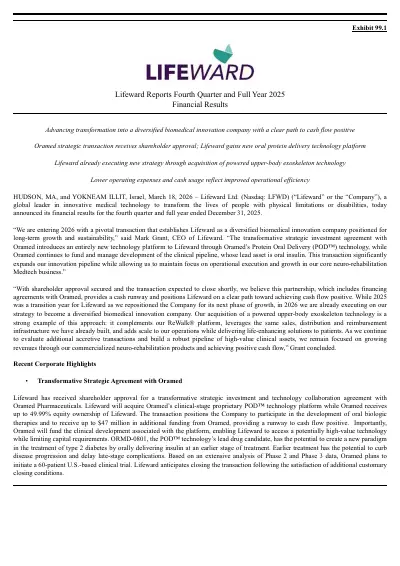
Our strategic transaction with Oramed gives us meaningful access to capital to support our growth initiatives, and we remain focused on driving the business toward cash flow positive operations while investing in innovations that will define the future of the company. An important milestone for Lifeward is the pending close of our strategic agreement with Oramed, following the receipt of shareholder approval last week.
This partnership significantly strengthens our financial foundation and expands our strategic scope. I want to thank our shareholders for approving the transaction.
Your support reflects confidence in the strategy we've laid out and the opportunity ahead of us. I also want to acknowledge the outstanding team at Oramed.
They've been great partners, and I look forward to building a long-term collaboration that creates meaningful value for patients, partners, and shareholders. Personally, this opportunity is particularly exciting for me given my background in diabetes at Medtronic and metabolic health at Bristol Myers Squibb.
One of the more compelling assets in this partnership is ORMP-0801, an advanced clinical stage oral insulin candidate that has the potential to fundamentally change how insulin therapy is delivered. Because oral insulin is delivered through the gut, it goes to the liver first, mimicking the path of natural insulin from the pancreas.
For the patient, this can mean better regulation of glucose production by the liver and less circulating through the body, which could reduce weight gain and the risk of hypoglycemia. Multiple studies have shown no increased risk of hypoglycemia compared with placebo.
This is an important distinction in the insulin field, and if successfully developed, could meaningfully improve both patient safety and treatment adherence. We're excited about the potential of this program and believe it represents meaningful addition to Lifeward's long-term innovation platform.
The current plan is to move forward with a new U.S. study.
The unique funding structure for the clinical program also allows Lifeward to maintain pinpoint operational focus on profitability and cash generation of our portfolio, while simultaneously gaining exposure to the potential substantial upside of a large-scale biotech opportunity. Another major recent step forward for the company is the acquisition of intellectual property and technology from ScaLable.
This transaction was structured in a very capital-efficient way, and we believe it will prove to be highly accretive as the technology advances to market. The technology we acquired supports development of a powered upper extremity orthotics system with AI capabilities designed to assist functional movement and restore function in individuals with weakened or paralyzed arms and hands, particularly following stroke.
The device is intended to enable patients to perform activities of daily living that would otherwise be very difficult or impossible, while supporting therapeutic goals such as muscle reeducation and improved range of motion. In the U.S.
alone, this upper-body neuro-rehab system could help an estimated 245,000 newly diagnosed stroke survivors annually and an additional 4.6 million stroke survivors who remain disabled. With plans to develop and launch the product, we are eager to get to this patient population.
What makes this acquisition particularly valuable is not only the technology itself, but it's the team that comes with it. As you don't have the opportunity for outside-in inflection points that often, the core ScaLable engineering group will be joining Lifeward, bringing more than 60 years of combined experience across electrical, software, mechanical, and industrial design.
That experience is incredibly important as we integrate the technology into our development framework. Bringing the original engineering team with the platform ensures continuity of knowledge and allows for a disciplined transfer of intellectual property, design intent, and technical architecture into our broader pipeline.
The stellar engineering team will also be a core team working on advancing the rest of our neuro-rehab product portfolio. We believe this platform expands Lifeward's leadership into whole-body robotic rehabilitation and opens a significant market opportunity with neuro-rehabilitation.
In fact, the new platform is highly complementary to our existing ReWalk ecosystem. We will leverage our established clinical relationships, distribution network, and reimbursement channels to accelerate time of commercialization.
I want to underscore here that Lifeward's focus in robotic rehabilitative technologies is exactly that: to rehabilitate and help the human return to full function or return to as much function as humanly possible. We are committed to continuous innovation, deploying the most advanced robotics and AI technologies to restore full health and quality of life to a broadening patient population.
Now turning to our established core neuro-rehab business, we continued to make important progress across reimbursement, clinical partnerships, and global distribution during the year. At the same time, revenue for the quarter and for the full year came in lower than estimated, and there were two primary drivers behind that.
First, in the United States, we implemented a major change in our sales and distribution infrastructure. As we discussed on our third quarter call, we began a transition toward a hybrid model that combines our internal direct sales efforts with external channel partnerships.
Building those partnerships takes time. They don't translate into revenue overnight, you're not seeing the full impact of those changes in our numbers yet.
Within this, restructured also our sales organization internally to better align with our business evolving. Today, our commercial efforts operate across three focus areas.
First, our direct-to-patient channel, which supports individuals pursuing a personal ReWalk system through the reimbursement process. Second, our capital equipment sales team, which focuses on institutional customers, including rehabilitation centers, hospitals, and support medicine facilities for AlterG.
We believe there are substantial untapped opportunities here that can better be served by our capital equipment sales team. The third is a dedicated reimbursement and payer engagement function that works across all payers to expand coverage and support both our direct and distribution channels.
As reimbursement is a critical driver of our long-term growth strategy, and building a stronger payer engagement capability is essential to expanding patient access, accelerating adoption of our technologies. It's critical for our patients to be able to access our technologies through their healthcare benefit in their community.
We believe this structure will ultimately improve the overall sales process, strengthen payer engagement, and drive greater adoption. As those changes mature, we expect to see the positive effects begin to show in the coming quarters.
The second factor affecting revenue was a decline in AlterG sales tied to a specific distributor dynamic. In 2024, one of our distributors made a very large inventory purchase.
That distributor did not place that comparable in 2025, which created a year-over-year comparison headwind. Based on our discussions with them, we expect that purchasing to normalize again in 2026.
Despite those temporary dynamics, the underlying fundamentals of the business remain strong. Reimbursement coverage continues to expand, clinical demand remains solid, and we're building a growing backlog and qualified pipeline.
Recently, we achieved reimbursement for coverage of ReWalk and the three largest Medicare Advantage insurers in the U.S.: Aetna, Humana, and UnitedHealthcare, which collectively represent over 16 million covered lives in America. We also made meaningful progress expanding international distribution for ReWalk.
Following the receipt of the CE mark in September of last year, we have been accelerating our efforts across Europe. Germany has become our primary international test market and is proving to be valuable insights to reimbursement pathways, clinical adoption, and patient demand.
International markets represent a significant long-term opportunity for the ReWalk platform, and we're opportunistic about the trajectory we're seeing so far. Through an agreement with Verita Neuro in a partner-led capital-efficient structure, we expanded distribution into Mexico, Thailand, and the United Arab Emirates.
Our core neuro-rehabilitation business serves as a powerful innovation engine for Lifeward. We have multiple next-generation technologies in development.
A new version of AlterG should be expected, and our next-generation ReWalk is currently targeted, and with the ScaLable IP and technology acquisition, we expect our upper-body exoskeleton platform to reach the market, too. Together, these programs significantly expand our addressable market and strengthen our long-term product pipeline.
I will now turn the call over to Almog to review our financial results and provide additional detail on operating performance and liquidity position. Before doing that, please note, given the significant transformation Lifeward has recently undergone and the pending close of our agreement with Oramed, we will not be providing guidance at this time.
We remain excited about the long-term prospects and cautiously optimistic about the growth in our core MedTech business, together with continued improvements in operating expenses, will help drive the company toward a positive cash flow in the near future.
Almog Adar
Thank you, Mark. Today, as we have a lot to share about the existing transition Lifeward is making into a diversified biomedical company, I will review highlights of our full-year 2025 results.
You may refer to the detailed report for the quarter and full year in our press release, which was issued earlier today. Please keep in mind that as we review our results, I will discuss both GAAP and non-GAAP figures.
The non-GAAP results exclude the items detailed in the reconciliation table in today's earnings release and, in our view, provide a clear picture of the company's underlying operating performance. I encourage you to refer to the GAAP results in the reconciliation table as we go through the 2025 financials.
Revenue for the year ended December 31st, 2025 was $22 million, compared to $25.7 million in 2024, a decrease of approximately 14%. Revenue from the sales of ReWalk personal exoskeleton was relatively flat at $8.5 million in 2025, compared to $8.9 million in 2024.
Importantly, while revenue remained relatively stable, the number of units sold increased by 22% year-over-year, reflecting growing adoption of the ReWalk personal system and increased reimbursement-driven demand. We believe this trend reflects continued progress in reimbursement coverage and increasing clinical adoption of the ReWalk personal system.
Revenue of the MyoCycle FES bike declined by 50% to $600,000, primarily reflecting the transition away from an exclusive distribution arrangement and the company's strategic focus on its core product portfolio. Revenue from the sales of AlterG products and services was $12.9 million, a decline of 18% from 2024.
This decrease was primarily due to lower international sales, including timing factor related to one international distributor that had placed larger orders in the fourth quarter of 2024. We believe the decline largely reflects the timing of distributor orders, which can vary from period to period.
Across both the ReWalk and AlterG product lines, our commercial pipeline remains healthy. For the ReWalk product line, we closed the year with a pipeline of more than 104 qualified leads in process in the United States.
Our growing medical-related accounts receivable balance also positioned us well for future cash inflows. In Germany, we had 49 leads in process at year-end, including 22 active rentals, which historically convert to sales within three to six months.
For AlterG, we closed the quarter with 26 systems in backlog. Move to gross profit.
Gross profit increased in 2025 to $8.4 million or 38.2% of revenue, compared to $8.2 million or 32% of revenue in 2024. On a non-GAAP basis, 2025 gross profit was $9 million or 41% of revenue, compared to $11 million or 43% of revenue in 2024.
The year-over-year decrease in adjusted gross margin was primarily driven by lower sales volume, which reduced absorption of fixed manufacturing overhead, as well as higher tariffs and freight expenses. Operating expenses declined by 25% to $28.1 million in 2025, compared to $37.6 million in 2024.
This decrease primarily reflects the impact of larger impairment charge recognized in the fourth quarter of 2024 related to certain acquired intangible assets, compared to a $2.8 million goodwill impairment charge recorded in 2025. On a non-GAAP basis, adjusted operating expenses also declined by 12% to $24.1 million in 2025, compared to $27.5 million in 2024.
This decrease was primarily driven by improved productivity in marketing and sales operations, greater efficiency in reimbursement activities, and lower R&D spending following the completion of major development programs. We expect the positive trend in marketing and sales efficiencies to continue into 2026.
At the same time, we plan to increase investment in R&D as we advance new products to market, including our recently acquired powered upper-body exoskeleton. Operating loss narrowed by 33% in 2025 to $19.7 million, compared to $29.3 million in 2024.
This was primarily due to a $9.8 million impairment charge recognized in the fourth quarter of 2024. On a non-GAAP basis, operating loss narrowed by 9% to $15.1 million, compared to $16.6 million in 2024.
Net loss narrowed by 31% to $19.9 million in 2025, compared to $28.9 million in 2024. On a non-GAAP basis, adjusted net loss narrowed by 5% to $15.3 million in 2025, compared to $16.2 million in the prior year.
We also reduced operating cash usage by 23% to $16.8 million in 2025, compared to $21.7 million in 2024. The improvement was primarily driven by better working capital management, including stronger collection of receivables and lower inventory levels.
The benefit was partially offset by lower revenues relative to operating expenses. During the fourth quarter, we entered into a $3 million loan agreement with Oramed, providing additional capital support to further strengthen our liquidity position as we move toward closing the broader strategic transaction.
As of December 31st, 2025, Lifeward had $2.2 million in unrestricted cash and cash equivalents on its balance sheet. We expect to finalize the closing of our strategic transaction with Oramed in the coming days with only a few remaining administrative steps.
Upon closing of the transaction, the company expects to receive $10 million in a convertible Note A financing from Oramed and another investor, as described in January 13th, 2026 press release. With that, I will turn the call back to Mark for closing remarks.
Mark Grant
To close, I want to return to the broader picture. Lifeward today is evolving into a diversified biomedical innovation company built on multiple complementary platforms: neuro-rehabilitative, robotics, and metabolic therapeutics.
Each of these areas offers meaningful growth potential, and together, they position us to build a company with scale and impact of a billion-dollar-plus enterprise over time. With Oramed partnership, we now have access to the funding necessary to execute this strategy, and we will remain disciplined in our approach as we move the company forward to cash-flow-positive operations.
We're confident in our roadmap, confident in the strength of our technology platforms, and confident in our ability to execute. Thank you, everyone.
Operator
Thank you. We'll now begin the question-and-answer session.
To ask a question, you may press star then one on your telephone keypad. If your question has already been addressed and you'd like to remove yourself from queue, please press star then two.
Our first question today comes from Yale Jen at Laidlaw & Company. Please go ahead.
Yale Jen
Good morning, and thanks for taking questions, and congrats on the transformation. Maybe a few questions related to that.
The first one is for the Oramed part technology. If the focus is on this oral insulin, first of all, how much work needed to be done before get approval, and secondly, how was that aligned with your leverage of your commercial infrastructure?
Mark Grant
A lot of that question is going to have to be answered once we actually get through the close. In short, right, I've got a long history, almost three decades in the metabolic space, and so this is really drive synergies across MedTech and biotech.
When you're looking at a diversified portfolio and a durable company, I think it positions us really well. I also think that if you look at how we're approaching the market and moving from a centralized approach of selling patient-to-patient to decentralized and exploiting commercial models, having a biotechnology like this fits.
We become an innovation company that then allows us to actually move into a decentralized approach.
Yale Jen
Maybe just if added, in terms of your current commercial infrastructure, how was a product like that to be able to leverage your current availability? Or you would need to build up added more new sales or other to be able to accomplish for a successful commercialization?
Mark Grant
I think the beauty of this is in the short term, while we continue to go through clinical trials, this is completely funded through the acquisition and allows us to actually keep completely focused on our core business while we continue to expand the opportunity with Oramed. Good news is, Yale, in the short term, it's actually fully funded and in motion.
Secondarily, just to expand on your question of what does it mean for a distribution network? Look, I've got multiple years experience developing these networks and bringing products to market.
When the commercialization opportunity presents itself, we'll be adept at that as a company. It's something I'm going to pull through while we're going through the clinical trials.
Yale Jen
Maybe just one more question here. In term of your upper extremity robotic assistance, I guess you suggest that it will take 12 18 to 12 24 months will be to complete.
Could you give us a little bit specific timeline in terms of the study need to be done, the regulatory process, and maybe lastly, how do you see the market of that and how that complements your ReWalk system? Thanks.
Mark Grant
If we're able to stay in the current space that we believe we're going to be in coding, this becomes a 510(k) exempt product. As we go through innovation and bringing it to commercialization, the barriers to entry are quite low.
We still have more to discover as we go through is making sure we meet the appropriate coding and making sure that we fall into that category. That's the trajectory that we believe that we see and that we've discovered during diligence.
As far as the 18 to 24 months, as far as the 18 to 24 months, yeah, we're confident hitting that. We've already started that work.
Yale Jen
Would that be some sort of clinical study needed and any timeline you can suggest on that as well as the timeline after that for the regulatory process? Thanks.
Mark Grant
We haven't outlined the exact clinical study yet. What we do know is it won't need to be high in numbers and it's probably going to be more oriented to a safety or bench study just to show efficacy and safety.
It's not something that takes a large amount of time given the hurdles to entry are low. You don't have to have a high clinical bar.
Yale Jen
Maybe the last question here is in terms of the upper extremity, that seems to be other competitors in the space currently. How do you see your benefits over others to be commercially successful?
Thanks.
Mark Grant
Look, that's a great question, and, Yale, I think that there's so much to come that I'm going to reserve the opportunity to answer that at a later date. As I see it today, we're going to enter the market differently, and while there may be competitors in this space, our job is actually for expansion into new areas.
Let me get a little bit under my belt before I actually address that one. I think you guys are going to be excited about the simplicity and efficacy of this product.
Yale Jen
Great. Appreciate it and congrats on the transformation process, and I'll get back to the queue.
Mark Grant
Thank you.
Operator
Thank you. As a reminder to ask a question, please press star then one.
Our next question comes from Swayampakula Ramakanth with H.C. Wainwright.
Please go ahead.
Swayampakula Ramakanth
Thank you. This is RK from H.C.
Wainwright. Good morning, Mark and Almog.
A broad high-level question, similar to what Yale was just asking. I think about two or almost three years ago now, the previous management brought in AlterG to kind of expand within the MedTech mobility space.
Then, it's just trying to integrate that whole business together when, Mark, you came on board. Now you're kind of pulling another lever into kind of biotech sort of space.
Plus on top of that, you added this upper extremity portion of it. In general, for an investor trying to follow the story, how should he or she think about this at a high level?
If they are concerned that you're going multiple places without kind of strengthening or deepening in one area, is that a fair assessment or people are not really understanding the strategy?
Mark Grant
RK, great to hear your voice and thank you for the question. Look, I think the fundamentals of commercialization weren't as strong or stable as they should have been.
I think what everybody should expect is getting products to the market through the right channel with the right coverage are most important. What you're going to see over time is us evolving into an innovation company that understands the channels to go to market.
It's not going to matter whether it's a biotech or a MedTech product. I'm going to use the experience that I've based over the last 30 years and also the experience that we're building within the organization through our payer and channel team to exploit these opportunities.
I think the expectation is, hey, listen, you've got a very diversified MedTech and biotech portfolio, which should be very, gosh, exciting, durable. It should be able to weather the storms of what comes and goes for us.
Also give us a lot of different opportunities to move products into the space. What you're going to see is this will become an execution company that understands reimbursement and commercialization better than anybody else.
As but I'll make sure the broader audience does, I've actually authored thousands of payer and commercial contracts across the globe and bringing that discipline here into the business, coupled with the new operational discipline, that's what we should be known for: is getting the right products to the right channels at the right time with operational discipline that allows us to scale.
Swayampakula Ramakanth
Okay.
Mark Grant
I think, the one thing that's probably a little confusing to everybody, I'll get the elephant in the room: being a core neuro-MedTech company and then moving into biologics, does it make sense? From an investor standpoint, absolutely makes sense.
Who wouldn't want the aspects of having a biologic on the hook inside the organization, who also wouldn't want to have it on the hook for somebody who's known for executional discipline and commercial channels? I think that I'm going to have to work over time on my talk track around what it looks like when you have multiple backgrounds.
If you look across some of the larger organizations in the world, having a bio-diverse MedTech company is important and having those differentials in the same ecosystem is doable.
Swayampakula Ramakanth
Thanks for that. Talking about execution, initially we were under the impression that your full-year revenues would be within the range of $24 to $26 million, but obviously it's higher.
What drove this additional execution? Do you think some of the things that you brought to the table are helping out?
That's the sort of stuff that we should be looking for in 2026 and '7?
Mark Grant
I'm going to describe this company a little bit because I think it's important to the answer. I view the company as a startup even though it's actually got a long-tenured history.
The reason I do that is because the commercialization and understanding of the reimbursement pathways weren't explicit. As we've integrated those into the organization, started to pave the way for growing the reimbursement, which everybody has seen since I've joined, we've started to garner better payer and global coverage and we'll continue to do that over time.
We're still not there, right? We still have another 12 to 18 months until we maximize the coverage across our products.
I think that's important. That discipline did not exist.
Secondarily, there was a lot of lift and shift of manufacturing that was going on as I entered the business. I would love to tell you it was as planful as it should have been, and it wasn't.
The good news is I've done it before, we actually have cleaned up some of those areas, we're looking for the highest quality products on the market, delivered on time. We've gone through those disciplined executions here inside the company and started to put the framework so we can lift and shift and do this with other products.
I think really the importance of building the business fundamentally, and I've said this before, from a foundation, from the bottom up, the good news is there wasn't a lot here. I know what good looks like, when we build it from the bottom up, we'll have the operational procedures in place to bring in new technologies.
We'll also have the reimbursement understanding and a team that's well adept across a multitude of products, whether it's biotech or MedTech. Then lastly, we'll have the channels for distribution already set up and going.
Those three areas are core to us as we go forward.
Swayampakula Ramakanth
One last question from me before I get back onto the queue. In terms of placements for Medicare beneficiaries this year, obviously it was a record.
Is there a way for you to quantify the backlog that you currently have as you enter 2026?
Mark Grant
RK, there is, and you guys know that we've been getting to the data. As we've expanded our payer coverage, though, we're going back through the qualified leads and pulling more and more into the pipeline.
That's new since we've got a lot of reimbursement coverage. I think what's exciting is the 22% growth in units year-over-year.
I think you need to stay hyper-focused on that and hold us to that unit number. You're going to see that expand as we move through this quarter and into next.
The pipeline is not solidified right now because reimbursement is growing. The line of sight is actually growing, which is good news, but I don't have the exact numbers for you today.
Swayampakula Ramakanth
Okay. Thank you very much.
Thanks for taking all my questions.
Mark Grant
Thank you. Appreciate it.
Operator
Thank you. That concludes our question-and-answer session.
I'd like to turn the conference back over to the company for any closing remarks.
Mark Grant
Listen, I want to thank everybody showing up today, appreciate the support. We're excited about the journey that we're getting ready to head on, and can't wait to report out next time.
Thanks, everybody. Have a great day.
Operator
Thank you, sir. That concludes today's conference call.
We thank you all for attending today's presentation. You may now disconnect your lines and have a wonderful day.