Legrand SA
Q3 FY2026 · Earnings Call TranscriptNovember 5, 2026
Operator
Good morning, ladies and gentlemen, and welcome to today's Legrand 2026 nine-month results conference call. For your information, this conference is being recorded.
All participants are in a listen-only mode. Later, there will be a question-and-answer session.
At this time, I would like to hand the call over to CEO Mr. Benoît Coquart and CFO Mr.
Franck Lemery. Please go ahead, sir.
Benoît Coquart
Thank you. Good morning, everybody.
Franck Lemery, Ronan Marc, and I are happy to welcome you to Legrand nine-month 2026 results conference call and webcast. This morning, as usual, we published our press release, financial statements, and the slide show that we will refer to during the call.
After a few opening remarks, we will comment on the results in more detail. Let me start on page 4 with the key highlights for the first nine months.
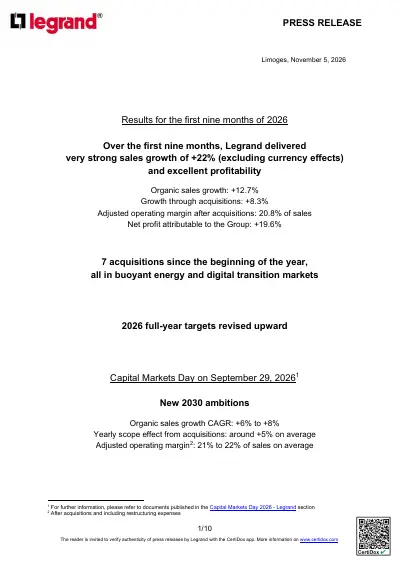
First, Legrand delivered very strong sales growth of +22% excluding currency effects, together with excellent profitability. Second, we continued to actively execute our development strategy, with seven acquisitions announced since the beginning of the year, all in buoyant energy and digital transition markets.
Third, we are revising our FY 2026 targets upward. Last, a short reminder of our new, highly value-creating 2030 ambitions.
Moving to pages 6 and 7, I will start with an overview of sales. Sales reached €8.3 billion in the first nine months of 2026, up 22.1% excluding currency effects.
This performance comprises organic growth of +12.7%, driven by data centers at close to +40%, as well as energy transition solutions, and growth from acquisitions with a positive scope effect of +8.3%. Based on acquisitions announced and their likely dates of consolidation, the overall impact of acquisitions would be around +8% for the full year.
The exchange rate effect was -2.1% over the first nine months. Based on average exchange rates in October 2026, the full-year effect would be around -1% in 2026.
On page 7, you will find the key takeaways by geography on a like-for-like basis. Europe was down 0.9% over nine months and grew +2.4% in the third quarter in a building market that remains mixed.
North and Central America increased sharply by +26.6%, driven by strong momentum in data center offerings and energy transition solutions in the US. Rest of the world grew by +8.4% in the first nine months, with significant growth in India, Australia, and many other Asian countries, while activity in China remained soft.
Sales in Africa and the Middle East grew despite the geopolitical context. These were the main comments I wanted to make on sales.
I will now hand over to Franck for more color on our financial performance.
Franck Lemery
Thank you, Benoît, and good morning, everyone. I will start on page 8 with adjusted operating profit and margin.
Profitability is excellent over the nine first months of 2026, with an adjusted operating margin of 20.8%. The profitability remained high despite continued cost inflation, and this reflects our strong execution, including disciplined pricing, solid productivity, and the contribution from recent acquisitions.
It's a solid performance, with adjusted operating profit growing +20% in value. Going now to page 9 and value creation.
First, the net profit attributable to the group reached €1.1 billion at 12.8%, up 29.6% versus 2025. This increase was primarily driven by higher operating profit, a corporate income tax of 27.5%, and an unfavorable change in financial result.
Second, free cash flow increased by 15.9% to €1 billion, representing 12.1% of sales. That's it for the key financial topics.
I will now hand back to Benoît.
Benoît Coquart
Thank you, Franck. Let me now cover two key aspects of our strategic road map: sustain acquisition momentum and our new 2030 ambitions.
First, acquisitions on page 11. Since the beginning of 2026, we have announced seven acquisitions, all focused on energy and digital transition markets: two in the US, two in Europe, and three in the rest of the world, in Brazil, Malaysia, and China.
Together, the acquisitions represent approximately €450 million in annual sales and further strengthen the group's leadership positions in attractive growth markets. Second, our new 2030 ambitions on page 13.
At our Capital Market Day on September 29, we detailed our strategic road map structured around three focus areas: data centers, energy transition directly driven by electrification, and essential infrastructures for buildings. For the 2027-2030 period, our ambitions include organic sales growth of +6% to +8% CAGR, combined with an average yearly scope effect from acquisitions of around +5%; an adjusted operating margin of 21% to 22% of sales on average, after acquisitions and including restructuring expenses; and, of course, solid free cash flow generation and disciplined capital allocation.
We can now move to page 15 with our full-year 2026 targets revised upward. Taking into account Legrand performance over the first nine months and the current global macroeconomic environment, Legrand is now targeting the following in 2026: sales growth excluding currency effects of between +20% and +22%, comprising organic growth of between +11% and +13%, versus +8% and +10% previously, and growth through acquisitions of around +8%, unchanged; adjusted operating margin after acquisitions of between 20.5% and 21% of sales, unchanged; and a CSR achievement rate of at least 100% for the second year of its 2025-2027 road map.
In conclusion, the first nine months highlight the strength of our business model and the acceleration of our momentum: very strong growth, excellent profitability, sustained value creation, and disciplined execution of our strategic road map. Our new 2030 ambitions provide a clear framework to accelerate further value creation, supported by structurally attractive markets and Legrand unique growth engines.
This concludes our presentation, and we are now ready to take your questions.
Operator
Thank you. To ask a question, you will need to press *1 and 1 on your telephone and wait for your name to be announced.
To withdraw your question, please press *1 and 1 again. We kindly request that participants limit themselves to one question and one follow-up, so that as many attendees as possible have the opportunity to ask questions.
Thank you. We are now going to start with our first question.
Just one moment. This question comes from Daniela Costa from Goldman Sachs.
Please go ahead.
Daniela Costa
Hi. Good morning.
Thank you for taking my question. I'll take the one and the follow-up, but I will start out with a question regarding, can you talk a little bit about Europe?
Obviously, you moved from negative growth to Q2 positive growth now. Exactly what drove that?
How did France do, given the situation there? Was there any data center pickup in Europe contributing to that?
Benoît Coquart
Hello, Daniela. There was nothing exceptional happening in Europe.
Yes, Q3 is slightly better than H1 in terms of growth. Data center is doing okay.
I think what really matter is a nine-month trend, which remains somehow a bit muted. I can confirm that there is no rebound happening so far in the building market in Europe, which remains pretty flattish, and our performance is okay in this context thanks to data center and to some extent also to energy transition.
As far as France specifically is concerned, it's amongst the European markets which are not helping us. Our sales are clearly down in France for the first nine months, and we expect in the quarters to come, the situation remains quite complicated.
I would not qualify the Q3 as a rebound in Europe. The market remained pretty flattish, and in this context, we are doing okay: slightly negative in H1, slightly positive in Q3, and we hold firmly our market share, but unfortunately, the market are not really helping us yet.
Daniela Costa
Thank you. Then just on the follow-up regarding, I guess, the margin.
Given you were so much higher than expectations, and guidance in terms of the organic growth in Q3 would have thought that you'd get a bit more operating leverage. Can you talk through about what was pricing?
Was there any dilution on the mix from data centers or from anything else? Yeah.
Benoît Coquart
I'll say a few words on pricing, and then I will let Franck zoom on the margin topics. As far as the nine months are concerned, prices are up by 3%, 3.1% to be precise, selling price.
Purchase price are also slightly up, by a little bit more than 3% for the first nine months, up 3.3%. Yes, we are doing a bit of pricing.
We are very cautious in not doing too much pricing, huh? It has been a deliberate strategy for quite some time now to do a bit of pricing to, of course, offset as much as possible the increase in price of raw mats and components, but making sure that we remain competitive.
I can maybe give you already the sort of high-level guidance for pricing for 2026, and I will then let Franck zoom a bit on the margin topic. For the full year, we expect selling price to be again more than +3%, we'd be 3.2, 3.4, 3.5, we'll see.
We'll do what it take. As far as purchase price, same, we expect the purchase price for the full year to be above +3% and probably a little bit more than selling price.
That's what we expect to see in terms of selling and purchase price. Now, Franck, maybe you can take the lead on the margin question?
Franck Lemery
Yes, of course. I assume, Daniela, that your question is on the group margin, not the European one, which I will be happy to comment if needed.
For the group, as I said first, let's look at the value creation. Operating profit is growing 20%.
Then margin-wise on the nine months, it's a strong margin, huh, and totally in line with our full-year guidance. The main building blocks are about, of course, two things: some operational leverage and good performance of the acquisition.
Let's look at the results excluding acquisition. On a year-to-date basis, margin is improving 20 bps, with some pressure on gross margin, -50 bps, with pricing covering largely in value the raw material inflation, but not fully in margin, and a strong leverage on SG&A.
This comes also with a very strong cost control. Globally speaking, on eight on a nine-month, the costs are growing 8%, head counts in SG&A is -1% on a like-for-like basis.
That's the building blocks of the nine months. If we look at Q3 alone, it's a little bit the same story, but with obviously much more leverage coming from the SG&A, and accordingly, excluding acquisition, adjusted operating margin growing 100 bps.
Daniela Costa
Sorry, Benoît, the number was 3.2 to 3.5, right, not 2.2 to 2.5?
Franck Lemery
Yeah,
Daniela Costa
3.2, of course, yeah. Yeah.
Okay. Thank you.
Franck Lemery
Which says, Daniela, by the way, that you got from my answer and the answer of Benoît, what could be the inflation balance on Q4 the year to go.
Daniela Costa
Got it. Thank you very much.
Operator
Thank you. We are now going to take the next question.
This one is from Alasdair Leslie from Bernstein. Please go ahead.
Alasdair Leslie
Oh, yeah. Good morning, everyone.
Obviously it seems like a strong acceleration in data centers again in the quarter. I was just wondering if you could comment on what kind of impact you had from perhaps just a more favorable comp, given last year I think we did have a bit of a slowdown in DC growth in Q3.
How much of this is just a kind of sort of genuine, underlying acceleration in your opinion in data centers? I was wondering if you could follow on from that, when you look at your different segments, critical power, computing infrastructure, cooling, testing, are you seeing any of those start to sort of significantly outperform, any additional color on those segments at all?
Thank you.
Benoît Coquart
Yeah. Maybe starting with the numbers.
As I said, data center over nine months are growing organically by close to +40%, which means that Q3 was indeed a very strong quarter. Q3 grew close to 50%, huh?
It's about, let's say, slightly more than 30% in H1, close to 50% in Q3, and close to 40% in nine months. Very, very solid quarter.
What are our expectations for the full year? We think now that the data center business should grow in 2026 full year somewhere between +35% and +40%, which means that we don't expect another quarter at +50%, but it will remain a very, very, very solid growth, and we are again upgrading our guidance for data center growth.
Full year, it should be between +35 to +40%. It implies that indeed not all quarters will be growing 50%.
Now, was there anything exceptional in Q3? The answer is no.
It's a mix of a number of very interesting projects, couple of new customers that we onboarded, old customers that orders a little bit more. Very, very solid quarter, but again, we don't believe that we're going to grow 50% every single quarter.
Are we seeing any sign of the demand weakening? The answer is clearly no, we are not.
We are very confident in the fact that our data center will continue to grow. We have orders coming in, a lot of very strong book-to-bill, very strong bookings, and it will definitely continue.
In terms of product families, well, it's the usual suspects. All families are growing nicely, and probably almost all families are growing double-digit, huh?
When you are growing close to +40%, you don't have a significant product family which is down or only growing single-digit. If I had to name three product families which are growing very fast, I would definitely name critical power, which is doing very well; cooling, which is also doing very well; and testing and commissioning, and especially the Astrone load bank business, which is also doing very, very well.
Again, all product families show very nice and satisfactory growth.
Alasdair Leslie
Fantastic. Maybe if I could just follow on that, cuz obviously we also saw very strong growth in the rest of the world region, 25% growth in APAC.
I think that's quite a strong quarter-on-quarter acceleration, I think high single digits last quarter. I guess that's not driven by comps, just looking at prior quarters, and it does look very broad-based, Benoît, maybe with the exception of China.
I guess is this largely data centers again, and is the growth kind of in that kind of APAC segment comparable to the kind of 50% that you called out for the group?
Benoît Coquart
I'm always a bit cautious in commenting quarterly trends, and it's a bit the answer I was doing to Daniela on Europe. Yes, it's a very solid quarter.
It's not coming specifically from data centers. Data centers are doing well in the rest of the world, but you also have the traditional essential business and the energy transition piece which are growing nicely, with countries such as India which are doing a fantastic performance, a lot of countries in Southeast Asia also growing nicely.
It's not solely data center. It's also energy transition and essentials.
Now, again, it's only a quarter. I think that what is most relevant is to look at the growth over nine months, which is quite solid, huh?
+8% over nine months, it's a solid performance. Going forward, again, we'll see.
Now, coming back to your question on comps, I don't believe that there's been anything helping the group when it comes to comps, neither in the data center business, nor in the traditional business, and neither in rest of the world, nor in North America and Europe. The performance over the first nine months of the year and in Q3 it does not include any technical factors like basis for comparison, like number of days, like big one-off in terms of projects.
This is a real, solid, let's say, performance.
Alasdair Leslie
Very clear. Thank you.
Operator
Thank you. We are not going to take the next question.
This one is from Phil Buller from JP Morgan. Please go ahead.
Phil Buller
Good morning, gentlemen. Thanks for the presentation and the questions.
I guess I've got two follow-ups. Firstly, just on that Asia-Pacific topic, if that wasn't data centers, are there any one-offs in there that we should bear in mind as we think to Q4?
Or really is the data center growth accretive to the 50% number that you mentioned at a group level? Or is your dollar per megawatt in the region different to the group average?
I just want to understand a bit better what's driving that growth if it's not data center. That's the first question.
Benoît Coquart
Indeed, it's not solely data center. If you take a country like India, for example, well, data center in India represent probably something like 10% for Indian sales.
It's not like in the US where it's about 50%. It's only 10%, and even if it's only 10%, India growth was a very solid double-digit performance.
In India, for example, all three businesses are growing: energy transition, essentials, and data center, at a very solid pace. Now, we couldn't identify anything exceptional, like, for example, one-off inventory building from our distributors, or, again, a big project, or a big number of days.
Again, I'm a bit cautious. A quarter doesn't make a trend.
At Legrand at least, we tend to analyze our performance on a yearly basis, not on a quarterly basis. To answer your question, there was nothing exceptional in the Q3 performance in Asia-Pacific or elsewhere.
Phil Buller
That's great to hear. Thank you.
Then a follow-up on the margin topic, specifically in Europe. In Q2, that was a point to pick on, I think, and I think most of us were surprised in Q2 to see some of the costs associated with North American growth allocated to Europe.
I know that's how you run the business, but the margin in Europe has improved significantly in Q3 on volumes which I assume are flattish. Is it as simple as you have chosen to allocate the SG&A and R&D costs slightly differently?
Is it as simple as that, or is there anything else going on here that's led to that jump in the European margins, please? Thanks.
Benoît Coquart
Let me be extremely clear on that one: no, we haven't changed any allocation. It's not the Legrand style to change the allocation of expenses or to do this kind of stuff between two quarters to optically improve the results in that or the other.
The key answer to that is we haven't changed anything in terms of allocation. Then specifically on European margin, I will let Franck answer.
Franck Lemery
Yes, hello. I will answer by making two points.
The first one is looking at the European profitability, and it's true for the quarter, it's true for the year to date. The gross margin is good.
Gross margin is well on hand. It's growing 10 bps versus last year on a year to date.
It's even increasingly more on a quarterly to date, huh, above 110 bps versus last year. Good margin is very good.
The question of the last call was about SG&A, with a confusion of the global SG&A evolution versus what was linked to the business. I will perhaps recap the number now at the end of the nine months.
We have SG&A growing on a like-for-like basis, because this is what is mattering, by 6%, when sales by origin are growing 2%. On the quarter, SG&A are growing 4%, sales 4%.
It's also a little bit what I said at the beginning commenting the margin: strong execution, a very good cost control, and SG&A growing faster than the top line in Europe is okay. It's growing 6% considering that Europe is also investing for the group, that the group is growing at 13% on a like-for-like basis, it's totally okay.
Definitely absolutely no change in methodology.
Phil Buller
Thank you very much.
Benoît Coquart
I could turn it differently, more qualitative comments, if I may say: our European margin was not a concern in H1, and it's not a relief in Q3, huh? It is exactly where we expected to be, actually, to be clear,
Phil Buller
huh? That's great.
Thanks for the clarification.
Operator
Thank you. We are now taking the next question.
This one comes from Max Yates from Morgan Stanley. Please go ahead.
Max Yates
Hi. Good morning.
Just my first question would be around your data center capacity. I guess if we look at sort of data center additions into next year, it would look like the gigawatts added will be growing, somewhere around 50%.
I guess my question is, given the likelihood that your data center business could grow, very rapidly again, I would think potentially similar to what we see this year, do you actually have the capacity to keep growing the business at that rate, or are you at the point where you may be running into capacity constraints?
Benoît Coquart
Two points, Max. This year, we expect the data center business to grow between 35% to 40%.
Last year, it grew close to 40%, it means that in two years, organically, our data center business will have more or less doubled. You could see that we've been able to increase to cope with this growth.
It did not come without challenges, to make things clear, but I confirm that we could do capacity increase without incurring a lot of capex, and so we could do it. If we need to add further capacity in the years to come, we would have the ability to add further capacity.
Again, it doesn't come without challenges. It has a cost.
It is complicated. It requires a lot of expertise and professionalism from our team, but we could do it, and we will be able to do it if needed.
Now, going forward, to make things clear, we don't expect the data center market to grow 40% every year, huh, and to double every two years. I remind you the guidance we gave at our last CMD, our assumption, or our midterm ambitions, are based on a data center market growing more or less 15% to 20% from 2027 to 2030.
I think it is a more reasonable assumption than every year growing 40%. To make a long story short, we will certainly have the ability to increase our capacity further if needed.
Our data center business is asset-light, and we have demonstrated our ability to do it in order to cope with the demand coming from our customers.
Max Yates
Okay. Just as maybe a bit more strategic kind of follow-up question.
Obviously, yesterday, the US election or Democrat kind of result, but even before then, we were starting to see a few more kind of stresses around data centers, whether it was kind of cost of financing, etc. Just as that relates to your M&A, it's obviously been somewhat skewed towards data center in recent years.
I was just wondering, given the events of maybe not just yesterday, but the last three months, is there any way to think proportionally how that 5% of sales that you're targeting every year from M&A may balance between data center and non-data center, and would it be reasonable to expect that maybe the sort of data-center-heavy M&A is a bit less than what we've maybe seen in the last sort of two, three years?
Benoît Coquart
Yeah. Couple of comments on this very interesting question.
Number one, the fact that you may have additional regulation here and there, that access to energy is sometimes complicated, permitting takes a long time, all of that is fully embedded in our midterm ambitions. I remind you the numbers: if we put together the announced gigawatt, there should be additional capacity of more than 300 gigawatt to be added, huh, throughout 2030, 300.
We have discounted that down to 100, we took only 1/3 of the announced capacity in our plan, turning the 300 into 100, and this 100 gigawatt capacity is enough for the market to grow 15% to 20% per year. In other words, we have already embedded into our ambitions the fact that there will be some regulation, there will be energy access issues, and so on and so forth.
I could even do one more comment: is regulation a problem for the business? The answer is no.
If the fact that there is in some communities a pushback leads to regulation implying, for example, a sort of bring your energy concept, it's good for Legrand, huh? I remind you that we have offsite energy generation capability with one of the business we bought in the US.
If it requires PUE, power usage effectiveness, or to be very low, or water usage effectiveness to be very low, it's good for Legrand. I remind you that 40% of our data center business is made with products that help saving energy.
If, in order to save contracting manpower, the market goes toward more container, skid, factory-assembled products, it's good for Legrand because we have bought some of those capabilities. Again, the fact that you have in some communities a bit of pushback and some regulations being implemented is almost a good news for data center business, not a bad news.
Now, when it comes to acquisitions specifically, yes, indeed, we have done a lot of data center acquisitions. As we showed in September, late September, a lot of the acquisitions we made recently, the last two years, were doing data center, but also energy transition, almost half-half.
Going forward, it will really depend on the opportunity. We may continue to do a number of data-center-related acquisitions because we still have a number of geographies where we are underrepresented and a few product families we would love to add, but you should expect to see also energy-transition-related acquisitions because we believe that it's a very strong and long-lasting megatrend, and there are many product families and geographies in which we are not yet represented, and you could also expect to see traditional essential type of acquisitions.
I know that it's not a very precise answer, but it will really depend on the opportunities. It's highly likely that you'll see probably a little bit more of energy-transition-related acquisitions than in the past couple of years.
Max Yates
That's helpful. Thanks, Benoît.
Operator
Thank you. We are now going to take the next question.
This one comes from Delphine Brault from ODDO BHF. Please go ahead.
Delphine Brault
Yes. Good morning, gentlemen.
Thanks for taking my questions. I have two.
We'll go one at a time. First, your new full-year guidance implies a Q4 organic sales growth around 10% at midpoint.
What would trigger such deceleration as compared to the close to 19% reached in Q3? Is it just the kind of traditional cautiousness, or is there something else?
Benoît Coquart
Bonjour, Delphine. Yes, you're right.
If you look at midpoint of our guidance, it implies a Q4 at +10%, which is very consistent with the H1 we did at +10%. Our scenario is that Q3 saw a sort of surge in sales, but which is not sustainable, and we don't expect to do again +19% like-for-like evolution every single quarter.
The sort of sustainable, recurring kind of growth we are experiencing is closer to 10%. We would have made +10% in H1, +10% in Q4 if we are at the midpoint, and then a sort of very strong, exceptional quarter Q3 at +19%.
This is the main scenario. I'm not sure that we can really say that it is a legendary conservatism of Legrand.
We are not the only one which are upgrading our guidance. The whole industry, I think, during the year 2026 has been somehow a bit surprised by the magnitude of the growth in some geographies and in some verticals.
No, we have issued this guidance based on what we think we should deliver, and again, the Q4 is very consistent with H1.
Delphine Brault
Thank you. The second one, how big is your data center backlog now, and how much visibility does it give you for 2027?
Benoît Coquart
We have a large backlog which we don't comment much, and Delphine, our approach, huh? The connection between backlog and actual sales is always a complicated topic.
I can only repeat what I said a little bit earlier in this call. There's a very active level of activity.
We have a lot of orders coming. We are confident for the next couple of quarters.
We will certainly see growth coming. Now, we'll give you a more precise guidance for 2027 at the time of the release of our for '26 results in February.
Delphine Brault
Thank you.
Benoît Coquart
Good try.
Operator
Thank you. We are now going to take the next question.
This question is from Martin Wilkie from Citi. Please go ahead.
Martin Wilkie
Hi, yeah. Good morning.
It's Martin from Citi. Just to continue on the data center theme, and obviously lots of market debates about this spending.
When you look at your customer base in data center, has that meaningfully changed over the last year or so? Obviously historically the hyperscalers were clear majority of industry spending, and there has been some broadening of that spend.
Just in terms of your exposure, have you seen a sort of broadening of your customer mix, either in your current sales or in your backlog, just to understand sort of how we should think about your customer base? Thank you.
Benoît Coquart
Of course, you have some customers that are growing faster than others, and sometimes you lose customers, and sometimes you gain customers. In terms of profile, I'm not aware of a very significant change in the last one or two years.
The hyperscalers definitely represent a large part of the market. Not all of them are buying direct from Legrand.
A number of them are renting space through colocators. It's likely that our sales more or less replicate the market, with basically two big type of customers: hyperscalers and colocators, either retail or wholesale colocators.
I don't see any reason why we would have a breakdown of our sales much different from how the market is organized. Now, if you zoom on a specific category which has attracted a bit of media attention, the neo-clouds, some of them are very nice customers, and we are very happy to have them as customers, but in total, neo-clouds represent approximately 1% of our total group sales, huh?
It's not a very meaningful exposure. To answer your question, no significant change in terms of customer weighting between hyperscalers, neo-clouds, retail colo, wholesale colo, enterprise, that I'm aware of in the last 12 months.
Martin Wilkie
Great. That's really helpful.
Then just a second question more broadly. You've mentioned a couple times that the energy transition has been a driver of growth as well.
When we think about the sort of underlying drivers of that, in some areas it can be regulation, in other areas it's just simply, commercial buildings customers or energy-saving reasons making those investments. What's triggered the sudden improvement in energy transition?
Benoît Coquart
Maybe starting with a number. I said that in the first nine months of the year, the data center business was up close to 40%, while energy transition is up mid-single-digit, and essentials is just slightly up.
You see that energy transition, it's not growing as fast as data centers, of course, but it has been consistently overperforming the essential part of the business for quite some time. It really depends on the geographies, but it's less and less regulation and more and more the private market prompting sales.
Take Europe, for example. There's now a good level of understanding that we need to electrify more, and I remind you the number that we showed at the last CMD: there's an official Electrify EU plan which is stating that the share of electricity in Europe energy mix should move from 23% in 2025 to 46% in 2040.
It's not prompted by regulation. It's really acknowledging the fact that people understand now that electrical vehicles and heat pumps and electrical press in factories make households and industries less dependent upon the fossil imports and hence the price of gas and oil.
Look at the percentage of sales in Europe which are of vehicles which are electric vehicles. In Europe, it's really the dependency upon fossil fuel and gas which is pushing people to electrify their vehicle, electrify the heating system, electrify industries, blah, blah, blah.
Of course, we're not selling much EV charging station, and we're not selling heat pumps at all, but every time you move from a gas-powered product or oil-powered product or device to an electric one, it's likely that you will install a circuit breaker, a load-shedding device, a panelboard, a measuring device, blah, blah, blah. This was for Europe.
As far as the US is concerned, it's really the very low quality of the US grid which provides us with opportunities. The wind and solar business in the US have been growing nicely, not because it is pushed by a lot of incentives, but because we need in the US to have more reliable, better grid.
Too much interruptions per year are damaging or negatively impacting businesses and households. Imports from fossil fuel in getting away from fossil fuel in Europe and in China and a few countries, and enhancing the quality of the grid in the US are very strong, long-term drivers that should support our energy transition business not in the next two or three years, but in the next 15 or 20 years.
We are very confident that this business should overperform the essential business. It's already meaningful: it's already about 20% of our sales.
Martin Wilkie
Great. Thank you very much.
Operator
Thank you. We are now going to take the next question.
This one comes from Lucas Ferhani from Jefferies. Please go ahead.
Lucas Ferhani
Good morning. Thanks for the time.
I have one and a follow-up as well, maybe we do it one at a time. The first one is just on your road map on new architectures.
See you highlighted that at the CMD, just wondering how you're executing on kind of those product launches you talked about, and whether there's any already kind of discussion, testing with customers that is happening. Thank you.
Benoît Coquart
The CMD is a month and a half old, huh? In terms of product development, you don't have news every single week.
It's as per the plan, no change in the launching dates of our new products, being AI load stabilizer or the other products. Everything is on plan.
Yes, we start to have some discussions with our customers, and which are quite early discussions, because everybody is thinking about what the next architecture should be, and those discussions have been going on even before the topic of direct current. Not much news yet.
Again, huh, it's only a month and a half old, and we have not seen out on the market anything since our CMD that would indicate that we're not doing the right direction. I confirm that our technical choices are the right ones.
Lucas Ferhani
Perfect. Thank you.
Then the follow-up is just on your ability to test a little bit the backlog and the projects you're working on, specifically on data center in the US, and to follow up really on the changes in election and what's happening on permitting, how far can you go in kind of testing what's happening at customer level, the level of permits they have, and the, let's say, reliability you have that those projects will be coming through? Thank you.
Benoît Coquart
It's difficult to answer this question. Our backlog is short-term backlog.
We don't have a lot of orders that we should deliver in '29 or 2030. It has always been the case, huh?
It's not a change recently. Our backlog is 12 to 18 months max.
Those are projects that are already well-advanced and already in execution phase, right? They can always be pushed, canceled, and so on and so forth.
Those are not projects that should come out of the blue in 2029 or 2030. Now, as far as the potential impact of the last US elections on our business is concerned, I just refer to my previous answer.
Again, it's already included in our midterm guidance, the fact that here and there, you could have some more regulation to be implemented, or requests for lower power usage effectiveness, or requests for customers to bring their own energy in order to All that has been fully included into our midterm ambitions.
Lucas Ferhani
Perfect. All clear.
Thanks.
Operator
Thank you. We are now going to take the next question.
This one is from Ben Uglow from Oxcap Analytics. Please go ahead.
Ben Uglow
Good morning, everyone. I hope all are well.
My question is about the M&A pipeline as we move into 2027. My kind of impression from the outside, which may be right or wrong, is that there are kind of more assets available than let's say that we've seen recently, and obviously last week we had Eaton coming in to take out the cold power distribution business in Italy, which was quite sizable.
When I look at your acquisitions so far this year, they're typically what we would call smaller, i.e., I think the average sales is something like €70 million. I guess my question is, number one, would you consider doing somewhat larger transactions as we move into 2027?
I guess, secondly, how are you feeling about the valuations of the assets that are on the block at the moment? Thank you.
Benoît Coquart
Yeah. Hello, Ben.
The answer to your first question is clearly yes. Almost the bigger, the better, huh?
For us, it's the same amount of work in terms of deal-making and docking whether a company is €50 million or the company is €500 million, and it's sometimes even easier to dock a €500 million company because you quite usually have the processes and so on and so forth. We are very open to bigger deals, provided, of course, they meet our criteria.
Both the strategic and the financial criteria, they have to be, for example, value-accretive within two, three, four years. We need to see ROCE higher than the WACC on year two, three, four, and not on year 10.
This is a very, very important criteria. We also want to make sure that the company we buy fits well into our portfolio of products.
We are not desperate to make deals. We really want to do the right picks.
The answer is clearly yes, we are open to larger deals, provided they meet our strategic and financial criteria, having in mind that in the 400 companies that are part of our pipeline, you have a lot more small deals than big deals. Statistically speaking, you're more likely to see small than big, but we're open to bigger ones.
As far as the pipeline itself is concerned, it remains very solid. We haven't seen anything specific in terms of pricing of the acquisitions.
We will have bought the 2026 We would have done the 2026 deals at approximately 11 times EBIT, 2026 EBIT, it's likely to be 10 times 2027 EBIT. Well, 11 times 2026 EBIT before synergy, I think it's a pretty reasonable multiple.
Sometimes we have to pay 13, 14, 15 times EBIT, huh, of the current year. It's not out of question if we feel that the company deserves it.
Sometimes we pay 7, 8, or 9. It really depends on the quality of the target and its business plan.
No significant change in terms of pricing. We are still able to make good deals at reasonable multiples, to dock them properly within Legrand, and to have a nice 8, 9, or 10% ROCE within a very short period of time.
Ben Uglow
That's understood and helpful. Thank you.
Then one follow-up. I know that you've sort of answered the question in terms of your targets and your guidance, etc.
Obviously, the markets are asking this question. In terms of your customer conversations on the data center side in the run-up to the midterms—and, obviously, people have been aware that this was going to come for some time—did any of your customers express a different view or a change of sentiment, or that plans may go from A to B based on this?
Or was it just accepted that there would be a Democratic clean sweep as it was, and this was always understood by your customers?
Benoît Coquart
I personally did not have discussions with customers for the past two days. I've been really focusing on other topics.
Based on the feedback I've got from my US teams, we have not seen any change in the conversation, and the fact that the data center market would come down to more reasonable growth rate, if I may say, has been in the air for quite some time, and it has been clear from a customer standpoint. Now, if you look at the capex investments which has been announced by the big guys, it's interesting to look at the numbers, huh?
When they entered the year, if you take the five big guys, like the Meta, Microsoft, Google, Oracle, Amazon, they started the year saying, "We're going to spend $500 billion of capex investments." Now, by understanding, they will rather spend 800, closer to 800, and most of them have announced further capex increase in 2027.
We'll see, but I don't have the feeling that they are slowing down. Now, again, those data center, but I think they knew it already and we knew it already, we need to be more efficient, less water-consuming, we need to pull less energy from the grid, and we'll need to provide their own energy, and so on and so forth.
I think it was already in everybody's plan. To make a long story short, I'm not aware of any change, neither in the capex plans of our customers, nor in the conversations we have or that our US teams have had with our customers lately.
Ben Uglow
That's great. Thank you, Benoît.
Operator
Thank you. We are now going to take the next question.
This one is from Aron Ceccarelli from Bank of America. Please go ahead.
Aron Ceccarelli
Hello. Good morning.
Thanks for taking my questions. I have two, please.
The first on North America gross margins. North America organic growth accelerated to about 30% in Q3, but gross margin declined 180 bps year-over-year after being broadly flat in Q2.
What changed sequentially in Q3, and how much of the dilution effects reflects data center mix versus acquisitions?
Franck Lemery
Yes, hello. Talking on the gross margin, on the first, starting from a year-to-date perspective, gross margin, you're right to say for North and Central America is down -180 bps.
Half is mix, half is acquisition. The part of the mix, obviously, is definitely recovered on SG&A, there is no bottom-line impact.
When we speak about Q4, we are speaking a Q3, sorry, more or less the same impact. Now, perhaps to echo your question, to rebound on your question on the margin, I'm personally much more looking at the value creation of the US than the margin, huh?
Operating profit of the US on Q3 is growing 46%. On a year to date, 42%.
Value-wise, very, very happy of that strong value creation, and with some mix challenges on the gross margin, but which is broadly recovered on the adjusted EBIT margin.
Benoît Coquart
As far as the mix is concerned, we remind you that the data center business has a level of gross margin which is below group's average, and a level of SG&A which is below group's average, and an EBIT margin which is more or less the group's average. Given the size of the data center business in the US and the impact it has on the US growth, this kind of mix phenomenon can play.
Now, when it comes to our performance and profitability performance in the US, we are very happy with what is happening. All the more as, don't forget that when you have this kind of hypergrowth—and we can qualify the US growth as hypergrowth, unprecedented hypergrowth for Legrand—it also comes with some cost, and we have to admit it.
It comes with inefficiencies, it comes with capacity increase you have to manage, additional subcontracting, sometimes delivering by plane what you should have delivered by truck because you want to make sure that your customer is satisfied. Again, this being said, in terms of value creation, rebounding or confirming what Franck said, +46% EBIT growth in North and Central America in Q3 is a fantastic performance, huh?
With a margin, 22% adjusted EBIT margin, I understand your point, but it's a fantastic performance.
Aron Ceccarelli
That's very clear. Thank you.
The second question, I would like to go back to rest of the world organic growth, which was particularly strong at 19.6%. Perhaps is that sort of lumpiness going to volatility, let's say, continue to appear in the coming quarters, and Q3 was a representative or underlying demand, or should we think that some of the strength was coming from, let's say, project timing between quarters?
How should we think about that, please?
Benoît Coquart
Again, I'm a bit uncomfortable in drawing big conclusions out of one quarter, huh? One quarter could be up 5%, another one could be up 20%.
It's a bit the same comment I made for the full group. Q3 was very strong in rest of the world.
It was a bit lighter, even though it was good, in H1. We'll see for Q4.
I wouldn't take for granted that every single quarter or next quarter, rest of the world business would grow 20%. Again, a quarter is not a trend, and a quarter is not a full year.
We'll see, huh? Sorry not to be more precise than that, but again, it's always complicated to comment only one quarter.
Aron Ceccarelli
Understood. Thank you very much, guys.
Thank you.
Benoît Coquart
Thank you.
Operator
Thank you. We are now going to take the last question.
This one comes from Gaël de-Bray from Deutsche Bank. Please go ahead.
Oh,
Gaël de Bray
thanks very much. Good morning, everybody.
The first question I have is related to the US dynamics. One of your peers recently highlighted that they're seeing demand broadening much beyond data centers, in commercial, in industrial buildings now, and it seems that you're seeing the same dynamics.
Could you provide an update on your strategy to diversify away from offices, from shopping malls into more technical buildings in the US? Thank you.
Benoît Coquart
Yeah. Two comments.
The building business, very traditional business, remains the market, if I may say, remains not very positive in the US. Resi, for example, is going down in 2026, even though we are overperforming.
It is true that the energy transition piece is doing very well in the US over nine months. It's not linked to data center, because the data center piece is accounted in a separate, let's say, bracket for Legrand.
It's everything which is linked to reshoring, semiconductors, industrial facilities, infra, all that is growing very, very nicely. We are more and more exposed to that thanks to the many acquisitions we've done in the US: the Gerhardt's, the Astrone, the Clatos of the world.
Yes, I can confirm that even though the traditional building market is still very so-so, there are pockets of growth elsewhere that we are now able to capture and that we couldn't capture two years back because we did not have the right assets for that. This is typically an area where we'll continue to look at opportunities, both organically and inorganically.
Gaël de Bray
Thank you. The second one very quickly: is there any update on the divestment program that you mentioned at the CMD?
Benoît Coquart
No update yet. To remind everybody, we said that the CMD that we would divest businesses representing between €0.5 billion and €1 billion of sales.
We have a bit of time, Gaël, because those divestments were announced over the duration of the plan, huh? Throughout 2030.
No update to share.
Gaël de Bray
Okay. Thank you very much.
Benoît Coquart
I can only confirm the rationale behind that, huh? The objective is not to sell business for the sake of selling business, but it's to accelerate the repositioning toward faster-growing energy and digital transition.
We intend to sell, let's say, traditional businesses, essential businesses, and to continue to invest heavily into energy and digital transition businesses. If I may add, same comment that I was saying a bit earlier: that we're not desperate to buy, we're not desperate to sell, huh?
We are waiting for the right buyers.
Gaël de Bray
Understood. Thank you very much.
Operator
Thank you. That is all the time that we have for questions for today.
I will now hand the call back to Mr. Coquart for closing remarks.
Benoît Coquart
Thank you very much, everybody, for connecting. As usual, the whole team, including Franck, Ronan, Delphine, and myself, are at your disposal for any further clarification, if needed.
Thanks a lot.
Operator
Thank you. This concludes today's conference call.
Thank you for participating. You may now disconnect.