Lennox International, Inc.
Q3 FY2026 · Earnings Call TranscriptOctober 28, 2026
Operator
Welcome to the Lennox 2026 third-quarter earnings call. All lines are in a listen-only mode, and there will be a question-and-answer session at the end of the presentation.
You may enter the queue to ask a question by pressing *1 on your phone. To exit the queue, press *2.
As a reminder, this call is being recorded. I will now turn the call over to Chelsey Pulcheon from Lennox Investor Relations.
Chelsey, please go ahead.
Chelsey Pulcheon
Thank you, Chloe. Good morning, everyone, and thank you for joining us as we share our 2026 third-quarter results.
Joining me today is CEO Alok Maskara, CFO Michael Quenzer. Each will share their prepared remarks before we move to the Q&A session.
Turning to slide two, a reminder that during today's call, we will be making certain forward-looking statements, which are subject to numerous risks and uncertainties as outlined on this page. We may also refer to certain non-GAAP financial measures that management considers relevant indicators of underlying business performance.
Please refer to our SEC filings available on our investor relations website for additional details, including a reconciliation of GAAP to non-GAAP measures. The earnings release, today's presentation, and the webcast archive link for today's call are available on our investor relations website at investor.lennox.com.
Now please turn to slide three as I turn the call over to our CEO, Alok Maskara.
Alok Maskara
Thank you, Chelsey. Good morning, everyone, and thank you for joining us today.
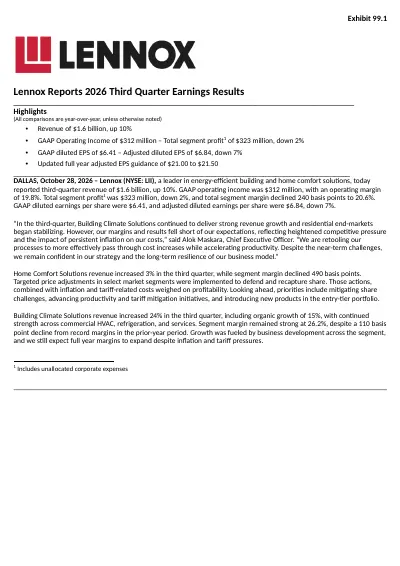
Let me start with our third-quarter results on slide three. Third-quarter revenue grew 10.2% to $1.6 billion, while total segment profit declined approximately 2% to $323 million.
Adjusted earnings per share declined 7% to $6.84. Double-digit revenue growth was driven by continued outperformance in building climate solutions, contributions from acquisition, and improving residential sales volumes.
Profitability, however, fell short of our expectations. In response to the competitive environment, we adopted a more dynamic pricing approach to defend and stabilize our residential market share position.
We are encouraged by the early results from these actions, but the tradeoff was lower price realization at a time when tariff and inflationary pressures continue to increase. Within Home Comfort Solutions, organic sales improved meaningfully from the second quarter, and our share position began to stabilize.
At the same time, underlying demand remains constrained by homeowner affordability, elevated mortgage rates, and broader consumer uncertainty. Building Climate Solutions delivered another quarter of double-digit growth, with revenue up 24%.
Margins remained healthy, although higher tariff and inflationary costs were not fully offset by pricing during the quarter. Given our third-quarter performance and expectations for the remainder of the year, we are reducing our full-year earnings outlook.
Our focus now is not only delivering a strong finish to 2026, but also on retooling the business to target consistent growth and revenue, profit, and EPS in 2027. Now, please turn to slide four.
We have launched a recovery plan focused on regaining share and restoring margins. While the near-term environment has changed, we remain confident in our long-term strategy.
Our recovery plan is centered on four actions, and we are moving with urgency on each of them. First, pricing.
We are rewiring our pricing approach to be more dynamic in current competitive conditions. This means being more responsive and targeted by region and customer segment, particularly where a competitive price gap affects our ability to win or retain business.
The objective is to defend our existing position and recapture share where we have lost it, while remaining disciplined about the economics of our business. Second, productivity.
We are right-sizing the residential business for current market conditions and accelerating productivity across manufacturing, distribution, and SG&A. With the A2L conversion behind us, we are able to dedicate more resources to productivity, which is expected to play a larger role in restoring margins.
Third, portfolio. Affordability has become increasingly important for homeowners, and entry-tier products have gained more relevance in the market.
We are refreshing our entry-tier portfolio with new products, including additional side discharge offerings. More accessible price points will also strengthen our product portfolio for new construction.
We are pleased with the Heat Controller acquisition, and early performance is in line with our expectations. Strategically, it has provided new insights and capabilities in the entry-tier market and broadened the portfolio available to us.
We see additional opportunities across parts and accessories to broaden how we serve our contractors and distributors. Finally, promoters.
As evidenced in our Net Promoter Score insights, we have a strong base of promoters across our traditional residential and commercial contractors, as well as our commercial national accounts. Within residential national accounts, particularly private equity-backed contractor groups and residential new construction, we see an opportunity to deepen relationships and create more promoters.
To capture that opportunity, we are updating our value proposition and expanding our capabilities to better meet the evolving needs of these customers. We also continue to strengthen the relationships that has made us successful across our traditional contractors and commercial national accounts.
These are actions within our control, and execution is already underway. The near-term objective is to stabilize share and improve profitability.
Over time, a stronger portfolio, a more advantageous cost structure, and deeper customer relationships position us to return to consistent growth and margin performance. With that, I'll turn it over to Michael to walk through the third-quarter financial results in more detail.
Michael Quenzer
Thank you, Alok. Good morning, everyone.
Please turn to slide five. Third-quarter revenue increased 10% driven by continued volume growth in commercial equipment and services, along with contributions from M&A.
Recent acquisitions are performing well, delivering approximately $20 million of operating profit accretion in the quarter. That growth helped offset higher tariffs and other costs.
However, competitive pressures limited price realization, and total segment profit declined 2%. Our immediate priority is turning revenue growth into improved profitability.
Alongside the product and pricing actions Alok outlined, we are accelerating cost productivity across manufacturing, distribution, and SG&A, including restructuring where appropriate. Restructuring actions are already underway, with associated charges included in GAAP net income and excluded from adjusted results.
Against that backdrop, let's take a closer look at our segment results, starting with Home Comfort Solutions on slide six. Home Comfort Solutions revenue increased 3% in the third quarter, with organic revenue down 1%, compared with a 9% decline in Q2.
Direct-to-contractor sales declined 6%, improving from a 12% decline in Q2, while two-step organic sales increased 13%, benefiting from last year's industry destocking comparison. Sales trends are improving, though we are not yet seeing a broad recovery in underlying demand.
Acquisitions contributed $39 million in revenue and $6 million in segment profit, performing in line with expectations. Despite improving sales trends, organic segment profit declined $46 million.
Favorable mix and price provided $13 million of benefit; however, tariffs and related inflation, net of cost productivity savings, drove $47 million in cost headwinds. We expected the price increase we introduced in late Q2 to cover more of the cost headwinds, but homeowner affordability pressures, softer demand, and increased competition limited realization.
With current competitive conditions, we are placing greater emphasis on cost productivity across manufacturing, distribution, and SG&A to support margins in the near term and position us for stronger margin expansion as volumes recover. Let's turn to slide seven and review Building Climate Solutions.
Building Climate Solutions revenue increased 24% in the third quarter, including 15% organic growth. Acquisitions contributed 9% to revenue growth and approximately $13 million in segment profit.
Our investments in factories and sales coverage are improving quoting speed and product availability, helping us win more emergency replacement business. We also continue to grow with national accounts through our full lifecycle equipment and service offerings, with new heat pump product offerings further expanding our opportunities.
Together, these capabilities position us for continued growth in both channels over the next several years. Higher sales volumes drove organic segment profit growth, but margins declined as pricing did not fully offset higher tariffs and inflation.
Price increases take longer to implement under large national account contracts, while competitive pressures limited realization with local contractors. We are focused on narrowing the price-cost gap through additional productivity, while we expect continued volume growth will provide further margin leverage.
Let's now turn to slide eight to review cash flow and capital deployment. We generated $395 million of operating cash flow in the third quarter, up $95 million from last year, with trailing 12-month free cash flow conversion reaching 108%.
We continued to reduce inventory, with organic inventory units down more than 15% from last year. Inventory dollars were slightly higher, as acquisitions added approximately $100 million of inventory and inflation further increased inventory costs.
Net debt-to-adjusted EBITDA increased to approximately 1.4 times, reflecting in part the $200 million acquisition of the Comfort-Aire and Century brands completed in Q3. We also repurchased approximately $151 million of shares during the quarter.
Looking ahead, our capital deployment will place greater emphasis on opportunistic share repurchases when our shares trade below our assessment of intrinsic value, while maintaining a disciplined net debt-to-adjusted EBITDA ratio. We continue to expect approximately $225 million in capital expenditures this year to support our entry-tier product launch in early 2027, new contractor training facilities, innovation labs for data center cooling applications, and AI tools to drive growth and productivity.
With that, let's turn to slide nine and discuss our updated financial guidance. As Alok outlined, we are updating our full-year adjusted EPS guidance range to $21 to $21.50.
Lower price realization and an expected tax rate of 21%, compared with 20% in our prior guidance, are the primary drivers of the reduction. Sales trends are improving in HCS, and growth remains strong in BCS.
However, competitive conditions have limited our ability to realize the pricing we expected to offset higher tariffs and inflation. Our updated outlook assumes these pressures continue through the remainder of the year.
We now expect revenue growth of approximately 6%, compared with 8% previously. This primarily reflects a lower contribution from price and mix, which we now expect to deliver low-single-digit growth, compared with mid-single-digit growth in our prior guidance.
Our overall volume outlook is also modestly lower, although we continue to expect a low-single-digit decline. Stronger BCS volumes partially offset lower volume expectations in HCS.
At the segment level, we now expect BCS revenue growth of approximately 23%, up from 20%, while HCS revenue is expected to decline approximately 4%, compared with our prior expectation for 1% growth. Consistent with the lower net income outlook, we reduced flat free cash flow guidance to $700 million to $750 million, from $750 million to $850 million.
We remain focused on reducing inventory and sustaining our progress in cash conversion. Looking ahead, improved residential sales trends and continued growth, supported by our commercial investments, provide opportunities to build momentum.
Entry-level product introductions and cost productivity actions also provide opportunities to improve profitability without relying solely on an end-market recovery. With that, I'll turn the call back to Alok.
Alok Maskara
Thanks, Michael. Before we close, I want to share some early perspective on our 2027 outlook.
Please note that we are not providing 2027 guidance today, but we will discuss several assumptions that are shaping our planning. Starting with price and cost, we expect inflationary pressures to continue, particularly from tariff, components, and commodities.
As we reset the business, the first half of 2027 will be more challenging as we work through year-over-year tariff headwinds. Our pricing approach will be responsive to competitive conditions, while productivity will play an increasingly important role in balancing the price-cost gap.
Successful execution of our recovery plan is expected to drive sales, EBIT, and EPS growth in 2027, with momentum building as the year progresses. Importantly, our plan does not depend on a significant market recovery.
We are planning around muted industry volumes, with resilient replacement demand and continued softness in new construction. Instead, our growth opportunities are largely driven by actions within our control.
In HCS, that means recapturing share, expanding our entry-tier offering, and growing penetration of parts, water heater, and ductless. In BCS, it means continuing the momentum with national accounts, emergency replacement, and services.
The third tier, and the one more directly within our control, is productivity. We have meaningful opportunities for material cost reductions, manufacturing productivity, and further efficiencies across distribution and logistics.
Improved volumes should also provide factory absorption benefits. We will provide our detailed 2027 guidance with our fourth-quarter results, but the actions underway are intended to reset the stage for continuous growth and productivity for 2027 and beyond.
Let me close on slide 11. While we are clearly not satisfied with our profitability this quarter, the short-term challenges we are addressing do not change the long-term value proposition of Lennox.
We operate in attractive markets with significant replacement demand. We have strong brands, differentiated technology, and a direct-to-dealer model that creates close relationship with our customers.
Over the last several years, we've also expanded the business through investments in capacity, innovation, acquisitions, and joint ventures, thus creating additional avenues for growth. The near-term priority is translating those trends into better financial performance.
That means restoring share in residential and improving profitability by closing the gap between price and inflation, while maintaining the momentum we have built in our commercial businesses. We are proud of our talented team and winning culture, and grateful for the loyalty of our customers.
Our long-term strategy remains intact, and we are confident in Lennox's ability to deliver sustainable value, strong margins, and high cash conversion. I truly believe that our best days are still ahead.
Thank you. Michael and I are happy to take your questions now.
Chloe, let's go to Q&A.
Operator
Certainly. If you'd like to ask a question, press *1 on your keypad.
To leave the queue at any time, press *2. Once again, that is *1 to ask a question.
We'll take our first question from Jeffrey Hammond with KeyBanc Capital Markets. Your line is open.
Jeffrey Hammond
Hey, good morning, guys.
Alok Maskara
Hi, Jeff.
Jeffrey Hammond
I'm really just trying to unpack the level of margin degradation in HCS. I understand kind of the more competitive dynamic and kind of the res new construction walk away, but just help me a little bit better understand what else was going on to drive kind of the margin degradation.
Alok Maskara
Sure. Jeff, I think it's pretty simple.
We were expecting to go out with a price increase with a higher realization, and as we talked about doing that towards the tail end of Q2. At the same time, we faced tariff and other inflation, and more so tariffs impact started coming through with the 232 derivative tariffs in Q3.
I just believe there's a short-term mismatch between our pricing realization, which was very low, and inflation and tariff that came through. That's kind of the one and only change since we talked last on why the margins in HCS were lower.
Jeffrey Hammond
The price realization being low is a function of the competitive dynamic?
Alok Maskara
It is a function of competitive dynamics. It's also some pricing fatigue.
We had done so many price increases with the ever-changing tariff environment. At this stage, we are planning to go out with a price increase for 2027, which I think works better for our national accounts, better for our contractors, and we expect that to offset inflation as we work through the year.
We just couldn't stick a mid-year price increase.
Jeffrey Hammond
That's helpful. Then it looks like your inventories are still kind of stubbornly high.
Just wondering where you think you're at in the destock. Do you need to destock more?
Michael Quenzer
Actually our inventory progress, we're making some really good progress. The units are down 15%.
Some of it is up because of acquisitions. We'll continue to see some decline go into the fourth quarter, seasonal decline, but most of the absorption headwind that we've seen is already behind us.
As we look into next year, we have some additional productivity initiatives around reducing inventory around raw materials, some of our sourced products, but those won't impact our absorption. We think the inventory will continue to go down, support our free cash flow guidance, and we're in a good spot on that.
Jeffrey Hammond
Thanks.
Alok Maskara
Thanks, Jeff.
Operator
We'll move next to Ryan Merkel with William Blair. Your line is open.
Ryan Merkel
Hey, everyone. Thanks for the questions.
Wanted to start with the actions to regain share. Can you just talk about where the share loss occurred and if the price adjustments you've made, has that helped you regain share or is there a lot more to go?
Alok Maskara
I think that's a good clarification. We've talked in the past about our share loss in RNC, and we are now at a stage where, within the next quarter or so, that will be lapping itself and we get back to more of a normalized year-over-year comparison.
In addition, when we talk about share, we didn't talk about share loss as much as we talked about defending our share. We had to essentially go to a much lower price realization in Q3 as we've looked to defend our share in the remaining portion of the business.
There's no incremental share loss beyond what we've talked about, but just to defend our share and not lose any more share, we had to go to the dynamic pricing approach, which meant we couldn't cover the steep tariff impact and inflation in Q3. Just want to clarify, there's no additional share loss that we're talking about.
We are clearly gaining share in BCS, gaining share in commercial, and the only share loss that's noticeable and evident is the ones we have talked about in the past.
Ryan Merkel
Got it. Thanks for clarifying that.
Then on the HCS revenue guide for '26, it's going to be down 4% now. Can you give some color on one-step versus two-step there?
Then is the biggest factor for the negative revision just the increased competitive dynamics, or is it equally residential new construction is a little bit worse?
Michael Quenzer
Overall what we expect is the one-step to be down in the full year low-double digits. Two-step, we expect to be up kind of low-single digits.
This is total organic sales, and it's pretty much in line with our previous guidance, with the expectation that maybe a little bit softer on the one-step as we enter the fourth quarter. Most of the revenue decline, though, in the guide was related to a second-half pricing actions
Ryan Merkel
though. That makes sense.
All right, thanks, guys. Pass it on.
Operator
We'll take our next question from Noah Kaye with Oppenheimer. Your line is open.
Noah Kaye
Thanks for taking the questions. Good morning.
[laughter] Maybe talk a little bit about the competitive pressures you're seeing. How much of this is coming from the incumbents versus kind of smaller entrants, non-US-based players?
Then, Alok, what do you think you need to do to the cost structure at this point to kind of put the operating costs on a more equal footing given those competitive pressures?
Alok Maskara
Sure. Let me first answer the competitive question.
The competitive pressure is just in the industry in general. We are a competitive industry.
We have had some new entrants. I think the lower-tier products typically come from more of those new entrants, and the competitive pressure for the rest of portfolio is typically from incumbents.
Those lines are blending as we look at lots of people partnering with one another. Net-net, it remains competitive, and the lower-tier offering is definitely in response to some of the overseas new competition coming in, because we want to make sure we remain competitive in the very long term.
That's where it is. From a cost structure perspective, we are very good with cost structure, as you know.
We have done this successfully many times. The large portion of the cost structure, and I would say about half of that, is going to come from our distribution network.
We've been retooling our distribution network. We added the FDC earlier this year, as you saw, and the second part of that is obviously now retrenching and taking out capacity from the regions, which makes the distribution network overall more efficient.
We come up with lower costs when it comes to intra-network freight. We've talked about millions of savings opportunity there.
We can exit some leases in different locations, including as we retool our stores network. Then, of course, there's brute-force SG&A, and we do start getting the benefit of absorption back in the picture.
It's a broad-based effort on our part on the cost structure. I'm not including in this the lower cost of new products or the new tier products.
Just want to say that is separate, because we just look at that as a new offering, realizing that there'll be some cannibalization from current offering, but our aim is to maintain our margin percentage with these lower-cost products, which will be lower cost and lower price with similar margin that we're experiencing today.
Noah Kaye
Thank you, Alok. I guess you did mention in terms of the capex guide some allocation of spending to innovative data center cooling.
Again, I know that this is very preliminary, but can you share some color on those efforts and how you see your opportunity, why it makes sense to invest at this point?
Alok Maskara
The investments are all in our refrigeration business, where we do have the core technology to address large-scale cooling requirement. What we're working on is an innovation lab, which has got proof of concept.
It's an offering. It's on the two-phase cooling technology, the technology which is 18 months away perhaps from the current-state technology.
We have seen some good early results, good early momentum, but at the same time, that's not baked into any of our plans. We are not going to bake it into our 2027 plans.
From our perspective, that's just maintaining the health of the business going forward, and if there's any upside that comes in terms of large orders, we'll let you guys know. At this stage, just an investment to make sure that our technology keeps up to date and showcase our two-phase cooling technology, which we're already very good at.
Noah Kaye
Makes sense. Thank you very much.
I'll pass it on.
Operator
We'll take our next question from Tommy Moll with Stephens Inc. Your line is open.
):
Tommy Moll
Good morning, and thank you for taking my questions.
Alok Maskara
Morning, Tommy. ):
Tommy Moll
Alok, I want to start on the topic of the entry-tier product you expect to launch early next year. This is not the first time it's been mentioned, but it does seem to have an increased level of importance now, and I'm curious if there's something you've observed over the last quarter that's escalated that up the list of priorities for you.
Thank you.
Alok Maskara
Tommy, thanks for the question. No, you are right.
This is not the first time we're talking about it. Chances are this is not the last time we'll talk about it either.
As we look at overall consumer affordability challenges, as we look at overseas competition coming in, we did a full study, which we had started before Q3, on just tearing apart all the products, looking at our product cost versus other product cost, and given that we are direct to business, direct to contractors, we know we have an inherent advantage in the supply chain and how we do this. We ran some pilots in Florida where we went after the whole market, including overseas competition.
We launched the side discharge earlier in the year at our trade show, and now we're putting it all together to come back with a whole set of SKUs, including the mini-splits that we launched last year, and the pilot we did in Florida was around a unitary product that would go head-on with unitary product from anybody, including overseas competition. Those all-designer efforts are now at a stage where we can talk about that being an inherent part of our portfolio with a full launch coming up in Q1 2027.
We just think it helps consumers with their affordability concerns, it helps our loyal contractor fight off any overseas competition, whether it's unitary or side discharge or mini-splits, and gives us offering to defend our share in other areas, including RNC and ARO. We just think it's an ongoing effort that now we've reached a stage and a maturation that we can talk about it publicly and start offering to our customers.
):
Tommy Moll
Thank you, Alok. I wanted to ask a follow-up on HCS volumes.
Making what I think are some reasonable assumptions about the fourth quarter on price-mix and the other line items there, it looks like we have to assume a double-digit decline in those HCS volumes for Q4, which if you look at the compare from last year, is rather favorable. I just want to see if your math is aligned with mine and what would drive the big decline there in Q4?
Thank you.
Alok Maskara
Michael can answer that question. I'll just tee it off by saying our focus at this stage is to make sure we are set up for success in 2027 and beyond.
It's a small quarter. It's obviously got lots of puts and takes, but we want to make sure that 2027 is set up for full success and we take all the actions we've outlined on that page, and drive success through that.
With that, I'll hand it over to Michael to actually answer your numbers question.
Michael Quenzer
Tommy, it's a smaller quarter. The quarter's off to a bit of a softer start with warm weather in the Midwest, as we're focused on kind of furnaces in that region.
Overall, the guide assumes a mid-single-digit total sales decline for the fourth quarter organically, better obviously on the indirect for some of the comparisons, and less on the one-step, but we feel it's a good guide, and as Alok said, we're focused on closing out the year strong and moving on to 2027.
Alok Maskara
As you do the math, I would suggest you also look at sales per day as a factor versus sales for the full quarter. ):
Tommy Moll
Sure thing. Thank you.
Operator
We'll take our next question from Nigel Coe with Wolfe Research. Your line is open.
Nigel Coe
Thanks. Good morning.
Appreciate all the color, guys. This is really helpful.
I want to take another crack, Mike, at the implied 4Q math since we warmed up on the revenues. On the margins, just doing similar kind of implied math, it looks like, I don't know, HCS margins down in the low-double digits sort of zone.
Just want to make sure that's correct. Then how do we think about the confidence in margin expansion in 2027?
Sounds like first half down, second half up. Any more color around that would be helpful.
Nigel,
Alok Maskara
I'll take the second part of the question, and then Michael will come back and address the margin thing. I think it's too early to talk about 2027 in that level of detail.
What we did say, and we feel confident about, is that 2027 will have higher sales, will have higher EPS, and higher EBIT dollars. You need to give us some time so that when we come back in January, we can break that out.
Our intent is to go with a price increase that goes into effect beginning of 2027, and that will reverse a lot of the margin pressures we're having. Let us work through all of the math, and we lay it out for you in the beginning of 2027.
For Q4 margins, let me hand it back to Michael.
Michael Quenzer
Sure. Implied in our financial guidance for the full year is about 200 basis points of margin decline at the enterprise.
When you break that down by segment, BCS full-year margins, we think, are approximately going to be flat. We're getting volume leverage, with some price-cost headwinds going against that.
Within HCS in the full year, we expect about 350 basis points of margin contraction, mostly driven by volume declines in the one-step, as well as some price-cost headwinds that we've seen through the year.
Nigel Coe
Okay. That's really helpful.
Thanks. Then just coming back to inventories, I think, again, Mike, I think you quantified $100 million of impact.
I think that's a year-over-year impact. I think when we look at the acquisition you closed in the third quarter, that's maybe, I don't know, $30 [million?]
or so. Is the high inventory balance intentional to kind of get ahead of some of this inflation that's been coming through the pipeline, or was it just a function of weaker demand, or, I don't know, a combination of both?
I'm just wondering what the policy is in terms of that inventory going forward.
Michael Quenzer
I mentioned, I think we are making some really good progress on the unit decline, 15 down 15%. We do see a $100 million increase from the acquisitions.
We completed one in the fourth quarter of last year, and then we've also completed one in the third quarter of this year, so that added on top of it. Just kind of reiterate, we do see some opportunities still in raw materials and sourced products.
Those are kind of higher than what we would like, and we're going to continue to drive some of that down. That won't have an absorption impact.
We think the absorption impact was really negligible in the third quarter. We don't see a lot of that headwind going into the fourth quarter, and it actually should turn into a tailwind as we look to increase production levels in 2027 versus 2026.
Alok Maskara
Just to specifically answer your hypothesis, no, we are not building up inventory to get ahead of inflation or anything else. Our organic volumes of inventory, as Michael said, is down 15%, and we feel comfortable with where our overall finished goods inventory is.
Yet in the spirit of continuous improvement and lean that we live in, we'll keep pushing on that, but there is no big step change coming.
Nigel Coe
Thanks, guys. Good luck.
Alok Maskara
We'll
Operator
move next to Steve Volkmann with Jefferies. Your line is open.
Steve Volkmann
Hey, thanks for fitting me in here. Michael, I think you mentioned some restructuring that was running through the P&L.
Any details there on what that might look like in terms of the saving benefits?
Michael Quenzer
Sure. As Alok mentioned, we've started to take some restructuring actions.
It's mostly around some of the acquisitions we've done, around a consolidation of distribution and some SG&A actions, these will start to materialize next year as additional synergies through the acquisitions we've done, as well as SG&A productivity. We still have additional potential opportunities on the distribution network within our one-step, we continue to look next year how we can accelerate some of those, we may have some more restructuring as we look to maybe exit some leases quicker than we normally would have done with the new FDC facility that we've put in within Dallas.
We still see some more opportunities on restructuring going forward, but these should definitely help us as we get into 2027 on our cost productivity journey.
Steve Volkmann
All right. Thank you.
Then, sorry to go back to this, but on the HCS share recapture, I just want to clarify, we're just talking about the builder channel there, and I'm just not understanding how you think you'd do that while also kind of pricing up for the inflation that you've seen.
Alok Maskara
A lot of it just comes down to, as you said, defending our share, so that's kind of our number one priority. Going back to capturing share, I do think that our portfolio of products, including the entry-tier product that we mentioned, is suitable to the builder channel, because in many cases they're looking for the lowest first cost.
I think overall, if I take a step back, we are strong with our traditional dealers and have a business model that works very well. As private equity-backed contractors have grown, as RNC has consolidated, we are just refreshing our value proposition.
I believe, and we believe, that given our direct-to-contractor model, we are structurally advantageous to serve these larger national accounts. Now we need to convert that into concrete actions, and we are actively working with these national accounts, both PE groups and RNC customers, to see how can we lower our joint cost to serve to create a win-win model, realizing the fact that we are both a manufacturer and a distributor.
While I don't want to play out our entire value proposition on an earnings call, we feel comfortable with where we are and our overall value proposition, and that will get enhanced with the entry-tier products that we are introducing.
Steve Volkmann
Understood. Thank you so much.
Operator
We'll take our next question from Joe Ritchie with Goldman Sachs. Your line is open.
Luke McCollester
Hey guys, this is Luke McCawley on for Joe. I'm just wanting to follow up on the question on the entry-level product platform.
Curious, how should we kind of be thinking about the margin profile on those offerings as they scale?
Alok Maskara
What we'll do is we'll cost reduce that product, and what we expect is that after that cost reduction, we'll see margins similar to what we have in our current entry-level products.
Luke McCollester
Got it. Helpful.
Then on Comfort-Aire and Century, now in the fold and contributing nicely to the top line, how are the logistics and SG&A synergies kind of tracking there, and are you still confident that those businesses will be accretive to EPS in 2027?
Alok Maskara
Yes, we remain confident in that. Remember first of all, both those brands are entry-level brands.
Going back to, while we've talked about entry-tier as a big focus, that's not new. The relationship they have with some of the overseas suppliers has provided us some really good strategic insight into the cost structure and strengthened our existing relationship with existing overseas suppliers as well.
In certain products like side discharge, now we have three really good partners that we can work with to immediately bring more to our customers. Being a manufacturer and distributor, we don't always have to manufacture all our products.
Net-net, it's going well. We're on track for synergies.
The big part of SG&A obviously happens next year when we get into our ERP platform, but we are pleased with the acquisition, pleased with the strategic insight, and we think it's going to continue driving growth for us above and beyond 2027 as well.
Luke McCollester
Great, I'll pass it on.
Operator
We'll move next to Joe O'Dea with Vertical Research. Your line is open.
Joe O'Dea
Hi, good morning. Thanks for taking my questions.
Wanted to start on what you're planning for on the price-cost dynamic as you're moving into next year when we think about the inflationary side of things, that move from kind of low-single digit to mid-single digit over the course of this year on tariffs. Sounds like there's a continuation of headwinds in the next year, whether that continues at kind of mid-single digit type of magnitude.
Then the pricing side of it, just given the fact that the pricing was a little bit more challenged middle of this year, explain confidence behind success on pricing as we go into next year.
Alok Maskara
Joe, from a inflation perspective, obviously it's a moving picture. The Section 232 derivative tariffs took us for a surprise in the middle of the year.
Although generally we are pretty good at, like, working with pre-purchases, locking in purchases to lock all those things and give you guys a good guidance. This year was just an exceptional because we were blindsided with the 232 derivative tariff, including 25% on certain product categories.
Too early to give any numbers for 2027 or answer that question in a meaningful way, but as we normally do, we'll wrap everything up and bring you a full detailed guidance on 2027 at the end of Q4 and fourth-quarter results in January. On the pricing side, going back to what you said, there was just a pricing fatigue in the market.
We had done price increase at the beginning of the year, we had done tariff-related price increases earlier. We just couldn't stick the mid-year price increase.
Quite a few of our national accounts, as have inflation clauses and material riders backward looking into what all the different prices are. Steel's up substantially, copper's up substantially, we feel very good about price capture starting 2027, when many of those contracts have automatic riders built in, and as we go with the annual price increase in the contractor channel as well.
I know Q3 is a disappointed, we are disappointed in the price capture, but we believe this is a short-term timing issue, and we will be able to get price-cost to be in a much better position starting 2027.
Joe O'Dea
Then on the entry-tier part of your portfolio, just any color on what percent of the mix that is, where you think it's going to go. It sounds like the margin side of that will not be much of a mix headwind, but just in terms of the revenue side of that, how big of a portion of the portfolio it is and where you think it could be.
Alok Maskara
I would tell you it's a small portion of the industry today. It's a small portion of our portfolio, but it is growing rapidly.
Part of this is about making sure that we don't miss out on that growth, and also that we remain competitive compared to other competition that new entrants coming in from overseas. I don't think the numbers move meaningfully in a year or six months, but we just want to be prepared for future trends in the industry and defend share on certain areas as appropriate.
As it's also very regional market, it's also driven by many different things such as consumer affordability and pricing. We're working through all of that, but this is more futuristic to stabilize and make sure, as we said, that our portfolio remains competitive.
Joe O'Dea
Thank you.
Operator
We'll take our next question from Amit Mehrotra with UBS. Your line is open.
Amit Mehrotra
Thanks, operator. Hi, Alok.
I just wanted to come back to your comment about changing or resetting the value proposition and sort of explain to me or us how that's not structurally bad for margins, because on one side it's kind of another way of saying revenue per unit is coming down, and while you can value engineer costs out of that unit, overall costs are inflating. It's probably too bullish to assume cost per unit come down on absolute basis.
How is that structurally not bad for margins?
Alok Maskara
Amit, let me separate two different things out, right? One is the or maybe three different things.
One is price-cost, which we can talk about. Second is the impact of the entry-tier, and third is the value proposition for these large national accounts.
There's obviously overlap in all three of those, but I do look at all three. On the price-cost, as we talked about, we fully intend to go and capture price in 2027, and that would offset overall inflation.
On entry-tier, small portion of the portfolio, we have introduced products and done pilots which have shown the power of that. It's really important for our contractors, our distributors to have that as a part of the portfolio so they can offer it to those consumers who really need it.
We don't expect it to grow substantially and take over majority of the portfolio. Lastly, the value proposition of national account, that's not necessarily based on price.
Because we are direct to contractors, we can do a lot of things that a traditional two-step channel cannot do. I would recap some of those, and we've talked about that in our strategy days.
Our belief, our digital strategy, digital footprint of providing prognostic, diagnostic, direct contract with the manufacturer is big deal. We're working with at least one or two of them on topics like lead generation, which some of our other industry players do better, and I don't mean HVAC, but outside HVAC there's good examples of companies like Generac who do a really good job on lead generation working with their contractors.
Then finally, on the logistics side, we can be really good with our FDC to deliver mixed loads direct to a certain site, and work on that to avoid extra handling, multiple transfers, and get to a win-win situation where our joint cost and supply chain come down, that benefits them and us. That's talking about those set of value propositions that we need to revise.
It's not purely just based on cost, Amit.
Amit Mehrotra
Got it. That's helpful clarification.
Thank you. Then just maybe as a quick follow-up, we all obviously all understand the affordability challenges and the macro dynamics, interest rates, etc.
I just, Alok, trying to get your perspective on, have you seen the channel sort of increasingly welcome non-US OEMs? Has that sort of been something that's sort of perked up more recently as these issues have been exacerbated by the macro environment?
Can you just comment on that?
Alok Maskara
Sure. I think non-US OEMs are not new.
Remember, Goodman got bought by Daikin many years ago, York got bought by Bosch many years ago. The line between a US OEM and a non-US OEM has been blending for many, many years.
Now there are many other players who manufacture their product overseas, including some very established US players. I think from our perspective, we have found that certain products, including side discharge, including lower-cost unitary products, including mini-splits, provide the consumers an alternative when they need it for certain application, like zero-lot lines, new lower-tier consumer homes, small sections of the house, whether it's garages or bedroom and loft conversions.
Obviously to a dealer, it gives them the opportunity to bring value, good, better, best as a full offering versus just sticking with good, better, best, and potentially losing out on the value tier. I think that's what we are working towards, is making sure our good, better, best portfolio has entry-level, good, better, best as four-tier offering, consumers who are very challenged could choose the entry-level portfolio.
Again, I don't think it's new. This is just the first time we've put all together in a package, and we believe we're in a really good shape with the Heat Controller acquisition, our partnership with Samsung on mini-split, and some of the pilots we have recently run on that, including a manufacturing cost out as a result of all those actions.
Amit Mehrotra
Right. Great.
Helpful. Thank you very much, Alok.
Appreciate it.
Operator
We'll move next to Steve Tusa with Wells Fargo. Your line is open.
Steve Tusa
Hi guys, good morning.
Alok Maskara
Hi, Steve.
Steve Tusa
I'm just still trying to kind of figure out last quarter I think you guys talked about the resi new home pressure. I'm just really trying to figure out how broad-based the new entrants are in this, what percentage of the market.
I think the newest product is really this hybrid side discharge thing. I don't think ductless is really it's always been competitive.
This new hybrid side discharge product, is it that or is it like 410A units that are coming in as replacement components and impacting the low end? If it is the side discharge, what percentage of the market do you think it is today, and where do you think it goes in the next call it three years?
Alok Maskara
Sure. Let me just backtrack and confirm.
In our perspective, the entry-tier has three different products, right? Everybody can make assumptions on how big.
I do think ductless acts as entry-tier products in certain areas. I do think the hybrid/side discharge is the second one.
The third one is also lower-cost unitary products, especially as some of the overseas competition is bringing those in and have certain advantages. Our focus is all three of those, Steve.
The side discharge, which you have seen, has been successful. It's actually done better than we expected, both in one-step and two-step, and we have reinforced that with the Heat Controller acquisition.
I wouldn't guess market numbers, but at least for heat pumps, it's becoming substantial portion of heat pump sales on the ducted side. At this stage, I don't have the market numbers handy to give to you.
I'm sure you have your own analysis and research to pull together. Our point here is we want to make sure we are fully prepared in all three of those, and as the market evolves and grows, our contractors and our national account customers should benefit from choices.
Here's entry-tier, here's our good, better, best following that.
Steve Tusa
Right. I guess as far as the approach to, how is this like mechanically working on the ground?
Are you are you losing share to established US players that have these products, or are you losing share to share to kind of these new entrants, and I'll I'll consider, Bosch one of those new entrants, or a Midea, or somebody like that. Where do you see, the most most of the fight from a market share perspective?
Alok Maskara
Sure. Since this comes down to we might lose share because we were just not in that market, but over the past two years, we have entered the market, but it's not that we are losing people and leaving us because we don't have it.
What I would say, those lines have always blended, and they continue to blend, as many of the established US players often buy and relabel those products as well. It's not very clear to us that how many of those are relabeled and how many people are self-manufacturing.
I would say those lines are very blended, it's very hard to answer your question in a definite A or B. It's kind of A and B.
It's established players who are blending the line, or overseas players who are selling it under their own brand.
Steve Tusa
Got it. Super helpful color, and appreciate all the detail on the slides.
It's a helpful conversation to kind of parse through what's happening out there. Appreciate it.
Thanks.
Alok Maskara
Thanks, Steve.
Operator
We'll move next to Nicole DeBlase with Deutsche Bank. Your line is open.
Nicole DeBlase
Thanks. Good morning, guys.
Alok Maskara
Hi, Nicole.
Nicole DeBlase
Hello. Just want to come back to the discussion around price.
Alok, I think a couple minutes ago you said you fully intend to capture price in 2027. I guess if you think about the inflation that you guys have seen so far in the impact of tariffs, how much price do you think you need?
Is this kind of a normal 1% to 2%-ish pricing environment that you're seeking in '27? I guess what happens if the market doesn't follow suit, and how do you think about the trade-off between share and price into '27 if you have to make that choice?
Alok Maskara
Sure. Nicole, this great question, and there's still a lot of moving pieces.
I'll tell you it's more than the traditional 1% to 2%, and that's what we'll be aiming for. To the second part of the question, we don't know and we can't speak for competition, but this is driven by significant increase in steel, significant increase in copper, significant increase in tariffs for any imported components.
We don't think we are uniquely positioned in the industry and facing any abnormal inflation compared to every other player. From our perspective, this is about recovering our cost, and I believe everybody else in the industry who manufactures products that are very, very similar to ours is facing the same pressure and would likely do their own efforts to recover those.
From our perspective, we'll wait and see. I can't speak for competition, but at this stage, it's very important, and we feel confident about recovering that price.
Nicole DeBlase
Understood. Thank you, Alok.
That's very helpful. Then just as a follow-up, the discussion around resizing capacity, focusing more on productivity, etc., any thoughts on the potential magnitude of that resizing, and maybe from a cost perspective, how much that could potentially impact your cost base if you're going that route starting next year?
Alok Maskara
We're working through all of that, and in many of these cases, I would rather talk to our own employees first before discussing that on a public earnings call. There is a lot of actions that we are working through.
I highlighted a few areas already, like distribution, and I think that's going to be an area where it's sometimes about just reducing intracompany freight cost, looking at leases on those, and then, of course, we do believe the spirit of continuous improvement. Nicole, we can share a lot more of that when we give you details in January for 2027 guidance.
Michael Quenzer
I will just add on top of that, we continue to focus on manufacturing absorption as well as tariff mitigations as we go into next year as well.
Nicole DeBlase
Understood. Thank you both.
I'll pass it on.
Operator
We'll move next to Toby Okwara with Morgan Stanley. Your line is open.
Toby Okwara
All right, thank you for the question. I just wanted to ask again on the mitigation efforts and some of the investment in the JVs.
Is there any sense on how that impacts mix from both a margin dynamic and a dollars per unit?
Alok Maskara
We are pleased with our JVs. We're in early stages of both the JVs, the Ariston JV with water heaters, the Samsung JV to really drive our penetration into the ductless area.
Both are doing well. As we've talked about in the past, we don't expect those to be margin-dilutive, and we are working through that and making the appropriate investments and trade-offs to take that forward.
It does add to our growth. The Samsung one does act to provide customers and consumers a different product options, and water heaters is a brand new category for us, it's all upside.
We don't expect that to be margin-dilutive. It's going to be similar to our overall margins when it falls down.
Toby Okwara
Would it be similar from a dollar basis there, or would there be any kind of slowdown in the dollars per unit?
Alok Maskara
They are facing similar inflationary environment, they also made out of metal and face a similar environment impact. No, I think even on a dollar basis, we'll see the same trend that we see in the rest of the portfolio.
Toby Okwara
Thank you. Then on parts and accessories, is some of the investment there indicative of some of the repair dynamics in the market?
Are you seeing any acceleration in repair demand there, and that brings opportunity for further growth?
Alok Maskara
The repair versus replace dynamic, pleased to say that's pretty stabilized at this point, and what we saw last year is no longer valid, people are not choosing repair more than replace. I think we reached a status quo, steady state there, we're not worried about degradation there.
Our effort on parts and accessories was about our own attachment rate. The timing was good in a way, because yeah, there was a short-term pick up in repair, but overall where we are is our attachment rate, as we talked about in investor day, is hovering around 15%.
We think it should be twice that much, so as we take that forward, that continues an opportunity. Again, early next year, we'll be launching new capabilities there and are super excited about that remaining our growth engine.
Just to go back to all the growth things, right, we have talked about our heat framework. Heat pump continued to be a growth opportunity.
Some of the entry-tier products that we talked about fit in that category. Emergency replacement for commercial remains a growth opportunity.
You've already seen strong results. Attachment rate, as we just talked about, for parts, accessories, services remains an opportunity, and the JVs help us with expanding our TAM.
From our perspective, none of that has changed. What has changed is the short-term price-inflation dynamic that is impacting us, especially given the uncertain amount of tariffs and what we got surprised earlier in the year.
We just have to work through that, and we're confident that we will.
Toby Okwara
Super helpful. Thank you again.
Operator
Since there are no further questions, this will conclude Lennox's 2026 third-quarter earnings call. You may disconnect your line, and have a wonderful rest of your day.