Linamar Corporation
Q3 FY2026 · Earnings Call TranscriptNovember 4, 2026
Operator
I will now hand the conference over to Linda Hasenfratz, Executive Chair. Please go ahead.
Linda Hasenfratz
Thanks very much. Good afternoon, everyone, and welcome to our third quarter conference call.
Before I begin, I'll draw your attention to the disclaimer that is currently being broadcast. Joining me this afternoon, as usual, are Jim Jarrell, our CEO and President, and Dale Schneider, our CFO, both of whom will be addressing the call formally.
We also have various executives available from our IR, marketing, finance, and legal teams here for the Q&A. I'll start us off with some highlights of the quarter.
A good place to start is a quick reminder of the key value drivers that make Linamar such a great investment and how they played out in this past quarter. As Linamar has a long track record of consistent, sustainable results driving out of our diverse business, and Q3 was another good example with earnings growth overall despite some market softness in our mobility business, despite tariffs, our industrial segment is seeing strong sales growth and some earnings growth now as well, which we have not seen in a while.
Being invested in both businesses helps trim big swings up and down in individual markets and leaves us with a more consistent, sustainable level of performance growing quarter after quarter after quarter. The second key point is our flexibility to mitigate risk.
Our equipment is programmable, flexible equipment. We can be using it on a large variety of types of products across different vehicle platforms and types of propulsion in our mobility business.
This flexibility is allowing us to reallocate equipment from programs running under capacity to new launches, critical in this time period of changing platform volumes, and keeping CapEx again under $100 million this quarter despite great top-line growth that we're driving in our mobility segment. Third, we've always run a prudent, conservative balance sheet.
We target keeping net debt to EBITDA under 1.5 times. Q3 saw net debt to EBITDA at 0.5 despite significant investment in CapEx for new programs.
Our peers are much more heavily indebted with net debt to EBITDA more than 2.7 times. That makes Linamar much more flexible to chase growth prospects in this opportunistic time.
Lastly, returning cash to shareholders is a key value creation driver at Linamar as well. We saw that play out this quarter with a renewal on our NCIB, which we have been active on all year.
To date, we have repurchased over 1.4 million shares for a total consideration of over 130 million Canadian dollars. Linamar has been committed to a program of continued repurchase of shares in the market, which we have been steadily doing since November of 2024.
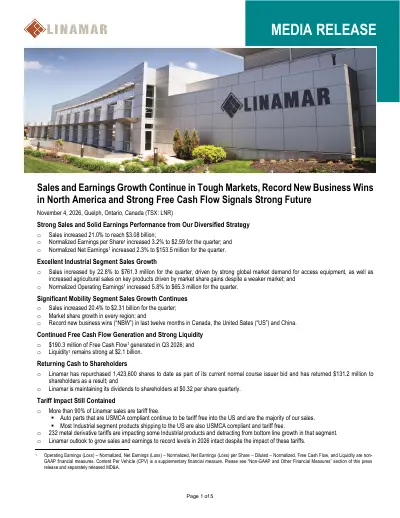
Turning to highlights for the quarter, it's been another strong quarter despite market challenges, illustrative of a strong, diversified strategy that's delivering results for today and tomorrow. First and very excitingly, we saw record levels of new business wins in both Canada and the US as our customers continue to look to onshore work with healthy, technology-leading suppliers like Linamar.
Our new business wins have exceeded our full-year wins last year and we're only three quarters through, in both Canada and the US. If we look at our last 12 months of new business wins in both countries, we are well over any prior annual records.
We are also seeing strong wins in China, also at record levels, in what is the world's largest vehicle market. We saw content per vehicle growth in every region globally again this quarter and strong double-digit content per vehicle growth on a global basis.
Growing content per vehicle is essential in soft markets to temper or offset declining volumes. We saw earnings growth resume, as I noted, in the industrial segment, great to see considering the tariff impact on some products in this segment.
Growth is being led by our access business, which is seeing market share growth notably in Europe on top of strong market growth globally. Finally, we're managing that tariff minefield very well with again more than 90% of our sales not impacted by tariffs.
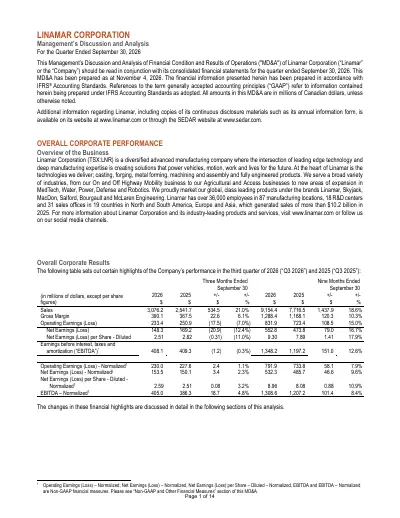
I'm going to review the tariff situation in more detail in just a minute. Turning to the numbers, we saw strong sales at $3.1 billion, up 21% over last year.
Sales were up 23% in our industrial business with access markets growing, offset by a continued softness on the ag side, which was tempered happily by market share growth of our ag businesses. Sales were up 20% in the mobility segment, thanks to recent acquisitions as well as launching business despite a softening volume curve on those launches, all of which is offsetting soft markets globally on the light vehicle side.
Mobility volumes were notably softer in the quarter thanks to extended shutdowns at various customers, resulting in declines in production sales of existing programs, some of which was offset by higher sales that we saw from metal market adjustments as well as FX, noting that these bumps to sales do not impact the bottom line by their nature. Market volumes were down 3.7% in North America in the quarter, which was much more than we had expected going into the quarter.
I will note similar dynamics look at play for Q4, as Dale going to outline for you shortly. Normalized net earnings were $154 million or 5% of sales, up 2.3% over last year.
Normalized EPS was $2.59, up 3.2% over last year. As noted, we saw production sales in our mobility segment down more than we expected, which of course had big impact to OE.
Top-line bumps from those favorable FX and metal market adjustments unfortunately don't impact the bottom line, which left the mobility segment flat on earnings despite that sales growth. Happily, our industrial segment did deliver earnings growth on strong access sales and market share-driven ag sales growth despite tariffs on certain products.
Finally, free cash flow was again excellent at more than $190 million. Strong cash flow drove from those strong earnings and continued focus on reallocating capital to control our CapEx spending.
I would summarize our results this quarter as being most impacted by, first, our various acquisitions done over the last year, Aludyne, Leipzig plant, and our Whiting plants in Germany; secondly, growth in Skyjack sales as well as launches in mobility despite moderating launch curves, which was offset by negative impact of tariffs from certain industrial products, as well as weak global demand in automotive with extended customer shutdowns and continued weakness in ag markets. Finally, let's have a look at an update on the tariff side.
As mentioned a moment ago, more than 90% of our sales this year are not impacted by any tariffs, and I think that's really the most important takeaway on tariffs. As outlined last quarter, the only major area of tariff impact to Linamar at the moment is regarding 232 metal derivatives product tariffs of 25%.
These tariffs are applying to some, but not all, products in our industrial segment. We're actively working to mitigate these tariffs as best we can with actions that don't cost us significant money or create significant disruption to existing manufacturing.
The impact on the sales that are subject to these tariffs is of course detracting from our earnings growth this year, but we continue to expect to grow earnings to new record levels, as again Dale's going to show you shortly. I think this is another great example of the benefit of a diverse business.
When all your eggs are in one basket, you're way more vulnerable to specific dynamics in that industry. When you have multiple revenue streams, those same dynamics are not impacting all areas of your business and also have differing economic cycles.
All of that helps to ensure a more consistent, sustainable level of growth as you have seen us deliver quarter after quarter and year after year. On the positive side, we are continuing to see customers looking at onshoring into North America parts and systems that they are currently buying from Asia or Europe in our mobility business.
As noted, we're seeing record levels of new business wins in our North American operations, including both Canada and the US. The tariff situation is also adding stress to an already stressed supply base, notably in the US and Europe.
This is leading to acquisition opportunities for us, as you've seen us act on, and the pipeline of distressed companies is continuing to grow. We've so far completed three distressed acquisitions over the last three years, significantly adding to our technology portfolio as well as our global footprint for a very reasonable cost.
Finally, I want to emphasize again that our strong results and positive outlook are very much a result of what I think is an excellent and unique business culture at Linamar. It's a culture that's been fine-tuned over 60 years to be opportunistic and entrepreneurial and find something positive and actionable to grow our business, regardless of circumstances.
We're naturally responsive. We're nimble and move fast.
We're innovative, and we're creative in deal-making and mitigating challenging situations, and we get things done. Those are critical elements to not just survive, but thrive in a challenging environment.
With that, I'm going to turn it over to our CEO, Jim Jarrell, to review industry and operation updates in more detail. Over to you, Jim.
Jim Jarrell
Thank you, Linda, and great to be with everyone tonight listening in. I've started obviously with this GRIT slide, Growth the Year, and we're going to continue to use it right through the end of 2027.
Why? Basically because our team has the grit to win, and I think our results continue to prove that.
We delivered strong sales growth with total sales more than $3 billion and solid earnings performance, despite operating in markets that remain challenging, fluid, and quite frankly, can change day to day. What is particularly important is how we delivered those results.
For many years, we have deliberately built Linamar as a diversified company, different markets, different customers, different geographies, mobility and industrial businesses that don't necessarily move in the same direction at the same time, and to me, that strategy is absolutely working. The split between industrial and mobility today may be different than we anticipated coming into the quarter, but that's the exact point of diversification.
When one part of the business faces pressure, another can provide strength. The sum of the parts allows Linamar to continue delivering.
That resilience is especially important in the environment we are operating in now. Demand remains uncertain in several end markets, and as Linda mentioned, trade and tariff conditions continue to evolve, and certainly cost pressures remain, yet we continue to move forward, win new business, and invest in the opportunities that will drive our future.
Certainly tonight, I think your questions are going to be focused around mobility, I'll sort of reiterate some of the things Linda said. First, very pleased with the sales growth we delivered in mobility and positive that we remained in our normal range for margin.
However, the makeup of that growth was different than we originally expected. Extended shutdowns at customers, program mix, and more gradual launch ramps reduced some of the higher-contribution production sales we had anticipated.
At the same time, and Dale will highlight foreign exchange and surcharge recoveries, provided additional sales growth, but very little, minimal impact on earnings. While the top-line growth was strong, the mix underneath it was not yet the ideal mix for earnings conversion.
To me, that's exactly one of the most important takeaways as we look forward. As customer production schedules normalize and our launches continue to mature, we see a clear opportunity to improve both our sales mix and our earnings conversion.
In other words, we like the growth we're seeing today, and we like the opportunity embedded in that growth even more. Then there's the cash side.
This was a great cash quarter, and I think that's an important part of the story. Strong cash generation gives us options.
It allows us to continue investing in organic growth, fund the launches and opportunities in front of us, pursue strategic opportunities where they make sense, return capital to shareholders, and maintain the strength and flexibility of our balance sheet. That flexibility is incredibly valuable in this environment we are living in day to day.
Of course, the markets will continue to move, and challenges will continue to change. Across Linamar, we remain focused on things we can control: execution, operational excellence, commercial discipline, winning new business, and carefully deploying capital.
We are continuing to invest in the future while maintaining a strong balance sheet and the flexibility to take advantage of opportunities as they emerge. Let's turn over to the operating segment on the mobility side, first taking a look at the overall market.
For '26, expectations on light vehicle production largely remain unchanged from last quarter. In North America, the industry is expected to see a decline of 1.9% versus the previous 1.3% expected decline.
Production remains under pressure as elevated inventories are driving further production adjustments. Outlook is expected to stabilize in '27 with growth forecasted at 0.8% versus the prior decline of 0.3%.
However, affordability pressures and inventory normalization continue to limit the pace of recovery. In Europe, the industry is expected to now see a slight increase of 0.7% for '26 versus the previous expected decline of 0.9%.
Production does remain challenged as recovery in domestic demand is absorbed by increasing imports from China and reduced export activity. In 2027, continued vehicle affordability, manufacturing and logistics cost pressures, which is leaving regional production expectations down 1.5% versus the previous decline of 0.1%.
It's also important to note, and many of us are aware of, the change in the market we've seen over the past years in Europe. What we see today is a new norm for the market.
The large influx of Chinese OEMs entering the region, establishing operations, has brought great detriment to the traditional OEMs and created opportunities, of course, for us at Linamar. Long gone are the days of 22 to 24 million production years, and we firmly believe that the new run rate is anywhere between 16 and 17.5 million units.
Consumer demand profiles have shifted to much cheaper vehicles given the affordability constraints brought up in the region by a multitude of the factors. In Asia for '26, expectations are a decline of 1.9% versus the previous decline of 2.1%.
Production is being pulled in different directions with continued weakness in China's domestic market weighing on the overall output in '26, while exports are providing an important offset for them. Looking into '27, growth is expected at 0.9% versus the previous 0.4% increase as stronger Chinese exports and continued growth in markets such as India support a return to modest regional growth.
Overall, the market appears to be stabilizing to a certain extent with global '26 expectations at a decline of 1.7% versus the previously forecasted 2.1% decline and growth of 0.9% in '27 versus the prior forecast of a 0.7% increase. Turning to Linamar's CPV performance for the quarter, our key strategic acquisitions of Aludyne North America, Leipzig, and beginning in Q2 with the Whiting Group's Remscheid and Plettenberg facilities continue to drive strong gains in existing and new customers.
We believe that this quarter's CPV is strong evidence of our distressed acquisition strategy paying dividends and navigating difficult, stagnant markets over the past few years. From Mobex to Aludyne, we have strengthened our positioning and been able to grow our book of business across the core regions with key existing, new customers.
As proof, North America CPV was up 30%, Europe was up 10.7%, and Asia saw growth with an increase of 7.9%, and globally, CPV grew an impressive 22% year over year. Looking at new business wins for the quarter across both mobility and industrial, Linamar saw a new business win value of close to $400 million.
Through our strategic acquisitions and takeover work, we saw significant new program wins for components such as control arms, knuckles, subframes, and significant differential program wins. Our propulsion-agnostic new business wins on mission-critical structural components emphasize our sustained momentum in Linamar's structural and chassis expansion, allowing Linamar to extend its propulsion-agnostic portfolio across all powertrain types.
Let's turn to Skyjack with what was an excellent quarter. Despite ongoing tariff and global market uncertainty, Skyjack delivered exceptional growth with volumes up 41% year-to-date versus the market being up 32%.
Growth again this quarter was broad-based across all major regions and product categories, demonstrating the strength of our brand, our execution, and our customer relationships. Even more encouraging, the industry outlook has once again improved dramatically since last quarter.
What was expected to be already large growth rate expectations has further climbed across all major regions. The global market is now forecast to grow nearly 27% in '26.
This is primarily driven by strong demand from data center construction, which is expected to grow from approximately $56 billion this year to about $95 billion by 2030. This infrastructure investment drives continued fleet expansion by rental companies, all of which Skyjack is uniquely positioned to capture.
Looking ahead, industry forecasts remain unchanged, but they do suggest that growth moderates in '27, but remains positive across all regions. Importantly, the underlying drivers supporting demand today, including data centers, infrastructure investment, housing, industrial construction, remain firmly in place, providing a constructive backdrop for continued growth.
While product mix always influences revenue performance, the bigger story is clear: Skyjack wins, we're strengthening our competitive position, gaining momentum in key markets, and capitalizing on attractive, long-term growth drivers around the world. Innovation continues to be a key differentiator.
During the quarter, we launched the SJ22 TE+, providing a 22-meter working height suitable for both indoor, outdoor. This launch extends Skyjack's electric telescope boom range in China and Southeast Asia markets and provides a clean, quiet, sustainable rental solution with zero emissions, lower operating costs, and increased utilization.
Skyjack also continues to receive awards for its products. The SJ3232 E electric scissor was recently honored as one of the rental industry's best products, winning the '26 Rental Editor's Choice Award.
This award represents the equipment industry's best products gaining interest from end users and rental professionals alike. The combination of strong execution, market recovery, and product leadership positions Skyjack exceptionally well for the continued growth.
Skyjack isn't just participating in the recovery; it's helping to lead it. Finally, turning to the agriculture market, conditions remain challenging with industry demand expected to be down approximately 10% to 15% in North America with Europe and the rest of the world being down 5% to 10% for the year.
Despite that backdrop, all three of our brands continue to gain market share on key product lines. Year-to-date, MacDon has grown its combine draper global market share, Salford has grown its US tillage market share, and Bourgault's air seeders US market share has grown.
In a downcycle, that's the ultimate proof point. It speaks to the strength of our products, our customer relationships, and the execution of our team.
In terms of regional markets, in North America, crop commodity pricing has improved slightly, though not too much movement overall, which is still causing some hesitancy around farmer optimism. Certainly fertilizer and diesel fuel prices also continue to squeeze farm income expected for '26, and overall input costs being higher is negating some of the potential gains from commodity pricing.
In Europe, the region experienced excessive heat and drought over the summer, impacting farm profitability. Western Europe markets, it was viewed as generally poor compared to the average year.
Australia market, crop yields are expected to be down year over year. However, the yield and crop results are still above the long-term average and somewhat better than what was expected.
Across all regions, harvesting continues to look generally positive. However, input costs are still expected to rise through Q4.
Some other exciting news that was announced back in August that you may have seen was our strategic alliance that Bourgault announced with CNH. Our teams worked very hard on getting this agreement in place, and we are extremely excited to have announced this with CNH.
Together with CNH, we are fusing Bourgault's industry-leading seeding expertise with the global reach and strong delivery networks of Case IH and New Holland. Through the collaboration, Bourgault will be supplying co-branded seeding solutions that are designed to meet the evolving needs of farming operations across North America, Australia, and other key international markets.
This announcement reflects a shared commitment to delivering innovative seeding technologies that will only help producers greatly improve productivity, efficiency, and agronomic outcomes. Also, our Salford Group continues to integrate Raven's rate control module across additional products.
The collaboration between Salford and Raven continues to deliver an exceptional customer experience coupled with a user-friendly interface and high-performance section control. In agriculture, we're doing what great companies do during downturns: gaining share, improving productivity, and preparing for the recovery to win.
As I mentioned last quarter, Linamar services eight different megamarkets in our 2100 year plan as displayed. These megamarkets have a combined potential between $15 and $20 trillion in the next decade.
Just to briefly touch on defense before turning to robotics, we continue to make excellent strides in the space. We have MOUs in place, and are also advanced discussions with other key international primes across all domains.
We're very excited to continue to grow in the space and provide long-term value to global primes. Looking at robotics where a lot of exciting developments have happened over the past quarter, what you see on the screen is our Linabot 500 challenge for 2027.
The goal's pretty simple: deploy 500 Linamar-manufactured robots, cobots across Linamar. We're already halfway there, and deploying these cobots is the future of our manufacturing.
Driving automation, strengthening skill of our teammates, and building a more competitive future are the core pillars behind this initiative. This will create more positive performance for our customers, solve real challenges with real solutions for our teams, and will provide better financial performance for our shareholders, creating a big win for all stakeholders.
To give you a flavor of 2027, Dale will give more guidance on this, basically built for growth, and the best we believe is yet to come. We have great momentum today, huge opportunities tomorrow.
We expect strong top-line growth, some EPS growth, modest margin expansion. Our launch pipeline is strong with new business opportunities emerging globally from geopolitical shifts, and we will capitalize on supply chains and dynamics.
We're gaining ground in attractive markets: construction, access, ag, automation, defense, robotics, and mobility. We will continue to use our founders' entrepreneurial culture to drive efficiencies through automation, capital investments, and elimination of waste.
We will remain excellent on cash, giving us the flexibility we need. With grit, we will win.
With that, I will pass it over to Dale to take us through a financial overview.
Dale Schneider
Thank you, Jim, and good afternoon, everyone. Linda had covered at a high level the financial performance in the quarter, I'll jump directly into the business segments, starting with mobility.
Mobility sales increased by $392.9 million or 20.4% over Q3 last year to $2.3 billion. This growth was mainly due to increased sales from recent acquisitions, as well as higher-than-normal metal market surcharge pass-throughs related to changes in international trade policies.
Favorable FX rate changes also provided a benefit in the quarter. In addition, launching programs contributed to the higher sales despite a slower ramp-up to mature volumes.
These gains were partially offset by lower volumes as a result of the weaker global market demand, extended customer shutdowns in the quarter, and lower production on certain ending programs. Q3 normalized operating earnings for mobility were down 0.7% over last year to $164.7 million, reflecting the impact of the lower volumes, as we just discussed, together with the unfavorable FX impact compared to Q3 last year.
These impacts were partially offset by increased earnings from our recent acquisitions and launching programs. Higher-than-normal metal market surcharge pass-throughs also increased the sales in the quarter.
These surcharges, though, are largely a customer recovery for higher metal costs and therefore have minimal impact on earnings, but the sales base does dilute our operating margins. Turning to industrial, sales increased by 22.8% or $141.6 million to $763 point $761.3 million in Q3.
The increase was driven by higher access equipment sales from the strong global market demand for scissors and booms. Agricultural sales also increased on key products, including combine drapers and tillage equipment, driven by market share gains despite the weaker underlying markets.
Favorable FX rate changes also provided a benefit compared to Q3 last year. Normalized industrial operating earnings in Q3 increased $3.6 million or 5.8% over last year to $65.3 million.
The increase reflects stronger earnings from our access equipment, increased agricultural earnings from the market share gains on key products, and operational and cost reductions. These improvements are largely offset by the impact of tariffs on certain industrial products, which significantly limited the earnings benefit from the strong sales growth in the quarter.
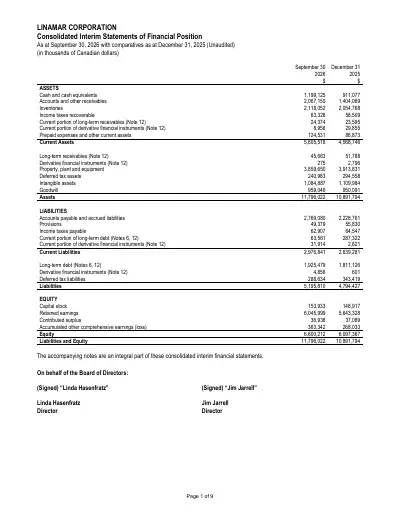
Starting with our overall cash position, which came in at $1.2 billion on September 30th, a decrease of $33.2 million compared to September last year. During the third quarter, we generated $285.5 million in cash from operating activities, which was used to fund the Q3 debt repayments, CapEx, and share buybacks.
Turning to leverage, net debt to EBITDA was 0.47 times, a significant improvement from 0.76 times a year ago, and continues to reflect our very strong balance sheet. The amount of available credit on our credit facilities was $873.9 million.
Our liquidity remains strong at $2.1 billion despite the capital deployed on three acquisitions over the past 12 months. Free cash flow in the quarter was $190.3 million, and year-to-date, we generated over $645 million in free cash flow.
Our current NCIB program was launched at the Q3 '25 earnings call and will expire on November 16th. This program authorized the purchase and cancellation of up to 3.9 million shares.
To date, we have returned over $131 million to shareholders and repurchased approximately 1.4 million shares. This brings our total cash returned to shareholders since we started NCIBs in November '24 to $231 million with the purchase and cancellation of approximately 3.2 million shares.
The TSX has approved the renewal of Linamar's NCIB program for the next 12 months. Under this renewed program, we may repurchase and cancel up to 3.7 million shares, representing 10% of our public float, between November 17th, '26, to November 16th, '27.
These initiatives reflect our disciplined capital allocation strategy of maintaining a strong balance sheet, investing in growth, and returning excess cash to shareholders. Turning to the outlook, I will outline Linamar's expectations for Q4, focusing on mobility and industrial segments, in addition to highlighting changes in our outlook for '26 and '27 from what was announced our last earnings call.
I would first like to look back at the guidance provided for Q3 at our second quarter earnings call. The Q3 outlook provided in August called for double-digit consolidated sales growth, normalized EPS growth, a modest normalized net margin contraction, and positive free cash flow, and Q3 met all of these expectations.
Regarding the mobility segment, we expect sales to grow in the fourth quarter, supported by the contribution from recent acquisitions and ongoing program launches. This growth is expected to be tempered by weak global mobility markets, particularly in North America, where customer production schedules and vehicle inventory adjustments continue to create volatility.
We expect normalized operating earnings to be flat compared to Q4 last year with margins contracting modestly below our normal range of 7% to 10%. The reduction in volumes on mature programs, which carry mature margins, will not be fully offset by the growth from launching programs that have not yet reached mature volumes or margins.
This unfavorable mix is expected to continue to contribute to the contraction in the mobility operating margins in Q4. There also remains some uncertainty around customer schedules that could further impact our near-term results.
Turning to industrial, we expect double-digit sales growth in Q4 compared to the prior year. Access continues to drive growth, supported by strong global demand, while agricultural markets remain soft despite the market share gains on several of our key products.
Normalized industrial operating earnings are expected to decline compared to Q4 last year. We also expect operating margins to contract and remain below our normal range of 14% to 18%.
Seasonality, the fourth quarter is typically lower for both access and agricultural businesses. Combined with the continued weakness in the agricultural markets and tariff pressure, these factors are expected to at least partially offset the earnings benefit from the higher sales.
As a result, on a consolidated basis, we expect double-digit sales growth in Q4, reflecting acquisition-related growth, program launches, and continued strength in access. We expect normalized EPS to decline compared to Q4 last year, primarily reflecting the reduction in industrial segment earnings.
Normalized net margins are expected to contract modestly from the prior year. Despite the expected pressure on the fourth quarter earnings, we continue to anticipate positive free cash flow.
For the full year 2026, our outlook remains unchanged from what we provided at the Q2 earnings call in August. We continue to expect double-digit sales growth, growth in normalized EPS, and a modest contraction to normalized net margins.
We continue to expect CapEx to increase from the prior year while remaining below our normal range as a percent of sales, and we continue to expect very strong balance sheet with low leverage alongside strongly positive free cash flow generation. This outlook reflects the strong full-year mobility growth from acquisitions and program launches, tempered by the market softness negatively impacting our back-half results.
Agricultural markets remain soft, although the rate of decline is moderating with stabilization expected next year. Continued double-digit growth in access market, and of course, known tariffs impacts are included in this outlook.
Overall, despite the softer mobility markets in the second half of the year and continued pressure in agriculture, our full-year outlook remains consistent with August. Jim has already covered the outlook for 2027, I will not repeat the guidance.
I would note, however, that our outlook assumes reasonably flat mobility industry volumes with some downside risk as the industry continues to reset. We also expect structural weakness in the European mobility market to persist.
In the industrial area, we are assuming some recovery in agriculture, and continued strength in access with modest access growth compared to 2026. Known tariffs impacts are also included in the outlook for the full year.
In summary, we have met our consolidated Q3 guidance that we provided in August across the sales growth, normalized EPS, and normalized net margins, and free cash flows. Looking ahead, we expect double-digit sales growth in Q4, although weaker mobility markets and a mix of mature and launching programs, industrial seasonality, and tariffs are expected to pressure earnings and margins.
For the full year, our outlook remains unchanged from August. We continue to expect the double-digit sales growth, normalized EPS growth, and a modest contraction in normalized net margin, a very strong balance sheet, and strongly positive free cash flow.
Overall, we expect 2026 to be another strong year of financial performance for Linamar, and we are currently expecting to deliver record sales, record earnings, and strong free cash flow generation for the year. Thank you, and I would now like to open up the call for questions.
Operator
We will now begin the question-and-answer session. If you would like to ask a question, please press star one to raise your hand.
To withdraw your question, press star one again. We ask that you pick up your handset when asking your question to allow for optimum sound quality.
If you are muted locally, please remember to unmute your device. Please stand by while we compile the Q&A roster.
Your first question comes from the line of Tamy Chen with BMO Capital Markets. Your line is now open.
Tamy Chen
Hi, good afternoon. Thanks for the question.
Dale, the higher-than-normal metal market surcharge, are you able to help us understand, if you didn't have this higher-than-normal surcharge pass-through sales, what the underlying mobility margin would have looked like?
Dale Schneider
We haven't disclosed it, but just think of the metal market surcharge is like this as an example. I may incur, say, a $100 of metal market costs that hits my COGS.
The recovery is, in theory, if the timing works out perfectly, $100 for the customer. That's why you get the dilution for margins.
Yes, we would expect to be higher in our normal range than we came in at if we didn't have that negative impact on the margins from the higher-than-normal sales.
Tamy Chen
Would you be able to say if the underlying margin, yeah, would have been higher in your normal range, would it have been flat year
Linda Hasenfratz
over year? I'll just jump in to say there was more than one factor happening there, Tamy.
There was FX as well, and we saw a big bump on the FX side to sales, which also doesn't translate to OE, and the metal market piece was a little higher than we might normally see, which is why we called it out, but neither are figures that we would normally disclose. They were factors.
I can tell you production was down quite a bit in the quarter, particularly in North America. North America, in comparison to prior year, was down more than 4% in terms of production volumes, and you know what our content per vehicle is in North America.
If I look at the change from Q2 to Q3 in terms of production volumes, it was down 4.5% from Q2. Pretty big impact given our significant content per vehicle in North America of close to $400.
That'll probably give you a bit of an understanding of what the underlying sale change from a production sales perspective.
Tamy Chen
Right. Got it.
On your customer's production as we head into 2027, I guess first of all, before that, for Q4 mobility, I hear you on the production schedules, the OEMs managing inventory. It sounds like when you say the industry might continue to reset next year, are you seeing that the OEMs in North America they're still managing inventory, and so there's still that downside risk to volumes?
I guess I'm just a little surprised that it might still carry forward into next year, and that it's not just a Q3, Q4 thing this year.
Jim Jarrell
We're looking mainly at a flat next year outlook right now. I think what we're cautioning is some of the headwinds that we're hearing in the market.
When you look at Europe, right, you just saw this week Schaeffler talking about five plants being shut down, Volkswagen talking about some headwinds on people, BMW, Mercedes all doing voluntary things like that. These are headwinds that we haven't seen factor into the actual releases.
On the inventory side, I think the norm is about 60 or whatever, but some of the Asians are better than that, and some of the traditional OEMs over here are higher than that. All those factors play a role, but I think we're just giving some qualitative comments, Tamy, that there could be some more fluid volumes in the market.
Tamy Chen
Got it. That's it for me.
I'll pass it on. Thank you.
Operator
Your next question comes from the line of Ty Collin with CIBC. Your line is now open.
Ty Collin
Hey, good evening. Thanks for taking my questions.
Just wanted to follow up on the mobility margin question a little bit. You talked about a number of headwinds there.
I think most of them sound kind of transitory in nature, whether that's extended shutdowns, FX, metal pass-throughs. I'm wondering if there's been any more structural cost increases that might change the margin profile of that business as you look forward to 2027, whether that's on the cost side or elsewhere?
If not, would you kind of expect to get back more central within your normalized range moving beyond Q4?
Linda Hasenfratz
If we look at our normal operating margin range for mobility of 7% to 10%, I still think that's a good range. It's a range we're going to be in for the year.
To your point, these factors are somewhat dynamic in terms of extended shutdowns, but we're here this quarter, maybe next year you're not seeing as much of that. Also the FX and metal markets, that's going to be very changeable quarter to quarter.
I think our 7% to 10% range is a good range. It's a range we're going to be in this year, and I still think it's a good long-term range for to expect for the future.
Ty Collin
Great. Thanks.
Then maybe switching gears a little bit, I'm just wondering if you could provide a bit of an update on your efforts to kind of mitigate your tariff exposure within the industrial business, any sort of incremental progress you've made since the summer, and I guess what sort of opportunity do you see from here to further work down that exposure?
Jim Jarrell
I think some key things. I can just hit some of the highlights, but obviously tariff classifications been one mitigation route.
Certainly, there's been recovery programs, and then also, how do you do distribution or custom structure optimization? Certainly, we've had some supply chain optimization, commercial actions, and the obvious cost discipline side.
You can even see in this quarter, right, obviously we had improvement on the industrial revenue side, but certainly, some of those tariff mitigation efforts also were playing through on the industrial side. You're getting some of that benefit there, too.
Ty Collin
Great. Thanks.
Then maybe just following up with one more question around Skyjack. Obviously a lot of attention being paid to the upside there from the AI build-out and data center projects.
I'm wondering if you could comment on whether you might see upside in Skyjack from some of the nation-building projects that are in the pipeline in Canada, whether that's things like mining projects, highway constructions, pipeline projects, how you see Skyjack maybe slotting into some of those?
Jim Jarrell
Absolutely. I think that is a good point, and certainly we know like data centers, and then publicly funded projects are certainly driving growth in US as well as Canada.
As I mentioned, that whole data center, you're looking at getting close to $100 billion in 2030. Also in Canada, there's a lot of local content rules or supply chain things if it's publicly funded.
Those really drive to a locally manufactured product. That would give us some upside on that as well, Ty.
Ty Collin
Appreciate the color, and all the best. Okay.
Operator
Your next question comes from the line of Michael Glen with Raymond James. Your line is now open.
Michael Glen
Hey, I'm just hoping, I know you're talking about contraction in the operating margin for industrial in Q4 on a year-over-year basis. We've seen varying degrees of contraction over the course of this year.
Are we talking about a point and a half of contraction, or are we talking about more than that, just maybe a little more insight. Thanks.
Linda Hasenfratz
The contraction in the industrial segment compared to last year because of tariffs, obviously. I think you've already got a flavor for what that's looking like in terms of margin.
I think you can take the last couple of quarters as a good indication of the kind of contraction that you might see.
Michael Glen
Okay. Then just on M&A, there was a comment regarding a pipeline of potentially distressed assets.
Can you indicate, I'm assuming, given what's happening in Europe, there's quite a strong pipeline of distress over in Europe. Are you still looking in Europe at some of the opportunities on an M&A standpoint?
Jim Jarrell
Yes, I would say that we're looking across the globe, and distress obviously has the biggest role right now, I would say, in Europe. Anything that we do on distressed assets, Michael, would obviously be with our customers.
We would not do anything just buying a distressed asset without engagement with customers that we have a trusted plan going forward. That would be the key of that.
Again, there's absolutely no shortage of things out there. We want to be very conscious and selective about the things we do.
The technology has to be right, the customer base, it has to fit our sort of operating model and culture, and those would be the ones that we would go after.
Michael Glen
Are you still seeing any distressed opportunities in the US right now?
Jim Jarrell
Yes, we are. There's a few out there, yep, for sure.
Michael Glen
Okay. Then just on the cobot deployments, you have a target of 500.
How many do you have deployed now? Could this accelerate?
Any information that you might be able to share in terms of how we think about paybacks associated with these cobot deployments?
Jim Jarrell
Yep, sure. We had this year our goal was 50, and we've done 43, built 43.
We have 30 that are deployed, that are sort of being ramped up and installed right now. The payback, you sort of look at as a person times three, right?
If you have three shifts, you would be sort of a three-person payback. Again, that's one part of it.
The collaboration of a repetitive job is sort of the other side. If you want have people use their brains.
Again, the collaborative robot side is you're collaborating with that robot. I want to make sure people understand that it's not just a people issue.
It's how do you collaborate and do more with these robots. We've got basically 30 out there, 43 sort of built, and next year, we've got 500 that we are planning to build and get out inside Linamar, and out of that, we probably have 303 already allocated inside the company where they're going to go.
Michael Glen
Thank you.
Jim Jarrell
Take care.
Operator
Your next question comes from the line of Brian Morrison with TD Cowen. Your line is now open.
Brian Morrison
Thanks very much. Just a couple of questions for me.
If I look at the impressive growth at Skyjack, I'm wondering if you can parse out just how much of that growth has been related to large-scale projects or data centers specifically?
Jim Jarrell
It's hard to really dissect that as we're going through the rental company, but I would say in North America, it's probably a big portion of the percentage, and just with all that data center stuff. You see really, our scissor side has really increased dramatically.
The other thing that we look at is how do you compare that to your open orders or backlog? I could probably say I think Q3 last year, we're probably up 5%, 6% on backlog, so that's another really strong indicator.
Then, obviously, we're just looking at the amount of money in the power and publicly funded projects, which also correlates back to that. Other big guidance that we know is the capital spend from the rental companies, which, of course, they're giving guidance that is going up.
All those things sort of drive you on growth, but it's really hard to tell you the percentage of what the data center would be.
Linda Hasenfratz
I would just add that to the earlier point, there's a lot of other nation-building stuff going on in terms of highway construction as a good example that's also going to add into some opportunities for growth for Skyjack. For sure, there's data center opportunities there, but there's a lot of other stuff going on as well that's also creating some growth opportunity at Skyjack.
Jim Jarrell
It's a little weird, too, because you have the big beautiful bill, or whatever that was, that has overlap with some of the data centers, because those data centers, some of them are inside the big beautiful, publicly funded stuff, it's hard to dissect that.
Brian Morrison
Okay. Maybe a high-level question, Jim.
What does it take for the mobility margins to get back to sort of that midpoint of your target range or higher? Is it really just volumes that could drive that?
Jim Jarrell
I think, again, what we saw, program mix was a little bit different than we thought in Q3, as we've talked about. Those what we all said, those gradual ramps, right?
When we talk about gradual ramps, we have put their capacity in place. We expected a higher ramp level on these programs, which didn't materialize, right?
Once these ramps sort of come through, we should start to get that benefit, right? We put all the fixed costs in.
We set up three shifts, and then the volumes don't come. You're sort of there with that fixed cost sitting there until those ramps come.
Those two things to me, the program mix, coming back to where it was, to that sort of an inventory question, and then those ramps back on some of these programs that we have capitalized for.
Linda Hasenfratz
I would just add to that, you're asking when are we going to get back into the mid-range? We've been in the mid-range in the first half of the year.
We were normalized margins in mobility of 8.1%, 8.2%. We had a quarter last year that was 8.6%.
We saw some extended shutdowns, and that brought the margins down a little bit. I don't think we need to panic over that.
Jim Jarrell
Brian, there's no structural things that are impacting us inside Linamar like extra costs here and there. Like our CAT program is in place, our purchasing reductions, our efficiency, our CapEx, all those things that we are focused on are there.
I just think some of the ramps and the mix were off here.
Brian Morrison
For sure. That's fair.
I guess last question for you, Linda, because you're very much in the know. It sounds like Canada and the US are negotiating or at least trying to negotiate once again.
I'm wondering what your latest hearings are that you can share with respect to potential USMCA outlook or even the potential for reduced 232 tariffs going forward, if you have any insight?
Linda Hasenfratz
I don't think I have any particular insights, but I certainly have opinions, which I'm happy to share,
Brian Morrison
that
Linda Hasenfratz
number one That's fine. Yeah.
Yes. Number one, I think that we absolutely will see USMCA continue to persevere into the future.
At the moment, we've got 10 more years in this agreement. Will it get renewed beyond that?
100%, I think it will. There's so much integration across our three countries and so much prosperity that is driven out of that agreement.
It is, no doubt in my mind, that it will continue beyond 2036. I think, are there going to be changes?
Of course. There's things that the US doesn't like in the agreement, and probably things that Canada would like change as well.
We'll see some adjustments, but I feel confident that we will see USMCA continue long into the future. With respect to more near-term of coming up with a deal that could mitigate some of the tariffs that are being imposed on Canada, for instance, the 232 metals derivatives or the vehicle tariffs that some of our customers are seeing.
I actually also think that we will without doubt come to an agreement sooner than later. I think we're quite close and, from the sounds of it, got a little off track, and getting back on track.
Personally, I think possibly, and this again, this is my opinion. This isn't something anybody's telling me.
By the end of this year or early next year, I think we'll see something come through in that regard. Again, there's too much at stake between our two countries.
We're so reliant on each other, us on the US, but the US on Canada as well. There's so much more we could do together that it only makes sense to try and figure out areas of concern, address them, and let's get something on a piece of paper so we can go forward.
Jim Jarrell
I think, Brian, the other thing, the political climate and pressures have potentially changed a little bit in the last couple of days here, so that might be something helpful.
Brian Morrison
For sure. Thank you.
Operator
There are no further questions at this time. I will now turn the call back to Linda for closing remarks.
Linda Hasenfratz
Great. Thank you very much.
To wrap up, I'd like to leave you with our key message for the quarter, which is actually identical to what I started out with. First, growing our business starts with winning new programs, and we are hitting it out of the park in that regard with record levels of new business wins over the last 12 months in all of Canada, the US, and China, well in excess of any level of annual new business wins that we've seen in those regions.
That's an excellent indicator for our continued, consistent, sustainable growth. Second, equally key to growth is growing market share, and in our mobility business, that is happening in every region and overall globally in impressive amounts, and also in our industrial businesses.
Market share growth is key to offsetting soft markets or amplifying market growth when that's happening in our top line as well. Thirdly, great to see some earnings growth in our industrial segment after a tough couple of years in terms of market demand.
The access market growth is a key part of that and is help and the moderating of ag market declines that were more than able to offset with our market share growth is important as well. Lastly, a reminder that despite a tariff-crazy world, we still have more than 90% of our sales not impacted by tariffs at all, and are not letting the tariffs that do impact impede our promise to grow top and bottom line again this year to new record levels.
Thanks very much, everybody, and have a great evening.
Operator
This concludes today's call. Thank you for attending.
You may now disconnect.