Lionsgate Studios Corp
NNYSE:LIONQ2 FY2027 · Earnings Call TranscriptNovember 5, 2026
Operator
Hello everyone, this is the conference operator. Today's call will begin in just a few moments.
We ask that you please stay on the line. Once again, today's call will begin in just a few moments.
Thank you. Good day, and welcome to the Lionsgate Studios second quarter 2027 earnings conference call.
All participants will be in listen-only mode. Should you need assistance, please signal a conference specialist by pressing the star key followed by 0.
After today's presentation, there will be an opportunity to ask questions. To ask a question, you may press star then 1 on your telephone keypad.
To withdraw your question, please press star then 2. Please note today's event is being recorded.
I'd now like to turn the conference over to Nilay Shah with Investor Relations. Please go ahead.
Nilay Shah
Good afternoon. Thank you for joining us for the Lionsgate Studios Corporation's fiscal 2027 second quarter conference call.
We'll begin with opening remarks from our CEO Jon Feltheimer, followed by remarks from our CFO Jimmy Barge. After their remarks, we'll open the call for questions.
Also joining us on the call today are Vice Chairman Michael Burns, COO Brian Goldsmith, Chairman of the TV Group Kevin Beggs, Chairman of the Motion Picture Group Adam Fogelson, Chief Revenue Officer Jim Packer, and Senior Advisor to the Office of the CEO at Lionsgate and Co-CEO of 3 Arts Brian Weinstein. The matters discussed on the call also include forward-looking statements, including those regarding the performance of future fiscal years.
Such statements are subject to a number of risks and uncertainties. Actual results could differ materially and adversely from those described in the forward-looking statements as a result of various factors.
This includes the risk factors set forth in our public filings for Lionsgate Studios Corp. The company undertakes no obligation to publicly release the result of any revisions to these forward-looking statements that may be made to reflect any future events or circumstances.
I'll now turn the call over to John.
Jon Feltheimer
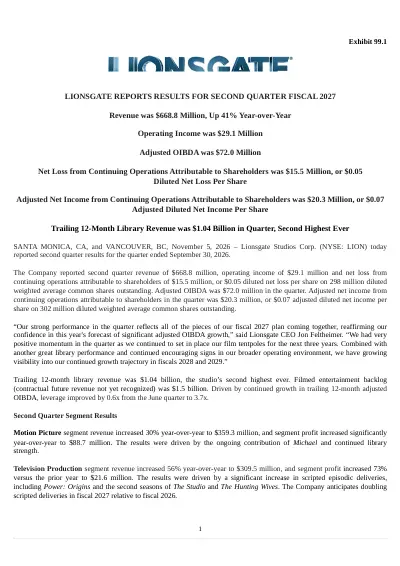
Thank you, Nilay, and good afternoon, everyone. Our strong performance in the quarter reflects all of the pieces of our fiscal '27 plan coming together, reaffirming our confidence in this year's forecast of strong adjusted OIBDA growth, and giving us greater visibility into our continued growth in fiscals '28 and '29.
I'd like to go through each of the components of that plan. First, we're driving our growth with our portfolio of franchises and other branded IP.
10 of our next 15 wide theatrical releases are repeatable branded properties. With the new Hunger Games, Resurrection of the Christ Parts 1 and 2, The Housemaid's Secret, Michael 2, and Naruto leading the way, complimented by other marquee properties and proved areas of strength, we have confidence in the earnings power of our film slate over the next 3 years.
One of the most celebrated of these franchises, The Hunger Games: Sunrise on the Reaping, opens in 2 weeks to kick off the Thanksgiving box office. We believe that this will be one of our biggest and best Hunger Games yet.
Our television business is also driven by our ability to create long-running hit properties. The Rookie is growing in popularity as it heads into its ninth season.
The Rookie: North spinoff will arrive in January on ABC, and will stream on Hulu in the U.S. and Disney+ in most international territories.
Ghosts is exploring new spinoff opportunities as it enters its sixth season on CBS. Our recent licensing deal with Netflix is indicative of the kind of value we're creating for the Power franchise, 10 years after the original Power series launched.
As you may have seen, Netflix announced a third season renewal of The Hunting Wives even before its second season launched. The Hunting Wives was a breakout hit on the platform in its first season, topping their global charts and attracting 35 million viewers worldwide.
Its second season will debut on Thanksgiving Day, and we will begin shooting the third season at our Lionsgate Studio sound stages in Atlanta next month. Second, we're continuing to extend our franchises into new growth areas.
We launched the North American tour of the Dirty Dancing musical to rave reviews in August, and as it heads for Broadway in February 2027, ticket sales are outpacing expectations. We announced the full creative team for the La La Land stage musical and begin workshopping it early next year for a 2028 opening.
We opened Now You See Me Live at the MGM Grand in Las Vegas to sold-out shows last month, and we'll be opening a limited run on Broadway next Friday. Earlier this week, we announced the expansion of one of our newest franchises, The Housemaid, into a stage play shepherded by Tony Award-winning Life of Pi producer Simon Friend that will open in the UK next September.
We're also working on the Saw Genesis multiplayer video game, launching in 2027, and the John Wick AAA game in partnership with leading developer Saber. All told, by the end of fiscal 2028, we expect to have at least 8 stage plays, 4 concert tours, 10 live experiences, and 9 interactive video games across our Global Products and Experiences Group.
Third, we're continuing to grow our verticals in categories where we have historically excelled. During the quarter, we began principal photography on an exciting new chapter of the found footage horror classic Blair Witch.
We announced Mike P. Nelson to direct the next installment of our billion-dollar horror franchise Saw, in partnership with Blumhouse Atomic.
Our adaptation of the horror thriller Magic, produced and directed by Spider-Man and Evil Dead filmmaker Sam Raimi, and our recent acquisition of Portrait of God, starring Chase Infiniti, with Jordan Peele and Sam Raimi producing, round out our strongest lineup of horror films since the early days of the studio. Contributing to this strength, our 3 Arts talent management company is a leader in representing the top voices of the next generation of horror, with clients Dylan Clark, who is directing both Blair Witch and Portrait of God, Backrooms director Kane Parsons, and Undertone director Ian Tuason.
You'll be hearing more about what 3 Arts is doing in the horror space soon. We're also continuing our focus on the action space, wrapping production on the John Rambo prequel starring Noah Centineo, and the next installment of the John Wick universe, Caine, directed by and starring Donnie Yen.
Both films have had strong early test screenings, and we've begun pre-production on the John Wick animated prequel, returning Keanu Reeves to his iconic role. Fourth, we're continuing to monetize our library in new ways as we scale our licensing business across a changing portfolio of buyers.
We've rolled out more than 50 global FAST channels, on track for a billion hours of viewership by the end of the fiscal year. We have SVOD add-on channels in 36 territories, approaching the 2 million subscriber mark.
Together, they comprise a global channels business that has tripled its annual revenue to well over $100 million in the past 2 years, giving us greater control over where and how we license our content. Our channels have become one of the drivers of our library's continued growth, and in that regard, we reported our second best trailing 12-month library revenue ever this quarter, returning to over $1 billion with approximately 60% cash flow margins.
The growth of our library is coming from many different places. Drivers in the quarter included the Hunger Games franchise, as you might expect, but also Heartland, a Canadian family drama TV series that has been on the air for nearly 20 years, and Kill Bill: The Whole Bloody Affair from legendary filmmaker Quentin Tarantino.
Fifth, we're finding new ways to monetize our content with new partners outside of our traditional media ecosystem. In September, we announced a joint partnership with Meta to support the launch of their new Meta VR glasses with a number of our films.
Earlier this week, we announced that we're again working with Meta to convert one of these films, The Hunger Games: Sunrise on the Reaping, for 3D theatrical release before becoming available on their glasses, and we're continuing to discuss with them additional content opportunities at the intersection of entertainment and technology. Finally, the key to every element of our plan is our ability to replenish our content platform by sourcing, packaging, producing, and delivering exciting new IP that adds value to our portfolio.
We announced earlier this week that after highly competitive bidding, Sony Pictures has come aboard as our international partner and co-financier on Naruto, the film adaptation of Kishimoto's iconic manga, one of the most beloved and successful entertainment properties in the world. Sony brings deep expertise in anime and tremendous strength in international distribution to the film, which is helmed by Destin Daniel Cretton, the director of the biggest domestic box office hit of all time, Spider-Man: A Brand New Day.
Naruto begins production in the spring. In closing, we're performing well against the backdrop of an operating environment that is showing a number of encouraging signs.
Audiences are coming back to the movie theaters. Scripted TV series orders are stabilizing, with new creative and financial partners emerging across the media ecosystem.
The close of the Skydance acquisition of Warner Discovery eliminates a layer of uncertainty that was hanging over the industry. We bring to this environment not only strong content slates, a world-class library, and a deep portfolio of branded IP, but a focus on monetizing it across a broader range of platforms than ever before.
Now I'd like to turn things over to Jimmy.
Jimmy Barge
Thanks, John, and good afternoon, everyone. I'll briefly discuss our fiscal second quarter 2027 financial results and provide an update on the balance sheet.
For the quarter, Lionsgate Studios' revenue increased 41% year-over-year to $669 million, while adjusted OIBDA improved significantly to $72 million. Operating income was $29 million, reported diluted loss per share was 5 cents, and diluted adjusted earnings per share was 7 cents.
Use of adjusted free cash flow for the quarter was $8 million, substantially better than the prior year. Trailing 12 months library revenue increased 4% year-over-year to approximately $1.04 billion, representing the second highest library performance in the studio's history.
Trailing 12 months library revenue has now exceeded $1 billion for 4 out of the past 5 quarters. Studio segment profit, which reflects our Motion Picture and TV segment profits before corporate overhead expense, more than doubled year-over-year to $110 million.
The improvement was driven by growth at both Motion Picture and Television. Looking specifically at Motion Picture, revenue increased 30% year-over-year to $359 million, while segment profit increased substantially to $89 million.
Results were driven by continued contributions from Michael, carryover from our prior year slate, continued library strength, and lower P&A expense. Turning to Television, revenue increased 56% year-over-year to $310 million, while segment profit increased by 73% to $22 million.
The year-over-year improvement was driven by 22 scripted episodic deliveries in the period, including deliveries for The Hunting Wives, Power: Origins, and The Studio, compared to 7 episodic deliveries in the prior year quarter. Now turning to the balance sheet, we ended the quarter with net debt of approximately $1.5 billion.
Leverage improved over a 1/2 turn from 4.3 times to 3.7 times, driven by continued growth in trailing 12-month adjusted OIBDA. We ended the quarter with $359 million of cash and $800 million of available capacity on our revolver.
Our capital structure remains well positioned, with no near-term corporate debt maturities. Additionally, last week we announced that SP Media made an investment into the new joint venture that includes Lionsgate's interest in 3 Arts.
The proceeds from this investment will be reflected in our December quarter balance sheet, and we anticipate that it will primarily be used to help satisfy our put obligation in January of 2027. We remain ever more confident in our fiscal 2027 outlook.
Our performance in the first half, combined with a highly compelling upcoming theatrical slate, and an expectation for both an increase in TV deliveries and continued strength in library performance, supports our visibility in a significant growth in adjusted OIBDA and free cash flow for the full year and beyond. Now I'd like to turn the call over to Nilay for Q&A.
Nilay Shah
Thanks, Jimmy. Operator, can we open the call for Q&A?
Operator
Absolutely. If you would like to ask a question, please press star then 1 on your telephone keypad.
If your question has already been addressed, or you'd like to remove yourself from queue, please press star then 2. Today's first question comes from Vikram Kesavabhotla with Baird.
Please go ahead.
Vikram Kesavabhotla
Great. Hey, thanks for taking the questions.
My first one is on The Hunger Games. Can you talk more about your observations there as you've gone through the marketing campaign for that film?
I know you had the London premiere recently. What was the initial reception like there?
Is there anything else you can share that's informing your outlook at this stage? Then separately, I also want to ask about the library business.
The trailing 12-month revenue there was the second highest ever. Can you talk more about the drivers of that performance?
What do you think is supporting the strength? As we look ahead, and particularly considering some of the changes unfolding at some of the streamers, how do you expect the appetite for licensing across the industry to evolve going forward?
Thank you.
Adam Fogelson
Hey, Vikram, it's Adam. Thanks for the question.
Look, the response to The Hunger Games has been spectacular. Starting as far back as a year ago when we launched that first teaser trailer, it became the second most watched trailer in the history of the studio.
Every beat since then has been really, really encouraging. Now that we're in the chute with a couple weeks to go, all of the signals are very, very positive, whether you're talking about tracking signals, whether you're talking about social media listening signals, or whether you're talking about advance ticket sales, which I don't want to comment on specifically, but Sean Gamble at Cinemark yesterday and IMAX today and others who have access to their own data are all pointing to a result that should be meaningfully higher than what we saw with the last Hunger Games movie and put us back in position to deliver, both creatively and financially, an incredible, incredible result.
The reaction to the film that you saw out of London is consistent with the other screenings we've had. Creatively and financially, we feel really good about where we're headed.
Jimmy Barge
Vikram, on the trailing 12 months, yeah, it's pretty spectacular. Another quarter well over $1 billion.
As John noted, cash margins are around 60%, gross contribution probably right around 50%. When you just step back and think about it, we're a relatively young company relative to some of our peers, but for the last 26 years, we've been creating massive amounts of film and TV programming.
What we find is that the more we own, the more the margins improve. Another factor would be, as international films and rights are constantly reverting back, we have films that have been out for 10 to 15 years coming back and driving margins.
What Jim Packer and his team is doing in self-directed channels is really adding incremental high margins. Jim, I don't know if you want to comment some on that in the licensing.
Jim Packer
I think the key is it's an amazing portfolio. If you look at the TV side over the last few years, it's grown to close to 30% of the trailing 12.
We have everything from the Power franchise to The Rookie, Mad Men, Weeds. You just look through the portfolio of TV.
That's been a driver every time we get a new film, like we're getting with Hunger Games. All of those library titles become incredibly in demand and help that whole trailing 12 months.
Then the channels business for us is really a unique situation where we can take advantage of open windows and be strategic, and it's offensive and defensive. It's really starting to become a meaningful part of the library.
Vikram Kesavabhotla
Great. Thank you.
Operator
Thank you. Our next question today comes from Brent Penter with Raymond James.
Please go ahead.
Brent Penter
Hey, everyone. Good afternoon.
Thanks for taking the questions. First one for me.
You mentioned the joint venture with SP Media. Can you expand on that a bit and what that enables?
Then does that mark a conclusion to the 3 Arts strategic review process, or are you still talking with other possible investors?
Brian Goldsmith
Hi, it's Brian Goldsmith. How are you today?
Thanks for the question. We're very excited to work with our new partner, SP Media's Steven Paul.
He's done a number of movies for us in the past, we have a bunch of experience with him. As Jimmy noted, in exchange for a meaningful investment, SP now holds an interest in a joint venture platform that holds, among other things, our interest in 3 Arts.
I think it's important to note that the venture itself does not have any involvement in 3 Arts' operations or management. We're also really excited to focus on developing the production and distribution relationship with SP Media, including in the multi-platform motion picture product business, which has really been a successful one for us historically.
Our new partner has a lot of expertise and has proven himself to be a reliable creator of commercial products in this area. That's going to be a real area of focus for us.
Brent Penter
Great. Then my next question, you also talked about the Warner Bros.
Paramount merger closing and it's good to hear that that has kind of cleared up some uncertainty. Realize it's only been a few weeks, but can you talk about how has that improved your conversations with buyers across the industry as well as how have your conversations gone with the new combined company?
Kevin Beggs
Sure, it's Kevin Beggs. I'll take that.
In the combined entity, we have a big book of business. Huge hits on CBS with Ghosts.
One of the evergreen franchises of the Discovery Network is the Naked and Afraid franchise. We just started production, really it's winding up being the first production in the newly emerged Paramount Warner Skydance TV arm, of Trauma, which is essentially a high-concept terrorist thriller, think Die Hard meets The Pit conceptually, that we're doing both for Paramount Global and Amazon UK.
We have development across all of them. We feel good about a stronger buyer, and they're moving very quickly to ramp up all their operations.
We think as a third-party supplier on the TV side, we're going to continue to be a big part of it.
Michael Burns
I'd add overall, we have a great relationship with everybody there at the combined company, starting with David, with whom we did probably his first television series, and whether it's co-financing movies together, whether it's buying television to them, we believe that having another strong buyer and strong partner is going to be really good for us.
Brent Penter
Great. Then final one for me.
You all laid out confidence out to fiscal 2029, and you talked about several of the film releases that are contributing to that. Can you talk a little bit more about the TV side going beyond fiscal '27 into fiscal '28 and '29, and what gives you the confidence on that side of the business, particularly given it's been such a strong year in fiscal '27 you're comping against?
Kevin Beggs
Sure, Kevin again. The good news for us is that we have a high degree of visibility.
Year-over-year, obviously, up 65% in episodic deliveries is going to be a tough comp to match, but we do plan on growth going forward. Many of our franchises are just that, franchises which we are tending to and growing and intending to go the distance.
John touched on The Rookie in season 9, The Rookie: North spinoff premiere with it this January on ABC and Hulu, the relationship with Disney+ domestically, global on Rookie: North. This kind of thing is important.
The Power franchise is really the gift that keeps on giving, both a giant success for us and for Starz, our network partner. The original Power series, the first of six that we have done, is coming on to Netflix next week.
It's been advertised. We think it's going to be a giant uplift for both Netflix viewers and Starz viewers, and introduce the franchise to a larger audience.
On a long-term basis with that many episodes of a show that is working, we think it's going to be one of the most consequential and lucrative financial franchises in the TV portfolio of the entire history of the company. That's the kind of thing that gets us excited and gives us confidence about growth moving forward.
Jimmy Barge
Brent, Brent, and just adding to Kevin's points about visibility, I would point out we have $1.487 billion of backlog. That's future revenues and free cash flow, as you know.
Really interesting is that about 58% of that is actually television. That's up from 52% from last year.
It's a bit slower build, a longer build, if you will, because we, relative to a lot of the others in our comps, we retain the back-end rights long-term. That's really building up, and you're seeing it not only come through library, as we've shown coming from 10% to 30% over the last decade in terms of trailing 12-month library, but it's showing up in backlog, too, representing almost really 58%, call it almost 60%, of the backlog.
That gives us a lot of visibility into fiscal '28 and '29, we're very well poised for growth in the future.
Brent Penter
Got it. Thanks, guys.
Operator
Thank you. Our next question comes from Omar Mejias with Wells Fargo.
Please go ahead.
Omar Mejias
Good evening, and thanks for the question. John, John or Michael, on M&A, there's been press reports that you guys received an offer from Legendary.
I know you don't comment on specific proposals, but can you help us understand how the board is thinking about the path forward, specifically, what would the board need to have in place before running a more formal process to evaluate strategic alternatives? Thanks.
Michael Burns
Omar, I haven't even seen any press. Are you sure about that?
No, as always, we're not going to respond to M&A speculation, but I'd say is what I've said before, which is in this rapidly consolidating environment, I believe we're very well positioned. Simple as that.
Omar Mejias
That's fair enough. Maybe, Jimmy, on the balance sheet, there's also been reports about refinancing the IP credit facility with library-backed bonds.
Can you walk us through the rationale and timing for that refinancing? How should we think about it alongside the strategic optionality you talked about?
Is it tied to that, or just more of a standalone financing decision?
Jimmy Barge
Thanks, Omar. What I would say is that we're always evaluating our capital structure.
Okay? There is not necessarily bonds, but relatively more likely, if we were to do something, right, would be more like an asset-backed security, ABS market, slightly different, as you know.
Look, we don't really have to do anything. There's no near-term maturities.
As the IP facility is also backed by IP, right, asset-backed. There are almost 3 years left on the eOne facility, and over 3 years on the Lionsgate IP facility.
Again, we're always willing to replace existing tranches of corporate debt with layers that have better terms and better pricing. We're always looking, but I wouldn't read too much into what the article said.
Again, always considering our optionality.
Omar Mejias
Great. One last one for me.
Jim, Michael Michael one of the first big films going through the new Pay 1 structure with Starz taking the first part of the window and Amazon taking the second. Now that you're seeing it in practice, how is that split window performing versus your expectations, and how should we think about downstream value for Hunger Games and next year's slate compared with the prior single window deal?
Thank you.
Jim Packer
It's performing exactly the way we had hoped. Starz is getting a big benefit out of it.
I think you've seen some of the announcements they've made about their happiness with our Pay 1 windows. Amazon, who I speak to all the time, has been very, very happy.
What's really interesting is that these are giving me and giving our team in the free windows some movies at levels that we have not had in a while. That's going to be a significant driver for future business for us.
If you just look at the transactional EST, and you look at TVOD, those windows also continue to be strong and robust. With Housemaid is an example, which one of the early ones that we got from Adam, it set records for us in that area.
Not only are people coming back to theaters, they're also renting and buying. Overall, very pleased and excited about what I'm getting from the Motion Picture Group.
Omar Mejias
Great. Appreciate it, guys.
Operator
Thank you. Our next question today comes from Sean Diffley at Morgan Stanley.
Please go ahead.
Sean Diffley
Great. Thanks very much, team.
I'd love to hear how you're leveraging AI in both the TV and film production side. What kind of cost savings are you seeing?
Is it 20%, 50% from AI? Is that all pre- and post-production, or VFX?
Are you leveraging Runway or other tools? Then should we expect that you'll reinvest most of that savings to make more content, or should we see some of it flow to the bottom line?
Thanks very much.
Brian Goldsmith
Thanks for the question. Hi, it's Brian Goldsmith again.
Look, we're moving AI into practical use across our entire business. That includes making the latest tools available to our creative and talent partners, particularly in the pre-production and post-production uses, including visual effects rendering, production logistics, etc., as well as throughout the entire organization, the goal of course to improve efficiency and productivity, throughout our businesses.
I'll name a couple of examples where we've integrated AI into internal processes so you can kind of get a sense for the breadth of what we're doing outside of the creative process. Our marketing teams are leveraging AI tools to track and collect data around theatrical marketing campaigns.
Our licensing and distribution teams under Jim are using these tools to enhance which titles we choose to license, and then model their performance across the platforms, and use those feedback mechanisms to make better decisions in the future. Then our accounting and collection teams are using the tech to process revenues faster and collect royalty statements faster.
We're doing all this in a very thoughtful manner, utilizing robust protections around our and our creative partners' content, data, and rights, which of course is paramount for us. I won't get to any specifics in terms of savings and the like, but ultimately we're going to try and squeeze out as much efficiency as we can while creating the most commercial products as possible.
Sean Diffley
Great. Maybe just elaborate on, I think you said 10 of the next 15 wide releases are repeatable branded properties.
Maybe just talk about the value of IP versus your desire to kind of create new IP, leveraging some of this unlocking creativity that you're talking about.
Adam Fogelson
Hey, it's Adam. Thanks.
Just because something is IP doesn't necessarily mean that the audience is desperate for more. The first job is to identify the IP, the characters, the story lines that the audience is asking for more, and then being really thoughtful and intentional about how we do that.
The other thing is if you're making original content at the right price with top creative talent, there is a huge opportunity to not only be successful on a one-off basis, but to start to create new IP. Over the course of the last year, The Long Walk was a mid-budget film that we were incredibly profitable with.
The Housemaid became a giant piece of new IP for the studio with 3 books that we're going to be able to hopefully make great films on. A number of the non-IP films that we're making, we think we have the right creative partners, we think we're making them for really, really good prices, and we think that we're going to be able to be profitable and create new franchises out of that.
We're constantly talking to all of our partners on the most important IP. I know that Kevin can speak to what's happening with respect to Twilight in the TV space, but we are constantly in communication with all our creators, and Stephanie and Twilight, for example.
We know that audience is desperate for more authentic content in that space, and Kevin can speak to TV, but certainly in film, we look forward to ongoing conversations with her.
Kevin Beggs
Just taking from what Adam said about Twilight and Stephanie, she's a huge fan of television all genres, as we come to get to know her better, and animation specifically, which really led directly to the adaptation of Midnight Sun, which was her latest book in the Twilight saga, which takes the point of view of the Cullen family, and retells the story that we know from a different POV. That's a 2-season adult animation order at Netflix.
Stephanie and her team are very hands-on, really running the process along with us and Netflix. We have high expectations and hope, and more importantly, are engaging our audience and her audience in a continuation and an expansion of her universe.
Sean Diffley
Thank you very much.
Operator
Thank you. Our next question today comes from Matthew Harrigan at StoneX.
Please go ahead.
Matthew Harrigan
Thank you. I guess maybe undead IP is even better than long-lived IP, going back to Bela Lugosi.
I was going to ask about Twilight, but you did obviously a great job of addressing that. I was just curious on the remarks that, on the Meta glasses, on Sunrise on the Reaping, you were going to also have it in theaters, maybe some of that is at the instigation of your partner.
Is that an indication that there's another better technology round for 3D in theaters that might actually get some traction with people? Or are you inclined to revisit that, or was that just kind of a casual comment on something you're working on with Meta?
Thanks.
Adam Fogelson
Hey, it's Adam. I'll start just by saying that while it hasn't been a primary focus as conversations about IMAX and the other major PLF formats and Dolby and other screens have taken the lion's share of the conversation about what's happening in theatrical, but there's actually been a really nice, robust business in 3D.
This opportunity that came about in the partnership with Meta allowed us to create content for the glasses when the movie reaches the home environment, but also allows us to take advantage of those screens that are doing and selling really nice ticket sales in the 3D space.
Kevin Beggs
Matthew, this was really a great opportunity to do something right at the intersection of technology and creativity. As a licensing deal, frankly, this is going to be a very lucrative one.
I think for us, we're looking at this a little differently, that as the space between the small screen and the large screen shrinks, frankly, I think Meta has the real possibility of being a big player in the content area. Again as part of this, we're already discussing some original programming ideas with them.
Matthew Harrigan
Great. Thank you.
Operator
Thank you. Our next question today comes from David Joyce at Seaport Research Partners.
Please go ahead.
David Joyce
Thank you. I had a question around your comment that Netflix is ordered The Hunting Wives third season before the second starts already.
Given that they've had some engagement issues because of the duration in between the first and second, or whatever subsequent series, are you seeing a trend of the industry's requesting that these series or the next seasons be produced more quickly? What are your constraints on doing that, and what are the opportunities for you?
Kevin Beggs
Absolutely, yes, it's Kevin. The cadence of getting things back on in a predictable timetable, similar, ironically enough, to the broadcast dynamic that we have all known and grew up with, is becoming more and more important.
There's so many other competitors and so many other things that are out there that viewers get a little bit disconnected and forget about it. It was important for Netflix when the season 1 launched last summer to quickly order a second season that we got in production on, and while we were in production, opened a writer's room, pitched them out a third season that Rebecca Cutter and Erwin and that creative team presented, that they loved, and we're going to be in production in a way that we can be on every year around this time.
We're feeling quite privileged to be on a Thanksgiving premiere, which has traditionally been the home of one of Netflix's biggest hits, Stranger Things. We consider it the Super Bowl of television.
Super excited. The entire month of November, I must say, is big for us.
Power is coming on to Netflix. The Vow on Fox Nation from our alternative team, The Hunting Wives season 2, Rainmaker is killing it on USA, and one of our Hallmark series, Mistletoe Murders, just launched on Netflix as well on a sublicensing basis, and it's in the top 5.
Just an important month of television, and we're thrilled to be part of it.
David Joyce
That's great. A second question, if I could.
This is for Jimmy. I was wondering, what are your opportunities to actually pay down debt as part of your deleveraging, as opposed to just driving up the EBITDA as you're firing on all cylinders?
Do you need to get through this kind of elevated theatrical and film production cycle until those new cash flows are starting to come before you would consider that?
Jimmy Barge
Look, we're just going to continue to delever, and net debt modestly declining. To your point, we're fully investing where appropriate with great visibility into our content across Motion Picture and TV, in a very responsible, de-risked way, and playing for the long-term valuation in our library.
You're seeing the results of that not only in backlog, but trailing 12 months, and that's our playbook. Naturally, the net debt will decline.
I'll remind you in the second half, if you look at our investment content spend this year, okay, it's more heavily weighted to the second half, more like 40% first half, 60% second half, just to give you an idea. In that context, that will, from any quarter-to-quarter trailing 12 months, affect the free cash flow.
Expect it totally be positive free cash flow on a trailing 12-month basis for the rest of the year, and accelerating that into '28 and '29, and continuing to delever in an absolute terms, and even more important, delevering significantly down below 3 times in '29, okay, based on increasing trailing 12 months.
David Joyce
Appreciate it. Thank you.
Operator
Thank you. Our next question today comes from Matt Condon at Citizens.
Please go ahead.
Matt Condon
Great. Thank you for taking my questions.
My first one just maybe following up on that last question, just given the progress you've made deleveraging, thinking out longer term, can you discuss how you think about capital allocation over the next few years? As leverage continues to come down, how do you balance your film and television slate with pursuing maybe strategic opportunities or returning capital to shareholders?
Jimmy Barge
Look, I think anytime you're deploying capital, you look and see where can you beat your greatest return on capital. Right now, that's investing in our content.
Content's more valuable than ever. You look at the multiples being put on libraries and content businesses, and we're pure-play content company for reason, and that's our playbook.
Obviously, if share prices don't respond, and all the other things respond in the right way, could there be a world where you've got a return of capital to shareholders? Of course, but right, we're focused on delevering below that 3 times in 2029, and then we'll talk about it.
Matt Condon
Great. Maybe just follow up, just following the recent Netflix licensing agreement for the Power franchise, just are there any additional major titles returning to the market that could drive a meaningful step-up in licensing revenue here over the next couple years?
Thank you so much.
Kevin Beggs
Yes, thank you. I think Orange Is the New Black is coming back in a year or two, a couple years, and that to me will be very significant.
Mythic Quest is another show we have on Apple that's coming back. Keep in mind all these library titles like Mad Men, Weeds, those titles all come back, HBO's deal, all of these come back.
One thing people need to realize, we are such a young company, our library is young. A deep catalog title for us is Mad Men, and that's not that old.
For us, what we bring to market is really, really good. I just look at the amount of series that are in licensing circulation right now.
In fiscal '22, we had 4 TV shows in circulation. This year, in fiscal '27, we have 15, and I think we'll end with 20.
Not only do we have more of these coming back, they're much more in demand, and you'll see it in our numbers.
Operator
Thank you. Our next question is a follow-up from Vikram Kesavabhotla with Baird.
Please go ahead.
Vikram Kesavabhotla
Hey, thanks for letting me ask a few more questions here. First one, I wanted to follow up on some of the comments on Michael.
Obviously, it sounds like that's continued to perform well following the theatrical run. Any updates you can share regarding a potential sequel, and more specifically, what the timing of that could look like?
Adam Fogelson
Hey, it's Adam. Thanks.
We are hard at work on breaking the story and on making sure that we've got the creative team fully in place, and hope that we'll be able to announce timing, both in terms of start of production and a release date, in the not-too-distant future, but it's lining up to be incredibly exciting. We're making real progress.
Vikram Kesavabhotla
That's helpful. Thank you.
Then maybe one for Jimmy on the adjusted operating profit, any comments you can share in terms of what the second half could look like this year, and more specifically, just what the biggest drivers are that will contribute to the second half, and your level of visibility into those components right now?
Jimmy Barge
Sure, Vikram. Look, if you're looking at the second half, right, we've got third quarter, obviously, I think's our peak quarter for the year in the context of absolute terms, right, with Power Netflix deal coming through licensing.
You'll see part of that in the backlog now, which will flow into third quarter earnings. Remember when we get to Q4, though, we're lapping a really big fourth quarter in fiscal '26, where that year was heavily back-end loaded.
We're going to have two theatrical releases, Colosio as well as Day Drinker. Day Drinker's coming out March 26th.
You're going to have the P&A spend associated with two films, one in the very last few days of the fourth quarter. In addition, we have Resurrection coming up May 7th in fiscal '28.
We're all super excited about all of those, by the way. There's going to be some pre-spend in the fourth quarter on Resurrection, which will be following the first quarter '28.
Great visibility. That's the cadence for the rest of the year.
Again, with the backlog and everything else that we can see coming through with that visibility, right, it gives us great confidence in finishing the year strong, like we said, significant growth in '27, as well as carrying that growth well into '28 and '29.
Vikram Kesavabhotla
That's very helpful. Thank you for walking through all of that.
You also earlier in the prepared remarks, you talked about extending your IP into new areas, and you highlighted a bunch of the live productions that you've started. How meaningful can all of that be to your business over time, and how should we expect your strategy around that to evolve over time?
Adam Fogelson
I believe quite meaningful. When you start these things, it takes a long time to get each Broadway show up and running.
Frankly, just like our films and television shows, we want to do them right, especially when we have great franchises and we want to enhance them and not hurt them. I believe, probably run rate, I'm going to give you sort of a ballpark, we don't do this that often, but ballpark, I think we're looking for run rate by the end of '28 of revenues around $50 million.
That's what I'm targeting, and contribution of over $30 million. Starting to be meaningful, and it will continue to grow.
Vikram Kesavabhotla
Great. Thank you for the color.
Then just the last question for me, and perhaps a bit of a higher-level question on the business. It feels like the last year or so has been particularly notable with your film slate, both in terms of the performance, but also just the variety of genres and IP that you've been successful with.
I'm curious, when you have a year with momentum like this, how does that impact your broader conversations with the creative community, whether that's IP holders, or directors, or on-screen talent, or whoever? I'm curious if you're seeing more opportunities arise on the back of the recent strength, and in general, how would you characterize the types of conversations you're having today versus even a few years ago?
Adam Fogelson
Hey, it's Adam. Thank you.
We are absolutely seeing momentum, and it comes, I think, from a variety of different factors. One is because of how we're structured, because of how efficient we are, because of our ability to make money on movies that others might not be able to make money on, and because we are delivering an experience for filmmakers and for talent that I think is unique.
It's really white-glove service that can be delivered only by a company of a smaller size, but the ability to deliver outsized results consistent with how major studios operate. When you look at the filmmakers who are signing up to every one of the films that John mentioned in the opening remarks, or that we've talked about today, when you look at the actors and actresses and producers who are working with us, when you look at the people who are signing first-look deals with us, when you look at the creativity of the marketing and distribution that we're putting together, when you look at our ability not only to successfully monetize films in the theatrical space, but to the point John was just making, figure out ways to really create exciting extensions of these franchises into other areas, beyond any words I might say on a call like this one, I just think looking at the names of the talent that are working with this studio gives you every indication that the momentum is there, and it's growing.
Michael Burns
I'd add, by the way, the really close relationship that our operating group, film and television at Lionsgate, have with 3 Arts. 3 Arts is really doing an amazing job bringing up this next group of filmmakers, the influencers, the directors, we're using a number of them.
I think the ability to go back and forth, the trust between the companies to bring talent back and forth, I think is really an important asset that most other companies don't have.
Vikram Kesavabhotla
Thank you, everyone. I appreciate all the color.
Operator
Thank you. That concludes our question-and-answer session.
I'd like to turn the conference back over to Nilay Shah for closing remarks.
Nilay Shah
Please refer to the press releases and events tab under the Investor Relations section of our website for discussion of certain non-GAAP forward-looking measures discussed on this call. Thanks, everyone.
Operator
Thank you. That concludes today's conference call.
We thank you all for attending today's presentation. You may now disconnect your lines, and have a wonderful day.