Lucid Diagnostics Inc.
NNASDAQ:LUCDQ1 FY2026 · Earnings Call TranscriptMay 14, 2026
Operator
Good morning, and welcome to the Lucid Diagnostics First Quarter 2026 Business Update Conference Call. Please note that this event is being recorded.
I would now like to turn the conference over to Matt Riley, Lucid Diagnostics Vice President of Investor Relations. Please go ahead.
Matt Riley
Thank you, operator, and good morning, everyone. Thank you for participating in today's business update call.
Joining me today on the call are Dr. Lishan Aklog, Chairman and Chief Executive Officer of Lucid Diagnostics, along with Dennis McGrath, Chief Financial Officer of Lucid Diagnostics.
The press release announcing our business update and financial results is available on Lucid's website. Please take a moment to read the disclaimers and forward-looking statements in the press release.
The business update press release and the conference call all include forward-looking statements, and these forward-looking statements are subject to known and unknown risks and uncertainties that may cause actual results to differ materially from statements made. Factors that could cause actual results to differ are described in the disclaimer and in our filings with the SEC.
For a list and a description of these and other important risks and uncertainties that may affect future operations, see Part I, Item 1A, entitled Risk Factors, in Lucid's most recent annual report on Forms 10-K filed with the SEC, and any subsequent updates filed in the quarterly reports on Forms 10-Q and subsequent Forms 8-K. Except as required by law, Lucid disclaims any intentions or obligations to publicly update or revise any forward-looking statements to reflect changes in expectations or in events, conditions, or circumstances on which this expectations may be based, or that may affect the likelihood that actual results would differ from those contained in the forward-looking statements.
I would now like to turn the call over to Dr. Lishan Aklog, Chairman and CEO of Lucid Diagnostics.
Lishan Aklog
Thank you, Matt, and good morning, everyone. Thank you for joining us today and for your continued engagement and support.
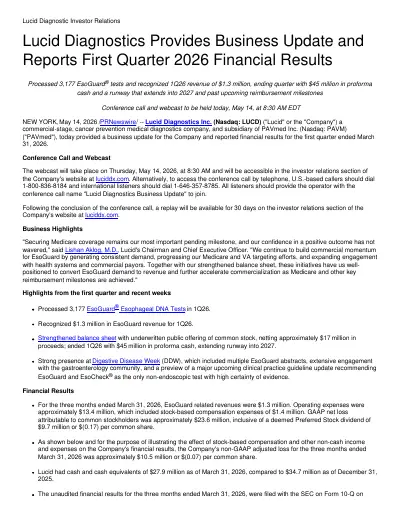
Let's begin with some key highlights from the first quarter and from recently. We performed 3,177 EsoGuard tests in the first quarter this year and generated revenue of $1.3 million.
The revenue was down slightly, but proportional to volume, which receded a bit, but remained above our target range of 2,500 to 3,000 tests, and preserving our average sales price. We also importantly strengthened our balance sheet with an underwritten public offering of common stock that netted approximately $16.8 million in proceeds.
This significantly bolstered our balance sheet, as Dennis will describe in more detail, to approximately $45 million in pro forma cash at the end of Q1. This extends our runway well into 2027, and we were encouraged by the participation of long-term institutional investors exhibiting confidence in our strategic opportunities.
This also mitigated a financing overhang and provides us with the resources that we will need to accelerate commercial efforts after we receive Medicare approval. at each of these individual tests to triage patients to endoscopy.
The outcome of this will be peer-reviewed publications that demonstrate the health care economic value of EsoGuard. Overall, in summary, lots going on, particularly on the market access and the commercial side.
Obviously, all focus is on Medicare, and as we acknowledge, joint frustration with some of the delays within the Medicare LCD process overall. We believe this is really at the end of the day systematic, and we continue to have our confidence that this is a near-term result really hasn't wavered at all.
As we've discussed before, we're not idle as we're awaiting Medicare. The commercial team continues to drive its activities, to drive patients to increase the proportion of our patients that are Medicare.
The VA activities are really off to a good start, strong engagements with our early targets of the VA centers, and we look to be starting testing and generating revenue from that in the very near future. In addition, as I've already outlined, lots of activity that allows us to aggressively build the infrastructure necessary to accelerate our health care system adoption, EHR coding, health care economics, and such.
Our direct engagements with multiple health systems across the country continues to accelerate, and we think will accelerate further once we secure Medicare coverage. With that, I'll let Dennis take over and provide an update on our financials.
Dennis McGrath
Thanks, Lishan, and good morning, every-
Lishan Aklog
to EGD only upon a positive EsoGuard test is very attractive to both the clinical team as well as the centers as a whole. Many VAs operate rural satellite VAs that are quite removed from the main centers, and EsoGuard is a very attractive option to avoid patients having to travel for EGD if they have a negative EsoGuard test.
Overall, lots of activity here. We're seeing progress.
We really look forward to further engagement across the entire VA system. major GI meeting, major annual meeting of gastroenterologists under the auspices of the American Gastroenterological Association, the AGA.
We had multiple abstracts in the near term following the successful public meeting that was held in September of last year. We continue to have ongoing engagement with leadership and other folks who are engaged in this space, and there clearly remain logistical delays with regard to putting out local coverage determinations remain, and we have expectations that they will pick up in the near future and and
Matt Riley
forward-looking statements in the press release. The business update press release and the conference call all include forward-looking statements, and these forward-looking statements are subject to
Dennis McGrath
Good morning, everyone. Obviously, we had a glitch in the pre-recorded prepared remarks, but the transition to me was at the appropriate time, I'll pick up from there.
The summary financial results for the first quarter were reported on our press release that has been distributed. On the next three slides, I'll emphasize a few key financial highlights from the first quarter, but encourage you to consider these remarks in the context of full disclosures covered in our quarterly report on Form 10-Q.
With regard to the balance sheet, cash at quarter-end March 31st was $27.9 million. On a pro forma basis including the recent April 24th financing, pro forma cash equals $44.8 million.
The average burn rate for the last four quarters, including cash interest on the debt, was $11.3 million per quarter, with the first quarter a bit higher, $12.1 million, as we made investments in our commercial teams, including sales, clinical services, and market access. You'll recall at the end of 2024, we refinanced our convertible debt into a $22 million five-year note, interest only at 12%, with a $1 conversion price, which is held by long-term shareholders.
The fair value of the convertible notes in the amount of $25.2 million at quarter-end is really the only other substantive change from the previously reported balances at the end of the fourth quarter. The fair value increase of $1.2 million in the quarter reflects a mark-to-market quarterly adjustment in parallel with the common stock price changes between the periods.
The fair value increase is also a substantial part of the first quarter expense charge of $1.9 million reflected in other income in the P&L. Shares outstanding, including unvested restricted stock awards and conversion of the remainder of the preferred shares as of last week, are approximately 203 million.
After the conversion of the preferred Series B-1 on May 6th, there was approximately 22.3 million common shares held in abeyance due to the 4.99% blockers, ownership blockers, in Series B and B-1 certificate of designation. If these abeyance shares had been issued, common shares outstanding would be around 225 million.
The GAAP outstanding shares as of March 31st of 164.9 million are reflected on the slide as well as on the face of the balance sheet in the 10-Q. GAAP shares do not reflect unvested RSA amounts, and there are no longer any preferred shares outstanding.
At present, PAVmed continues to be the single largest common shareholder of Lucid Diagnostics with ownership of approximately 15% of the common shares outstanding. Although PAVmed no longer has voting control of Lucid, PAVmed together with the board and management still have considerable influence over Lucid with approximately 25% voting interest.
Next slide, Matt. With regard to the P&L, this slide compares this year's first quarter to last year's first quarter.
I trust you'll review the information and my comments in light of the cautionary disclosure at the bottom of the slide about supplemental information, particularly non-GAAP information. Our sales team sold almost 3,200 tests, 3,177 to be exact, for the first quarter with a billable value over $8.7 million, resulting in recognized revenue of $1.3 million.
The test volume for the quarter is above the upper end of the range that we've been targeting in this pre-Medicare time period. The fourth quarter sequential comparative period of 3,664 tests had an unusually high number of one-time firefighter testing events toward the end of the period, which pushed last quarter's target range well above the norm.
With new investors once again joining us for this call, it's worth repeating what we've communicated in past quarters about revenue recognition. The key determinant in how revenue is recognized at this point in the reimbursement journey is the probability of collection.
Therefore, the fact that we are in this transitional stages of our reimbursement processes means revenue recognition for the majority of our claims submitted to traditional government or private health insurers will be recognized when the claim is actually collected versus when the patient report is delivered, invoiced, and submitted for reimbursement. As you'll see in our 10-Q, this is called variable consideration in the jargon of GAAP's ASC 606 revenue recognition guidelines, and presently there's insufficient predictive data to reflect revenue from all of our quarterly test volume at the point where the test report is delivered to the referring physician.
For billable amounts contracted directly with employers, including the VA, and that are fixed and determinable, will be recognized as revenue when our contracted service is delivered. Generally, that means when the report is delivered to the referring physician.
It's important to note that a pending Medicare approval decision impacts 40% to 50% of our testable patient population, and therefore will have a significant impact on our future revenue recognition analysis. Furthermore, for tests performed on Medicare patients with dates of service within 12 months of a final Medicare policy will also get paid within a reasonable timeframe after the policy is issued.
With regard to the remainder of the P&L, the first quarter's total OpEx on both a GAAP and a non-GAAP basis is generally flat year-over-year. As expected, there will be increases in sales team costs, which are substantially offset by decreases in G&A expenses.
This sequential decrease in total OpEx expense from the fourth quarter of about $2 million is mostly in G&A costs and one-time expenses in last quarter. The non-GAAP net loss per share of $0.07 in the first quarter is better by about $0.03 versus each of the previous three quarters.
Next slide. With regard to the operating expense, this slide is a graphic illustration of the operating expenses after eliminating non-cash expenses for the periods reflected.
Non-GAAP operating expenses of $11.7 million are basically in line with the average non-GAAP OpEx for the previous five quarters, $11.7 million versus an average of $12 million. Let me close with a few reimbursement highlights for the first quarter.
In the first quarter, we sold almost 3,200 tests, reflecting about just under $9 million in pro forma revenue at our list price of $2,749. During the first quarter, we recognized revenue of about 14% of that, and remember, $1.3 million.
Recognized revenue included about 72% from insurance claims submitted in prior quarters, the longest-dated item almost 2 years ago. Of the claims submitted in the first quarter, about 77% have been adjudicated, 23% are pending, and out of that 77% that have been adjudicated, about 31% resulted in an allowable amount by the insurance company with an average of $1,646 per test, which bumps up against the Medicare rate.
Of those denied, most fit into one of three buckets: A, deemed not medically necessary or investigational, or require prior authorization, or require additional medical records. The balance are deemed to be non-covered.
With that, operator, let's open it up for questions.
Operator
Thank you. Ladies and gentlemen, we will now begin the question-and-answer session.
Should you have a question, please press the * followed by the 1 on your touchtone phone. You will hear a prompt that your hand has been raised.
Should you wish to decline from the polling process, please press the * followed by the 2. If you are using a speakerphone, please lift the handset before pressing any keys.
One moment, please, for your first question. Your first question comes from Mark with BTIG.
Please go ahead.
Dennis McGrath
Good morning, Mark. Good
morning,
Dennis McGrath
Mark.
Hey, good morning, guys. I figured I would start with a reimbursement question.
Would love just an update as far as what you might be hearing from MolDx. As someone who covers the industry, it was nice to see Medicare coverage decision come into the space yesterday.
We know that they're still open for business. Can you just give us a sense for what you're hearing, maybe any back-and-forth?
Would love to hear any color on that topic. Thanks.
Lishan Aklog
Yep. Thanks, Mark.
We do continue to have ongoing dialogue with leadership. There is no sort of concrete or specific information with regard to where things stand.
We remain confident based on the results of the CAC meeting, and we've had follow-up conversations with regard to the CAC meeting, that this remains a logistical issue with regards to delays more broadly with LCDs coming through, as you sort of hinted. I believe the LCD you're referring to is a Novitas LCD that published recently.
Our conversations with them, as well as with others who are knowledgeable and follow this space, there is a sense, I think which is what you're hinting at, that some of the backlog with LCDs is likely to start clearing in the near term. There just to be very, very clear about the fact that nothing in our conversations has raised any concerns with regard to the substantive nature of our expectations with regard to the likelihood of the draft coming out in a positive direction.
All of that confidence is anchored in the substance of the CAC meeting, which, as we all know, is a public record of commentary that's very important in this process by physician experts across the country. We continue to view this as a logistical delay, and one that we still are highly confident will result in a positive outcome in the near future.
Perfect. It was nice to hear you guys talk about the VA activities off to a good start.
Can you just give us a sense, there are a lot of VA systems, maybe can you give a little more color about what types of dialogue you're having both either at the sort of the national level or at the local level? Then can you speak to EHR integration?
I I think that sometimes VAs have separate systems, or maybe can you give us an update, maybe they are starting to unify a bit in systems integration?
Lishan Aklog
Great, great question. Let's go a little bit through this systematic about how the VA works, particularly as it relates to molecular diagnostic tests like ours.
As you know from our previous announcement that we are now on the Federal Supply Schedule. The contracted payment rate under that schedule is the Medicare rate of $1,938.
There are a couple hundred VA centers across the country, and by being on the FSS, we have the opportunity for our team to engage with individual centers. Generally speaking, that's the starting point with regard to getting engaged with the VA is on a health center by health center basis.
Our team has a very, very deep pipeline, has had extensive outreach to the VA systems all across the country. I think I mentioned on our last call that the internal process by which we are engaging with the VA includes our entire sales team, generating leads, generating connections with and engagements with clinical champions within their own region, but we've also centralized.
We have two senior members of our team that are focused nationally on sort of a strategic accounts manner with individual VAs. Those conversations, as we noted, and engagements are going really well.
The pipeline's robust. We have a number that are going through the process of working with the individual VA centers.
The way this works is you ultimately generate a PO that is for a number of tests, and then we work out the logistics with the clinical team in the center as a whole with regard to the cell collection part of it. We've received our first PO, which is great, and look forward to beginning testing at our first target, and there are actually many more along the way.
The VAs, obviously operate within the overall federal budget, and they all have their individual budgets. When we work with the VAs, this is somewhat analogous to how we engage with other health systems, with other health systems, private or otherwise.
We do have to work in this case within their budget. Our opportunity between now and the end of the federal fiscal year is in fact to generate POs which would be off-budget, but in parallel, we're having conversations to be on the full budget for the next fiscal year as part of those parallel processes.
The federal fiscal year starts on October 1st. Really overall, again, very positive, really really good engagement.
The engagements with the clinical champions has been excellent. We've talked previously about the fact that there are some very unique aspects to the VA that enhance our ability to engage with clinicians.
The VA tends to have a population that is higher risk with regard to these conditions and also is often resource-constrained with regard to the number of EGDs. The value, the clinical utility, and the economic value of EsoGuard as a triage test to the more expensive and more complicated invasive endoscopic procedure is a very attractive value proposition.
Another aspect is that the VAs often operate rural centers that are actually quite remote from the main center, and that's another obviously very classic opportunity for a non-invasive test to prevent patients from having to travel to the main center. One other aspect is that most VAs are partnered with academic medical centers.
Many of the same physicians that were in discussions with the health systems underlying academic medical centers are the same physicians or partners of the same physicians who operate at the VA, and that's been a very useful aspect of these relationships, and obviously ultimately will help us within that health system as well. EHR integration with the VA is really not a major factor.
I think you point out the fact that there's a lot of work, I believe, to integrate their systems, but in the individual health systems, it's much less of a factor than it is outside the VA system in our traditional commercial engagements, which we've discussed in our last call, happy to talk a bit more about that.
Okay. That makes perfect sense.
One last question for me. I believe you are coming up on your one-year anniversary of signing Highmark Blue Cross Blue Shield a year ago.
In recent calls, you've had some really nice commentary about dialogue you're having with commercial payers. Can you just give us a sense for what that dialogue has been like the last number of weeks or so?
I'd be curious if some of these commercial payers might be perhaps waiting for CMS to move first, or do you think that you could sign some even without CMS?
Lishan Aklog
Yeah. That actually had been our stance and, frankly, our position and our expectation was that really for us to get any meaningful traction on the commercial realm that we would have to wait for Medicare.
There certainly are a subset, and maybe even the majority, of payers where we would view that as a catalyst or accelerant to advance our conversations and secure coverage. However, as we sort of introduced previously, that hasn't been the case for others.
One very interesting and potentially productive pathway that we are pursuing is engaging with certain payers who have published on their own EGD endoscopy policies that explicitly reference EsoGuard as an appropriate triage test that drives the indication for endoscopy. That activity, which we highlighted in the last couple of calls, is very active.
There's a whole process that you go through. This is separate from the laboratory benefit manager process, which I'll touch on in a second.
That activity involves credentialing as well as engaging in contracting, and that's a process that we are actively pursuing with the payers that have published coverage policies that include EsoGuard as a triage test for endoscopy. With regard to the laboratory benefit manager side of things, again as we've talked about before, we continue to have positive engagements with laboratory benefit managers.
As we previewed last time, and will reiterate today, we have secured our first coverage policy with a laboratory benefit manager. It's not public yet, but it will be public in the next couple of weeks, and we expect after that's public that plans under that LBM will also publish their own positive coverage policies.
Again, I think I mentioned this last time, we've had very good conversations with one of the largest LBMs on a pathway forward for coverage.
Great. Thanks, guys, for the time.
Lishan Aklog
Thanks, Mark.
Operator
Your next question comes from Kyle with Canaccord. Please go ahead.
Lishan Aklog
Morning, Kyle.
Hey, guys. Morning.
Why don't I just start where we typically start off with and ask about the percentage of claims that are represented by the Medicare segment? We think the increasing portion of the test that you guys report still kind of probably below 20% of the total claims, but how is that?
Where's that stand now? When you think about some of your efforts to either increase the sales team in favor of more Medicare-focused reps or maybe train them or incentivize them a little bit more to kind of increase that segment of the market a bit more, how is that progress as well in light of the increased percentage ducked in mix as well?
Lishan Aklog
I'll let Dennis touch on the numbers, and we can fill in some of the operational side as well.
Dennis McGrath
Kyle, I'll call it the government group, which is predominantly Medicare, Medicare Advantage, was 13% in the first quarter. As you'll recall, in the fourth quarter, it was around 15%.
That 2% delta is around 60-some tests. The compensation plans for the sales team, and Lishan will expand upon this, is focused on predominantly the revenue-generating components of the target population.
That is contracted revenue as well as Medicare and VA. That's where their focus is on in generating test volume, we're in that transition phase.
Lishan Aklog
As it relates to allocating resources, we've stated on several occasions our commitment to not add resources and not meaningfully increase our OpEx. What our team is really doing is a balancing act between a target of maintaining our test volume and slightly exceeding it, which is most efficiently done through these increasingly contracted health fair events, while positioning ourselves so that once we get Medicare, that we can aggressively drive up that percentage.
On a quarter-to-quarter basis until we get Medicare, we're not expecting that number to rise dramatically because the team is sort of in parallel focused while with the same level of resources at maintaining our overall test volume.
That's interesting. That's good color, guys.
Thanks. Then on the Dennis, you provided a bunch of numbers, and you do this every quarter, I think, around the percentage of claims you're recognizing revenue on, then the percentage that's adjudicated, what's actually paid on there, what's the ASP there.
How have some of those metrics kind of changed over time? I don't have all of them in front of me.
I'm just curious if to the earlier point, if obviously non-Medicare payers are getting more comfortable with this product, or are they almost waiting and I see and maybe payment or a kind of ASP in that segment is actually reducing because just the waiting is kind of taking longer than maybe was communicated maybe? Just if that makes sense to you, if you could give a snapshot of how that's progressed.
Dennis McGrath
It's still pretty volatile, and it's difficult to make sense on those that don't have a specific program or don't have consistency in payment. The first quarter certainly clouds or increases that volatility because you have an increased amount of deductibles and copays, where patient burden in the first quarter is heavier than it would be in the balance of the year, which influences what we get paid from some of those insurers.
Even where we see some pluses and minuses in the first quarter versus, say, the third or fourth quarter, we still have to rely upon cash collection for the revenue recognition, and there is really not a sufficient pattern to give you an adequate answer to your question yet. Those patterns are still developing.
Fair enough. Finally, we see where R&D is coming in each quarter.
It's been pretty consistent, $1 to $2 million in expenses.
Are you guys either still doing or thinking about generating clinical evidence, either in a worst-case scenario with MolDx, which doesn't sound like it's happening, but just obviously worst case,
Lishan Aklog
or
if you want to go for FDA or things like or just kind of enhance the acceptance, or just curious if that line item could maybe expand over time?
Lishan Aklog
Yeah. The answer is a definite yes, but I'd like to emphasize the fact that our commitment to ongoing data generation, ongoing clinical evidence is not connected to the fact that we believe that we have sufficient evidence to secure the LCD.
We are a data-driven company. We firmly believe in expanding our clinical evidence on an ongoing basis.
There is a lot of activity. Doesn't get a lot of attention because we're all very much focused on the reimbursement side, but there are ongoing clinical studies.
There are ongoing institutional clinical studies. There's an active NIH study going on right now.
We have a registry. We've been collecting real-world evidence.
It would be a long conversation, but there is an interesting dynamic right now, now that we're well out from the courts vacating the FDA LDT rule, as to what the advantages of engaging with the FDA may be for single-laboratory tests. We're certainly aware of those, and we're crafting our longer-term strategies in relation to the fact that that landscape is settling a little bit, and certainly our longer-term goals with regard to generating clinical evidence is fundamentally informed by that.
Great. If I could just add on to that just briefly, years ago, I think your guys' intention was to scalp the collection device and the test internationally, globally.
They're both CE marked in Europe, obviously. How much more extra clinical evidence would be needed for some kind of an international expansion, maybe some kind of decentralized model with a partner or distributed model with a partner?
Is that part of the kind of formula as you look maybe medium to long term?
Lishan Aklog
I just let's make maybe we could separate the clinical evidence question from the international market question. Our clinical evidence is not is not a limiting factor for us to to the potentially expand internationally.
We, we've looked from day one at opportunities in internationally, both in Europe, as you noted, we went ahead and got CE mark right off the bat from the early the earliest days. The challenge is, the US is obviously the the largest market opportunity.
We're we remain a a small company. We have limited resources.
That we we certainly are expect certainly would expect to focus our resources in the in the near term. Europe is a very difficult market for screening tests because of the overall economics of of their socialized health system.
When we've looked at this in the past, it's just simply has not made sense, and I believe even many of the larger companies, their traction in Europe is molecular diagnostics companies is is more limited. That said, we do on a regular basis get inbound inquiries from, I think as you were suggesting, from commercial entities in in various OUS countries for the opportunity to partner.
We've had some from Canada, South America, the UK, and we engage in those conversations, and we've explored every one each of them as whether that's something that with limited resources on our part, we could engage in in in activity in those markets with the help of a local partner. None of those have really come to fruition.
None of them have really have made have made sense from an overall business strategy point of view. It's certainly something we're we're open to.
Again, those activities are really related to the to the local sort of economics the the dynamics in these regions and countries. It's not really It doesn't really inform our clinical evidence plan.
That's really related to our US efforts.
Got it. Okay.
That's helpful. Thanks, guys.
Appreciate it.
Lishan Aklog
All right. Thanks, Kyle.
Have a good day.
Operator
Your next question comes from Michael with Needham. Please go ahead.
Lishan Aklog
Morning, Mike.
Michael Matson
Hey. Thanks for taking my questions.
I guess just the DDW presence that you guys had, can you maybe comment on kind of interest level you're seeing from physicians, any kind of feedback, etc.? Yeah.
Lishan Aklog
I'm just chuckling a little bit here, Mike. Thanks for bringing that up, because that was the portion of the pre-record that got garbled.
I'm happy to have the opportunity to fill that. DDW went great.
For those who are on the call who are not aware of this, DDW is the largest gastroenterology meeting in the country, one of the two or three major ones here in the US. We had a very strong presence there, both from our commercial team and our clinical team, lots of engagement with clinicians, just overall was frankly, our best conference ever, just very there's a lot of just generalized increased attention, increased buzz around esophageal precancer screening, about Barrett's esophagus in particular, on multiple fronts, and we very much benefited from that in our engagements, and they were very positive.
We had a significant presence on the academic side. There were multiple abstracts that related to EsoGuard that were very overall very well-received.
One of the highlights of the meeting, in addition to all of that, was that the American Gastroenterological Association presented a preview of upcoming update, a draft of their updated guidelines, clinical practice guidelines for Barrett's esophagus. We're very excited about that.
They, for the first time, at least in this preview, they highlight individual non-endoscopic tests including EsoGuard and EsoCheck by name, and they evaluated the clinical evidence for accuracy, the certainty of the evidence. EsoGuard and EsoCheck were presented as having high certainty of evidence, and it was the only one.
The rest of the potential future modalities were rated as low. Now this is a preview, it's a draft, but there was a lot of excitement, a lot of buzz around this.
Obviously, guidelines are a very important driver, an important part of our engagements, particularly with commercial payers, and having this finalized in this form will be an overall boon to us.
Michael Matson
Great. Then just a few financial questions.
I guess, Dennis, the share count, what should we be modeling? I think you said post-offering it's 203 million, but there's the 22 million in abeyance.
I'm not sure if we should be including that in our share count or not for now.
Dennis McGrath
The 203 is the number you should model your EPS on. The remaining 22 million shares will be issued once the holders' 4.99% limitation is lowered, either by distributing it to their members or if the share count goes up.
I think 203 for the time being is probably the right number,
Michael Matson
but
Dennis McGrath
in the future, that additional 22 million that they're owed to those investors will be issued. These are long-term shareholders, it may be a while before they get issued, but nonetheless, they're out there.
But 203 is probably the right number to use for your EPS modeling.
Michael Matson
All right. Then the quarterly cash burn rate, given that you did raise some additional capital and you're getting closer to the Medicare coverage, is there any potential that that would go up, or are you expecting to kind of hold it around recent levels?
Dennis McGrath
I think the burn rate at where it is right now is probably the level it will stay. Yes, we will be making additional investments.
We do think some of that cost, if not all of that cost, will be offset by revenue opportunity, either collections or increased volume, as we move forward with increased reimbursement landscape.
Michael Matson
Okay. Great.
Thank you.
Dennis McGrath
Thanks, Mike.
Operator
Your next question comes from Jeremy with Maxim. Please go ahead.
Good morning,
Lishan Aklog
Jeremy. Yeah.
Good morning. Thank you for taking my question.
Just related to the VA, I think I inferred, and correct me if I'm wrong, that in the first quarter, there was no contribution to both volume or revenue from the VA opportunity from that contract?
Dennis McGrath
The first quarter, you remember the announcement was in late January, and the first quarter was focused on pipeline metrics and building a pipeline, converting engagement into purchase orders, you'll see more of that as the year unfolds, but that's correct in the first quarter.
Okay. Okay.
Understood. Then just also is the reimbursement from the VA contract, that's completely separate from Medicare, right?
That's the $1,900 rate for the test, you'll get reimbursed through the VA system regardless of when you get the CMS reimbursement. You could go full steam ahead on that opportunity?
Lishan Aklog
That's correct. It's direct payment through the VA.
Obviously, we're appreciative that we were able to secure the same rate as Medicare, but the process is entirely separate from Medicare, and it's just directly comes through the VAs with POs that get invoiced and paid. It's like direct billing.
POs, PO and invoicing.
Right. No, no, that's great.
Maybe also I don't know if you have this number. How many, let's say, we'll call it covered lives you have currently based both the VA, I think you mentioned last call that was roughly 9 million lives, and then maybe the commercial payers that you have also under contract now?
How many covered lives then if and when hopefully when you get the Medicare, what would that increase to?
Lishan Aklog
That's a bit of a multifaceted sort of question there, right? The VA, as you mentioned, is 9 million 9 million patients, and we'll be able to target that.
That's available to us right now. Medicare, the epidemiology of the conditions that lead to a recommendation for testing, the target population is at least approximately 50% Medicare, and once we have Medicare coverage, there's no reason we can't, as others have done, expand beyond that number.
Medicare, I believe, represents 60 60 to 80 million people overall. That's that.
On the commercial side, we haven't yet reached the level. We're still in the early stages with contracting and with coverage and contracting, we have not reported on covered lives.
Once this first LBM, laboratory benefit manager, coverage policy is publicized and we hear from the payers that outsource their technical assessments to that LBM, we'll be able to start discussing covered lives. It's a bit premature to do that on the commercial side.
Okay. Understood.
Then just last question, how should we look at your sales force productivity currently versus let's say what it was a year ago, the sales learn cycle, especially considering now I think you've said on the call your entire sales team is also engaging with the VA, and there's new I guess job descriptions they have, they're new, how should we look at that?
Lishan Aklog
I think productivity solid, has gone up over the years. We have a increasingly tenured and increasingly experienced staff.
What we're asking them to do is sort of juggle multiple things at the same time, right? To maintain the test volume, to find opportunities within the VA system that they can hand over to our national director on that.
Productivity as a whole is great, and I think, as we mentioned, we have been positioning ourselves with regard to the composition of our team to have some more senior-level folks so that when the time comes to expand the team, that we'll be able to do so and in sort of the most efficient way to maintain that productivity as we expand our team.
Great. Thank you for taking my questions.
Enjoy the rest of your day.
Lishan Aklog
Thanks, Jeremy.
Operator
Your next question comes from Edward Woo with Ascendiant Capital. Please go ahead.
Lishan Aklog
Morning, Ed.
Edward Woo
Congratulations on the progress. My question is on the Medicare reimbursement rate.
Is there any opportunity to increase it over time?
Lishan Aklog
We have no plans to do so. The whole Medicare fee schedule process is a complex one, but we have no particular plans to pursue that.
We're quite happy with that rate, and we feel we can build a very robust business under these rates.
Edward Woo
Great. That's all the questions I have.
I wish you guys good luck. Thank you.
Lishan Aklog
Thanks, Ed.
Operator
There are no further questions at this time. I'll turn the call back over to Dr.
Lishan Aklog.
Lishan Aklog
Great. Thanks, operator, and thank you all for taking your time and for your attention this morning.
Again, apologies for the technical glitch that led to me being cut off. I appreciate the opportunity.
Obviously, great questions, as always, from our analysts, and appreciate the opportunity to fill in some of those gaps. I hope you all found this dialogue informative.
Again, just obviously we're acknowledging and sharing some of the frustrations with regard to the logistics around the LCD process. Just continue to reiterate our confidence has not wavered that this is a near-term positive outcome.
Again, as we've said repeatedly, as we await the draft LCD, we're not resting on our laurels. We're very encouraged by our efforts on multiple fronts: our engagements with the VA, our securing of our first positive coverage policy from a laboratory benefit manager, and great opportunities on the commercial payer side, as well as something we didn't spend as much time on today, that is progressing very nicely, which is our engagement with a series of major health systems.
Obviously, we came out of the DDW meeting very energized and feeling very very positive about the prospects of an updated guideline that enhances our position within this field. Thanks again.
As always, we encourage you to keep abreast of our progress. Please follow our news releases, these update calls, and on our website and social media, and feel free to reach out to us if you have any questions.
Thanks again, everybody, and have a great day.
Operator
Ladies and gentlemen, this concludes today's conference call. Thank you for participating.
You may now disconnect.