Lucid Diagnostics Inc.
NNASDAQ:LUCDQ2 FY2026 · Earnings Call TranscriptAugust 13, 2026
Operator
Good morning, ladies and gentlemen, and welcome to the Lucid Diagnostics Second Quarter 2026 Business Update Conference Call. At this time, all lines are in listen-only mode.
Following the presentation, we will conduct a question-and-answer session. If at any time during this call you require immediate assistance, please press *0 for the operator.
This call is being recorded on Thursday, August 13th, 2026. I would now like to turn the conference over to Matt Riley, Lucid Diagnostics Vice President of Investor Relations.
Please go ahead.
Matt Riley
Thank you, operator, and good morning, everyone. Thank you for participating in today's business update call.
Joining me today on the call are Dr. Lishan Aklog, Chairman and Chief Executive Officer of Lucid Diagnostics, along with Dennis McGrath, Chief Financial Officer.
The press release announcing our business update and financial results is available on Lucid's website. Please take a moment to read the disclaimers about forward-looking statements in the press release.
The business update, press release, and conference call all include forward-looking statements, and these forward-looking statements are subject to known and unknown risks and uncertainties that may cause actual results to differ materially from statements made. Factors that could cause actual results to differ are described in the disclaimer and in our filings with the SEC.
For a list and a description of these and other important risks and uncertainties that may affect future operations, see Part I, Item 1A entitled Risk Factors in Lucid's most recent annual report on Form 10-K filed with the SEC, and any subsequent updates filed in quarterly reports on Form 10-Q and subsequent Forms 8-K. Except as required by law, Lucid disclaims any intentions or obligations to publicly update or revise any forward-looking statements to reflect changes in expectations or in events, conditions, or circumstances on which expectations may be based, or that may affect the likelihood that actual results will differ from those contained in the forward-looking statements.
I would now like to turn the call over to Dr. Lishan Aklog.
Lishan Aklog
Thank you, Matt, and good morning, everyone. Thank you for joining us today and for your continued engagement and support.
We continue to make strong progress across key commercialization initiatives as we await Medicare draft LCD publication, and we're eager to discuss these today. Let's begin with some key highlights from the second quarter and recently.
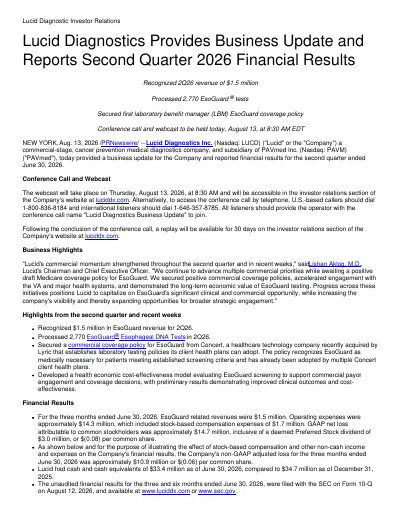
This quarter, our laboratory performed 2,770 EsoGuard tests, and we recognized $1.5 million in revenue. Revenue is up about 17% from the prior quarter, and our volume remains within our target range of approximately 2,500 to 3,000 tests.
This reflects increased commercial focus on testing opportunities that are likely to drive revenue. In addition, we secured our first laboratory benefit manager commercial coverage policy from Concert.
The Concert policy has already been adopted by multiple client health plans. This is a major commercial coverage milestone and represents third-party review of EsoGuard's clinical evidence.
Concert concluded that EsoGuard is medically necessary for patients meeting established screening criteria, and that the evidence definitively demonstrates improved health outcomes. We'll talk more about Concert and the significance of this policy shortly.
Now let's turn to key updates related to market access and commercialization. With regards to Medicare, we continue to wait for publication of our draft LCD, but we remain confident that we will secure a positive draft policy.
We do note that there has been a broad backlog at CMS with regard to LCD output, but, however, there does seem to be a sign that that backlog may be loosening. Several long-awaited LCDs have been posted in recent weeks.
With regard to the VA, this remains a very large opportunity for us, and the process is progressing very well. Our team has built a robust, high-quality pipeline of VA centers across the U.S., and most notably, our clinical engagement has been extremely positive.
We're essentially getting no pushback from the clinicians. The team is making progress in translating those clinical engagements into contracts.
A key focus is securing contracts for the new federal fiscal year, which begins on October 1st. Next, I'll try to provide some additional context on Concert and our commercial coverage updates.
As anticipated, last week Concert issued positive coverage policy for EsoGuard, representing our first laboratory benefit manager or LBM coverage policy. They specifically covered our test, but noted that other esophageal precancer tests that were evaluated were considered investigational due to insufficient evidence.
Let's talk a little bit about how laboratory benefit managers work. Laboratory benefit managers concentrate the technical assessment of molecular diagnostic tests into single entities, and client health plans contract with them in order to write coverage policies.
Three of Concert's client plans have adopted our policy, with several more expected to do so in the coming months. Not all plans permit public announcements, we won't necessarily be presenting that publicly.
Now the plans that have adopted the policy are somewhat concentrated, and securing these regional commercial plans enhances our ability to allocate resources accordingly. We continue to be actively engaged with all the other laboratory benefit managers, and we do feel confident that the Concert policy will set a precedent for others.
Moving on to healthcare economic research, unlike with Medicare, an important tool for commercial coverage is demonstrating cost-effectiveness. We have partnered with the lead author of the American College of Gastroenterology guidelines, and have developed a sophisticated cost-effectiveness model working alongside HEOR experts and international key opinion leaders in Barrett's esophagus and esophageal cancer.
This model compares the long-term clinical and economic impact of EsoGuard screening versus current care across the at-risk population. It's very important to take a long-term view with these cost-effectiveness models, particularly in screening, where the benefits of early detection can take years to emerge.
The model assessed the impact on disease detection, on esophageal cancer stage shifting, esophageal cancer avoidance, and esophageal cancer-related mortality. This information helps payers assess whether the clinical benefits of EsoGuard justify the costs.
The model is expected to be completed this summer, but the preliminary results are actually very encouraging and show positive clinical impact, with EsoGuard appearing as cost-effective compared to current care. Another key area of focus is our engagements with health systems.
There's extensive health system work underway and is a major part of our commercialization strategy. We're translating those initial conversations into active implementation work.
The lead time with this can take a bit of time, but we're starting to see results from it. Part of the work involves tailoring the clinical workflow, supporting patient identification, ordering, and results.
The EHR plays a particular important role in health systems with regard to automated patient identification, streamlining patients within the health systems towards EsoGuard testing as appropriate. To summarize, we really are getting meaningful traction across market access and our commercialization efforts.
We haven't been idle as we await Medicare coverage. Obviously, Medicare coverage remains our most important near-term milestone, and we remain confident that we will secure a positive draft policy.
Our VA work, as I noted, is progressing well, and we expect that success to build in the new budget cycle and contribute to future revenue growth. Commercial coverage, economic evidence, and health system infrastructure are all advancing extremely well.
Collectively, this progress is increasing Lucid's visibility and creating interesting opportunities for broader strategic engagements. With that, I'll turn it over to Dennis for the financial update.
Dennis McGrath
Thanks, Lishan, and good morning, everyone. The summary financial results for the second quarter were reported in our press release that has been distributed.
On the next three slides, I'll emphasize a few key financial highlights from the second quarter, but I encourage you to consider these remarks in the context of the full disclosures covered in our quarterly report on Form 10-Q. With regard to the balance sheet, cash at quarter-end June 30th was $33.4 million, which is essentially flat with the year-end balance.
We completed a common stock offering during the quarter with net proceeds of about $16.8 million. The average burn rate for the last four quarters, including cash interest on the debt, was $11.6 million per quarter, with the second quarter a little bit lower at $11.3 million.
Our $22 million secured convertible debt is a five-year note, interest-only at 12%, with a dollar conversion price, which is held by long-term shareholders. The fair value of the convertible notes in the amount of $23.5 million at quarter-end is really the only other substance change from the previously reported balances at the end of the year and also at the end of the first quarter.
The fair value decrease of $1.7 million in the quarter reflects a mark-to-market quarterly adjustment in parallel with the common stock price changes between the periods. The fair value decrease also is a substantial part of the second quarter income pickup of $1 million reflected in other income in the P&L.
Shares outstanding, including unvested restricted stock awards and the earlier conversion of the remainder of the preferred shares, are approximately 203 million. After the conversion of the Series B-1 preferred shares on May 6th, there were approximately 22 million common shares held in abeyance due to the 4.99% ownership blockers in the former Series B and B-1 certificate of designation.
If these abeyance shares had been issued, common shares outstanding would be around 225 million. The GAAP outstanding shares as of June 30th of 190.8 million are reflected on the slide as well as on the face of the balance sheet in the 10-Q.
GAAP shares do not reflect unvested RSA amounts, and there are no longer any preferred shares outstanding. At present, PAVmed continues to be the single largest common shareholder of Lucid Diagnostics, with ownership of approximately 15% of the common shares outstanding.
Although PAVmed no longer has voting control of Lucid, together with the board and management, still have a considerable influence over Lucid with approximately 25% voting interest. With regard to the P&L, this slide compares this year's second quarter to last year's second quarter and year-over-year on certain key items.
Trust you'll review the information in my comments in the light of the cautionary disclosure at the bottom of the slide about supplemental information, particularly non-GAAP information. Our sales team sold 2,770 tests for the second quarter with a billable value over $7.5 million, resulting in recognized revenue of $1.5 million.
The test volume is within the range we have been targeting in this pre-Medicare time period. With new investors once again joining us for this call, it's worth repeating what we've communicated in past quarters about revenue recognition.
The key determinant how revenue is recognized at this point in our reimbursement journey is the probability of collection, and therefore, due to the fact that we are in the transitional stages of our reimbursement process, means revenue recognition for the majority of our claims submitted to traditional government or private health insurance will be recognized when the claim is actually collected, versus when the patient's report is delivered, invoiced, and submitted for reimbursement. As you'll see in our 10-Q, this is called variable consideration in the jargon of GAAP's ASC 606 revenue recognition guidelines, and presently, there is insufficient predictive data to reflect revenue from all of our quarterly test volume at the point where the test is delivered to the referring physician.
For billable amounts contracted directly with employers, including the VA, and that are fixed and determinable, will be recognized as revenue when our contracted service is delivered. Generally, that means when the report is delivered to the referring physician.
It's important to note that a pending Medicare approval decision impacts 40% to 50% of our addressable patient population, and therefore will have a significant impact on our future revenue recognition analysis. Furthermore, for tests performed on Medicare patients with dates of service within 12 months of a final positive Medicare policy, we'll also get paid within a reasonable timeframe after the final policy is issued.
With regard to the remainder of the P&L, the second quarter's total OpEx on both a GAAP and a non-GAAP basis is slightly higher than the first quarter by about 5%, reflecting expected increases in commercial activities, including headcount, sales personnel, clinical service staff, and market access. The non-GAAP net loss per share of 6 cents in the second quarter is better by about a penny sequentially and about 4 cents versus each of the previous three quarters prior to that.
With regard to our operating expenses, this slide is a graphic illustration of our operating expenses after eliminating non-cash expenses for the periods reflected. Non-GAAP operating expenses of $12.3 million are basically in line with the average non-GAAP OpEx for the previous five quarters, that is $12.3 million versus an average of $12.2 million for those five quarters.
Let me close with a few reimbursement highlights for the second quarter. In the second quarter, as mentioned, we sold almost 2,800 tests, reflecting about $7.6 million in pro forma revenue at our list price of $2,749.
During the second quarter, we recognized revenue of about 19% of that amount, or $1.5 million. Recognized revenue included about 35% from insurance claims submitted in the prior quarters, with the longest-dated item over two years ago.
Of the claims submitted in the second quarter, about 65% have been adjudicated, and 35% are pending. Out of the 65% that have been adjudicated, about 28% resulted in an allowable amount by the insurance company, with an average of $1,424 per test.
Of those denied, most fit into one of three buckets: a) deemed to be medically not necessary, or investigational; or b) require a prior authorization; or c) require additional medical records. The balance are deemed to be non-covered.
With that, operator, let's open it up for questions.
Operator
Thank you. Ladies and gentlemen, we will now begin the question-and-answer session.
Should you have a question, please press the * followed by the 1 on your touchtone phone. You will hear a prompt that your hand has been raised.
Should you wish to decline from the polling process, please press the * followed by the 2. If you are using a speakerphone, please lift the handset before pressing any keys.
We ask that you limit yourself to one question and one follow-up question. Your first question comes from Kyle.
Please go ahead. Good morning, Kyle.
Lishan Aklog
Morning, Kyle.
Hi, this is Alex [Toukasen?] on line for Kyle Mikson.
Thank you for taking our questions, and congratulations on the quarter. The test volume remains essentially within the bounds of the guidance you've given us previously, so that comes to no surprise, really.
How did the VA factor into test volume during the quarter? Thanks.
Lishan Aklog
The VA has not yet contributed meaningfully to the test volume. We're still in the process of engaging with the centers, and working through budgets and contracting, and we're really in that phase.
That's going well. We're starting to secure contracts, and we'll start to see the VA contribute to our volume moving forward.
Makes sense.
Looking at operating expenses, you noted there was an uptick during the quarter reflecting increasing commercial activities. Given the tentative timing of the draft and final LCDs, can you just discuss plans to potentially accelerate SG&A in the next few quarters?
Lishan Aklog
Let me just start. As we've discussed before, as we're awaiting Medicare, we have been, over the past couple of quarters, making some updates to our commercial infrastructure in order to be ready to accelerate our commercial activities upon securing broader reimbursement.
That involves shifting some of our commercial personnel to more senior personnel so that we'll be able to scale more readily, and adding a modest amount, as Dennis mentioned, to the overall commercial headcount. Dennis, did you want to add anything?
Dennis McGrath
Sure thing. Implicit in your question is also the implication in terms of burn and capital requirements.
It's important to note, when you think about that, yes, we are going to increase headcount, we are going to increase programs and take advantage of the reimbursement landscape as it improves. Because we have a roughly $2,000 test and a 90% margin for the next patient in the door, you're not going to have the incremental burn that you otherwise would have if this was a 50% margin test at a lower price point.
One of the favorable things, or tailwinds, if you would, is just that: the test price, the margin, and that yes, we are going to increase our OpEx, but it won't have the direct correlation to the burn that otherwise might have.
Lishan Aklog
If I could also add one other thing, Alex, which is that, as you'd sort of said in your first question, we do expect to start seeing the impact of our efforts at the VA, as well as our efforts on the commercial payer side as we start to secure coverage policies and ultimately translate those into contracts and allocate resources accordingly. It's also in preparation for increased commercial activity related to the VA and the commercial side as well.
One last one for me. You recently contracted with your first LBM, efforts of which you alluded to during our discussions earlier this year.
Can you just elaborate a bit more on this news, as well as the potential you could bring on additional LBMs into the fold in the near term prior to Medicare coverage? Thank you.
Lishan Aklog
Thanks, Alex. I think the first part was just elaborating on the LBM itself and what that means, and then how this may serve as a launchpad for future.
Is that correct?
Yes, thank you.
Lishan Aklog
Yeah. Great.
We're quite excited about this. Maybe just a bit of an additional primer on how the system works.
The diagnostic industry on the commercial coverage side has laboratory benefit managers, where they concentrate the technical expertise in assessing complex molecular diagnostic tests like ours, and client health plans, regional as well as national plans, contract with these laboratory benefit managers to write coverage policies on their behalf. This is a very big first step for us, as it's our first laboratory benefit manager, Concert.
We're quite excited that the coverage policy that they wrote makes it clear that EsoGuard is medically necessary, and really validates the bulk of our clinical evidence in support of that. It did so looking at the entire landscape of potentially other products, and found that only ours had sufficient evidence to justify that.
That was a big step, and further validation of its importance is that three of client plans for Concert, almost essentially immediately published their own coverage policies in sync with that, and we expect several more to come. This gives us an opportunity, as I mentioned in my prepared remarks, since often these plans tend to be regionally concentrated, it gives us the opportunity to allocate resources in a geographic fashion consistent with that.
The second part of your question is also extremely important. It's always important to get sort of the first one under our belt in conversations with other plans and with other LBMs.
Obviously, a very common question is who else is on board. Having Concert on board will certainly help us, and has had a positive impact on our ongoing discussions with other LBMs.
Thank you, team, for your explanations. Appreciate it.
Lishan Aklog
Thanks, Alex.
Operator
Your next question comes from Mark with BTIG. Please go ahead.
Dennis McGrath
Morning, Mark.
Lishan Aklog
Hi, Mark.
Hey, guys, how's it going? Thank you for taking the questions.
I guess the first one, just maybe asking about CMS. I completely understand there's been a long queue for several years.
I just wanted to maybe ask, I know there was at least one person who changed or is about to change his role at Palmetto GBA. I'm just curious if you think any of the personnel change might have any impact to your weight in front of Medicare?
Lishan Aklog
We don't think so. As we've said before, we've been in close communication with the leadership at MolDx, and we obviously do our best to try to understand, to the best of our ability, what may be going on behind the scenes.
We feel quite confident that things are in the late stages, and that the work that went into getting us this far, all the way through the CAC meeting and beyond, is already sort of built in, baked in. It's our understanding, to the best of our ability to ascertain, that as you hinted at the beginning of your question, that there has been a bit of a prolonged backlog with delays in processing LCDs coming out of the MACs, including MolDx and at CMS.
There's a sort of broad sense within the community that this may be loosening up, as a couple of long-awaited LCDs that apparently were using up significant amount of the bureaucratic bandwidth have come to fruition over the last couple of weeks. We're hopeful that that loosening will accelerate the process of processing our LCD.
Great. Then, congrats again on getting Concert over the goal line.
I guess, can you just remind us It looks like three of the plans have followed their coverage. If you could remind us how many plans look to Concert, and if all of them converted, do you have a sense for how many covered lives that could mean?
Lishan Aklog
Under Concert, there are numerous plans under Concert, leading to just under 10 million covered lives. All I can really say publicly is that three are on board, we expect a couple more in the coming quarters, and then ultimately, we have every reason to believe that all of the client plans will ultimately mimic the coverage policy of the LBM.
Perfect. If I can sneak one last one in.
I just want to make sure that you're still planning to move in line with your target of 2,500 to 3,000 tests per quarter. Then I wanted to get a sense for how some of the activity is going, just generally, with firefighters, and also with some of the more typical initiatives in primary care type clinics.
Lishan Aklog
Yeah. So, yeah, I think for now we're still targeting that range as we prep behind the scenes, and kind of make the modifications behind the scenes that I had mentioned in my in my earlier response.
I think the trigger for us to start trying to drive up that volume by increasing our resources will really depend on, obviously, the the big trigger would be securing our draft coverage policy, but also the parallel efforts and traction at the VA, and on and with our commercial plans will will obviously influence influence that as well. As we, as we've talked about previously, the mix of our of that volume, even though we kind of report a fairly steady number quarter to quarter, we're we're trying to shift that.
That that earlier that was dominated by the health fair type events that that you had described, that you that you were hinting at, the firefighter events, as those were the most efficient ways for us to generate the test volume that we need to to to draw claim submissions and drive and support our engagement with commercial payers. Behind the scenes, as we've talked about previously, we have been making adjustments to our commercial strategy, our incentive plans, and so forth to start shifting that volume back towards more traditional engagements with primary care physicians and gastroenterologists, and as well as we've described, health systems as well.
That is that is that is working. We've also started to see also have been pushing the team to shift more of our health fair events towards contracted plans where we where we have confidence in assurance that we'll get paid for.
That and that progress that that's progressing as well. As you note as you may note that our revenue this quarter was up, even though our test volume was flat, and it's a reflection of that of those kind of those behind-the-scene efforts.
Dennis, do you want to add anything to that?
Dennis McGrath
Sure thing. Mark, maybe just a little bit more granularity, just expanding on what Lishan said.
Our comp plans are now more heavily weighted towards what the team's calling MVAC: Medicare, VA, and contracted revenue. The contracted revenue would include firefighters and self-insured employers.
It's an emphasis on getting paid. When you look at the totals, 2,800 tests in the quarter, just under 40% fit that category, and that's up substantially from the previous quarter.
The government insurance, which include Medicare, Medicare Advantage, Medicaid, TRICARE, and the VA, is about half of that, and the direct contracting is the other half. As Lishan said, the VA presently is not contributing to the test volume, but the VA is more about obtaining purchase orders and pipeline building until the new budget year in October.
Test volume from those purchase orders is forthcoming, and that will contribute to the mix. If that gives you a little bit more color in terms of the split on the volume, but it is increasing in terms of the concentration on the MVAC commercial efforts.
Yep, that's really helpful. Thanks, guys, very much.
Dennis McGrath
Thanks, Mark.
Operator
Your next question comes from Mike with Needham. Please go ahead.
Lishan Aklog
Good morning, Mike. Morning.
Yeah. Hey, guys.
I guess first, just on the cost-effectiveness model, was wondering if there were any kind of metrics you could share there? I don't know if you were looking at things in terms of cost per quality-adjusted life year or something like that?
Lishan Aklog
We're not ready to disclose to the public numbers. We're still wrapping up the final touches to the model, but it is a very sophisticated HEOR model.
We have worked with Dr. Nick Shaheen, who's one of our close advisors.
You guys may recall he's the lead author of the American College of Gastroenterology guidelines, and he also happens to have a lot of expertise in this type of model building. These are quite sophisticated kind of analyses that incorporate numerous variables, does modeling in a variety of scenarios, and their view is towards the long-term value across multiple parameters, as I mentioned, all the way from the detection of the precancerous conditions all the way through the patient journey, including those who develop cancer.
Yes, one of the metrics will in fact be what you mentioned, quality-adjusted years of life, but there's a lot of other details that come out of it. It's really designed to be the type of model that commercial payers can sink their teeth into.
If you recall, we've said this before, Medicare doesn't incorporate healthcare economics, but obviously the commercial payers do. Demonstrating long-term cost-effectiveness, not just budget impact, but long-term cost-effectiveness, is important, will be important over the long term.
All I can say right now is that the initial results with regard to the cost-effectiveness of EsoGuard testing across that broad spectrum of parameters is looking quite good, and it's looking quite good across nearly all model scenarios that were modeled in this analysis. Those results will be released shortly, will be submitted for publication.
These models need to go through the peer-review process and publication for them to have their greatest impact in our conversations with commercial payers.
Got it. Then just on, curious where you're seeing test samples being taken, has there been any kind of changes there?
I guess what I'm asking about is the PCPs versus the GIs versus your test centers?
Lishan Aklog
Yeah. As I sort of hinted at this with Mark's question, and Dennis elaborated on it, our efforts over the last couple of quarters to shift our incentive plans so that our volume starts to shift away from being heavily dominated by these firefighter health fair type of events towards engagement with primary care physicians and with GIs in our more traditional model, which in our case includes what we've referred to as our satellite Lucid Test Center model, where our nursing team, our clinical services team performs testing days at practices, primary care practices and GI practices, as well as desired.
Yes, behind the scenes, that shift is going well. It always will include both primary care and gastroenterologists.
Both of those are targets for us, but the majority of patients are at the primary care physician. However, the GIs play a very important role as a conduit towards their primary care referral patterns, but also within their four walls, within the practice of the GIs.
There are patients that they are happy to adopt our technology, and we can discuss that further if you'd like. In addition, as I wanted to emphasize, the long-time efforts over the last couple of years for us to engage with health systems and develop models for building programs within larger health systems that include incorporating the entirety of the primary care physician group, for example, within a health system, training them, incorporating the cell collection processes, and all of the integration that's involved with EHR integration and system building and all of that.
That's really starting to come to fruition, and we're starting to lock down the final implementation and actually doing volumes, and then having these programs be active at multiple health systems.
Okay. That's all I have.
Thank you.
Lishan Aklog
Great. Thanks, Mike.
Operator
Your next question comes from Anthony with Maxim Group. Please go ahead.
Lishan Aklog
Anthony, good morning.
Hi, Lishan. Hey, Dennis, how are you?
Good morning. Great.
In terms of the coverage policy from Concert, do we know the number of enrolled lives, or covered lives into that, and what that potential is in terms of patients?
Lishan Aklog
Yeah. Covered lives is always a bit of a tricky number.
There's obviously complexities that underlie that with regards to geographic distribution, the age distribution, the demographics, and so forth. Overall, the covered lives are not at the LBM level, right?
They're at the individual client health plans underneath the LBM. The total number is about a bit under 10 million covered lives within the client health plans under Concert.
As I said, they are concentrated. They tend to be in the Midwest, in the upper Midwest and central Midwest.
Those areas are dominant within there. In terms of the potential, yeah, it's significant potential, and we are, as I mentioned, because it's concentrated geographically, it gives us the ability to allocate resources, allocate our team.
Our team has generally been concentrated in certain areas, and this gives us some directionality in terms of where to target our resources further.
Then just as a follow-up, has the number of denials of coverage for your product, has that started to trend down, or is it just every quarter this is sort of the process, and is there anything else that you're doing from your end to try to get those denials down in terms I know when there's a denial you provide evidence of necessity and so forth, but is there anything else you can do from your end to prevent that denial from happening initially?
Dennis McGrath
Yep. It's choppy, Anthony, and to give you a couple things that we can do, when it requires additional medical information, we're doing things to provide that in advance.
Some of the puzzling things, which just point to it's a placeholder until they get it into network and in policy, is medically not necessary. Every one of our patients meet all the guidelines that exist.
Or a denial that's experimental or investigational. United and Cigna now have policies about their endoscopy that point to EsoGuard as a gating factor to approve an endoscopy.
That goes against it being experimental and investigational. It's just indication it's placeholders.
It's just the continuing work of engagement, having the tools, clinical evidence, having the health economics, having Medicare. All of those components help.
Having an LBM like Concert now demonstrate coverage based upon clinical evidence is certainly a good indicator of some of these pillars are starting to fall based upon claims data, appeals, providing engagement with all of the significant clinical evidence. There'll be more of that.
As far as the denials, there's really no trends that we can make headway out of it.
Lishan Aklog
Just to emphasize something Dennis said. We as you were sort of asking, we definitely sort of no stone left unturned with regard to our efforts within our revenue cycle management process.
Dennis mentioned a few of those, being very aggressive about supplying the full medical records and full clinical evidence in advance, being meticulous about how the test requisition forms are filled out and make sure that they have the appropriate coding and criteria and so forth, and even exploring situations where prior auth comes into place, working through the appeals process in a sophisticated way. We do all of that, but I think much of that is on the edges, right?
At the end of the day, the only way to really flip this fundamentally is to start securing coverage policies, and that's what we're doing.
Yep, sounds like you're doing everything humanly possible. It's just the way the system works.
Many years ago I worked for an insurance company. Yeah.
Right.
Lishan Aklog
Right. Yeah.
What was the percent approximately of denials this quarter?
Dennis McGrath
I'm going back to my statistics that I put in my prepared remarks. Just give me a moment here, we'll get there.
Sure.
Dennis McGrath
In the second quarter, of the 2,800 tests, we've so far had about two-thirds of them that have been adjudicated, and out of the ones that were adjudicated, about a third resulted in a payment allowance. Now the allowance that I quoted of $1,424 is after deductibles and copays and that sort of thing.
It's bumping up with all of that components. It's out-of-network, predominantly.
It bumps up against the Medicare rate. Of those denied, those three buckets: experimental or investigational was 18%, require a prior authorization was 22%, or require some additional medical records was 5%.
That gives you some color in terms of the percentage in those couple buckets.
Lishan Aklog
Can I just add one thing? Because this your question really does help remind people about some of the complexities here.
The issue is not simply you don't have coverage, or a prior author, some of the other some of the other flags that that that are brought up that lead to denials. Even in situations where where there's an allowable amount, if you are out-of-network, then the ability to collect on that because of the the portion that's under patient responsibility is limited.
The importance of of securing these coverage policies is not simply to to to have claims, approved, but we're also going to get paid through them because the whole the portion that's allocated to to patient responsibility goes down dramatically. Does that make sense?
Right. As your network grows also, it lowers the denial rate.
Lishan Aklog
Being in-network,
exactly.
Lishan Aklog
Being in-network ultimately has the biggest impact on converting an allowed claim into revenue.
Dennis McGrath
Exactly.
Great. That was very helpful.
Thank you. I'll hop back in the queue.
Lishan Aklog
Thanks, Anthony.
Operator
Your next question comes from Ed with Ascendiant Capital. Please go ahead.
Dennis McGrath
Good morning, Ed.
Hi, Ed. Congrats on all the progress.
My question is on the $2,000 test reimbursement. Is there any opportunity to increase that going forward for factoring inflation?
Lishan Aklog
Look, at this point, we're not really pushing for that. We're quite satisfied that that's a fair price.
Our marginal incremental cost of goods is relatively modest, and our focus is on adoption and on securing coverage policy.
Great. Thanks for answering my questions, and wish you guys good luck.
Lishan Aklog
Thanks, Ed.
Dennis McGrath
Thanks a lot, Ed.
Operator
Your next question comes from Kyle with Canaccord. Please go ahead.
Lishan Aklog
Hi, Kyle. Welcome back.
Kyle Mikson
Hey, guys. Thanks for the questions.
Just a follow-up. I just want to ask if there's any update on concierge medicine, and kind of unique ways of getting payment, and maybe going forward, ways to kind of supplement non-coverage and the traditional ways of having coverage or reimbursement.
Thanks.
Lishan Aklog
As you're hinting at, last year we did explore the concierge medicine side of things, and had some success, but we found that the hurdles were really quite high with regard to the resources that are required to convert a concierge practice into test volume as well as into payment. Our emphasis outside of the traditional pathways include sort of contracted events, whether it's contracted through fire departments and other entities, as well as on the employer side, as well as what we mentioned, shifting our focus to MVAC.
Ultimately, concierge is not a major emphasis for us. We just didn't see the payoff with regard to the resources that we were trying to allocate towards it.
Kyle Mikson
Got it. When you think about hiring new reps, what would make sense for them to come from?
How do you think about kind of hiring from pharma or medtech? It's sort
Lishan Aklog
of a wide net. Sorry to interrupt.
We've had a lot of experience with that over now five or six years, and we have really honed our internal expertise and skill set with regard to recruiting and training and demonstrating what types of individuals with regard to their background fit well within the hierarchy of the sales team. It actually includes sort of all of the above, that we've had good success getting sort of younger, early-stage, early-career folks out in the field as long as they're well trained and engaging directly with physicians.
Certainly on the sales leadership side, at the district and regional and national level, having folks many of them have experience within GI diagnostics. It's a bit of a mix, but our experience over the last couple of years is really at the end of the day, let me just emphasize one other thing, which is that it all still ultimately comes down to training.
Our team that does sales training has gotten really quite sophisticated. The most recent updates to our programs include AI-based role playing, objection handling with physicians, and sort of the ability to train folks to engage and tell our story and tell our message as they interact with physicians has gotten quite a bit more sophisticated.
Backgrounds matter. It's diverse, as I mentioned.
What really translates into effectiveness in the field is converting that experience into sales training.
Kyle Mikson
Okay. It's been a few years obviously offering the test.
I'm just curious if you've already kind of unlocked most of the COGS, the cost of goods sold, savings over the years, or if there's some sort of automation or next-gen versions that you can kind of do that with, and maybe talk about what a COGS per test could look like over the long term.
Lishan Aklog
Yep. At our current volumes, we've really spent a lot of time honing our SOPs and the entire underlying processes for the assay, and it is really quite efficient.
We continue to improve on that. We have new AI-based tools for requisitions, as samples come in.
There are still some improvements that we're able to extract, but really quite efficient. As you hinted, clearly as volume grows and we are in higher levels of volume, there are multiple opportunities to incorporate further technological advances to improve efficiencies, and much of that centers around automations.
There are plenty of opportunities for that. I don't know, Dennis, if you want to comment on how that COGS versus
Dennis McGrath
Just to give you a sense, presently, the EsoCheck device costs around $60, and to process a test through the lab is about $125 or so. We see the cost of the lab coming down marginally.
As you produce at a higher volume, the EsoCheck devices will come down as well. Is there another $50 in there?
Likely. How much further you can push it down, you're talking about incremental amounts of 90% margins on the overall test.
Adoption and price preservation are probably more important to margin profitability than trying to squeeze the profit, although they're doing everything they can, and as Lishan said, automation will certainly help with that.
Kyle Mikson
All right. Are there any other levers to reduce cash burn in the near term, I guess?
Obviously maybe the revenue influx would help offset that. Anything else we can think about as we model out kind of the burn going forward and cash needs for this path?
Dennis McGrath
As you do kind of a look backwards, the burn is pretty flat at $11.3 million. A good chunk of that is in commercial and clinical services and clinical evidence.
As we have indicated that we need to stay in that 2,500 to 3,000 test band at a minimum just to stay relevant with chief medical officers. You have to file claims, you have to file appeals.
If you don't have test volume, then you're just not going to be thought about. When we look at that mix and trying to balance level of test volume to achieve those endpoints versus growth without getting paid, it just makes sense to try and preserve that.
To cut the cash burn further, we would have to cut into some of the commercial activities, and that just doesn't make sense at this point, being in this I'll call zone of Medicare and gearing up for that. As we move forward, one of the comments we made earlier in this call is that with a test price at $2,000 and a margin of 90%, increasing our commercial activities, whether headcount or programs, and both are relevant in terms of increasing the speed of adoption, you can do so without the normal significant burn because the payment cycle and the margin will help cut down what a lot of early-stage companies have to suffer through an increasing burn and consumption of capital during their growth phase.
That's a tailwind for us that's very beneficial.
Lishan Aklog
Just maybe to emphasize one other thing, I think really our best opportunity to lower our cash burn is to just drive revenue. You should note, our revenue was up a modest amount this quarter, despite the volume remaining flat or even slightly down from quarter to quarter.
That really is where the near-term opportunity lies, is realizing revenue through the VA, through increasing contracted events, as well as by securing some of these commercial plans as we await Medicare.
Kyle Mikson
Perfect. Thanks, guys.
Appreciate it.
Lishan Aklog
Great. Thanks, Kyle.
Operator
Ladies and gentlemen, that concludes today's Q&A session. I will turn the call back over to Dr.
Lishan Aklog.
Lishan Aklog
Great. Thanks, operator, and thank you all for taking the time and for your attention this morning.
As always, great questions from our analysts. I hope you found the discussions informative.
Just to quickly summarize, we do remain confident that a positive Medicare draft LCD is forthcoming, and we're encouraged by some of the signs that the LCD backlog may be loosening. Meanwhile, we're happy with the progress we're making on multiple fronts.
As we've discussed repeatedly during this call, the first LBM coverage policy is really important. Really solid progress on the VA.
This new fiscal year will be really important in terms of us securing longer-term contracts within the upcoming budget. Our engagement with health systems and the ability to use EHR integration within health systems to drive success in those programs is great.
Again, it's a bit obscure, but our efforts on the healthcare economics side is extremely important, a very important milestone coming up, and it'll certainly over the long term will have a significant impact. All of this activity has been really important in sort of increasing our visibility and sort of our opportunities for broader strategic engagements, which is exciting.
Thanks again. As always, we encourage you to keep abreast of our progress.
Please follow our news releases, these update calls, our website, social media, and as always, feel free to reach out to us if you have any questions. Thanks, everybody, and have a great day.
Operator
Ladies and gentlemen, this has concluded today's conference call. Thank you for participating.
You may now disconnect.