LexinFintech Holdings Ltd.
NNASDAQ:LXQ1 FY2026 · Earnings Call TranscriptMay 25, 2026
Operator
Good day, and thank you for standing by. Welcome to Lexin first quarter 2026 earnings conference call.
At this time, all participants are in listen-only mode. After the speakers' presentation, there will be question-and-answer session.
To ask a question during the session, you will need to press *11 on your telephone. You would then hear an automated message advising your hand is raised.
To withdraw your question, please press *11 again. Please be advised that today's conference is being recorded.
I'd like to hand the conference over to your first speaker today, Will Tan, IR Director of the company. Please go ahead.
Will Tan
Thank you, Operator. Hello, everyone.
Welcome to our first quarter 2026 earnings conference call. Our results were released earlier today and concurrently available on our IR website.
Today, you will hear from our Chairman and CEO, Mr. Jay Wenjie Xiao, who will provide an update on our overall performance and strategies of our business.
Our CRO, Mr. Arvin Zhanwen Qiao, will then provide more details on our risk management initiatives and updates.
Lastly, our CFO, Mr. James Zheng, will discuss our financial performance.
Before we continue, I would like to refer you to our safe harbor statement in our earnings press release, which also applies to this call, as we will be making forward-looking statements. Last, please note that all figures are presented in RMB terms and all comparisons are made on a quarter-over-quarter basis, unless otherwise stated.
Please kindly note, Jay and Arvin will give their whole remarks in Chinese first, then the English version will be Jay and Arvin's AI-based voices. With that, I'm now pleased to turn over to the call to Mr.
Jay Wenjie Xiao, Chairman and CEO of Lexin. Please,
Jay Wenjie Xiao
sir. 好的。大家好,很高兴和各位分享我们2026年第一季度的业绩。一季度面对宏观环境及行业挑战,公司布局多年的独特的多元生态业务展现出了较强的经营韧性。季度内,分期零售、线下普惠及2B数智科技业务等交易量占比接近50%,生态业务增速高于线上信贷业务,成为公司新的增长曲线。新旧业务动能转换初步完成,多元发展的长期主义显现成效。公司正朝着稳健、可持续的健康方向发展。季度内,公司交易额578.98亿元,环比增长了15.9%,同比增长12.2%;营收33.09亿元;活跃用户516.7万,环比增长14.1%,同比增长8.6%;新增活跃用户数144.4万,环比增长63.0%,同比增长101.6%;净利润2.01亿元,多项风险指标保持稳定并持续改善。接下来,我向大家介绍重点工作的进展。第一,多元生态业务占比近50%,成为新的增长引擎。一季度虽有春节假期的影响,公司分期零售、线下普惠、2B数智科技等业务依然稳定增长,交易量大幅提升,为公司业绩带来新的动能。高效对接流量平台与金融机构,打开2B增长的新空间。一季度,公司布局多年的2B数智科技业务开始快速增长,我们的云犀科技Pro解决方案,通过技术能力与运营经验的结合,在互联网流量平台与各类金融机构之间搭建协同的桥梁,让合作平台流量实现精准、高效的分发,助力合作机构获得最稳健、盈利的资产,充分实现了三方的共赢。分期零售完善供应链,全面渗透至刚需消费场景。分期零售业务深耕分期消费场景,完善供应链体系,丰富吃、穿、用、行、游、购、娱、宠等多品类商品供给。季度内,平台发挥头部品牌的合作优势,新增引入知名头部品牌近150个,并推出品牌特卖频道,签约20多个国内外时尚运动品牌。频道上线以来,参与特卖品牌总销量环比提升43%,充分满足了用户品质消费需求。针对民生刚需、节庆送礼等场景,在元旦、年货节、春节等消费节点,平台推出多场大促活动,持续带动消费增长。在3C数码领域,持续不断贴息、免息优惠,有效促进了用户活跃度的提升。季度内,平台优质用户交易订单环比增长37.5%。普惠业务扩大县域布局,在下沉市场挖掘新的增量。公司线下普惠业务一直聚焦本地化经营,面向农、林、牧、渔等特色产业,公司推出独特的针对行业客群的风险模型与审批准则,助力县域小微、个体工商户资金需求与地方金融机构精准匹配,推动普惠金融活水持续流向县域,助力县域经济的发展。季度内,海外业务也取得了稳定的发展,规模、盈利与资产质量继续保持稳步的增长。第二,调优风险策略,优化产品矩阵,资产质量有所改善。一季度,我们持续调优风险策略,深度迭代的算法和模型,大幅提升渠道对接及目标用户筛选效率,新推出征信报告解读智能体以及交互式增额功能,让用户识别更加准确,有效支持了优质客户的个性化定价、定额。公司开放所有产品至随借随还、先息后本的灵活化功能,聚焦白领、小微客群打造成差异化授信与触达策略。通过场景化经营向优质客群倾斜定价与额度资源,持续促进优质客群活跃。季度内,公司资产质量延续稳定恢复的态势,新增资产和存量资产风险同步改善。存量资产入催率环比四季度下降7%左右,30天出催率保持逐月回升,新客质量显著改善,优质客群放款规模显著增多。预估一季度新增放款FPD30下降约6%。一季度,公司不断加大消保和客户体验改善方面的资源投入。我们强化前台服务、消保团队与各业务条线之间的协调联动,使信息传递更为顺畅,问题响应更加及时,整体处理闭环机制更加高效。在服务体验方面,通过智能化路由、分配与排队策略,并引入高峰期预警机制,用户服务效率得到明显提升,核心用户服务指标进一步改善。在用户关怀层面,我们通过更加完善的模型,强化用户的针对不同群体实施更有针对性的服务关怀举措,整体提升了用户的体验与满意度。在打击黑灰产、金融黑灰产方面,公司积极响应有关部门部署,发挥在人工智能、大数据领域的技术优势,完善风险识别、案件侦破等全链条防御与治理体系,有效的维护了消费者的合法权益。展望未来,公司将在多元布局已取得阶段性成果、业务呈现良好增长态势的基础上,继续发力分期零售、线下普惠、2B数智科技等业务,在多元稳健发展的道路上继续前进。我们相信独特的生态优势将会持续增强公司的经营韧性,充分应对未来的不确定性,为股东创造长期可持续的回报。接下来,我把发言时间交给CRO Arvin,谢谢。
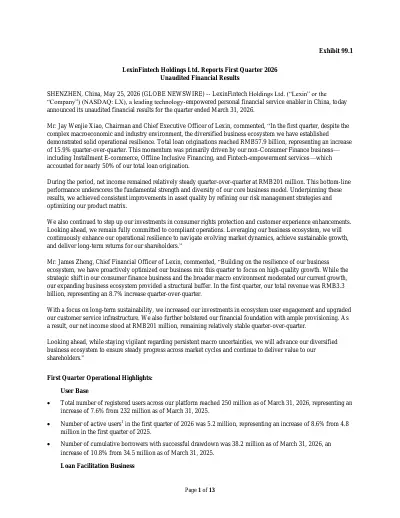
Hi everyone, thanks for joining us today for our first quarter 2026 earnings call. In the first quarter, against the backdrop of macroeconomic and industry challenges, our unique and diversified business ecosystem, which we have been building for many years, demonstrated strong operational resilience.
During the quarter, the loan volume of our installment e-commerce, offline inclusive finance, and fintech empowerment businesses accounted for nearly 50% of the total loan volume. Ecosystem businesses grew faster than the online loan facilitation business, becoming the company's new growth drivers.
This indicates the transition from old to new growth drivers, the initial success of our long-term oriented strategy of diversified development, and the company's steady progress toward healthy and sustainable development. During the quarter, the company achieved a loan volume of RMB 57.9 billion, representing a quarter-over-quarter increase of 15.9% and a year-over-year increase of 12.2%.
Revenue reached RMB 3.3 billion. Number of active users stood at 5.17 million, a quarter-over-quarter rise of 14.1% and 8.6% year-over-year.
Number of new active users was 1.44 million, up 63.3% quarter-over-quarter and 101.6% year-over-year. Net profit reached RMB 201 million.
Besides, a number of key risk indicators continued to show improvement, maintaining a stable trend. Next, I will walk you through the key initiatives we have undertaken since the first quarter.
First, our diversified ecosystem businesses accounted for nearly 50% of our total loan volume, becoming the new growth drivers. In the first quarter, despite the seasonal impact of Chinese Spring Festival holiday, our installment e-commerce, offline inclusive finance, and fintech empowerment businesses continued to grow steadily, with loan volume increasing significantly, adding new growth momentum to the company's overall performance.
We have unlocked a new growth space for our B2B business by efficiently connecting with internet traffic platforms and financial institutions. In the first quarter, our fintech empowerment business, which we have been building for many years, began to grow rapidly.
Our Yunxi Technology Pro solution builds a bridge of resource collaboration between Lexin, internet traffic platforms, and various financial institutions by incorporating our technological capabilities and operational experience. It enables our partner platforms to distribute traffic precisely and efficiently, empowers financial institution partners to obtain assets with stable profitability, and thereby maximizes benefits for all three parties.
Our installment e-commerce refined its supply chain and fully penetrated essential consumption scenarios. Installment e-commerce business continued to deepen its presence in different consumption scenarios, refine the supply chain system, and enrich product offerings across categories such as food, apparel, transportation, travel, shopping, entertainment, and pets.
During the quarter, leveraging our advantage in partnerships with industry leaders, we added nearly 150 well-known brands and launched an outlet channel for select merchants, signing more than 20 domestic and international fashion and sports brands. Since its launch, total transaction volume of participating brands in the outlet channel increased by 43% quarter-over-quarter, fully meeting users' demand for quality consumption.
Targeting essential daily needs and festive gifting scenarios, and several major promotional campaigns during key consumption periods, such as New Year's Day, Chinese Spring Festival gift fair, and the Lunar New Year holiday, consistently driving consumption growth. In the 3C digital product segment, ongoing interest-free and discount offers effectively boosted user activity.
During the quarter, the number of orders from high-quality users on our platform increased by 35.7%. Inclusive finance business expanded its county-level presence, unlocking new growth in lower-tier markets.
Our offline inclusive finance business has always focused on localized operations. For specialized industries such as agriculture, forestry, animal husbandry, and fishery, we have launched unique risk models and credit approval strategies tailored to industry-specific customer segments.
This helps match the funding needs of county-level small and micro businesses and individual merchants with local financial institutions, ensuring that inclusive financing resources continue to flow into county economies and support their development. During the quarter, our overseas business developed steadily, with continued stable growth in loan volume, profitability, and asset quality.
Second, we refined our risk strategies and optimized our product matrix, leading to improvements in asset quality. In the first quarter, we continued to adjust and optimize our risk strategies.
Our deeply iterated algorithms and models significantly improved the efficiency of channel connection and target user screening. We newly launched a credit report interpretation AI agent and an interactive credit enhancement function, making user identification more accurate and effectively supporting personalized pricing and credit line allocation for high-quality users.
We have made flexible repayment features such as on-demand borrowing and repayment and bullet repayment available across all products. Focusing on white-collar workers and small and micro business owners, we developed differentiated credit granting and outreach strategies.
Through scenario-based operations, we allocated pricing and credit line resources preferentially to high-quality customers, consistently boosting their activity levels. During the quarter, our asset quality continued its steady recovery, with risk indicators improving for both existing and new assets.
For total assets, Day 1 delinquency ratio decreased by about 7% quarter-over-quarter. 30-day collection rate improved month-over-month.
New customer quality also improved, and loan volume to high-quality segments rose notably. FPD30 of new loans initiated in the first quarter is expected to decrease by about 6%.
In the first quarter, we continued to increase resource investment in consumer protection and customer experience improvement. We strengthened the coordination between our frontline service and consumer protection teams and various business lines, enabling smoother information flow, more timely issue response, and a more efficient closed-loop resolution mechanism.
In terms of service experience, by optimizing intelligent routing and queuing strategies and introducing peak-time early warning mechanisms, we significantly improved service efficiency, with key customer service metrics showing further improvement. On the customer care front, we enhanced our user behavior analysis through more sophisticated models and refined customer tiering, implementing more targeted care measures for different segments, which improved overall user experience and satisfaction.
In combating illegal financial activities and fraudulent syndicates, we actively responded to relevant regulatory deployments, leveraging our technological advantages in AI and big data to strengthen the end-to-end defense and governance system, including risk identification and case detection, thereby safeguarding consumers' legitimate rights and interests. Looking ahead, building upon the initial success of our diversified ecosystem strategy and the solid growth momentum of our businesses, we will continue to drive our installment e-commerce, offline inclusive finance, and fintech empowerment businesses, steadily advancing along the path of diversified and resilient development.
We believe that our unique ecosystem advantages will continue to strengthen the company's operational resilience, enabling us to navigate future uncertainties and create long-term sustainable returns for our shareholders. Next, I'll hand over the floor to our CRO, Arvin.
Thanks.
Arvin Zhanwen Qiao
谢谢Jay。下面我将汇报一下今年一季度风险管理方面的工作情况。2026年一季度,随着新规落地对行业风险影响逐步降低,一季度行业整体风险开始企稳回落,我们也保持了从去年11月起风险稳步下降趋势。从具体风险表现来看,一季度环比25年四季度,全量资产入催率下降了7%左右,30天出催率也保持了逐月回升,预估一季度新增放款FPD30下降约6%左右,整体风险表现持续改善。下面介绍一下我们一季度采取的具体风险措施。第一,我们季度继续加大大模型在风险管理场景中的应用,持续提升风险管理的效率和效果。在负向处置方面,利用大模型能力,优化升级了负向处置机器人和风险自动巡检机器人,有效的提升了风险识别能力和风险客户处置效率,使得一季度风险继续保持下降趋势。同时,通过大模型进行实时交互提额,做大优质分母,促进新增放款,风险持续改善。通过大模型实现线上提额实时交互,高效获取客户的额度需求和增信材料,这不仅大幅提升了风险识别的准确性与效率,更能基于对客户风险的全面洞察和对客户需求的全面了解,为客户提供满足其个性化需求的信贷offer。第二,消费信贷业务通过优质客群专项经营,促进优质规模稳步增长。重点针对优质白领和小微客群,通过专项识别模型、差异化提额降价策略和管护服务,大幅提升优质专项人群的可经营人数以及动支率,促进优质规模显著增长。一季度相比四季度,优质白领客群规模上涨了56%,优质小微客户规模上涨了30%,优质人群专项经营方案初见成效。二季度将持续优化优质人群专项经营能力,进一步促进优质资产规模增长。第三,普惠金融业务,我们持续深耕广阔县域,全面落地本地化经营策略。针对县域客户的特点,开发县域小微风控模型,优化准入、授信、定价等风控策略,适配线下批发、农资、养殖等类别小微客户的风险特点和信贷需求。同时,通过线上线下协同,深化县域小微客群风险管理和贷后回收。截至目前,覆盖近百个县域,累计服务400万家小微个体,风险表现稳健,业务规模持续提升。另外,我们在第一季度还加大了对黑灰产的识别和打击,构建事前预警、事中拦截、事后打击、生态协同全链路防控体系,打击代理诉讼等黑灰产行为,向公安机关移送有效黑产线索,并协助成功打击山东某黑灰产团伙,抓获犯罪嫌疑人40余名。展望2026年二季度,我们将继续加强资产结构优化以及新增放款的风险管控,同时更好满足优质客户需求,提升用户体验,促进优质资产规模增长,保障风险平稳可控,逐步将风险水平控制到风险偏好以内。下面有请CFO James介绍公司一季度的财务表现情况。
Thanks, Jay. Next, I will provide a review of our key initiatives and achievements in risk management for the first quarter of this year.
In the first quarter of 2026, as the impact of the new regulations on industry risk gradually subsided, industry-wide risk began to decline. We also maintained the steady risk reduction trend we have seen since November last year.
Regarding specific risk performance compared to the fourth quarter of 2025, Day 1 delinquency ratio of total assets decreased by approximately 7%. The 30-day collection rate continued to recover month-over-month, and we estimate that FPD30 for new loans initiated in the first quarter to decline by about 6%.
Overall risk performance continued to improve. Now, let me walk you through the specific risk initiatives implemented during the quarter.
First, we continued to scale up the application of large models in risk management scenarios during the first quarter, consistently improving the efficiency and effectiveness of risk management. On the high-risk asset management side, we leveraged large model capabilities to optimize and upgrade our high-risk asset management robot and automated risk inspection robot, effectively enhancing our risk identification capabilities and the efficiency of high-risk customer management.
This helped sustain the downward trend in risk during the quarter. At the same time, we used large models to enable real-time interactive credit line increases, growing the prime asset base and driving continued improvement in new loan risk.
Through large models, we achieved real-time online interaction for credit line increases, efficiently capturing customers' credit needs and credit enhancement documentation. This not only significantly improved the accuracy and efficiency of risk identification, but also enabled us, based on a comprehensive understanding of customer risk profiles and needs, to offer customers personalized credit offers that meet their specific requirements.
Second, in our consumer credit business, we promoted steady growth in prime asset volume through dedicated prime customer segment management. Focusing on prime white-collar customers and small and micro business owners, we leveraged dedicated risk identification models, differentiated credit line increase and pricing reduction strategies, and account management services to substantially increase both the addressable customer base and drawdown rate of prime target segments, driving significant growth in prime asset volume.
Compared with the fourth quarter of 2025, loan volume from prime white-collar customers increased by 56%, and volume from prime small and micro business customers increased by 30% in the first quarter, demonstrating the early success of our prime segment management approach. In the second quarter, we will continue to refine our prime segment management capabilities to further drive prime asset growth.
Third, regarding our inclusive finance business, we continued to deeply cultivate broad county-level markets and fully implemented a localized operation strategy. Tailored to the characteristics of county-level customers, we developed a county-level small and micro business risk model and optimized risk strategies with optimized customer onboarding, credit granting, and pricing to match the risk profile and credit needs of small and micro customers in offline wholesale and retail, agricultural supplies, and farming segments.
At the same time, we strengthened risk management and post-loan collection for small and micro customers through online and offline coordination. To date, we have covered nearly 100 counties, served over 4 million small and micro merchants and individual operators, maintained stable risk performance, and continued to grow loan volume.
Additionally, in the first quarter, we strengthened our identification and crackdown on illegal and fraudulent activities. We built an end-to-end prevention and control system encompassing early warning, in-process interception, post-event enforcement, and ecosystem coordination to combat illicit activities, such as agent-assisted complaints.
We provided actionable leads to public security authorities, assisted in the successful crackdown of a fraudulent syndicate in Shandong province, and facilitated the arrest of over 40 suspects. Looking ahead to the second quarter of 2026, we will continue to optimize our asset mix and strengthen risk management over new loans.
At the same time, we will better serve prime customers and enhance their experience, driving further growth in high-quality assets while keeping risk stable and controllable. Our goal is to gradually bring risk levels back within our target risk appetite.
Next, I will hand over to our CFO, James, to provide a review of the company's financial performance for the first quarter.
James Zheng
Thanks, Arvin. I will now provide a detailed overview of our first quarter financial results.
Please note that all figures are presented in RMB terms, and all comparisons are made on a quarter-over-quarter basis, unless otherwise stated. During the first quarter, the industry continued to navigate a period of adjustment.
Against this complex backdrop, our diversified business ecosystem demonstrated continued operational resilience. Driven by the structural optimization of our business portfolio, we successfully grew our total loan volume.
While our online consumer finance business faced pressure due to the macro uncertainties, our ecosystem segments, particularly the fintech empowerment service, achieved solid growth. Consequently, total revenue for the first quarter was 3.3 billion, representing an 8.7% sequential increase, with net income remaining relatively stable at 201 million.
Now, let's take a closer look and review of our first quarter financial results. First, net revenue of the credit business, which is derived by adding up credit facilitation service income and tech empowerment service income, net of credit costs, including provisions and fair value changes, and funding cost, was 1.5 billion, representing a 7.2%, or 98 million increase quarter-over-quarter.
The overall growth was largely driven by 382 million rise in tech empowerment service income. This was underpinned by revenue growth from lower provision top-ups for our capital-light portfolio amidst improving asset quality.
Since our capital-light income is recorded net of credit cost, the material sequential decline in provisions directly boosted this revenue line. On the other hand, credit facilitation service income, our capital-heavy business, declined by about 10%, or 253 million.
This reflects the ongoing volume and pricing headwinds in our online consumer finance business, partially offsetting the increase in our tech empowerment service income. Second, net income of the installment e-commerce business, defined by installment e-commerce revenue net of cost of inventory sold, increased by 41 million to 208 million.
The total net revenue, summing the credit and installment e-commerce business, added up to 1.7 billion, a 9.1%, or 138 million increase quarter-over-quarter. On the expense side, operating expenses, including sales and marketing, research and development, general and administrative expenses, and processing and servicing costs, increased by 13.8%, or 169 million, to 1.4 billion.
Tax and others decreased by 20.9%, or 18 million, to 68 million. Consequently, total expenses added up to 1.5 billion, an increase of 151 million.
By deducting the total expenses of 1.5 billion from the total net revenue of 1.7 billion, we arrive at net income of 201 million, a decrease of 5.9%, or 13 million quarter-over-quarter. While the industry faces macro headwinds, our diversified ecosystem has successfully sustained our financial performance.
Now, let me walk you through three key business highlights behind these results. First, the resilience of our diversified business ecosystem.
Amid continued industry consolidations in the first quarter of 2026, we proactively optimized our business mix to strengthen risk management and compliance. Anchored by our diversified ecosystem, we continue to demonstrate strong operational resilience.
Consequently, non-online consumer finance GMV, which encompasses offline inclusive finance, fintech empowerment services, and our e-commerce businesses, grew to nearly 50% of our total GMV, up 42% sequentially, effectively offsetting the contraction in our online consumer finance business. This shift was largely fueled by our fintech empowerment, or Shuke model, where we partnered with leading internet platforms and banks on risk assessment and assumed the corresponding credit risk.
With loan volume surging to around 21 million—rather, 31 billion—the model's financial contribution is not yet fully reflected due to its lower pricing and amortized revenue recognition. However, the buildup of the Shuke model creates a robust revenue pipeline, and it will improve our long-term asset quality and ensures steady profitability across market cycles.
The installment e-commerce business maintained its positive momentum, supported by stable transaction volumes and improving gross margins, which I will elaborate later. At the same time, our offline inclusive finance and overseas business advanced steadily, serving as additional stabilizers and diversifiers for our broader business portfolio.
Second, the steady development of our installment e-commerce business. Our installment e-commerce business continued to be deeply integrated into our ecosystem, providing seamless and convenient consumption scenarios and acting as a unique competitive advantage.
Given the current macroeconomic environment, this segment continued to prioritize asset quality over rapid expansion. While demand remains strong in the first quarter of 2026, we deliberately moderated growth to contain credit risk within our risk appetite.
As a result, installment e-commerce GMV remained steady at 2.2 billion. Gross profit from the e-commerce business reached 208 million, representing a 24% increase, with gross margin expanding by 169 basis points sequentially to 9.4%.
The solid performance was largely driven by the continued refinement of our e-commerce operations. Ultimately, the steady development of this segment not only generates reliable gross profit, but also allows us to capture and serve the diverse consumption needs of our users, further diversifying our revenue streams and reinforcing our operational resilience.
Third, prudent provision coverage. In the first quarter, our total credit cost, which encompasses three provision line items and fair value changes of financial guarantee derivatives in our income statement, stood at 1.3 billion, up 0.8% sequentially.
This increase was primarily volume-driven, aligning with growth in our new loan originations. As Arvin noted, our risk indicators are stabilizing, with risks for both existing and new loans trending downward from January through March, the supplementary provisions required for our existing portfolio were lower than in Q4.
To highlight our provisioning strength, let's look at our gross provision metrics. By stripping out the net drag impact of the fair value changes, gross provision offers a true picture of the capital we have reserved against our loan portfolio.
Specifically, our gross provision ratio for new capital-heavy loans stood at about 7.2%, comfortably exceeding our historical peak vintage charge-off rates, while the provision coverage ratio was 258% in the first quarter. To summarize, our diversified ecosystem has proven its value as a structural stabilizer.
The solid progress in our fintech empowerment and e-commerce segments effectively offsets the near-term pressure of consumer finance business, building a sustainable revenue pipeline for future quarters. Coupled with our conservative provisioning strategy, we have established resilient foundations to navigate current and potential market uncertainties, ensuring steady operations across all cycles.
Now, let's move on to our operating expense line items. On the cost and expense side, total operating expenses increased by 14%, or 169 million, to 1.4 billion, mainly due to the increase of sales and marketing expenses of 124 million, primarily reflecting our investment in ecosystem user engagement, alongside the upgrading of our service infrastructure to further improve consumer protection and overall user experience.
For balance sheet items, as of March 31st, our cash position, which includes cash, cash equivalents, and restricted cash, was approximately 3.3 billion. Shareholders' equity remained solid at about 10.5 billion.
We expect the gradual recovery trend we saw in the first quarter to carry into the second quarter, modest in pace, but trending in the right direction. That said, as the lingering impacts of macroeconomic uncertainties have not yet fully dissipated, we will strictly maintain our prudent operational approach.
As such, we expect total loan originations for the second quarter to remain relatively stable. That's all our prepared remarks for today.
Operator, we're now ready to take questions.
Operator
Thank you. To ask a question now, please press *11 on your telephone and wait for your name to be announced.
To withdraw your question, please press *11 again. A moment for our first question.
We will now take our first question from the line of Alex Ye from UBS. Please ask your question, Alex.
Your line is open. 感谢给我这个提问的机会。我这边两个问题。第一个关于监管这边,近期也看到出台了比较多的一些新的监管政策。能不能请管理层给我们展望一下未来在监管这边的一个情况以及我们怎么去应对?然后第二块关于贷款的资产质量的,想请教一下这个最新的一些风险表现怎么样,以及对接下来几个季度的风险有什么展望和判断?So
Alex Ye
my first question is regarding the recent rollout of various new regulations. What's the company's outlook on this front, and what are the proactive measures that you are taking to adapt to those changes?
Second question is regarding the asset quality. Could you provide some update on the latest asset quality trend for your loan portfolio, and how should we think about the risk outlook for the coming quarters?
Thank you. 好的,我来回答一下第一个问题。在近期的整个的也是新的这个政策落地的整个情况下呢,我们认为行业正在朝着更加成熟、合规、规范的方向发展。未来整体也会更加强调合规经营,还有用户的体验。对我们来说呢,这是一个挑战,同时也是一个机遇。随着整个的一个宏观经济温和的整个的复苏呢,加上部分同行正在逐步地收缩,甚至退出市场,行业的空间其实还是在大的。这也为我们未来的整个的发展提供了更多的一些可能性。在这样的一个环境下,我们还会继续的深化以用户为中心的整个的一个全域经营的战略。具体来说,我们还是会继续优化用户的体验,在做大优质资产的整个的同时,我们会进一步优化资产结构,提升整体抗风险的能力。此外,我们也会继续统筹推动多元生态业务的稳健发展。与此同时呢,我们也在加快探索新客群、新产品、新的业务模式,比如说进一步深耕小微群体,提升对优质用户的服务能力等等。消费者权益保护方面呢,我们也会全面筑牢防线,从产品设计、信息披露到贷后服务,全流程落实合规要求。长期来看,我觉得公司还是坚信、坚定地践行合规经营的这个理念。依托我们多元生态的整个业务体系,我们持续来提升公司的经营韧性。我们相信这样的战略布局能够帮助我们从容地应对外部环境的变化,实现长期、稳健的一个增长。
Jay Wenjie Xiao
Here
is the translation for Jay's remarks. Overall, the industry is moving towards a more mature and standard path with a greater focus on compliance and user experience.
For us, that's both a challenge and an opportunity. With the macro economy continuing to recover and some competitors scaling back or even exiting the market, market space and opportunities remain.
This gives us more room to grow in a healthy and high-quality way. In this environment, we will continue to deepen our customer-centric approach to serve different customer segments.
More specifically, we will keep improving customer experience, grow our high-quality assets, further optimizing our asset mix, and strengthen the overall risk resilience. At the same time, we will steadily promote the healthy development of our diversified ecosystem businesses.
We are also accelerating our efforts to explore new customer segments, new products, and new business models. For example, going deeper into serving small and micro businesses owners, and improving services for both prime customers.
On consumer rights protection, we will put more focus on compliant process, covering the whole process from product design, disclosure, to post-loan services. Over the long run, we will stick to compliant operation and leverage our diverse business ecosystem to further enhance our operational resilience.
We believe this strategic positioning will help us navigate external changes and achieve stable operations and long-term sustainable growth.
Arvin Zhanwen Qiao
OK,关于贷款风险方面的,我来回答一下。在一季度,无论是全量资产入催率,还是新增放款的FPD30,我们均保持了一个持续下降趋势。出催率一季度也逐月改善,持续的一个回升。存量具体风险表现来看,我们的入催率环比Q4下降了7%左右,我们的30天出催率逐月回升,FPD30下降了6%左右,整体风险表现出持续改善的一个良好趋势。然后展望2026年的二季度,我们将继续加强风险的识别处置,提升新增放款的审核标准,然后进一步巩固当前的风险下降趋势。我们的目标是在二季度继续保持风险水平稳步下行,逐步控制在风险偏好以内。
Overall, in the first quarter of 2026, the quality of both our new loans and existing loans maintained an improving trend. Regarding the specific metrics, compared to Q4 of 2025, Day 1 delinquency ratio of total assets decreased about 7% in Q1.
30-day collection rate [unclear] FPD30 for new loans originated in Q1 is expected to decline around 6%. You can see, the overall risk performance continue to improve.
Looking ahead to the second quarter of 2026, we will continue to optimize our asset mix and strengthen risk management over new loans by enhancing risk identification, risk disposal, and maintaining the quality of new loans. This will help us to further reinforce the current downward trend that we have already seen in the risk metrics.
Our overall goal is to reduce our risk steadily in the second quarter, and which will set us up for a recovery and high-quality growth for the rest of the year.
Operator
Thank you. We will now take our next question from the line of Judy Zhang from Citi.
Please ask your question, Judy. Your line is open.
Judy Zhang
谢谢给我提问的机会,我是花旗银行的分析师Judy Zhang。我的问题就想问一下,近期在一个比较快速变化的一个监管环境下,可否请管理层帮我们展望一下今年全年的一个财务表现?Thank you for letting me ask question. This is Judy Zhang from Citi.
In light of the changing regulatory environment, what's your outlook for the company's full-year financial performance? Thank you.
James Zheng
I will take the question. As a summary, if we look ahead to 2026, there are still a lot of uncertainties in the macro environment, we'll continue to take the prudent approach and keep strengthening our operational resilience.
I really at this time can't really provide explicit numbers. Maybe I can quickly walk you through a few key metrics and its trend.
First, on the loan volume side, the online consumer finance business may remain under pressure. Thanks to the solid growth of our ecosystem business, like our fintech empowerment and installment e-commerce platform, we would expect the total loan volume to stay relatively stable quarter-over-quarter.
Second, on the revenue side, because the fintech empowerment business recognizes revenue more gradually due to the accounting policy, it won't fully offset near-term revenue impact from the contractions of the online consumer finance business. However, in the longer run, having a larger contribution from these businesses will give us more stable revenue base.
Our asset quality continued to improve, resulting in lower provision top-ups on the existing capital-light business, which led to the increase in our tech empowerment service revenue. I would expect this trend to contribute positively to our revenue in the future.
Third, on the credit cost side, they should come down as risk continued to decline, assuming no major macro or regulatory changes. With that said, we'll remain prudent with our provisions.
Fourth, on the expense side, due to the expansion of our ecosystem business, our continuous investment in customer experience, operating expenses increased slightly on the sequential basis in Q1. Going forward, we'll keep driving operational efficiency, reduce costs where we can, and aim to steadily optimize our expense ratio.
Put all these together, as a summary, overall for 2026, we'll continue to be focused on making steady progress while navigating the uncertainties, we'll keep building a strong foundation for the long-term high-quality business.
Operator
Thank you. We will now take our next question from the line of Zhuhan Wang from Goldman Sachs.
Please ask your question, Zhuhan. Your line is open.
Zhuhan Wang
好的。谢谢管理层给我这个提问的机会,我是高盛的分析师王子涵。我想请管理层帮我们展望一下公司在提升股东回报方面未来有什么具体的计划?谢谢。我来翻译一下。Thank you for taking my questions. This is Zhuhan Wang from Goldman Sachs.
Could you please elaborate on the corporate plans to enhance shareholder returns? Thank you.
Jay Wenjie Xiao
好的,这个问题我来回答一下。我们一直把股东回报放在比较重要的一个位置。近期,公司计划注销2000万ADS,约占公司总发行及流通股本的12%。当然,考虑到当前宏观环境存在一定的不确定性,我们阶段性地暂停了新增的股票回购。我们始终兼顾股东回报与资本使用效率,未来我们也会根据市场环境的变化,灵活重启回购计划,争取在合适的时候最大化释放回购资金对公司价值的催化作用。在完成本次回购以后,公司还会结合经营发展和资本市场情况,积极考虑推出新的股票回购方案,稳步提升股东的长期回报。我们希望通过持续、务实的举措,让股东切实分享到公司成长的价值。
We have always put a high priority on shareholder returns. The company plans to cancel 20 million ADSs, which represents about 12% of our total outstanding shares.
That said, given the ongoing macro uncertainties, we have temporarily suspended new share repurchases for now. We always try to balance shareholder returns with capital efficiency.
Going forward, we will stay flexible. When market conditions are right, we can restart our program to make sure our buyback dollars have the best [unclear] on company value.
After we complete this repurchase program, we will actively consider launching a new one based on how our business develops. Our goal is to steadily improve long-term returns for our shareholders.
Through consistent and practical steps and initiatives, we want our shareholders to truly share in the value we create.
Operator
We have now reached the end of the question-and-answer session. I'll now like to turn the conference back to Will for closing comments.
Will Tan
Thank you. This conference is now concluded.
Thank you for joining us today. If you have any more questions, please do not hesitate to contact us.
Thanks again.
Operator
Thank you for your participation in today's conference. This does conclude the program.
You may now disconnect your lines.