Lynas Rare Earths Limited
Q1 FY2027 · Earnings Call TranscriptOctober 28, 2026
Operator
Welcome to the Lynas Rare Earths October quarterly results briefing. Following the formal presentation, there will be a Q&A session.
Investors and analysts can ask live audio questions during today's call. To ask a live audio question, press the Request to Speak button at the top of the broadcast window.
The broadcast will be replaced by the audio question screen. Use the dial-in number and access PIN provided to ask your question via the phone.
Alternatively, for those on a home or personal network, you can ask your questions via the web by pressing Join Queue. If prompted, select Allow in the pop-up to grant access to your microphone.
If you have any issues using the platform, dial-in details can also be found on the homepage under Asking Audio Questions. Press the Documents icon to see today's files and platform instructions.
Select a document to open it, and you can still listen to the meeting while you read. I will now hand over to Lynas.
Good morning, and welcome to Lynas's quarterly report for the period ending 30 September 2026. On the call today, we have Pol Le Roux, Interim CEO; Gaudenz Sturzenegger, CFO; Daniel Havas, Chief External Affairs Officer; and Sarah Leonard, General Counsel and Company Secretary.
I'll now hand over to Pol. Please go ahead.
Pol Le Roux
Thank you, Lauren. Good morning, everybody.
I'm taking the call from Seoul, Korea, where I'm attending the MetSoc/Leadence conference, the oldest rare earths conference, where I will give a speech right after this call. I can tell you that in the business rare earths world, Lynas is seen as a winner, and it's quite easy for me to give a presentation.
Coming to the quarter, I have to say that, while Lynas's team is always engaged to maximize the company performance, there are quarters where reporting our activities to our shareholders is easier. This is one, indeed.
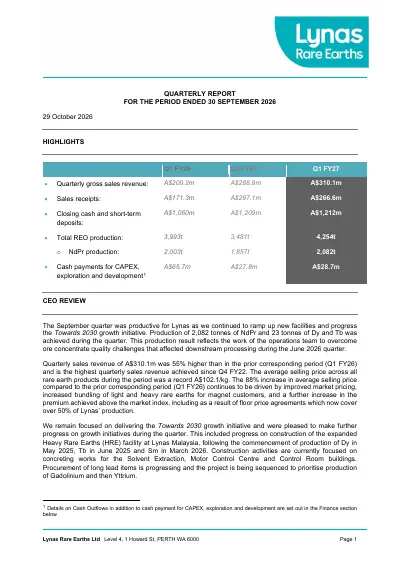
It has been a very rewarding quarter, a quarter of records, records of gross sales, records of production. Our new sales record is now $310 million Australian dollar for the quarter.
That's 7% up compared to previous quarter. It's 55% up compared to last year, first quarter last year.
This record, [cough], is supported by the continued positive dynamics of market, the confirmed appetite for secured rare earths supply chain outside China, and the subsequent high market price. It is also supported by the demonstrated ability of Lynas's team to actually deliver on its commitment.
Finally, it is supported by our sales strategy, where we make profit of our position as the only dysprosium-terbium supplier outside China to combine our sales to magnet makers, sales of NdPr and heavy rare earths, so that we can secure a long-term partnership with our customers. This favorable market environment is pushing us to grow as fast as possible, growing our NdPr and heavies production.
The team has responded to that push with new records. Mt Weld reached in September performance way above the downstream need at nameplate capacity.
That's a great achievement. As I said in the previous call, the ramp-up of Mt Weld is astonishing.
LAMP, compensating for July, which was still impacted by our previous quarter quality issues, LAMP has delivered a production record in August, only to beat it again in September, establishing a new record of NdPr production. Dysprosium-terbium production volumes continue to grow in line with NdPr, supporting our combined sales strategy with magnet makers outside China.
While our supply of dysprosium-terbium, as of this kind outside China, is very welcomed by the market, the market needs more. To that purpose, we are finalizing our plan to move forward mining activities at Mt Weld in to the dysprosium-terbium-rich zones.
This appears as the fastest way to substantially increase our dysprosium-terbium supply to the market. Another way to increase our dysprosium-terbium supply is the announced intention to acquire Meteoric.
Caldeira is the largest known ionic clay deposit outside China. It is a cost-competitive additional resource for rare earths, with a higher dysprosium-terbium and NdPr ratio in line with the market demand.
It can fit perfectly LAMP process setup, and a detailed study has commenced between Lynas and Meteoric to optimize the overall performance from mine to big bag. Downstream, this quarter has also seen the signature of our long-term partnership with JS LINK, who is starting the construction of a magnet factory in Malaysia, in addition to their existing factory in Korea.
Finally, we are finalizing our agreement with LS Eco, who will build a metal facility in their existing site in Vietnam. This is primarily addressing samarium, pure Dy, pure terbium metal, element that are essential, for delivering high-performance magnet making.
Meanwhile, on the HRE separation project, the construction is on track with the previous announcements. All in all, a very good quarter that is in line with our growth plan 2030.
On that note, I would be happy to answer questions together with Sarah, Gaudenz, and Daniel. We'll try our best to answer any question you may have following this quarter.
Operator
Thanks, Pol. If you have not yet joined the live audio queue, please do so now.
To hear from as many people as possible, we request that you ask one question at a time. If you have more questions, please rejoin the queue.
I will introduce each caller by name and ask you to go ahead. You will then hear a beep indicating that your microphone is live.
Our first question comes from Jonathan Sharp of JP Morgan. Jonathan, please go ahead.
Jonathan Sharp
Morning, Pol, Daniel, and team. Just first question, or my only question, on sales.
Production was about 1.2 thousand tonnes ahead of sales this quarter. Can you just talk us through what's sitting in the inventory by product?
Roughly what NdPr sales were, if you can? How much of the record ASP came from sales mix rather than higher pricing?
Thanks.
Pol Le Roux
Sorry, you are asking how much inventory we have in end of the quarter, is it correct, Jonathan?
Jonathan Sharp
In particular NdPr.
Pol Le Roux
NdPr, we know that the previous quarter we were a bit disappointed with our production performance, we shipped as much product as possibly. Of course, the best production being in September, that explains probably why you see the cash collection is not as high as the gross sales, but you can see that we invoiced most of our product, and we always keep just a few days of stock end of the quarter.
Jonathan Sharp
Great. I'll jump to the end of the queue.
Thanks. Mhm.
Operator
Thank you. Our next question comes from Rahul Anand of Morgan Stanley.
Rahul, please go ahead.
Rahul Anand
Oh, hi, Pol and team. Good morning.
Thank you for the call. My one question is on the maintenance shut for December.
I noted you did do a 6-week shut about 3 years ago, and this one seems to be similar or in line with that. I guess you are at a different stage at that time as a company in terms of what your plant was producing in Malaysia, and this time I think you also have a Kal shut that's incorporated within.
Can you help us understand perhaps the nature of the upgrades you're doing this time and sort of what are the main items of work that are happening over this 4-week period? What do you expect as, I guess, a benefit on the other side?
Is there any improvement in recoveries or anything else you'd like to call out? Thanks.
Pol Le Roux
Okay. That's a question, a long answer for a simple question.
[Laughter]. Basically, every year, you see, from October-December is the period of time where we execute most of our preventive maintenance.
The primary objective of this shutdown is to execute necessary preventive maintenance. That concerns, in particular, one kiln in Kuantan, which needs to have the bricks replaced.
Combined with this, we had the request from Western Power in Kalgoorlie for them to upgrade the grid, for hopefully improving the reliability of the grid in Kalgoorlie. That will force us to shut down Kalgoorlie for a bit more than 2 weeks, whereas the Kuantan work will represent overall a month of maintenance.
The things we do on top of preventive maintenance is that we work on a small modification to increase our nameplate capacity in Kuantan, before cracking, whereas at the moment, our bottleneck is more under gas treatment, we are trying to solve that with a few modifications. At the same time, we found ways to further increase the nameplate capacity downstream.
That's on Kuantan side, the two elements for us to be ready for the next quarter to deliver maximum production. In Kalgoorlie, we still have a few modification to make, to improve the reliability of equipments, mainly, and so we make profit of this forced 2 weeks shutdown to execute those modification and improvements, so that we are aiming at starting the January quarter at maximum speed and better equipped to maximize our production.
Rahul Anand
Got it. Quite interesting to see the Kuantan cracking improvement there.
Are you able to call out sort of how much more that would be there in terms of additions, or is that too early to talk about?
Pol Le Roux
Let me demonstrate that with next quarter figures. What I can tell you is we have four kilns, and they are on two different gas treatments.
When you shut down one kiln out of two on one single gas treatment, you notice that we can push the production higher than half of the capacity, which clearly indicates the bottleneck is in the gas treatment. I won't give you numbers, I'm sorry, because I prefer to demonstrate rather than claiming.
It's substantial enough for us to have decided to execute those modifications this quarter.
Operator
Thank you. Our next question comes from Chen Jiang of Bank of America.
Chen, please go ahead.
Chen Jiang
Good morning, Pol. Thank you for taking my question.
Just a follow-up on the sales, production, and also the 1-month [laughter] Personally good to say you don't have any ore quality or operational issues this August or congrats. [Laughter].
For the sales versus production this quarter, did you do that in purpose because you have 1 month that down, you are building the inventory that you can maintain your sales in December month when you are shut down your production? Another follow-up after this.
Thank you. Listen,
Pol Le Roux
I would be happy to run a factory where no preventive maintenance is needed, but, as we always maximize production. It's I would say the other way around.
We are very happy to have delivered this production record last quarter, so that we are more comfortable supplying our customers, and we feel very comfortable we will not make them short of a product in this quarter, which typically is the moment when we concentrate the maintenance. We didn't push on purpose because of the shutdown planned in second quarter.
We always push, and it's very fortunate that the production went so well in this quarter, of course. We'll continue pushing despite the shutdown during this quarter, the current quarter.
Chen Jiang
Right. Thanks, Pol.
Pol Le Roux
Lost you, Chen.
Chen Jiang
That's all. Can you hear me?
Hello?
Pol Le Roux
I lost you for a minute. Can you repeat, please?
Okay. Okay.
Chen Jiang
Just another way to ask this question. Do you have enough rare earths inventory, especially NdPr and Dy and Tb, during the shutdown period to fulfill your sales, it's more near-term question, but for your sales in second quarter, how during your shutdown, should I think about you have inventory, then there's no impact to your sales?
Pol Le Roux
Yes, we have enough inventory. We follow that very very closely with our customers.
They are used to that. The second quarter is always lower than the first one and the others.
We are very comfortable on that. There won't be anyone cut short of supply during the quarter.
Now, part of this, or big part of this inventory is actually in our sales because it's carried by our distributor in Japan. They carry the inventory for us.
Chen Jiang
Right. It's fair to say that production loss of 1 month, you can continue to sell to your customers without any impact.
Is that fair conclusion from what you just mentioned?
Pol Le Roux
Absolutely, Chen. Absolutely.
Chen Jiang
Okay. All right.
Great to hear. Thank you.
I might queue back. Thanks, Pol.
Pol Le Roux
Thanks.
Operator
Our next question is from Paul Young from Goldman Sachs. Paul, please go ahead.
Paul Young
Thanks. Good day, Pol and team.
Paul, another question about the ramp and also the impact from the maintenance shut, but actually more so I just want to look through the next quarter and into the June half, considering that you make the comment that Mt Weld has actually been running really well and the ramp in July and August, which should imply, based on a lag of getting the concentrate, either through Kalgoorlie cracking and leaching or transported to Malaysia through the cracking and leaching facility, that you should actually have quite a decent inflection, positive inflection in production in the March quarter and the June quarter, just because that lag from Mt Weld and getting it produced into oxide. Can you maybe just talk through just how well Mt Weld has been performing from an NdPr production standpoint?
Is my logic correct that post the shut, based on that 6-month lag or so, that March quarter we should see quite a decent inflection in NdPr production? Paul,
Pol Le Roux
definitely, we are looking forward to a substantial increase in Q3, Q4, March and June quarter. Mt Weld has now everything operational except for the IsaMill, which is not aiming at increasing production, but improving the recovery, so that should come up by end of this current quarter.
It's very very positive element for us to see that concentrate-wise, we are well covered with the current performance of Mt Weld. All the game will be to maximize both the cracking-leaching in Kuantan and the cracking-leaching in Kalgoorlie, since, as I said last time, the downstream part now is already demonstrated the nameplate, and as I mentioned just a while ago, we are even working on increasing further this nameplate capacity downstream.
Looking forward for a very good results in the third and fourth quarter this
Paul Young
year. Thanks.
Just to maybe expand on that, seeing as a few people are having follow-ups, but does that mean that you have some degree of confidence you can test the nameplate of the refinery of 10.5, 10.8 thousand tonnes per annum in the March quarter and June quarter?
Pol Le Roux
At least, yeah.
Paul Young
Okay. Great.
Excellent. Good to hear.
I'll pass that on. That's all I want to hear.
Thank you.
Operator
Thank you. Our next question comes from Mitch Ryan of Jefferies.
Mitch, please go ahead.
Mitch Ryan
Thank you for taking my question this morning. Following on from Youngy's question and also the discrepancy between production and sales, we've got this positive inflection into the second half from an NdPr production perspective.
What comfort can you give me that then sales will also grow on the same trajectory? You've talked anecdotally that the demand is there, but the differential between production and sales volumes in this quarter, can you explain that differential and why that will resolve in second half?
Pol Le Roux
Listen, I'm surprised with this question, to be honest. We have absolutely no problem to sell more NdPr and even less more dysprosium-terbium.
The only point is it's simply a shipment matter that makes it end of the quarter. Since our production was really excellent in September, particularly in the second half of September, of course, part of the production couldn't be invoiced.
There is absolutely no worries on our side, and all the discussions I have with customers show that there is only more appetite to buy more from us, and absolutely no concern there. It will continue being a game where sales pulls the production and not the other way around.
I don't know how I can give you more comfort than that, but I really have zero concern about the demand side.
Mitch Ryan
Yep, thank you. That's it for me.
Operator
Thank you. Our next question comes from Daniel Morgan of Barrenjoey.
Daniel, please go ahead.
Daniel Morgan
Hi, Pol. Question's very similar to some of the others on sales mix and production versus sales.
You provide NdPr production, you also provide REO production, but on the sales side you give REO and not NdPr. I think a lot of the participants on the call would kind of like an indication when looking at revenue, realized price, what is the sales mix?
Can you provide some indication of what NdPr sales volumes were, was it the ratio in line with what we can see as a visible sales lag in production, or we're just trying to understand how to look at realized price versus the benchmarks we're looking at in the market. Thank you.
Pol Le Roux
I think it's a good suggestion, Daniel. I realized, when I look at the table, it could be confusing.
Probably that we started 2 years ago, and we'll continue doing that, removing low-value rares as early as possible in the process, and what I mean with that is, mainly cerium, or cerium-lanthanum, which are not worth processing all the way through. That's the reason why you don't have in a sales ratio Probably, we think of putting a line with the NdPr sales volume, that would be easier for everyone to understand.
The content of NdPr in the total REO is higher than the natural rare earths distribution because we actually eliminate upstream as much as possible cerium-lanthanum. I understand better now where the confusion comes from, yeah.
Daniel Morgan
Can I just follow on that? We'll
Pol Le Roux
try to improve for next report then. We'll try to improve for next report then.
Daniel Morgan
Yeah. There's a few drivers here which could still lead to confusion, sorry, Pol.
NdPr, of course you produce that more than the assemblage in the ore because it's more valuable. The production ratio to the REO ratio, we understand that that would be different to the assemblage in the ore.
I guess we're also trying to understand in the sales piece, what is the mix of NdPr in it, because how else can we judge whether your realized price is a good one or not? That's what we're trying to understand, I guess.
Pol Le Roux
I understand that, and for that we should show you the exact sales numbers of NdPr, which we haven't done, and which we'll try to implement for next report. I can tell you that the number of sales of NdPr is extremely close to the production of NdPr for the quarter.
Just to clarify, when we eliminate cerium upstream the production, it's not accounted for as a production. Yeah.
Okay. We'll clarify that on the next slide,
Daniel Morgan
yeah. We'll clarify that on
Pol Le Roux
this slide,
Daniel Morgan
yeah. Just to clarify, is the NdPr sales within the REO sales, is that broadly indicative of a normal mix?
Listen,
Pol Le Roux
we had around 2,100 tonnes or 2,082 tonnes of NdPr or Nd and Pr ready for sales in the quarter. The actual sales of NdPr in the same quarter was extremely close to this number.
That's what I can say at this stage.
Daniel Morgan
Thank you, Pol, for the answer.
Operator
Our next question comes from Neal Dingmann of William Blair. Neal, please go ahead.
Neal Dingmann
Thanks. Morning, Pol, nice to talk to you again.
My question is on the JS LINK partnership, specifically, do you have any insight on general timing of when this plant will come on and maybe more specifically, what the pricing terms of the rare earths materials you'll supply, how you'll come up with that pricing agreement?
Pol Le Roux
I can't talk on behalf of JS LINK, but they made a very good presentation yesterday at the conference, advertising a lot Lynas, which is good. What I know is from them, and I have a meeting with them tomorrow in more in detail, but they ordered all the main equipments for the Malaysian factory.
We're talking here about start of first production for qualification probably by early '28 calendar year. The site is selected, and magnet factory is all about bringing in the main equipments.
It's not like a chemical factory with lots of piping. They are fully aligned, and Korean style, ppalli-ppalli, they go as fast as possible, and I don't see as of today any reason to worry that it would be late.
Neal Dingmann
Very good. Thank you, Paul.
Operator
Our next question comes from Matthew Hope from Ord Minnett. Matthew, please go ahead.
Matthew Hope
Thank you. I just wanted to follow up on your comment that a lot of inventory is held by a distributor in Japan.
I was just wondering, is that logged as part of your sales, and is that material actually paid on delivery, or is it sort of paid when the distributor sells it?
Pol Le Roux
No, it's paid on delivery plus some payment terms that are our agreement with them. When I say they carry the inventory, it means that we invoice, they pay, and then they get the money back when they sell the product.
We are paid on the product to their stock.
Matthew Hope
Sorry, you were dropping out there, couldn't really hear the second part of you.
Pol Le Roux
They carry the inventory, it means that the payment to Lynas by them is made based on the shipment of product from Lynas to their stocks, not the shipment from their stocks to the final customer. They really carry the working capital, in other words.
Matthew Hope
Right. Thank you very much.
Just one other question, you were talking about in the quarterly about the Mt Weld cutback to access more heavier rare earth material, which surrounds the central lanthanide deposit. When do you expect that may take place, and is that going to have a heavy capital cost?
Pol Le Roux
It's anticipation. It's a substantial amount, but it's an amount of mining activity that we would have proceeded if things go normal, in let's say 3 to 5 years' time, because that's where the zone is located.
What we are finalizing now is actually mining ahead, so that we can process ASAP this Dy-rich zone, and therefore deliver much higher, substantially higher quantity of dysprosium-terbium to the market. The exact amount and time will be communicated very soon as soon as we finalize that.
It's the fastest way because I don't need any permitting. We know the process, because at the end of the day, it's the same process like today, just a matter of moving dirt, [laughter], a lot of dirt, but okay.
I think it's basically the best, and I discussed that with a number of customers at the conference, they all wait for that because they're all desperate to get more dysprosium-terbium on the market. That's the fastest way to get it.
Matthew Hope
Sure. Thank you very much.
Operator
We have another question from Jonathan Sharp from JP Morgan. Jonathan, please go ahead.
Jonathan Sharp
Yeah. Hi, Pol, thanks for taking my second question.
Just an update on the CEO, that would be great, just on how that's going, timing, when the market will know, just anything on that would be good, thanks.
John Humphrey
Hi, it's John Humphrey speaking, the Chair of Lynas. Permanent CEO appointment process is continuing.
It will take as long as it takes. Lynas is a unique company, and we're looking for a unique person as the next CEO.
In the meantime, the company's in good hands under the interim CEO, as you can hear from the latest operations report. That is really the update.
We are not going to rush to do it, but having said that, obviously, we will do it as soon as we can.
Pol Le Roux
Jonathan, I would just add one thing. I understand your concern.
On the other hand, the performance that we share with you for this quarter demonstrate, if needed, that the team is fully mobilized and not so disturbed by this situation.
Jonathan Sharp
Great. Thanks for that.
I might just ask a second question if I can, just on the Meteoric acquisition. It seems like the market isn't giving it much value.
Can you just talk on this particular asset, Pol? The work that I've done, it looks like a really really good ionic clay deposit.
Maybe just mention what are the benefits here, what are we missing, what is the market missing? Anything there would be great.
Pol Le Roux
I think we need to grow and to grow fast. We have Mt Weld, which is a great resource.
It just happens that having a combination of a hard rock Mt Weld and an ionic clay deposit appears to make sense, and Meteoric, and we worked on this quite a lot, would fit very well into the LAMP processing setup, being quite cost-competitive, and, very important aspect to me, [cough], it will also increase the quantity of dysprosium-terbium that you produce in relation with NdPr. Generally speaking, if you look at the magnet industry, for 30 tonnes of NdPr, you should have 1 tonne of dysprosium-terbium.
Anything that can get us closer to that is more than welcome, and Meteoric would be a great contributor to that. This, for us, is really improving our setup, aligning us better to the market demand, and finally, giving us access to another area around the planet, where down the road maybe, we'll manage to develop an ecosystem.
You have in Brazil a very good level of expertise, technical expertise. I've been working many years in my previous company with Brazilian process engineers, maintenance.
They are absolutely great, and so there is potential to be developed there. It's to be seen as a substantive add-up to the business of Lynas geographically and in terms of product mix.
It's for us a fantastic news, yeah.
Jonathan Sharp
Okay. Thanks, Pol, I'll pass it on.
Operator
Thank you. Our next question comes from Reg Spencer from Canaccord.
Reg, please go ahead.
Reg Spencer
Good morning, Pol. Thanks for taking my question.
I'm going to change tack a little bit here and just talk about market more broadly and geopolitics. Obviously, Trump and Xi kicked the proverbial can down the road in their recent meeting with the original November deadline on the relaxation of export controls into January next year.
What is your expectation, or maybe ask a different way, what are the expectations of your customers as to the potential outcomes here, or given the fact that Trump is involved, who the hell knows?
Pol Le Roux
You are asking me to predict the policy of the US President? That's a challenge.
[Laughter].
Reg Spencer
I would
Pol Le Roux
not try that. No, no, no, seriously, what is I think, it's the second time we have a kind of rare earths crisis, a disruption of a supply chain linked to geopolitical issues rather than a simple supply-demand.
The first one was in 2011, and at that time, I think there was a lot of excitement, a lot of projects, and everything collapsed very quickly. Basically, Lynas was the only one to survive through this market storm.
This time, I think, and I see that, in particular for the people who are the real decision makers, the OEMs, the end users, and it's possible that the COVID has helped as well in this. There is a real strategy from OEMs to secure part of their supply from outside China.
I don't know and I don't want to anticipate on variations on the political landscape. What I'm very convinced of is that the rare earths market is now different from where it was, and it will not come back to where it was before.
There is a real strategy around the world to not be too dependent on one single source of raw material.
Reg Spencer
What you're saying, Pol, that irrespective of whatever decision or resolution is made on the negotiations around export controls, you continue to expect the Western supply chains to continue to work to at least some level of independence of China?
Pol Le Roux
Absolutely. I don't think China will ease some of their official and non-official decisions, such as it is impossible for any expert in rare earths industry from China to work for a non-Chinese company.
It is impossible to source equipments specific to rare earths processing from China to magnet maker or a processor outside China. That's all the work and challenge that will remain.
I don't see why China will all of a sudden ease that situation. I explain, especially the impact on that for our heavy rare earth separation, we were very dependent to China for a lot of equipments, because the world had given up on making furnaces, on making specific reactors, etc.
That's all the heavy weight we had to rebuild an ecosystem, where we can actually secure And so it's the same for us, secure a source of equipments that we need to process, to run our factories. This won't change.
I don't see a reason why it would change. Building a Lynas outside China was challenging, but I can tell you it's more challenging today than it was 16 years ago.
Reg Spencer
Thank you, Pol. We could talk about this for hours, but I'll pass it on.
Thank you.
Operator
Our next question is from Neal Dingmann from William Blair. Neal, please go ahead.
Neal Dingmann
Thanks. Thanks again, Pol.
My question is on the Meteoric resources again. Specifically, how do you all think about the margins that will be produced or achieved from the ionic clay produced there versus the monazite-bearing ore you all are currently producing?
Pol Le Roux
What I can tell you is that when I say cost-competitive, my reference is Mt Weld, because producing from Mt Weld at Lynas, we proved that we could go through a very tough times. Just a reminder, in July 2016, the price of NdPr was $19, $29, [laughter], and we didn't die.
It just happened that the specific rare earths distribution and very high concentration of ionic clay of Meteoric, so that's a very important aspect, makes it possible for this ionic clay to be cost-competitive, which is not always the case. You have a lot of ionic clay and talks around ionic clay around the world, but with very low rare earths in the ground, which means you move or you leach a lot more, and at the end of the day, it's deposits that have a hard time to be cost-competitive.
Meteoric has this specific situation of very high rare earths content in the ground, we're talking here about 2,500 ppm versus in some areas in Southeast Asia of 600. You see the difference.
That was essential for us. We wouldn't put our hands on something unless we know it can be cost-competitive.
Cost is our muscles, right? We always focus on that.
Operator
Thank you. Our next question comes from Matthew Hope from Ord Minnett.
Matthew, please go ahead.
Matthew Hope
I was just wondering about samarium. You didn't say much about samarium in the quarterly, or I didn't see much.
Were you still producing that, and did it increase from previous quarters?
Pol Le Roux
Samarium, we are producing samarium. The point is the specification of samarium, especially for samarium-cobalt, is quite strict, and so we adjusted our production to the time for the magnet makers to qualify, but we have set up the production for nameplate capacity of 400 tonnes a year.
There is no issue here, so as soon as the qualifications are moving up, we'll increase production in line with that. At the moment, it's a bit marginal, I think it was 10 tonnes around, something like this, in the quarter, so.
Matthew Hope
Right, okay, thank you very much for that. Then just on another question on Meteoric's Caldeira.
Are you planning to continue that on and push it forward as fast as it can go? It could probably start by 2029 if you got going ASAP.
Or are you planning to sort of have a think about it, review it, and see where it fits into your strategy, more than just push it as hard as possible?
Pol Le Roux
At the moment, Meteoric plan was to start operation 2031. We have started a detailed engineering with the team of Meteoric and our team of R&D and engineering.
Our aim is dual, actually. Number one is to optimize the total cost, OPEX, from mine to big bag, sometimes there are things you better do on the mine site rather than on the processing site, and vice versa.
This is a detailed review that we are having now. Then the second objective is to go as fast as possible.
It's too early to tell you when, but we have our hands on it, and at the moment it's the most important aspect, how to, as quick as possible, start Meteoric, yeah.
Matthew Hope
Right. Thank you very much for that.
Operator
Thank you. We have one more question from Chen Jiang from Bank of America.
Chen, please go ahead.
Chen Jiang
Thank you for taking my follow-up question. A follow-up question on Jonathan's question for the CEO search.
I remember Meteoric announcement or feel weeks ago, we had the impression the CEO succession announcement is due in a few weeks because you have AGM coming in November as well. Now, John, in the call earlier, you mentioned it will take as long as it takes, and you are looking for unique person.
I'm just wondering what is the definition of a unique person, and are you taking feedback from your shareholders on the CEO, and wondering why it's taking so long to looking for a CEO? Thank you.
John Humphrey
There are a number of questions in that. The outside-China rare earths industry is comparatively small.
Lynas's position justifies the description of unique because we have a large share of that outside China industry. In terms of the timing, I've said two things.
The first is that the search will take as long as it takes. Secondly, we will proceed to appoint someone as soon as we can.
I can't really take things much further than that. Obviously, we will do it as fast as we can, but it has to be the right person.
Chen Jiang
Thank you for that, John. Thanks, Pol.
Operator
Thank you. There are no further questions.
I'll now hand back to Pol for closing remarks.
Pol Le Roux
Thank you very much for all, and I think we're looking forward for continuing increasing production, although we have some maintenance exercise during this quarter, but we take the points, your questions. I remember the point, I forgot who asked to have the sales of NdPr, I think it's not a problem to avoid the misunderstanding, we'll move forward in the next quarters with specifying the sales of NdPr versus total REO.
If any questions, Daniel, Sarah, Gaudenz, myself, we'll be more than happy to answer your questions whenever you have one. Thank you very much, all.