Lifezone Metals Limited
NNYSE:LZMQ3 FY2026 · Earnings Call TranscriptOctober 29, 2026
Catherine Nichas
Welcome. Please give us a minute for all our attendees to arrive.
Welcome to the Lifezone Metals webcast. Please give us a few more minutes for more attendees to arrive.
Welcome to the Lifezone Metals webcast to discuss the Q3 2026 interim financial results and to provide an operational update. We'll finish today's event with a question-and-answer session.
You can submit a question using the Q&A box at the top of the page. Please feel free to contact us directly for any questions not addressed in this webcast.
Before we begin, I would like to remind everyone that today's event will contain forward-looking statements that involve risks and uncertainties that can cause actual results to differ materially from those in the forward-looking statements. Details of the forward-looking statements are contained in our October 29th news release on our website at www.lifezonemetals.com.
Please see additional disclaimers, which I'd encourage you to read in your own time. Joining me today is Lifezone's Chief Executive Officer, Chris Showalter, and Chief Financial Officer, Ingo Hofmaier.
Without any further ado, I'd like to turn things over to Ingo to start the presentation. Thank you.
Ingo Hofmaier
Thank you, Catherine, and welcome to our Q3 financial results presentation. As in the past, we want to speak about the nickel market first, which is topical after last week's LME Week.
After a strong first half, the second half has so far seen a mixed nickel market with many contradictory signals. Sulfur peaked mid-year at around $1,100 per ton, which was a historical high.
Indonesian imports of sulfur fell in volume, but rose in value as Middle Eastern suppliers retreated sharply. Starting in Q3, improved shipping through the Strait of Hormuz and supplementary imports, such as Canadian sulfur, significantly improved Indonesian sulfur supply compared to Q2.
Sulfur is now reported to be trading at around $800 per ton, which is still eight times last year's price. Our friend Jim Lennon reported that every $100 increase in sulfur prices adds around $1,000 per ton of HPAL production costs in Indonesia.
Therefore, Indonesian HPAL producers have moved from the bottom to the top of the cost curve, with some cutting outputs by up to 50%, and there is rumors that more cuts are going to follow. Also, some of the analysts noted recently that ore grades in the limonite ore falling below 1.5% to 1.4% raises acid consumption per unit of nickel recovered, which compounds the sulfur cost pressure.
On the other hand, Class 1 stocks have risen, seemingly keeping LME prices in check, and more importantly, ore prices have fallen in the last couple of months as extra RKAB quotas came onto the market, with downstream operations complaining about not having enough ore, and a delayed rainy season extending the mining window in Indonesia. With well over 65% of market share and still growing, Indonesia holds the key to nickel prices and has publicly maintained in recent weeks that its target price is $19,000 to $20,000 per ton.
With that, I would like to hand over to Chris to a more operational update before I return with the financials.
Chris Showalter
Thank you, Ingo. Welcome, everyone.
Very excited to kind of dive right in here. I think from our last quarterly, we do have some material updates to talk about, and I'll kind of jump right into the key elements on the financing.
First and foremost, on the short-term financing, this was really important liquidity for us to bridge from the DFS to FID. We've drawn down a total of $41 million, and we have the last tranche drawdown.
This is really empowering our owner's team, and I'll talk on another slide really the activities that have been undertaken and what the owner's team is focused on, because there's a lot of activity on the ground that's very important, and really keeping us on these timelines to march toward FID, and really get all of the preparation in place for the full-scale construction. Next, we did issue a press release on Friday.
It was publicly announced that Lifezone Metals is in advanced negotiations with the Orion Critical Minerals Consortium. This was disclosed on Friday, this gives me the latitude to really discuss how we're positioned as a company and what this really means going forward.
The Orion CMC, by introduction, this is a multibillion-dollar critical minerals consortium involving the U.S. government; Orion, which is really the preeminent private investor in the mining space; as well as the sovereign investment fund, Lunate, from the UAE.
What this really does is bring together some of the world's leading metals and mining investors, pools of capital, in addition to the projects and operators, really this is all driven for the creation of competitiveness and national security, really led by the U.S. government.
For us, what I'm excited to kind of convey here is for a tier 1 project like Kabanga, this is a demonstration of the types of capital we're able to attract and the strategic importance of Kabanga as a project, just given its size and scale, these are the pools of capital driven by the United States and its Western allies that are absolutely best-in-class for us to demonstrate the competitiveness for us moving forward as a project. This is something we'll be able to announce more details in the near term.
We can't give a lot of details, but I think the fact that this is now public, what I can outline a little bit more is the U.S. nexus that we're capitalizing on, the amount of support we are getting from all the various departments and agencies, and this is really a Western-aligned investment consortium that we're marching forward with, and I think that really translates into the project finance process as well.
What you're going to see as we get into more detail on the project financing is a construct of a number of Western kind of best-in-class banks, DFIs, ECAs that will be complementary to the equity piece, which is obviously a very Western, U.S.-centric driven equity group. Something we're really excited about, and there'll be more detail to disclose as we go forward.
For our board of directors, the process we've gone through, we couldn't have really designed a better investment group to come in and support this project. This news should be very, very positively taken, and a demonstration of the work and support we've been undertaking in D.C.
and overall with the U.S.-led initiative. Just in addition, I think, like to highlight on the Tanzanian side, we continue to advance and get into final closing on the framework agreement.
We've worked very intently to, in parallel to getting the equity in place and getting towards closing, to finalize our agreements with the Tanzanian government, and a credit to Honorable Mavunde, the Minister of Mines, for his support getting us to this point. He's been very active on the road.
The Tanzanian delegations have been on a number of different circuits across really the globe, focusing on Tanzania being open for business. What we're very excited to do is once we get into our final announcements to really demonstrate this as the hallmark project supported by this Western-ally consortium, and for Tanzania to be unlocking one of their most strategic sovereign resources with the help of this Western-aligned network.
This is going to be something very powerful. Really, really excited to get to that point, but a credit to the Tanzanians and their excitement as well to see us close this deal.
Next. As we indicated, the Taurus bridge funding has been very critical.
The owner's team that's been assembled, a credit to Gerick Mouton, our Chief Operating Officer, and the team he's put in place. Gerick brings a tremendous amount of expertise on the ground in Africa building and developing projects, and he's really put together kind of the team that he envisions is going to be the one to kind of bring this to fruition.
The team has been very busy working with our partners at DRA Global. There have been a number of workshops down in Johannesburg over the past several weeks, and all the workstreams that are being deployed right now and undertaken as part of this interim bridge funding to get us from DFS to FID, there's been a tremendous amount of progress on the ground.
Everything from camp upgrades to the procurement process. We've gone out now with over 600-plus packages for procurement, and that is a very intensive process, for us to be able to be working on this right now is critically important because the timelines we want to meet, and especially as we march towards FID, these are critical workstreams.
The team has been incredibly busy on the ground, and this is obviously all in advance of getting to the final closing and full FID. Next.
As I always mention, sustainability and really community engagement is going to be a hallmark of how we conduct ourselves on the ground. This is something that we put an enormous amount of time and effort into.
The social performance and resettlement program, what we'd like to highlight here is the standard we hold ourselves to is incredibly high, and we're very proud to be able to demonstrate that standard has resulted in us achieving a commercial result in our exit agreements with BHP, where we have an additional $8 million reduction in the terms with BHP. That was something that they challenged us to adhere on their exit to a certain standard, and we've been able to meet that IFC performance standard.
That's something that we intend to continue to achieve as part of our overall motivation. This is just a tangible, quantitative demonstration of we are actually on track, we're doing this the right way, the community has been massively engaged on all fronts, and this is resulting in tangible value back to Lifezone shareholders as a result.
Really, really excited about this, and congrats to all the teams that worked on this. Other highlight: obviously, 3 million-plus hours with no lost time or injury at Kabanga.
That's something we're going to be continually focused on as a organization. In terms of the overall performance, environmental permitting, compliance, everything is tracking, a lot of engagement has been taking place with TANESCO in terms of the power line coming in.
These are all part of the workstreams being managed by the owner's team to ensure that we're advancing every part of the project as we march towards FID. Okay?
Okay. Really underpinning everything we do in Tanzania is the enormous commitment they've made to infrastructure.
The TANESCO engagements are paramount right now. TANESCO being the utility company in Tanzania, that power station, that substation we're going to be building, those negotiations with TANESCO are critical and advancing very well right now.
That's the 88-kilometer transmission line we need to bring in to the mine site so that we can tap into the new grid. The new grid's powered by a number of new hydro sites that I've outlined before, but the Tanzania is actually a oversupplier of power versus its overall draw.
Tanzania's in an incredibly strong position to be kind of that regional hub for infrastructure, and they continue to demonstrate that. On the standard gauge rail, over 5 million passengers have now traveled on that, and the next stage of the expansion has been announced.
Standard Chartered is leading that. It's going to be $3.79 billion.
This will be extending that railway, that standard gauge rail, through the interior of the country to the area near Kahama called Isaka, where our rail siding will be located. It's also going to be extending further into the region.
On the port side, a lot of activity with DP World Ports being in control of the port. What you're seeing is you're seeing that translate into increased efficiencies in delivery time and turnaround time, and this is also leading to expansion projects being progressed, which are really critical for us.
To have that, DP World, you're seeing a strong nexus of investment and cooperation from the UAE that does have a correlation to us. The Orion CMC has the UAE sovereign fund as part of that consortium.
We see a lot of synergies between the U.S. leading this consortium, also with the UAE as a very major part of this, and that's something we'll look to expand on further announcements.
Next. As I mentioned, the extension of the standard gauge rail, one of the extension lines will go into Burundi, where we have our Musongati nickel project, and this is really at the epicenter of how Tanzania is creating itself as a central kind of critical metals corridor underpinned by the infrastructure development they've done to date.
What we're seeing right now is we're seeing the initial results of how that's translating further inland to countries like Burundi. Now that we're seeing progress on that, we're able to work and move forward on the Musongati project.
We've had teams in the country, and really what we've seen is, again, a U.S.-centric support for critical metals investment and development, and this is something where we're replicating the relationships we have in Tanzania, and with those same supportive networks, we are unlocking and getting a lot of support from the U.S. government in Burundi, really driving and supporting Burundi and U.S.
companies by association. We are also working closely with KoBold Metals as two of the preeminent mining companies in country.
What's really nice about this relationship is KoBold Metals focuses on digitizing historic geological data. The material and the geological information from Musongati has been in very old form.
To translate and upgrade that, and for that to be an initiative that KoBold's focusing on, that works very nicely for us to get an advanced series of information that we can then download into our processes. A very symbiotic, very positive relationship with KoBold Metals, and that's a relationship that I wanted to highlight.
In terms of the next stages in Burundi, Burundi for us is really focusing on working with the government. As I said, we have the teams there right now, and we'll have some more announcements later on before end of this year on really what the shape of that next step of program's going to look like.
That entails getting samples out to do hydrometallurgical test work on, and undertaking a drilling program to not only further confirm the laterite in the extent of that ore body, but also to focus and look at the extent of the potential deeper sulfide material. Working very closely with the government right now in Burundi and the ministry, and working out what that drilling program will look like.
Exciting progress in Burundi. I think as we, number one, leverage the regional infrastructure that Tanzania is driving, these additional ore bodies of critical metals increases the size and scale of the opportunity in the overall East African region, and the size and scale of these opportunities have to be supported by large governments and investment capital.
That's what Lifezone is demonstrating, that we are in a preeminent position to begin unlocking some of these new core sources of battery metals with the support of a Western-allied investment capital group. Okay?
I'll touch on another extension. As I said, we're focused on really the flagship project in Tanzania, but also we have a pipeline of other projects that also include support from the United States government.
What you're seeing is us focused on a domestic autocat recycling program. We are very, very pleased with the results of the last piloting.
One of the key elements of a hydromet process for the recycling of catalytic converters is can you get those recoveries up to be competitive with the pyrometallurgical processes? Our teams have delivered on that.
We are into the second confirmatory piloting. This is a partnership with Glencore in the U.S.
What we're doing right now is working with Glencore. We have identified a site, so that's very important that we have concluded on a site selection, and we will be marching towards FID in Q1 2027.
This is, again, I kind of emphasize this sometimes on these calls about how exciting this project is. As we focus on getting Kabanga funded, closed, Lifezone will be focused on identifying other areas where we can work with our U.S.
strategic partners and allies to unlock these choke points that you hear about in the press. The way you unlock those choke points is you design and develop solutions for the processing and refining.
The mines and the locations are one part of the equation, but when you really look at the supply chain, the real choke point is in the processing and refining. With how we're positioned right now, that's where we can focus our core competitive positioning.
I think this is going to be another demonstration of how we go from Kabanga to autocats, and then we have a pipeline of additional projects that we're going to continue to focus on. Bringing in the prowess of these investment partners is really going to be one of the strongest complements for us as a platform.
Positioning ourselves as a U.S.-listed, main-board company with this funding capacity, the technological innovation and capacity that we have focused on projects, that's really how you're going to see Lifezone positioned really to solve a lot of these issues going forward. Really, really well-designed strategically going forward.
If I then go to the next slide, we're seeing a lot of this in our labs in Perth. Simulus group and the work they're doing, not only have they delivered for us the first ever refined metal out of Kabanga through that process, the R&D that they've undertaken has unlocked our hydromet flowsheet for the autocats, but those are only two proprietary projects that we've been working on with Simulus.
What Simulus is focused on right now, there's piloting for other products, other critical metals: antimony, germanium, rare earths, a series of base metals where they have a core expertise, and also precious metals, including gold. What we're seeing is we have our proprietary projects, but Simulus continues to grow and be bringing in third-party work where we're not only doing this for Lifezone, but we're assisting other mining companies throughout the world delivering our expertise through a collaborative agency process.
What I like about this is we have the opportunity to also work with some of these projects we see going through our pipeline. If we see a project that we think is really well positioned, we can look at a collaborative approach as Lifezone on specific projects that we see.
I think unlocking these solutions for Lifezone translates into unlocking these solutions for other mining companies. A really critical role we're playing is, and an unheralded role, is the work we're doing at Simulus in Perth, where we are helping other mining companies really solve those choke points, trying to find new, innovative flowsheets so that we can move forward and really collectively be part of this transition from supply chains being really controlled by one region and really focusing on kind of an emerging Western-allied supply chain that transcends not only our Kabanga project, but we can play a major role assisting not only the majors, but other mid-tiers and juniors.
A lot of work going through our labs right now, and that's going to really be part of our pipeline going forward. Okay?
I'll turn back over to you, Ingo.
Ingo Hofmaier
Thank you, Chris. Now we come to the core part of the Q3s.
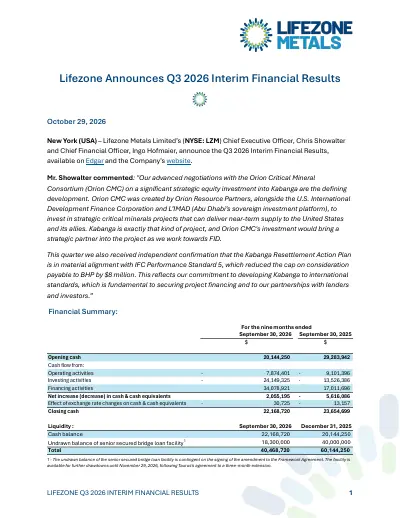
Please follow me on the very right side through the table. What you can see here is the nine months through the September 2026 and the nine months to 30th September 2025.
In 2026, we started the year with $20 million in cash and cash equivalents. We had operating cash flows of $7.8 million.
That's an improvement of around $1.3 million. We are in the second year now where we try to manage our general and administrative cash costs tightly.
The investing activities, as you would have expected, increasing our execution readiness activities and final engineering design and procurement activities have increased to $24 million in cash. Financing activities were $34 million in the nine months.
There were no financing activities in Q3. I think, as you remember, we had a capital raise in April where we raised $25 million in gross proceeds, $23.3 in net.
Then we also received $21.7 million in the first half from the Taurus bridge loan that we signed last August. There's another $18.3 million undrawn, which is available until the 29th of November, and conditional on the joint financial model and framework agreement amendment.
We ended the Q3 at $22 million, and the liquidity, including the undrawn amounts from the bridge loan, is $40.5 million. In terms of our liabilities, the convertible debenture with a nominal value $50 million is on the books for $39.5 million and kind of gets amortized and will get to this point after the four years.
We have the warrants from the 2025 offering, and then the senior secured bridge loan facility, plus the deferred consideration from BHP, which is now reduced by $8 million. What you see there on the books is, on the one side, it's a $10 million payment 12 months after FID and $28 million indexed to our share price, and the index reference point is $4.16.
That maximum amount has been reduced by $8 million, there's a cap on it. In terms of DE&A assets, they've increased, and this is basically the book value of our Kabanga asset from $140 to $172 million.
If you compare this to the investing cash flows, there is, to say, non-cash elements there. In particular, we capitalize the interest costs or the costs of the senior secured bridge loan facility from Taurus, because that's exclusively for the advancement of Kabanga.
The loss per share, basic and diluted, is the same, simply because it was a loss in the period, and therefore diluted is the same. It's not always just about numbers.
We have a team size of 248 employees and contractors. As one of the slides from Chris mentioned earlier, 188 people, the large majority, of course, are linked to the Kabanga project and working across the Kabanga site, Dar es Salaam, but also in our engineering partner offices in Jo'burg, South Africa.
Next slide, please. In terms of our register, as we didn't raise equity this quarter, there wasn't much of a change in the outstanding shares.
We issued around 500,000 shares under our RSU program. You can see here the fully diluted share count, and as of yesterday, we had a market cap of $307 million.
Probably the one noteworthy thing is that, of course, we have seen a nice uptick after the announcement of the advanced conversations with Orion CMC, but also that after we bought the 17% stake of BHP last year, they have also in the quarter exited our Lifezone Metals shareholder register. With that, I think we're going into Q&A, and I hand back to Catherine.
Thank you very much.
Catherine Nichas
Thank you, Ingo. Thank you, Chris.
As a reminder, if anyone has any questions, please raise them via the Q&A box, which should be located at the top of your screen. We are only taking written questions, please could you post these in the Q&A, and we'll address them as we go forward.
We have our first question. Chris, this will be for you.
Can you talk a bit more on the conversations with the U.S. government and other strategic partners for Musongati, and could conversations be similar to what we're undergoing with the Orion CMC?
Chris Showalter
They're very early stage compared and relevant to Kabanga, but I think the overall way we approach these transactions is really, we are being very supported by the U.S. State Department, by other areas within the U.S.
government. I think what we're able to do is really kind of go shoulder-and-shoulder into some of these discussions.
I think what you're seeing is we are uniquely positioned to be able to capitalize on the strong policy initiative from the U.S. and leading Western allies.
This is a incredibly important point in time, and I think with the strategic knowledge that these supply chains are not going anywhere in terms of policy importance, we're really, really focused on capitalizing on our positioning, and that's going to extend from Kabanga to the project in Burundi. You're going to see us in a situation where we can replicate that model going forward.
As I said, this is a point in time where the momentum is there for us to take advantage of. We're uniquely positioned.
I love the fact that we are a main-board listed company, and once we fully announce the terms of this deal, I think we are in a position to materially rerate, and that'll put us in a position to just continually access the full scope and potential of the U.S. financial intermediary markets and be a funding and leverage platform going forward for additional projects, additional growth, and that to us is very exciting.
I think we've got the platform where we can tap into U.S. institutional capital, we've got the key strategic partners, as we've evidenced in the discussions with the Orion CMC, there will be additional announcements regarding other areas of cooperation that we've not disclosed as yet, and we will in the near term.
I think this kind of big bang, full, comprehensive approach is something we're going to be evidencing that we are just right at the forefront of being able to monetize.
Catherine Nichas
Thank you. Chris, we have a few questions on Orion CMC, I'm going to ask a few of them in order.
The first one being, will Lifezone still be the operator and controlling shareholder of the project following the current negotiations?
Chris Showalter
Our intent, and I think this is something that we can demonstrate based on the build-out of our owner's team, is we as Lifezone and with the capability and skills of the team we've assembled, we are going to move forward, we are going to be the operator and controlling shareholder driving this project into full-scale construction and commissioning. We're highly confident in the team we have, and I think that's obviously been through a very detailed due diligence process by the various investors.
Just to kind of take a step back, We've had a very competitive process. I think when you look at the process we've been alluding to with Standard Chartered, an asset the quality of Kabanga, there was tremendous interest, and so we were in an incredibly privileged position to be able to select really the top-tier, best-in-class investment capital to come into this project.
I think the board was very specific about what is going to be in the best interest of shareholders and where can we achieve the most value. I think the magnitude and the overall breadth of these pedigreed partners, I don't think we could be in a stronger position.
To the point, we intend to drive this project forward. We will be the controlling operator, and we are going to go build this mine.
Catherine Nichas
Thank you. Second question to that is, are we still expecting to close the deal before the end of the year, and are the terms still being negotiated, or is the size of the deal pretty much arranged?
Chris Showalter
What I can say is pretty much we have concluded the commercial negotiations. We are in final kind of legal processes, and I think, yeah, what I can say right now is we are looking to close this as soon as possible.
Without giving any definitive dates, we all want this closed, and we want to be able to get all the details out there as soon as possible. We are very much on a short track to get the announcement out in the near term.
Catherine Nichas
Thank you. Next question: how do you think about the funding for the PGM project, and how conversations with Glencore progressed around their ability to fund a portion of the project capital?
Chris Showalter
I think on the PGM is very straightforward. This is not a very large capex program, which is really the attractiveness of it.
For roughly a $40-plus million capital investment, that would be split obviously between Lifezone and Glencore, we'll be delivering over 200,000 ounces of three PG, platinum, palladium, rhodium, and producing a specific solution for domestic U.S. consumption of those metals, which right now primarily gets processed and refined overseas.
In terms of the funding, we have several DOE grants in place. We are in negotiations with the government to play a similar type role utilizing some of the facilities and funding that they've announced for this project.
Those are all discussions underway, but I think with what we've demonstrated regarding the depth of involvement and cooperation with the U.S. government, I think it's safe to say that we will be pushing for their involvement in this in one way or the other, and seeing where they can play a key role.
Obviously Glencore, this is a small project by their standards, pretty easy for them to make a very quick decision once we get to FID. We had really good meetings, update meetings with them last week, and in terms of the site being identified, we're really keen to get more detail on this in the near term.
Catherine Nichas
Thank you, Chris. The next question will go to Ingo: is the debt drawn down under the Taurus facility due to be fully repaid by the 29th of November?
How do you expect to fund activities beyond this point if the strategic investment has not been secured?
Ingo Hofmaier
Let me try to decompose this in terms of the questions.
Catherine Nichas
There's
Ingo Hofmaier
a final drawdown, and the final drawdown date is the 29th of November, and there is conditions to that, which is the amendment, and particularly the agreement on the joint financial model, which was depending on the release of the feasibility study last year. It defines how the fiscal benefits are being shared between us and the government, and of course, that's a very sensitive and important point for all of our parties.
The 29th of November is not the date of the repayment of whatever is drawn down at that point of time. That ultimately means we signed the agreement in August last year, we have two-year availability period, so that means that in August next year, we would pay down, also pay back, or we can extend another six months.
If FID, as currently planned, is happening earlier, in the uses of funds of FID, and particularly the debts, the project finance debt that we're raising, a component of that is the repayment of the Taurus facility. We have assembled a group of pathfinders.
Currently, these are all ECAs and DFIs. There were no discussions yet with Taurus if they want to continue also being in the long-term project financing debt.
Catherine Nichas
Thank you, Ingo. The next question is, is the completion of the ESIA for the transmission line a prerequisite for Kabanga's financing and FID?
Ingo Hofmaier
I can actually answer that if you want me to. Go ahead.
Catherine Nichas
Sorry, this is completely in my remit, but to confirm, the national ESIA and EIA certificate has been received, so that is already completed. What we're doing is uplifting it to international standards.
The requirement is that you understand your risks and impacts so you can address that, and that is what third parties and pathfinders will be looking at for financing the project to ensure that we understand the risks and how we're going to mitigate them. Thank you.
Next question, back to Kabanga. Chris, this will go to you: when do you expect the framework agreement and joint financial model to be finalized?
If you can't say, what is the timeline of meetings to work that out over the next few months?
Chris Showalter
We have been in very intense, final discussions to conclude the framework agreement and the joint financial model with the government. Our team's been on the ground over the past several weeks, and as far as we're concerned, we're pretty much in that conclusive phase to close everything off.
That will then trigger the approval process within the government bodies for final sign-off. As we finalize all the negotiations for the equity and to close the equity, all this is being done in parallel.
Best-case scenario, if we can time everything up the same, we will. The framework agreement is of paramount importance for us to close off, and so that's getting our full time and attention.
The government has been working tirelessly as well with us to conclude. That is something we want to conclude as quickly as possible, and we're in that process right now.
Catherine Nichas
Thank you. The next question, and maybe our last, is: earlier this year, you discussed a political risk insurance package with the DFC.
Now that negotiations with Orion CMC are at an advanced stage, could you update us on where that stands, specifically, is the DFC risk insurance expected to be part of the Orion closing?
Chris Showalter
No, that would be something outside the specific Orion CMC. I think all we've been able to disclose right now is we are in obviously negotiations with DFC on the PRI instrument, but there's at this point in time, there's nothing more we can say in terms of final decisions.
We will, when possible to make a definitive announcement, we will.
Catherine Nichas
Perfect, thank you. I've got one last question that I'm going to go for: you've said Orion CMC is making a significant investment in the equity for the project.
Does that mean that you have secured other partners?
Chris Showalter
Yes, what I can say is the overall equity quantum is just over $500 million, and so when we announce the closing of the equity overall, this will be a fully funded equity process. There will be additional participants in this equity consortium outside the Orion CMC.
That's something we can't disclose at this time, but I think will be very keen to get out there and, again, disclose the pedigree and the quality of the investors. I think if you look at this quality of project, the quality of support we're getting from the Orion CMC and the U.S.
government, I think you can extrapolate that there would be a lot of additional interest to partner in a consortium of this quality and size and scale and capability. There will be additional equity participants, and we'll make an announcement when we can.
Ingo Hofmaier
Chris, I think maybe to add, we have said this in the past, that the equity investment goes into the KNL group. That ultimately means KNL is the UK holding company that benefits from a bilateral investment agreement with the government or the state of Tanzania, and the debt is going in as within the group as well, but the borrower is the project entity in Tanzania called Tembo Nickel Limited.
The equity is not at the listco level. I think this is an important point always to reiterate.
Chris Showalter
I think what we will attempt to do as well, once we're able to make further announcements, is highlight the project financing process of just upwards of $800 million. As you would expect, the interest to fund on a debt side is intimately linked to the quality and caliber of your equity commitments.
I think given the strong cash flows that Kabanga puts off, it's a highly bankable project to project finance in our view and in our advisors' view. There's been a substantial amount of interest in the debt side, we'll be able to articulate the quality of the participants that have already lined up for that when we're able to.
No, exciting times. We've been able to discuss a little bit on this call.
A lot more I'd love to get out there, and we're working really hard to get this done so we can provide the full scope of all the details to the market and to our shareholders, which we're really excited about.
Catherine Nichas
Thank you very much, Chris and Ingo, very well said. We have covered all the questions in the Q&A today, we're going to wrap the webcast up.
A quick reminder that if you have any further questions, please feel free to follow up directly via email at [email protected], or contact our newly appointed Senior Vice President of Investor Relations and Capital Markets, Ken Chernin, at [email protected]. This concludes our webcast.
I'd like to thank everyone for attending today's event, and we look forward to speaking with you soon. Thank you.
Chris Showalter
Thanks a lot, everyone.
Ingo Hofmaier
Thank you.
Chris Showalter
Bye-bye.