Lifezone Metals Limited
NNYSE:LZMQ1 FY2026 · Earnings Call TranscriptApril 30, 2026
Moderator
Welcome everyone, please give us a moment, we're waiting for everyone else to join. Welcome to everyone who has joined, we are just giving it a few more minutes, please bear with us.
Hi all, welcome to the Lifezone Metals webcast to discuss the Q1 2026 financial results summary and to provide an operational update. We'll finish today's event with a question-and-answer session.
You can submit a question using the Q&A box at the top of your page. Please feel free to contact us directly for any questions not addressed in this webcast.
Before we begin, I would like to remind everyone that today's event will contain forward-looking statements that involve risks and uncertainties that can cause actual results to differ materially from those in the forward-looking statements. Details of the forward-looking statements are contained in our April 30th news release on our website at www.lifezonemetals.com.
Please see additional disclaimers which I'd encourage you to read in your own time. Joining us today are Lifezone Metals' Chief Executive Officer Chris Showalter and Chief Financial Officer Ingo Hofmaier.
Without any further ado, I'd like to turn things to Ingo for his introduction and the presentation.
Ingo Hofmaier
Thank you, Catherine, and welcome to our webinar. If you can please turn to the next page.
As we all know, we had a very challenging period in the nickel market over the last two years, predominantly caused by oversupply from Indonesia. Since the start of this year, things look a lot brighter.
As of the end of last week, nickel prices actually reached a two-year high, and they're up 37% from one of the low points in late 2025. Today, spot prices for nickel, copper, and cobalt, the products that the mine will produce, are all higher than the long-term price assumptions in the feasibility study that we released in July 2025.
For nickel, the price increase has various reasons, but most of all, there is, we believe, a realization in Indonesia that the relatively uncontrolled oversupply from lateritic operations in Indonesia needs to be brought under control. That seems to be driven by a desire in Indonesia to increase the tax take from royalties and from taxes.
What have the Indonesians done in the recent past? They have reduced the nickel ore mining quota quite significantly compared to apparent demand.
To better manage output, they've also reduced the validity of the quota system from three years to one year, they can really turn the dial on a much shorter timeline. They've also revised the benchmark pricing mechanism, which means all the byproducts are now included.
The results for that is that the costs ultimately go up because you're also paying, for instance, royalties on cobalt, which is a very valuable byproduct, but you're paying the royalty, so that's the price increase. Then there was first the implementation of a tiered royalty system.
That means, if you look at the chart on the right side, that at current nickel prices, the royalty is 15% compared to 10% at the start of last year. That's a 50% increase of royalty rates, so that's quite significant.
Then there's other factors that I think are well-documented, which is, number one, mining in Indonesia has happened for decades now and therefore the best parts are already mined and ore grades are declining. Also there is an understanding in Indonesia and authorities to enforce environmental regulations more strictly.
There were quite a few incidences over the couple of years that the local communities were very upset about, and I think this is very much driven by Indonesians considering the demands and needs of Indonesian communities. A very recent change and an upside risk, probably most significant of all LME metals impacted, is the increase in sulfuric acid prices and the potential shortage of sulfuric acid globally.
China has implemented an export ban on sulfuric acid, and every leach operation in Indonesia needs sulfuric acid, around 15% to 20% of Indonesian output is highly dependent on this. The growing consensus is that ultimately fertilizer production will have priority in the next couple of weeks and months over other metal or chemical applications, and that nickel is probably at the very low end of the pecking order in terms of the ability to pay for or getting priority for sulfuric acid delivery.
There's quite a few things here where analysts and traders expect the nickel price still to have a lot to go for and that there's an upside risk. For the first time also in years, the International Nickel Study Group published last week that the market outlook for this year is a deficit, compared to, I think, the last two years, but you can see how big the number was in 2025, a significant surplus that suppressed prices.
In short, in today's world, under today's spot prices, the Kabanga Nickel NPV is around $300 million higher than the NPV in the study on the long-term prices, and I think this outlines the very significant change in the nickel market environment. I stop here for a moment, we can speak about this more in the Q&A, I guess, and I'm sure there will be questions.
In the meantime, I hand over to Chris to continue with the operational update.
Chris Showalter
Thanks, Ingo. What I'll transition to now is really kind of an update of where we are.
We are in this transition process from really guiding through this strategic process to the transition into feed, execution readiness. As we've talked to the market about, we are in this period where we are utilizing the $60 million bridge loan from Taurus.
I'll show some slides that really goes to the deployment of that capital, what are the priority areas we're focused on in terms of execution readiness, local infrastructure, and all the details of what we're actually focused on with the local Tembo team. Importantly, we updated on the last public webcast that we are advancing the long-term strategic partnership process.
We have been very, I think, clear to the market that we are very much focused on shareholder value, and really tabling to the board of directors what is going to be the most shareholder-driven, value-accretive recommendation based on the offers we've received. This is very advanced, and this is a large amount of management's time and effort right now is considering the proposals that have come in, finalizing negotiations, and getting prepared for recommendations to the board.
This is in a very advanced stage, and we will be updating the market as soon as we can regarding this process. This is the number one priority for us right now as executive management is to conclude this process.
That's getting most of our time and attention. In parallel to this, we are very focused on the project finance.
This is something that Ingo has been leading on his side. This is really a process, this does take quite a bit of time.
It's very detailed. There are a lot of stakeholders involved.
What we can say on this process is the indications we've had are very, very positive, specifically regarding the nature and size, cash flow generation, duration of the mine longevity. This is a very attractive project for project financiers, and we've had a very, very positive engagement with a number of potential lenders.
This is something that will kick off once we finalize and announce the long-term strategic partnership or alternative, and that process with StanChart, we will be able to make some material updates on the process with SocGen. This has been progressing in parallel very, very nicely, we'll have more updates for the market shortly.
Next. As we're building up on the strategic process, there are a number of things we're doing in parallel, and this is very important because there are a number of work streams in terms of execution readiness that we are focused on.
A lot of this just to outline and highlight, this is getting a series of elements on the ground, project setup and governance, engineering and technical delivery, procurement and contracting, construction readiness, commissioning, and early delivery, project controls and risks. Our Chief Operating Officer, Herk Mouton, and his team are working hand in hand with the Tembo team and bringing in a number of consultants that we are scaling up.
This is all in preparation for the pathway to FID. The Taurus funds are enabling us and giving us the ability to maintain timelines, maintain all the execution readiness, all the development works that need to be put in place to put us in the strongest position, once we hit FID, to maintain the timelines and forecasts for the project delivery.
There's a number of things, obviously, we're in continual negotiations and engagement with the government of Tanzania. That's very important because as we go through this strategic process, we have to work very closely with our partners in Tanzania to outline and keep them informed.
That is a big priority right now. Also I'd like to highlight that we have concluded the US Development Finance Corporation process, their E&S process and the standard we need to achieve in terms of IFC performance standard 5.
We did pass that milestone, so that is a very big credential for us to have concluded. That's something I would like to note.
Next slide. Just to kind of continue, here's some photos and just some snapshots of some of the activity on the ground.
To highlight, one of the biggest activities is north box cut, and really getting all the earth works and surface works underway. You'll see us drilling boreholes for water, you're going to see a number of test pits.
This is, in terms of the project execution readiness, preparation, what this highlights is that we are busy on the ground. The teams are being deployed, we're scaling up, and all the activities that are required for us to move the project forward are fully underway.
What I'd like to do is also compliment the teams on the ground. They've been working very hard, and there's a lot of activity.
This is probably the most important commitment we're demonstrating not only to investors and shareholders, but also to the government of Tanzania, is this pathway to progress the project while we get to FID. Next.
This is just another slide outlining some of the activities. The other example of what we're doing right now is working with the Mining Commission.
There are a number of critical path expressions of interest that we're going out. In terms of the work programs, the activities, the packages, we have gone through the process of releasing these to the market, requests for proposals.
This is in the tune of roughly $380 million, everything from camp upgrade to infrastructure, water treatment plant development, maintenance areas, camp storage, and building. This is just another slide demonstrating the level of activity on the ground, all the preparation, all the readiness that's currently underway.
This, for us it's important to demonstrate on these calls and show examples of the progress that's actually taking place on the ground while we continue the more confidential process of working on the strategic investment and the FID process. Then obviously we're working with the government in terms of the pathway for beneficiation.
I'd like to note that this is something that is very important to the government of Tanzania. It is one of their major policy initiatives is to show through our proposal of focusing on the mine and concentrator up front, we continue to work with the government on a long-term downstream beneficiation pathway.
That's something that we have committed to, and that we're working very hard with them to do those technical studies together. Okay.
The standard through which we hold ourselves is very high. I think this goes back to some of the initial partnerships we've had with previous investors, BHP for example.
We've always adhered to a very high standard on the ground, and that continues through this transition process. When you see the occupational health and safety reports, this is something we're always going to herald in board meetings, in company presentations, project reports.
But 2.7 million hours worked without a lost-time injury at Kabanga, this is obviously something we're going to be very much focused on. I think when you look at the scale-up of the project, this becomes even more important to focus on as management.
We have roughly 230 employees and contractors by the end of March currently, and the environmental monitoring that runs in parallel. This is all in a build-up to FID and going into the full construction process.
Importantly, we've also completed ISO-compliant lifecycle analysis assessment, LCA, for the Kabanga project. This is something we have not released yet, but we can say as management we're very pleased with the results.
I think this is something that'll demonstrate the differentiating factor between us and Indonesia is really the low-emission impact, and those credentials are very important to us still. That's something that we're going to be able to release in the near term, but that is concluded and we are pleased with the results.
Okay. Just an extension of the activity and the commitment on the ground, what's fundamental to us right now is in this transition period where there's the commencement of more material activities on the ground, it's really that social license to operate.
The standard we strive to is to really overachieve when it comes to specifically engaging with the community. Catherine, specifically her team, this is a major focus.
The MOU that we've implemented for the CSR project, this is something that's really a step forward. This is not something we're required to do, but in terms of health, education, local sports activities, assisting with local agricultural support, these are all things that we are continuing through this transition process as we bridge from conclusion of the DFS through to the process of funding and FID.
That social license to operate and demonstrating to the local community that we are committed, we're there, and we're moving everything forward is paramount for us right now in this current stage. The resettlement plan obviously has progressed, we've compensated people, and we continue that extensive community engagement on the ground.
That's, I can't emphasize again the importance of this workstream in this current period. Next.
Something we really wanted to highlight in this presentation specifically on the back of the additional capital we have raised for the deployment of additional projects. Now, for Lifezone Metals, we have our flagship project in Kabanga, but that has always been one major first demonstration of our capabilities, but there obviously is a much larger vision for us as a company.
One really good demonstration of that is the ability for us to have worked very closely with the Burundi government to begin the process of exploring, investigating this second large deposit that rests in the same region as Kabanga. Just by way of background, the Musongati deposit, we have an exclusivity agreement with the government of Burundi that we signed in March.
This was discovered at the same time as Kabanga. It's a laterite deposit, it's different, but it is another very large, very significant resource.
The interest for us to look at this in parallel is when you look at the focus on critical supply chains globally around the world right now, when you look at Kabanga and potentially the bolt-on of Musongati, you're almost creating a completely separate, independent nickel and cobalt supply chain away from the East. Now, the scale and size of that is massively important when it comes to the direction of Western governments to focus on critical supply chain security.
This is another demonstration of how Lifezone is there providing solutions, long-term, scalable sources of critical metals. This is something that we're going to be updating on more going forward.
I think the adjacency of Musongati, it's a project that would be very challenged without the infrastructure, the shared operational potential, and then there's some very key operational synergies that we've identified that we're going to be investigating over the period. This is something where this is the largest potential economic driver for Burundi, it's a very small country.
It's getting a tremendous amount of support right now from specifically the US, and so this is something that we see as a very complementary initiative that shows the scale and size of East Africa as a massive source of new critical supply chain solutions for the consortium of Western-aligned governments. Okay.
Then very exciting, I know I kind of hit on this at the end of presentations, but again, I emphasize this is something we are very, very excited to discuss in more detail. We have concluded the piloting study and all the R&D for the platinum, palladium, and rhodium recycling.
Again, this is a demonstration of our Hydromet commercializing, being deployed, and this is a much shorter pathway to market for us to demonstrate our key core advantage of being specialists in hydrometallurgy. We've been working very closely, and the consultant and the team member we have on this project right now, Justin Froneman, is working very closely with our team.
We are going into the finalization, and we'll be concluding this in the coming weeks, of the feasibility study. All the piloting has concluded with very, very high recoveries, and I would like to emphasize this project had taken a little bit longer because of some more extended R&D, but what we've done is we have, in our view, we have identified an innovative breakthrough process that will really be groundbreaking in terms of this industry, specifically this recycling industry.
It is an industry right now that is fractured, and it has a number of different components in the value chain. We can consolidate that into one central collecting to final refining, and we would be solving one of the key requirements specifically for the United States, which is ticking off platinum, palladium, and rhodium from the critical supply chain risk register.
This is something we've also applied for two grants from the DOE. We should be hearing back from them within the next two to four weeks.
That would be for both potentially grant and debt funding for co-investment with us on this. We tick all the boxes in terms of what we're proposing as a solution to deliver, which is final refined metals recycled domestically in the US.
Again, to emphasize, this is a partnership with Glencore. What we really like about that partnership is this is something where Glencore doesn't have an extensive amount of exposure to the PGM market.
The partnership with Lifezone and on this project gives them a rapid ability to scale up their metal book in partnership with us in recycling, which is a core strategic initiative for them right now. We're always focusing on Kabanga as our flagship project, but these are the type of solutions.
Importantly, when you hear a lot of these governments talk, it's not about getting and securing licenses for mining rights or mineral rights. If you're really going to solve the supply chain challenges in the world right now, you need the downstream processing and refining to be solved.
That is how we're positioned as a company, and this is a really good example of how we're going to continue to provide solutions through a competitive advantage of applying our technology. Again, really excited about this one.
Okay. I'll turn it back over to Ingo.
Ingo Hofmaier
Thank you, perfect. The final slides, we want to speak on the financial results, and there's two things that really matter and are material for our investors, which is cash and liquidity and cash flows for the period.
The period, in this case, is the 1st of January this year to the 31st of March. We want to also speak about cash uses in terms of the funds that we have recently raised, and I come back to this in a second.
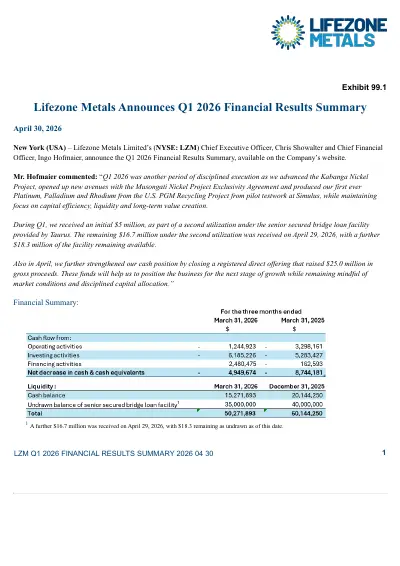
Let's look at the cash flow statement. We had an opening cash balance of $20.1 million.
We had operating activities, cash outflows in this department of $1.2 million, significant improvement to the $3.3 million cash outflows in the comparable period a year before. The main driver for this is, and this is important to stress, that we have a cash-generating, already cash-generating business in Perth with the Simulus lab.
The Simulus lab in the last two years was highly focused on the flowsheet for Kabanga, that means the Kahama refinery, which is to a to a large degree complete. Secondly, what Chris just alluded to, the PGM recycling flowsheet.
While these things have come to a close, there's still work to be done, of course. We have refocused the efforts of the Simulus lab on external revenue generation, and that drives this positive view.
Of course, as our investors know and readers know, we have also been trying to optimize our operating structure, and costs have come down in that sense as well. With regards to investing activities, they are now increasing.
You have seen that we have, with owner's team employees in Tembo Nickel in Tanzania and many short-term contractors in various areas of execution readiness and geotech and hydrotech drilling, there's of course more happening. This number is up and is going to go up in the next couple of months until we reach FID, and then it goes up a lot further for obvious reasons.
The financing activities is a net number. That means the $2.48 million is a cash inflow.
That was $5 million we received from Taurus as part of the second drawdown. The rest were interest payments under the convertible loan note that we issued, announced two years ago.
The convertible loan note, because it is now in place for more than two years, the second anniversary was on the 27th of March, from now on, we are paying the interest in cash. Before, it was a component between share interest and PIK.
That big outflow here was the PIK payment. Another part of that PIK payment was actually paid at the start of April.
In terms of the liquidity, we had $15.27 million in the bank at 31st of March, plus undrawn amounts under the Taurus facility of $35 million meant $50 million. It is worthwhile to update this number, even though this is a Q1 focus, for recent events.
We have last week raised $23.3 million in net proceeds via issuing 5.7 million shares at $4.4 US dollars, plus we've received yesterday, out of this $35 million available, $16.7 million, which completes the second drawdown under the Taurus bridge loan facility. That means only $18.3 million is remaining to be drawn down, and in our opinion, this is also sufficient to get to FID.
The point I want to clarify is that Taurus is earmarked for the Kabanga Nickel project and can't be used for anything else. The funds that we have raised from existing and new investors in the US last week is for some of the initiatives that Chris has just spoken about.
It means it is there if we want to undertake further activities in Burundi at Musongati, it's there for regional exploration, that means outside, expanding the mine plan, for instance, in Tanzania, it's there for PGM recycling, it's for research projects, and it's on it's also for corporate working capital expenses. Income before tax was $2.4 million, and quite a lot of this income, and we will speak about this because there's always swings here, it was driven by fair value gains.
In our case in the first quarter, this was $8.7 million in terms of fair value gains. There's three things or three situations that we are fair valuing on a quarterly or on a regular basis.
Next page, please. To explain the profit before tax number, all of these are gains, and they were basically driven that our share price was lower at the end of the quarter than at the start of the quarter.
I don't want to speculate here, but quite a lot of this was driven because of the uncertainty caused by the conflict in the Middle East. Our share price has since then, and it was $3.36 at the end of the quarter, also quite significantly recovered.
As I mentioned at the outset, there is a significant amount of upside risk in the nickel price, where many observers believe the upside risk in nickel is the highest of all LME metals for reasons related to the shortage or potential shortages of sulfuric acid. What we're currently fair valuing is on the one side, the embedded derivatives, and that is currently, the main driver here is the conversion right itself in the convertible at $8 per share.
Then it's the fair value gain on warrants that we issued as part of the 2025 offering, it's 4.4 million warrants. Then there's the deferred consideration, as a reminder on that, that's the deferred consideration payable to BHP, and it's a two-staged, where $10 million has to be paid 12 months after FID, and then $28 million, sorry, $28 million indexed to our share price payable 12 months after commercial production.
That's why it is called a deferred consideration, but it's ultimately an outstanding and a liability of financial instruments to BHP, and the $28 million is indexed to the share price. When the share price falls, then the value of this falls, and then there's a gain because that liability reduces.
I want to stress to readers, of course, there is an expectation of a significant amount of volatility in these calculations, as well as there's assumptions underpinning all of this. There could be a reversal to the trends, for instance, if our share price is going up.
That means these things could become ultimately losses on the P&L and impact income. Next page, please.
Having talked about cash and cash flows and liquidity, an update here which is relevant on the capital structure. After what we call the 2026 offering that closed Thursday a week ago, we have 89.9 million ordinary shares outstanding.
The rest, there's no changes here. We have warrants, these are the warrants from our listing, we have earnout shares, these were the earnout shares under our business combination agreement.
We have warrants to Taurus, these are not fair valued, they're an equity instrument, then the warrants that were issued in November last year, they are a liability, but in this calculation, they are shown as, of course, potential dilution. Then there's stock options and RSUs to key management personnel and employees.
The market capitalization as of yesterday was $435 million. With this, I would like to conclude our operational update and financial results and opening up for questions and answers.
Thank you very much for joining.
Moderator
Thank you, Chris and Ingo, and as a reminder to everyone, if you have a question, there's a Q&A box at the top of your screen. Please could you submit questions via that.
Starting off, I've had an anonymous question come through regarding the nickel price outlook. The question, I think it goes to you, Ingo, would be: where do you think the nickel market is likely to be in the next couple of years, specifically around the time that Kabanga is expected to come online?
Ingo Hofmaier
This is very much a forward-looking statement, I will take it, but this is probably something which is more my opinion. There were a lot of people that were very wrong about the nickel outlook, most of us the nickel outlook as of the end of last year, probably including most of us.
The view was that nickel will be oversupplied because there are still quite a significant amount of development and expansion projects in Indonesia, and the view was somehow, and this was relayed by consultants and participants in the industry, that probably until '28 or '29, the market will be oversupplied. As the slide and the press release by the International Nickel Study Group outlined, there is now the belief both in Asia, where there was an earlier realization the market is a lot tighter, as well as in the rest of the world, that the market can be quite tight.
Ultimately, it's very much in the hands of the Indonesian government, and I think listeners need to make up their mind what they think is the driver ultimately. Indonesia, like many other countries, has financial GDP, trade deficits and GDP deficits, from that perspective, there is a view that the government is looking for avenues to increase revenues, and it's the whole metals space, royalties particularly seem to be an area where, especially if you have a strong market share, you you can do something there.
There is a toolbox there, and we can see it already. Costs are definitely going up.
There's also the view that costs are going up because energy prices are going up, supply chain restrictions, grades are going down. You can see this, we haven't shown this slide, that there's more and more imports of nickel ore into Indonesia from neighboring countries, particularly from the Philippines.
Also, what is a well understood point is that the Indonesian government wants also further downstream beneficiation. First step was export ban for ore, that means the next step of beneficiation.
Next step now is really going down into the battery space. This was always like in 10-year blocks, and we are now entering the the third phase of this.
We can only speculate if the export tax comes. It might well be that because of the developments in the Middle East, that that has been put on hold currently.
It is a fact that the royalty rate is 50% higher today than it was at the start of 2025. It's also a fact that grades are falling.
Most commodity analysts are now believing that there is, in the short term, significant upside risk because of sulfuric acid, and in the long in the mid-term, that this is probably a new price environment. Looking looking a lot better than last year.
Which which which, sorry, last point here, what is also very encouraging around this is that from a project financing and from a funding perspective, I mean you can the listener can see that it was significantly easier and at better prices to raise equity at this time of the year than only a couple of months before, number one. Also we have a lot more incomings from equity and debt investors this year.
It's also much easier to fill roadshows this year. I think last year it was basically nickel was parked, and it was a show that was happening in the rare earths, silver, and gold space.
I think this is broadening out. You can see in the precious metals that the peaks have not been reached again, while on the base metals, and this seems to be moving quite nicely to the upside.
Thank you.
Moderator
Thank you, Ingo. The next question I think will be for Chris.
Chris, pre-development is significant. What is the potential to move forward with a strategic partner, as with BHP?
Chris Showalter
Thanks. I think as we've outlined, the process we're running with StanChart has been a very comprehensive process, and we've gone into this with a directive from our board of directors to look at all possible avenues with a steering from the board that we need to look at what's in the best interest of shareholder value.
That's been really our marching orders as executives for the company, and I think what we've done is we've looked at all alternatives, and that's everything from, and we have disclosed this, that we've entertained offers for 100% of the project, we've looked at strategic partnerships, we've looked at scenarios where we have financial investors come in to partner with Lifezone. What I can say is we've been very fortunate just given the quality and tier-1 status of Kabanga, the strategic importance of Kabanga as an alternative nickel supply chain source to the East, we've had an incredibly competitive process.
I think that I can say categorically that that is why this has taken some time. We've had a number of very strong contenders that we've entertained offers from, and we've been very thoughtful and we've been really analyzing and looking at what is going to be in the best interest of shareholders.
I think we've done a very, very detailed, thorough process analyzing those, and we're really at the end of the process. I can't really give an indication of what direction we're going to go, but I can give assurances to our shareholders that this is a, as I said, very competitive.
We have all the right interested parties you would hope for as part of this process, and that we're going to have some pretty tough decisions, but we have very, very good decisions to make in the near term. That really echoes back to the quality of the asset and the strategic importance.
I think we're in a very strong position. I look forward to making that update to the market once we're ready.
Moderator
Thank you, Chris. The next question is regarding the PGM recycling.
Actually, I have two questions. The first one is, what is the cost and scale of the PGM recycling project in the US and how is the partnership with Glencore structured?
That tagged on with, are there any indications from Glencore in how they're thinking about the recycling opportunity in terms of increasing funding or could there be alternative options?
Chris Showalter
Sure, I'll take that one. I think in terms of the cost, I'd really like to kind of benchmark this against if you were going to bring on a new source of several hundred thousand ounces of 3PGMs, you would have to build a mid- to large-scale mine in South Africa, which would be close to a billion US.
You compare that versus the capital intensity ratio of us building a roughly $30 million recycling plant in North America to produce just over 200,000 ounces of 3PG through a recycling plant. That is a massive derisked alternative to be doing that in North America versus South Africa.
That's a major component of how Glencore is looking at this and how we look at it as well. The partnership with Glencore is a 50/50 partnership.
We have jointly funded on a 50/50 basis the piloting and the R&D to this point, and then there will be a continued capital call once we reach FID to the shareholders on a 50/50 basis. We do have mechanisms in the agreement to increase our shareholding over time that we'll be able to outline.
Obviously for Glencore, the value, as I mentioned earlier, is really this gives them a low-cost, immediate PGM book. Obviously they care about the metals and the offtake primarily, given that's a core of their business, but they do have a very big emphasis on recycling.
This was a very easy relationship. We've known the team at Glencore for a very long time, we work really well with them, and I think when you look at some of the initiatives they have in the recycling space, this is very, very compatible with their directions.
We're looking forward to talking more about this project.
Moderator
Thanks, Chris. Mike, I see your hands up.
Are you able to add your question to the Q&A? I think that would be the easiest.
We do have three minutes left, it will probably be one or two questions, and then we'll revert and email you directly. Here's a new question.
Any indication around the timing for the DOE decisions for the PGM funding?
Chris Showalter
That we have communicated with them. We should be hearing back mid to end of May.
This is two to four weeks in our estimation. What I can say is there already have been people in the process that have been told that they would not qualify for the funding, and we're still very advanced in the process.
We're hopeful that we will qualify for that, but that remains to be approved in two to four weeks.
Moderator
Here. Oh, we're getting them hot and fast.
Sorry, I'm just trying to figure out which one came first. [Paris?]
says, our strategic partners were negotiated during lower nickel prices. Any thought if the difference will affect the potential deal?
Chris Showalter
It's a good question. I think with the gyrations of the nickel market, we've been through a number of chapters in our existence here, obviously with BHP and the effect that the nickel market had on BHP, closing of their projects during the point when they were a shareholder in our project and then transitioning.
The nickel price volatility has definitely impacted where we've gone from the beginning of our journey in Tanzania to now. I think what you'll see in some of the decisions we'll make is we would be equally aligned with several potential scenarios.
Any swing in the nickel price will directly benefit the shareholders jointly. I think there has been some negotiability just given where prices have gone, but this recent price, we're very, very advanced in negotiations.
I wouldn't say that we're going to try to day-trade negotiations around intermittent nickel price spikes. If anything, we know the future potential of nickel.
We have a very strong view that we would be coming into construction and commencement of mining at a point when nickel prices should be going into a deficit. I think that's the longer-term view.
I wouldn't see short-term gyrations as giving us a lot of leverage because we're all focused on the long-term potential of Kabanga right now.
Moderator
Thanks, Chris. Unfortunately we are at time and nearing overtime, for all remaining questions, we will reply to you directly.
A quick reminder that if you do have any further questions, please feel free to follow up with us directly via email at [email protected]. Ingo, I see you have your hand up.
I think you want to quickly answer one.
Ingo Hofmaier
As Catherine said, if you want to get in touch, please simply email us. Secondly, we will also put conferences or non-deal roadshows on our homepage.
The next event that we are taking part at is the EU Raw Materials Summit or the EIT Raw Materials Summit. We will meet several of our European and African partners at that event in Brussels in May.
Please reach out if you're participating, you can meet us there. Otherwise, yeah, always open for one-on-one calls, and particularly we will have follow-up calls with the research community next week.
Thank you very much for joining.
Chris Showalter
Thank you.
Moderator
Thank you. That concludes our webcast.
Thank you for attending, and we look forward to speaking with you.
Ingo Hofmaier
Thank you.
Chris Showalter
Thanks, everyone. Bye.