Mativ Holdings, Inc.
Q3 FY2026 · Earnings Call TranscriptNovember 5, 2026
Operator
Welcome to Mativ's third quarter 2026 earnings conference call. On the call today from Mativ are Shrudhi Singhal, President and Chief Executive Officer; Scott Minder, Chief Financial Officer; and Chris Cooper, Director of Investor Relations.
Today's call is being recorded and will be available for replay later this afternoon. At this time, all participants have been placed in listen-only mode, and the floor will be opened for your questions following the prepared remarks.
If you would like to ask a question at this time, please press *1 on your touch-tone phone. If you need to remove yourself from the queue, please press *1 again.
If you require operator assistance, please press *0. We ask that you pick up your handset to allow optimum sound quality.
It is now my pleasure to turn the call over to Mr. Chris Cooper.
Sir, you may begin.
Chris Cooper
Good morning, everyone, and thank you for joining us for Mativ's third quarter 2026 earnings call. Before we begin, I'd like to remind you that comments included in today's conference call include forward-looking statements.
Actual results may differ materially from these comments for reasons shown in detail in our SEC filings, including our annual report on Form 10-K and our quarterly reports on Form 10-Q. Some financial metrics discussed during this call are non-GAAP financial metrics.
Reconciliations of these metrics to the closest GAAP metrics are included in the appendix of the earnings release, which along with the accompanying slide deck is now available on our website at ir.mativ.com. I will also note that unless we say otherwise, any comparisons we make to prior periods, including references to our performance since Mativ's formation, are on a continuing operations basis, excluding the divested Engineered Papers business.
With that, I'll turn the call over to Shrudhi.
Shrudhi Singhal
Thanks, Chris. Good morning, everyone, and thank you for joining us today to discuss Mativ's third quarter 2026 financial results.
The third quarter reinforced Mativ's improving earnings power and strategic momentum. In Filtration and Advanced Materials, or FAM, our focused investments and commercial strategy translated into strong growth, meaningful margin expansion, and indicative market share gains.
I'm happy to report that we reached an important commercialization milestone in our aerospace and defense end market, and our aftermarket transportation portfolio continued to win in the marketplace. In Sustainable and Adhesive Solutions, or SAS, the quarter was affected by two identifiable external headwinds: the operational disruption from the July tornado in Wisconsin and the newly imposed Canadian tariffs.
Importantly, underlying customer demand and commercial traction remained solid, giving us confidence that our underlying performance reflected a healthy business with solid momentum. In fact, absent the temporary volume and logistics impacts from the Wisconsin tornado, consolidated Mativ adjusted EBITDA would have grown year-over-year in the third quarter, a clear testament to the earnings power we are building across the enterprise.
Taken together, Q3 demonstrates why we believe Mativ offers an increasingly compelling combination of differentiated growth platforms, operational resilience, and strong financial discipline. FAM's momentum, SAS's ongoing stabilization, and our continued progress on profitability, cash generation, and deleveraging strengthen our confidence in the value creation opportunity ahead.
It's been encouraging to see our teams execute with discipline through a year marked by unexpected events and pockets of soft demand. Year-to-date, that execution has translated into measurable financial progress.
Through the first nine months, Mativ adjusted EBITDA grew 8% and margins expanded by 100 basis points alongside a 5% improvement in free cash flow. As we enter the final 2026 quarter, Mativ is operating from a stronger foundation with expanding commercial momentum and a portfolio increasingly positioned toward higher-value, mission-critical applications.
That strength is most visible in FAM. The segment delivered an exceptional third quarter, achieving its strongest year-over-year organic sales growth in its history, up more than 11%, adjusted EBITDA up 20%, and 150 basis points of margin expansion.
Organic growth was broad-based, led by strength across our films category and solid execution in industrial and aftermarket transportation filtration. Within films, aerospace and defense remains our primary growth catalyst, complemented by robust demand for paint protection films.
In filtration, our growth in priority categories shows that differentiated product performance and close customer alignment are translating into share gains. I'll take a moment to expand on our aerospace and defense end market and how it's becoming a more meaningful growth platform for Mativ.
In Q3, specialty films revenue focused on commercial space increased by more than 30% year-over-year, reinforcing both the demand profile and this business's strategic value. This growth provides tangible proof that our focus on higher-value, mission-critical applications is working.
We are applying differentiated capabilities in advanced coatings and precision multilayer processing to solve complex thermal, optical, and weight challenges for low Earth orbit vehicles. As discussed in our May call, we are a long-term development partner with a leading commercial space launch provider, supplying engineered materials that enable next-generation satellite constellations to operate reliably in extreme environments.
Our solutions help to reduce payload mass, improve launch economics, and support reliable connectivity. During Q3, these materials reached a key operational milestone, moving from customer qualification to commercial usage.
This transition supports our partner's expanding launch cadence, scaling meaningfully across 2027, and builds an attractive, long-term Mativ growth platform. This progress demonstrates how our strategic growth blueprint is translating into commercial wins that benefit financial results.
It also illustrates how Mativ's technical capabilities bring value to markets where reliability, performance, and customer qualification create meaningful barriers to entry. Beyond our commercial wins in films, we continue to strengthen our innovation and sustainability profile within filtration.
We are scaling a lignin-based filter media product that replaces fossil-based resins with a natural, plant-derived polymer. Already validated and in production with major aftermarket transportation customers across demanding engine, air, oil, and fuel filtration applications, this solution can reduce the carbon footprint of the filter media compared with conventional alternatives while maintaining filtration efficiency and durability.
Importantly, it delivers these environmental and regulatory benefits while meeting customers' performance requirements. It's a good example of how Mativ's differentiated R&D turns our customers' sustainability goals into scalable, competitive market advantages.
While FAM showcased its strategic growth potential, SAS demonstrated true operational tenacity, highlighting the resilience of our customer relationships and the effectiveness of our operating teams. In July, a severe tornado struck our primary third-party distribution center in Menasha, Wisconsin, and wiped out the vast majority of our paper and packaging inventory.
To restore shipping velocity with minimal downtime after this devastating event, our logistics teams orchestrated an agile transition from a single warehouse to an interim network of three regional warehouses. While this makeshift footprint enabled us to get back up to speed quickly, managing inventory across three sites introduced inefficiencies.
These additional inventory handling and transportation costs increased our Q3 operational expenses and will likely remain a modest headwind in the near term as we re-optimize the network. I have been impressed by the resilience, dedication, and agility shown by our employees and operating partners throughout this ongoing recovery process.
It has required difficult trade-offs, creative problem-solving, and cross-functional coordination under tight deadlines. Our transparent communication and commitment to restoring customer supply as quickly as possible have been well received.
In fact, one of our largest paper and packaging customers suggested that Mativ could write the playbook on how to recover a warehouse post a disaster. This speaks directly to the deep commercial trust Mativ commands in the marketplace.
Looking ahead, we have a firm handle on the remaining recovery process steps. Although the interim footprint will remain less efficient in the near term, order fulfillment is returning to more normalized levels and our focus is shifting from rebuilding capabilities to network optimization and margin restoration as we look to finish 2026 strong and enter 2027 on more stable footing.
In Healthcare, performance reflected ongoing customer inventory destocking against elevated channel builds in the prior year across a handful of high-volume product lines. Tapes, labels, and liners were roughly flat versus prior year.
Labels and liners increased, while our tapes business faced demand headwinds in Europe and the impact of newly established Canadian tariffs in North America. To provide additional color on recent cross-border trade dynamics, our Renfrew, Canada facility exports finished cable and construction tapes into the US building and construction market.
This exposure is relatively small, representing approximately 2% of consolidated annual revenue. However, given the magnitude of the 50% tariff, we're actively tracking customer inventory levels and order cadence to stay ahead of any demand impacts.
To mitigate these exposures in the near term, we've collaborated across our customer and supplier base to protect volumes and relationships while working to minimize the net financial impact. If this trade policy prevails over the longer term, we have developed a comprehensive playbook focused on alternative sourcing, pass-throughs, and targeted price increases.
Overall, the SAS team is executing well and effectively navigating Q3's interim operational headwinds. Beyond managing near-term dynamics, we are structurally working to strengthen Mativ's long-term operating efficiency through AI and digital transformation.
As we continue to navigate within this fast-paced technology environment, we're converting exploratory pilots into intentional, business-led capabilities that improve how we operate, decide, and compete. Building on the previously shared enterprise framework, our strategy balances foundational workforce productivity, expanding employee capacity and decision speed, with targeted, high-return business performance initiatives.
Specifically, we're driving execution across three core programs designed to accelerate commercial growth, automate production scheduling, and improve yield and reduce waste across our manufacturing footprint. Underpinning these high-impact deployments is a relentless focus on resource optimization, driving steady margin expansion, stronger operational execution, and durable long-term returns.
Ultimately, these structural initiatives build upon the operational discipline our teams are demonstrating every day. Before I hand over the call to Scott, let me summarize Q3.
FAM delivered high-quality growth and margin expansion, while SAS stabilized its financial results after unplanned disruptions, and our cash generation in both segments demonstrated the strength of our operating model. Mativ is poised to finish 2026 with increased commercial momentum, improving financial performance, and multiple levers that create shareholder value.
As near-term external pressures abate and our high-margin growth platforms continue to scale, we are positioned to unlock enhanced earnings power and free cash flow generation capabilities in 2027 and beyond. With that, Scott can walk you through the financials in more detail.
Scott Minder
Thanks, Shrudhi, and good morning. I'll start by saying that Q3 showed solid underlying progress despite external disruptions that were beyond our control.
While the tornado significantly impacted our business and financial results, our crisis management team made tangible progress on the restoration plan. As a result, the Q3 sales impact was between $20 and $25 million, in line with the aggressive recovery expectations laid out on our last earnings call.
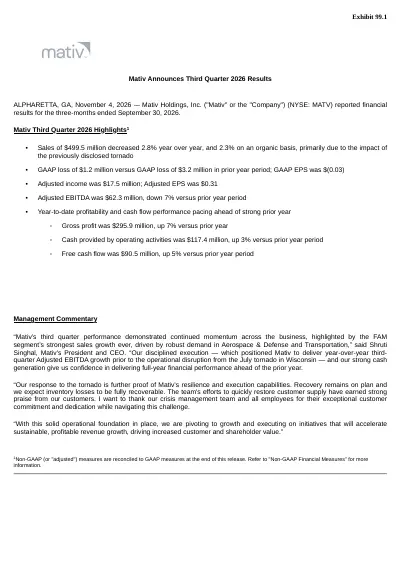
Moving to our consolidated Q3 financials, net sales were $500 million, decreasing by more than 2% year-over-year on an organic basis and down nearly 3% as reported. Lower volume mix, primarily due to the tornado's impact, and unfavorable currency were partially offset by higher selling prices.
Q3's adjusted EBITDA of $62 million decreased by 7% versus prior year. A favorable price-to-cost ratio was more than offset by lower volume mix and higher distribution expenses, partly due to the tornado's impact, as well as increased SG&A expenses and unfavorable currency.
Our adjusted EBITDA margin of 12.5% decreased by 50 basis points compared to prior year. Taking a look by segment, FAM produced its strongest ever quarterly sales growth, with net sales of $219 million, rising by more than 11% on an organic basis and by more than 10% on a reported basis when compared to prior year.
This growth was driven by higher volume mix in our films and filtration businesses due to strong demand from the aerospace, defense, and aftermarket transportation end markets, as well as higher selling prices across the segment. FAM's adjusted EBITDA of $40 million increased by 20% year-over-year, while margins of 18.1% improved by 150 basis points.
These strong gains were led by higher volume mix and a favorable price-to-cost ratio and were partially offset by increased manufacturing costs. SAS net sales of $281 million were down by more than 10% year-over-year, primarily due to three factors: first, the tornado's effects on our paper and packaging business; second, the ongoing destocking impact within our healthcare business; and lastly, the impact from newly created Canadian tariffs on select tape exports to the US.
Lower volume mix and unfavorable currency were partially offset by higher selling prices across the segment. SAS adjusted EBITDA of $33 million decreased by 25% year-over-year due to lower volume mix and higher distribution expenses resulting from the tornado, which were partially offset by a favorable price-to-cost ratio.
Looking at corporate items, unallocated expense of $10 million increased slightly versus prior year due to higher advisory expenses. Other expense of $0.4 million compared to other expense of $3.9 million in the prior year.
This improvement was primarily due to lower 2026 pension costs and foreign currency losses in 2025. Q3's tax expense was $2.6 million, resulting in a tax rate of 186%, and was driven by our geographical earnings mix and our inability to benefit from losses in some jurisdictions that carry a full valuation allowance.
Interest expense of $18 million increased slightly versus prior year, as the benefit from lower average debt balances was more than offset by the impact from higher average borrowing rates on the floating portion of our outstanding debt. Turning to cash generation, Q3's free cash flow was $38 million, reducing by $29 million year-over-year.
This decrease was primarily driven by the tornado's impact and a comparison to a robust prior period that included a more significant working capital release and lower capital expenditures as the business intensified its focus on cash flow optimization. Importantly, underlying cash generation remains solid.
Our ongoing operational discipline, focused on enhancing working capital efficiency, is driving greater consistency in our free cash flow generation. In early November, we sold our previously closed Appleton, Wisconsin facility for approximately $7 million.
This site was classified as an asset held for sale on our balance sheet. This transaction will be reflected in our Q4 financials and demonstrates our ongoing commitment to footprint optimization and the monetization of non-core assets.
At quarter end, net debt of $879 million decreased by 6% year-over-year, primarily due to a $52 million reduction in our outstanding debt balance. Net leverage, as defined in our credit agreement, was 3.8 times at the end of Q3, improving by 400 basis points versus prior year.
Taking a step back, when you look beyond the tornado-related disruption, our Q3 results extended the operating momentum evident in our strong Q2 performance. Without the storm's impact, we would have generated year-over-year adjusted EBITDA growth.
In fact, our year-to-date results show measurable improvement in the company's core financial profile. Through the first nine months, adjusted EBITDA of $185 million was up 8% year-over-year, with margins of 12.2% expanding by 100 basis points.
Free cash flow of $90 million increased by 5% over prior year. These results demonstrate an improved earnings quality, greater cash flow consistency, and continued progress toward our long-term objectives.
Now let's turn to Q4 and the drivers that shape our outlook. First, I'll offer a quick comment on the financial aspects of our tornado recovery efforts.
Our insurance claims are proceeding, and we expect full reimbursement for all damaged inventory. Looking at the broader business, we expect continued momentum across the majority of our business categories, producing year-over-year organic volume growth in both operating segments.
Order pacing through October and into November gives us confidence in this result. Advanced films and filtration should remain key revenue and margin growth drivers, with strong demand across the aerospace, defense, and aftermarket transportation end markets.
These businesses support our strategic portfolio shift toward differentiated, higher-value applications. We expect to continue managing a few discrete, well-understood headwinds in Q4.
In paper and packaging, the distribution footprint inefficiency will continue to be a cost headwind as we finalize our long-term fulfillment architecture. For revenue, we expect Q3's negative impact to be transitory as our order fulfillment cadence returns to more normalized rates in this business.
In healthcare, customer destocking is expected to continue through year-end, with order pattern normalization in early 2027. Finally, the 50% Canadian tariffs implemented in August are creating near-term margin and volume pressures in our North American tapes business.
We have actions underway to reduce the impact of these items and are confident that they won't impede the company's underlying positive trajectory. Factoring in these moving pieces, we expect fourth quarter adjusted EBITDA to remain resilient and broadly stable, with a low single-digit percent moderation year-over-year, driven primarily by the temporary headwinds from storm-related costs and North American tariffs.
Looking through the near-term disruptions, we continue to strengthen our core growth engines. Supported by rigorous execution, cost discipline, and close customer alignment, we remain on track to deliver full-year revenue, earnings, and cash generation ahead of prior year levels.
We'll remain disciplined in our capital allocation, using excess cash for continued debt reduction. As a result, we continue to expect reaching the upper end of our target leverage range of 2.5 to 3.5 times by mid-2027.
In summary, the investment case for Mativ is strengthening. Our highest-value platforms are growing, margin and cash generation are improving, debt leverage is moving in a consistent downward direction, and near-term headwinds are temporary and manageable.
We believe that this combination creates a credible path to sustained shareholder value creation. With that, I'll hand the call back to Shrudhi for his closing remarks.
Shrudhi Singhal
Thanks, Scott. I'll leave you with one key takeaway today.
Mativ is becoming a stronger, more focused, and more valuable enterprise. Our differentiated growth platforms are gaining momentum, our underlying financial performance is improving, and our teams are executing with discipline on the initiatives within our control.
Progress in aerospace and defense and aftermarket transportation end markets demonstrate the growth potential being unlocked in our portfolio. At the same time, improving year-to-date EBITDA and margins, more consistent cash generation, and deleveraging progress show disciplined execution.
While we remain clear-eyed about near-term risk, we believe that the current headwinds' temporary nature, combined with actions already underway, create meaningful tailwinds into 2027. We are confident in the company's direction and are focused on converting this momentum into durable earnings growth, stronger cash flow, and shareholder value.
Thank you to our employees, customers, and to our shareholders for your continued trust and support. With that, let's open the line for your questions.
Operator?
Operator
We will now begin the question and answer session. Your question comes from the line of Daniel Harriman with Sidoti Company.
Daniel, your line is open.
Daniel Harriman
Hey, guys. Good morning.
Thank you so much for taking my questions. In A&D, you highlighted moving from customer qualification to commercial usage.
Would you be able to provide some estimates for the size of that business today and what it could look like in the future? Then along the same lines, FAM margins really took a big step up in the quarter.
Is this new business that's the real driver here, and what can we expect from FAM's margins moving forward?
Shrudhi Singhal
Thanks, Dan, for the question. Appreciate it.
Maybe I'll take the first part and then let Scott talk a little bit about the margins. As I mentioned, Q3 was a really exciting quarter for our commercial space business.
As I pointed out, our materials, they're included in the vehicles launched into the low Earth orbit, and they were part of our customer's successful trial. As a result, our business now is moving into commercial production, and we are ramping up our throughput and output for this business.
In Q3, our commercial space films, they grew by more than 30% year-on-year. That's what really helped propel FAM to a organic growth rate of more than 11%.
It's really important to understand that reaching that commercial deployment milestone, that's a true validation that we can leverage our existing capabilities, know-how, assets, and deliver a state-of-the-art solution under some very, very strict and tight timelines and performance requirements. Moving from this qualification to commercialization step was a pivotal milestone in Q3 for our company and for our commercial space business.
Our films are now used in standard production runs. We've proven that and qualified.
This should then continues to allow for scaling up in 2027 as our customer ramps up its launch frequency. To sum up, this really does validate our product and process capabilities and sets up the stage very nicely for a broader, profitable expansion into the fast-growing aerospace defense sector.
Scott, maybe a comment on the margins?
Scott Minder
Sure. Thanks, Shrudhi.
I'll take a shot at that. Along with the 11% organic sales growth that Shrudhi pointed out, FAM segment margins did increase by 150 basis points year-over-year, reaching just over 18%.
Really the driver of that, both the sales and the profitability gains, was volume and mix. That really was a result of the higher-margin portions of FAM's portfolio, most notably the commercial space films that Shrudhi mentioned, but also aftermarket automotive filtration, as well as automotive films, expanded faster than other portions of that portfolio.
We also did still see a moderately favorable price-to-cost ratio in the quarter. When I think about what's coming as we look ahead, Q3's favorable tailwinds really should stay with us in Q4.
We expect commercial space films growth to continue as our primary customer here ramps up its schedule, and we also expect continued growth in the other categories I mentioned, aftermarket automotive, both for filtration and protective films. One thing to remind you of, as I mentioned earlier, we did still have a favorable price-to-cost ratio, and that's really been a result of our proactive price realization in 2026 ahead of those cost inputs.
We expect that to continue to taper in the fourth quarter as those input costs do start to catch up to the pricing. The headline for me here really is Q3's success drivers largely remain in place.
I think we've significantly strengthened FAM's foundation through a lot of what we've been doing. We're delivering innovation-led growth in collaboration with customers.
We're gaining, and in some cases recovering, market share with key customers and profitable product categories. I think really importantly, we're operating with commercial and cost discipline both here in Mativ, but also within FAM.
When you put all that together, I think you have a really solid recipe for more consistent and profitable growth over the long term here in the FAM segment.
Daniel Harriman
That's helpful. Another one for me just kind of shifting gears towards the tornado impact.
In the remarks, you noted that adjusted EBITDA would have grown year-over-year absent the tornado impact, and it sounds to us like the top-line impact was within kind of your guided range. Can you quantify the EBITDA impact from lost sales and the logistics inefficiencies inside the SAS segment results?
Scott Minder
I can take a shot at that. As you cited, the tornado impact on sales in Q3 was in our range of $20 to $25 million, which we laid out on our last earnings call.
That kind of makes it sound easy when you hit the target, but to get to that result, the team had to react quickly. They literally started the recovery the next day.
In doing that, their priority was twofold: meet customer commitments and preserve long-term customer relationships, which they've done. To achieve that aggressive recovery timeline, the team worked very quickly with our third-party warehouse provider to stand up an interim distribution network.
Beyond that top-line impact that we called out, there were some profitability headwinds also in Q3. First, the lost contribution on those lower sales in the $20 to $25 million range, and then the additional costs related to transportation and warehousing costs for that temporary warehouse.
We now have three warehouse buildings instead of the one we had, which drives additional cost. When you think about the segment's year-over-year EBITDA decline, this tornado impact was greater than 50% of that.
While the storm created challenges, it also showed what our team was capable of accomplishing for our customers and ultimately for our business. As we look ahead, on the top line, we expect to largely recover Q3's lost sales over the next couple of quarters, including in Q4.
On the profitability side, there are a couple moving parts still as we head into Q4. I think we talked earlier that we expect our insurance coverage to offset the inventory losses, and the process there is progressing.
We're also working with our insurance providers on a business interruption claim for additional storm-related costs. We'll keep you posted how that works.
As we pointed out in our Q4 guidance, we do expect some of the additional costs related to our interim distribution network inefficiencies to remain as we work toward a more permanent solution in that business. As the team pivots from reactionary response mode to more purposeful planning, we expect improvements in our fulfillment and distribution processes over time.
We do believe that these improvements will ultimately reduce operating costs and, importantly, inventory levels, making our business stronger than ever before as a result of this unfortunate storm.
Shrudhi Singhal
Dan, maybe I'll just add a—
Daniel Harriman
Thank you. Last one for me is—
Shrudhi Singhal
Go ahead, Dan.
Daniel Harriman
Oh, go ahead, Shrudhi.
Scott Minder
Yeah.
Shrudhi Singhal
I'll just add a couple of thoughts. Thanks, Scott, for that.
As you look beyond the dollars and cents, first and foremost, I really would like to thank our team for the incredible effort. This was a lot of work, their resilience, and their focus on customer was greatly appreciated.
We started the recovery process, as Scott mentioned, the next day, and we were shipping our customer orders within 72 hours of our distribution center being completely destroyed. Really amazing effort on behalf of the team, which has led to incredible results.
Our customer, also we are very grateful to them for their partnership. Their response has been very consistent, positive, and while we lost sales, as we mentioned, in Q3, but expect to fully recover them within the next couple of quarters.
The most important thing is, again, very grateful to our customers' partnership, we did not lose any customers. In fact, one of our largest customers actually said that we could write the book on how to recover from a warehouse disaster.
Myself and my leadership team, in October took a time to thank the team in Menasha and our team across Wisconsin, and they went right back to work on exceeding and meeting our customers' expectations. It's how they are wired.
This is who they are. They show up everyday and they want to do what's right for our customers.
I'm very grateful to them. I thank them for their efforts in Q3 and continued efforts in Q4.
Daniel Harriman
Thanks. Last one from me, just about the guide.
You're guiding for Q4 adjusted EBITDA to remain resilient and broadly stable with only a low single-digit percentage moderation year-over-year. To us, that seems counter to your comments for year-over-year organic volume growth in both segments.
Can you kind of walk us through the moving parts within your Q4 low single-digit percentage EBITDA moderation?
Scott Minder
Sure, Dan. This is Scott.
I'll take it. It's a fair question.
There really are different drivers in Q4, one for the top line and then one or a couple for the bottom line. The growth drivers are much more durable, and the profit impacts that I'm going to walk through here are much more temporary in nature.
I'll start with revenue and the positives around volume growth. As we talked earlier, FAM's expected volume growth is being driven by positive contributions from commercial space films, and filtration media and paint protection films for the automotive aftermarket.
In SAS, we expect that the paper and packaging volume recovery post-tornado will outpace the destocking we talked about in healthcare, both segments we expect to have volume growth. On the earnings side, there are a few temporary headwinds, which we did talk about, but I'll go through them here again, that are offsetting the benefits from that volume growth.
First, those 50% Canadian tariffs that were implemented mid-August, that applies to about 2% of our sales, most notably here are finished tapes we produce in Renfrew, Ontario that are bound for US building and construction customers. We're working with these customers to find solutions to limit the impact, but we're still trying to preserve the long-term relationships here.
We also talked about the ongoing distribution inefficiency within our tornado recovery efforts. We also talked about how we're working to solve that and ultimately make the business more efficient through costs and inventory going forward.
Then lastly, the mix impact here from the customer destocking in healthcare is unfavorable for us. When I step back, I think it's important to view Q4 within the context of our full-year trajectory and the structural improvements we've made across Mativ.
I think we here strongly believe today that Mativ is a fundamentally better business than it was 12 months ago. Year-to-date, Mativ's results have improved across the board.
Gross margins increased while SG&A expenses have decreased. Adjusted EBITDA has grown by 8% and margins have expanded by 100 basis points, and free cash flow is ahead of last year's record pace, including the results from the third quarter.
Despite the low single-digit percent EBITDA headwind that we cited for Q4, we remain on track to deliver full-year revenue, earnings, and cash generation ahead of a strong 2025 year. The earnings headwinds in Q4 are temporary, while the more durable volume growth should enable a strong start to 2027 as we start to see those temporary headwinds dissipate.
Daniel Harriman
Extremely helpful, guys, and congratulations.
Scott Minder
Thanks, Dan.
Shrudhi Singhal
Thank you, Dan.
Operator
There are no further questions at this time. I will now turn the call back to Shrudhi Singhal for closing remarks.
Shrudhi Singhal
In closing, I want to thank all of you for joining us today. We look forward to speaking with you again in February.
Have a great rest of the day. Be safe.
Thank you.
Operator
This concludes today's call. Thank you for attending.
You may now disconnect.