Pediatrix Medical Group, Inc.
Q3 FY2026 · Earnings Call TranscriptOctober 29, 2026
Operator
Hello, and thank you for standing by. At this time, I would like to welcome everyone to the Q3 2026 Pediatrix Medical Group Inc.
earnings conference call. All lines have been placed on mute to prevent any background noise.
After the speakers' remarks, there will be a question-and-answer session. If you would like to ask a question during this time, simply press star followed by the number 1 on your telephone keypad.
If you would like to withdraw your question, please press star 1 again. Thank you.
I would now like to turn the conference over to David Haddock, General Counsel. You may begin.
David Haddock
Good morning. Certain statements and information during this conference call may be deemed to be forward-looking statements within the meaning of the Federal Private Securities Litigation Reform Act of 1995.
These forward-looking statements are based on assumptions and assessments made by Pediatrix's management in light of their experience and assessment of historical trends, current conditions, expected future developments, and other factors they believe to be appropriate. Any forward-looking statements made during this call are made as of today, and Pediatrix undertakes no duty to update or revise any such statements, whether as a result of new information, future events, or otherwise.
Important factors that could cause actual results, developments, and business decisions to differ materially from forward-looking statements are described in the company's filings with the SEC, including the sections entitled Risk Factors. In today's remarks by management, they will be discussing non-GAAP financial metrics.
A reconciliation of these non-GAAP financial measures to the most comparable GAAP measures can be found in this morning's earnings press release, in the company's quarterly and annual reports, and on the Pediatrix website at www.pediatrix.com. With that, I will turn the call over to Mark Ordan, Chief Executive Officer of Pediatrix Medical Group.
Mark Ordan
Thank you, David, and good morning, everyone. Also with me today is Kasandra Rossi, our Chief Financial Officer.
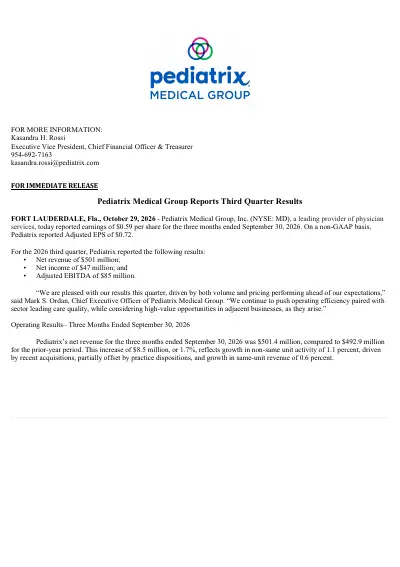
We are pleased to report a strong quarter with adjusted EBITDA of $85 million. Same-unit revenue was positive, with equal contributions from volume and pricing, even with pricing reflecting the lapping of the tailwinds we experienced from strong collection activity over the past several quarters.
Our overall results for the quarter exceeded our expectations in spite of increasing costs in virtually all areas of providing great healthcare. We are narrowing the range of our full-year 2026 outlook to $290 to $300 million in adjusted EBITDA.
In the quarter, we repurchased just over 3 million shares of our stock, bringing our total buybacks since August of 2025 to 10 million shares, and our shares outstanding to 78 million, down from 87 million at the end of the second quarter of 2025. The average price of the 10 million-share buyback is $23.
For several quarters, I've been asked why our numbers have not been adjusted because of the effect of the lapse of the ACA subsidies. As our results continue to show, we have still seen no clear negative effect to date.
Turning from the quarter to what gives us increased confidence in our future are several highlights I'll share. Our annual meeting of all of our practice medical directors two weeks ago had basically one agenda item: care quality.
It may seem anomalous for a public company to hold such a meeting and not discuss scheduling, expenses, etc. However, we believe our core is about care and quality, and that's what our 300 directors came to discuss.
It was of course led by our clinical leadership team, and my contribution was to be proud to be among our extraordinary clinicians. I've recently recorded that we take advantage of our strong financial condition to support internal growth and to be in a position to find larger potential value-add outside opportunities.
We continue to work on expanding our telehealth services as well as select opportunities in the OB hospitalist field. On the latter, announced coding changes are scheduled to take effect in 2027, and we will see then how this area changes in response.
Of course, it is not a material part of our business at this point, and we'll plan to report to you as we all learn more. We also know, of course, that the No Surprises Act IDR rules are being reviewed, and we have read about alleged abuses of the process.
Pediatrix submits claims that we believe are right down the middle of the spirit and letter of the process rules, and we do not have an outsider determine in their view what is a proper claim. We determine that ourselves.
We do not expect the process to be a headwind for us, since it is designed to balance fairly the interests of payors and acute care providers who follow the rules. I'll close by returning to quality.
Dr. Medel founded Pediatrix with a clear charge: take care of the patient.
That is what our patients and our hospital partners expect of us. Whenever we can find ways to improve, we do.
We do this only because we have, by far, the nation's largest team of world-class clinicians in our sector of women's and children's health. I'll now turn to Kasandra.
Kasandra Rossi
Thanks, Mark, and good morning, everyone. Our consolidated revenue increased by just under 2%, driven by non-same-unit activity, primarily recent acquisitions, and same-unit growth of 60 basis points.
Same-unit patient service volumes were up about 30 basis points, driven by MFM services, partially offset by declines in other neonatology services, primarily newborn nursery. NICU days were stable as compared to the prior year.
Same-unit pricing was also up by 30 points, driven by favorable payor mix, an increase in hospital admin fees, and increased patient acuity, primarily in neonatology. As expected, and as Mark stated, we've begun to lap the strong tailwind from improved collection activity, which is flowing through as a decrease in pricing this quarter.
Payor mix improved by over 70 basis points as compared to the prior-year third quarter, and remained stable as compared to the second quarter of 2026. Practice-level SW&B expenses increased year-over-year, and on a same-unit basis, reflected increases in salary expenses, partially offset by lower benefits expense.
Salary growth has remained consistent with the ranges we have seen over the past couple of years in that 3% area. Our G&A expense increased year-over-year, primarily related to higher incentive-based compensation based on financial results, partially offset by lower technology-related expenses.
D&A expense was up about $700,000 year-over-year, primarily reflecting CapEx at our existing units, as well as CapEx and amortization of intangibles from recent acquisitions. Other non-operating expenses were $200,000 for the third quarter, compared to non-operating income of $19.7 million for the prior-year period.
The prior-year period reflected a net gain on divested businesses of $20.9 million. For the third quarter of '26, we also saw a decrease in interest expense from modestly lower interest rates and borrowings as compared to the prior-year period.
Moving on to cash flow, we generated $118 million in operating cash flow in the third quarter, compared to $138 million in the prior year, with the change driven by decreases in cash flow from accounts payable and accrued expenses, and accounts receivable. Our leverage at 9/30 sits at just under 1 times, using the midpoint of our updated adjusted EBITDA outlook range for 2026, with cash of $312 million and net debt of just over $266 million.
Our accounts receivable DSO at 9/30 of 42.5 days were unchanged from June 30th and March 31st, and were down just over a half a day year-over-year. I'll go ahead and turn the call back over to Mark.
Mark Ordan
Great, thank you, Kasandra. Now we will take any questions that you have.
Operator
Thank you. Ladies and gentlemen, we will now begin the question-and-answer session.
If you have dialed in and would like to ask a question, please press star 1 on your telephone keypad to raise your hand and join the queue. If you would like to withdraw your question, simply press star 1 again.
Your first question comes from the line of Ryan Daniels with William Blair. Please go ahead.
Matthew Mardula
Hello, this is Matthew Mardula on for Ryan. Thank you for taking all the questions.
I want to start with pricing. With it coming in at 0.3%, could you break down how each factor of pricing made up this quarter's pricing, especially by quantifying what the RCM impact was?
Kasandra Rossi
Then,
Matthew Mardula
looking ahead -- Yeah. Go ahead, Kasandra.
Kasandra Rossi
Sorry, Matt, I cut you off.
Matthew Mardula
You
Kasandra Rossi
can finish your question.
Matthew Mardula
No, I was just going to finish up with and then looking ahead to next quarter, how should we think about the sustainability of the pricing benefits we saw? Is there just any changes to the kind of key drivers of pricing than previously mentioned?
Then with that RCM impact we saw this quarter, is that a reasonable way to think about it for next quarter as well?
Kasandra Rossi
Sure. First I'll take the pricing components.
On the positive side, pricing was led by payor mix, a close second was the hospital administrative fees, and coming in third was the acuity. I'd say for the payor mix impact, that was probably if you look at the positive impacts for the pricing, it was about 40%, the hospital admin fees about 25%, and the acuity was about 15%.
Maybe I'll hit the sustainability of those while we're talking about those. Listen, we've talked about the payor mix impacts, it's continued to be favorable for us, and we don't anticipate anything changing there, but if anything, I think it will remain stable.
On the hospital admin fees, we talk about that each and every quarter. The hospital environment is tough, but when we require increases, we go to the hospital, we have those tough conversations, and we've been having success, we expect those conversations and those successes to continue.
On acuity, we talked about that a little bit in detail last quarter, that we've looked at that really on a 3-year stack, and we have seen just a trajectory that takes that increasing, and of course, that is supported by the fact that we are in more level 3s and level 4s than anyone. We do consider those to be sustainable, but as with everything, there is variability and they do bounce around a bit.
As far as the RCM, the lapping, we did start talking about that we would expect in the back half of the year to start seeing that lapping. It did impact the quarter by a little over 100 basis points, and I think right now we are in a very steady state, but we have talked about continuing to look for ways to further automate, but we think that right now it is very stable, but again, we'll look to deliver improvement there as we can over the next coming years.
Matthew Mardula
Great, thank you for that. Then in the prepared remarks, you kind of discussed the IDR process.
Can you help us understand maybe the magnitude of IDR has on your business, any kind of numbers around that? Then as we kind of look forward, what's kind of giving you that confidence that this won't become a headwind, particularly if there are any changes to the IDR process that occurs?
Mark Ordan
We're overwhelmingly, as we always have been, in-network, the IDR process is not something that we've ever had to live based on. I can't quantify it precisely, but again, we're always overwhelmingly in-network.
Matthew Mardula
Great. Thank you so much.
Kasandra Rossi
Sorry, Matt. I was going to say, with the changing rules, like Mark said, we're one of those who, like we said, we abide by the rules, we're doing the right thing, and so we don't anticipate any changes from the changes that are happening in that process.
Matthew Mardula
Great. Thank you so much for all the color.
I really appreciate it.
Kasandra Rossi
Thanks, Matt.
Operator
Your next question comes from the line of A.J. Rice with UBS.
Please go ahead.
A.J. Rice
Hi, everybody. Just to put a finer point on that, do you have a percentage of your revenues or claims or business that is out-of-network at this point?
I assume it's in the single digits, but is there a figure you could give us?
Mark Ordan
We've typically been out-of-network of less than 5% of our business, it's always been about that. If that helps.
A.J. Rice
Okay.
Mark Ordan
We've lived with the IDR process now for several years, and as I said on my call, we've read about alleged abuses by others, and people, I guess it's as I'm learning, use different tactics. We think that the rules were well-crafted, and we see the proposed changes, and we think that the spirit and letter of the proposed changes is to make sure that there's a fair process between payors and providers.
In 2020, when the No Surprises Act first came out, we were supporters of it. We believe that if you're going to take care of the patient, the patient should be out of the middle.
As long as the rules are fair and the payors are playing by the rules and providers doing it the right way, we're comfortable.
A.J. Rice
Yep. Company obviously came in ahead of expectations on the quarter, $85 million, 85.5 of EBITDA, you've updated the guidance.
When I look at what that applies for fourth quarter, if I'm doing the math right, I get about $70 to $80 million in EBITDA. Is there anything embedded in there?
Is that natural seasonality? Is there something that doesn't recur that occurred in the Q3, or you're just being conservative?
Kasandra Rossi
No, I'd say it just gives us a little bit of flexibility. Volumes have bounced around, pricing has bounced around, and it just gives us that flexibility to land in that range.
Nothing else baked in there, A.J.
Mark Ordan
A.J., tomorrow is November.
A.J. Rice
Okay. All right.
You mentioned that you're still looking at high-value opportunities in adjacent businesses. I wondered, maybe if I could get you to just flesh out what's behind that.
What would be things that would be of interest to the company?
Mark Ordan
I can only flesh it out a little bit. I'd say that what we have said repeatedly is that we have a very strong balance sheet, and we have the ability to make larger acquisitions.
We strategically would only look at something that is in something adjacent to what we already do, staying in the women's and children's space is important to us. I'm just underscoring that when people look at our balance sheet and see our very low leverage, I don't want people to think that we're complacent and we're just sitting there.
Yes, we've bought back shares, but not to the extent that it limits us from doing something if there's a very good opportunity. We do think in the women's and children's space there are bound to be attractive opportunities, and we actively consider them.
A.J. Rice
Okay. Then the level of share repurchase, I'll just wrap up with this, $83 million during the quarter, any comments on pacing going forward on that?
Mark Ordan
We've tried to be opportunistic. We're happy that over the course of the last year, our average price was $23, which looks like it was a good buy.
We'll consider along with the board what our pace going forward is.
A.J. Rice
If other opportunities -- -- and if
Mark Ordan
there are other opportunities.
A.J. Rice
Yep. I understand.
Thanks so much.
Kasandra Rossi
Thanks, A.J.
Operator
Your next question comes from the line of Jack Slevin with Jefferies. Please go ahead.
Jack Slevin
Hey, good morning. Thanks for taking the questions.
There's a note in the release on a little bit of, it sounds like small disposition activity in the quarter. Could you maybe just provide a little more color on maybe what took place from practice dispositions, or how you're approaching that?
Kasandra Rossi
No, that's just the carryover from the disposition activity that happened in '24. When we're talking about non-same-unit, it's the net of the acquisitions and any disposition, it's just natural flow-through of that.
Jack Slevin
Understood. Thanks.
Appreciate the clarification there. A lot of questions already been asked, maybe just to understand what you're seeing on the labor front or from a wage inflation perspective, how that's sort of tracking underlying in the business?
Kasandra Rossi
I would just say, we kind of talked about we've been able to keep those clinical salaries in the last couple of years in that 3, 3.5% area. We're really comfortable that what we saw back a few years back where we were in the mid to high single digits at times, we're not seeing that.
Nothing really more to say on that, Jack.
Jack Slevin
Okay. Then one more for me, just a quick one.
The mentioning of some of the coding changes, my understanding is there's an unbundling that's looking to happen next year of some of the related codes in your space for those services. The way that I had read it, if you sort of trend towards the higher side of the acuity scale, that unbundling might end up being a positive opportunity.
Got your comment, Mark, that you're sort of still weighing it up and you'll see what happens on the coding front, but just want to understand if you could sort of handicap whether or not you think that possibly is a positive or a negative for you as you look at '27. Thanks.
Mark Ordan
Rather not handicap it because first of all, the rules should be finalized in the next few weeks in November. Handicapping it before it all comes out, I don't think is going to be particularly helpful.
We're going to see based on the rules how OBs react to that. I think it's a little bit hard.
Yes, there potentially, depending on how the rules shake out, there could be opportunities on the OB hospitalist side or more on the OB side, but I think it's too early to tell, both because the rules aren't finalized and we don't know how people are going to react to the rules. Again, importantly for us, it's not a material part of our business, and this gives us an opportunity to see how the rules change and what we make of it.
Jack Slevin
Got it. That's helpful.
Appreciate all the color and congrats on the quarter.
Mark Ordan
Thank you.
Kasandra Rossi
Thanks, Jack. Once again,
Operator
if you would like to ask a question, simply press star 1 on your telephone keypad. The next question comes from the line of Whit Mayo with Leerink Partners.
Please go ahead. Whit Mayo, you might be on mute.
Whit Mayo
Yep, there we go. Sorry about that, guys.
Little early this morning. I know you're in the budgeting process, the planning process for '27, but just was wondering if you could share any headwinds, tailwinds as you're thinking about next year.
Mark Ordan
No, not at this point. I think obviously we'll report, as you said, we're in the budgeting process, we're looking at a lot of things, but we're not going to talk today about '27.
I've given the characterization of the things that we're looking at that stand out right now. I think that covers it.
Whit Mayo
K. Maybe just on the exchange stuff, I know you haven't seen a headwind this year.
Would you think that maybe you see a little bit of a slip in mix next year, or just any preliminary thoughts as it relates to payor mix?
Mark Ordan
It's hard for me to say that because starting in the fourth quarter of last year, we were getting this question, and we said, 'Well, we don't know.' When people said, 'Why aren't you reducing their numbers?'
I said because I could pull a number out of the air, but we prefer not to do that, we like to do things based on numbers, and that has continued. We haven't seen anything that points to it.
I hypothesize that possibly because of the population that we serve, people are doing a different calculation about the value of insurance without the subsidies, but that's me sitting around trying to figure out why our results are different than some people are. Other than that, we continue, and a lot of people, I would say probably you included, thought that sometime in the first or second quarter we would see the effect, and we haven't.
I'm not sitting here worried about what happens next year. I'll be paying attention to it, we do check, and when we hear something anecdotal, we track it down to see if it's affecting us, and it just hasn't.
Whit Mayo
Yeah. Maybe just last one.
Kasandra, you mentioned in your prepared comments lower technology expenses. Can you just elaborate a little bit more on what that was?
Thanks.
Kasandra Rossi
Just some of the SaaS costs that we had just rolling out of P&L.
Whit Mayo
Thank you.
Kasandra Rossi
Welcome, Whit.
Operator
Your next question comes from the line of Pito Chickering with Deutsche Bank. Please go ahead.
Pito Chickering
Hey, good morning, guys. Thanks for taking the question.
I guess looking at the pricing, what percent of your NICU practices today have subsidies from hospitals? How has that changed in the last year?
Where do you think it can go next year, or sort of what inning are we in at this point of getting subsidies for your NICUs?
Mark Ordan
I'm sorry, I just want to make sure I understand the question, Pito. You're asking what percentage of our NICU revenue comes from --
Pito Chickering
What percent of your NICU practice, if you have 1,000 NICU practices, are half of them getting subsidies from the hospitals, sort of where are we on that at this point? How has that changed in the last year?
Kasandra Rossi
No. It's not half.
It's much lower than that.
Mark Ordan
There's not much change year to year.
Pito Chickering
Okay. Do you think that can continue to grow going forward?
I'm trying to understand, we're seeing pressures on hospitals from practices getting more subsidies, and just curious, I guess let me ask you differently: what inning are you guys in in order to get subsidies for your NICU practices? Are we in the second or third inning here, or are we more of the seventh or eighth inning?
Mark Ordan
What I'm about to say is not sidestepping the question, I'll respond to that. We work very closely with our hospital partners, and we think that along with taking care of the patient, it's very important that they know that we do things very efficiently, so that they're better off with us running that NICU than if they did it themselves.
We think we have to demonstrate that value all the time. It's not like you come to the end of the year and you have a discussion.
You have a constant relationship with the hospital to show that you're adding value. If the reason that you receive a payment from the hospital is because if they did it themselves, they would have that or a greater expense.
It's not charity. It's saying that they understand the real cost involved in providing the care that we provide, and all the expenses that go in it to make sure that they're confident that they have a really really high-functioning NICU.
We feel, as Kasandra said, I'm being longer-winded about it, we feel that while those discussions are a push and pull, we feel that we can continue to demonstrate value and be fair in the requests that we make of hospitals. I think if hospitals value us and what we do, we think we'll be okay.
Is it a higher-pressure environment with the big, beautiful bills in the [unclear]? Sure.
That takes away from the system, so that does provide pressure.
Pito Chickering
Let me ask this a slightly different way. I guess, looking at the economics of a NICU, the technical component the hospital gets is very large, and therefore, the relative cost of any subsidies frankly is sort of fairly inconsequential.
Keeping NICU practices happy is a very profitable endeavor for hospitals due to the technical component. I guess I'm just trying to ballpark today sort of where we are.
Is it a quarter of your practices today have subsidies? Is that the right ballpark, plus or minus?
Mark Ordan
Maybe at a future date. We haven't published that number, and I'd rather not comment.
Kasandra Rossi said, it's considerably less than half. I appreciate your comment about the relative economics for us versus the hospital system.
We might add you to our negotiating team. You could be helpful.
Pito Chickering
All right, yeah. Fair enough.
Okay. Just cuz you guys look at this thing next few years, that, for me, seems like a pretty massive driver for pricing as a durable segue going forward.
Any color you can provide to us in terms of how this has changed over time would be very helpful. Thanks, guys.
Mark Ordan
Sure.
Kasandra Rossi
Thanks, Pito.
Operator
There are no further questions at this time. I would like to hand it back to Mark Ordan for closing remarks.
Mark Ordan
Great. Thank you all for joining us this morning, and for your continued support of Pediatrix.
Have a great day.
Operator
This concludes today's conference call. Thank you all for joining.
You may now disconnect.