MDU Resources Group, Inc.
Q3 FY2026 · Earnings Call TranscriptNovember 5, 2026
Operator
I will now hand the conference over to Brent Miller, Treasurer of MDU Resources Group. Brent, please go ahead.
Brent Miller
Thank you, Jen, and again welcome, everyone, to our third quarter 2026 earnings conference call. Our earnings release and supporting materials for this call are available on our website at mdu.com under the Investors section.
Leading today's call are Nicole Kivisto, President and Chief Executive Officer, and Jason Vollmer, Chief Financial Officer of MDU Resources Group. During today's call, we will make certain forward-looking statements within the meaning of the federal securities laws.
Please refer to our SEC filings for a discussion of risks and uncertainties that could cause actual results to differ. We may also refer to certain non-GAAP information.
For a reconciliation of any non-GAAP information to the appropriate GAAP metric, please refer to our earnings release. I'll now turn the call over to Nicole for her prepared remarks.
Nicole?
Nicole Kivisto
Thank you, Brent, and good afternoon, everyone. We appreciate you joining us today and for your continued interest in MDU Resources.
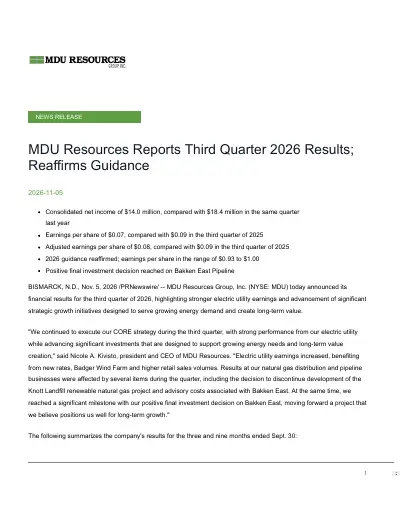
This morning, we reported third quarter 2026 earnings of $14 million, or 7 cents per share. Our results reflected solid performance for the underlying businesses, including strong performance at our electric segment, benefiting from new rates, the Badger wind farm, and higher retail sales volumes.
We are also reporting adjusted earnings to reflect the impact of a couple items not reflective of ongoing operations. At the natural gas distribution segment, a decision was made to discontinue development of the Knott Landfill renewable natural gas project, and at our pipeline segment, we incurred advisory costs associated with the Bakken East project that are not eligible to be capitalized as part of the project cost.
Adjusted earnings, absent these items, were $16.6 million, or 8 cents per share for the quarter. Jason will provide more detail on the quarterly results later during this call.
The most significant milestone this quarter was our board's positive final investment decision to proceed with WBI Energy's Bakken East pipeline project. This decision reflects the customer commitments we have secured, our confidence in the strategic importance of the project, and our belief in the long-term economic opportunities it creates for MDU Resources, North Dakota, and the broader region.
We have narrowed our estimated capital investment range to between $2.8 and $3.1 billion and finalized the project design, which will include segments of 42-inch, 36-inch, and 30-inch diameter pipe. We also expect four new compressor stations along the 350-mile route, with additional compression at two existing facilities on our system.
The project remains designed to transport 1.4 billion cubic feet per day of natural gas and will be constructed in two phases, with in-service dates of late 2029 and late 2030. We are still anticipating a Q4 filing date for our FERC 7(c) filing and are also actively evaluating financing options, including potential participation of financial and strategic investors, while maintaining our expectation for WBI Energy to retain majority ownership and operational control.
We also continue to see encouraging development activity across our service territory, including data center opportunities and broader infrastructure demand. As we have discussed previously, our approach to serving data centers and other large-load customers is grounded in protecting existing customers while ensuring growth creates value for the communities we serve.
We continue to follow the principle of cost causation: customers that create costs are responsible for those costs through contracts, approved tariffs, and regulatory mechanisms. This approach allows existing customers to benefit from broader utilization of our system while supporting economic development opportunities within our service territory and results in a reduction to customer bills.
As an example, since 2023, we have returned $45.4 million to our North Dakota customers with this approach. We currently have over 1 gigawatt of data center load signed under ESAs, with approximately 280 megawatts currently online and additional volumes expected to ramp online over the next few years.
As I did mention, during the quarter, we did make the decision to discontinue development of the Knott Landfill renewable natural gas project in Oregon due to continued increased development costs and changes enacted by rulemaking that have shifted the timing and reduced the volume of our need for the renewable natural gas in the state. We believe this decision reflects disciplined capital allocation and a continued focus on investments that are expected to provide the strongest long-term value for customers and stockholders.
This decision resulted in the recognition of an after-tax loss of $2.1 million in the quarter. Now moving on to regulatory matters, in North Dakota, interim electric rates of $26.3 million became effective September 1st, subject to refund.
In Montana, interim electric rates of $10.4 million remain in effect, subject to refund, while the settlement agreement of $10 million is still pending approval. At our natural gas distribution segment, a $12.2 million annual revenue increase was approved in our Oregon rate case settlement, with rates effective October 31st.
We also filed a Minnesota rate case on October 30th requesting an annual revenue increase of $4.5 million. An interim rate increase request of $3.9 million was also filed and, if approved, will be implemented on January 1st, 2027.
Our Washington multi-year rate case filed in May remains pending before the commission. At the pipeline segment, rates from the FERC rate case we filed in May will become effective December 1st, subject to refund and the outcome of hearing procedures if a settlement with our customers and FERC is not reached.
We have made significant progress on the regulatory front, and with continued deployment of our capital plan, we believe we will be filing about three to five rate cases annually. As we near the end of the year, we have delivered solid underlying business performance, advanced regulatory initiatives, executed on a robust capital plan, and made a strategic decision to advance the Bakken East project.
Despite the negative weather impacts in the first quarter, we demonstrated solid performance on a year-to-date basis, putting us in a position to reaffirm our 2026 earnings per share guidance range of 93 cents to $1.00. This guidance continues to assume normal weather, economic and operating conditions, continued customer growth, successful execution of our capital investment plans, and constructive regulatory outcomes for the remainder of the year.
Our long-term earnings per share growth objective remains at 6% to 8%. We remain focused on disciplined execution of our capital program while advancing infrastructure investments that support growing energy demand throughout our service territories.
As always, MDU Resources is committed to operating with integrity and with a focus on safety. We remain dedicated to delivering safe, reliable, cost-effective, and environmentally responsible energy services while positioning the company for compelling long-term growth.
I will now turn the call over to Jason for the financial update. Jason?
Jason Vollmer
Thank you, Nicole. This morning, we announced third quarter earnings of $14 million, or 7 cents per share, compared with $18.4 million, or 9 cents per share in the third quarter of 2025.
Adjusted earnings for the quarter totaled $16.6 million, or 8 cents per share. Year-to-date earnings were $116.1 million, or 55 cents per share, compared with $114.1 million, or 56 cents per share through the first nine months of last year.
Adjusted year-to-date earnings totaled $119.4 million, or 57 cents per share. We did experience lower returns on non-qualified benefit plan investments when compared to the same quarter last year, which impacted all of our business segments.
In total, this reduced earnings by approximately 1.5 cents per share when compared to the third quarter of 2025. Operating income for the quarter was $47.6 million, compared to $39.8 million in the third quarter of 2025.
On a year-to-date basis, operating income was $211.2 million, compared to $183 million last year at this same time. This 15% increase in operating income highlights the strength of our operations and the meaningful impact that our growth projects and positive rate case outcomes have had over the last year.
Now let's turn to our individual business segments. Our electric utility reported third quarter earnings of $26.5 million, compared with $21.5 million in the third quarter of 2025.
The increase was driven by $7.1 million in additional revenue from new rates approved in North Dakota, Montana, and Wyoming, $3.2 million in earnings from the Badger wind farm investment, as well as higher retail sales volumes across all customer classes due to warmer weather. Total retail electric sales volumes increased 9.3% year-over-year, and data center sales volumes increased 18.4%.
These favorable impacts were partially offset by higher operation and maintenance expense, as well as lower returns on non-qualified benefit plan investments. Our natural gas distribution segment reported a seasonal loss of $20.7 million, compared with a seasonal loss of $18.2 million in the third quarter of 2025.
This year-over-year decline reflects higher operation and maintenance expense costs, including payroll-related expenses, and the $2.1 million after-tax loss related to the Knott Landfill project that Nicole previously discussed. Higher interest expense and lower returns on non-qualified benefit plan investments also contributed to the decrease.
These impacts were partially offset by new rates, particularly in Idaho, Washington, and higher retail sales volumes across all of our customer classes. Pipeline segment earned $13.1 million during the quarter, compared to $16.8 million in the prior period.
Results were impacted by higher operation and maintenance expense, including payroll-related and materials costs, as well as advisory costs related to the Bakken East project and lower storage injections and lower returns on non-qualified benefit plan investments. These impacts were partially offset by short-term natural gas transportation contracts and contributions from previously completed growth projects.
The other category reported a net loss of $4.9 million, compared to a net loss of $1.7 million in the third quarter of 2025. The decline was primarily related to higher claims experience within our captive insurance operations and higher income tax expense associated with adjustments related to the company's annualized effective tax rate.
We continue to maintain a strong balance sheet and ample access to working capital to finance our operations. That summarizes our financial highlights for the quarter.
We appreciate your interest in MDU Resources and would ask that we now open the line for questions. Operator?
Operator
Thank you. We will now begin the question-and-answer session.
If you would like to ask a question, please raise your hand now. If you have dialed in to today's call, please press star one to raise your hand.
Please stand by while we compile the Q&A roster. Your first question comes from the line of Aidan Kelly with J.P.
Morgan. Your line is open, please go ahead.
Aidan Kelly
Hey, guys. Good afternoon, thanks for the time today.
Nicole Kivisto
Good afternoon.
Aidan Kelly
Maybe just to kick off on Bakken East to start, the elephant in the room. How are you evaluating the trade-offs between financial and strategic partnerships as of now?
I know you kind of mentioned, at least you look to kind of maintain that majority ownership structure, but just curious how we should think about also the potential to kind of mitigate external equity needs while kind of preserving the longer-term earnings contribution, just any kind of in-depth color how you think about the equity portion at this point in time?
Nicole Kivisto
I'll have Jason go ahead and talk about this, but certainly we are keeping the options open, as we did mention in the script as well as the news release. Our parameters are that we want to be the majority owner as well as the operator of the pipeline, but continue to evaluate the financing options.
Jason, maybe you want to provide additional detail there.
Jason Vollmer
Certainly. Great question, Aidan.
Appreciate the follow-up here. As we know, a high-focus item for investors as they think about the size of an important project like this for our business.
Our base capital plan that we've been working on here the last, again, what we updated last year in November, we'll probably be updating that here again towards the end of November on the business as we look forward here, but have a sizable amount of capital investment that we are spending in this company, even outside of this Bakken East project. We're extremely excited about the Bakken East project and where this is going to go, but I think your point on balancing external financing needs along with executing the existing business plans here is very important.
As we look at longer term what this project will do for the organization, certainly a very positive project to bring into the group. We want to make sure that we are looking overall at the investments that we're making and making sure that we've got a good ability to finance this and provide solid returns for our investors into the long term.
To Nicole's point, we are looking at all options for how to finance this project. We're actively pursuing that as we speak here today.
We don't have a lot of updates for you at this point in time. As we get into the new year and think about our fourth-quarter call that we would have in February, I would expect we will have a lot more color on that, likely as far as where we're at in process of finalizing those opportunities.
It's a high-focus item for us here internally, making sure that we balance the appropriate return for investors going forward, with also looking at the impact of the ongoing business here and making sure we've got the right financing structures in place.
Aidan Kelly
Great, thanks for the rundown on that, Jason. Sounds like to keep our eyes peeled for 4Q plan or EEI, I guess.
Maybe just one other question on my end kind of just turning to some of the disclosures on the project itself. It looks like you've narrowed the cost range slightly to 2.8, 3.1, just curious if you could provide any detail on what gave you the confidence to kind of tighten the range at this point in time?
Just any rationale behind the revised compressor station configuration, and whether that there's any read-through for implications on project costs or future expansion capacity there? Any detail there would be great.
Jason Vollmer
Certainly. I can provide a little bit of detail on that.
As we think about, again, this project, as we've been working on this for a long time, looking at different design, routes, various items that would make sense here. The new item that we would have talked about now is that we have finalized the pipe sizes with this, really starting with 42-inch in the west, going to 36, and then down to 30-inch pipe.
What that does do, and specifically to your compressor station question, is it does allow us to operate this more efficiently, with less compression needed from a larger pipe basis, which then offsets some need for additional compression, but also, for customers involved here, will reduce fuel costs for them on a go-forward basis as well. We think that is the optimal structure based on what we've determined with where we're at now, so that does change a little bit of the calculus, I guess, on the overall cost.
Narrowing the range now, I think what we've been able to do as we've continued to progress and work on this project, reaching FID in the end of September was very important milestone for us. Now moving forward, we've been able to take some of the unknowns that we would have here and make them a bit more known as we've continued to work through.
Again, getting in front of finalizing the design, understanding what compressor items we need, getting orders made in certain areas, working on pipe design, pipe mill space, working with contractors, gave us a lot more clarity to be able to narrow down and really kind of take in the bookends of that range and narrow to something that we feel very comfortable with here now, landing in this $2.8 to $3.1 billion range.
Nicole Kivisto
I would just highlight one more Oh, go ahead, I'm sorry.
Aidan Kelly
No, all you, Nicole. Thanks.
Nicole Kivisto
I was just going to highlight one more item that you would note for capex, as it relates to the pipeline, you would have seen an increase compared to last quarter is basically once we got to FID, we're bringing those into capex. What that capex demonstrates is we are making some of these decisions that Jason alluded to.
We've been working through this project for quite some time, but we're now able to kind of get to a decision point and lock some of these things in as we finish out the year, and that actually helped us then, to his point, narrow that range a bit.
Aidan Kelly
Got it. That's super clear.
Appreciate all the color and I'll leave it there. See you guys soon.
Nicole Kivisto
Thank you.
Operator
Your next question comes from the line of Julien Dumoulin-Smith with Jefferies. Your line is open, please go ahead.
Brian Russo
Hi, it's actually Brian Russo on for Julien. Good afternoon.
Nicole Kivisto
Good afternoon.
Brian Russo
Hey, you mentioned a fourth quarter kind of update. Is it at all possible to get some insight into who the partner might be, or financing structure, when you report the updated capex, with your usual annual update, I guess, in November?
Nicole Kivisto
Our normal cadence, I think that you're referring to, is when we update and refresh our five-year capital plan, we normally do that following EEI. As Jason mentioned, I don't know that we'll be in a position to be disclosing anything additional as it relates to financing.
What he alluded to would be we would have more information at our year-end call, which is more in the February time
Brian Russo
frame. Understood.
When we look into 2027, given the rate cases that have concluded for partial-year contribution this year, full year next year, along with the interim rate filings, do you think you can kind of move back comfortably in the middle or the high end of that 6% to 8% long-term range, just based on rate relief?
Jason Vollmer
I can take that one, Brian. I think as we look ahead now, we certainly have not given guidance beyond '26 at this point, right?
We did update and reaffirm our guidance, I guess, for '26 at this point. We feel comfortable with that range we've got now.
As we lean to '27, certainly the rate case activity that we've had, along with some of the growth projects we've had here, I think will continue to provide benefit for us as we look forward. I don't want to get ahead of foreshadowing any guidance for next year.
We just haven't given that yet. That's typically a fourth quarter cadence for us as well.
Again, a similar time frame with what Nicole just mentioned with our fourth quarter call.
Brian Russo
Okay. Then lastly, we've seen some non-utility generation being developed in the region to serve some of your data center customers, I believe.
I'm just curious, have you been involved in any of those discussions, and why MDU is in a position to not only serve economic growth through the Bakken East pipeline, but also through utility-owned generation?
Nicole Kivisto
I would just say, as we think about the development that we're seeing, and, as Brian, it's been our practice to really talk about where we're at with these once we have a signed ESA, but it is fair to say that we continue in conversation on various other opportunities. Now saying that, I think you're really getting to the question of are we willing to make investments to serve these types of loads?
In the past, we have not done that, so that would be different. What I would say is we're not opposed to that, looking at investment opportunities that make sense, but we're going to want to make sure that we've got the right cost causation, similar to how we've treated these in the past, that the large load pays for that cost, and that it makes sense for our shareholders and customers as well.
Again, we will continue to evaluate these opportunities on a case-by-case basis. It's not that we're opposed to investment, but it's going to have to make sense for our shareholders.
Jason Vollmer
I would probably just add a little bit to this, too. When you think about the pipeline project and what this does for the state of North Dakota, again, getting this FID decision with Bakken East has been very instrumental, I think, not only for our company, but even for economic development across the state.
We don't serve the entire state of North Dakota, but North Dakota is a state that has had a lot of data center development going on. To your point, you're probably seeing others that are announcing generation projects.
Where we see the value of the business mix that we have today is our ability to potentially participate by serving data centers ourselves, or large-load customers of other sorts, if they land in our service territory. Alternatively, with our pipeline business, we certainly have the ability to serve power generation to serve whatever kind of load that would be, whether that's existing load growth that we may see customers have, or whether that is large-load customers in there.
We think we sit kind of in a unique position to be able to capitalize on both opportunities.
Brian Russo
Great. Thank you very much.
Nicole Kivisto
Thank you.
Operator
A reminder, if you would like to ask a question, please press star one to raise your hand. To withdraw your question, press star one again.
We'll hold for a moment to allow for questions. There are no further questions at this time.
I will now turn the call back to Nicole Kivisto for closing remarks.
Nicole Kivisto
All right. I want to thank you all again for joining us today and for your thoughtful questions.
We certainly appreciate your continued interest in and support of MDU Resources. As a reminder, we do plan to release our new five-year capital expenditures forecast later this month, in line with our typical timing of releasing after the EEI conference.
We look forward to seeing many of you at the conference. Finally, I do want to close by once again thanking our employees for their ongoing commitment to safety, reliability, operational excellence, and customer service.
It is their dedication that enables us to continue delivering for our customers while advancing opportunities for future growth. With that, we look forward to staying engaged with you throughout the remainder of the year.
Operator, you may now conclude the call.
Operator
Thank you. This concludes today's call.
Thank you for attending. You may now disconnect.